

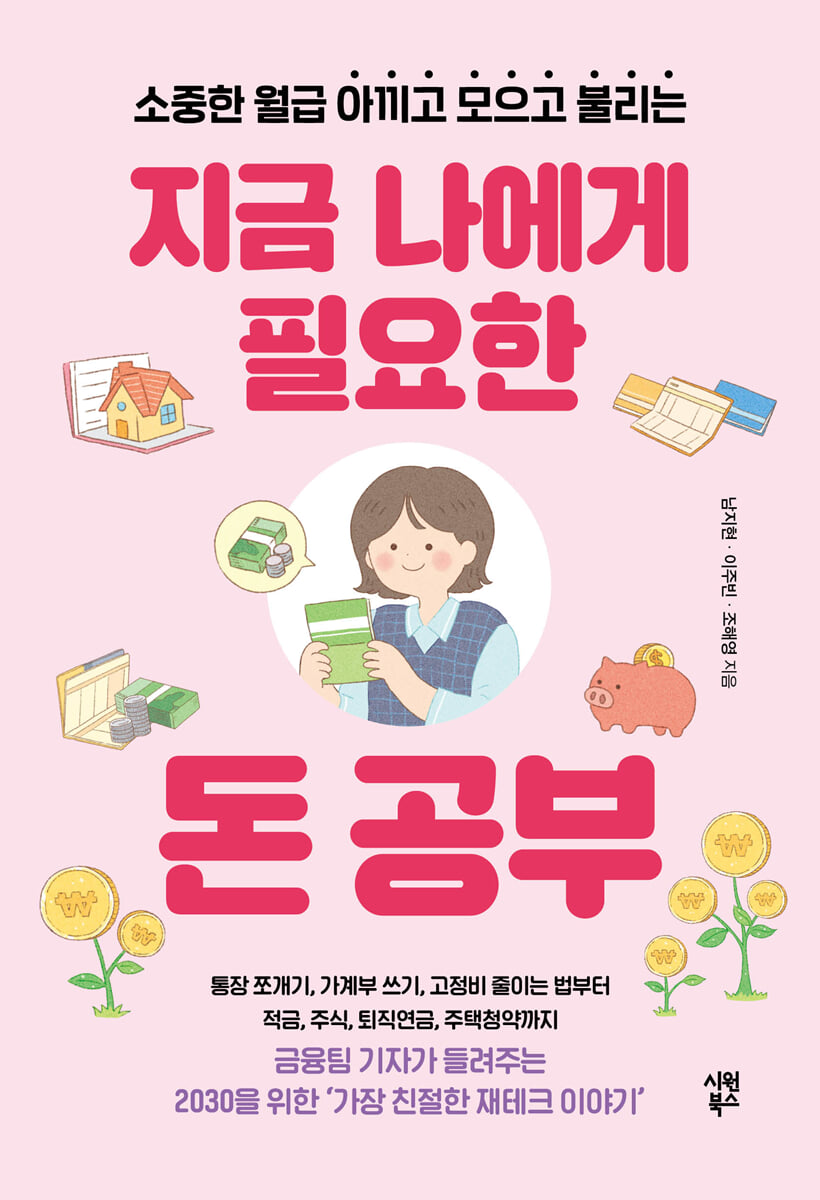
Studying the money I need now
 |
Description
Book Introduction
Splitting your bank account, keeping a household account book, and reducing fixed expenses
From savings, stocks, retirement pensions, to housing subscriptions
The easiest and most convenient way to invest in 2030, as told by a financial reporter!
This book was created based on the serial “Money and Wealth,” which was written by three financial reporters from the Hankyoreh.
The title 'Jeonhwawibok' is taken from the Chinese idiom 'Jeonhwawibok'.
Just as misfortune can lead to good results, I hope this book will serve as a financial management guide that will help you turn financial crises into opportunities.
This book was written by adding and organizing new content based on the serialized work, “Jeonhwawibok.”
The three authors are financial reporters, but they are also ordinary office workers.
While learning and studying financial technology.
To provide reliable financial information as easily as possible, we've compiled the essential financial knowledge that the 2030 generation needs to know into one book.
I highly recommend this book to anyone who wants to save money, anyone who doesn't even know the first word in "financial management," or anyone who wants to learn the complex and difficult aspects of financial management in an easy-to-understand way.
From savings, stocks, retirement pensions, to housing subscriptions
The easiest and most convenient way to invest in 2030, as told by a financial reporter!
This book was created based on the serial “Money and Wealth,” which was written by three financial reporters from the Hankyoreh.
The title 'Jeonhwawibok' is taken from the Chinese idiom 'Jeonhwawibok'.
Just as misfortune can lead to good results, I hope this book will serve as a financial management guide that will help you turn financial crises into opportunities.
This book was written by adding and organizing new content based on the serialized work, “Jeonhwawibok.”
The three authors are financial reporters, but they are also ordinary office workers.
While learning and studying financial technology.
To provide reliable financial information as easily as possible, we've compiled the essential financial knowledge that the 2030 generation needs to know into one book.
I highly recommend this book to anyone who wants to save money, anyone who doesn't even know the first word in "financial management," or anyone who wants to learn the complex and difficult aspects of financial management in an easy-to-understand way.
- You can preview some of the book's contents.
Preview
index
Prologue: Turning Money Crisis into Opportunity: "Jeonhwawibok"
Chapter 1: How do you manage your salary?
How should I spend my precious salary?
Where and how much do other people spend?
Negotiating with myself, budgeting
Split your account for saving first and then spending later
Get free financial advice from experts
Chapter 2 How do you save money?
Keeping a household account book that shows your spending and expenses at a glance
Are credit cards good or bad for me?
The Pitfalls of Credit Cards: Installment Payments, Late Payments, and Revolving Payments
How to reduce unnecessary insurance premiums without a designer
How to Reduce Small Fixed Costs: Telecommunications
How to Reduce Small Fixed Costs: Transportation
How to Reduce Small Fixed Costs: Subscription Fees
Let's learn how to properly calculate the 13th month's salary and year-end tax settlement.
Chapter 3 How do you save money?
Let's learn about the basics of savings and deposits, annual interest rates, and interest rates.
How are simple and compound interest calculated?
Turning a windmill to increase savings
What's the difference between primary and secondary financial institutions?
ISA accounts are not optional, they are essential.
Chapter 4 What is money called?
If you don't even know what a "stock" is, let's start with the concept.
Practical Basics for New Stock Investors
Using CMA Accounts Effectively
If you are new to investing, choose ETFs rather than individual stocks.
How to Use Exchange Rate Fluctuations to "Hantech"
Chapter 5 How do you borrow money well?
Understanding Secured and Unsecured Loans
What's the difference between an overdraft account and a loan?
How to repay what you borrow
A glance at the complex loan policy
Chapter 6 How do we prepare for the future?
Learn about the types and characteristics of retirement pensions.
A "must-have" savings account, subscribed to by half of the population
The First Step to Homeownership: The Subscription System in Practice
Epilogue: The Story of the Realization of the True Meaning of Money: Chapters of Hope and Despair
Chapter 1: How do you manage your salary?
How should I spend my precious salary?
Where and how much do other people spend?
Negotiating with myself, budgeting
Split your account for saving first and then spending later
Get free financial advice from experts
Chapter 2 How do you save money?
Keeping a household account book that shows your spending and expenses at a glance
Are credit cards good or bad for me?
The Pitfalls of Credit Cards: Installment Payments, Late Payments, and Revolving Payments
How to reduce unnecessary insurance premiums without a designer
How to Reduce Small Fixed Costs: Telecommunications
How to Reduce Small Fixed Costs: Transportation
How to Reduce Small Fixed Costs: Subscription Fees
Let's learn how to properly calculate the 13th month's salary and year-end tax settlement.
Chapter 3 How do you save money?
Let's learn about the basics of savings and deposits, annual interest rates, and interest rates.
How are simple and compound interest calculated?
Turning a windmill to increase savings
What's the difference between primary and secondary financial institutions?
ISA accounts are not optional, they are essential.
Chapter 4 What is money called?
If you don't even know what a "stock" is, let's start with the concept.
Practical Basics for New Stock Investors
Using CMA Accounts Effectively
If you are new to investing, choose ETFs rather than individual stocks.
How to Use Exchange Rate Fluctuations to "Hantech"
Chapter 5 How do you borrow money well?
Understanding Secured and Unsecured Loans
What's the difference between an overdraft account and a loan?
How to repay what you borrow
A glance at the complex loan policy
Chapter 6 How do we prepare for the future?
Learn about the types and characteristics of retirement pensions.
A "must-have" savings account, subscribed to by half of the population
The First Step to Homeownership: The Subscription System in Practice
Epilogue: The Story of the Realization of the True Meaning of Money: Chapters of Hope and Despair
Detailed image

Into the book
"Why isn't there anyone who can properly teach the financial knowledge essential to living?" This book began with this question.
Perhaps you work hard, but your bank account is always empty, and you're always looking forward to payday, driven by credit card bills? We were like that too.
It was because I didn't know basic financial knowledge and how to manage money.
Actually, if you think about it, it might be natural.
Even in school, we never learned how to make money.
---From "Prologue - 'Money Crisis Turns into Opportunity'"
I think about it when payday comes.
“I should just spend a little and save the rest.” But I fail every time.
But there was a reason why it was bound to fail.
The very plan to leave it behind 'after writing' was wrong.
I want to eat yogurt ice cream and buy new sneakers.
There are so many things I want to consume.
There is no end to consumption.
If you want to save money, you have to first 'set aside' and then spend it.
You should 'save first and then spend', not 'spend first and then save'.
---From "Chapter 1 - How do you manage your salary?"
I got my first credit card while covering the financial sector.
Even though I had been working for 7 years, I didn't feel the need for a credit card, and I even had a vague fear that 'I'd definitely swipe my card without thinking and end up losing money, so it would be dangerous.'
---From "Chapter 2 - How do you save money?"
The most commonly mentioned method is 'windmilling'.
It means signing up for a new savings product every month, like a windmill that turns without stopping.
If you sign up for a one-year term savings account, you will receive interest along with the principal one year after signing up.
Spinning the Windmill is a way to sign up for new products every month.
Assuming it is a one-year maturity product, it will mature every month after one year.
You will receive the principal plus interest back every month.
---From "Chapter 3 - How do you save money?"
Stocks are a representative financial investment product.
Have you noticed the difference between financial products and financial investment products? As the term "investment" suggests, financial investment products carry the risk of principal loss.
If I deposit 10 million won, no matter how low the interest rate is, there is no way I will end up with less than 10 million won at maturity.
However, if I invest 10 million won in stocks, there is a possibility that the money I receive as a result of the investment will be less than 10 million won.
In the worst case scenario, you may end up not getting a single penny.
---From "Chapter 4 - What is money called?"
What comes to mind when you hear the words "loan" or "debt?" You might feel a vague sense of dread, or you might think of it as something you're actively using to invest in your future.
A friend of a ...
If you are someone who is just starting out in economic life, you may be confused and wonder what is right.
However, considering the rent that is difficult to cover with just a pretty salary and the credit card that is taken out several times a day, it would be difficult to find someone without debt.
---From "Chapter 5 - How to Borrow Money Well"
Let me ask you two questions.
Do you know what type of retirement pension you have? What is the return on your retirement pension? If you answered these questions without hesitation, it means you're managing your retirement pension well.
Perhaps you work hard, but your bank account is always empty, and you're always looking forward to payday, driven by credit card bills? We were like that too.
It was because I didn't know basic financial knowledge and how to manage money.
Actually, if you think about it, it might be natural.
Even in school, we never learned how to make money.
---From "Prologue - 'Money Crisis Turns into Opportunity'"
I think about it when payday comes.
“I should just spend a little and save the rest.” But I fail every time.
But there was a reason why it was bound to fail.
The very plan to leave it behind 'after writing' was wrong.
I want to eat yogurt ice cream and buy new sneakers.
There are so many things I want to consume.
There is no end to consumption.
If you want to save money, you have to first 'set aside' and then spend it.
You should 'save first and then spend', not 'spend first and then save'.
---From "Chapter 1 - How do you manage your salary?"
I got my first credit card while covering the financial sector.
Even though I had been working for 7 years, I didn't feel the need for a credit card, and I even had a vague fear that 'I'd definitely swipe my card without thinking and end up losing money, so it would be dangerous.'
---From "Chapter 2 - How do you save money?"
The most commonly mentioned method is 'windmilling'.
It means signing up for a new savings product every month, like a windmill that turns without stopping.
If you sign up for a one-year term savings account, you will receive interest along with the principal one year after signing up.
Spinning the Windmill is a way to sign up for new products every month.
Assuming it is a one-year maturity product, it will mature every month after one year.
You will receive the principal plus interest back every month.
---From "Chapter 3 - How do you save money?"
Stocks are a representative financial investment product.
Have you noticed the difference between financial products and financial investment products? As the term "investment" suggests, financial investment products carry the risk of principal loss.
If I deposit 10 million won, no matter how low the interest rate is, there is no way I will end up with less than 10 million won at maturity.
However, if I invest 10 million won in stocks, there is a possibility that the money I receive as a result of the investment will be less than 10 million won.
In the worst case scenario, you may end up not getting a single penny.
---From "Chapter 4 - What is money called?"
What comes to mind when you hear the words "loan" or "debt?" You might feel a vague sense of dread, or you might think of it as something you're actively using to invest in your future.
A friend of a ...
If you are someone who is just starting out in economic life, you may be confused and wonder what is right.
However, considering the rent that is difficult to cover with just a pretty salary and the credit card that is taken out several times a day, it would be difficult to find someone without debt.
---From "Chapter 5 - How to Borrow Money Well"
Let me ask you two questions.
Do you know what type of retirement pension you have? What is the return on your retirement pension? If you answered these questions without hesitation, it means you're managing your retirement pension well.
---From "Chapter 6 - How do we prepare for the future?"
Publisher's Review
Financial knowledge essential for living
Why isn't there anyone who teaches it properly?
Starting with the 2025 curriculum, the subject of 'Finance and Economic Life' will be added as an elective subject for high schools.
The purpose is to familiarize children with saving, insurance, and investing from a young age.
However, most people who are already adults and working have not received any financial education at school or at work.
We live in a world where we cannot survive without knowing about money and financial management, yet no one has ever taught us anything.
There are people who work hard and honestly, but their bank accounts are always empty right before payday, and they can't even dream of saving money because they have to pay off their credit card bills.
On the other hand, we hear stories of people who saved 50% of their salary and made a lot of money by investing in stocks or coins.
When I hear things like this, it seems like winning the lottery, stocks, or coins are the only answers.
However, winning the lottery, coins, or stocks is closer to gambling.
Rather than relying on low-probability gambles, you need to face reality and quickly find a financial strategy that suits you.
Studying money is what I need right now.
How should I manage my salary?
This book covers the basics of investing that anyone can start with.
Money management starts with accurately understanding your income.
We'll show you how to budget your salary, identify expenses you can cut, and split your savings account to practice "save first, spend later."
We share information on free financial counseling from experts, as well as personal experiences of the authors themselves.
To manage your consumption and expenses at a glance, keeping a household account book is essential.
Although there are many convenient apps these days, this book emphasizes that you should keep a household account book yourself.
This is because you will be able to know exactly what you are spending, which you had vaguely thought about, and it will be easier to get a feel for where you need to cut back on spending.
Tips for keeping a household account book consistently, and how to write down confusing details in the household account book.
If you use your credit card without a plan, you can easily fall into the trap of installment payments.
This book also covers things to keep in mind when using a credit card and how to choose the right credit card for you.
In addition, it also contains methods to effectively save fixed costs.
If you are an office worker, you cannot avoid the year-end tax settlement, also known as the “13th month salary.”
However, there are probably not many people who know the exact principles of year-end tax settlement.
If you want to know exactly what year-end tax settlement is and receive a large refund, you should pay attention to the information introduced in this book.
My precious salary,
How should it be collected and called?
If you've taken the first step toward financial management, you can't leave out 'savings,' the basics of saving money.
We will go over vague information such as annual interest rate, interest rate, simple interest, compound interest, and the difference between deposits and savings.
We also summarize the special features of the ISA account, which is called the 'all-purpose account' that can receive tax benefits.
Now that you've saved some money, it's time to think about investing.
Rather than hesitating due to vague fears, let's learn the basic concepts of investing step by step.
This book provides easy-to-understand explanations of CMA accounts, ETFs, and financial technology, and promotes stable investment through realistic methods rather than risky investments.
While debt often conjures up negative images, loans can be a huge asset to your finances if used wisely.
This book provides detailed guidance on how to borrow effectively and repay effectively, and provides a practical overview of policy loans, such as the "support loan" for housing loans, which can be considered complex and difficult.
Retirement pension and home ownership,
How should we prepare for the future?
For the 2030 generation, preparing for retirement may feel like a story from the distant future.
However, you need to prepare as soon as possible to enjoy a comfortable old age.
This book compares the characteristics of three types of retirement pensions and provides helpful guidance on preparing for the future, including how to grow your pension through investments.
To prepare for retirement, you must purchase a home, and to purchase a home, you must take out a housing loan.
We have also organized how to use the subscription savings account, which is an 'essential item' for purchasing a home, and helped you find the subscription type that is right for you through ladder climbing.
Please also take a look at the key points to consider for each type and how to earn bonus points.
This book can be called an "introductory guide to financial management for those in their 20s and 30s," containing all the essential financial information you need to know, from managing your salary to buying a home.
Let's put vague ideas about financial management into practice through this book.
How about starting today to learn about money, which is what I need right now?
This book is recommended for these people!
*The spending fairy who becomes 'empty' right before payday
*A freshman in society who is at a loss as to how to manage his income.
* Beginners in financial management who want to start managing their spending
*Investors new to investing who are curious about financial products such as ETFs, ISAs, and CMAs.
*Those who want to manage their overdraft accounts and loans wisely
*Office workers who are confused about the types of retirement pension DB, DC, and IRP
*A real estate beginner who wants to buy a house with a subscription account
Why isn't there anyone who teaches it properly?
Starting with the 2025 curriculum, the subject of 'Finance and Economic Life' will be added as an elective subject for high schools.
The purpose is to familiarize children with saving, insurance, and investing from a young age.
However, most people who are already adults and working have not received any financial education at school or at work.
We live in a world where we cannot survive without knowing about money and financial management, yet no one has ever taught us anything.
There are people who work hard and honestly, but their bank accounts are always empty right before payday, and they can't even dream of saving money because they have to pay off their credit card bills.
On the other hand, we hear stories of people who saved 50% of their salary and made a lot of money by investing in stocks or coins.
When I hear things like this, it seems like winning the lottery, stocks, or coins are the only answers.
However, winning the lottery, coins, or stocks is closer to gambling.
Rather than relying on low-probability gambles, you need to face reality and quickly find a financial strategy that suits you.
Studying money is what I need right now.
How should I manage my salary?
This book covers the basics of investing that anyone can start with.
Money management starts with accurately understanding your income.
We'll show you how to budget your salary, identify expenses you can cut, and split your savings account to practice "save first, spend later."
We share information on free financial counseling from experts, as well as personal experiences of the authors themselves.
To manage your consumption and expenses at a glance, keeping a household account book is essential.
Although there are many convenient apps these days, this book emphasizes that you should keep a household account book yourself.
This is because you will be able to know exactly what you are spending, which you had vaguely thought about, and it will be easier to get a feel for where you need to cut back on spending.
Tips for keeping a household account book consistently, and how to write down confusing details in the household account book.
If you use your credit card without a plan, you can easily fall into the trap of installment payments.
This book also covers things to keep in mind when using a credit card and how to choose the right credit card for you.
In addition, it also contains methods to effectively save fixed costs.
If you are an office worker, you cannot avoid the year-end tax settlement, also known as the “13th month salary.”
However, there are probably not many people who know the exact principles of year-end tax settlement.
If you want to know exactly what year-end tax settlement is and receive a large refund, you should pay attention to the information introduced in this book.
My precious salary,
How should it be collected and called?
If you've taken the first step toward financial management, you can't leave out 'savings,' the basics of saving money.
We will go over vague information such as annual interest rate, interest rate, simple interest, compound interest, and the difference between deposits and savings.
We also summarize the special features of the ISA account, which is called the 'all-purpose account' that can receive tax benefits.
Now that you've saved some money, it's time to think about investing.
Rather than hesitating due to vague fears, let's learn the basic concepts of investing step by step.
This book provides easy-to-understand explanations of CMA accounts, ETFs, and financial technology, and promotes stable investment through realistic methods rather than risky investments.
While debt often conjures up negative images, loans can be a huge asset to your finances if used wisely.
This book provides detailed guidance on how to borrow effectively and repay effectively, and provides a practical overview of policy loans, such as the "support loan" for housing loans, which can be considered complex and difficult.
Retirement pension and home ownership,
How should we prepare for the future?
For the 2030 generation, preparing for retirement may feel like a story from the distant future.
However, you need to prepare as soon as possible to enjoy a comfortable old age.
This book compares the characteristics of three types of retirement pensions and provides helpful guidance on preparing for the future, including how to grow your pension through investments.
To prepare for retirement, you must purchase a home, and to purchase a home, you must take out a housing loan.
We have also organized how to use the subscription savings account, which is an 'essential item' for purchasing a home, and helped you find the subscription type that is right for you through ladder climbing.
Please also take a look at the key points to consider for each type and how to earn bonus points.
This book can be called an "introductory guide to financial management for those in their 20s and 30s," containing all the essential financial information you need to know, from managing your salary to buying a home.
Let's put vague ideas about financial management into practice through this book.
How about starting today to learn about money, which is what I need right now?
This book is recommended for these people!
*The spending fairy who becomes 'empty' right before payday
*A freshman in society who is at a loss as to how to manage his income.
* Beginners in financial management who want to start managing their spending
*Investors new to investing who are curious about financial products such as ETFs, ISAs, and CMAs.
*Those who want to manage their overdraft accounts and loans wisely
*Office workers who are confused about the types of retirement pension DB, DC, and IRP
*A real estate beginner who wants to buy a house with a subscription account
GOODS SPECIFICS
- Date of issue: August 11, 2025
- Page count, weight, size: 376 pages | 145*212*30mm
- ISBN13: 9791161505466
- ISBN10: 1161505466
You may also like
카테고리
korean


korean

![GQ KOREA Mark (Monthly): December [2025]](http://librairie.coreenne.fr/cdn/shop/files/8ef265dbbfbf186523ed75ba7319009d.jpg?v=1765340328&width=3840)


