

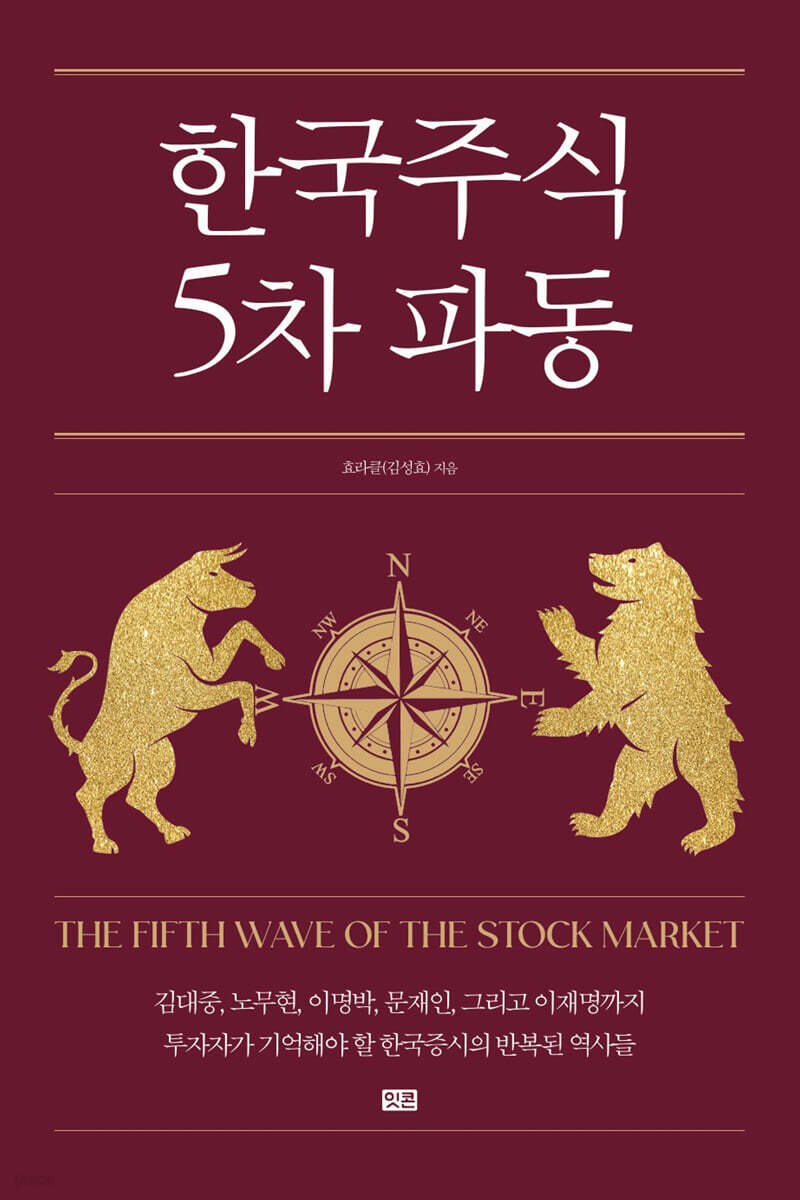
Korean stock market 5th wave
 |
Description
Book Introduction
"Korean stocks are not about companies, they're about politics."
Prepare for the "fifth wave" that will hit the Korean stock market during the Lee Jae-myung era.
An In-Depth Analysis of Lee Jae-myung's 10 Must-Read Promises for Investors
“If Warren Buffett had been born in Korea, he wouldn’t have become Warren Buffett.” This is a common saying among stock investors.
The Korean market operates on a unique mechanism.
What creates that mechanism? We've mastered countless investment techniques, but we've missed one crucial principle.
The fact that 'Korean stocks are unconditionally influenced by the government'.
"The Fifth Wave of the Korean Stock Market" delves into the essence of the market, focusing on the "waves"—the trends experienced by each administration—that the Korean stock market has experienced. From the dot-com bubble under the Kim Dae-jung administration, which came to power immediately after the IMF crisis, to the influx of foreign capital during the Roh Moo-hyun administration, to the V-shaped recovery under the Lee Myung-bak administration, to the pandemic and liquidity explosion under the Moon Jae-in administration, the author demonstrates, with rich data and narrative, that "focusing on the direction of the administration, rather than individual stocks," is the most crucial strategy for investing in Korean stocks.
And above all, it predicts the 'fifth wave' of the Lee Jae-myung administration that has just begun and even informs us of the attitude toward preparing for it.
Prepare for the "fifth wave" that will hit the Korean stock market during the Lee Jae-myung era.
An In-Depth Analysis of Lee Jae-myung's 10 Must-Read Promises for Investors
“If Warren Buffett had been born in Korea, he wouldn’t have become Warren Buffett.” This is a common saying among stock investors.
The Korean market operates on a unique mechanism.
What creates that mechanism? We've mastered countless investment techniques, but we've missed one crucial principle.
The fact that 'Korean stocks are unconditionally influenced by the government'.
"The Fifth Wave of the Korean Stock Market" delves into the essence of the market, focusing on the "waves"—the trends experienced by each administration—that the Korean stock market has experienced. From the dot-com bubble under the Kim Dae-jung administration, which came to power immediately after the IMF crisis, to the influx of foreign capital during the Roh Moo-hyun administration, to the V-shaped recovery under the Lee Myung-bak administration, to the pandemic and liquidity explosion under the Moon Jae-in administration, the author demonstrates, with rich data and narrative, that "focusing on the direction of the administration, rather than individual stocks," is the most crucial strategy for investing in Korean stocks.
And above all, it predicts the 'fifth wave' of the Lee Jae-myung administration that has just begun and even informs us of the attitude toward preparing for it.
- You can preview some of the book's contents.
Preview
index
Preface _ Everyone encounters a major current at least once in their life.
[Introduction] Where Do Korean Stock Market Fluctuations Come From?
- The market is silent, but it always says something.
Two inseparable waves: politics and stocks.
- Big waves are always accompanied by structural changes.
- Ask.
Which wave are you on?
[1st Wave] The Dot-Com Fire That Started from the Bottom
The Kim Dae-jung administration comprehensively reformed the market structure.
- It all started with the IMF crisis.
- The sudden declaration of the "information age"
The KOSDAQ of fever and greed, and the start of the dot-com bubble.
As the economic structure changed, the KOSPI came back to life.
- Players who quietly escape from the madness
- Summary and discussion of the first wave
[Second Wave] The Era of KOSPI 2000: Built on Trust
: The Roh Moo-hyun administration was actually the most market-friendly
- The emergence of a never-before-seen character, 'Roh Moo-hyun'
Foreign capital began to trust Korea.
Overcoming the psychological barrier of "KOSPI 2000"
- The era of Samsung Electronics and Hyundai Motors
- Circular sale of construction steel finance
The 'Trust Premium' Earned by the Korean Stock Market
As global stock markets grind to a halt, the second wave also ends.
- Summary and discussion of the second wave
[3rd Wave] Lehman Brothers and the Legend of the V-Shaped Rebound
: Lee Myung-bak government policies and securities firms lead the market.
- Even in the midst of fear, someone started to cheat.
- From 900 to 2000.
The beginning of a legendary rebound
- "Cha Hwa-jeong" is the leading stock created by a securities company.
"Korean New Deal" in Korea, "Export Drive" overseas
The return of orthodox conservatism, but the leadership is gone.
- In a market without policies, themes prevail.
- Summary and discussion of the third wave
[4th Wave] The Era of the Pandemic and KOSPI 3000
: The Moon Jae-in administration and the market changes brought about by the liquidity tsunami.
Park Geun-hye's impeachment was not a trigger, but a result.
An unprecedented pandemic that brought the world to a standstill
- Money is cheap! The era of a liquidity explosion
The historical emergence of individual investors: the Donghak Ant Movement
- Everyone watched the KOSPI 3000 in real time.
- Three sectors that led the fourth wave
From Samsung to Mirae Asset, MZs are rewriting the stock hierarchy.
- Summary and discussion of the 4th wave
[5th Wave] Will Another Wave Come?
: Expected direction of Korean stocks under the Lee Jae-myung administration
- At the end of the Yoon Seok-yeol administration, the market abandoned the government.
- If politics shifts from risk to premium
Lee Jae-myung's core policy: local currency.
- Why You Should Pay Attention to the 10 Major Promises
- First pledge: 'Economic structure,' a core pledge encompassing all pledges.
- Second Promise: "Political Stabilization," a Premium Key to Mid- to Long-Term Performance
Third Promise: "Support for Household Small Business Owners" to Transform the Capital Market
- 4th Promise: "Diplomacy and Security," the Slowest but Farthest-Reaching Wave
- Pledge No. 5: "National Safety," the Invisible Fundamental Strength of the Market
- Promise 6: Sejong, the new epicenter of the wave, the administrative capital.
- Pledge 7: "Respect for Labor": The Changes Brought by the 4.5-Day Workweek
- Eighth Pledge: "Stability of Living" to Increase Consumer Power Across the Market
Pledge No. 9: "Low Birth Rate and Aging Population Crisis": An Opportunity to Transform Care into an Industry
- Pledge 10: "Climate Crisis Response," Planting a Future That Hasn't Arrived in the Current Market
- Why another wave is expected
[Introduction] Where Do Korean Stock Market Fluctuations Come From?
- The market is silent, but it always says something.
Two inseparable waves: politics and stocks.
- Big waves are always accompanied by structural changes.
- Ask.
Which wave are you on?
[1st Wave] The Dot-Com Fire That Started from the Bottom
The Kim Dae-jung administration comprehensively reformed the market structure.
- It all started with the IMF crisis.
- The sudden declaration of the "information age"
The KOSDAQ of fever and greed, and the start of the dot-com bubble.
As the economic structure changed, the KOSPI came back to life.
- Players who quietly escape from the madness
- Summary and discussion of the first wave
[Second Wave] The Era of KOSPI 2000: Built on Trust
: The Roh Moo-hyun administration was actually the most market-friendly
- The emergence of a never-before-seen character, 'Roh Moo-hyun'
Foreign capital began to trust Korea.
Overcoming the psychological barrier of "KOSPI 2000"
- The era of Samsung Electronics and Hyundai Motors
- Circular sale of construction steel finance
The 'Trust Premium' Earned by the Korean Stock Market
As global stock markets grind to a halt, the second wave also ends.
- Summary and discussion of the second wave
[3rd Wave] Lehman Brothers and the Legend of the V-Shaped Rebound
: Lee Myung-bak government policies and securities firms lead the market.
- Even in the midst of fear, someone started to cheat.
- From 900 to 2000.
The beginning of a legendary rebound
- "Cha Hwa-jeong" is the leading stock created by a securities company.
"Korean New Deal" in Korea, "Export Drive" overseas
The return of orthodox conservatism, but the leadership is gone.
- In a market without policies, themes prevail.
- Summary and discussion of the third wave
[4th Wave] The Era of the Pandemic and KOSPI 3000
: The Moon Jae-in administration and the market changes brought about by the liquidity tsunami.
Park Geun-hye's impeachment was not a trigger, but a result.
An unprecedented pandemic that brought the world to a standstill
- Money is cheap! The era of a liquidity explosion
The historical emergence of individual investors: the Donghak Ant Movement
- Everyone watched the KOSPI 3000 in real time.
- Three sectors that led the fourth wave
From Samsung to Mirae Asset, MZs are rewriting the stock hierarchy.
- Summary and discussion of the 4th wave
[5th Wave] Will Another Wave Come?
: Expected direction of Korean stocks under the Lee Jae-myung administration
- At the end of the Yoon Seok-yeol administration, the market abandoned the government.
- If politics shifts from risk to premium
Lee Jae-myung's core policy: local currency.
- Why You Should Pay Attention to the 10 Major Promises
- First pledge: 'Economic structure,' a core pledge encompassing all pledges.
- Second Promise: "Political Stabilization," a Premium Key to Mid- to Long-Term Performance
Third Promise: "Support for Household Small Business Owners" to Transform the Capital Market
- 4th Promise: "Diplomacy and Security," the Slowest but Farthest-Reaching Wave
- Pledge No. 5: "National Safety," the Invisible Fundamental Strength of the Market
- Promise 6: Sejong, the new epicenter of the wave, the administrative capital.
- Pledge 7: "Respect for Labor": The Changes Brought by the 4.5-Day Workweek
- Eighth Pledge: "Stability of Living" to Increase Consumer Power Across the Market
Pledge No. 9: "Low Birth Rate and Aging Population Crisis": An Opportunity to Transform Care into an Industry
- Pledge 10: "Climate Crisis Response," Planting a Future That Hasn't Arrived in the Current Market
- Why another wave is expected
Detailed image
.png)
Into the book
But Korea is different.
This is a market where the government's will is much more important than the capabilities of individual companies.
When the government announces an important policy, related stocks rise or fall all at once along with the trend.
To exaggerate a bit, Korea is a country where the government's intentions are so important that you can make money without having to analyze individual companies.
The current reality is that we are focusing too much on corporate analysis while ignoring these characteristics.
However, conversely, this also means that even if the analysis of individual companies is somewhat lacking, if the government's will is properly understood, it is possible to catch the general trend and achieve sufficient results.
---From the "Preface"
The first wave occurred during the Kim Dae-jung administration (1998-2002), which took office after the IMF crisis. The KOSPI, which plummeted to 270 in June 1998 due to a series of corporate bankruptcies immediately following the IMF crisis, rose above 1,000 points just one year later in July 1999.
KOSDAQ (a stock market centered on technology stocks) showed an even stronger rise due to the 'dot-com bubble'.
/ The second wave occurred during the Roh Moo-hyun administration (2003-2007).
In 2002, just before taking office, there was a surge in delinquent credit borrowers due to the aftermath of the 'credit card crisis'.
As consumer sentiment rapidly declined, the KOSPI index was threatened with falling below 500 points in March 2003.
However, after showing a steady rise thereafter, in July 2007, four years later, the KOSPI index finally broke the historic mark of 2,000 points. / The third wave occurred during the Lee Myung-bak administration (2008-2012).
The KOSPI collapsed below 900 points in October 2008 due to the global financial crisis triggered by the bankruptcy of Lehman Brothers.
However, in April 2011, just two and a half years later, the KOSPI again exceeded 2,200 points. / The fourth wave skipped the Park Geun-hye administration and occurred during the Moon Jae-in administration (2017-2022).
Early in his term, the KOSPI fell to the low 1,400s in March 2020 due to the COVID-19 pandemic that swept the world.
However, just 10 months later, in January 2021, the KOSPI surpassed 3,000 points for the first time ever.
---From "Two Inseparable Waves: Politics and Stocks"
In 1998, President Kim Dae-jung declared upon taking office that he would make Korea a powerhouse in information and communications technology.
People tilted their heads.
The reaction was, what on earth is the point of informatization when hundreds of thousands of people have lost their jobs, banks have failed, and the country's credit rating has fallen to "speculative" level.
But his choice was not impulsive.
(...) At first, there were doubts, but when Saerom Technology's stock price doubled in ten days and Daum Communication's market capitalization rose to the top, the entire market started to be surprised.
KOSDAQ, once the object of ridicule, has now become the foundation of a venture myth, and the saying "From now on, you have to know KOSDAQ to make money" has begun to circulate among stock investors.
/ The government's informatization strategy and the reevaluation of KOSDAQ did not move separately.
The two created a new trend in the Korean stock market, like two rivers joining together to create waves.
---From "The Outrageous Declaration of the 'Information Age'"
Candidate Roh Moo-hyun was a lawyer by training, but he did not graduate from college. The fact that he only had a high school education was emphasized in every newspaper article.
He said he would shorten his military service and emphasized distancing from the United States.
On the other hand, his opponent, candidate Lee Hoi-chang, was an elite who graduated from Seoul National University Law School, was a judge, and served as Prime Minister twice.
/ Anti-American, anti-Hannara Party, anti-chaebol.
From the market's perspective, he was too much of an 'anti' icon.
The press called him “a smooth talker but a nervous candidate.”
The market evaluated Roh Moo-hyun as “a political rookie who doesn’t know where he will go” and “he has emotions but no direction.”
When he was elected president, stock prices plummeted within a day, and the media started talking about the "regime change risk."
No one in the market trusted him.
/ But what happened next was unexpected.
From the beginning of his term, President Roh Moo-hyun began refining laws and systems to improve corporate governance.
It empowered the Fair Trade Commission, attacked the conglomerates' circular investment structure, and legislated investor protection provisions such as the outside director system and strengthened internal oversight.
He did not hold the hand of the company, but the hand of the market. / Foreign investors who distrusted Roh Moo-hyun quietly watched his reforms.
And that flow gradually led to an inflow of funds starting in the second half of the same year.
Since 2003, foreign buying has quietly begun.
From 2003 to 2005, foreign buying began to quietly but completely dominate the Korean stock market.
---From "The anti-market icon, showing the most pro-market behavior"
The effects of the Korean New Deal and export drive were clear.
From 2009 to 2010, Korea's GDP growth rate recovered to the 6% range, and exports exceeded pre-crisis levels.
That's how Korea overcame the crisis.
The KOSPI index also surpassed 2,000 again.
Companies jumped on the platform laid by the government, and money poured in.
A wave in which the market, real estate, and capital all move in the same direction.
At this point, the economy had recovered just like in a textbook.
/ But there was a price.
It was an inevitable price to pay, given that the government had designed all of this.
Korea originally had a government-led economic structure, but since this period, it has become a market that cannot function without the government.
Businesses only watched where the government was going, and the market moved according to what policies were coming out.
The market's ability to make its own decisions and move forward was gradually weakening.
---From "'Korean New Deal' in Korea, 'Export Drive' overseas"
The term "creative economy" was around, but no one could explain how it would actually impact any industry.
Big business still welcomed the conservative government, but it didn't know where or how to invest.
Small and medium-sized businesses are still struggling, and venture companies are unsure of their direction.
Meanwhile, foreigners began to quietly slip away.
In the market, the rumor that “this government doesn’t seem to care about the economy” began to spread quietly.
/ The market moves in the shadow of politics.
In particular, the Korean market is never separated from politics.
Politics is the wind of the market, and the market is a reed swaying in the wind.
When the wind is strong, the reeds bend in one direction, and that creates waves.
/ But during the Park Geun-hye administration, there was no wind at all.
A time so quiet that there was no momentum at all.
---From "The Return of Orthodox Conservatism, But Leadership Has Gone"
In the spring of 2020, the world came to a standstill.
There was silence on the streets, and the news was full of words like deaths, confirmed cases, quarantines, and lockdowns.
But in that frozen time, one thing clearly began to move.
It's the stock market.
/ The foreigner left, and the agency took notice.
But the ones who saved the collapsing market were the ants, the individual investors.
It was even nicknamed the 'Donghak Ant Movement' because it defended the domestic market against the inflow of foreign capital.
Individuals bought virtually nonstop.
Individuals recorded unprecedented net buying throughout 2020.
47 trillion won on KOSPI and 21 trillion won on KOSDAQ.
/ For the first time in Korean stock history, individuals have begun to lead the market.
This was a change that couldn't be explained simply by saying, "There were more investors."
It was a moment when the power structure of the market changed.
---From "The Historical Emergence of Individual Investors: The Donghak Ant Movement"
And in December 2024, all that distrust finally erupted like a volcano.
When martial law was declared, state affairs were paralyzed and policy decisions came to a halt.
The government's review of martial law documents has been released to the press.
There was widespread fear in the market that this might not just be a scenario, but a 'real plan'.
/ During that day, the won-dollar exchange rate soared by more than 80 won, and foreigners sold more than 1.4 trillion won in net sales before hastily fleeing Korea.
The won's value in the Seoul foreign exchange market hit its lowest level since the 2009 financial crisis.
Foreign media reported that “Korea is the epicenter of political instability.”
/ We must recall the conclusion of this book.
No matter how well a company does, if the government makes a wrong decision, its stock price will plummet.
That day, investors left the Korean stock market.
What they saw was neither financial statements nor market share.
It was the stability of the regime and trust in its policies.
---From "At the end of the Yoon Seok-yeol administration, the market gave up on the government"
President Lee Jae-myung faced many risks during his candidacy, but his approval rating did not fall.
Morality controversy, judicial risk, prosecutorial investigation… .
Yet half of the people did not abandon him.
Even when the unprecedented full bench of the Supreme Court overturned the guilty verdict and sent the case back to the lower court after all three trials had been completed, his approval rating remained solid.
The reason is that people saw his ‘ability’ rather than his ‘morality’.
/ He gave the public the impression that he was a man who knew how to fight in a crisis and who had achieved real results in Seongnam and Gyeonggi Province.
The same was true for President Lee Myung-bak, whose criminal record was no less than that of President Lee Jae-myung.
People chose him because of his abilities rather than his morality.
Voters paid more attention to the fact that he had achieved many things while serving as mayor of Seoul than to the question of who owned the office.
---From "If Politics Changes from Risk to Premium"
The foundation of the Lee Jae-myung administration's economic policy is not a grand national plan.
It starts with local currency.
(...) When President Lee Jae-myung implemented the same policy when he was the governor of Gyeonggi Province, people initially tilted their heads in confusion.
“This small, peripheral policy is the core of economic policy?” But the market soon learned.
This is not just a simple welfare policy, but a tool to change the flow of money and, furthermore, a trigger that will change the landscape of the capital market.
Money must circulate to survive.
When a crisis comes, people save money.
So savings increase, and consumption freezes.
Then self-employment dies and the local economy cools down.
Lee Jae-myung, then governor of Gyeonggi Province, started there.
(...) In fact, when President Lee Jae-myung experimented with local currency in Seongnam City and Gyeonggi Province, sales of self-employed people in the area increased by an average of 10-20%, and the consumption-to-income ratio was nearly 30% higher than the national average.
The market has that memory.
---From "Lee Jae-myung administration's key policy 'local currency'"
In particular, if the Commercial Act is revised, it is expected that holding companies will benefit as it will be possible to legally prohibit indiscriminate split listings.
Until now, duplicate listings have been a chronic problem in the Korean stock market.
If a parent company that is listed on the stock market spins off a profitable subsidiary and then lists it, the existing shareholders of the parent company will suffer serious losses.
If such irregularities are blocked through revisions to the Commercial Act, the value of holding companies such as Doosan, Hanwha, HD Hyundai, and LS will rise.
/ This will also have a positive effect on the overall index.
When the index rises, not only index-tracking ETFs such as 'KODEX Leverage' but also stocks naturally rise along with it.
---From "Support for Household Small Business Owners": The Third Pledge to Change the Bottom of the Capital Market
Among the contents of the 6th pledge, there is one line that is very important from the perspective of stock investment.
It is “mandatory issuance of local love gift certificates.”
With the Lee Jae-myung administration in power, the local love gift certificate is no longer simply a welfare tool, but is increasingly likely to function as a state-led digital liquidity distribution system.
This can expand and create waves through the path of 'regional economic revitalization → increased consumption → rising prices → inflow into asset market → local stock market cycle'.
/ In particular, the entire process from distribution to settlement and payment is being digitized, and there are companies that are actually making profits in this market.
For example, companies like Kona I, Webcash, and Kucoin, which were briefly explained earlier, are companies that provide local currency issuance, payment, and data linkage API platforms, and their structure is such that once the execution of this promise begins, it can be directly linked to performance.
---From "Sejong Administrative Capital, the New Epicenter of the 6th Pledge Wave"
The stock market always moves first.
But it doesn't climb without direction.
Waves are created when there is expectation, direction, and structure.
The Kim Dae-jung, Roh Moo-hyun, Lee Myung-bak, and Moon Jae-in administrations, which had these conditions, created waves, while the Park Geun-hye and Yoon Seok-yeol administrations, which did not have these conditions, collapsed miserably without creating waves.
So, will the Lee Jae-myung administration actually create a stir?
This is a market where the government's will is much more important than the capabilities of individual companies.
When the government announces an important policy, related stocks rise or fall all at once along with the trend.
To exaggerate a bit, Korea is a country where the government's intentions are so important that you can make money without having to analyze individual companies.
The current reality is that we are focusing too much on corporate analysis while ignoring these characteristics.
However, conversely, this also means that even if the analysis of individual companies is somewhat lacking, if the government's will is properly understood, it is possible to catch the general trend and achieve sufficient results.
---From the "Preface"
The first wave occurred during the Kim Dae-jung administration (1998-2002), which took office after the IMF crisis. The KOSPI, which plummeted to 270 in June 1998 due to a series of corporate bankruptcies immediately following the IMF crisis, rose above 1,000 points just one year later in July 1999.
KOSDAQ (a stock market centered on technology stocks) showed an even stronger rise due to the 'dot-com bubble'.
/ The second wave occurred during the Roh Moo-hyun administration (2003-2007).
In 2002, just before taking office, there was a surge in delinquent credit borrowers due to the aftermath of the 'credit card crisis'.
As consumer sentiment rapidly declined, the KOSPI index was threatened with falling below 500 points in March 2003.
However, after showing a steady rise thereafter, in July 2007, four years later, the KOSPI index finally broke the historic mark of 2,000 points. / The third wave occurred during the Lee Myung-bak administration (2008-2012).
The KOSPI collapsed below 900 points in October 2008 due to the global financial crisis triggered by the bankruptcy of Lehman Brothers.
However, in April 2011, just two and a half years later, the KOSPI again exceeded 2,200 points. / The fourth wave skipped the Park Geun-hye administration and occurred during the Moon Jae-in administration (2017-2022).
Early in his term, the KOSPI fell to the low 1,400s in March 2020 due to the COVID-19 pandemic that swept the world.
However, just 10 months later, in January 2021, the KOSPI surpassed 3,000 points for the first time ever.
---From "Two Inseparable Waves: Politics and Stocks"
In 1998, President Kim Dae-jung declared upon taking office that he would make Korea a powerhouse in information and communications technology.
People tilted their heads.
The reaction was, what on earth is the point of informatization when hundreds of thousands of people have lost their jobs, banks have failed, and the country's credit rating has fallen to "speculative" level.
But his choice was not impulsive.
(...) At first, there were doubts, but when Saerom Technology's stock price doubled in ten days and Daum Communication's market capitalization rose to the top, the entire market started to be surprised.
KOSDAQ, once the object of ridicule, has now become the foundation of a venture myth, and the saying "From now on, you have to know KOSDAQ to make money" has begun to circulate among stock investors.
/ The government's informatization strategy and the reevaluation of KOSDAQ did not move separately.
The two created a new trend in the Korean stock market, like two rivers joining together to create waves.
---From "The Outrageous Declaration of the 'Information Age'"
Candidate Roh Moo-hyun was a lawyer by training, but he did not graduate from college. The fact that he only had a high school education was emphasized in every newspaper article.
He said he would shorten his military service and emphasized distancing from the United States.
On the other hand, his opponent, candidate Lee Hoi-chang, was an elite who graduated from Seoul National University Law School, was a judge, and served as Prime Minister twice.
/ Anti-American, anti-Hannara Party, anti-chaebol.
From the market's perspective, he was too much of an 'anti' icon.
The press called him “a smooth talker but a nervous candidate.”
The market evaluated Roh Moo-hyun as “a political rookie who doesn’t know where he will go” and “he has emotions but no direction.”
When he was elected president, stock prices plummeted within a day, and the media started talking about the "regime change risk."
No one in the market trusted him.
/ But what happened next was unexpected.
From the beginning of his term, President Roh Moo-hyun began refining laws and systems to improve corporate governance.
It empowered the Fair Trade Commission, attacked the conglomerates' circular investment structure, and legislated investor protection provisions such as the outside director system and strengthened internal oversight.
He did not hold the hand of the company, but the hand of the market. / Foreign investors who distrusted Roh Moo-hyun quietly watched his reforms.
And that flow gradually led to an inflow of funds starting in the second half of the same year.
Since 2003, foreign buying has quietly begun.
From 2003 to 2005, foreign buying began to quietly but completely dominate the Korean stock market.
---From "The anti-market icon, showing the most pro-market behavior"
The effects of the Korean New Deal and export drive were clear.
From 2009 to 2010, Korea's GDP growth rate recovered to the 6% range, and exports exceeded pre-crisis levels.
That's how Korea overcame the crisis.
The KOSPI index also surpassed 2,000 again.
Companies jumped on the platform laid by the government, and money poured in.
A wave in which the market, real estate, and capital all move in the same direction.
At this point, the economy had recovered just like in a textbook.
/ But there was a price.
It was an inevitable price to pay, given that the government had designed all of this.
Korea originally had a government-led economic structure, but since this period, it has become a market that cannot function without the government.
Businesses only watched where the government was going, and the market moved according to what policies were coming out.
The market's ability to make its own decisions and move forward was gradually weakening.
---From "'Korean New Deal' in Korea, 'Export Drive' overseas"
The term "creative economy" was around, but no one could explain how it would actually impact any industry.
Big business still welcomed the conservative government, but it didn't know where or how to invest.
Small and medium-sized businesses are still struggling, and venture companies are unsure of their direction.
Meanwhile, foreigners began to quietly slip away.
In the market, the rumor that “this government doesn’t seem to care about the economy” began to spread quietly.
/ The market moves in the shadow of politics.
In particular, the Korean market is never separated from politics.
Politics is the wind of the market, and the market is a reed swaying in the wind.
When the wind is strong, the reeds bend in one direction, and that creates waves.
/ But during the Park Geun-hye administration, there was no wind at all.
A time so quiet that there was no momentum at all.
---From "The Return of Orthodox Conservatism, But Leadership Has Gone"
In the spring of 2020, the world came to a standstill.
There was silence on the streets, and the news was full of words like deaths, confirmed cases, quarantines, and lockdowns.
But in that frozen time, one thing clearly began to move.
It's the stock market.
/ The foreigner left, and the agency took notice.
But the ones who saved the collapsing market were the ants, the individual investors.
It was even nicknamed the 'Donghak Ant Movement' because it defended the domestic market against the inflow of foreign capital.
Individuals bought virtually nonstop.
Individuals recorded unprecedented net buying throughout 2020.
47 trillion won on KOSPI and 21 trillion won on KOSDAQ.
/ For the first time in Korean stock history, individuals have begun to lead the market.
This was a change that couldn't be explained simply by saying, "There were more investors."
It was a moment when the power structure of the market changed.
---From "The Historical Emergence of Individual Investors: The Donghak Ant Movement"
And in December 2024, all that distrust finally erupted like a volcano.
When martial law was declared, state affairs were paralyzed and policy decisions came to a halt.
The government's review of martial law documents has been released to the press.
There was widespread fear in the market that this might not just be a scenario, but a 'real plan'.
/ During that day, the won-dollar exchange rate soared by more than 80 won, and foreigners sold more than 1.4 trillion won in net sales before hastily fleeing Korea.
The won's value in the Seoul foreign exchange market hit its lowest level since the 2009 financial crisis.
Foreign media reported that “Korea is the epicenter of political instability.”
/ We must recall the conclusion of this book.
No matter how well a company does, if the government makes a wrong decision, its stock price will plummet.
That day, investors left the Korean stock market.
What they saw was neither financial statements nor market share.
It was the stability of the regime and trust in its policies.
---From "At the end of the Yoon Seok-yeol administration, the market gave up on the government"
President Lee Jae-myung faced many risks during his candidacy, but his approval rating did not fall.
Morality controversy, judicial risk, prosecutorial investigation… .
Yet half of the people did not abandon him.
Even when the unprecedented full bench of the Supreme Court overturned the guilty verdict and sent the case back to the lower court after all three trials had been completed, his approval rating remained solid.
The reason is that people saw his ‘ability’ rather than his ‘morality’.
/ He gave the public the impression that he was a man who knew how to fight in a crisis and who had achieved real results in Seongnam and Gyeonggi Province.
The same was true for President Lee Myung-bak, whose criminal record was no less than that of President Lee Jae-myung.
People chose him because of his abilities rather than his morality.
Voters paid more attention to the fact that he had achieved many things while serving as mayor of Seoul than to the question of who owned the office.
---From "If Politics Changes from Risk to Premium"
The foundation of the Lee Jae-myung administration's economic policy is not a grand national plan.
It starts with local currency.
(...) When President Lee Jae-myung implemented the same policy when he was the governor of Gyeonggi Province, people initially tilted their heads in confusion.
“This small, peripheral policy is the core of economic policy?” But the market soon learned.
This is not just a simple welfare policy, but a tool to change the flow of money and, furthermore, a trigger that will change the landscape of the capital market.
Money must circulate to survive.
When a crisis comes, people save money.
So savings increase, and consumption freezes.
Then self-employment dies and the local economy cools down.
Lee Jae-myung, then governor of Gyeonggi Province, started there.
(...) In fact, when President Lee Jae-myung experimented with local currency in Seongnam City and Gyeonggi Province, sales of self-employed people in the area increased by an average of 10-20%, and the consumption-to-income ratio was nearly 30% higher than the national average.
The market has that memory.
---From "Lee Jae-myung administration's key policy 'local currency'"
In particular, if the Commercial Act is revised, it is expected that holding companies will benefit as it will be possible to legally prohibit indiscriminate split listings.
Until now, duplicate listings have been a chronic problem in the Korean stock market.
If a parent company that is listed on the stock market spins off a profitable subsidiary and then lists it, the existing shareholders of the parent company will suffer serious losses.
If such irregularities are blocked through revisions to the Commercial Act, the value of holding companies such as Doosan, Hanwha, HD Hyundai, and LS will rise.
/ This will also have a positive effect on the overall index.
When the index rises, not only index-tracking ETFs such as 'KODEX Leverage' but also stocks naturally rise along with it.
---From "Support for Household Small Business Owners": The Third Pledge to Change the Bottom of the Capital Market
Among the contents of the 6th pledge, there is one line that is very important from the perspective of stock investment.
It is “mandatory issuance of local love gift certificates.”
With the Lee Jae-myung administration in power, the local love gift certificate is no longer simply a welfare tool, but is increasingly likely to function as a state-led digital liquidity distribution system.
This can expand and create waves through the path of 'regional economic revitalization → increased consumption → rising prices → inflow into asset market → local stock market cycle'.
/ In particular, the entire process from distribution to settlement and payment is being digitized, and there are companies that are actually making profits in this market.
For example, companies like Kona I, Webcash, and Kucoin, which were briefly explained earlier, are companies that provide local currency issuance, payment, and data linkage API platforms, and their structure is such that once the execution of this promise begins, it can be directly linked to performance.
---From "Sejong Administrative Capital, the New Epicenter of the 6th Pledge Wave"
The stock market always moves first.
But it doesn't climb without direction.
Waves are created when there is expectation, direction, and structure.
The Kim Dae-jung, Roh Moo-hyun, Lee Myung-bak, and Moon Jae-in administrations, which had these conditions, created waves, while the Park Geun-hye and Yoon Seok-yeol administrations, which did not have these conditions, collapsed miserably without creating waves.
So, will the Lee Jae-myung administration actually create a stir?
---From "4 Reasons to Expect Another Wave"
Publisher's Review
Five Governments, Five Waves
South Korea's stock market is the most heavily influenced by governments in the world.
The government-led growth structure that began with the Park Chung-hee administration has continued to be a major trend every time a president changes the direction of state affairs.
This book divides the waves into five major categories.
- First wave: Kim Dae-jung administration's overcoming of the IMF crisis, declaration of informatization, and dot-com bubble
- Second Wave: Foreign Capital Inflow during the Roh Moo-hyun Administration and the Samsung Electronics Era
- Third Wave: The Lee Myung-bak administration's overcoming of the Lehman Brothers crisis and a policy-driven V-shaped recovery.
The Fourth Wave: The Moon Jae-in Administration's Liquidity Explosion and the Donghak Ant Movement
- The 5th Wave: A New Economic Structural Transition Announced by the Lee Jae-myung Administration
This book sharply analyzes how politics sends signals to the market and how those signals become waves.
And he says.
“Waves start with structural changes, not chart changes.”
“Ask ‘Where do you stand?’ rather than ‘What do you buy?’”
This book is not just a look back at the past.
It predicts the impact of the new administration on the market and asks questions that integrate the administration and the market, structure and flow, emotions and judgment, and even the rhythm of life.
“What is your current stance on the market?”
“Are you someone who can quietly prepare when the real wave begins?”
In this time of uncertainty for both markets and investors, "The 5th Wave of Korean Stocks" is a powerful book that offers solid insight, sharp analysis, and a rethinking of one's approach to life.
South Korea's stock market is the most heavily influenced by governments in the world.
The government-led growth structure that began with the Park Chung-hee administration has continued to be a major trend every time a president changes the direction of state affairs.
This book divides the waves into five major categories.
- First wave: Kim Dae-jung administration's overcoming of the IMF crisis, declaration of informatization, and dot-com bubble
- Second Wave: Foreign Capital Inflow during the Roh Moo-hyun Administration and the Samsung Electronics Era
- Third Wave: The Lee Myung-bak administration's overcoming of the Lehman Brothers crisis and a policy-driven V-shaped recovery.
The Fourth Wave: The Moon Jae-in Administration's Liquidity Explosion and the Donghak Ant Movement
- The 5th Wave: A New Economic Structural Transition Announced by the Lee Jae-myung Administration
This book sharply analyzes how politics sends signals to the market and how those signals become waves.
And he says.
“Waves start with structural changes, not chart changes.”
“Ask ‘Where do you stand?’ rather than ‘What do you buy?’”
This book is not just a look back at the past.
It predicts the impact of the new administration on the market and asks questions that integrate the administration and the market, structure and flow, emotions and judgment, and even the rhythm of life.
“What is your current stance on the market?”
“Are you someone who can quietly prepare when the real wave begins?”
In this time of uncertainty for both markets and investors, "The 5th Wave of Korean Stocks" is a powerful book that offers solid insight, sharp analysis, and a rethinking of one's approach to life.
GOODS SPECIFICS
- Date of issue: June 25, 2025
- Page count, weight, size: 220 pages | 486g | 160*228*20mm
- ISBN13: 9791190877985
- ISBN10: 1190877988
You may also like
카테고리
korean


korean

![GQ KOREA Mark (Monthly): December [2025]](http://librairie.coreenne.fr/cdn/shop/files/8ef265dbbfbf186523ed75ba7319009d.jpg?v=1765340328&width=3840)


