

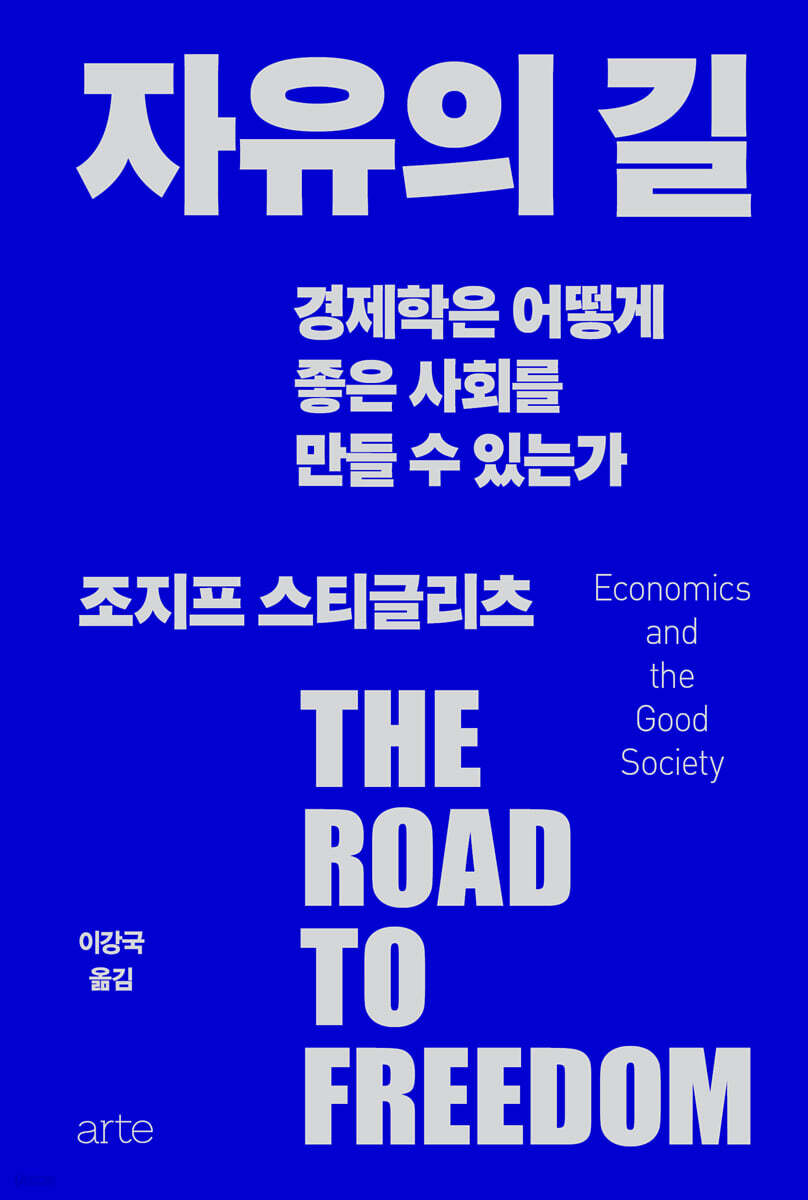
The Road to Freedom
 |
Description
Book Introduction
“Freedom for the wolf means death for the sheep.”
How have the self-proclaimed "guardians of freedom" suppressed freedom?
Freedom Through the Eyes of a Nobel Prize-Winning Economist
Today, the value of 'freedom' has gone beyond issues of human rights and equality to become a sharp battleground for political and economic ideologies.
Joseph Stiglitz, a world-renowned scholar and Nobel Prize winner in economics, confronts this inconvenient truth head-on and sharply examines how free discourse has been distorted into a tool representing the interests of certain powers.
According to the author, the right wing's clever monopolization and distortion of the concept of freedom led to the rise of neoliberalism and market fundamentalism.
As a result, only the freedom of a privileged few has increased, while economic inequality and instability across society have deepened to unprecedented levels.
"The Path to Freedom" questions whether this trend truly realizes freedom and examines which economic system can truly expand the freedom of the majority of citizens.
Having worked on the front lines of economic policy decisions, the author has personally witnessed the reality that an economic system that touts itself as free actually threatens true freedom.
As a practicing economist who straddles both academia and politics, he dissects the errors of conservative economists who guided the global economy over the past century and suggests a new path for social reform that fosters shared prosperity.
In a world where austerity policies and deepening inequality have repeatedly proven to be detrimental to the economy since the global financial crisis, this book poses the fundamental question: "How can economics create a better society?"
In this rich discussion encompassing theory and practice, readers will discover a new 'path to freedom' for all.
Koreans demonstrated their commitment to freedom and democracy by rallying against former President Yoon Seok-yeol's illegal seizure of power.
Now is the time to reflect more deeply on what freedom means and what we can do to preserve it.
I hope this book will serve as a guide on your journey of endeavor.
- Joseph Stiglitz, from the author's preface to the Korean edition of "The Road to Freedom"
How have the self-proclaimed "guardians of freedom" suppressed freedom?
Freedom Through the Eyes of a Nobel Prize-Winning Economist
Today, the value of 'freedom' has gone beyond issues of human rights and equality to become a sharp battleground for political and economic ideologies.
Joseph Stiglitz, a world-renowned scholar and Nobel Prize winner in economics, confronts this inconvenient truth head-on and sharply examines how free discourse has been distorted into a tool representing the interests of certain powers.
According to the author, the right wing's clever monopolization and distortion of the concept of freedom led to the rise of neoliberalism and market fundamentalism.
As a result, only the freedom of a privileged few has increased, while economic inequality and instability across society have deepened to unprecedented levels.
"The Path to Freedom" questions whether this trend truly realizes freedom and examines which economic system can truly expand the freedom of the majority of citizens.
Having worked on the front lines of economic policy decisions, the author has personally witnessed the reality that an economic system that touts itself as free actually threatens true freedom.
As a practicing economist who straddles both academia and politics, he dissects the errors of conservative economists who guided the global economy over the past century and suggests a new path for social reform that fosters shared prosperity.
In a world where austerity policies and deepening inequality have repeatedly proven to be detrimental to the economy since the global financial crisis, this book poses the fundamental question: "How can economics create a better society?"
In this rich discussion encompassing theory and practice, readers will discover a new 'path to freedom' for all.
Koreans demonstrated their commitment to freedom and democracy by rallying against former President Yoon Seok-yeol's illegal seizure of power.
Now is the time to reflect more deeply on what freedom means and what we can do to preserve it.
I hope this book will serve as a guide on your journey of endeavor.
- Joseph Stiglitz, from the author's preface to the Korean edition of "The Road to Freedom"
- You can preview some of the book's contents.
Preview
index
Preface to the Korean Edition 6
Introduction 10
Chapter 1: Introduction: Freedom at Risk 28
Chapter 2: How Economists Think About Freedom 54
Part 1: Liberation and Freedom: Basic Principles
Chapter 3: One Man's Freedom Is Another Man's Unfreedom 82
Chapter 4 Freedom Through Coercion: Public Goods and the Free-Rider Problem 114
Chapter 5: Contracts, Social Contracts, and Freedom 133
Chapter 6: Freedom, Competitive Economy, and Social Justice 155
Chapter 7: Freedom to Exploit 179
Part 2: Freedom, Faith, Preference, and Building a Good Society
Chapter 8: Social Coercion and Social Cohesion 210
Chapter 9: The Joint Formation of Individuals and Faith 234
Chapter 10: Tolerance, Social Solidarity, and Freedom 267
Part 3: What kind of economy creates a good, just, and free society?
Chapter 11: Neoliberal Capitalism: Why It Failed 292
Chapter 12: Freedom, Sovereignty, and Coercion Between States 316
Chapter 13: Progressive Capitalism, Social Democracy, and the Learning Society 350
Chapter 14: Democracy, Freedom, Social Justice, and the Good Society 368
Acknowledgments 389
Unlock: The Path to Freedom and a Better Society (Lee Kang-guk) 395
Week 402
Introduction 10
Chapter 1: Introduction: Freedom at Risk 28
Chapter 2: How Economists Think About Freedom 54
Part 1: Liberation and Freedom: Basic Principles
Chapter 3: One Man's Freedom Is Another Man's Unfreedom 82
Chapter 4 Freedom Through Coercion: Public Goods and the Free-Rider Problem 114
Chapter 5: Contracts, Social Contracts, and Freedom 133
Chapter 6: Freedom, Competitive Economy, and Social Justice 155
Chapter 7: Freedom to Exploit 179
Part 2: Freedom, Faith, Preference, and Building a Good Society
Chapter 8: Social Coercion and Social Cohesion 210
Chapter 9: The Joint Formation of Individuals and Faith 234
Chapter 10: Tolerance, Social Solidarity, and Freedom 267
Part 3: What kind of economy creates a good, just, and free society?
Chapter 11: Neoliberal Capitalism: Why It Failed 292
Chapter 12: Freedom, Sovereignty, and Coercion Between States 316
Chapter 13: Progressive Capitalism, Social Democracy, and the Learning Society 350
Chapter 14: Democracy, Freedom, Social Justice, and the Good Society 368
Acknowledgments 389
Unlock: The Path to Freedom and a Better Society (Lee Kang-guk) 395
Week 402
Detailed image

Into the book
Freedom is an important value we must uphold, but it is more complex and nuanced than the right wing claims.
Current conservative interpretations of the meaning of freedom are superficial, misleading, and ideologically motivated.
The right claims to be the defenders of freedom, but I will show that the way they define and pursue freedom has had the opposite effect, significantly curtailing the liberties of many citizens.
--- p.13
The term “unbridled market”—a market without rules and regulations—is an oxymoron.
If so, corruption will become rampant and trust will decrease.
A world without restrictions would be a jungle where the only thing that mattered was power, which determined who got what and who did what.
It wouldn't be a market at all.
--- p.21
The very word freedom as it is currently used limits our ability to reason soundly about which economic, political, and social systems best enhance societal well-being and which systems are most likely to provide meaningful freedom and happiness to the greatest number of people.
The words coercion and freedom have become emotive parts of our political vocabulary.
Freedom is good and compulsion is bad.
In fact, there is a widespread simplistic logic that views freedom and coercion as opposing concepts.
--- pp.24-25
Neoliberalism is not self-sufficient.
It is self-negating.
It has deformed our society and the people within it.
Materialism and the extreme selfishness it fosters have had a negative impact on democracy, social cohesion, and trust, and have even weakened the functioning of the economy.
--- pp.54-55
It is difficult to find a place in a capitalist system where some form of fraud or exploitation does not occur.
The problem isn't just the costs imposed on those who experience the dark side of capitalism firsthand.
We are all constantly on guard to ensure that we are not being taken advantage of.
The economic cost is great, but the psychological cost is even greater.
This reflects a failure of the system that has serious consequences, such as the relatively poor health of Americans compared to other developed countries mentioned above.
--- pp.72-73
Neoliberalism has overlooked the importance of externalities, but climate change and the COVID-19 pandemic have made it clear that externalities are paramount.
Government is as necessary to help society maintain the environment and public health as it is to maintain macroeconomic stability.
--- p.81
Right-wing beliefs, which I have described as essentially “religious,” have the power to capture human imagination and passion.
Their appeal to individuality is incredibly appealing.
If everyone works hard, is creative, and only pursues their own interests, everything will be fine.
Unfortunately, however, such claims are false.
To hold on to that belief now would be to ignore all the intellectual advances and global changes of the past half-century.
--- pp.81-82
Freedom cannot stand alone.
In an integrated society, individual freedom cannot be considered without considering its consequences for others.
--- p.100
If the distribution of dollars is the result of present or past exploitation, then even in a competitive market, prices and wages that appear in the market lack moral legitimacy.
Even if today's rules are set in a morally just way.
This clearly shows that even in a perfectly competitive market, the scale of compensation may lack fundamental moral justification.
Even though there are strong moral or economic arguments that people who work hard or save more should be rewarded more for their hard work and willingness to save.
--- pp.173-174
Whether due to peer pressure to behave well or empathy, considering how one's actions affect others can be considered part of social cohesion or solidarity.
These prosocial behaviors define us.
It is about thinking of oneself as a good citizen, a member of a community where each person fulfills his or her role.
We are not forced to act good.
Part of our being demands that we show respect for others, such as helping our neighbors during a natural disaster or donating blood.
To the extent that social cohesion exists, the demand to act for the good of society is not coercive.
--- p.216
Donald Trump is a prime example of what happens when parents and teachers fail and individuals are not socialized.
When norms, peer pressure, and traditions functioned normally, there was no need for strong laws governing what a president could ethically do.
Almost every president has acted within the constraints.
But Trump and his brazenness may force us to define the limits of the presidency more precisely, including in laws and regulations.
--- p.217
The neoliberal system has failed in itself by failing to deliver the shared prosperity it promised, but more worryingly, it has also created more selfish and materialistic people who lack honesty and trust.
What kind of world would it be if people could routinely make money by exploiting others without even feeling guilty?
Current conservative interpretations of the meaning of freedom are superficial, misleading, and ideologically motivated.
The right claims to be the defenders of freedom, but I will show that the way they define and pursue freedom has had the opposite effect, significantly curtailing the liberties of many citizens.
--- p.13
The term “unbridled market”—a market without rules and regulations—is an oxymoron.
If so, corruption will become rampant and trust will decrease.
A world without restrictions would be a jungle where the only thing that mattered was power, which determined who got what and who did what.
It wouldn't be a market at all.
--- p.21
The very word freedom as it is currently used limits our ability to reason soundly about which economic, political, and social systems best enhance societal well-being and which systems are most likely to provide meaningful freedom and happiness to the greatest number of people.
The words coercion and freedom have become emotive parts of our political vocabulary.
Freedom is good and compulsion is bad.
In fact, there is a widespread simplistic logic that views freedom and coercion as opposing concepts.
--- pp.24-25
Neoliberalism is not self-sufficient.
It is self-negating.
It has deformed our society and the people within it.
Materialism and the extreme selfishness it fosters have had a negative impact on democracy, social cohesion, and trust, and have even weakened the functioning of the economy.
--- pp.54-55
It is difficult to find a place in a capitalist system where some form of fraud or exploitation does not occur.
The problem isn't just the costs imposed on those who experience the dark side of capitalism firsthand.
We are all constantly on guard to ensure that we are not being taken advantage of.
The economic cost is great, but the psychological cost is even greater.
This reflects a failure of the system that has serious consequences, such as the relatively poor health of Americans compared to other developed countries mentioned above.
--- pp.72-73
Neoliberalism has overlooked the importance of externalities, but climate change and the COVID-19 pandemic have made it clear that externalities are paramount.
Government is as necessary to help society maintain the environment and public health as it is to maintain macroeconomic stability.
--- p.81
Right-wing beliefs, which I have described as essentially “religious,” have the power to capture human imagination and passion.
Their appeal to individuality is incredibly appealing.
If everyone works hard, is creative, and only pursues their own interests, everything will be fine.
Unfortunately, however, such claims are false.
To hold on to that belief now would be to ignore all the intellectual advances and global changes of the past half-century.
--- pp.81-82
Freedom cannot stand alone.
In an integrated society, individual freedom cannot be considered without considering its consequences for others.
--- p.100
If the distribution of dollars is the result of present or past exploitation, then even in a competitive market, prices and wages that appear in the market lack moral legitimacy.
Even if today's rules are set in a morally just way.
This clearly shows that even in a perfectly competitive market, the scale of compensation may lack fundamental moral justification.
Even though there are strong moral or economic arguments that people who work hard or save more should be rewarded more for their hard work and willingness to save.
--- pp.173-174
Whether due to peer pressure to behave well or empathy, considering how one's actions affect others can be considered part of social cohesion or solidarity.
These prosocial behaviors define us.
It is about thinking of oneself as a good citizen, a member of a community where each person fulfills his or her role.
We are not forced to act good.
Part of our being demands that we show respect for others, such as helping our neighbors during a natural disaster or donating blood.
To the extent that social cohesion exists, the demand to act for the good of society is not coercive.
--- p.216
Donald Trump is a prime example of what happens when parents and teachers fail and individuals are not socialized.
When norms, peer pressure, and traditions functioned normally, there was no need for strong laws governing what a president could ethically do.
Almost every president has acted within the constraints.
But Trump and his brazenness may force us to define the limits of the presidency more precisely, including in laws and regulations.
--- p.217
The neoliberal system has failed in itself by failing to deliver the shared prosperity it promised, but more worryingly, it has also created more selfish and materialistic people who lack honesty and trust.
What kind of world would it be if people could routinely make money by exploiting others without even feeling guilty?
--- p.368
Publisher's Review
“Freedom for the wolf means death for the sheep.”
“Freedom for the wolves has often meant death to the sheep.”
How have the so-called guardians of freedom suppressed freedom?
Is an economy that promotes empathy, fairness, safety, and cooperation possible?
The most misused and problematic concept today
Freedom Through the Eyes of a Nobel Prize-Winning Economist
Nobel Prize winner in economics Joseph Stiglitz's new book, "The Road to Freedom," has been published by Arte Publishing as the 40th book in the Philos series.
In this book, Stiglitz corrects the concept of "freedom" that has been distorted by the right wing in modern political and economic discourse, and delves into the role of the economic system and government that can realize freedom for all.
It also sharply criticizes the inequality and instability brought about by market fundamentalism, and poses the fundamental question, “How can economics create a good society?”
The Korean edition includes a timely preface by the author, addressing the martial law and impeachment crisis of 2024, offering contemporary insights into the crisis of democracy and freedom.
Is freedom a fundamental human right? A full discussion of this would require further elaboration, but it's undeniable that the very fact that a person can act and exist according to their own will, free from coercion or constraint, is the starting point of human dignity.
However, we need to pay attention to the reality that today the word 'freedom' is being idealized beyond the context of human rights and into a powerful political and economic ideology.
With this problem in mind, world-renowned economist Stiglitz examines how the concept of freedom has been distorted by certain economic forces.
According to him, neoliberalism and the tyranny of the market began when the right wing monopolized and misused the word “freedom,” which only expanded the freedom of a few while deepening economic inequality and instability throughout society.
In his new book, "The Path to Freedom," he reinterprets the distorted concept of freedom from the perspective of 21st-century economics and discusses which economic system can substantially expand the freedom of all citizens.
The author, who served as Chairman of the Council of Economic Advisers in the Bill Clinton administration and Chief Economist at the World Bank, has witnessed from the forefront of policy how a market economy, championing freedom, paradoxically stifles freedom.
Based on this shocking experience, he exposes and criticizes the errors and failings of 20th-century economic thinkers like Hayek and Friedman, and examines alternatives and challenges for social reform to ensure shared prosperity for all.
His argument begins with the recognition that humans live in interdependence.
In an interdependent society, one person's freedom can inevitably lead to the lack of freedom of others.
The author connects this to the problem of externalities prevalent in modern society, such as climate change, and reexamines the dichotomous structure of “freedom and coercion” through standard economic analyses such as trade-offs, public goods, and coordination failures.
Furthermore, 『The Road to Freedom』 persuasively advocates for the government's active role in the economic sphere based on the empirical achievements of modern economics.
By systematically demonstrating that more people can achieve substantial freedom when the government takes the lead in tax policy and public investment, it also opens the door to discussion about the economic system and society our society should pursue.
The Korean edition, in particular, includes a timely preface addressing the martial law and impeachment crisis of 2024, offering contemporary insights into the crises and challenges facing liberal democracy, delivering a more urgent message to Korean readers.
Right-wing economists in collusion with capitalists
How freedom has been distorted
Exposing the History of the Misrepresentation of Freedom
They [conservative economists] seem to think that imposing rules and regulations will create a “non-free market.”
We talked about the “free market.”
-In the text
"The Road to Freedom" traces the background and ideological history of how the distorted concept of freedom has become so widespread today.
In particular, we note that the right-wing forces, which have claimed to be the guardians of freedom, have actually restricted the freedoms of the majority of citizens, and in the process, have arbitrarily distorted Adam Smith's ideas to secure academic legitimacy.
Today's conservative economists and their followers claim that their theoretical positions are legitimately based on Adam Smith's argument, represented by the "invisible hand."
However, Smith never assumed that individuals were completely selfish, but rather that humans instinctively considered the well-being of others.
Nevertheless, classical economists have interpreted Smith's ideas fragmentarily and used them as a tool to justify the laissez-faire theory that everything should be left to the market.
In "The Path to Freedom," Stiglitz exposes how right-wing economists have been interpreting and explaining capitalism in a way that benefits their own interests, rather than objectively analyzing how it actually works.
What's even more remarkable is that even moderate or conservative international organizations like the IMF and OECD recognize that egalitarian economic systems actually produce better outcomes.
Based on this reality, Stiglitz criticizes market-oriented economists such as Friedman and Hayek as nothing more than "intellectual handmaids" representing the interests of capitalists.
An economic system that makes everyone miserable,
How does neoliberal capitalism affect society and humanity?
And furthermore, it eats away at itself
Drawing on the legacy of behavioral economics, "The Path to Freedom" illuminates how an economic system that champions freedom fosters individual selfishness.
Neoliberal capitalism not only undermines social trust, but also shapes individual attitudes and behavior patterns in ways that threaten the capitalist system itself.
The results are clearly evident in reality.
In today's capitalist system, even when various injustices occur in the name of 'freedom', the mechanisms to stop them do not function properly.
This leads to widespread fraud and exploitation in various ways, forcing members of society to constantly be on edge to avoid being exploited by others.
In this way, the current system is structurally harmful in that it imposes serious psychological burdens on individuals in addition to the economic costs it incurs.
Moreover, global events like the pandemic have clearly demonstrated how the impact of externalities, overlooked by conventional economics, can be amplified in serious and unpredictable ways.
In this reality, the author raises fundamental doubts about the approach of leaving everything to the market without government intervention, while focusing on the positive function that social norms can perform as a means of responding to externalities.
At the heart of this search for alternatives lies a reevaluation of human nature.
Humans are inherently endowed with social virtues such as honesty, empathy, and cooperation, but mainstream economics has thoroughly excluded these values of social cohesion and reciprocity, and as a result, we have lost the ability to even imagine a better society.
Ultimately, neoliberalism not only failed to deliver the shared prosperity it promised, but also undermined honesty and trust across society.
The harm is even more serious in that it has produced a large number of individuals obsessed with selfish and materialistic thinking.
Climate change, the COVID-19 pandemic, social media…
Starting from universal and timely daily life
Thoughts on Today's Economic Crisis
Although "The Road to Freedom" focuses primarily on the case of the United States, the reality it addresses is similarly recurring in numerous countries today, including Korea.
In particular, Korea and the United States experienced martial law in 2024 and the Capitol riots in 2011, respectively, and shared the experience of those who were obsessed with the illusion of "protecting freedom" shaking the very foundations of society.
In this context, this book's discussion, which warns of the dangers of distorted freedom, delivers a message that is even more timely and urgent for Korean society today.
Stiglitz also persuasively presents how the rapidly changing world order of the past two decades can be interpreted through the lens of modern economics.
The author views climate change and the COVID-19 pandemic, the two events that have had the most decisive impact on the course of human history since the 2010s, as global externalities, and explains why free market advocates are so resistant to climate change prevention measures and refuse to wear masks and get vaccinated.
In short, acknowledging the importance of externalities leads to the acceptance of collective action, and we cannot leave the economy to the market to its own devices.
This is not the only contemporary reality that the author focuses on.
Stiglitz is deeply concerned about today's structure, where social media companies and big tech firms wield more wealth and power than nations.
In particular, media giants have enjoyed freedom from regulation and taxation by political power, while simultaneously shaping and reproducing the metanarratives that determine how the public perceives "freedom."
In this way, "The Road to Freedom" leads readers to reconsider today's economic reality through examples of technological capital that has penetrated deeply into our daily lives through smartphones.
“Freedom for the wolves has often meant death to the sheep.”
How have the so-called guardians of freedom suppressed freedom?
Is an economy that promotes empathy, fairness, safety, and cooperation possible?
The most misused and problematic concept today
Freedom Through the Eyes of a Nobel Prize-Winning Economist
Nobel Prize winner in economics Joseph Stiglitz's new book, "The Road to Freedom," has been published by Arte Publishing as the 40th book in the Philos series.
In this book, Stiglitz corrects the concept of "freedom" that has been distorted by the right wing in modern political and economic discourse, and delves into the role of the economic system and government that can realize freedom for all.
It also sharply criticizes the inequality and instability brought about by market fundamentalism, and poses the fundamental question, “How can economics create a good society?”
The Korean edition includes a timely preface by the author, addressing the martial law and impeachment crisis of 2024, offering contemporary insights into the crisis of democracy and freedom.
Is freedom a fundamental human right? A full discussion of this would require further elaboration, but it's undeniable that the very fact that a person can act and exist according to their own will, free from coercion or constraint, is the starting point of human dignity.
However, we need to pay attention to the reality that today the word 'freedom' is being idealized beyond the context of human rights and into a powerful political and economic ideology.
With this problem in mind, world-renowned economist Stiglitz examines how the concept of freedom has been distorted by certain economic forces.
According to him, neoliberalism and the tyranny of the market began when the right wing monopolized and misused the word “freedom,” which only expanded the freedom of a few while deepening economic inequality and instability throughout society.
In his new book, "The Path to Freedom," he reinterprets the distorted concept of freedom from the perspective of 21st-century economics and discusses which economic system can substantially expand the freedom of all citizens.
The author, who served as Chairman of the Council of Economic Advisers in the Bill Clinton administration and Chief Economist at the World Bank, has witnessed from the forefront of policy how a market economy, championing freedom, paradoxically stifles freedom.
Based on this shocking experience, he exposes and criticizes the errors and failings of 20th-century economic thinkers like Hayek and Friedman, and examines alternatives and challenges for social reform to ensure shared prosperity for all.
His argument begins with the recognition that humans live in interdependence.
In an interdependent society, one person's freedom can inevitably lead to the lack of freedom of others.
The author connects this to the problem of externalities prevalent in modern society, such as climate change, and reexamines the dichotomous structure of “freedom and coercion” through standard economic analyses such as trade-offs, public goods, and coordination failures.
Furthermore, 『The Road to Freedom』 persuasively advocates for the government's active role in the economic sphere based on the empirical achievements of modern economics.
By systematically demonstrating that more people can achieve substantial freedom when the government takes the lead in tax policy and public investment, it also opens the door to discussion about the economic system and society our society should pursue.
The Korean edition, in particular, includes a timely preface addressing the martial law and impeachment crisis of 2024, offering contemporary insights into the crises and challenges facing liberal democracy, delivering a more urgent message to Korean readers.
Right-wing economists in collusion with capitalists
How freedom has been distorted
Exposing the History of the Misrepresentation of Freedom
They [conservative economists] seem to think that imposing rules and regulations will create a “non-free market.”
We talked about the “free market.”
-In the text
"The Road to Freedom" traces the background and ideological history of how the distorted concept of freedom has become so widespread today.
In particular, we note that the right-wing forces, which have claimed to be the guardians of freedom, have actually restricted the freedoms of the majority of citizens, and in the process, have arbitrarily distorted Adam Smith's ideas to secure academic legitimacy.
Today's conservative economists and their followers claim that their theoretical positions are legitimately based on Adam Smith's argument, represented by the "invisible hand."
However, Smith never assumed that individuals were completely selfish, but rather that humans instinctively considered the well-being of others.
Nevertheless, classical economists have interpreted Smith's ideas fragmentarily and used them as a tool to justify the laissez-faire theory that everything should be left to the market.
In "The Path to Freedom," Stiglitz exposes how right-wing economists have been interpreting and explaining capitalism in a way that benefits their own interests, rather than objectively analyzing how it actually works.
What's even more remarkable is that even moderate or conservative international organizations like the IMF and OECD recognize that egalitarian economic systems actually produce better outcomes.
Based on this reality, Stiglitz criticizes market-oriented economists such as Friedman and Hayek as nothing more than "intellectual handmaids" representing the interests of capitalists.
An economic system that makes everyone miserable,
How does neoliberal capitalism affect society and humanity?
And furthermore, it eats away at itself
Drawing on the legacy of behavioral economics, "The Path to Freedom" illuminates how an economic system that champions freedom fosters individual selfishness.
Neoliberal capitalism not only undermines social trust, but also shapes individual attitudes and behavior patterns in ways that threaten the capitalist system itself.
The results are clearly evident in reality.
In today's capitalist system, even when various injustices occur in the name of 'freedom', the mechanisms to stop them do not function properly.
This leads to widespread fraud and exploitation in various ways, forcing members of society to constantly be on edge to avoid being exploited by others.
In this way, the current system is structurally harmful in that it imposes serious psychological burdens on individuals in addition to the economic costs it incurs.
Moreover, global events like the pandemic have clearly demonstrated how the impact of externalities, overlooked by conventional economics, can be amplified in serious and unpredictable ways.
In this reality, the author raises fundamental doubts about the approach of leaving everything to the market without government intervention, while focusing on the positive function that social norms can perform as a means of responding to externalities.
At the heart of this search for alternatives lies a reevaluation of human nature.
Humans are inherently endowed with social virtues such as honesty, empathy, and cooperation, but mainstream economics has thoroughly excluded these values of social cohesion and reciprocity, and as a result, we have lost the ability to even imagine a better society.
Ultimately, neoliberalism not only failed to deliver the shared prosperity it promised, but also undermined honesty and trust across society.
The harm is even more serious in that it has produced a large number of individuals obsessed with selfish and materialistic thinking.
Climate change, the COVID-19 pandemic, social media…
Starting from universal and timely daily life
Thoughts on Today's Economic Crisis
Although "The Road to Freedom" focuses primarily on the case of the United States, the reality it addresses is similarly recurring in numerous countries today, including Korea.
In particular, Korea and the United States experienced martial law in 2024 and the Capitol riots in 2011, respectively, and shared the experience of those who were obsessed with the illusion of "protecting freedom" shaking the very foundations of society.
In this context, this book's discussion, which warns of the dangers of distorted freedom, delivers a message that is even more timely and urgent for Korean society today.
Stiglitz also persuasively presents how the rapidly changing world order of the past two decades can be interpreted through the lens of modern economics.
The author views climate change and the COVID-19 pandemic, the two events that have had the most decisive impact on the course of human history since the 2010s, as global externalities, and explains why free market advocates are so resistant to climate change prevention measures and refuse to wear masks and get vaccinated.
In short, acknowledging the importance of externalities leads to the acceptance of collective action, and we cannot leave the economy to the market to its own devices.
This is not the only contemporary reality that the author focuses on.
Stiglitz is deeply concerned about today's structure, where social media companies and big tech firms wield more wealth and power than nations.
In particular, media giants have enjoyed freedom from regulation and taxation by political power, while simultaneously shaping and reproducing the metanarratives that determine how the public perceives "freedom."
In this way, "The Road to Freedom" leads readers to reconsider today's economic reality through examples of technological capital that has penetrated deeply into our daily lives through smartphones.
■ Author's Preface (some excerpts)
Almost every society today celebrates freedom and the effort to create a better world—a good society.
But in many cases, this is nothing more than empty rhetoric, a series of platitudes without substance.
The right wing in particular has been guilty of this mistake.
They talk about “freedom” while stifling freedom of the press, downplaying its central role as a watchdog of democracy and labeling it an enemy of the people.
The American right appears to celebrate freedom, but it does everything it can to take away women's reproductive freedom.
The world witnessed this contradiction clearly, especially when former President Yoon Seok-yeol, while frequently championing freedom, declared martial law to deprive people of basic freedoms.
I believe that a good society must be democratic.
(…) But democracy isn’t just about voting once every few years.
It involves giving people a say in the decisions that affect their lives, both at work and in public life.
Democracy can thrive only when political and economic power are not excessively concentrated.
These two are deeply intertwined.
(…)
Koreans demonstrated their commitment to freedom and democracy by rallying against former President Yoon Seok-yeol's illegal seizure of power.
Now is the time for Koreans to reflect more deeply on what freedom means and what they can do to preserve it.
I hope this book will serve as a guide on your journey of endeavor.
■ Translator's Note (some excerpts)
Lee Kang-guk (Professor of Economics, Ritsumeikan University; Translator of "The Road to Freedom")
In South Korea, the right wing has long argued that freedom primarily means anti-communism politically and reduced government intervention in the market economically.
However, this is a false concept of freedom, and it is time for a deep reflection on the meaning of true freedom and what is needed to expand it.
Professor Stiglitz's "The Road to Freedom" is a book that presents just such an analysis.
This book advances our understanding of freedom from a 21st-century economic perspective and discusses which economic systems can expand citizens' freedom.
The author emphasizes that freedom should be understood in a broad sense, encompassing the freedom to act in relation to a set of opportunities, an expanded concept linked to values such as fairness and justice, and the freedom to realize one's potential.
But in the United States, the right wing has monopolized and misled the word "freedom," leading to tax cuts, deregulation, and other measures that reduce the role of government, leading to unbridled markets and neoliberalism.
This system expanded the freedoms of a few, but it curtailed the freedoms of countless others, producing stagnant growth, deepening inequality, and economic instability.
He therefore argues that progressive capitalism, based on an active economic role for government and a balance of power, is necessary to create a good society that expands citizens' freedom.
(…)
During the presidential election, there should be in-depth discussion about desirable economic policies and the direction of the economic system surrounding the future of Korean society.
I believe this book, which presents progressive economics that illuminates the path to freedom, will serve as a valuable guide along the way.
I sincerely hope that Korean society can overcome political turmoil and embark on the path of freedom toward a better society.
■ Author's Preface (excerpts)
Almost every society today celebrates freedom and the effort to create a better world—a good society.
But in many cases, this is nothing more than empty rhetoric, a series of platitudes without substance.
The right wing in particular has been guilty of this mistake.
They talk about “freedom” while stifling freedom of the press, downplaying its central role as a watchdog of democracy and labeling it an enemy of the people.
The American right appears to celebrate freedom, but it does everything it can to take away women's reproductive freedom.
The world witnessed this contradiction clearly, especially when former President Yoon Seok-yeol, while frequently championing freedom, declared martial law to deprive people of basic freedoms.
I believe that a good society must be democratic.
(…) But democracy isn’t just about voting once every few years.
It involves giving people a say in the decisions that affect their lives, both at work and in public life.
Democracy can thrive only when political and economic power are not excessively concentrated.
These two are deeply intertwined.
(…)
Koreans demonstrated their commitment to freedom and democracy by rallying against former President Yoon Seok-yeol's illegal seizure of power.
Now is the time for Koreans to reflect more deeply on what freedom means and what they can do to preserve it.
I hope this book will serve as a guide on your journey of endeavor.
■ Translator's Note (some excerpts)
Lee Kang-guk (Professor of Economics, Ritsumeikan University; Translator of "The Road to Freedom")
In South Korea, the right wing has long argued that freedom primarily means anti-communism politically and reduced government intervention in the market economically.
However, this is a false concept of freedom, and it is time for a deep reflection on the meaning of true freedom and what is needed to expand it.
Professor Stiglitz's "The Road to Freedom" is a book that presents just such an analysis.
This book advances our understanding of freedom from a 21st-century economic perspective and discusses which economic systems can expand citizens' freedom.
The author emphasizes that freedom should be understood in a broad sense, encompassing the freedom to act in relation to a set of opportunities, an expanded concept linked to values such as fairness and justice, and the freedom to realize one's potential.
But in the United States, the right wing has monopolized and misled the word "freedom," leading to tax cuts, deregulation, and other measures that reduce the role of government, leading to unbridled markets and neoliberalism.
This system expanded the freedoms of a few, but it curtailed the freedoms of countless others, producing stagnant growth, deepening inequality, and economic instability.
He therefore argues that progressive capitalism, based on an active economic role for government and a balance of power, is necessary to create a good society that expands citizens' freedom.
(…)
During the presidential election, there should be in-depth discussion about desirable economic policies and the direction of the economic system surrounding the future of Korean society.
I believe this book, which presents progressive economics that illuminates the path to freedom, will serve as a valuable guide along the way.
I sincerely hope that Korean society can overcome political turmoil and embark on the path of freedom toward a better society.
Almost every society today celebrates freedom and the effort to create a better world—a good society.
But in many cases, this is nothing more than empty rhetoric, a series of platitudes without substance.
The right wing in particular has been guilty of this mistake.
They talk about “freedom” while stifling freedom of the press, downplaying its central role as a watchdog of democracy and labeling it an enemy of the people.
The American right appears to celebrate freedom, but it does everything it can to take away women's reproductive freedom.
The world witnessed this contradiction clearly, especially when former President Yoon Seok-yeol, while frequently championing freedom, declared martial law to deprive people of basic freedoms.
I believe that a good society must be democratic.
(…) But democracy isn’t just about voting once every few years.
It involves giving people a say in the decisions that affect their lives, both at work and in public life.
Democracy can thrive only when political and economic power are not excessively concentrated.
These two are deeply intertwined.
(…)
Koreans demonstrated their commitment to freedom and democracy by rallying against former President Yoon Seok-yeol's illegal seizure of power.
Now is the time for Koreans to reflect more deeply on what freedom means and what they can do to preserve it.
I hope this book will serve as a guide on your journey of endeavor.
■ Translator's Note (some excerpts)
Lee Kang-guk (Professor of Economics, Ritsumeikan University; Translator of "The Road to Freedom")
In South Korea, the right wing has long argued that freedom primarily means anti-communism politically and reduced government intervention in the market economically.
However, this is a false concept of freedom, and it is time for a deep reflection on the meaning of true freedom and what is needed to expand it.
Professor Stiglitz's "The Road to Freedom" is a book that presents just such an analysis.
This book advances our understanding of freedom from a 21st-century economic perspective and discusses which economic systems can expand citizens' freedom.
The author emphasizes that freedom should be understood in a broad sense, encompassing the freedom to act in relation to a set of opportunities, an expanded concept linked to values such as fairness and justice, and the freedom to realize one's potential.
But in the United States, the right wing has monopolized and misled the word "freedom," leading to tax cuts, deregulation, and other measures that reduce the role of government, leading to unbridled markets and neoliberalism.
This system expanded the freedoms of a few, but it curtailed the freedoms of countless others, producing stagnant growth, deepening inequality, and economic instability.
He therefore argues that progressive capitalism, based on an active economic role for government and a balance of power, is necessary to create a good society that expands citizens' freedom.
(…)
During the presidential election, there should be in-depth discussion about desirable economic policies and the direction of the economic system surrounding the future of Korean society.
I believe this book, which presents progressive economics that illuminates the path to freedom, will serve as a valuable guide along the way.
I sincerely hope that Korean society can overcome political turmoil and embark on the path of freedom toward a better society.
■ Author's Preface (excerpts)
Almost every society today celebrates freedom and the effort to create a better world—a good society.
But in many cases, this is nothing more than empty rhetoric, a series of platitudes without substance.
The right wing in particular has been guilty of this mistake.
They talk about “freedom” while stifling freedom of the press, downplaying its central role as a watchdog of democracy and labeling it an enemy of the people.
The American right appears to celebrate freedom, but it does everything it can to take away women's reproductive freedom.
The world witnessed this contradiction clearly, especially when former President Yoon Seok-yeol, while frequently championing freedom, declared martial law to deprive people of basic freedoms.
I believe that a good society must be democratic.
(…) But democracy isn’t just about voting once every few years.
It involves giving people a say in the decisions that affect their lives, both at work and in public life.
Democracy can thrive only when political and economic power are not excessively concentrated.
These two are deeply intertwined.
(…)
Koreans demonstrated their commitment to freedom and democracy by rallying against former President Yoon Seok-yeol's illegal seizure of power.
Now is the time for Koreans to reflect more deeply on what freedom means and what they can do to preserve it.
I hope this book will serve as a guide on your journey of endeavor.
■ Translator's Note (some excerpts)
Lee Kang-guk (Professor of Economics, Ritsumeikan University; Translator of "The Road to Freedom")
In South Korea, the right wing has long argued that freedom primarily means anti-communism politically and reduced government intervention in the market economically.
However, this is a false concept of freedom, and it is time for a deep reflection on the meaning of true freedom and what is needed to expand it.
Professor Stiglitz's "The Road to Freedom" is a book that presents just such an analysis.
This book advances our understanding of freedom from a 21st-century economic perspective and discusses which economic systems can expand citizens' freedom.
The author emphasizes that freedom should be understood in a broad sense, encompassing the freedom to act in relation to a set of opportunities, an expanded concept linked to values such as fairness and justice, and the freedom to realize one's potential.
But in the United States, the right wing has monopolized and misled the word "freedom," leading to tax cuts, deregulation, and other measures that reduce the role of government, leading to unbridled markets and neoliberalism.
This system expanded the freedoms of a few, but it curtailed the freedoms of countless others, producing stagnant growth, deepening inequality, and economic instability.
He therefore argues that progressive capitalism, based on an active economic role for government and a balance of power, is necessary to create a good society that expands citizens' freedom.
(…)
During the presidential election, there should be in-depth discussion about desirable economic policies and the direction of the economic system surrounding the future of Korean society.
I believe this book, which presents progressive economics that illuminates the path to freedom, will serve as a valuable guide along the way.
I sincerely hope that Korean society can overcome political turmoil and embark on the path of freedom toward a better society.
GOODS SPECIFICS
- Date of issue: April 30, 2025
- Format: Hardcover book binding method guide
- Page count, weight, size: 460 pages | 132*204*30mm
- ISBN13: 9791173571657
- ISBN10: 1173571655
You may also like
카테고리
korean


korean

![GQ KOREA Mark (Monthly): December [2025]](http://librairie.coreenne.fr/cdn/shop/files/8ef265dbbfbf186523ed75ba7319009d.jpg?v=1765340328&width=3840)


