

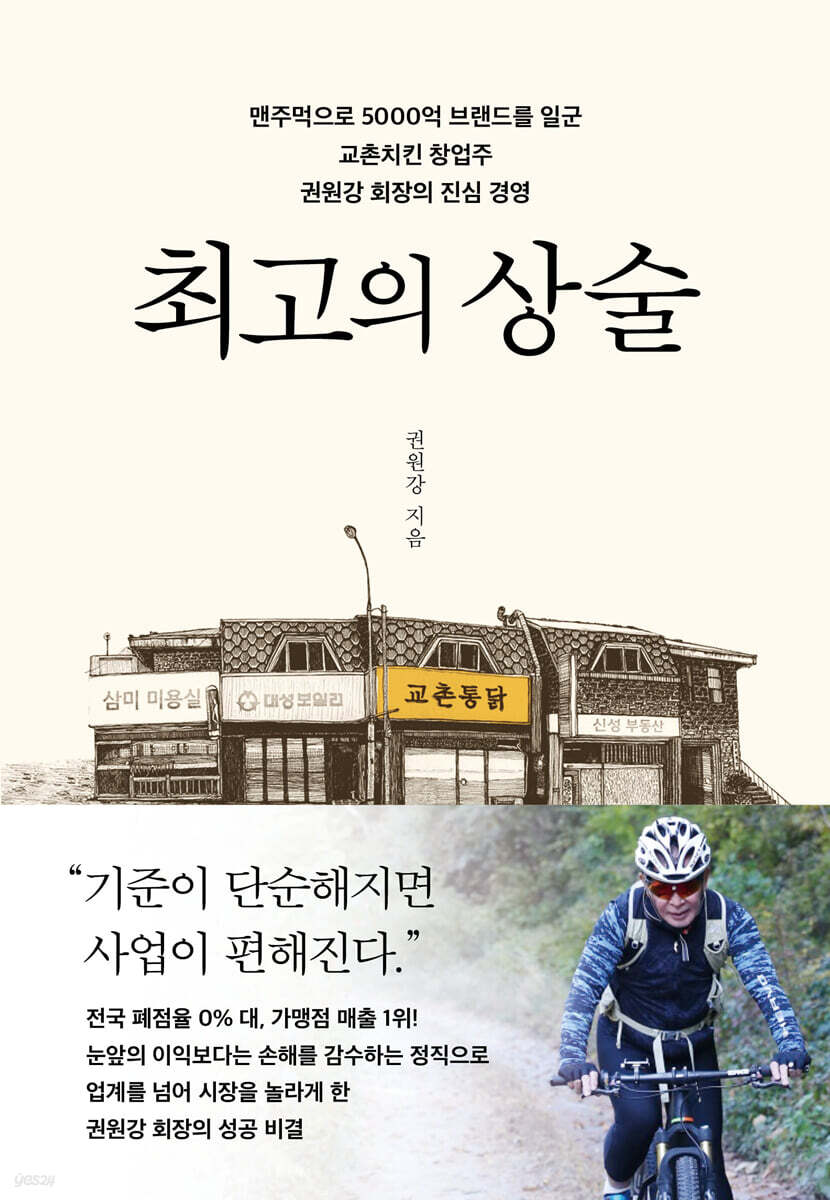
The best salesmanship
 |
Description
Book Introduction
“Business becomes easier when standards are simple!”
From the owner of a small fried chicken restaurant in Gumi to the birth of the national chicken brand, Kyochon…
Honesty that accepts loss rather than immediate profit
The secret to Chairman Kwon Won-kang's success that surprised the market beyond the industry!
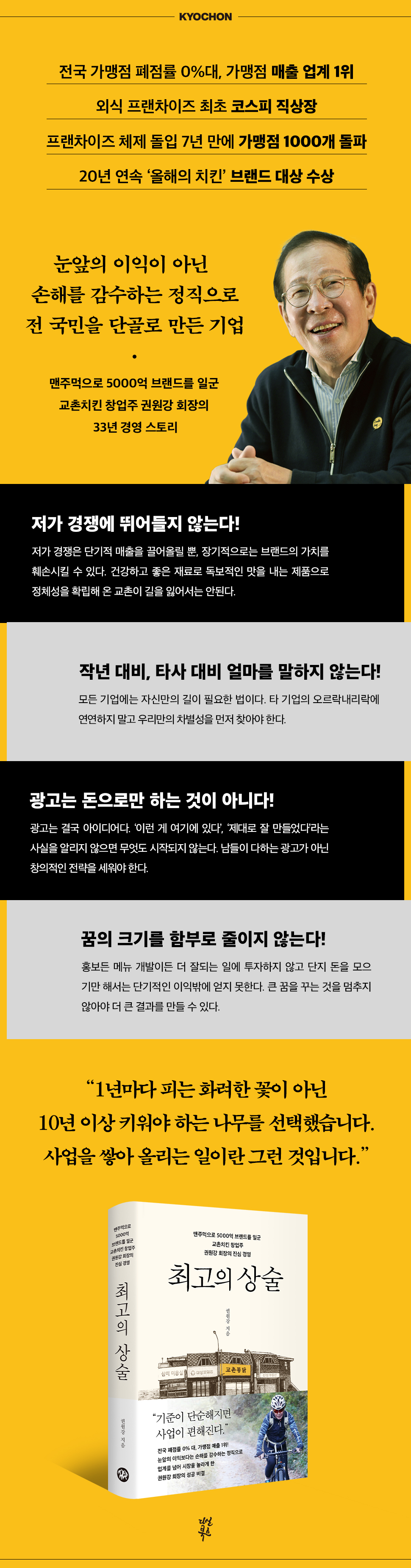
The restaurant franchise with the lowest store closure rate in Korea, the brand with the highest franchise sales, the first company in the franchise industry to be directly listed on the KOSPI, a national favorite that no one has tried at least once… This is the story of Kyochon Chicken, the originator of soy sauce chicken and the legend of the honey combo.
This book contains the secrets of Kyochon's success, first revealed by Chairman Kwon Won-kang, the founder of Kyochon Chicken.
Just as everyone dreams of opening a chicken restaurant after retirement, Chairman Kwon Won-gang also opened a small chicken restaurant in Gumi at the age of 40 without any skills or capital.
How did he, with such a reputation, create Korea's number one chicken brand? In this book, Chairman Kwon Won-kang unravels the countless management challenges he faced, fighting to uphold the principle of "honesty."
Thus, it proves that only when the business standards are accurately established can the purpose of management and the manager's philosophy be achieved.
From business to management, from a small 10-pyeong shop to a brand with over 1,400 franchises, Chairman Kwon Won-gang has endlessly expanded his dream. We hope you'll discover the "best salesmanship" in this book.
From the owner of a small fried chicken restaurant in Gumi to the birth of the national chicken brand, Kyochon…
Honesty that accepts loss rather than immediate profit
The secret to Chairman Kwon Won-kang's success that surprised the market beyond the industry!
The restaurant franchise with the lowest store closure rate in Korea, the brand with the highest franchise sales, the first company in the franchise industry to be directly listed on the KOSPI, a national favorite that no one has tried at least once… This is the story of Kyochon Chicken, the originator of soy sauce chicken and the legend of the honey combo.
This book contains the secrets of Kyochon's success, first revealed by Chairman Kwon Won-kang, the founder of Kyochon Chicken.
Just as everyone dreams of opening a chicken restaurant after retirement, Chairman Kwon Won-gang also opened a small chicken restaurant in Gumi at the age of 40 without any skills or capital.
How did he, with such a reputation, create Korea's number one chicken brand? In this book, Chairman Kwon Won-kang unravels the countless management challenges he faced, fighting to uphold the principle of "honesty."
Thus, it proves that only when the business standards are accurately established can the purpose of management and the manager's philosophy be achieved.
From business to management, from a small 10-pyeong shop to a brand with over 1,400 franchises, Chairman Kwon Won-gang has endlessly expanded his dream. We hope you'll discover the "best salesmanship" in this book.
- You can preview some of the book's contents.
Preview
index
Preface: Maintaining the Status Quo Is Not Enough
Chapter 1: Don't Give Up Easily
01 Age doesn't matter when it comes to changing your life.
02 Don't stop until you find a way to live.
03 Nothing changes if you don't take action.
04 Wait quietly for the right time
05 I won't sell anything that doesn't meet my standards.
Chapter 2: No Compromise
01 The best salesmanship is honesty.
02 Don't work with people who aren't passionate about what they do.
03 If you are not satisfied with the performance, start over from the beginning.
04 Do not arbitrarily reduce the size of your dreams.
05 If the seller is comfortable, the eater is uncomfortable.
06 In the food business, ingredients are everything.
07 Do not enter the low-price competition
08 Don't forget that there are things more important than money.
09 Don't ignore reality
Chapter 3: Beyond Common Sense
01 Advertising isn't just about money.
02 Customers are not numbers
03 If you take only one step when you should take two, you will retreat.
04 Packaging is a silent seller
05 Don't set a goal end point
06 Sit down and sell
07 Failures accumulate to become success.
08 When it comes to betting, bet even if it means taking a loss.
09 It doesn't say how much compared to last year or how much compared to other companies.
Chapter 4: No tricks
01 Don't try to live well alone.
02 If you help me, I'll forget it
03 If you don't settle, you'll fail.
04 Don't act like the chairman
05 Going slow is going fast
06 Don't be fooled into thinking you accomplished it alone.
07 Learn from those who are lower than you.
08 Don't look up at the summit until you've climbed it all the way.
Conclusion: Sincerity moves the world.
Chapter 1: Don't Give Up Easily
01 Age doesn't matter when it comes to changing your life.
02 Don't stop until you find a way to live.
03 Nothing changes if you don't take action.
04 Wait quietly for the right time
05 I won't sell anything that doesn't meet my standards.
Chapter 2: No Compromise
01 The best salesmanship is honesty.
02 Don't work with people who aren't passionate about what they do.
03 If you are not satisfied with the performance, start over from the beginning.
04 Do not arbitrarily reduce the size of your dreams.
05 If the seller is comfortable, the eater is uncomfortable.
06 In the food business, ingredients are everything.
07 Do not enter the low-price competition
08 Don't forget that there are things more important than money.
09 Don't ignore reality
Chapter 3: Beyond Common Sense
01 Advertising isn't just about money.
02 Customers are not numbers
03 If you take only one step when you should take two, you will retreat.
04 Packaging is a silent seller
05 Don't set a goal end point
06 Sit down and sell
07 Failures accumulate to become success.
08 When it comes to betting, bet even if it means taking a loss.
09 It doesn't say how much compared to last year or how much compared to other companies.
Chapter 4: No tricks
01 Don't try to live well alone.
02 If you help me, I'll forget it
03 If you don't settle, you'll fail.
04 Don't act like the chairman
05 Going slow is going fast
06 Don't be fooled into thinking you accomplished it alone.
07 Learn from those who are lower than you.
08 Don't look up at the summit until you've climbed it all the way.
Conclusion: Sincerity moves the world.
Detailed image
Into the book
My standard was just one thing.
I wanted to make chicken that would make me exclaim, “This is really delicious!” even when I tried it.
I worked day and night with the idea of making delicious chicken that would satisfy anyone who ate it.
It would not be an exaggeration to say that he was 'crazy about chicken'.
If there was ever a time when I put my all into something, it would definitely be this time.
The menu developed in this way was Kyochon Original, the soy sauce chicken that has become Kyochon's signature dish today.
--- p.49, from “Chapter 1: Don’t Give Up Carelessly”
“Kyochon is expensive, but I never regret eating there.” This sounded like the biggest compliment to me.
It wasn't the high price that was the problem, but rather the satisfaction that I felt for the price that was what I wanted.
Low price brings customers in, but value keeps them there.
Entering the low-price race may attract more customers in the short term.
But what drives those customers to return? It comes from value, not price.
--- p.122, from Chapter 2, “No Compromise”
So, if you can't advertise due to lack of funds, how can you change this frustrating situation? First, you need to view constraints as opportunities for creativity.
If you think about the concept of advertising differently, you will see parts of it that were previously invisible.
Advertising, in my opinion, is not simply giving a lot of money and asking someone to “make something I made look cool and make it known as widely as possible.”
Because I believe that even in situations where resources are limited, if you find creative ways to spread the word, you can do so.
--- p.147, from Chapter 3, “Beyond Common Sense”
We often perceive failure as a state of being 'lost'.
But failure is not losing your way, it is the process of finding your true path.
If I had mistakenly thought that the chicken I made was delicious after seeing customers who were just enjoying the moderate taste, I might not have done so many experiments later.
As I later learned, failure wasn't a sign that I was on the wrong path, but rather an opportunity to make better choices.
It was a valuable lesson that taught me the direction I should take.
I've failed so many times that I've been able to push myself to find a better way.
Just as success is not a one-time thing, neither is failure a one-time thing.
As long as you live, as long as you do business, you will continue to experience failure.
But you will become more humble and learn something new each time.
--- p.196, from “Chapter 3: Not Believing in Common Sense”
“Don’t you get angry when you see people making it easy to do something that was difficult?” someone asked.
But I guess it's good to follow along, so I'll do it.
If it's not good and it's harmful, there's no way to follow it.
I think it is meaningful that if we take a step forward like this, those who follow will see our steps and come safely.
But sometimes you take big steps that are too big to keep up with.
I wanted to make chicken that would make me exclaim, “This is really delicious!” even when I tried it.
I worked day and night with the idea of making delicious chicken that would satisfy anyone who ate it.
It would not be an exaggeration to say that he was 'crazy about chicken'.
If there was ever a time when I put my all into something, it would definitely be this time.
The menu developed in this way was Kyochon Original, the soy sauce chicken that has become Kyochon's signature dish today.
--- p.49, from “Chapter 1: Don’t Give Up Carelessly”
“Kyochon is expensive, but I never regret eating there.” This sounded like the biggest compliment to me.
It wasn't the high price that was the problem, but rather the satisfaction that I felt for the price that was what I wanted.
Low price brings customers in, but value keeps them there.
Entering the low-price race may attract more customers in the short term.
But what drives those customers to return? It comes from value, not price.
--- p.122, from Chapter 2, “No Compromise”
So, if you can't advertise due to lack of funds, how can you change this frustrating situation? First, you need to view constraints as opportunities for creativity.
If you think about the concept of advertising differently, you will see parts of it that were previously invisible.
Advertising, in my opinion, is not simply giving a lot of money and asking someone to “make something I made look cool and make it known as widely as possible.”
Because I believe that even in situations where resources are limited, if you find creative ways to spread the word, you can do so.
--- p.147, from Chapter 3, “Beyond Common Sense”
We often perceive failure as a state of being 'lost'.
But failure is not losing your way, it is the process of finding your true path.
If I had mistakenly thought that the chicken I made was delicious after seeing customers who were just enjoying the moderate taste, I might not have done so many experiments later.
As I later learned, failure wasn't a sign that I was on the wrong path, but rather an opportunity to make better choices.
It was a valuable lesson that taught me the direction I should take.
I've failed so many times that I've been able to push myself to find a better way.
Just as success is not a one-time thing, neither is failure a one-time thing.
As long as you live, as long as you do business, you will continue to experience failure.
But you will become more humble and learn something new each time.
--- p.196, from “Chapter 3: Not Believing in Common Sense”
“Don’t you get angry when you see people making it easy to do something that was difficult?” someone asked.
But I guess it's good to follow along, so I'll do it.
If it's not good and it's harmful, there's no way to follow it.
I think it is meaningful that if we take a step forward like this, those who follow will see our steps and come safely.
But sometimes you take big steps that are too big to keep up with.
--- p.245, from “Chapter 4: No Tricks”
Publisher's Review
“Don’t reduce the size of your dreams arbitrarily!”
In an era of stagnant growth, what's needed is not compromise, but challenge.
From a small neighborhood store of about 10 pyeong (approximately 33 square meters) called 'Kyochon Tongdak' to a national brand of Korea called 'Kyochon Chicken', Chairman Kwon Won-gang has overcome countless ups and downs in the market with his uncompromising tenacity.
Even when not a single chicken was sold in a day, Chairman Kwon Won-gang never gave up on his beliefs and values.
Even if it meant giving up his salary, he invested even small profits in bold marketing, and he adhered to a meticulous recipe that included applying sauce hundreds of times with a brush to ensure that the chicken would be delicious no matter who ate it or when.
Despite market criticism and concerns that the company does not know how to lower costs, it has insisted on using only expensive, high-quality oil and 100% domestically produced ingredients.
Because I firmly believed that small efforts to go one step further and small investments for tomorrow would ultimately produce completely different results.
“Low price brings customers in, but value keeps them there.
Entering the low-price race may attract more customers in the short term.
But what keeps those customers coming back isn't price, it's value."
Despite the record-breaking business performance of No. 1 in franchise sales and a 0% store closure rate, Chairman Kwon Won-gang's mindset has not changed since he first opened Kyochon Tongdak.
His thought was that 'maintaining the status quo is not enough.'
Whenever I thought, "Isn't this enough?" in the face of Kyochon's dazzling success, I steeled myself and thought about tomorrow.
He says true growth comes when we take risks instead of playing it safe, and when we challenge ourselves instead of compromising.
And even in this era of stagnant growth, his management philosophy remains unchanged.
Maintaining a certain level, not succumbing to circumstances, and walking by the values of honesty.
This is the essence of the management philosophy that Chairman Kwon Won-gang wants to convey.
“Business becomes easier when standards are simplified.”
Only 'honesty' is the best salesmanship.
“Some people say that it is difficult to maintain the single principle of honesty, but it is actually easier when the standards are simple.
Because you don't have to worry about anything else and just focus on that.
It's much more concise than having ten or twenty criteria.
There is no need to worry about priorities as to what to protect first.
In that sense, honesty is not just a strategy I can choose, but the essence and foundation of what I do.”
When doing business, you need standards to remain unshaken even in the worst of situations.
If you decide based on your standards, you won't regret it later, and even if you suffer a loss, it will only be for that moment.
Chairman Kwon Won-gang has set the standard for business as 'honesty' and has maintained it to the end, no matter what the circumstances.
Whenever faced with the demands of a rapidly changing market, the pressures of competition, or the temptation to make short-term profits, he first reached for his compass of honesty.
It was the same when he decided to dispose of 1 billion won worth of chickens because the quality of the chickens he had hastily contracted due to avian influenza was poor, and when he gave up 8 billion won in profits and abandoned plans to expand to 400 franchise stores after seeing franchise owners anxious due to worsening market conditions.
We first thought about how to maintain trust with customers and how to keep our promises to franchisees.
Because of these standards, Chairman Kwon Won-gang does not discuss performance solely in numbers.
Be wary of exaggerating your worries by talking about how much it is compared to last year or how much it is compared to other companies.
Instead, let's first look at what we're aiming for and how far we've come.
First, we need to examine what direction is in line with the values that Kyochon pursues.
To those who prefer to talk about corporate growth indicators only in numbers, Chairman Kwon Won-kang says this.
“If you walk the path with sincerity, good results will follow naturally.
It may seem like a common and obvious statement, but the true value of a company is revealed in how well it can be put into practice.
Also, when the standards are simplified, business becomes more convenient.
If you uphold the value of 'honesty', other problems will be solved on their own.
“If you are honest, your food will taste good, you will sleep well, and you will have confidence in yourself, so you will not have to fear anything.”
A company with upright values is not easily shaken by any crisis.
We can see from Chairman Kwon Won-kang's actions that we must establish a clear management philosophy before worrying about the immediate crisis and being swayed by immediate profits.
In these times, when it's difficult to predict the end of the recession, this book will help you understand what mindset you should have as a manager and how you should view and manage your business.
In an era of stagnant growth, what's needed is not compromise, but challenge.
From a small neighborhood store of about 10 pyeong (approximately 33 square meters) called 'Kyochon Tongdak' to a national brand of Korea called 'Kyochon Chicken', Chairman Kwon Won-gang has overcome countless ups and downs in the market with his uncompromising tenacity.
Even when not a single chicken was sold in a day, Chairman Kwon Won-gang never gave up on his beliefs and values.
Even if it meant giving up his salary, he invested even small profits in bold marketing, and he adhered to a meticulous recipe that included applying sauce hundreds of times with a brush to ensure that the chicken would be delicious no matter who ate it or when.
Despite market criticism and concerns that the company does not know how to lower costs, it has insisted on using only expensive, high-quality oil and 100% domestically produced ingredients.
Because I firmly believed that small efforts to go one step further and small investments for tomorrow would ultimately produce completely different results.
“Low price brings customers in, but value keeps them there.
Entering the low-price race may attract more customers in the short term.
But what keeps those customers coming back isn't price, it's value."
Despite the record-breaking business performance of No. 1 in franchise sales and a 0% store closure rate, Chairman Kwon Won-gang's mindset has not changed since he first opened Kyochon Tongdak.
His thought was that 'maintaining the status quo is not enough.'
Whenever I thought, "Isn't this enough?" in the face of Kyochon's dazzling success, I steeled myself and thought about tomorrow.
He says true growth comes when we take risks instead of playing it safe, and when we challenge ourselves instead of compromising.
And even in this era of stagnant growth, his management philosophy remains unchanged.
Maintaining a certain level, not succumbing to circumstances, and walking by the values of honesty.
This is the essence of the management philosophy that Chairman Kwon Won-gang wants to convey.
“Business becomes easier when standards are simplified.”
Only 'honesty' is the best salesmanship.
“Some people say that it is difficult to maintain the single principle of honesty, but it is actually easier when the standards are simple.
Because you don't have to worry about anything else and just focus on that.
It's much more concise than having ten or twenty criteria.
There is no need to worry about priorities as to what to protect first.
In that sense, honesty is not just a strategy I can choose, but the essence and foundation of what I do.”
When doing business, you need standards to remain unshaken even in the worst of situations.
If you decide based on your standards, you won't regret it later, and even if you suffer a loss, it will only be for that moment.
Chairman Kwon Won-gang has set the standard for business as 'honesty' and has maintained it to the end, no matter what the circumstances.
Whenever faced with the demands of a rapidly changing market, the pressures of competition, or the temptation to make short-term profits, he first reached for his compass of honesty.
It was the same when he decided to dispose of 1 billion won worth of chickens because the quality of the chickens he had hastily contracted due to avian influenza was poor, and when he gave up 8 billion won in profits and abandoned plans to expand to 400 franchise stores after seeing franchise owners anxious due to worsening market conditions.
We first thought about how to maintain trust with customers and how to keep our promises to franchisees.
Because of these standards, Chairman Kwon Won-gang does not discuss performance solely in numbers.
Be wary of exaggerating your worries by talking about how much it is compared to last year or how much it is compared to other companies.
Instead, let's first look at what we're aiming for and how far we've come.
First, we need to examine what direction is in line with the values that Kyochon pursues.
To those who prefer to talk about corporate growth indicators only in numbers, Chairman Kwon Won-kang says this.
“If you walk the path with sincerity, good results will follow naturally.
It may seem like a common and obvious statement, but the true value of a company is revealed in how well it can be put into practice.
Also, when the standards are simplified, business becomes more convenient.
If you uphold the value of 'honesty', other problems will be solved on their own.
“If you are honest, your food will taste good, you will sleep well, and you will have confidence in yourself, so you will not have to fear anything.”
A company with upright values is not easily shaken by any crisis.
We can see from Chairman Kwon Won-kang's actions that we must establish a clear management philosophy before worrying about the immediate crisis and being swayed by immediate profits.
In these times, when it's difficult to predict the end of the recession, this book will help you understand what mindset you should have as a manager and how you should view and manage your business.
GOODS SPECIFICS
- Date of issue: March 3, 2025
- Format: Hardcover book binding method guide
- Page count, weight, size: 296 pages | 128*188*20mm
- ISBN13: 9791130661766
- ISBN10: 1130661768
You may also like
카테고리
korean


korean

![GQ KOREA Mark (Monthly): December [2025]](http://librairie.coreenne.fr/cdn/shop/files/8ef265dbbfbf186523ed75ba7319009d.jpg?v=1765340328&width=3840)


