

Designers of the Tipping Point
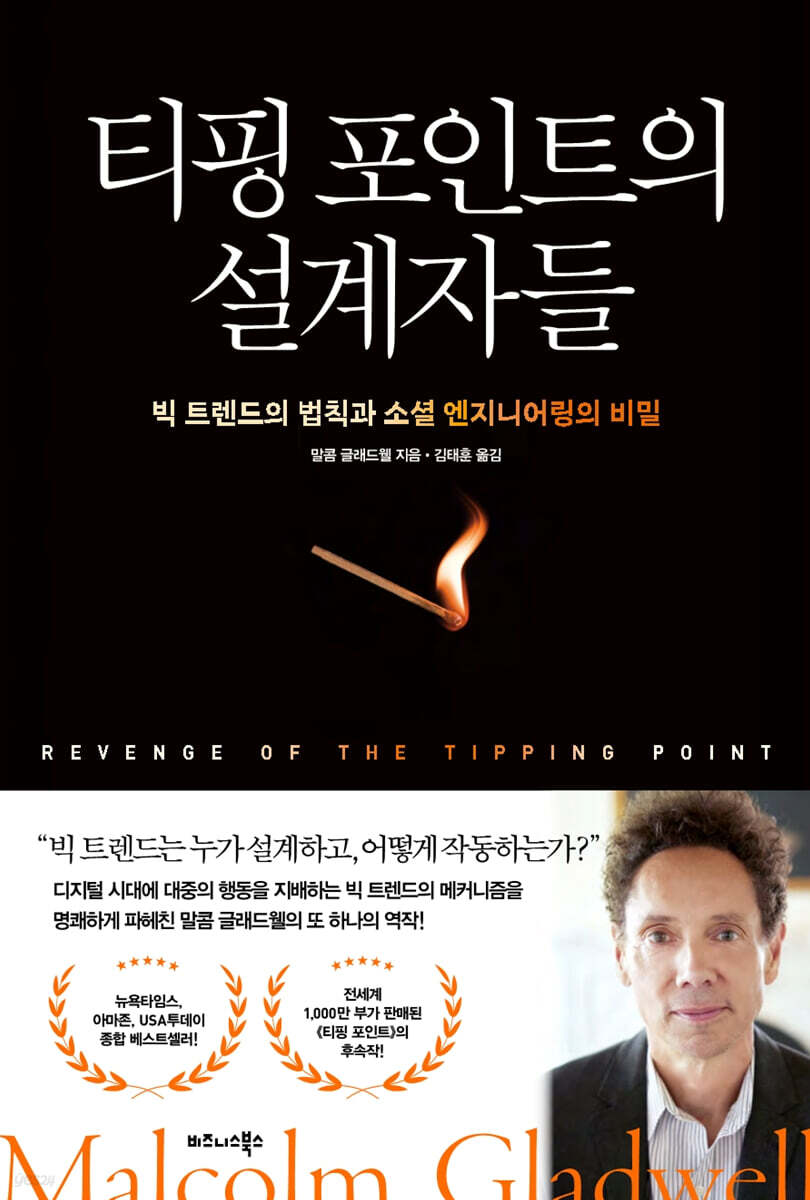 |
Description
Book Introduction
- A word from MD
-
Who designs big trends?A new book by world-renowned journalist Malcolm Gladwell.
He delves into the transformation into the digital age, which was not covered in his first book, The Tipping Point, the laws of the newly discovered big trends within it, and the activities of the social engineers who designed the point where the tipping point occurred.
The secrets of trend designers who control public behavior.
March 4, 2025. Economics and Management PD Oh Da-eun
An instant New York Times, USA Today, and Amazon bestseller!
A masterpiece that delves into the mechanisms of big trends in a changing world!
Malcolm Gladwell's first book, The Tipping Point, published in 2000, was a remarkable study of the point at which a word, action, idea, or product explodes into a viral phenomenon.
The Tipping Point became a huge hit, just like the subject it covers.
It has been on the New York Times bestseller list for several years, and former President Bill Clinton called The Tipping Point “the book everyone’s talking about.”
'The Tipping Point' has become a household term and a business management bible with over 10 million copies sold worldwide.
One day, as COVID-19 swept the world, Malcolm Gladwell reread The Tipping Point, which he had not been able to read for 25 years due to his busy schedule.
The world has changed, and so has his thinking.
Malcolm Gladwell decided to explore the topic of social pandemics in a new way, fitting for the current moment.
He began writing this book after discovering the newly formed laws of pandemics in the changing digital age.
In his first book, The Tipping Point, which was a global bestseller 25 years ago, he presented rules that explained the inner workings of social contagion, such as the "law of the few," the "power of circumstances," and the "stickiness factor," and argued that these could be used to promote positive changes such as reducing crime rates, teaching children to read, and curbing smoking.
In this book, "Designers of the Tipping Point," the authors present the "overstory" (a community value that governs people's behavior), "superspreaders" (spreaders with powerful influence), and "magic thirds" (the rate at which the entire group's culture or mindset changes) as new laws for trend creation.
Moreover, it was discovered that there are 'social engineers' who meticulously design and execute the process by which tipping points occur.
The author's newly discovered laws of big trends in the digital age, and the secret activities of "social engineers" who have meticulously designed the tipping points that have been invisible to us until now and have changed the world, will thrill readers.
A masterpiece that delves into the mechanisms of big trends in a changing world!
Malcolm Gladwell's first book, The Tipping Point, published in 2000, was a remarkable study of the point at which a word, action, idea, or product explodes into a viral phenomenon.
The Tipping Point became a huge hit, just like the subject it covers.
It has been on the New York Times bestseller list for several years, and former President Bill Clinton called The Tipping Point “the book everyone’s talking about.”
'The Tipping Point' has become a household term and a business management bible with over 10 million copies sold worldwide.
One day, as COVID-19 swept the world, Malcolm Gladwell reread The Tipping Point, which he had not been able to read for 25 years due to his busy schedule.
The world has changed, and so has his thinking.
Malcolm Gladwell decided to explore the topic of social pandemics in a new way, fitting for the current moment.
He began writing this book after discovering the newly formed laws of pandemics in the changing digital age.
In his first book, The Tipping Point, which was a global bestseller 25 years ago, he presented rules that explained the inner workings of social contagion, such as the "law of the few," the "power of circumstances," and the "stickiness factor," and argued that these could be used to promote positive changes such as reducing crime rates, teaching children to read, and curbing smoking.
In this book, "Designers of the Tipping Point," the authors present the "overstory" (a community value that governs people's behavior), "superspreaders" (spreaders with powerful influence), and "magic thirds" (the rate at which the entire group's culture or mindset changes) as new laws for trend creation.
Moreover, it was discovered that there are 'social engineers' who meticulously design and execute the process by which tipping points occur.
The author's newly discovered laws of big trends in the digital age, and the secret activities of "social engineers" who have meticulously designed the tipping points that have been invisible to us until now and have changed the world, will thrill readers.
- You can preview some of the book's contents.
Preview
index
Author's Note: Why I Rewrote My First Book on a Blank Sheet of Paper
Header_ When the Tipping Point Hits the Back of Our Heads
Part 1: Three Riddles
Chapter 1: Casper and C-Dog
Man in a Yankee hat
How LA Became the Bank Robbery Capital of the World
From Yankee to Casper: The Evolution of the Bank Robbery Business
Same crime, different place, different outcome
Why Doctors' Dispositions Differ by Region
Why Waldorf students aren't vaccinated
Chapter 2: The Miami Problem
Tears of a Fraudster
What Miami has but Chicago doesn't
Waldorf School and Buffalo
What Happened to the Chief Cardiologist
Why Medicare Has Become a Fraudster's Playground
1980 changed everything
A suspicious office building with different interiors and exteriors
A collaboration between a doctor and a conman who just rolls his pen
Chapter 3 Poplar Grove
The Secret of a Seemingly Perfect Neighborhood
community consciousness or community pressure
Decline in cheetah populations and monoculture
A tragedy created by a place that cannot be different
Mass deaths that started with just two birds
Why did those who seemed perfect take their own lives?
Who is responsible for driving them to their deaths?
Part 2 Social Engineers
Chapter 4: Magic Third
A street with rules
White exodus
Why weren't the only women recognized?
'One-third' magic
Magic exists somewhere between a quarter and a third.
The Dilemma of Artificial Adjustment and Reverse Discrimination
Chapter 5: The Mystery of the Harvard Women's Rugby Team
Why Harvard Created a Women's Rugby Team
A place where only 'selected' students can enter
What's really special about a truly great tennis player?
Is the 'equal opportunity' they talk about really equal?
Chapter 6: Mr. Index and the Marriott Mass Infection
Workshop of Fear
One person who infected 300,000 people
When the law of the minority works as 'the minority's fault'
How people around the world began wearing masks
Epidemics operate according to the laws of the few.
What Happens When You Identify a Superspreader
That day, at that time, there was Mr. Index.
Part 3: The Overstory
Chapter 7: LA Survivors' Meeting
The Birth of the Martyrs' Memorial Museum
An incident that no one spoke of and no one knew about
The miniseries that changed everything
How powerful are shared experiences?
People I couldn't bring myself to say
It doesn't take a lot of people to change the overstory.
Holocaust becomes a proper noun
Chapter 8 Prison Life at Maple Drive
Revolution comes when no one expects it.
Why didn't they see the victory right in front of them?
Three Rules of the 'Gay Narrative'
Breaking the rules of overstory
Dramatic changes brought about by the weight of time
Part 4 Conclusion
Chapter 9: Overstories, Superspreaders, and Population Ratios
The emergence of the painkiller OxyContin
Why the US Was So Vulnerable to Opioids
An overstory created by just two copies
A gift from nature or an addictive drug?
Why did they target states without triple-prescription regulations?
The 80/20 Rule Found in Prescription Counts
Worst decision ever made to change group ratios
Are we really not responsible for the epidemic?
Acknowledgements
annotation
Header_ When the Tipping Point Hits the Back of Our Heads
Part 1: Three Riddles
Chapter 1: Casper and C-Dog
Man in a Yankee hat
How LA Became the Bank Robbery Capital of the World
From Yankee to Casper: The Evolution of the Bank Robbery Business
Same crime, different place, different outcome
Why Doctors' Dispositions Differ by Region
Why Waldorf students aren't vaccinated
Chapter 2: The Miami Problem
Tears of a Fraudster
What Miami has but Chicago doesn't
Waldorf School and Buffalo
What Happened to the Chief Cardiologist
Why Medicare Has Become a Fraudster's Playground
1980 changed everything
A suspicious office building with different interiors and exteriors
A collaboration between a doctor and a conman who just rolls his pen
Chapter 3 Poplar Grove
The Secret of a Seemingly Perfect Neighborhood
community consciousness or community pressure
Decline in cheetah populations and monoculture
A tragedy created by a place that cannot be different
Mass deaths that started with just two birds
Why did those who seemed perfect take their own lives?
Who is responsible for driving them to their deaths?
Part 2 Social Engineers
Chapter 4: Magic Third
A street with rules
White exodus
Why weren't the only women recognized?
'One-third' magic
Magic exists somewhere between a quarter and a third.
The Dilemma of Artificial Adjustment and Reverse Discrimination
Chapter 5: The Mystery of the Harvard Women's Rugby Team
Why Harvard Created a Women's Rugby Team
A place where only 'selected' students can enter
What's really special about a truly great tennis player?
Is the 'equal opportunity' they talk about really equal?
Chapter 6: Mr. Index and the Marriott Mass Infection
Workshop of Fear
One person who infected 300,000 people
When the law of the minority works as 'the minority's fault'
How people around the world began wearing masks
Epidemics operate according to the laws of the few.
What Happens When You Identify a Superspreader
That day, at that time, there was Mr. Index.
Part 3: The Overstory
Chapter 7: LA Survivors' Meeting
The Birth of the Martyrs' Memorial Museum
An incident that no one spoke of and no one knew about
The miniseries that changed everything
How powerful are shared experiences?
People I couldn't bring myself to say
It doesn't take a lot of people to change the overstory.
Holocaust becomes a proper noun
Chapter 8 Prison Life at Maple Drive
Revolution comes when no one expects it.
Why didn't they see the victory right in front of them?
Three Rules of the 'Gay Narrative'
Breaking the rules of overstory
Dramatic changes brought about by the weight of time
Part 4 Conclusion
Chapter 9: Overstories, Superspreaders, and Population Ratios
The emergence of the painkiller OxyContin
Why the US Was So Vulnerable to Opioids
An overstory created by just two copies
A gift from nature or an addictive drug?
Why did they target states without triple-prescription regulations?
The 80/20 Rule Found in Prescription Counts
Worst decision ever made to change group ratios
Are we really not responsible for the epidemic?
Acknowledgements
annotation
Detailed image

Into the book
You know that feeling when you look at old photos of yourself? Whenever I do, I can't quite recognize the person in the photo.
So, on the 25th anniversary of its publication, I thought it would be interesting to revisit The Tipping Point and look at something written so long ago through very different eyes.
In the 25th Anniversary Revised Edition of The Tipping Point, one author will return to the scene of his first success as a young man.
But as I delved back into the world of social contagion, I realized I didn't want to return to the same problems I addressed in The Tipping Point.
The world seemed so different to me back then.
In The Tipping Point, I introduce a set of principles that help us understand the rapid shifts in behavior and beliefs that shape our world.
I still think those ideas are useful.
But now I have other questions.
--- From “Author’s Note_Why I Rewrote My First Book on a Blank Sheet of Paper”
Casper and C-Dog led 175 bank robberies.
Even focusing solely on the Yankee Robber, Casper, and the Nasty Boys gives a nearly complete picture of what was happening in LA in the 1980s and early 1990s.
It was an epidemic phenomenon that grew and peaked with the extraordinary actions of a few.
“In terms of pandemics, Casper was a ‘superspreader,’” Wiley said.
--- From "Chapter 1 Casper and C-Dog"
Communities have their own stories, and those stories are contagious.
Actually, the word 'story' is not very appropriate.
The word 'overstory' is better.
The overstory refers to the upper part of the trees that make up the forest.
The size, density, and height of the overstory influence the behavior and development of all species on much lower ground.
I think the essence of the subregional differences that make Waldorf schools different from other schools, or Boulder from Buffalo, is more about the overstory than the story.
It is not something explicit that is instilled in all residents.
The overstory consists of things that are high up and often exist outside our consciousness.
So we tend to forget the existence of overstory.
Because we are so immersed in the life that is going on before our eyes and around us.
But the overstory, when you get to know it, is really, really powerful.
--- From "Chapter 2: The Miami Problem"
So far, we have explored the concept that social contagion does not spread indiscriminately and uncontrollably.
Social contagion is tied to a specific location.
The case of Philippe Espomes and Miami also shows that the power of a place comes from the stories that its community tells to the people within it.
In this chapter, we will add a third question based on these two concepts.
If the overstory created by its residents influences the spread of the disease, then isn't that community, in a sense, responsible for the disease that afflicts them?
--- From Chapter 3, Poplar Grove
In the end, everyone came to a consensus.
In any group, when the proportion of outsiders, which was initially negligible, reached between one-quarter and one-third, dramatic changes occurred.
Let's call the maximum in this range the 'Magic Third'.
--- From "Chapter 4: Magic Third"
“We cast a wide net to find students who want to come to Harvard and who are a good fit for the team, both on and off the field,” Mel Denham, head coach of the Harvard women’s rugby team, told the Harvard Crimson several years ago.
The phrase 'casting the net wide' meant selecting players from all over the world.
(...) Coach Dunham said, “We have started to contact some British players as well.
We are also in the process of building relationships with directors in the UK, New Zealand and Australia.
Our team now includes players from Scotland, Canada, Hong Kong, Australia, China, Germany, and Honduras.
“It’s amazing how much diversity we can embrace in our team culture,” he said.
Why did Harvard go to such trouble?
--- From "Chapter 5: The Mystery of the Harvard Women's Rugby Team"
But if the virus is airborne, everything is explained.
All you have to do to spread COVID-19 is breathe and talk.
The man at the heart of the Biogen outbreak spoke in the Marriott's large, stuffy conference room.
“The louder you speak, the more aerosol particles are formed,” Listenpart and co-authors wrote.
A person severely infected with COVID-19 stood before an entire crowd and exhaled aerosol particles filled with the deadly virus for a full 40 minutes.
This explains the mass infection caused by superspreaders.
Or is there something that hasn't been explained yet?
If viruses could be transmitted simply by breathing and speaking in a confined space, why haven't countless incidents like the Marriott outbreak occurred? The reason we know about it is because it was a unique event.
Why was it unique?
--- From Chapter 6, Mr. Index and the Marriott Mass Infection Incident
Today, we refer to the massacre that occurred in Europe during World War II with a capital 'H': the 'Holocaust'.
This atrocity got its name.
This capital letter Holocaust is a roundabout translation of the Hebrew word 'shoah'.
(...) If you used the word 'Holocaust' in everyday conversation, no one would know what you meant.
Look at the following graph from The New Republic.
This graph shows how often "holocaust" with a lowercase "h" and "Holocaust" with a capital "H" have been used over the past 200 years.
The regular lowercase version only increases slightly at very small levels.
The uppercase version, on the other hand, was rarely used until the late 1960s.
Even in the late 1960s, it was at a minimal level.
But wait a minute.
Around 1978, something dramatic happened.
--- From "Chapter 7 LA Survivors' Meeting"
Will & Grace was actually quite subversive.
Why is that? Because it breaks every single rule of overstory proposed by Dow.
Is the gay character central to the story? Yes.
The story doesn't make sense without Will and Jack.
Doesn't homosexuality seem like a problem that needs to be solved? Yes.
This is essentially the message of Will & Grace.
“Look at Will here.
He's a fun, likable, and successful person.
He can love and be loved.
What speaks volumes about his character are the strong relationships he has with those around him.
He is an ordinary person.
“It’s just that my sexual orientation is gay.”
--- From "Chapter 8 Prison Life in Maple Drive"
Prescription forms must be printed on special paper, each form must show the serial number of the prescription bundle, and each form must be serially numbered.
Additionally, each prescription form must be printed in triplicate.
One of them should be easy to remove, and two should have perforated cut lines.
The key word here was 'three-layer'.
Every page of the special prescription had two copies attached to it.
The copy at the bottom was to be kept by the prescribing physician for at least two years.
The second copy was for the pharmacy's records.
The final copy had to be sent directly to the Drug Enforcement Administration by the end of the month.
So, on the 25th anniversary of its publication, I thought it would be interesting to revisit The Tipping Point and look at something written so long ago through very different eyes.
In the 25th Anniversary Revised Edition of The Tipping Point, one author will return to the scene of his first success as a young man.
But as I delved back into the world of social contagion, I realized I didn't want to return to the same problems I addressed in The Tipping Point.
The world seemed so different to me back then.
In The Tipping Point, I introduce a set of principles that help us understand the rapid shifts in behavior and beliefs that shape our world.
I still think those ideas are useful.
But now I have other questions.
--- From “Author’s Note_Why I Rewrote My First Book on a Blank Sheet of Paper”
Casper and C-Dog led 175 bank robberies.
Even focusing solely on the Yankee Robber, Casper, and the Nasty Boys gives a nearly complete picture of what was happening in LA in the 1980s and early 1990s.
It was an epidemic phenomenon that grew and peaked with the extraordinary actions of a few.
“In terms of pandemics, Casper was a ‘superspreader,’” Wiley said.
--- From "Chapter 1 Casper and C-Dog"
Communities have their own stories, and those stories are contagious.
Actually, the word 'story' is not very appropriate.
The word 'overstory' is better.
The overstory refers to the upper part of the trees that make up the forest.
The size, density, and height of the overstory influence the behavior and development of all species on much lower ground.
I think the essence of the subregional differences that make Waldorf schools different from other schools, or Boulder from Buffalo, is more about the overstory than the story.
It is not something explicit that is instilled in all residents.
The overstory consists of things that are high up and often exist outside our consciousness.
So we tend to forget the existence of overstory.
Because we are so immersed in the life that is going on before our eyes and around us.
But the overstory, when you get to know it, is really, really powerful.
--- From "Chapter 2: The Miami Problem"
So far, we have explored the concept that social contagion does not spread indiscriminately and uncontrollably.
Social contagion is tied to a specific location.
The case of Philippe Espomes and Miami also shows that the power of a place comes from the stories that its community tells to the people within it.
In this chapter, we will add a third question based on these two concepts.
If the overstory created by its residents influences the spread of the disease, then isn't that community, in a sense, responsible for the disease that afflicts them?
--- From Chapter 3, Poplar Grove
In the end, everyone came to a consensus.
In any group, when the proportion of outsiders, which was initially negligible, reached between one-quarter and one-third, dramatic changes occurred.
Let's call the maximum in this range the 'Magic Third'.
--- From "Chapter 4: Magic Third"
“We cast a wide net to find students who want to come to Harvard and who are a good fit for the team, both on and off the field,” Mel Denham, head coach of the Harvard women’s rugby team, told the Harvard Crimson several years ago.
The phrase 'casting the net wide' meant selecting players from all over the world.
(...) Coach Dunham said, “We have started to contact some British players as well.
We are also in the process of building relationships with directors in the UK, New Zealand and Australia.
Our team now includes players from Scotland, Canada, Hong Kong, Australia, China, Germany, and Honduras.
“It’s amazing how much diversity we can embrace in our team culture,” he said.
Why did Harvard go to such trouble?
--- From "Chapter 5: The Mystery of the Harvard Women's Rugby Team"
But if the virus is airborne, everything is explained.
All you have to do to spread COVID-19 is breathe and talk.
The man at the heart of the Biogen outbreak spoke in the Marriott's large, stuffy conference room.
“The louder you speak, the more aerosol particles are formed,” Listenpart and co-authors wrote.
A person severely infected with COVID-19 stood before an entire crowd and exhaled aerosol particles filled with the deadly virus for a full 40 minutes.
This explains the mass infection caused by superspreaders.
Or is there something that hasn't been explained yet?
If viruses could be transmitted simply by breathing and speaking in a confined space, why haven't countless incidents like the Marriott outbreak occurred? The reason we know about it is because it was a unique event.
Why was it unique?
--- From Chapter 6, Mr. Index and the Marriott Mass Infection Incident
Today, we refer to the massacre that occurred in Europe during World War II with a capital 'H': the 'Holocaust'.
This atrocity got its name.
This capital letter Holocaust is a roundabout translation of the Hebrew word 'shoah'.
(...) If you used the word 'Holocaust' in everyday conversation, no one would know what you meant.
Look at the following graph from The New Republic.
This graph shows how often "holocaust" with a lowercase "h" and "Holocaust" with a capital "H" have been used over the past 200 years.
The regular lowercase version only increases slightly at very small levels.
The uppercase version, on the other hand, was rarely used until the late 1960s.
Even in the late 1960s, it was at a minimal level.
But wait a minute.
Around 1978, something dramatic happened.
--- From "Chapter 7 LA Survivors' Meeting"
Will & Grace was actually quite subversive.
Why is that? Because it breaks every single rule of overstory proposed by Dow.
Is the gay character central to the story? Yes.
The story doesn't make sense without Will and Jack.
Doesn't homosexuality seem like a problem that needs to be solved? Yes.
This is essentially the message of Will & Grace.
“Look at Will here.
He's a fun, likable, and successful person.
He can love and be loved.
What speaks volumes about his character are the strong relationships he has with those around him.
He is an ordinary person.
“It’s just that my sexual orientation is gay.”
--- From "Chapter 8 Prison Life in Maple Drive"
Prescription forms must be printed on special paper, each form must show the serial number of the prescription bundle, and each form must be serially numbered.
Additionally, each prescription form must be printed in triplicate.
One of them should be easy to remove, and two should have perforated cut lines.
The key word here was 'three-layer'.
Every page of the special prescription had two copies attached to it.
The copy at the bottom was to be kept by the prescribing physician for at least two years.
The second copy was for the pharmacy's records.
The final copy had to be sent directly to the Drug Enforcement Administration by the end of the month.
--- From Chapter 9, "Overstories, Superspreaders, and Population Ratios"
Publisher's Review
Who designs big trends and how do they work?
Uncover the secrets of the trend designers who control public behavior!
When Malcolm Gladwell wrote The Tipping Point 25 years ago, he was fascinated by the idea that small things could make a big difference in social contagion.
Malcolm Gladwell said, “Look at the world around you.
It seems like a place that cannot be moved or changed.
No, it isn't.
“If you push (the exact point) a little bit, you can get past it,” he said.
If the world could be moved by a simple push, then those who knew where and when to push would have true power.
In "The Tipping Point Architects," Malcolm Gladwell reveals who the real power holders are and what technologies they use.
Just as the legal profession uses forensics to investigate the causes and processes of criminal acts, Malcolm Gladwell examines the moments when designers explode social contagion in this book.
Gladwell's sharp insights uncover the secrets of the designers who create trends that dominate public behavior.
We analyze examples of social engineering at work from a new perspective today, such as how Paul Madden's three-layer prescription form saved a nation from drug addiction, how a 1970s television miniseries changed the world's perception of the Holocaust, and how same-sex marriage became accepted.
Meanwhile, the case of Harvard University creating a women's rugby team despite difficult conditions provides a glimpse into the social engineering that goes on behind the scenes to maintain a certain racial ratio.
Gladwell has already exposed how social engineering has become one of the covert core activities of the social establishment.
The original title of this book is 'Revenge of the Tipping Point'.
The reason I use the word 'revenge' is to warn that there may be 'designers' working covertly to harm us.
The emergence of the designer is a double-edged sword.
It provides hints on how to leverage social contagion for good, as the outcomes and impacts can vary significantly depending on one's intentions.
'Overstory,' 'Superspreader,' and 'Magic Third:' Three Laws of the New Big Trend!
Flipping the frame for understanding 21st century trends!
The laws of explosive trends that Malcolm Gladwell revealed in "The Tipping Point" were the "law of the few," the "power of context," and the "stickiness factor."
In this new book, Malcolm Gladwell adds three laws with new insights into a world that has changed over the past 25 years.
The first law of the new big trend is 'overstory'.
Gladwell found that doctors choose different treatments depending on the region.
So what happens if a cardiologist moves from area A to area B? He becomes a doctor with a B-based background.
A cardiologist who changed locations moves to a medical practice in a new city.
This is an environmental influence, as each community has its own unique story, and these stories are highly contagious.
Gladwell actually says that the word 'story' is not very appropriate.
He says that the word 'overstory' is better.
The overstory refers to the upper part of the trees that make up the forest.
The size, density, and height of the overstory influence the behavior and development of all species on much lower ground.
The same goes for society.
Overstories often exist outside our consciousness, yet they exert a powerful influence.
The second big trend law is 'superspreaders.'
When LA became the crime capital of the world in the early 1990s with an explosion of bank robberies, other cities didn't experience the same wave of bank robberies.
Around the same time, carjackings also increased at an alarming rate in LA, which the media took as another isolated sign that indiscriminate crime was sweeping the streets.
However, many of them were actually the work of a gang called Casper and C-Dog.
What happened in Los Angeles in the 1980s and early 1990s was actually an epidemic that grew and peaked with the extraordinary actions of a few.
The gang called Casper was a 'superspreader'.
The third law of big trends is the 'magic third'.
This refers to the rate at which the culture or thinking of the entire group changes.
In any group, when the proportion of outsiders, which was initially negligible, reached between one-quarter and one-third, dramatic changes occurred.
Gladwell calls the maximum point in this range the 'Magic Third'.
Knowing this ratio can help us identify the magic point where group behavior changes, and even manipulate the size of a particular group to keep it below or above the threshold.
And there are ways to intentionally manipulate these thresholds.
Clear and extraordinary writing, with a variety of case studies that delve into the topic!
Witness the moment of contagion, when a small spark spreads into a wildfire!
The opioid crisis is a prime example of social engineering, meticulously designed and executed to exploit this big trend.
Fentanyl, now a familiar name to Koreans, is an opioid painkiller that has contributed to becoming a global social problem.
Malcolm Gladwell's analysis of the opioid crisis shows that it follows the laws of a newly discovered big trend.
In other words, Purdue Pharma targeted Miami, a state with lax drug regulations (the overstory), focused its efforts on a small number of doctors who could prescribe more painkillers (the superspreaders), and pushed to the "magic third" level needed to change the culture or mindset of the entire population.
And the result of all these principles being carefully designed and implemented was a devastating blow to the United States.
Through numerous stories, Gladwell refines and deepens our understanding of the diffusion of customs and practices.
We will have the special experience of looking into a previously unknown side of the world through Gladwell's in-depth gaze.
Emma Goldberg in The New York Times called it “a book so fitting for our current society, where contagious negativity is causing all sorts of problems,” and Shannon Carlin in Time magazine praised it, saying, “It explores with curiosity and humor the watershed moment that defines this new era of social upheaval.”
Malcolm Gladwell suggests that despite the rise of contagious "trend designers," we still have the key.
Contagion has clear rules and boundaries, and is also affected by overstory.
Because we are always the ones creating the overstory, we emphasize that we can use this tool to create a better world.
Uncover the secrets of the trend designers who control public behavior!
When Malcolm Gladwell wrote The Tipping Point 25 years ago, he was fascinated by the idea that small things could make a big difference in social contagion.
Malcolm Gladwell said, “Look at the world around you.
It seems like a place that cannot be moved or changed.
No, it isn't.
“If you push (the exact point) a little bit, you can get past it,” he said.
If the world could be moved by a simple push, then those who knew where and when to push would have true power.
In "The Tipping Point Architects," Malcolm Gladwell reveals who the real power holders are and what technologies they use.
Just as the legal profession uses forensics to investigate the causes and processes of criminal acts, Malcolm Gladwell examines the moments when designers explode social contagion in this book.
Gladwell's sharp insights uncover the secrets of the designers who create trends that dominate public behavior.
We analyze examples of social engineering at work from a new perspective today, such as how Paul Madden's three-layer prescription form saved a nation from drug addiction, how a 1970s television miniseries changed the world's perception of the Holocaust, and how same-sex marriage became accepted.
Meanwhile, the case of Harvard University creating a women's rugby team despite difficult conditions provides a glimpse into the social engineering that goes on behind the scenes to maintain a certain racial ratio.
Gladwell has already exposed how social engineering has become one of the covert core activities of the social establishment.
The original title of this book is 'Revenge of the Tipping Point'.
The reason I use the word 'revenge' is to warn that there may be 'designers' working covertly to harm us.
The emergence of the designer is a double-edged sword.
It provides hints on how to leverage social contagion for good, as the outcomes and impacts can vary significantly depending on one's intentions.
'Overstory,' 'Superspreader,' and 'Magic Third:' Three Laws of the New Big Trend!
Flipping the frame for understanding 21st century trends!
The laws of explosive trends that Malcolm Gladwell revealed in "The Tipping Point" were the "law of the few," the "power of context," and the "stickiness factor."
In this new book, Malcolm Gladwell adds three laws with new insights into a world that has changed over the past 25 years.
The first law of the new big trend is 'overstory'.
Gladwell found that doctors choose different treatments depending on the region.
So what happens if a cardiologist moves from area A to area B? He becomes a doctor with a B-based background.
A cardiologist who changed locations moves to a medical practice in a new city.
This is an environmental influence, as each community has its own unique story, and these stories are highly contagious.
Gladwell actually says that the word 'story' is not very appropriate.
He says that the word 'overstory' is better.
The overstory refers to the upper part of the trees that make up the forest.
The size, density, and height of the overstory influence the behavior and development of all species on much lower ground.
The same goes for society.
Overstories often exist outside our consciousness, yet they exert a powerful influence.
The second big trend law is 'superspreaders.'
When LA became the crime capital of the world in the early 1990s with an explosion of bank robberies, other cities didn't experience the same wave of bank robberies.
Around the same time, carjackings also increased at an alarming rate in LA, which the media took as another isolated sign that indiscriminate crime was sweeping the streets.
However, many of them were actually the work of a gang called Casper and C-Dog.
What happened in Los Angeles in the 1980s and early 1990s was actually an epidemic that grew and peaked with the extraordinary actions of a few.
The gang called Casper was a 'superspreader'.
The third law of big trends is the 'magic third'.
This refers to the rate at which the culture or thinking of the entire group changes.
In any group, when the proportion of outsiders, which was initially negligible, reached between one-quarter and one-third, dramatic changes occurred.
Gladwell calls the maximum point in this range the 'Magic Third'.
Knowing this ratio can help us identify the magic point where group behavior changes, and even manipulate the size of a particular group to keep it below or above the threshold.
And there are ways to intentionally manipulate these thresholds.
Clear and extraordinary writing, with a variety of case studies that delve into the topic!
Witness the moment of contagion, when a small spark spreads into a wildfire!
The opioid crisis is a prime example of social engineering, meticulously designed and executed to exploit this big trend.
Fentanyl, now a familiar name to Koreans, is an opioid painkiller that has contributed to becoming a global social problem.
Malcolm Gladwell's analysis of the opioid crisis shows that it follows the laws of a newly discovered big trend.
In other words, Purdue Pharma targeted Miami, a state with lax drug regulations (the overstory), focused its efforts on a small number of doctors who could prescribe more painkillers (the superspreaders), and pushed to the "magic third" level needed to change the culture or mindset of the entire population.
And the result of all these principles being carefully designed and implemented was a devastating blow to the United States.
Through numerous stories, Gladwell refines and deepens our understanding of the diffusion of customs and practices.
We will have the special experience of looking into a previously unknown side of the world through Gladwell's in-depth gaze.
Emma Goldberg in The New York Times called it “a book so fitting for our current society, where contagious negativity is causing all sorts of problems,” and Shannon Carlin in Time magazine praised it, saying, “It explores with curiosity and humor the watershed moment that defines this new era of social upheaval.”
Malcolm Gladwell suggests that despite the rise of contagious "trend designers," we still have the key.
Contagion has clear rules and boundaries, and is also affected by overstory.
Because we are always the ones creating the overstory, we emphasize that we can use this tool to create a better world.
GOODS SPECIFICS
- Date of issue: February 25, 2025
- Page count, weight, size: 404 pages | 698g | 152*225*24mm
- ISBN13: 9791162544112
- ISBN10: 1162544112
You may also like
카테고리
korean


korean

![GQ KOREA Mark (Monthly): December [2025]](http://librairie.coreenne.fr/cdn/shop/files/8ef265dbbfbf186523ed75ba7319009d.jpg?v=1765340328&width=3840)


