

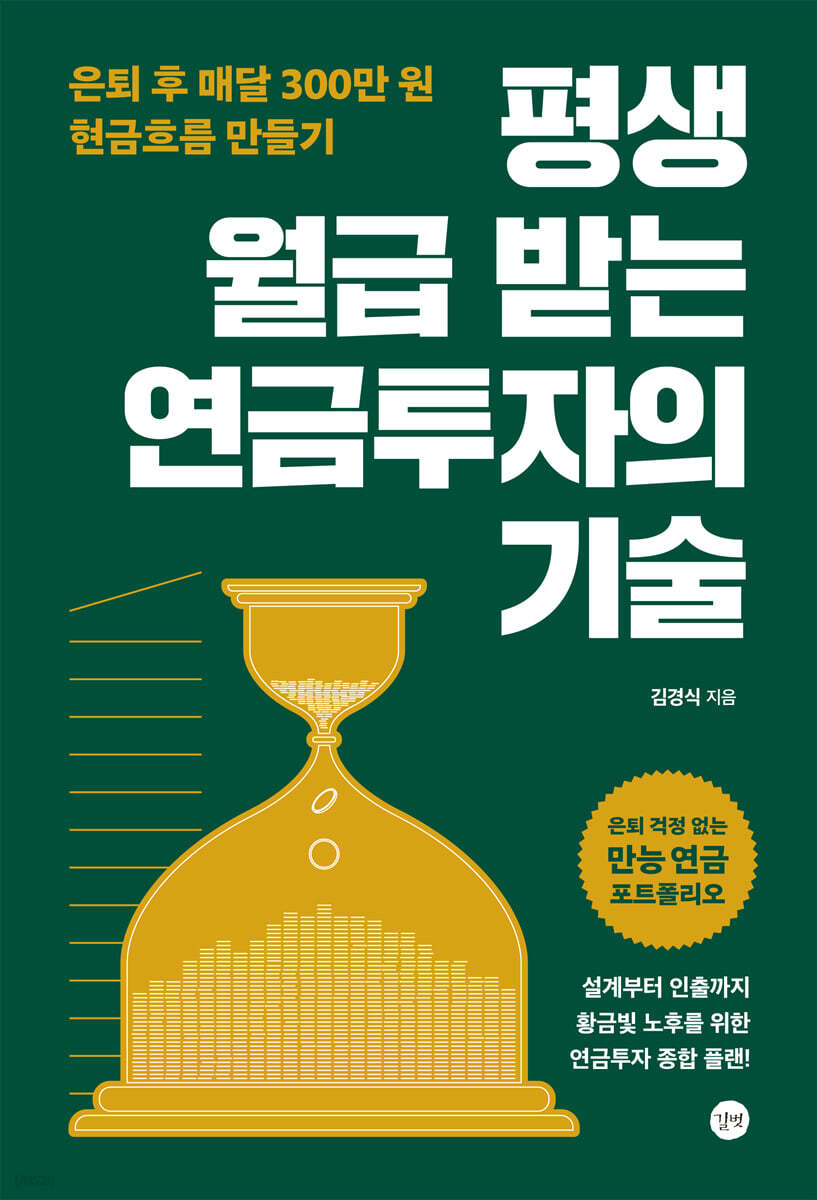
The art of pension investment that provides a lifetime salary
 |
Description
Book Introduction
30 years after retirement, it's decided now!
A game where the person who starts first, rather than the smarter person, always wins!
·Create a lifetime monthly income with the magic of compound interest and tax savings
·A pension plan that provides a secure retirement by utilizing pension savings, retirement pension, IRP, and ISA.
·Revealing a pension investment portfolio that generates 3 million won in monthly cash flow after retirement.
A game where the person who starts first, rather than the smarter person, always wins!
·Create a lifetime monthly income with the magic of compound interest and tax savings
·A pension plan that provides a secure retirement by utilizing pension savings, retirement pension, IRP, and ISA.
·Revealing a pension investment portfolio that generates 3 million won in monthly cash flow after retirement.
- You can preview some of the book's contents.
Preview
index
prolog
There is no such thing as a free lunch.
PART 1: WHAT IS A PENSION?
Chapter 1: Everyone Needs a Pension
1 Dream of becoming a pension millionaire
2. Salary received without working
Chapter 2: Principles of Pension Investment for Lifetime Monthly Income
3. Pension is ultimately about concentrated investment and asset allocation.
4. What matters is not the rate of return but the quantity.
5 As momentum increases, profits decrease.
Chapter 3: Understanding the Pension System
6 Differences between the Korean and American pension systems
7 The Magic of Compound Interest and Tax Savings
8 Pension Investment Strategies for a Secure Retirement
PART 2 Understanding the Structure of Pensions
Chapter 4: Pension Savings for a Leisurely Life
9 The goal of pension savings is to receive a pension.
Can you live on 1.25 million won per month with 10.3 billion won in savings?
11 Obstacles to Pension Receipt: Other Income Tax
12 When to Start Saving for Pension
13 Tax-Saving Investment ISAs to Replace Pensions
14 Second Pension Savings IRP
15 Additional contributions to grow your pension account
Chapter 5: Retirement Pension for a Stable Life
16 Reasons for introducing the retirement pension system
When is it advantageous to switch to DC 17?
18 How to receive retirement pension
PART 3 The Golden Pond That Never Runs Dry
Chapter 6: Creating a Lifetime Monthly Income with a Pension
19 Comprehensive Pension Plan for Three Types of Pensions
20 Pension receipt scenarios using the three-tier pension structure
21 Pension overdraft and additional contributions
22 Inheritance of Pension
Chapter 7 Pension Account Management Principles
23 Plain Vanilla's 9 Principles of Pension Investment
24 The quiet but powerful power of time
25 Opportunities and Limitations of Accumulated Investments
26 U.S. Stock Market, Bonds, and the Dollar
27 How to Identify Good Funds and ETFs
Chapter 8: Building a Practical Portfolio Without Worries About Retirement
28 Representative assets that make up the pension portfolio
29 A portfolio that makes money through pension savings
30 A portfolio that makes money with retirement pensions and IRPs
31 Income Portfolios to Make Money After Retirement
Investment Portfolio for 32 Children
33 Ways to Use Your ISA to Make Money
34 Limitations and Solutions of Pension Management
[Appendix 1] Pension-Related FAQs
[Appendix 2] Recommended Websites for Studying
There is no such thing as a free lunch.
PART 1: WHAT IS A PENSION?
Chapter 1: Everyone Needs a Pension
1 Dream of becoming a pension millionaire
2. Salary received without working
Chapter 2: Principles of Pension Investment for Lifetime Monthly Income
3. Pension is ultimately about concentrated investment and asset allocation.
4. What matters is not the rate of return but the quantity.
5 As momentum increases, profits decrease.
Chapter 3: Understanding the Pension System
6 Differences between the Korean and American pension systems
7 The Magic of Compound Interest and Tax Savings
8 Pension Investment Strategies for a Secure Retirement
PART 2 Understanding the Structure of Pensions
Chapter 4: Pension Savings for a Leisurely Life
9 The goal of pension savings is to receive a pension.
Can you live on 1.25 million won per month with 10.3 billion won in savings?
11 Obstacles to Pension Receipt: Other Income Tax
12 When to Start Saving for Pension
13 Tax-Saving Investment ISAs to Replace Pensions
14 Second Pension Savings IRP
15 Additional contributions to grow your pension account
Chapter 5: Retirement Pension for a Stable Life
16 Reasons for introducing the retirement pension system
When is it advantageous to switch to DC 17?
18 How to receive retirement pension
PART 3 The Golden Pond That Never Runs Dry
Chapter 6: Creating a Lifetime Monthly Income with a Pension
19 Comprehensive Pension Plan for Three Types of Pensions
20 Pension receipt scenarios using the three-tier pension structure
21 Pension overdraft and additional contributions
22 Inheritance of Pension
Chapter 7 Pension Account Management Principles
23 Plain Vanilla's 9 Principles of Pension Investment
24 The quiet but powerful power of time
25 Opportunities and Limitations of Accumulated Investments
26 U.S. Stock Market, Bonds, and the Dollar
27 How to Identify Good Funds and ETFs
Chapter 8: Building a Practical Portfolio Without Worries About Retirement
28 Representative assets that make up the pension portfolio
29 A portfolio that makes money through pension savings
30 A portfolio that makes money with retirement pensions and IRPs
31 Income Portfolios to Make Money After Retirement
Investment Portfolio for 32 Children
33 Ways to Use Your ISA to Make Money
34 Limitations and Solutions of Pension Management
[Appendix 1] Pension-Related FAQs
[Appendix 2] Recommended Websites for Studying
Detailed image

Publisher's Review
A comprehensive pension investment plan for a golden retirement, from planning to withdrawals and portfolio management!
Retire as a pension millionaire!
The appropriate living expenses for a retired couple is 3 million won per month.
No worries if you have national pension + retirement pension + pension savings!
Typically, when looking at the results of a survey on living expenses after retirement, the minimum monthly living expenses for a couple are said to be 2 million won, an appropriate living expense is about 3 million won, and an ample living expense is said to be 5 million won.
And many people say that you need 500 million won or 1 billion won to receive a generous monthly pension after retirement.
However, there is no need to give up or be frustrated in advance because your level is lower than others.
It would be nice to have a lot of living expenses, but you can live in your own way according to your circumstances.
In fact, it's not difficult to generate a cash flow of 3 million won per month after retirement.
If you have been economically active, you would have paid into the national pension and can expect to receive at least 1 million won after the age of 65.
There is also a retirement pension.
Regardless of whether the retirement pension is DB or DC, if you start with 3 million won per month and experience a 5% annual salary increase, you will have about 150 million won accumulated in your retirement pension account after 20 years.
Lastly, there are personal pensions, such as pension savings and IRP.
If you pay 6 million won per year based on the pension savings tax deduction limit, the principal alone will be 120 million won if the payment period is 20 years, and 180 million won if it is 30 years.
If we meet the general average expected annual return of about 3%, we can expect to achieve a final amount of about 300 million won.
If you use IRP here, the amount will be even larger.
Take advantage of the greatest benefit of pensions: tax deferral.
Pension withdrawals are planned to be 15 million won per year for 10 years!
Why did you talk about 300 million won?
Pension savings are a typical tax-deferred product.
If you operate a pension savings account, you will receive tax deductions and tax exemption benefits on operating profits.
Instead, when receiving a pension after the age of 55, it is taxed at 3.3% to 5.5% depending on age.
This is called pension income tax.
Pension income tax is very low compared to the tax deduction rate (13.2-16.5%) received as a benefit when paying into a pension account or the withholding tax rate on interest and dividends (15.4%).
Also, if you earn and receive income from a pension account, not only do you not have to worry about comprehensive financial income taxation, but the effective tax rate is also low.
There are conditions to receiving a pension at such a low tax rate.
The principal amount for which tax deductions have been received from pension-related accounts and the operating profits generated from pension-related accounts must be withdrawn within 15 million won per year over a period of 10 years or more.
If you do not meet this condition, you will have to choose between taxing it by adding it to your comprehensive income tax or taxing it as other income at a rate of 16.5%.
In other words, to maximize tax savings, you should only withdraw up to 15 million won per year, even if you have a large pension balance.
What if you have 300 million won in your pension account at retirement and withdraw 15 million won annually? If you manage a 5% annual dividend portfolio, you'll generate 15 million won in annual income.
Even if you withdraw 15 million won every year, the principal of 300 million won you have accumulated will not be depleted.
If you lower the target rate of return to 4% per year, even if you withdraw 15 million won each year, you will still have 130 million won in principal remaining after 30 years.
If you lower your target return a bit and create a 3% annual dividend portfolio, most of your principal will disappear after 30 years.
If you have 300 million won around the age of 60 and withdraw only 15 million won per year, you can calculate that you will be able to save up until the age of 90 without any problems.
However, our investment goal is not a pension that will one day disappear, but an infinite pension like a golden pond that never dries up.
The secret to success in pension investing is simplicity and patience!
Focus on stock funds with an annual income of 7% before retirement and 4% after retirement.
In his book, "The Art of Pension Investment for a Lifetime Salary," Kim Kyeong-sik, CEO of Plain Vanilla Investment Consulting, recommends allocating assets to stock funds with a target annual return of 7% until retirement when constructing a portfolio.
Because it is important to save money before retirement.
After retirement, the portfolio is restructured to focus on income assets and the target is lowered to generate a dividend yield of around 4%.
Once this portfolio is complete, you'll have a regular cash flow through dividends, allowing you to spend your money as you earn it.
Achieving 4% or 7% annual returns will not be easy.
That doesn't mean it's impossible.
From the perspective of pension investors, there is no need to consider whether stocks or bonds are good or bad, or which stocks are promising and which bonds are unstable.
It is highly unlikely that everyone will make money through stock analysis like Warren Buffett, and in fact, the risk of loss can increase due to concentrated stock investment.
Rather, pension investors should utilize funds or ETFs that manage multiple stocks rather than just one or two.
Additionally, individual investors' pension portfolios should be simple.
You can organize your investment funds into around five, and for overseas investments, include US growth and dividend funds. Focusing on these funds, you can purchase developed and emerging Asian stock funds, domestic and overseas bond funds, real estate REITs, and infrastructure funds.
I believe that the key to personal investment success lies in simplicity, not sophistication, and that simplicity will yield greater returns.
I encourage you to put aside sophisticated proprietary allocation models, expert market and economic forecasts, and rigorous risk management systems and instead focus on investing based on the principles and practices outlined in this book.
Retire as a pension millionaire!
The appropriate living expenses for a retired couple is 3 million won per month.
No worries if you have national pension + retirement pension + pension savings!
Typically, when looking at the results of a survey on living expenses after retirement, the minimum monthly living expenses for a couple are said to be 2 million won, an appropriate living expense is about 3 million won, and an ample living expense is said to be 5 million won.
And many people say that you need 500 million won or 1 billion won to receive a generous monthly pension after retirement.
However, there is no need to give up or be frustrated in advance because your level is lower than others.
It would be nice to have a lot of living expenses, but you can live in your own way according to your circumstances.
In fact, it's not difficult to generate a cash flow of 3 million won per month after retirement.
If you have been economically active, you would have paid into the national pension and can expect to receive at least 1 million won after the age of 65.
There is also a retirement pension.
Regardless of whether the retirement pension is DB or DC, if you start with 3 million won per month and experience a 5% annual salary increase, you will have about 150 million won accumulated in your retirement pension account after 20 years.
Lastly, there are personal pensions, such as pension savings and IRP.
If you pay 6 million won per year based on the pension savings tax deduction limit, the principal alone will be 120 million won if the payment period is 20 years, and 180 million won if it is 30 years.
If we meet the general average expected annual return of about 3%, we can expect to achieve a final amount of about 300 million won.
If you use IRP here, the amount will be even larger.
Take advantage of the greatest benefit of pensions: tax deferral.
Pension withdrawals are planned to be 15 million won per year for 10 years!
Why did you talk about 300 million won?
Pension savings are a typical tax-deferred product.
If you operate a pension savings account, you will receive tax deductions and tax exemption benefits on operating profits.
Instead, when receiving a pension after the age of 55, it is taxed at 3.3% to 5.5% depending on age.
This is called pension income tax.
Pension income tax is very low compared to the tax deduction rate (13.2-16.5%) received as a benefit when paying into a pension account or the withholding tax rate on interest and dividends (15.4%).
Also, if you earn and receive income from a pension account, not only do you not have to worry about comprehensive financial income taxation, but the effective tax rate is also low.
There are conditions to receiving a pension at such a low tax rate.
The principal amount for which tax deductions have been received from pension-related accounts and the operating profits generated from pension-related accounts must be withdrawn within 15 million won per year over a period of 10 years or more.
If you do not meet this condition, you will have to choose between taxing it by adding it to your comprehensive income tax or taxing it as other income at a rate of 16.5%.
In other words, to maximize tax savings, you should only withdraw up to 15 million won per year, even if you have a large pension balance.
What if you have 300 million won in your pension account at retirement and withdraw 15 million won annually? If you manage a 5% annual dividend portfolio, you'll generate 15 million won in annual income.
Even if you withdraw 15 million won every year, the principal of 300 million won you have accumulated will not be depleted.
If you lower the target rate of return to 4% per year, even if you withdraw 15 million won each year, you will still have 130 million won in principal remaining after 30 years.
If you lower your target return a bit and create a 3% annual dividend portfolio, most of your principal will disappear after 30 years.
If you have 300 million won around the age of 60 and withdraw only 15 million won per year, you can calculate that you will be able to save up until the age of 90 without any problems.
However, our investment goal is not a pension that will one day disappear, but an infinite pension like a golden pond that never dries up.
The secret to success in pension investing is simplicity and patience!
Focus on stock funds with an annual income of 7% before retirement and 4% after retirement.
In his book, "The Art of Pension Investment for a Lifetime Salary," Kim Kyeong-sik, CEO of Plain Vanilla Investment Consulting, recommends allocating assets to stock funds with a target annual return of 7% until retirement when constructing a portfolio.
Because it is important to save money before retirement.
After retirement, the portfolio is restructured to focus on income assets and the target is lowered to generate a dividend yield of around 4%.
Once this portfolio is complete, you'll have a regular cash flow through dividends, allowing you to spend your money as you earn it.
Achieving 4% or 7% annual returns will not be easy.
That doesn't mean it's impossible.
From the perspective of pension investors, there is no need to consider whether stocks or bonds are good or bad, or which stocks are promising and which bonds are unstable.
It is highly unlikely that everyone will make money through stock analysis like Warren Buffett, and in fact, the risk of loss can increase due to concentrated stock investment.
Rather, pension investors should utilize funds or ETFs that manage multiple stocks rather than just one or two.
Additionally, individual investors' pension portfolios should be simple.
You can organize your investment funds into around five, and for overseas investments, include US growth and dividend funds. Focusing on these funds, you can purchase developed and emerging Asian stock funds, domestic and overseas bond funds, real estate REITs, and infrastructure funds.
I believe that the key to personal investment success lies in simplicity, not sophistication, and that simplicity will yield greater returns.
I encourage you to put aside sophisticated proprietary allocation models, expert market and economic forecasts, and rigorous risk management systems and instead focus on investing based on the principles and practices outlined in this book.
GOODS SPECIFICS
- Date of issue: December 13, 2024
- Page count, weight, size: 344 pages | 574g | 152*225*22mm
- ISBN13: 9791140714308
You may also like
카테고리
korean


korean

![GQ KOREA Mark (Monthly): December [2025]](http://librairie.coreenne.fr/cdn/shop/files/8ef265dbbfbf186523ed75ba7319009d.jpg?v=1765340328&width=3840)


