

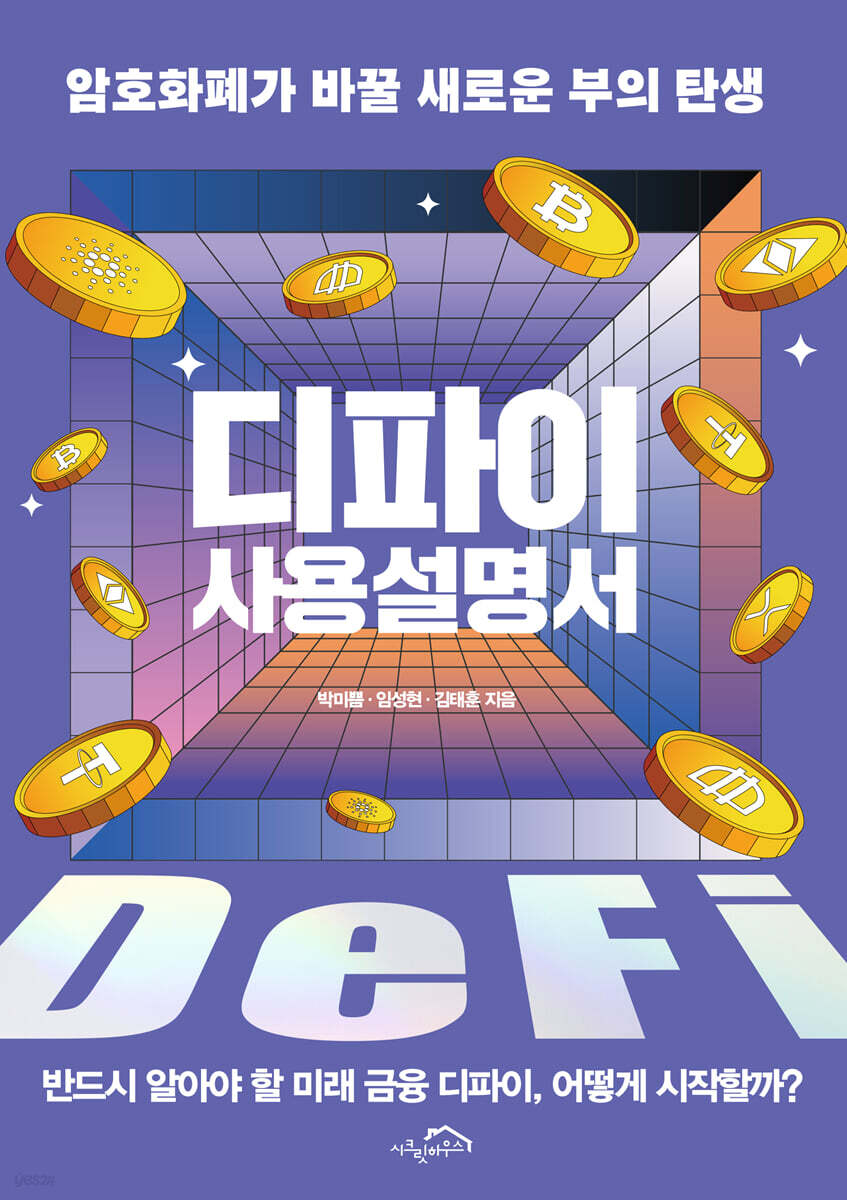
DeFi User Manual
 |
Description
Book Introduction
“Seize the opportunity to make huge wealth by investing in DeFi!”
Decentralized financial services, DeFi
"Can cryptocurrencies be used for deposits and loans?" "Can you accumulate enormous wealth by investing in DeFi?"
Recently, the MZ generation has shown interest in investing in cryptocurrencies in addition to stocks and real estate.
Why are they interested in investing in cryptocurrency? Because they no longer have the opportunity to build wealth in traditional financial markets.
For the younger generation, who have been striving for economic freedom during this increasingly prolonged recession, this is an unstoppable situation.
Even as we wait for a larger market of opportunity, we hear that money is pouring into the cryptocurrency market, and many people are making huge fortunes.
In keeping with this, the cryptocurrency market is facing a period of unprecedented opportunity and change.
At the center of it all is 'Defi'.
But why is interest in DeFi growing? Investment expectations in the recently sluggish cryptocurrency market are emerging as an unstoppable trend in the future of finance.
We are now entering an era where traditional finance offers no opportunities for wealth creation, and it is difficult to achieve satisfactory performance and profits even with stocks and real estate.
This allows DeFi to provide financial investments and services without third-party intervention.
In addition to high investment returns, there may also be profits generated from loans other than interest payments.
This is a financial innovation that is even more anticipated in the Web 3 era, as it provides a golden opportunity to accumulate enormous wealth.
So what is DeFi, and what should we do with it? DeFi (Decentralized Finance) is, as the name suggests, decentralized finance.
Decentralization means that there is no specific administrator, i.e. no third party.
It is a financial service that is realized through programs that operate autonomously on the blockchain without going through financial institutions.
The book "DeFi User Guide" helps those with growing interest in DeFi investment to explore and understand individual DeFi products on their own, empowering them to make sound choices.
This is an introductory book for beginners who want to learn about DeFi, as it is too extensive to cover all the details of DeFi one by one, and only summarizes the most basic core content.
Additionally, for beginners, video lectures on key concepts are provided, and readers can easily view the videos using QR codes.
The book begins with an explanation of stablecoins, the most basic DeFi money Lego that operates within the Ethereum smart contract environment.
We also delve into the fundamentals of DeFi and its key services, from the deposit and lending protocols that form the foundation of financial services, to the decentralized exchange (DEX) for active use, to the additional financial services that facilitate the convenient use of these services.
Additionally, it addresses the risks associated with utilizing DeFi.
The book, “Defi User Manual,” is a book for beginners to Defi, as the title suggests.
Even after you start investing, you should continue to study various investment methods and safe investments.
No matter what investment you make, opportunities and risks coexist.
Moreover, the nascent DeFi market presents both enormous opportunities and risks.
For those who have yet to enter DeFi or are looking to get started, or for those who are interested in DeFi due to limited opportunities in traditional finance, I hope this book will serve as a foundation for learning about DeFi investment and seize the opportunity to make a fortune.
Decentralized financial services, DeFi
"Can cryptocurrencies be used for deposits and loans?" "Can you accumulate enormous wealth by investing in DeFi?"
Recently, the MZ generation has shown interest in investing in cryptocurrencies in addition to stocks and real estate.
Why are they interested in investing in cryptocurrency? Because they no longer have the opportunity to build wealth in traditional financial markets.
For the younger generation, who have been striving for economic freedom during this increasingly prolonged recession, this is an unstoppable situation.
Even as we wait for a larger market of opportunity, we hear that money is pouring into the cryptocurrency market, and many people are making huge fortunes.
In keeping with this, the cryptocurrency market is facing a period of unprecedented opportunity and change.
At the center of it all is 'Defi'.
But why is interest in DeFi growing? Investment expectations in the recently sluggish cryptocurrency market are emerging as an unstoppable trend in the future of finance.
We are now entering an era where traditional finance offers no opportunities for wealth creation, and it is difficult to achieve satisfactory performance and profits even with stocks and real estate.
This allows DeFi to provide financial investments and services without third-party intervention.
In addition to high investment returns, there may also be profits generated from loans other than interest payments.
This is a financial innovation that is even more anticipated in the Web 3 era, as it provides a golden opportunity to accumulate enormous wealth.
So what is DeFi, and what should we do with it? DeFi (Decentralized Finance) is, as the name suggests, decentralized finance.
Decentralization means that there is no specific administrator, i.e. no third party.
It is a financial service that is realized through programs that operate autonomously on the blockchain without going through financial institutions.
The book "DeFi User Guide" helps those with growing interest in DeFi investment to explore and understand individual DeFi products on their own, empowering them to make sound choices.
This is an introductory book for beginners who want to learn about DeFi, as it is too extensive to cover all the details of DeFi one by one, and only summarizes the most basic core content.
Additionally, for beginners, video lectures on key concepts are provided, and readers can easily view the videos using QR codes.
The book begins with an explanation of stablecoins, the most basic DeFi money Lego that operates within the Ethereum smart contract environment.
We also delve into the fundamentals of DeFi and its key services, from the deposit and lending protocols that form the foundation of financial services, to the decentralized exchange (DEX) for active use, to the additional financial services that facilitate the convenient use of these services.
Additionally, it addresses the risks associated with utilizing DeFi.
The book, “Defi User Manual,” is a book for beginners to Defi, as the title suggests.
Even after you start investing, you should continue to study various investment methods and safe investments.
No matter what investment you make, opportunities and risks coexist.
Moreover, the nascent DeFi market presents both enormous opportunities and risks.
For those who have yet to enter DeFi or are looking to get started, or for those who are interested in DeFi due to limited opportunities in traditional finance, I hope this book will serve as a foundation for learning about DeFi investment and seize the opportunity to make a fortune.
- You can preview some of the book's contents.
Preview
index
Author's Note
prolog
1_ Wealth Creation in the Cryptocurrency Market
2_ Finance on Blockchain, DeFi
Chapter 1.
The Beginning of Money Lego: Stablecoins
The first stablecoin, USDT
DAI attempts decentralization
Another attempt: algorithmic stablecoins
Becoming the cornerstone of DeFi
Chapter 2.
DeFi deposits, loans, and lending protocols
What is a landing protocol?
Collateralization ratio and loan utilization
Reward Coin, the magic that makes you profitable even when you borrow money
Interest rate mechanism of the lending protocol
Liquidation of the Landing Protocol
Unsecured loan service, Flash Loan
Using AAVE
Chapter 3.
Blockchain Exchange, DEX
The emergence of decentralized exchanges
AMM and slippage
Liquidity provision and impermanent loss
DEX aggregator
Using Uniswap
Use 1 inch
Chapter 4.
Interest farming
Interest farming to maximize profits
Advantages of Staking
Liquidity Mining and Staking
Yield farming aggregator
Using Harvest
Chapter 5.
Managing DeFi Risk
A Closer Look at DeFi Investments
Scam, a scam that will cut off your nose if you don't know
Risks that users themselves may fall into
Other risks and regulations
How to minimize risk
Epilogue
1_ Even if you cross a stone bridge, knock on it first
2_ The Future of Finance: Decentralization
Appendix_ Common Sense You Must Know Before Getting Started with DeFi
Blockchain | The Birth of Ethereum | Smart Contracts | Gas | Interest Rate Notation: APR vs. APY | Cryptocurrency Wallets | DeFi
This Preparation | Useful Tools for DeFi
prolog
1_ Wealth Creation in the Cryptocurrency Market
2_ Finance on Blockchain, DeFi
Chapter 1.
The Beginning of Money Lego: Stablecoins
The first stablecoin, USDT
DAI attempts decentralization
Another attempt: algorithmic stablecoins
Becoming the cornerstone of DeFi
Chapter 2.
DeFi deposits, loans, and lending protocols
What is a landing protocol?
Collateralization ratio and loan utilization
Reward Coin, the magic that makes you profitable even when you borrow money
Interest rate mechanism of the lending protocol
Liquidation of the Landing Protocol
Unsecured loan service, Flash Loan
Using AAVE
Chapter 3.
Blockchain Exchange, DEX
The emergence of decentralized exchanges
AMM and slippage
Liquidity provision and impermanent loss
DEX aggregator
Using Uniswap
Use 1 inch
Chapter 4.
Interest farming
Interest farming to maximize profits
Advantages of Staking
Liquidity Mining and Staking
Yield farming aggregator
Using Harvest
Chapter 5.
Managing DeFi Risk
A Closer Look at DeFi Investments
Scam, a scam that will cut off your nose if you don't know
Risks that users themselves may fall into
Other risks and regulations
How to minimize risk
Epilogue
1_ Even if you cross a stone bridge, knock on it first
2_ The Future of Finance: Decentralization
Appendix_ Common Sense You Must Know Before Getting Started with DeFi
Blockchain | The Birth of Ethereum | Smart Contracts | Gas | Interest Rate Notation: APR vs. APY | Cryptocurrency Wallets | DeFi
This Preparation | Useful Tools for DeFi
Into the book
First, the development of stablecoins designed to maintain the same value as the dollar has laid the foundation for more active investment in the cryptocurrency market, which had been shunned due to its high volatility.
This foundation not only makes it easier to measure returns in fiat currency terms, but also opens the way to absorb dollar-based financial demand rather than cryptocurrency volatility.
So, high net worth individuals, private equity firms, and hedge funds who are unwilling to invest in cryptocurrencies are knocking on the door of the DeFi market with stablecoins.
The advent of lending services here has provided a means for dollar depositors to earn interest income, and for those seeking higher returns to leverage their lending.
Additionally, decentralized exchanges have emerged, allowing for the free exchange of assets at any time, creating a marketplace where cryptocurrencies can be easily exchanged for each other as needed.
The financial market has now opened on the blockchain.
--- p.19, from "Prologue"
To solve this problem, cryptocurrencies with fixed prices regardless of the point in time emerged, and these are called 'stablecoins'.
There are several ways to fix the price of a cryptocurrency, but the most reliable and simple way is to exchange it 1:1 with spot currency.
When you deposit $1 of spot currency, you issue a cryptocurrency with a value of $1, and when you return this cryptocurrency, you get $1 of spot currency back, so it has a value of $1 regardless of the point in time.
The first stablecoin launched with this idea was 'USDT (Tether)'.
--- p.25, from "The Beginning of Money Lego, Stablecoins"
Thanks to blockchain technology and smart contracts, creating new tokens and distributing them is not terribly difficult.
So, each lending protocol created and distributed its own coin to its users, depositors and borrowers, to encourage their use of the protocol.
This is called a 'reward coin', and in Korea, reward coins are also called 'pickaxes' in reference to mining.
As many lending protocols began distributing reward coins to both depositors and borrowers, a negative interest rate situation arose, where borrowers could still make a profit despite having taken out a loan.
--- p.54, from “Defi Deposits and Loans, Lending Protocol”
To trade cryptocurrencies, you typically use a centralized exchange.
While cryptocurrency exchanges have recently become relatively trustworthy and offer a reliable trading environment, their credibility was initially low due to security issues related to hacking and fraudulent transactions.
And in some cases, you may have to find another exchange or give up on trading cryptocurrencies that are not listed on the exchange.
To solve these problems and inconveniences, early decentralized exchanges (DEXs) emerged.
--- p.82, from “Blockchain Exchange, DEX”
In DeFi, yield farming refers to any activity that maximizes profits by utilizing the cryptocurrency you hold in various ways.
Many DeFi protocols display yields in fiat currencies like the US dollar, but it's more reasonable to view DeFi returns as an increase in the amount of invested cryptocurrency or additional reward coins.
Even if you generate profits while farming, if the value of the cryptocurrency itself goes down, your assets may decrease in fiat currency terms.
Conversely, if the value rises, your assets may increase significantly.
Those who wish to engage in yield farming can deposit their cryptocurrency holdings or provide liquidity to increase their investment principal through interest or fee income, or receive reward coins.
At this point, farmers will compare multiple DeFi protocols to maximize their profits, looking for the protocol with the highest interest rates or the most reward tokens.
--- p.114~115, from “Farming with Interest”
There are also cases where tokens are issued based on other popular features, such as 'Jindoji Coin', which imitates Dogecoin, and 'Squid Coin', which was created by capitalizing on the popularity of the squid game.
At this time, the characteristics of DEX, which do not have difficulties in listing, are utilized to easily list, raise the price, and then the operators use the 'pump and dump' method, issuing additional coins not included in the white paper in large quantities, selling them all at once, and taking the profits and disappearing.
Additionally, a smart contract is created to pay interest on the deposited amount and then, when the money is withdrawn, the money is withdrawn to a wallet other than the withdrawer's wallet.
Anyone can easily create coins, list them on DEXs for almost free, and avoid separate audits or investigations, so rug pools like this can happen in DeFi at any time, so it's always important to be vigilant.
--- p.147~148, from “Managing DeFi Risk”
So far, we've looked at the key services that form the foundation of the DeFi ecosystem.
We also looked at the risk factors that must be kept in mind when utilizing these services.
The purpose of separating risk factors into a separate chapter is not to scare you away from investing in DeFi before you even begin, nor to discourage you from doing so.
The Dafai market is sometimes called 'The Wild West', a play on the American pioneering era, because outlaws run rampant there.
This implies that there is great danger, but at the same time, there is also tremendous opportunity.
Over time, DeFi will expand with the emergence of various services to meet market demands, and methods to mitigate current risks will emerge, achieving stability.
This foundation not only makes it easier to measure returns in fiat currency terms, but also opens the way to absorb dollar-based financial demand rather than cryptocurrency volatility.
So, high net worth individuals, private equity firms, and hedge funds who are unwilling to invest in cryptocurrencies are knocking on the door of the DeFi market with stablecoins.
The advent of lending services here has provided a means for dollar depositors to earn interest income, and for those seeking higher returns to leverage their lending.
Additionally, decentralized exchanges have emerged, allowing for the free exchange of assets at any time, creating a marketplace where cryptocurrencies can be easily exchanged for each other as needed.
The financial market has now opened on the blockchain.
--- p.19, from "Prologue"
To solve this problem, cryptocurrencies with fixed prices regardless of the point in time emerged, and these are called 'stablecoins'.
There are several ways to fix the price of a cryptocurrency, but the most reliable and simple way is to exchange it 1:1 with spot currency.
When you deposit $1 of spot currency, you issue a cryptocurrency with a value of $1, and when you return this cryptocurrency, you get $1 of spot currency back, so it has a value of $1 regardless of the point in time.
The first stablecoin launched with this idea was 'USDT (Tether)'.
--- p.25, from "The Beginning of Money Lego, Stablecoins"
Thanks to blockchain technology and smart contracts, creating new tokens and distributing them is not terribly difficult.
So, each lending protocol created and distributed its own coin to its users, depositors and borrowers, to encourage their use of the protocol.
This is called a 'reward coin', and in Korea, reward coins are also called 'pickaxes' in reference to mining.
As many lending protocols began distributing reward coins to both depositors and borrowers, a negative interest rate situation arose, where borrowers could still make a profit despite having taken out a loan.
--- p.54, from “Defi Deposits and Loans, Lending Protocol”
To trade cryptocurrencies, you typically use a centralized exchange.
While cryptocurrency exchanges have recently become relatively trustworthy and offer a reliable trading environment, their credibility was initially low due to security issues related to hacking and fraudulent transactions.
And in some cases, you may have to find another exchange or give up on trading cryptocurrencies that are not listed on the exchange.
To solve these problems and inconveniences, early decentralized exchanges (DEXs) emerged.
--- p.82, from “Blockchain Exchange, DEX”
In DeFi, yield farming refers to any activity that maximizes profits by utilizing the cryptocurrency you hold in various ways.
Many DeFi protocols display yields in fiat currencies like the US dollar, but it's more reasonable to view DeFi returns as an increase in the amount of invested cryptocurrency or additional reward coins.
Even if you generate profits while farming, if the value of the cryptocurrency itself goes down, your assets may decrease in fiat currency terms.
Conversely, if the value rises, your assets may increase significantly.
Those who wish to engage in yield farming can deposit their cryptocurrency holdings or provide liquidity to increase their investment principal through interest or fee income, or receive reward coins.
At this point, farmers will compare multiple DeFi protocols to maximize their profits, looking for the protocol with the highest interest rates or the most reward tokens.
--- p.114~115, from “Farming with Interest”
There are also cases where tokens are issued based on other popular features, such as 'Jindoji Coin', which imitates Dogecoin, and 'Squid Coin', which was created by capitalizing on the popularity of the squid game.
At this time, the characteristics of DEX, which do not have difficulties in listing, are utilized to easily list, raise the price, and then the operators use the 'pump and dump' method, issuing additional coins not included in the white paper in large quantities, selling them all at once, and taking the profits and disappearing.
Additionally, a smart contract is created to pay interest on the deposited amount and then, when the money is withdrawn, the money is withdrawn to a wallet other than the withdrawer's wallet.
Anyone can easily create coins, list them on DEXs for almost free, and avoid separate audits or investigations, so rug pools like this can happen in DeFi at any time, so it's always important to be vigilant.
--- p.147~148, from “Managing DeFi Risk”
So far, we've looked at the key services that form the foundation of the DeFi ecosystem.
We also looked at the risk factors that must be kept in mind when utilizing these services.
The purpose of separating risk factors into a separate chapter is not to scare you away from investing in DeFi before you even begin, nor to discourage you from doing so.
The Dafai market is sometimes called 'The Wild West', a play on the American pioneering era, because outlaws run rampant there.
This implies that there is great danger, but at the same time, there is also tremendous opportunity.
Over time, DeFi will expand with the emergence of various services to meet market demands, and methods to mitigate current risks will emerge, achieving stability.
--- p.162~163, from “Epilogue”
Publisher's Review
How to start investing in DeFi?
A DeFi Primer for Cryptocurrency Investors
Wealth in the cryptocurrency market stems from three sources: expectations of rising cryptocurrency prices, fees from exchanges and blockchain networks, proof-of-work rewards, and interest earned from using cryptocurrencies as assets.
This book delves into DeFi, which touches on all three sources of cryptocurrency wealth.
DeFi refers to smart contract-based financial activities that operate on blockchains that enable the use of smart contracts.
Here, we begin with an explanation of stablecoins, the most basic DeFi money Lego, and delve into the fundamentals of DeFi and its key services, from deposits and lending services to decentralized blockchain exchanges (DEXs) and additional financial services utilizing them.
In addition, key concepts are explained easily using videos.
Chapter 1 describes stablecoins, which were developed to improve the volatility of cryptocurrencies and facilitate their use in real-world transactions.
Stablecoins are broadly categorized into three types: fiat currency-collateralized, cryptocurrency-collateralized, and uncollateralized. The issuance method and risks of each type are explained.
Chapter 2 explains the operating principles, loan-to-value (LTV) ratio, interest rate mechanism, and forced liquidation method to prevent loan defaults for the Lending Protocol, a cryptocurrency deposit and loan service on the blockchain.
Additionally, it covers Flash Loan, an unsecured lending service that stems from the characteristics of blockchain, and the expansion of the DeFi ecosystem.
Chapter 3 explains DEX, a decentralized exchange that has been activated by the emergence of the AMM method, and details the operating principles of the AMM method, slippage that users must bear, LP tokens as receipts for liquidity supply, and the concept of impermanent loss that liquidity providers must understand.
Additionally, we looked at explanations and examples of DEX aggregators that emerged for ease of use due to the emergence of various DEXs.
In Chapter 4, we looked at what yield farming is and what methods are available in DeFi.
We explained staking and liquidity mining as representative yield farming methods, and also looked at yield farming aggregators that replace complex investment methods resulting from the development of various protocols, and the benefits of using them.
Chapter 5 explores the potential risks of DeFi, which allows for a wide range of transactions, but also requires individuals to be fully responsible for any issues that arise.
We explored scam projects aimed at embezzling customers' funds, the potential losses from user error, and the potential losses from transactions made without proper verification. We also discussed external risk factors such as national regulations.
We also looked at ways to minimize these risks.
The DeFi market presents both great risks and enormous opportunities, and is sometimes called "The Wild West," a play on the American pioneering era.
Existing financial institutions have also gone through a long period of trial and error, and many aspects of the system have stabilized, resulting in today's system.
DeFi will follow the same path, but it is also true that there is still much room for further development and the possibilities are endless.
The DeFi market will become larger and more efficient due to the fairness, efficiency, and increased participation that decentralization brings.
Many high-net-worth individuals and institutional investors have already entered the DeFi market, and this trend is expected to continue to grow.
Even at this very moment, there are people somewhere accumulating wealth through DeFi, and it's important to prepare appropriately in advance to seize this opportunity.
A DeFi Primer for Cryptocurrency Investors
Wealth in the cryptocurrency market stems from three sources: expectations of rising cryptocurrency prices, fees from exchanges and blockchain networks, proof-of-work rewards, and interest earned from using cryptocurrencies as assets.
This book delves into DeFi, which touches on all three sources of cryptocurrency wealth.
DeFi refers to smart contract-based financial activities that operate on blockchains that enable the use of smart contracts.
Here, we begin with an explanation of stablecoins, the most basic DeFi money Lego, and delve into the fundamentals of DeFi and its key services, from deposits and lending services to decentralized blockchain exchanges (DEXs) and additional financial services utilizing them.
In addition, key concepts are explained easily using videos.
Chapter 1 describes stablecoins, which were developed to improve the volatility of cryptocurrencies and facilitate their use in real-world transactions.
Stablecoins are broadly categorized into three types: fiat currency-collateralized, cryptocurrency-collateralized, and uncollateralized. The issuance method and risks of each type are explained.
Chapter 2 explains the operating principles, loan-to-value (LTV) ratio, interest rate mechanism, and forced liquidation method to prevent loan defaults for the Lending Protocol, a cryptocurrency deposit and loan service on the blockchain.
Additionally, it covers Flash Loan, an unsecured lending service that stems from the characteristics of blockchain, and the expansion of the DeFi ecosystem.
Chapter 3 explains DEX, a decentralized exchange that has been activated by the emergence of the AMM method, and details the operating principles of the AMM method, slippage that users must bear, LP tokens as receipts for liquidity supply, and the concept of impermanent loss that liquidity providers must understand.
Additionally, we looked at explanations and examples of DEX aggregators that emerged for ease of use due to the emergence of various DEXs.
In Chapter 4, we looked at what yield farming is and what methods are available in DeFi.
We explained staking and liquidity mining as representative yield farming methods, and also looked at yield farming aggregators that replace complex investment methods resulting from the development of various protocols, and the benefits of using them.
Chapter 5 explores the potential risks of DeFi, which allows for a wide range of transactions, but also requires individuals to be fully responsible for any issues that arise.
We explored scam projects aimed at embezzling customers' funds, the potential losses from user error, and the potential losses from transactions made without proper verification. We also discussed external risk factors such as national regulations.
We also looked at ways to minimize these risks.
The DeFi market presents both great risks and enormous opportunities, and is sometimes called "The Wild West," a play on the American pioneering era.
Existing financial institutions have also gone through a long period of trial and error, and many aspects of the system have stabilized, resulting in today's system.
DeFi will follow the same path, but it is also true that there is still much room for further development and the possibilities are endless.
The DeFi market will become larger and more efficient due to the fairness, efficiency, and increased participation that decentralization brings.
Many high-net-worth individuals and institutional investors have already entered the DeFi market, and this trend is expected to continue to grow.
Even at this very moment, there are people somewhere accumulating wealth through DeFi, and it's important to prepare appropriately in advance to seize this opportunity.
GOODS SPECIFICS
- Date of issue: August 24, 2023
- Page count, weight, size: 222 pages | 372g | 148*210*13mm
- ISBN13: 9791192312545
- ISBN10: 1192312546
You may also like
카테고리
korean


korean

![GQ KOREA Mark (Monthly): December [2025]](http://librairie.coreenne.fr/cdn/shop/files/8ef265dbbfbf186523ed75ba7319009d.jpg?v=1765340328&width=3840)


