

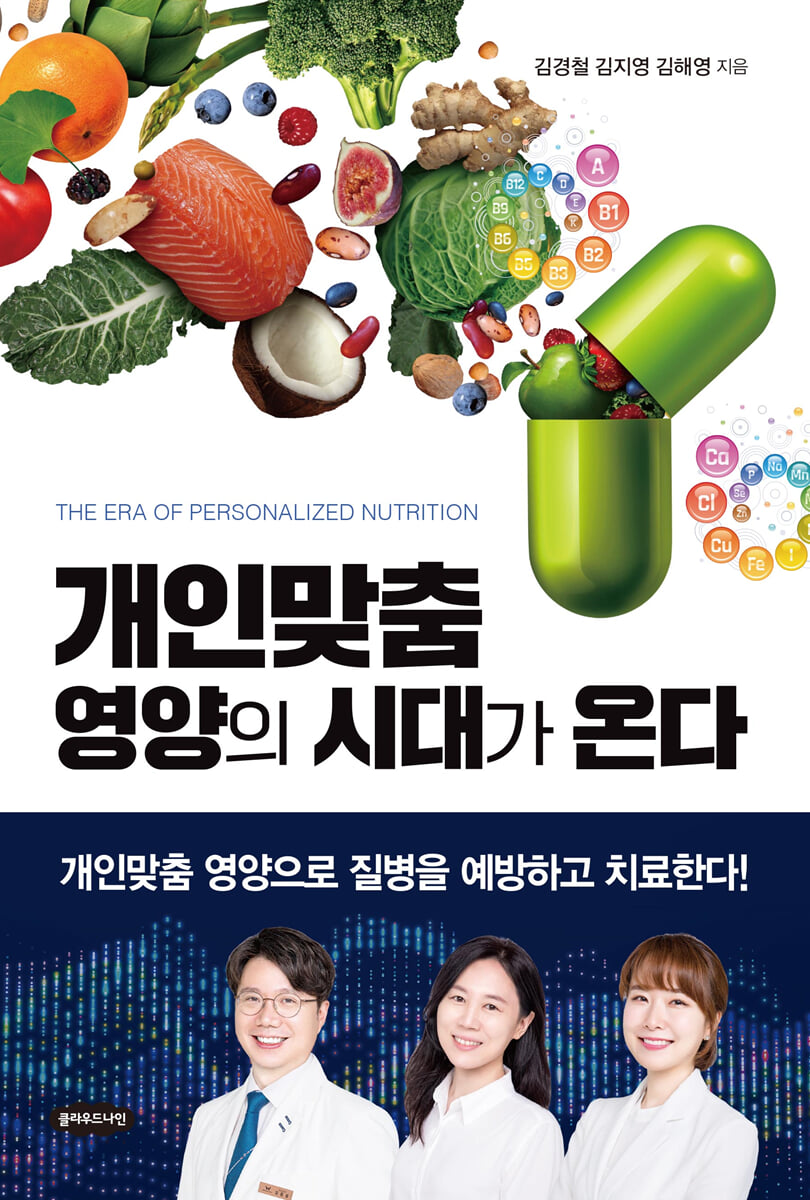
The era of personalized nutrition is coming.
 |
Description
Book Introduction
Prevent and treat disease with personalized nutrition!
The cutting edge of personalized nutrition, from experts in academia, industry, and the medical community.
This book is a collection of books written by three experts from academia, industry, and the medical field, and provides a front-line overview of what research and results are being achieved in personalized nutrition in academia, how businesses and other industries are creating and implementing business models, and how the medical community is applying personalized nutrition to patients.
Why is personalized nutrition necessary? Because there's no one-size-fits-all nutrition or food plan.
Each person has a different genome, epigenetics, metabolome, and lifestyle, and therefore different nutritional and dietary needs.
Some people can sleep well even if they drink coffee like water, while others can't sleep even after drinking just one cup of coffee.
Some people don't get drunk no matter how much they drink, while others get red in the face and feel unwell after just one drop.
Some people gain weight just by drinking water, while others don't gain weight no matter how much they eat.
Such differences occur even among identical twins.
Even if you are born with poor or bad genes, you can treat and prevent them in advance with personalized nutrition and diet.
This is why personalized nutrition (precision nutrition) and diet are becoming increasingly important.
This book covers the hottest topics at the heart of preventive medicine and future medicine.
The cutting edge of personalized nutrition, from experts in academia, industry, and the medical community.
This book is a collection of books written by three experts from academia, industry, and the medical field, and provides a front-line overview of what research and results are being achieved in personalized nutrition in academia, how businesses and other industries are creating and implementing business models, and how the medical community is applying personalized nutrition to patients.
Why is personalized nutrition necessary? Because there's no one-size-fits-all nutrition or food plan.
Each person has a different genome, epigenetics, metabolome, and lifestyle, and therefore different nutritional and dietary needs.
Some people can sleep well even if they drink coffee like water, while others can't sleep even after drinking just one cup of coffee.
Some people don't get drunk no matter how much they drink, while others get red in the face and feel unwell after just one drop.
Some people gain weight just by drinking water, while others don't gain weight no matter how much they eat.
Such differences occur even among identical twins.
Even if you are born with poor or bad genes, you can treat and prevent them in advance with personalized nutrition and diet.
This is why personalized nutrition (precision nutrition) and diet are becoming increasingly important.
This book covers the hottest topics at the heart of preventive medicine and future medicine.
- You can preview some of the book's contents.
Preview
index
Introduction: The era of personalized nutrition is coming.
Chapter 1: How Far Has Personalized Nutrition Research Come? _ Kim Ji-young
1. Personalized Nutrition Meets Artificial Intelligence
2 Israel developed a personalized postprandial blood sugar prediction algorithm.
3. The UK uses machine learning to predict an individual's postprandial triglyceride response.
4. The EU-funded Foodforme study explores the relationship between food and gene expression.
5 The United States is investing heavily in personalized precision nutrition research.
6. Korea is building a national integrated bio big data for precision medicine.
Personalized nutrition based on personal big data
7 What are the challenges we need to overcome to understand the science of personalized nutrition?
Chapter 2: How Far Has the Personalized Nutrition Industry Grown? _ Kim Hae-young
1. The demand for personalized health functional foods is increasing.
Overseas actual commercialization cases
2 Various companies are preparing domestically as well.
Domestic actual commercialization cases
3 Food companies are experimenting with customized diets.
domestic companies
overseas companies
4. The development of medical food and meal kits is remarkable.
5 The domestic and international microbiome market is growing.
Chapter 3: Why We Need Personalized Nutrition Based on Our Genomes _ Kim Kyung-chul
1 How do genes determine an individual's characteristics?
2 What is the difference between nutrigenomics and nutritional genetics?
3 Can Specific Nutrient Deficiencies Be Detected Genetically?
4 How to Use Nutritional Genomes
5 Genetic Analysis Can Predict Vitamin Deficiencies
6 There are obesity genes that cause obesity and gluttony.
7 What are the expansion and limitations of DTC genetic testing?
8 What is the Microbiome?
9 Why You Should Get a Personalized Probiotic Prescription
10 Anti-Aging Nutrients Can Lengthen Telomeres
11 Food and Nutrition Can Change Gene Expression
Chapter 4: Personalized Disease Prevention with Functional Medicine Data _ Kim Kyung-chul
1 Treating the cause of disease with functional medicine
2. What are the representative tests of functional medicine?
3 Urine organic acid tests can reveal nutrient deficiencies.
4 Hair mineral testing reveals heavy metal accumulation
5 Food Antibody Tests Can Detect Food Allergies
6 Autonomic nervous system tests reveal stress levels.
7. Even if you have bad genes, you can prevent disease.
Chapter 5: Treating Disease with Personalized Nutrition _ Kim Hae-young
1 Fatigue
2 Insomnia, depression, anxiety
Insomnia
melancholia
anxiety disorder
Chapter 3
irritable bowel syndrome
inflammatory bowel disease
4 eyes
dry eye
Cataracts and age-related macular degeneration
glaucoma
5 Blood Sugar Management
6 Menopause
7 joints
8.
memory
9 Allergies
10 Menstrual Pain and Premenstrual Syndrome
11. Recovery of liver function
12 Diet
13 Children and Adolescents
Appendix: Key Functions, Recommended Dosages, and Sources of Vitamins and Minerals
References
Chapter 1: How Far Has Personalized Nutrition Research Come? _ Kim Ji-young
1. Personalized Nutrition Meets Artificial Intelligence
2 Israel developed a personalized postprandial blood sugar prediction algorithm.
3. The UK uses machine learning to predict an individual's postprandial triglyceride response.
4. The EU-funded Foodforme study explores the relationship between food and gene expression.
5 The United States is investing heavily in personalized precision nutrition research.
6. Korea is building a national integrated bio big data for precision medicine.
Personalized nutrition based on personal big data
7 What are the challenges we need to overcome to understand the science of personalized nutrition?
Chapter 2: How Far Has the Personalized Nutrition Industry Grown? _ Kim Hae-young
1. The demand for personalized health functional foods is increasing.
Overseas actual commercialization cases
2 Various companies are preparing domestically as well.
Domestic actual commercialization cases
3 Food companies are experimenting with customized diets.
domestic companies
overseas companies
4. The development of medical food and meal kits is remarkable.
5 The domestic and international microbiome market is growing.
Chapter 3: Why We Need Personalized Nutrition Based on Our Genomes _ Kim Kyung-chul
1 How do genes determine an individual's characteristics?
2 What is the difference between nutrigenomics and nutritional genetics?
3 Can Specific Nutrient Deficiencies Be Detected Genetically?
4 How to Use Nutritional Genomes
5 Genetic Analysis Can Predict Vitamin Deficiencies
6 There are obesity genes that cause obesity and gluttony.
7 What are the expansion and limitations of DTC genetic testing?
8 What is the Microbiome?
9 Why You Should Get a Personalized Probiotic Prescription
10 Anti-Aging Nutrients Can Lengthen Telomeres
11 Food and Nutrition Can Change Gene Expression
Chapter 4: Personalized Disease Prevention with Functional Medicine Data _ Kim Kyung-chul
1 Treating the cause of disease with functional medicine
2. What are the representative tests of functional medicine?
3 Urine organic acid tests can reveal nutrient deficiencies.
4 Hair mineral testing reveals heavy metal accumulation
5 Food Antibody Tests Can Detect Food Allergies
6 Autonomic nervous system tests reveal stress levels.
7. Even if you have bad genes, you can prevent disease.
Chapter 5: Treating Disease with Personalized Nutrition _ Kim Hae-young
1 Fatigue
2 Insomnia, depression, anxiety
Insomnia
melancholia
anxiety disorder
Chapter 3
irritable bowel syndrome
inflammatory bowel disease
4 eyes
dry eye
Cataracts and age-related macular degeneration
glaucoma
5 Blood Sugar Management
6 Menopause
7 joints
8.
memory
9 Allergies
10 Menstrual Pain and Premenstrual Syndrome
11. Recovery of liver function
12 Diet
13 Children and Adolescents
Appendix: Key Functions, Recommended Dosages, and Sources of Vitamins and Minerals
References
Into the book
Israel's Personalized Nutrition Research (PNP) has presented several interesting research findings that highlight the importance of personalized nutrition and food in managing human health.
To investigate within-subject variation and intra-subject differences in response to a specific food served identically, all participants were given three types of standardized meals (bread, bread and butter, and glucose) twice. We found that postprandial glycemic responses were similar within individuals, but postprandial glycemic responses to the same meal (bread) varied between individuals.
--- p.26
Unfortunately, our country lacks research that examines the differences in responses to the same food based on individual physiological and environmental differences, such as Israel's Personalized Nutrition Research Program (PNP), the UK's Predict 1, and the US' Precision Nutrition Research Program (NPH).
However, in Korea, a national integrated bio big data construction project is underway to establish a foundation for precision medicine, and the goal is to collect data from 1 million voluntary health and genetic information providers, including patients with rare diseases and the general public.25 In order to conduct proper personalized nutrition research in Korea, we need our own precision nutrition research plan that collects response data to the same diet from participants in the national integrated bio big data construction project and designs algorithms based on that data.
--- p.53
Humans are biologically and environmentally very diverse.
Personalized nutrition aims to maintain a healthy lifestyle, prevent disease, and manage it by recommending dietary options based on one or a combination of individual characteristics, such as genetic background, gut microbiome, metabolic capacity, and environmental exposure.
This goes beyond the concept of nutrigenomics based on an individual's genes to identify the nutrients an individual needs based on physiological and environmental differences, and aims to design algorithms by digitizing and collecting an individual's response to the same foods and nutrients.
--- p.61
The personalized nutrition (Personalized Nutrition) or precision nutrition market is still in its early stages of industrialization.
However, it is expected that this will continue to expand in the future as DTC genetic testing, blood testing, urine testing, and intestinal microbiome testing become more active, along with healthcare management through mobile apps, personal lifestyle analysis, advancement of big data-based artificial intelligence algorithms, and growth in the health functional food market.
We have developed by taking the lead and making various attempts, focusing on startups.
Recently, large corporations have also shown active interest and are competing to enter the market.
--- p.71
In Korea, various companies are also preparing customized health functional foods.
According to the Korea Health Functional Food Association, the domestic health functional food market in 2021 exceeded 5 trillion won for the first time, reaching approximately 5.5 trillion won.
In particular, Korea is no exception. The impact of COVID-19, which has swept the globe, has led to increased interest in personal immunity, health management, and wellness, leading to increased purchases of health functional foods. Even in the era of COVID-19, this interest has not diminished and continues to grow. As a result, more customers will be interested in disease prevention rather than treatment, and the market is expected to grow accordingly.
However, many companies are already rushing to launch products.
Recently, pharmaceutical companies that produce specialized medicines, beauty companies that produce cosmetics, and even food companies that specialize in food are jumping into the health functional food manufacturing business.
--- p.87
According to the Ministry of Food and Drug Safety, the medifood industry grew from approximately 27 billion won in 2010 to approximately 50 billion won in 2016 and approximately 78 billion won in 2019.
Considering the accelerated aging of the population and the increase in chronic diseases, the market is expected to grow further, similar to medical foods in the United States, and to continue to expand, similar to Japan, which has a high elderly population like Korea.
Accordingly, many companies are competing to develop and industrialize medifood, and it is recognized as an essential element for improving the quality of life and living a disease-free life in the 100-year era.
The global market size was approximately 21 trillion won in 2018 and is expected to reach 35 trillion won by 2025.
--- p.111
A gene is the smallest unit that can be translated into a protein, and if DNA were expressed as a book, it would correspond to a sentence in the book.
The genome is the sum total of bases that make up genes, which corresponds to the words that make up a sentence.
But let's go into one more thing here: not all human DNA is the same.
Only 99.7% is the same, the remaining 0.3% is different for each person.
This is called a variant.
A single DNA molecule consists of approximately 3 billion bases.
Of these, about 10 million base pairs, or 0.3%, differ from person to person.
This variation is the basis of biological diversity, including differences between people, such as differences in facial features, skin color, hair shape, height, and weight.
Biological diversity isn't just about appearance.
--- p.124~125
Each person's biological activity is different.
Some people can't sleep when they drink coffee, while others can sleep well even if they drink coffee like water.
Some people get red in the face and feel sick after just one glass of alcohol, while others don't get drunk no matter how much they drink.
Some people respond well to certain medications, while others do not respond well and are more prone to side effects.
Furthermore, some people are born with rare diseases or have a predisposition to developing diseases such as cancer, dementia, or heart disease.
All of this is not determined by an individual's efforts or practice, but is something that can be said to be innate, something called constitution or predisposition.
What about food and nutrition? Perhaps the answer will come immediately if you reflect on the experiences of all readers of this article.
Everyone is different! Some people find red ginseng works well, while others experience fever and discomfort when eating only red ginseng.
Some people get diarrhea when they drink milk, and some people can't lose weight even if they follow everyone else's diet.
--- p.125
Many studies have shown that certain lifestyle habits affect telomere length.
A 2014 study published in the International Journal of Obesity found that following a Mediterranean diet for five years resulted in longer telomeres.
This means that the Mediterranean diet helps with anti-aging.
A 2013 study published in the journal The Lancet found that five years of active exercise in prostate cancer patients resulted in longer telomeres.
Telomeres in white blood cells can be lengthened in a relatively short period of time simply through weight loss, exercise, and improved eating habits, so they can also be used as an indicator of a healthy lifestyle.
To investigate within-subject variation and intra-subject differences in response to a specific food served identically, all participants were given three types of standardized meals (bread, bread and butter, and glucose) twice. We found that postprandial glycemic responses were similar within individuals, but postprandial glycemic responses to the same meal (bread) varied between individuals.
--- p.26
Unfortunately, our country lacks research that examines the differences in responses to the same food based on individual physiological and environmental differences, such as Israel's Personalized Nutrition Research Program (PNP), the UK's Predict 1, and the US' Precision Nutrition Research Program (NPH).
However, in Korea, a national integrated bio big data construction project is underway to establish a foundation for precision medicine, and the goal is to collect data from 1 million voluntary health and genetic information providers, including patients with rare diseases and the general public.25 In order to conduct proper personalized nutrition research in Korea, we need our own precision nutrition research plan that collects response data to the same diet from participants in the national integrated bio big data construction project and designs algorithms based on that data.
--- p.53
Humans are biologically and environmentally very diverse.
Personalized nutrition aims to maintain a healthy lifestyle, prevent disease, and manage it by recommending dietary options based on one or a combination of individual characteristics, such as genetic background, gut microbiome, metabolic capacity, and environmental exposure.
This goes beyond the concept of nutrigenomics based on an individual's genes to identify the nutrients an individual needs based on physiological and environmental differences, and aims to design algorithms by digitizing and collecting an individual's response to the same foods and nutrients.
--- p.61
The personalized nutrition (Personalized Nutrition) or precision nutrition market is still in its early stages of industrialization.
However, it is expected that this will continue to expand in the future as DTC genetic testing, blood testing, urine testing, and intestinal microbiome testing become more active, along with healthcare management through mobile apps, personal lifestyle analysis, advancement of big data-based artificial intelligence algorithms, and growth in the health functional food market.
We have developed by taking the lead and making various attempts, focusing on startups.
Recently, large corporations have also shown active interest and are competing to enter the market.
--- p.71
In Korea, various companies are also preparing customized health functional foods.
According to the Korea Health Functional Food Association, the domestic health functional food market in 2021 exceeded 5 trillion won for the first time, reaching approximately 5.5 trillion won.
In particular, Korea is no exception. The impact of COVID-19, which has swept the globe, has led to increased interest in personal immunity, health management, and wellness, leading to increased purchases of health functional foods. Even in the era of COVID-19, this interest has not diminished and continues to grow. As a result, more customers will be interested in disease prevention rather than treatment, and the market is expected to grow accordingly.
However, many companies are already rushing to launch products.
Recently, pharmaceutical companies that produce specialized medicines, beauty companies that produce cosmetics, and even food companies that specialize in food are jumping into the health functional food manufacturing business.
--- p.87
According to the Ministry of Food and Drug Safety, the medifood industry grew from approximately 27 billion won in 2010 to approximately 50 billion won in 2016 and approximately 78 billion won in 2019.
Considering the accelerated aging of the population and the increase in chronic diseases, the market is expected to grow further, similar to medical foods in the United States, and to continue to expand, similar to Japan, which has a high elderly population like Korea.
Accordingly, many companies are competing to develop and industrialize medifood, and it is recognized as an essential element for improving the quality of life and living a disease-free life in the 100-year era.
The global market size was approximately 21 trillion won in 2018 and is expected to reach 35 trillion won by 2025.
--- p.111
A gene is the smallest unit that can be translated into a protein, and if DNA were expressed as a book, it would correspond to a sentence in the book.
The genome is the sum total of bases that make up genes, which corresponds to the words that make up a sentence.
But let's go into one more thing here: not all human DNA is the same.
Only 99.7% is the same, the remaining 0.3% is different for each person.
This is called a variant.
A single DNA molecule consists of approximately 3 billion bases.
Of these, about 10 million base pairs, or 0.3%, differ from person to person.
This variation is the basis of biological diversity, including differences between people, such as differences in facial features, skin color, hair shape, height, and weight.
Biological diversity isn't just about appearance.
--- p.124~125
Each person's biological activity is different.
Some people can't sleep when they drink coffee, while others can sleep well even if they drink coffee like water.
Some people get red in the face and feel sick after just one glass of alcohol, while others don't get drunk no matter how much they drink.
Some people respond well to certain medications, while others do not respond well and are more prone to side effects.
Furthermore, some people are born with rare diseases or have a predisposition to developing diseases such as cancer, dementia, or heart disease.
All of this is not determined by an individual's efforts or practice, but is something that can be said to be innate, something called constitution or predisposition.
What about food and nutrition? Perhaps the answer will come immediately if you reflect on the experiences of all readers of this article.
Everyone is different! Some people find red ginseng works well, while others experience fever and discomfort when eating only red ginseng.
Some people get diarrhea when they drink milk, and some people can't lose weight even if they follow everyone else's diet.
--- p.125
Many studies have shown that certain lifestyle habits affect telomere length.
A 2014 study published in the International Journal of Obesity found that following a Mediterranean diet for five years resulted in longer telomeres.
This means that the Mediterranean diet helps with anti-aging.
A 2013 study published in the journal The Lancet found that five years of active exercise in prostate cancer patients resulted in longer telomeres.
Telomeres in white blood cells can be lengthened in a relatively short period of time simply through weight loss, exercise, and improved eating habits, so they can also be used as an indicator of a healthy lifestyle.
--- p.172~173
Publisher's Review
The bio healthcare industry is expected to become a bigger market than the semiconductor industry worldwide.
Advancing towards!
Now is not the time to treat illness when it occurs.
This is an era where diseases can be predicted and prevented in advance.
The completion of the Human Genome Project in 2003, which uncovered the human blueprint, not only revealed the genetic characteristics of human disease but also laid the foundation for unlocking the secrets of individual differences in drugs, food, and more.
Additionally, the cost of genome analysis continues to decrease, and individuals are increasingly testing their own genetic information.
Moreover, with the development of the Fourth Industrial Revolution, we have entered an era in which artificial intelligence technology and big data are introduced to predict and prevent individual diseases.
In line with this, personalized nutrition research is active worldwide.
Israel, the UK, the EU, and the US are all competing to dominate the still-untapped market of personalized nutrition.
First and foremost, Israel has taken a significant first step toward personalized nutrition.
The Personalized Nutrition Research Program (PNP), centered at the Weizmann Institute of Science, has extensively monitored human populations for changes in individual dietary intake, lifestyle, host phenotype, and gut microbiome genomes, and developed machine learning algorithms that accurately predict individual glycemic responses to meals.
In the Predict1 study, the UK used machine learning to predict postprandial triglyceride response.
Lead researcher Tim Spector found that study participants responded differently to food intake depending on the ratio of protein, fat, and carbohydrates.
99% of the participants did not fit the average, and even identical twins had differences.
The European Union's Foodforme is studying the relationship between food and gene expression.
We seek to answer the fundamental question of personalized nutrition: How can we best leverage our current understanding of food, genes, and physical characteristics to design a healthy diet tailored to each individual?
The United States plans to invest $156 million in a five-year, personalized nutrition study targeting 10,000 Americans.
It aims to improve the health of diverse populations and reduce chronic diseases by promoting precision research and establishing algorithms to predict personalized diets.
In Korea, research similar to that in Israel, the UK, the EU, and the US is still absent.
However, a national integrated bio big data construction project is underway to establish a precision medicine foundation, with the goal of collecting data from 1 million voluntary genetic information providers.
Global food companies and startups are racing to create personalized diets.
Recent statistics show that 75% of Americans are taking nutritional supplements since the COVID-19 pandemic.
The U.S. health functional food market was estimated to be worth $48.4 billion in 2021.
More and more consumers are looking for health supplements tailored to their specific health and wellness needs.
However, the personalized nutrition or precision nutrition market is still in the early stages of industrialization.
Overseas personalized health functional foods are provided through questionnaire algorithms, genetic testing, blood testing, intestinal microbiome analysis, and urine testing.
Hair tests, metabolite analysis, etc. are also used.
In Korea, too, various companies are preparing personalized health functional foods.
Food companies are also experimenting with personalized diets.
It consists of a model that recommends nutritional components suitable for each individual based on data such as various test results for genes, blood, urine, stool, hair, etc., or personal eating habits and lifestyle logging, or a model that suggests customized foods suitable for specific diseases or specific life stages such as infants, young children, seniors, and pregnant women.
In addition, the development of medical food and meal kits is notable.
Additionally, microbiome-based beauty products such as cosmetics, shampoos, and anti-aging products, as well as microbiome-tailored diet management and pet food and nutritional supplements utilizing microbiome are available.
An era of personalized nutrition based on genetics and disease prevention using functional medicine data is coming.
Advances in nutritional genetics now allow us to identify specific nutrient deficiencies.
Through genetic analysis, vitamin deficiencies can be predicted and prescribed accordingly. If you are dieting, you can test for genes that cause obesity and gluttony and prescribe accordingly. You can also test your intestinal microbiome and prescribe personalized probiotics.
In particular, as the field of functional medicine develops, its utility is increasing.
Functional medicine is a discipline that diagnoses and treats abnormal physiological functions, such as chronic fatigue, pain, sleep disorders, and various symptoms caused by stress, although it is not a disease such as cancer, diabetes, or high blood pressure.
Even if you have bad genes, you can prevent and treat diseases through tests such as aging hormone tests, NK immune cell activation tests, urine organic acid tests, hair mineral tests, food antibody tests, and autonomic nervous system tests.
Telomere length, also known as the biological clock, can be increased through personalized nutrition.
This book provides a clear overview of cutting-edge research on personalized nutrition and diets that enhance individuals' healthy quality of life, as well as various business and medical services provided by companies.
Advancing towards!
Now is not the time to treat illness when it occurs.
This is an era where diseases can be predicted and prevented in advance.
The completion of the Human Genome Project in 2003, which uncovered the human blueprint, not only revealed the genetic characteristics of human disease but also laid the foundation for unlocking the secrets of individual differences in drugs, food, and more.
Additionally, the cost of genome analysis continues to decrease, and individuals are increasingly testing their own genetic information.
Moreover, with the development of the Fourth Industrial Revolution, we have entered an era in which artificial intelligence technology and big data are introduced to predict and prevent individual diseases.
In line with this, personalized nutrition research is active worldwide.
Israel, the UK, the EU, and the US are all competing to dominate the still-untapped market of personalized nutrition.
First and foremost, Israel has taken a significant first step toward personalized nutrition.
The Personalized Nutrition Research Program (PNP), centered at the Weizmann Institute of Science, has extensively monitored human populations for changes in individual dietary intake, lifestyle, host phenotype, and gut microbiome genomes, and developed machine learning algorithms that accurately predict individual glycemic responses to meals.
In the Predict1 study, the UK used machine learning to predict postprandial triglyceride response.
Lead researcher Tim Spector found that study participants responded differently to food intake depending on the ratio of protein, fat, and carbohydrates.
99% of the participants did not fit the average, and even identical twins had differences.
The European Union's Foodforme is studying the relationship between food and gene expression.
We seek to answer the fundamental question of personalized nutrition: How can we best leverage our current understanding of food, genes, and physical characteristics to design a healthy diet tailored to each individual?
The United States plans to invest $156 million in a five-year, personalized nutrition study targeting 10,000 Americans.
It aims to improve the health of diverse populations and reduce chronic diseases by promoting precision research and establishing algorithms to predict personalized diets.
In Korea, research similar to that in Israel, the UK, the EU, and the US is still absent.
However, a national integrated bio big data construction project is underway to establish a precision medicine foundation, with the goal of collecting data from 1 million voluntary genetic information providers.
Global food companies and startups are racing to create personalized diets.
Recent statistics show that 75% of Americans are taking nutritional supplements since the COVID-19 pandemic.
The U.S. health functional food market was estimated to be worth $48.4 billion in 2021.
More and more consumers are looking for health supplements tailored to their specific health and wellness needs.
However, the personalized nutrition or precision nutrition market is still in the early stages of industrialization.
Overseas personalized health functional foods are provided through questionnaire algorithms, genetic testing, blood testing, intestinal microbiome analysis, and urine testing.
Hair tests, metabolite analysis, etc. are also used.
In Korea, too, various companies are preparing personalized health functional foods.
Food companies are also experimenting with personalized diets.
It consists of a model that recommends nutritional components suitable for each individual based on data such as various test results for genes, blood, urine, stool, hair, etc., or personal eating habits and lifestyle logging, or a model that suggests customized foods suitable for specific diseases or specific life stages such as infants, young children, seniors, and pregnant women.
In addition, the development of medical food and meal kits is notable.
Additionally, microbiome-based beauty products such as cosmetics, shampoos, and anti-aging products, as well as microbiome-tailored diet management and pet food and nutritional supplements utilizing microbiome are available.
An era of personalized nutrition based on genetics and disease prevention using functional medicine data is coming.
Advances in nutritional genetics now allow us to identify specific nutrient deficiencies.
Through genetic analysis, vitamin deficiencies can be predicted and prescribed accordingly. If you are dieting, you can test for genes that cause obesity and gluttony and prescribe accordingly. You can also test your intestinal microbiome and prescribe personalized probiotics.
In particular, as the field of functional medicine develops, its utility is increasing.
Functional medicine is a discipline that diagnoses and treats abnormal physiological functions, such as chronic fatigue, pain, sleep disorders, and various symptoms caused by stress, although it is not a disease such as cancer, diabetes, or high blood pressure.
Even if you have bad genes, you can prevent and treat diseases through tests such as aging hormone tests, NK immune cell activation tests, urine organic acid tests, hair mineral tests, food antibody tests, and autonomic nervous system tests.
Telomere length, also known as the biological clock, can be increased through personalized nutrition.
This book provides a clear overview of cutting-edge research on personalized nutrition and diets that enhance individuals' healthy quality of life, as well as various business and medical services provided by companies.
GOODS SPECIFICS
- Publication date: September 26, 2022
- Page count, weight, size: 308 pages | 566g | 152*225*20mm
- ISBN13: 9791191334890
- ISBN10: 1191334899
You may also like
카테고리
korean


korean

![GQ KOREA Mark (Monthly): December [2025]](http://librairie.coreenne.fr/cdn/shop/files/8ef265dbbfbf186523ed75ba7319009d.jpg?v=1765340328&width=3840)


