

40-day industrial tour
 |
Description
Book Introduction
Semiconductors, bio, batteries, internet, K-content, etc.
40 Industries Leading the Global Economy
How do they make money, who do they compete with, and what do they worry about?
Capturing disruptive innovations that blur industry boundaries!
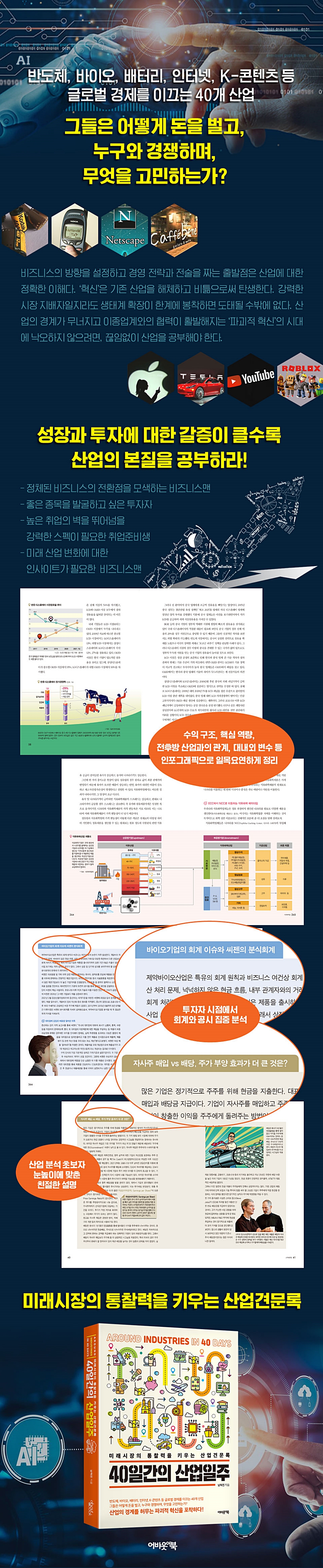
“What is the essence of the ○○ industry?” This is a question the late Chairman Lee Kun-hee asked himself and Samsung executives countless times.
He cited a thorough understanding of the industry as the starting point for setting the direction of a business and developing management strategies and tactics.
Businesses develop and expand as they strive to remain true to the essence of their industry.
New businesses called 'innovation' are also ultimately born by dismantling and distorting existing industries.
The nature of industry is not fixed, but evolves like a living organism.
Even powerful market leaders will lose their competitiveness and be eliminated if they fail to keep pace with the evolving nature of the industry.
A fundamental change in one industry brings about a chain reaction of changes in other industries.
In the 21st century, industrial boundaries are collapsing and collaboration with other industries is becoming more active.
To avoid being left behind in this new era of disruptive innovation, we must constantly study diverse industries, not just our own.
This book analyzes in detail how 40 industries leading the global economy, including semiconductors, bio, batteries, the internet, and K-content, make money, who they compete with, whether changes in their internal and external environments pose a crisis or an opportunity, and what challenges they must overcome to achieve sustained growth.
Your journey through the forest of industry will deepen your understanding of business and economics, giving you the insight to choose sound investments.
For job seekers, this is an opportunity to build the best specifications that cannot be compared to anything else.
The economy is suffering from a triple whammy of exchange rates, inflation, and interest rates, and the stock market is drifting, having lost its direction.
“When the water drains out of the pool, you can see who was swimming naked.” As investment guru Warren Buffett observed, when the liquidity bubble fostered by low interest rates bursts, the true skills of market participants will be revealed.
The best way to weather the economic downturn is not to leave the market, but to strengthen your fundamentals and build up the strength to make a leap forward.
Now is the time to go back to basics and study the essence of industry.
40 Industries Leading the Global Economy
How do they make money, who do they compete with, and what do they worry about?
Capturing disruptive innovations that blur industry boundaries!
“What is the essence of the ○○ industry?” This is a question the late Chairman Lee Kun-hee asked himself and Samsung executives countless times.
He cited a thorough understanding of the industry as the starting point for setting the direction of a business and developing management strategies and tactics.
Businesses develop and expand as they strive to remain true to the essence of their industry.
New businesses called 'innovation' are also ultimately born by dismantling and distorting existing industries.
The nature of industry is not fixed, but evolves like a living organism.
Even powerful market leaders will lose their competitiveness and be eliminated if they fail to keep pace with the evolving nature of the industry.
A fundamental change in one industry brings about a chain reaction of changes in other industries.
In the 21st century, industrial boundaries are collapsing and collaboration with other industries is becoming more active.
To avoid being left behind in this new era of disruptive innovation, we must constantly study diverse industries, not just our own.
This book analyzes in detail how 40 industries leading the global economy, including semiconductors, bio, batteries, the internet, and K-content, make money, who they compete with, whether changes in their internal and external environments pose a crisis or an opportunity, and what challenges they must overcome to achieve sustained growth.
Your journey through the forest of industry will deepen your understanding of business and economics, giving you the insight to choose sound investments.
For job seekers, this is an opportunity to build the best specifications that cannot be compared to anything else.
The economy is suffering from a triple whammy of exchange rates, inflation, and interest rates, and the stock market is drifting, having lost its direction.
“When the water drains out of the pool, you can see who was swimming naked.” As investment guru Warren Buffett observed, when the liquidity bubble fostered by low interest rates bursts, the true skills of market participants will be revealed.
The best way to weather the economic downturn is not to leave the market, but to strengthen your fundamentals and build up the strength to make a leap forward.
Now is the time to go back to basics and study the essence of industry.
- You can preview some of the book's contents.
Preview
index
Chapter 1. IT and Electronics Industry
Day 01.
Telecommunications Industry - Why Telecommunications Companies Are Crying Out 'De-telecommunications'
Day 02.
Internet Service Industry - How to interpret Kakao's PER of 266 times?
[Station] Korea Discount Originates from the Absence of 'G'
Day 03.
Smartphone Industry: The Foldable Era: A Golden Chance to Steal Customers
[Station] Stock Buybacks vs. Dividends: Which Has a Greater Stock Price Boost?
Day 04.
Semiconductor Industry - Can Samsung Electronics' Rush Continue?
Day 05.
Display Up - Beware of the gray rhinoceros from China charging forward without hesitation!
Chapter 2.
financial industry
Day 06.
Banking - a money intermediary that lends money to borrowers
Day 07.
Securities Industry - Did securities firms benefit from BTS's high popularity?
Day 08.
Insurance industry _ Insurance companies are asset management companies that make money from customers' insurance premiums.
Day 09.
Card Industry: Card companies facing increasing pressure from stricter regulations and the advance of big tech.
Day 10.
Installment Lease Business - Capital Companies Face Threats to Their Homelands by Advancing Card Companies
Day 11.
Ritz Up - How to become a building owner for the price of a cup of coffee
Chapter 3.
Content and entertainment industry
Day 12.
Gaming Industry: One Well-Made IP Can Last 20 Years
[Station] Games, the first content to be targeted by the metaverse
Day 13.
Entertainment Industry - Psy's music revenue from [Gangnam Style] is 36 million won?
Day 14.
Film Industry: OTT is Scarier Than the COVID-19 Pandemic
Day 15.
Broadcasting Industry _ [Squid Game] A small ball that was launched into the broadcasting industry
Day 16.
Advertising: Big Tech Joins the Battle for the Advertising Market
[Station] '200 Million Won Per Second': The World's Most Expensive Advertisement
Day 17.
Education Industry: Why Education Stocks Are Soaring Despite a Declining School-Age Population
Day 18.
Travel Industry: Travel Agencies Under Pressure from Airlines, OTAs, and Google
Day 19.
The Evolving Essence of the Hotel Industry: From Real Estate to Brand
Chapter 4.
Construction, heavy industry, and automobile industries
Day 20.
Construction Industry - Why Stock Prices Are Falling Despite Getting Jobs
Day 21.
Shipbuilding Industry: Expected Boom in Orders Riding the Eco-Friendly Wind
Day 22.
Steel Industry: The Butterfly Effect of China's Carbon Reduction Policy
Day 23.
The Automotive Industry: The Third Source of Disruptive Innovation
Day 24.
Batteries, Auto Parts, and Tires: Can Secondary Batteries Become the Next Semiconductor?
Chapter 5.
Energy industry
Day 25.
Oil Refining _ The Many Hands That Shake Oil Prices
Day 26.
Petrochemical Industry: Deepening Concerns About the Carbon-Free Trend
Day 27.
The power industry: an industry facing a huge dilemma called 'nuclear power plants'
Day 28.
City Gas Industry: Signs of Cracks in Monopoly System Due to Growing Demand for Eco-Friendly Energy
Chapter 6.
Distribution and retail (lifestyle) industry
Day 29.
Offline Distribution: How COVID-19 Changed the Distribution Map of South Korea
Day 30.
Online Retailer: The Secret Behind Coupang's Listing on the New York Stock Exchange Just 10 Years After Launch
[Station] A Collector of Businesses Born from E-Commerce
Day 31.
Food and Beverage Industry: A Food War Worse Than the Energy War
Day 32.
Liquor and Tobacco Industry - Sinful Liquors, but a Strong Source of National Taxes
Day 33.
Franchise Business - Starbucks vs. Ediya: Which is More Profitable?
Day 34.
Clothing Industry - Inventory Management Is More Important Than Fashion-Leading Design!
Day 35.
The cosmetics industry: An opportunity to end its long-standing love affair with China and reorganize internally and externally.
Day 36.
Pharmaceutical Industry - Why are all new drug launches carried out by foreign pharmaceutical companies?
[Station] Accounting Issues in Biotech Companies and Seegene's Fraudulent Accounting
Chapter 7.
transportation industry
Day 37.
Aviation Industry: The Impact of Accounting Standard Changes on Airline Stock Prices
Day 38.
Shipping Industry: Why Shipping Company Stocks Are Sluggish Despite Record-Breaking Boom
Day 39.
A modern-day general store that is both a broker and a producer.
Day 40.
Land Transportation: The Secret to Making a Profit Even When Selling at Cost for Online Shopping Malls
Day 01.
Telecommunications Industry - Why Telecommunications Companies Are Crying Out 'De-telecommunications'
Day 02.
Internet Service Industry - How to interpret Kakao's PER of 266 times?
[Station] Korea Discount Originates from the Absence of 'G'
Day 03.
Smartphone Industry: The Foldable Era: A Golden Chance to Steal Customers
[Station] Stock Buybacks vs. Dividends: Which Has a Greater Stock Price Boost?
Day 04.
Semiconductor Industry - Can Samsung Electronics' Rush Continue?
Day 05.
Display Up - Beware of the gray rhinoceros from China charging forward without hesitation!
Chapter 2.
financial industry
Day 06.
Banking - a money intermediary that lends money to borrowers
Day 07.
Securities Industry - Did securities firms benefit from BTS's high popularity?
Day 08.
Insurance industry _ Insurance companies are asset management companies that make money from customers' insurance premiums.
Day 09.
Card Industry: Card companies facing increasing pressure from stricter regulations and the advance of big tech.
Day 10.
Installment Lease Business - Capital Companies Face Threats to Their Homelands by Advancing Card Companies
Day 11.
Ritz Up - How to become a building owner for the price of a cup of coffee
Chapter 3.
Content and entertainment industry
Day 12.
Gaming Industry: One Well-Made IP Can Last 20 Years
[Station] Games, the first content to be targeted by the metaverse
Day 13.
Entertainment Industry - Psy's music revenue from [Gangnam Style] is 36 million won?
Day 14.
Film Industry: OTT is Scarier Than the COVID-19 Pandemic
Day 15.
Broadcasting Industry _ [Squid Game] A small ball that was launched into the broadcasting industry
Day 16.
Advertising: Big Tech Joins the Battle for the Advertising Market
[Station] '200 Million Won Per Second': The World's Most Expensive Advertisement
Day 17.
Education Industry: Why Education Stocks Are Soaring Despite a Declining School-Age Population
Day 18.
Travel Industry: Travel Agencies Under Pressure from Airlines, OTAs, and Google
Day 19.
The Evolving Essence of the Hotel Industry: From Real Estate to Brand
Chapter 4.
Construction, heavy industry, and automobile industries
Day 20.
Construction Industry - Why Stock Prices Are Falling Despite Getting Jobs
Day 21.
Shipbuilding Industry: Expected Boom in Orders Riding the Eco-Friendly Wind
Day 22.
Steel Industry: The Butterfly Effect of China's Carbon Reduction Policy
Day 23.
The Automotive Industry: The Third Source of Disruptive Innovation
Day 24.
Batteries, Auto Parts, and Tires: Can Secondary Batteries Become the Next Semiconductor?
Chapter 5.
Energy industry
Day 25.
Oil Refining _ The Many Hands That Shake Oil Prices
Day 26.
Petrochemical Industry: Deepening Concerns About the Carbon-Free Trend
Day 27.
The power industry: an industry facing a huge dilemma called 'nuclear power plants'
Day 28.
City Gas Industry: Signs of Cracks in Monopoly System Due to Growing Demand for Eco-Friendly Energy
Chapter 6.
Distribution and retail (lifestyle) industry
Day 29.
Offline Distribution: How COVID-19 Changed the Distribution Map of South Korea
Day 30.
Online Retailer: The Secret Behind Coupang's Listing on the New York Stock Exchange Just 10 Years After Launch
[Station] A Collector of Businesses Born from E-Commerce
Day 31.
Food and Beverage Industry: A Food War Worse Than the Energy War
Day 32.
Liquor and Tobacco Industry - Sinful Liquors, but a Strong Source of National Taxes
Day 33.
Franchise Business - Starbucks vs. Ediya: Which is More Profitable?
Day 34.
Clothing Industry - Inventory Management Is More Important Than Fashion-Leading Design!
Day 35.
The cosmetics industry: An opportunity to end its long-standing love affair with China and reorganize internally and externally.
Day 36.
Pharmaceutical Industry - Why are all new drug launches carried out by foreign pharmaceutical companies?
[Station] Accounting Issues in Biotech Companies and Seegene's Fraudulent Accounting
Chapter 7.
transportation industry
Day 37.
Aviation Industry: The Impact of Accounting Standard Changes on Airline Stock Prices
Day 38.
Shipping Industry: Why Shipping Company Stocks Are Sluggish Despite Record-Breaking Boom
Day 39.
A modern-day general store that is both a broker and a producer.
Day 40.
Land Transportation: The Secret to Making a Profit Even When Selling at Cost for Online Shopping Malls
Detailed image
Publisher's Review
◎ “Understand the essence of industry!”
The late Chairman Lee Kun-hee's management motto remains relevant even in the era of the Fourth Industrial Revolution.
“What is the essence of the ○○ industry?” This is a question the late Chairman Lee Kun-hee asked himself and Samsung executives countless times.
He cited a thorough understanding of the industry as the starting point for setting the direction of a business and developing management strategies and tactics.
In the late 1980s, Chairman Lee asked about the essence of the hotel industry during a meeting with Hotel Shilla executives.
The executive answered, “Service industry.”
The chairman, who could not agree with this, gave the task of finding the essence of the hotel industry.
An executive who toured famous hotels overseas and investigated the factors affecting hotel sales came up with a different answer: “The essence of the hotel industry is real estate.”
He explained that this is because the customers recruited differ depending on the hotel's location, and the service must also be adjusted accordingly.
Only then did Chairman Lee nod and give instructions to develop a specific strategy for the hotel industry, focusing on its essence as the "real estate industry."
The reason I bring up this old story again is because Chairman Lee Kun-hee's management motto, "Penetrate the essence of industry!", is still relevant today.
Accurately understanding the nature of an industry is crucial to the success or failure of a business.
Depending on where you focus, the direction of your business will differ significantly.
Businesses develop and expand as they strive to stay true to the essence of their industry.
The Fourth Industrial Revolution, driven by artificial intelligence, autonomous driving, blockchain, and digital transformation, is no different.
This book analyzes in detail how 40 industries leading the global economy, including semiconductors, bio, batteries, the internet, and K-content, make money, who they compete with, whether changes in their internal and external environments pose a crisis or an opportunity, and what challenges they must overcome to achieve sustained growth.
It also includes investment issues and agendas, including ESG trends and the industrial landscape that will be transformed by autonomous driving technology.
◎ Capturing disruptive innovations that break down industry boundaries!
The nature of industry is not fixed, but evolves like a living organism.
In response to the irreversible trend of environmental friendliness, oil companies are seeking change by all promoting 'de-oil'.
In 2021, Kia Motors removed the word "automobile" from its mission statement and declared its transformation from an internal combustion engine vehicle manufacturer to a mobility company focused on future vehicles.
Coupang has redefining the essence of the retail industry as a "traffic business that attracts people through shopping," leading to a paradigm shift in the Korean retail industry.
Even powerful market leaders will lose their competitiveness and be eliminated if they fail to keep pace with the changing nature of the industry.
All industries are connected to various other industries in both forward and backward directions, forming organic relationships.
Therefore, a fundamental change in one industry brings about a chain reaction of changes in other industries.
In the 21st century, industrial boundaries are collapsing and collaboration with other industries is becoming more active.
Amidst these changing business environments, the industry's profit structure, upstream and downstream industries, and core competencies are constantly changing.
To meet the era of autonomous driving, Tesla has installed a platform in its vehicles that allows users to enjoy various games in the car.
Hyundai Motor Company has signed a business agreement with CJ ENM to enable OTT viewing in cars.
We have now entered an era where industry boundaries are collapsing, with content industries such as games, movies, and music competing or cooperating with the automobile industry.
To avoid being left behind in this new era of disruptive innovation, we must constantly study diverse industries, not just our own.
◎ The greater your thirst for successful investment, the more you should study the essence of the industry!
The number of stock investors has exploded since COVID-19.
How did individual investors perform? The fruits of the stock price surge were monopolized by institutional and foreign investors.
According to the Korea Exchange, the average return on the top 10 stocks net purchased by individual investors in the domestic stock market was -20.9%.
On the other hand, foreign investors recorded an average return of +15%, and institutional investors recorded an average return of +14.4%.
Institutional and foreign investors did not monopolize profits solely through their overwhelming financial power.
Institutional and foreign investors also have an information advantage over individual investors.
Institutions and foreign investors mobilize all their resources to analyze markets and companies.
In contrast, the efforts individual investors put into stock investment fell short of their aspirations for high returns.
There were countless investors who blindly bought stocks recommended by leading brokers, even taking out loans to invest, or made blind investments without even reading the business reports and financial statements of the companies they were investing in.
A typical method for selecting good stocks is industry analysis.
The reason it's important to look at the industry as a whole before researching a company is that even if a leading company's market share continues to increase, if the "industry," which corresponds to the "forest," is stagnant, it's difficult to guarantee that the stock price will rise.
You can't predict Samsung Electronics' stock price movement by just focusing on it.
We must comprehensively examine the micro- and macro-level environments surrounding the company, including market trends in the semiconductor industry over the past decade, upstream industries that could become new demand sources like electric vehicles, the technological advancements in downstream industries like displays and cameras, smartphone penetration rates in developing countries, and the strategies of competing companies.
Even in the process of determining the timing of buying and selling, you can make rational decisions when you have a clear understanding of the industry's trends.
There are many accounting problems that are difficult to interpret without knowing the unique characteristics of the industry.
Understanding the sales recognition methods and differences specific to the distribution industry is essential to filtering out "sales illusions" appearing in e-commerce companies' financial statements. Furthermore, understanding the order-based industry is essential to properly analyzing a shipbuilding company's financial statements.
Only by understanding the industry can one correctly interpret the accounting characteristics that appear in each industry.
◎ When the water in the pool drains, it is a chance to rebound.
Industry analysis can be a valuable tool for anyone preparing to launch a startup or considering expanding a stagnant business.
Startups that are now giants—Airbnb, Netflix, Twitch—all achieved success by disrupting their competitors' business models.
By understanding the profit structure of existing industries and addressing customer inconveniences and inefficiencies, they were able to emerge as leading companies.
For job seekers, industrial analysis skills are a powerful skill that can help them overcome the high barriers to employment.
It is essential to have a thorough understanding of the companies you are applying to through industry analysis.
When you can clearly see through the labyrinthine industrial flow, you can think creatively and revitalize a stagnant business.
Even if two people are laying bricks, the results of their work will be different for someone who thinks they are simply laying bricks and for someone who thinks they are building a building.
Our economy is currently suffering from a triple whammy of exchange rates, inflation, and interest rates, and the stock market is drifting without direction.
“When the water drains out of the pool, you can see who was swimming naked.” As investment guru Warren Buffett observed, when the liquidity bubble fostered by low interest rates bursts, the true skills of market participants will be revealed.
As we've learned from a series of events, including the 2008 global financial crisis and the COVID-19 pandemic, a recession is an opportunity for recovery for those who are prepared.
The best way to weather the economic downturn is not to leave the market, but to strengthen your fundamentals and build up the strength to make a leap forward.
Now is the time to go back to basics and study the essence of industry.
The late Chairman Lee Kun-hee's management motto remains relevant even in the era of the Fourth Industrial Revolution.
“What is the essence of the ○○ industry?” This is a question the late Chairman Lee Kun-hee asked himself and Samsung executives countless times.
He cited a thorough understanding of the industry as the starting point for setting the direction of a business and developing management strategies and tactics.
In the late 1980s, Chairman Lee asked about the essence of the hotel industry during a meeting with Hotel Shilla executives.
The executive answered, “Service industry.”
The chairman, who could not agree with this, gave the task of finding the essence of the hotel industry.
An executive who toured famous hotels overseas and investigated the factors affecting hotel sales came up with a different answer: “The essence of the hotel industry is real estate.”
He explained that this is because the customers recruited differ depending on the hotel's location, and the service must also be adjusted accordingly.
Only then did Chairman Lee nod and give instructions to develop a specific strategy for the hotel industry, focusing on its essence as the "real estate industry."
The reason I bring up this old story again is because Chairman Lee Kun-hee's management motto, "Penetrate the essence of industry!", is still relevant today.
Accurately understanding the nature of an industry is crucial to the success or failure of a business.
Depending on where you focus, the direction of your business will differ significantly.
Businesses develop and expand as they strive to stay true to the essence of their industry.
The Fourth Industrial Revolution, driven by artificial intelligence, autonomous driving, blockchain, and digital transformation, is no different.
This book analyzes in detail how 40 industries leading the global economy, including semiconductors, bio, batteries, the internet, and K-content, make money, who they compete with, whether changes in their internal and external environments pose a crisis or an opportunity, and what challenges they must overcome to achieve sustained growth.
It also includes investment issues and agendas, including ESG trends and the industrial landscape that will be transformed by autonomous driving technology.
◎ Capturing disruptive innovations that break down industry boundaries!
The nature of industry is not fixed, but evolves like a living organism.
In response to the irreversible trend of environmental friendliness, oil companies are seeking change by all promoting 'de-oil'.
In 2021, Kia Motors removed the word "automobile" from its mission statement and declared its transformation from an internal combustion engine vehicle manufacturer to a mobility company focused on future vehicles.
Coupang has redefining the essence of the retail industry as a "traffic business that attracts people through shopping," leading to a paradigm shift in the Korean retail industry.
Even powerful market leaders will lose their competitiveness and be eliminated if they fail to keep pace with the changing nature of the industry.
All industries are connected to various other industries in both forward and backward directions, forming organic relationships.
Therefore, a fundamental change in one industry brings about a chain reaction of changes in other industries.
In the 21st century, industrial boundaries are collapsing and collaboration with other industries is becoming more active.
Amidst these changing business environments, the industry's profit structure, upstream and downstream industries, and core competencies are constantly changing.
To meet the era of autonomous driving, Tesla has installed a platform in its vehicles that allows users to enjoy various games in the car.
Hyundai Motor Company has signed a business agreement with CJ ENM to enable OTT viewing in cars.
We have now entered an era where industry boundaries are collapsing, with content industries such as games, movies, and music competing or cooperating with the automobile industry.
To avoid being left behind in this new era of disruptive innovation, we must constantly study diverse industries, not just our own.
◎ The greater your thirst for successful investment, the more you should study the essence of the industry!
The number of stock investors has exploded since COVID-19.
How did individual investors perform? The fruits of the stock price surge were monopolized by institutional and foreign investors.
According to the Korea Exchange, the average return on the top 10 stocks net purchased by individual investors in the domestic stock market was -20.9%.
On the other hand, foreign investors recorded an average return of +15%, and institutional investors recorded an average return of +14.4%.
Institutional and foreign investors did not monopolize profits solely through their overwhelming financial power.
Institutional and foreign investors also have an information advantage over individual investors.
Institutions and foreign investors mobilize all their resources to analyze markets and companies.
In contrast, the efforts individual investors put into stock investment fell short of their aspirations for high returns.
There were countless investors who blindly bought stocks recommended by leading brokers, even taking out loans to invest, or made blind investments without even reading the business reports and financial statements of the companies they were investing in.
A typical method for selecting good stocks is industry analysis.
The reason it's important to look at the industry as a whole before researching a company is that even if a leading company's market share continues to increase, if the "industry," which corresponds to the "forest," is stagnant, it's difficult to guarantee that the stock price will rise.
You can't predict Samsung Electronics' stock price movement by just focusing on it.
We must comprehensively examine the micro- and macro-level environments surrounding the company, including market trends in the semiconductor industry over the past decade, upstream industries that could become new demand sources like electric vehicles, the technological advancements in downstream industries like displays and cameras, smartphone penetration rates in developing countries, and the strategies of competing companies.
Even in the process of determining the timing of buying and selling, you can make rational decisions when you have a clear understanding of the industry's trends.
There are many accounting problems that are difficult to interpret without knowing the unique characteristics of the industry.
Understanding the sales recognition methods and differences specific to the distribution industry is essential to filtering out "sales illusions" appearing in e-commerce companies' financial statements. Furthermore, understanding the order-based industry is essential to properly analyzing a shipbuilding company's financial statements.
Only by understanding the industry can one correctly interpret the accounting characteristics that appear in each industry.
◎ When the water in the pool drains, it is a chance to rebound.
Industry analysis can be a valuable tool for anyone preparing to launch a startup or considering expanding a stagnant business.
Startups that are now giants—Airbnb, Netflix, Twitch—all achieved success by disrupting their competitors' business models.
By understanding the profit structure of existing industries and addressing customer inconveniences and inefficiencies, they were able to emerge as leading companies.
For job seekers, industrial analysis skills are a powerful skill that can help them overcome the high barriers to employment.
It is essential to have a thorough understanding of the companies you are applying to through industry analysis.
When you can clearly see through the labyrinthine industrial flow, you can think creatively and revitalize a stagnant business.
Even if two people are laying bricks, the results of their work will be different for someone who thinks they are simply laying bricks and for someone who thinks they are building a building.
Our economy is currently suffering from a triple whammy of exchange rates, inflation, and interest rates, and the stock market is drifting without direction.
“When the water drains out of the pool, you can see who was swimming naked.” As investment guru Warren Buffett observed, when the liquidity bubble fostered by low interest rates bursts, the true skills of market participants will be revealed.
As we've learned from a series of events, including the 2008 global financial crisis and the COVID-19 pandemic, a recession is an opportunity for recovery for those who are prepared.
The best way to weather the economic downturn is not to leave the market, but to strengthen your fundamentals and build up the strength to make a leap forward.
Now is the time to go back to basics and study the essence of industry.
GOODS SPECIFICS
- Publication date: July 28, 2022
- Page count, weight, size: 406 pages | 754g | 172*235*27mm
- ISBN13: 9791192229089
- ISBN10: 1192229088
You may also like
카테고리
korean


korean

![GQ KOREA Mark (Monthly): December [2025]](http://librairie.coreenne.fr/cdn/shop/files/8ef265dbbfbf186523ed75ba7319009d.jpg?v=1765340328&width=3840)


