

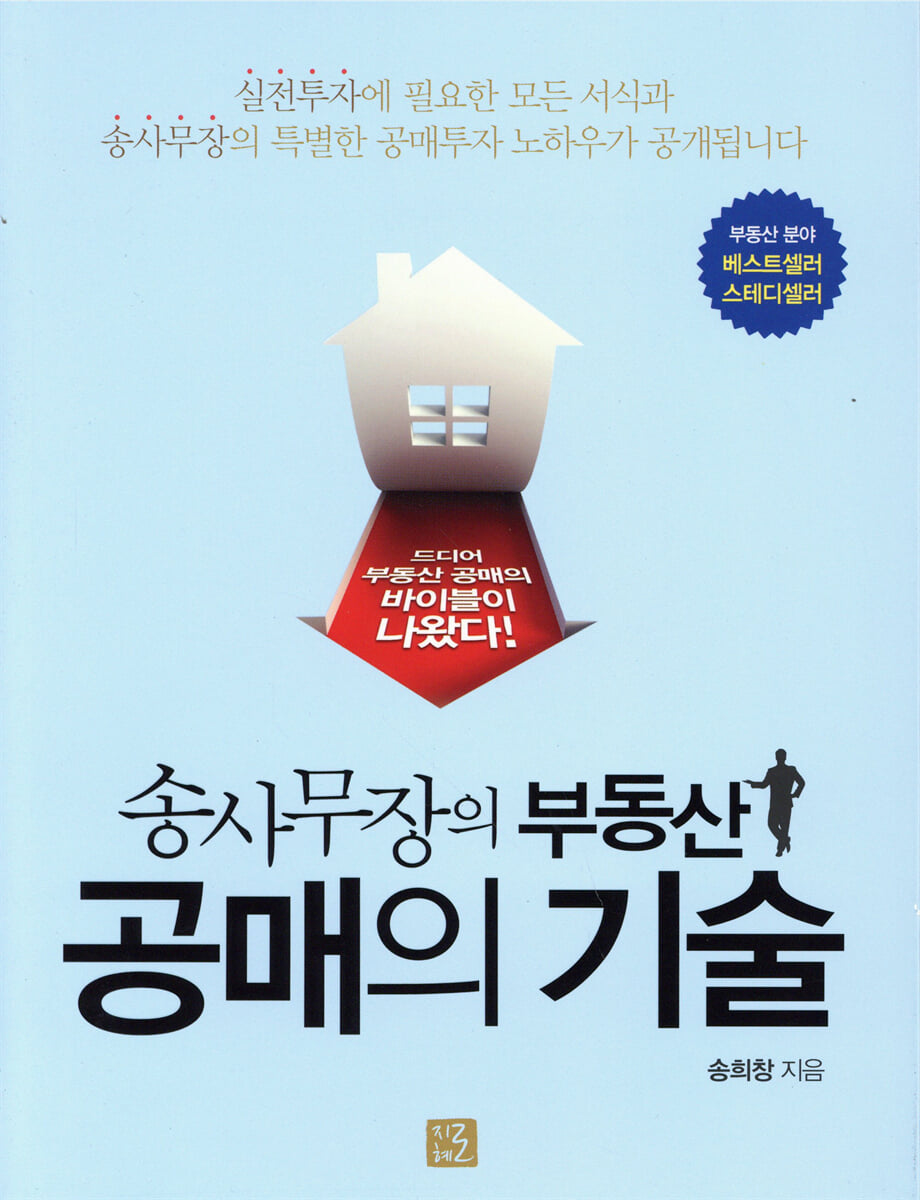
Songsamujang's Real Estate Auction Techniques
 |
Description
Book Introduction
The author, known as an expert in the field of real estate auctions, has published a book that can be used as a guide to investing in public auctions.
This book, which has been consistently loved by readers since its first publication in 2012 and has been a bestseller for five consecutive years, was recently republished in a revised edition in 2017 to reflect the revision of the National Tax Collection Act and the reorganization of the Onbid website.
This book covers the essential theories of short-term investment that investors need to know, along with the author's various practical examples. The columns also provide a glimpse into important investment considerations and short-term investment know-how.
Additionally, the various inserted forms are ones that investors can immediately use in practice when investing in real estate auctions.
This book, which has been consistently loved by readers since its first publication in 2012 and has been a bestseller for five consecutive years, was recently republished in a revised edition in 2017 to reflect the revision of the National Tax Collection Act and the reorganization of the Onbid website.
This book covers the essential theories of short-term investment that investors need to know, along with the author's various practical examples. The columns also provide a glimpse into important investment considerations and short-term investment know-how.
Additionally, the various inserted forms are ones that investors can immediately use in practice when investing in real estate auctions.
- You can preview some of the book's contents.
Preview
index
Prologue: The Art of Auctioning
Practice 01: Earn 10 Million Won with Just 700 Won
【PART 1】 Introduction to Auctions and the Selling Process
Practice 02: Use auction information to overcome the complexities of public auctions.
Applying Supreme Court precedents to practice
【PART 2】 Search Tips for Auctioned Properties
Practice 03: To invest successfully, first understand the causes of failed bids.
How to Win a Column Bid
【PART 3】Tips for Analyzing Rights in Auctioned Real Estate
Practice 04: If you've won the bid by mistake, cancel it.
【PART 4】On-site inspection and bidding tips for public auction properties
Practice 05: Buying a Commercial Property Through Public Auction
How to Get a Column Loan
【PART 5】Decision to Sell Auctioned Property
Practice 06 · The real opportunity is when no one is paying attention.
Column: When is the best time to sell?
【PART 6】Payment of Auctioned Property and Cancellation of Sale Decision
Practice 07: Don't blindly trust auction appraisals.
【PART 7】Distribution of the sale proceeds of public auctioned properties
Practice 08 · Cases where the sale decision is cancelled even after winning the bid (share, priority registration)
【PART 8】Distribution Methods for Sold Real Estate
Practice 09 · Returning the property to the owner after winning the auction
【PART 9】 Three Invisible Pitfalls of Public Auctions
Practice 10: Take on the new field of trust auctions.
【PART 10】 The Art of Clearing the Name of Publicly Auctioned Real Estate
Practice 11: Become the Owner of 50 Apartments Through Trust Property Auctions
When column investing feels difficult and challenging
【PART 11】 Legal Procedures After the Auction
Concluding the epilogue
【Data】Practical format used by Song Sa-mu-jang
Form 1 - Confirmation of Occupancy (Tenant)
Form 2 - Notice of Intended Enforcement
Form 3 - Distribution Request (Tenant)
Form 4 - Application for Cancellation of Sale Decision
Form 5 - Agreement (Tenant)
Form 6 - Landlord Agreement (Owner)
Form 7 - Consent to Cancel Sale Decision
Form 8 - Fact Check
Format 9 - Certified Contents (Possessor's Refusal to Obtain Title)
Form 10 - Certified Contents (Receiving Tenant)
Form 11 - Certified Mail (Notice of Intended Litigation)
Form 12 - Application for Injunction Against Transfer of Possession
Form 13 - Petition (Request for Building Name, etc.)
Form 14 - Supreme Order (Disposition of Tangible Property)
Practice 01: Earn 10 Million Won with Just 700 Won
【PART 1】 Introduction to Auctions and the Selling Process
Practice 02: Use auction information to overcome the complexities of public auctions.
Applying Supreme Court precedents to practice
【PART 2】 Search Tips for Auctioned Properties
Practice 03: To invest successfully, first understand the causes of failed bids.
How to Win a Column Bid
【PART 3】Tips for Analyzing Rights in Auctioned Real Estate
Practice 04: If you've won the bid by mistake, cancel it.
【PART 4】On-site inspection and bidding tips for public auction properties
Practice 05: Buying a Commercial Property Through Public Auction
How to Get a Column Loan
【PART 5】Decision to Sell Auctioned Property
Practice 06 · The real opportunity is when no one is paying attention.
Column: When is the best time to sell?
【PART 6】Payment of Auctioned Property and Cancellation of Sale Decision
Practice 07: Don't blindly trust auction appraisals.
【PART 7】Distribution of the sale proceeds of public auctioned properties
Practice 08 · Cases where the sale decision is cancelled even after winning the bid (share, priority registration)
【PART 8】Distribution Methods for Sold Real Estate
Practice 09 · Returning the property to the owner after winning the auction
【PART 9】 Three Invisible Pitfalls of Public Auctions
Practice 10: Take on the new field of trust auctions.
【PART 10】 The Art of Clearing the Name of Publicly Auctioned Real Estate
Practice 11: Become the Owner of 50 Apartments Through Trust Property Auctions
When column investing feels difficult and challenging
【PART 11】 Legal Procedures After the Auction
Concluding the epilogue
【Data】Practical format used by Song Sa-mu-jang
Form 1 - Confirmation of Occupancy (Tenant)
Form 2 - Notice of Intended Enforcement
Form 3 - Distribution Request (Tenant)
Form 4 - Application for Cancellation of Sale Decision
Form 5 - Agreement (Tenant)
Form 6 - Landlord Agreement (Owner)
Form 7 - Consent to Cancel Sale Decision
Form 8 - Fact Check
Format 9 - Certified Contents (Possessor's Refusal to Obtain Title)
Form 10 - Certified Contents (Receiving Tenant)
Form 11 - Certified Mail (Notice of Intended Litigation)
Form 12 - Application for Injunction Against Transfer of Possession
Form 13 - Petition (Request for Building Name, etc.)
Form 14 - Supreme Order (Disposition of Tangible Property)
Publisher's Review
The bible of real estate auctions, never before seen, has been released!
Short-term investment techniques and a variety of practical examples that are incomparable to existing books!
The story of real estate auctions told by Song Samujang, a real-world investment expert!
The author shares vivid stories from his diverse real-world experiences in real estate auction investment, including earning 10 million won with just 700 won, becoming the owner of 50 apartments through trust auctions, venturing into the new field of trust auctions, purchasing commercial properties through auctions, and canceling bids that were incorrectly awarded.
Opportunities exist where there is less competition!
Anyone who sees a low bid price for a public auction item would have no choice but to start investing in the public auction.
But when I actually started studying for the auction with confidence, it was a daunting task from the start.
This is because there is no book that properly covers real estate auctions, and there are no lectures that provide in-depth learning.
There was absolutely no way to build up systematic knowledge about public auctions.
But the author did not give up, but rather dug deeper.
I thought that since even I, a full-time investor, had a hard time obtaining information, how much more difficult would it be for others?
While writing 'The Art of Auctioning,' the author went back to the beginning and recalled the things he was curious about when he first started out in auctioning.
In the book, I looked back on the obstacles I encountered in the field and the expert advice I desperately wanted at the time, and wrote them down as they were.
The auction cases presented in this way are diverse, including not only seized property but also trust auctions and trust property, allowing readers to gain a wide range of indirect experience.
All of these cases, like Auction Techniques 1 and 2, are based on cases that the author personally handled through public auctions until recently, so you will be able to read them with a vivid sense of presence.
When investing in public auctions, the winning bidder's ability to make a profit is very important.
The biggest concern investors have about short sales is probably the visibility.
This is because there is no ‘delivery order’ system in public auctions, which allows for relatively simple handling when transferring possession after a successful bid.
As a result, a lawsuit must be filed in court at the time of the incident, but for the general public, a lawsuit still feels like a distant dream.
However, the author says that short-term investment is not that difficult.
In the author's experience, if the successful bidder identifies the occupant and takes appropriate measures, including legal procedures, depending on the situation, the title of the auctioned property can be resolved without much difficulty.
He emphasized that if the successful bidder has the “proper skills,” he can reach an amicable agreement with the occupant in the case of a public auction, and that the time required for the transaction is not much different from that required for an auction, and that the most important thing in a public auction is not the system, but the successful bidder’s ability to judge the situation and respond accordingly.
I've covered this method in more detail in the "Technology of Brightness" section, so I'm confident it will be of great help to many investors if you read that section repeatedly to see if it's helpful in practice.
Short-term investment techniques and a variety of practical examples that are incomparable to existing books!
The story of real estate auctions told by Song Samujang, a real-world investment expert!
The author shares vivid stories from his diverse real-world experiences in real estate auction investment, including earning 10 million won with just 700 won, becoming the owner of 50 apartments through trust auctions, venturing into the new field of trust auctions, purchasing commercial properties through auctions, and canceling bids that were incorrectly awarded.
Opportunities exist where there is less competition!
Anyone who sees a low bid price for a public auction item would have no choice but to start investing in the public auction.
But when I actually started studying for the auction with confidence, it was a daunting task from the start.
This is because there is no book that properly covers real estate auctions, and there are no lectures that provide in-depth learning.
There was absolutely no way to build up systematic knowledge about public auctions.
But the author did not give up, but rather dug deeper.
I thought that since even I, a full-time investor, had a hard time obtaining information, how much more difficult would it be for others?
While writing 'The Art of Auctioning,' the author went back to the beginning and recalled the things he was curious about when he first started out in auctioning.
In the book, I looked back on the obstacles I encountered in the field and the expert advice I desperately wanted at the time, and wrote them down as they were.
The auction cases presented in this way are diverse, including not only seized property but also trust auctions and trust property, allowing readers to gain a wide range of indirect experience.
All of these cases, like Auction Techniques 1 and 2, are based on cases that the author personally handled through public auctions until recently, so you will be able to read them with a vivid sense of presence.
When investing in public auctions, the winning bidder's ability to make a profit is very important.
The biggest concern investors have about short sales is probably the visibility.
This is because there is no ‘delivery order’ system in public auctions, which allows for relatively simple handling when transferring possession after a successful bid.
As a result, a lawsuit must be filed in court at the time of the incident, but for the general public, a lawsuit still feels like a distant dream.
However, the author says that short-term investment is not that difficult.
In the author's experience, if the successful bidder identifies the occupant and takes appropriate measures, including legal procedures, depending on the situation, the title of the auctioned property can be resolved without much difficulty.
He emphasized that if the successful bidder has the “proper skills,” he can reach an amicable agreement with the occupant in the case of a public auction, and that the time required for the transaction is not much different from that required for an auction, and that the most important thing in a public auction is not the system, but the successful bidder’s ability to judge the situation and respond accordingly.
I've covered this method in more detail in the "Technology of Brightness" section, so I'm confident it will be of great help to many investors if you read that section repeatedly to see if it's helpful in practice.
GOODS SPECIFICS
- Date of publication: December 28, 2016
- Page count, weight, size: 456 pages | 638g | 170*225*25mm
- ISBN13: 9791187799016
- ISBN10: 1187799017
You may also like
카테고리
korean


korean

![GQ KOREA Mark (Monthly): December [2025]](http://librairie.coreenne.fr/cdn/shop/files/8ef265dbbfbf186523ed75ba7319009d.jpg?v=1765340328&width=3840)


