

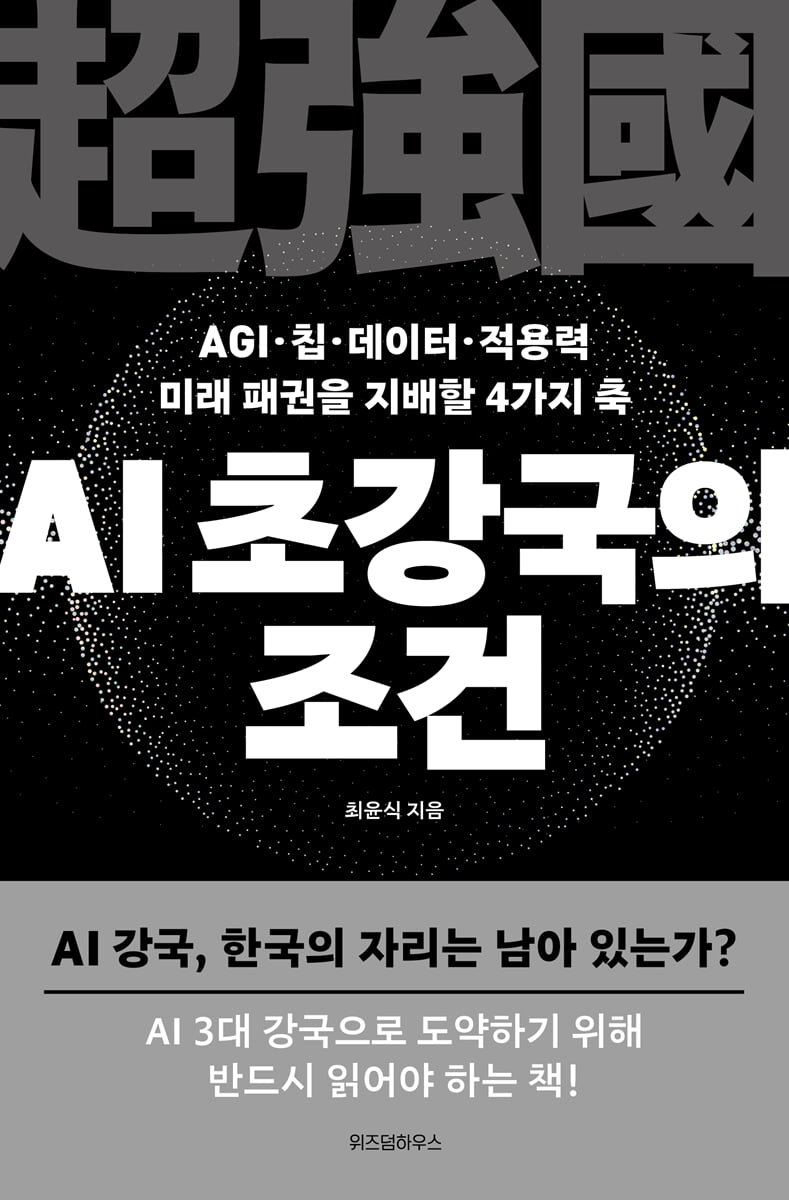
Conditions for an AI superpower
 |
Description
Book Introduction
Will the future that will enter our homes be Tesla from the US or Unitri from China?
Digital Imperialism vs.
Digital Tribute System: The AI Superpowers the US and China Dream of
The battle between Tesla's Optimus and China's Unitri's G1 in the robotics market is a microcosm of the AI war.
While Optimus aims to be a robot close to AGI with high autonomy and versatility, G1 aims for rapid commercialization with cost-effectiveness and practicality in specific fields.
The United States is building a superintelligence infrastructure through the Stargate Project, a combination of private innovation and large capital.
China is responding with a state-led 10 million-robot project and its "Made in China 2025" strategy.
Ultimately, this conflict is not simply a competition for hegemony.
It is a civilizational conflict over what kind of world order humanity will live in.
In this book, author Choi Yun-sik, Korea's leading futurist, analyzes the new world order that AI will create from various angles.
Readers will learn what is happening now in the world of AGI, robots, and data-driven world, and what the conditions and strategies are for survival.
We will also witness firsthand how AI will reshape industries, the military, and life beyond software, and gain insights into how individuals and organizations should prepare for this transformation.
Digital Imperialism vs.
Digital Tribute System: The AI Superpowers the US and China Dream of
The battle between Tesla's Optimus and China's Unitri's G1 in the robotics market is a microcosm of the AI war.
While Optimus aims to be a robot close to AGI with high autonomy and versatility, G1 aims for rapid commercialization with cost-effectiveness and practicality in specific fields.
The United States is building a superintelligence infrastructure through the Stargate Project, a combination of private innovation and large capital.
China is responding with a state-led 10 million-robot project and its "Made in China 2025" strategy.
Ultimately, this conflict is not simply a competition for hegemony.
It is a civilizational conflict over what kind of world order humanity will live in.
In this book, author Choi Yun-sik, Korea's leading futurist, analyzes the new world order that AI will create from various angles.
Readers will learn what is happening now in the world of AGI, robots, and data-driven world, and what the conditions and strategies are for survival.
We will also witness firsthand how AI will reshape industries, the military, and life beyond software, and gain insights into how individuals and organizations should prepare for this transformation.
- You can preview some of the book's contents.
Preview
index
Prologue: The Challenge of Becoming an AI Superpower
Chapter 1: The US vs. China: Who Will Win AI Hegemony?
AI Wars: The Ultimate Winner
Scenarios for the US-China AGI Competition | Who Has the Qualities to Become an AI Superpower? | Where the Money Will Grow
Chapter 2: The War for AGI Hegemony
Is superintelligence a technological god or a weapon of destruction?
America's AGI Architecture | China's AGI Strategy | The Truth About AI Chip Technology Spying | AGI on Chips | Who Will Secure the Future of Chip Hegemony?
Chapter 3: Humanoid Robots: Shaping the Future
Will American Tesla beat China's Unitree?
Tesla's other competitor, Nvidia | Is China Destroying American Manufacturing? | The Real Strategy for America's Manufacturing Empire's Resurgence | Trump's Stargate Project | China's 10 Million Robotic Process Project | What if Chinese Robots Enter Our Homes in 2035?
Chapter 4: Smart Mobility, Dominating the Road
He who rules the road has hegemony.
Mastering the New Path | The Key to Sky Dominance: The Drone Corps | Trump's Golden Dome Plan
Epilogue: How Should We Live in the Age of AGI War?
Chapter 1: The US vs. China: Who Will Win AI Hegemony?
AI Wars: The Ultimate Winner
Scenarios for the US-China AGI Competition | Who Has the Qualities to Become an AI Superpower? | Where the Money Will Grow
Chapter 2: The War for AGI Hegemony
Is superintelligence a technological god or a weapon of destruction?
America's AGI Architecture | China's AGI Strategy | The Truth About AI Chip Technology Spying | AGI on Chips | Who Will Secure the Future of Chip Hegemony?
Chapter 3: Humanoid Robots: Shaping the Future
Will American Tesla beat China's Unitree?
Tesla's other competitor, Nvidia | Is China Destroying American Manufacturing? | The Real Strategy for America's Manufacturing Empire's Resurgence | Trump's Stargate Project | China's 10 Million Robotic Process Project | What if Chinese Robots Enter Our Homes in 2035?
Chapter 4: Smart Mobility, Dominating the Road
He who rules the road has hegemony.
Mastering the New Path | The Key to Sky Dominance: The Drone Corps | Trump's Golden Dome Plan
Epilogue: How Should We Live in the Age of AGI War?
Detailed image

Into the book
The foundation of AI competitiveness is data.
Securing high-quality data requires regulatory reform, support for data purchases, and reprocessing of public data.
Government investment must also be proactive and consistent to prepare for future technology areas where private investment is difficult, especially in the era of universal humanoids becoming commonplace.
Policies must look beyond the present to the future, or we will never catch up with the United States and China.
What we face is not simply a technological competition.
A future where the abstract concept of intelligence merges with the Earth's physical and informational foundations, creating a completely new layer of perception.
The analysis contained in this book is the reality of a fierce battle that goes beyond competition and can be called a war.
To survive this war, we must also shift our attitude towards it to 'war mode'.
--- p.7
The AI war is bound to be fierce.
The United States opened the floodgates.
In October 2022, the United States imposed export controls on advanced semiconductors to China, effectively blocking imports of key AI hardware.
At the same time, by taking control of the global supply chain with its allies, it has blocked China's own production of advanced chips and even alternative sourcing.
It is difficult to train a super-large AI model without the latest GPUs from Nvidia or AMD, and China is highly dependent on American semiconductors, to the point that almost all of the 97 AI chips used by the Chinese military in 2022 were made by American companies.
In response, China also responded by controlling exports of key materials such as rare earth elements.
In order to overcome the slowdown in AI development caused by export controls, the company evaded sanctions through smuggling and accelerated its own semiconductor development.
--- p.14
In the economy, as the benefits of AGI spread across the globe, the fruits are divided between the United States and China.
As both the US and China leverage AGI to achieve explosive productivity increases, the global economy will enjoy a long-term boom.
The GDP of both countries is rising competitively, and the wave of AI innovation is changing the industrial landscape.
While the US leads in finance and software, China leads in manufacturing and infrastructure, demonstrating a division of labor advantage.
The global corporate ecosystem is also becoming more bifurcated, growing within the technological standards and market influence of the US and China.
The US camp uses English-based AGI services and semiconductor standards, while the Chinese camp builds a Chinese-based AGI and its own chip ecosystem.
Both sides develop their own AGI economies while blocking the other bloc's technology, but overall wealth expands and world trade actually expands.
However, even in this prosperity, the essence of competition for hegemony remains.
The United States and China will begin a war of nerves again, competing for supremacy in more advanced AI technologies, such as hyper-AGI or singularity technology.
--- p.29
This is why I wrote this book.
Over the next decade, the rapid advancement of AI technology will have a significant impact on the global macroeconomy, transcending individual industries and contributing to GDP growth, improving productivity, shifting employment structures, and restructuring industrial structures.
In 2017, PwC estimated that AI could boost global GDP by an additional 14 percent by 2030, generating an economic impact of approximately $15.7 trillion.
This is larger than the combined GDP of China and India. Analysts estimate that approximately 40 percent (approximately $6.6 trillion) of the economic impact of AI will result from improved labor productivity, with the remainder coming from increased consumption of new products and services.
But this prediction is conservative.
As mentioned earlier, the LLM revolution wasn't reflected at all in 2017. AI will create the greatest economic opportunity since the Industrial Revolution.
--- p.68~69
For reference, China lags behind the United States in both memory and logic technology.
Overall, the US is assessed to be more than two generations ahead, which is a technological gap of more than 5 to 10 years.
Foundry SMIC's commercially advanced process is at the 14-nanometer level, and 7-nanometer is known to be in the small-scale pilot stage.
In fabless design, Huawei HiSilicon designed a cutting-edge mobile AP in the late 2010s, but production was halted due to sanctions. Currently, Alibaba, Tencent, and others are also designing their own AI chips for the cloud, but their performance is generationally behind that of Nvidia.
For memory, YMTC mass-produces 128-layer 3D NAND, but lags behind the US and Korea in the latest 200-layer+ technology.
This gap is also evident in the numbers: as of 2020, China's semiconductor consumption self-sufficiency rate was only 15.9 percent, far from its target.
Just to reduce the gap
Through their efforts, SMIC succeeded in developing a 7-nanometer prototype, and Huawei is pursuing localization of EDA and development of a high-performance AP based on a 14-nanometer process.
--- p.103
Musk's experience operating powerful AI infrastructure and real-world robots (and cars) has given him another huge ambition.
It was the humanoid robot 'Optimus' project.
Tesla AI Day 2021.
With the world's attention focused on him, Musk unveiled his humanoid robot called Optimus.
On stage, dancers wearing robot suits appeared instead of actual robots and performed awkward dances.
Many people were disappointed and the rich were ridiculed.
But Musk wanted to send a clear message through this show.
The message was that Tesla would develop general-purpose humanoid robots that could replace simple, repetitive, or dangerous human labor, and that this market had greater potential than the automobile business.
And one day in the future, they will not only work as factory workers, but also as housekeepers, caregivers for the elderly, and even as human companions.
Musk has vowed that Optimus could become more important than Tesla's car business, a game-changer that goes beyond replacing labor and fundamentally changes the way we live, and could make Tesla a $25 trillion company.
--- p.120
Some consider the Stargate Project to be a major undertaking comparable to the Manhattan Project, the secret U.S. effort to develop an atomic bomb during World War II.
That's right.
Initially, anyone could develop nuclear weapons without any particular regulations as long as they had the technology. However, just as only a few countries under the NPT eventually possessed nuclear weapons, it is highly likely that AI or AGI will eventually be dominated by a small number of powerful countries, especially the United States and China.
The reason AI or AGI is as important as nuclear weapons is that it can act as an operating system that runs the world beyond technology.
This operating system can manage and govern everything, not only in the virtual world but also in the real world through physical AI or AGI.
If such an AGI operating system were to rely entirely on the technology of a specific country, such as the United States or China, it could lead to digital colonization, affecting not only our lives and our economy, but also entire nations.
In the future, countries without AGI technology may face far greater difficulties than those without nuclear weapons.
In particular, countries without AGI technology are likely to end up paying huge costs to countries with AGI and become technologically dependent.
--- p.178
Perhaps the United States may not be so uncomfortable with Russia and China's response strategies to the Golden Dome concept.
This response will put a huge burden on the Chinese and Russian economies.
In particular, Russia is currently spending massive amounts on defense due to the prolonged war in Ukraine, and its economic situation has also worsened due to strong sanctions from the West.
If we enter a new strategic arms race with the United States, the financial pressure will only intensify.
As limited resources are concentrated on military spending, people's livelihoods become more difficult and, in the long term, this could lead to a weakening of national competitiveness.
Securing high-quality data requires regulatory reform, support for data purchases, and reprocessing of public data.
Government investment must also be proactive and consistent to prepare for future technology areas where private investment is difficult, especially in the era of universal humanoids becoming commonplace.
Policies must look beyond the present to the future, or we will never catch up with the United States and China.
What we face is not simply a technological competition.
A future where the abstract concept of intelligence merges with the Earth's physical and informational foundations, creating a completely new layer of perception.
The analysis contained in this book is the reality of a fierce battle that goes beyond competition and can be called a war.
To survive this war, we must also shift our attitude towards it to 'war mode'.
--- p.7
The AI war is bound to be fierce.
The United States opened the floodgates.
In October 2022, the United States imposed export controls on advanced semiconductors to China, effectively blocking imports of key AI hardware.
At the same time, by taking control of the global supply chain with its allies, it has blocked China's own production of advanced chips and even alternative sourcing.
It is difficult to train a super-large AI model without the latest GPUs from Nvidia or AMD, and China is highly dependent on American semiconductors, to the point that almost all of the 97 AI chips used by the Chinese military in 2022 were made by American companies.
In response, China also responded by controlling exports of key materials such as rare earth elements.
In order to overcome the slowdown in AI development caused by export controls, the company evaded sanctions through smuggling and accelerated its own semiconductor development.
--- p.14
In the economy, as the benefits of AGI spread across the globe, the fruits are divided between the United States and China.
As both the US and China leverage AGI to achieve explosive productivity increases, the global economy will enjoy a long-term boom.
The GDP of both countries is rising competitively, and the wave of AI innovation is changing the industrial landscape.
While the US leads in finance and software, China leads in manufacturing and infrastructure, demonstrating a division of labor advantage.
The global corporate ecosystem is also becoming more bifurcated, growing within the technological standards and market influence of the US and China.
The US camp uses English-based AGI services and semiconductor standards, while the Chinese camp builds a Chinese-based AGI and its own chip ecosystem.
Both sides develop their own AGI economies while blocking the other bloc's technology, but overall wealth expands and world trade actually expands.
However, even in this prosperity, the essence of competition for hegemony remains.
The United States and China will begin a war of nerves again, competing for supremacy in more advanced AI technologies, such as hyper-AGI or singularity technology.
--- p.29
This is why I wrote this book.
Over the next decade, the rapid advancement of AI technology will have a significant impact on the global macroeconomy, transcending individual industries and contributing to GDP growth, improving productivity, shifting employment structures, and restructuring industrial structures.
In 2017, PwC estimated that AI could boost global GDP by an additional 14 percent by 2030, generating an economic impact of approximately $15.7 trillion.
This is larger than the combined GDP of China and India. Analysts estimate that approximately 40 percent (approximately $6.6 trillion) of the economic impact of AI will result from improved labor productivity, with the remainder coming from increased consumption of new products and services.
But this prediction is conservative.
As mentioned earlier, the LLM revolution wasn't reflected at all in 2017. AI will create the greatest economic opportunity since the Industrial Revolution.
--- p.68~69
For reference, China lags behind the United States in both memory and logic technology.
Overall, the US is assessed to be more than two generations ahead, which is a technological gap of more than 5 to 10 years.
Foundry SMIC's commercially advanced process is at the 14-nanometer level, and 7-nanometer is known to be in the small-scale pilot stage.
In fabless design, Huawei HiSilicon designed a cutting-edge mobile AP in the late 2010s, but production was halted due to sanctions. Currently, Alibaba, Tencent, and others are also designing their own AI chips for the cloud, but their performance is generationally behind that of Nvidia.
For memory, YMTC mass-produces 128-layer 3D NAND, but lags behind the US and Korea in the latest 200-layer+ technology.
This gap is also evident in the numbers: as of 2020, China's semiconductor consumption self-sufficiency rate was only 15.9 percent, far from its target.
Just to reduce the gap
Through their efforts, SMIC succeeded in developing a 7-nanometer prototype, and Huawei is pursuing localization of EDA and development of a high-performance AP based on a 14-nanometer process.
--- p.103
Musk's experience operating powerful AI infrastructure and real-world robots (and cars) has given him another huge ambition.
It was the humanoid robot 'Optimus' project.
Tesla AI Day 2021.
With the world's attention focused on him, Musk unveiled his humanoid robot called Optimus.
On stage, dancers wearing robot suits appeared instead of actual robots and performed awkward dances.
Many people were disappointed and the rich were ridiculed.
But Musk wanted to send a clear message through this show.
The message was that Tesla would develop general-purpose humanoid robots that could replace simple, repetitive, or dangerous human labor, and that this market had greater potential than the automobile business.
And one day in the future, they will not only work as factory workers, but also as housekeepers, caregivers for the elderly, and even as human companions.
Musk has vowed that Optimus could become more important than Tesla's car business, a game-changer that goes beyond replacing labor and fundamentally changes the way we live, and could make Tesla a $25 trillion company.
--- p.120
Some consider the Stargate Project to be a major undertaking comparable to the Manhattan Project, the secret U.S. effort to develop an atomic bomb during World War II.
That's right.
Initially, anyone could develop nuclear weapons without any particular regulations as long as they had the technology. However, just as only a few countries under the NPT eventually possessed nuclear weapons, it is highly likely that AI or AGI will eventually be dominated by a small number of powerful countries, especially the United States and China.
The reason AI or AGI is as important as nuclear weapons is that it can act as an operating system that runs the world beyond technology.
This operating system can manage and govern everything, not only in the virtual world but also in the real world through physical AI or AGI.
If such an AGI operating system were to rely entirely on the technology of a specific country, such as the United States or China, it could lead to digital colonization, affecting not only our lives and our economy, but also entire nations.
In the future, countries without AGI technology may face far greater difficulties than those without nuclear weapons.
In particular, countries without AGI technology are likely to end up paying huge costs to countries with AGI and become technologically dependent.
--- p.178
Perhaps the United States may not be so uncomfortable with Russia and China's response strategies to the Golden Dome concept.
This response will put a huge burden on the Chinese and Russian economies.
In particular, Russia is currently spending massive amounts on defense due to the prolonged war in Ukraine, and its economic situation has also worsened due to strong sanctions from the West.
If we enter a new strategic arms race with the United States, the financial pressure will only intensify.
As limited resources are concentrated on military spending, people's livelihoods become more difficult and, in the long term, this could lead to a weakening of national competitiveness.
--- p.241
Publisher's Review
Hidden Opportunities Amid the US-China AI War: This is Where Money Will Be Made!
The AI Hegemony War and Korea's Future, Written by Korea's Leading Futurist
The world is already in the midst of an AI war. The convergence of AGI, semiconductors, data, and humanoid technology has ushered in a whole new era.
Amid the conflict between the United States and China, the question of who will take the lead in AGI, control data, and dominate chips to apply them to our lives is a global topic.
Korea is also pursuing a strategy and investing 100 trillion won to become one of the top three AI powerhouses, but securing technology alone is not enough.
First, we need to clearly understand the current state of the AI war, and then comprehensively prepare for policy integration, ecosystem development, and commercialization.
In particular, the United States is at the center of the global AI hegemony war.
The United States, with its wealth of technology, capital, and talent, is also facing fierce competition within its own borders, and this internal dynamic is shaping the global AI war. Looking at the competitive landscape in the robotics market, which integrates AI with the physical world, many may not realize that Tesla's main competitor is Nvidia.
NVIDIA leads the market by providing platforms and technologies without building finished robots.
On the other hand, Tesla is focusing on perfecting its own robots and establishing a production system, and aims to commercialize general-purpose humanoids.
In the short term, Nvidia's approach is advantageous for industry innovation and market expansion.
This is because many companies can quickly expand their application areas and customer acceptance by developing robots based on NVIDIA's technology.
However, if Tesla were to launch a price-competitive, general-purpose humanoid, the real competition would begin, with a clear battle between "data accumulation and integration" and "platform flexibility."
China is also emerging as a huge variable.
The AI industry is racing to the limit, leveraging massive government support, massive investment, and vast data assets.
In particular, Unitree is shaking up the global market balance with its agile and accessible humanoid robots.
With a significantly lower price than existing products, rapid production and distribution capabilities, and systematic government support, Unitree's G1 is likely to quickly establish itself in certain markets.
This will pose a real challenge to the US-centric technology competition structure.
For Korea to emerge as a leading power in the AI war, where the US and China are vying for leadership, comprehensive preparation is necessary, encompassing not only simple technological acquisition but also policy integration, ecosystem building, data strategy, organic hardware and software integration, and a global expansion strategy.
Because it is a battle of technology, policy, industry, and speed.
This book closely tracks the front lines of this global AI war.
This book analyzes the strategies and technological changes of major companies, including Tesla, Nvidia, Unitri, and Baidu, and provides an in-depth look at where the AI industry is headed. While many books address the latest AI-related issues, none so organically integrate technology, policy, and industry as this book.
A must-read book to help you leap forward to become one of the top three AI powerhouses!
Will Korea have a place in the US-China AI hegemony war?
To leap forward as an AI powerhouse, Korea must go beyond simply securing technology and secure the four core pillars of AGI, chips, data, and application capabilities. To do so, it must first closely examine the competitive landscape between the United States and China and identify strategic opportunities within the gaps.
Chapter 1 of this book analyzes in detail the competitive landscape between the United States and China and what would happen if both China and the United States were to win.
If the US wins, the use of AGI will increase productivity and accelerate the reshoring of American manufacturing.
This could soon have a positive effect on activating the stock market and maintaining the value of the dollar.
What if China wins? Japan, South Korea, the United States, and others could form a "Democratic AGI Coalition" to block China's AGI expansion.
Chapter 2 examines the chip technology competition at the heart of the era of superintelligence, highlighting the strategies of the United States and China and the impact of the combination of AGI and chips on industry.
Chapter 3 discusses the competition between Tesla Optimus and China's Unitri G1 and the latest technological trends of each company.
Chapters 2 and 3 analyze the technological prowess and market competitiveness of major companies such as Tesla, Nvidia, and Boston Dynamics in the US and Huawei, Baidu, DeepSec, and Unitree in China, and examine which company holds the upper hand.
In particular, we compare the differences in the level of core technologies and the completeness of industrial ecosystems between the US and China, focusing on AI semiconductors, robotics, autonomous driving, and cloud infrastructure.
The United States possesses technological prowess two to three generations ahead in chip design, AI models, and robot control software, and its dominance in global supply chains and capital markets is accelerating the pace of innovation.
Meanwhile, China is pursuing technological independence based on large-scale government-led investment and rapid commercialization capabilities, but US export restrictions and dependence on key equipment are limiting factors.
Chapter 4 explains the laws of strategic hegemony that control roads, skies, and infrastructure, and the global response strategies of the US and China, examining the impact on industry, the military, and our daily lives, as well as countermeasures.
In particular, focusing on the US-led "Golden Dome" initiative, we analyze how the integrated strategy of space-based missile defense systems and air and satellite networks will change the world order.
If this plan becomes reality, China, Russia, and even North Korea will inevitably feel a security threat, and this could trigger a new Cold War structure characterized by competition for space supremacy and the proliferation of arms.
"The Conditions for an AI Superpower" explores in detail the future society and industries that will be reshaped by AI and AGI, and presents the strategies and preparations individuals, businesses, and nations need to survive and thrive in the age of superintelligence.
By the end of this book, readers will understand the reality of the global AI race and have a clear understanding of the path forward and the opportunities ahead.
The AI Hegemony War and Korea's Future, Written by Korea's Leading Futurist
The world is already in the midst of an AI war. The convergence of AGI, semiconductors, data, and humanoid technology has ushered in a whole new era.
Amid the conflict between the United States and China, the question of who will take the lead in AGI, control data, and dominate chips to apply them to our lives is a global topic.
Korea is also pursuing a strategy and investing 100 trillion won to become one of the top three AI powerhouses, but securing technology alone is not enough.
First, we need to clearly understand the current state of the AI war, and then comprehensively prepare for policy integration, ecosystem development, and commercialization.
In particular, the United States is at the center of the global AI hegemony war.
The United States, with its wealth of technology, capital, and talent, is also facing fierce competition within its own borders, and this internal dynamic is shaping the global AI war. Looking at the competitive landscape in the robotics market, which integrates AI with the physical world, many may not realize that Tesla's main competitor is Nvidia.
NVIDIA leads the market by providing platforms and technologies without building finished robots.
On the other hand, Tesla is focusing on perfecting its own robots and establishing a production system, and aims to commercialize general-purpose humanoids.
In the short term, Nvidia's approach is advantageous for industry innovation and market expansion.
This is because many companies can quickly expand their application areas and customer acceptance by developing robots based on NVIDIA's technology.
However, if Tesla were to launch a price-competitive, general-purpose humanoid, the real competition would begin, with a clear battle between "data accumulation and integration" and "platform flexibility."
China is also emerging as a huge variable.
The AI industry is racing to the limit, leveraging massive government support, massive investment, and vast data assets.
In particular, Unitree is shaking up the global market balance with its agile and accessible humanoid robots.
With a significantly lower price than existing products, rapid production and distribution capabilities, and systematic government support, Unitree's G1 is likely to quickly establish itself in certain markets.
This will pose a real challenge to the US-centric technology competition structure.
For Korea to emerge as a leading power in the AI war, where the US and China are vying for leadership, comprehensive preparation is necessary, encompassing not only simple technological acquisition but also policy integration, ecosystem building, data strategy, organic hardware and software integration, and a global expansion strategy.
Because it is a battle of technology, policy, industry, and speed.
This book closely tracks the front lines of this global AI war.
This book analyzes the strategies and technological changes of major companies, including Tesla, Nvidia, Unitri, and Baidu, and provides an in-depth look at where the AI industry is headed. While many books address the latest AI-related issues, none so organically integrate technology, policy, and industry as this book.
A must-read book to help you leap forward to become one of the top three AI powerhouses!
Will Korea have a place in the US-China AI hegemony war?
To leap forward as an AI powerhouse, Korea must go beyond simply securing technology and secure the four core pillars of AGI, chips, data, and application capabilities. To do so, it must first closely examine the competitive landscape between the United States and China and identify strategic opportunities within the gaps.
Chapter 1 of this book analyzes in detail the competitive landscape between the United States and China and what would happen if both China and the United States were to win.
If the US wins, the use of AGI will increase productivity and accelerate the reshoring of American manufacturing.
This could soon have a positive effect on activating the stock market and maintaining the value of the dollar.
What if China wins? Japan, South Korea, the United States, and others could form a "Democratic AGI Coalition" to block China's AGI expansion.
Chapter 2 examines the chip technology competition at the heart of the era of superintelligence, highlighting the strategies of the United States and China and the impact of the combination of AGI and chips on industry.
Chapter 3 discusses the competition between Tesla Optimus and China's Unitri G1 and the latest technological trends of each company.
Chapters 2 and 3 analyze the technological prowess and market competitiveness of major companies such as Tesla, Nvidia, and Boston Dynamics in the US and Huawei, Baidu, DeepSec, and Unitree in China, and examine which company holds the upper hand.
In particular, we compare the differences in the level of core technologies and the completeness of industrial ecosystems between the US and China, focusing on AI semiconductors, robotics, autonomous driving, and cloud infrastructure.
The United States possesses technological prowess two to three generations ahead in chip design, AI models, and robot control software, and its dominance in global supply chains and capital markets is accelerating the pace of innovation.
Meanwhile, China is pursuing technological independence based on large-scale government-led investment and rapid commercialization capabilities, but US export restrictions and dependence on key equipment are limiting factors.
Chapter 4 explains the laws of strategic hegemony that control roads, skies, and infrastructure, and the global response strategies of the US and China, examining the impact on industry, the military, and our daily lives, as well as countermeasures.
In particular, focusing on the US-led "Golden Dome" initiative, we analyze how the integrated strategy of space-based missile defense systems and air and satellite networks will change the world order.
If this plan becomes reality, China, Russia, and even North Korea will inevitably feel a security threat, and this could trigger a new Cold War structure characterized by competition for space supremacy and the proliferation of arms.
"The Conditions for an AI Superpower" explores in detail the future society and industries that will be reshaped by AI and AGI, and presents the strategies and preparations individuals, businesses, and nations need to survive and thrive in the age of superintelligence.
By the end of this book, readers will understand the reality of the global AI race and have a clear understanding of the path forward and the opportunities ahead.
GOODS SPECIFICS
- Date of issue: October 22, 2025
- Page count, weight, size: 260 pages | 450g | 148*225*16mm
- ISBN13: 9791171715404
- ISBN10: 1171715404
You may also like
카테고리
korean


korean

![GQ KOREA Mark (Monthly): December [2025]](http://librairie.coreenne.fr/cdn/shop/files/8ef265dbbfbf186523ed75ba7319009d.jpg?v=1765340328&width=3840)


