

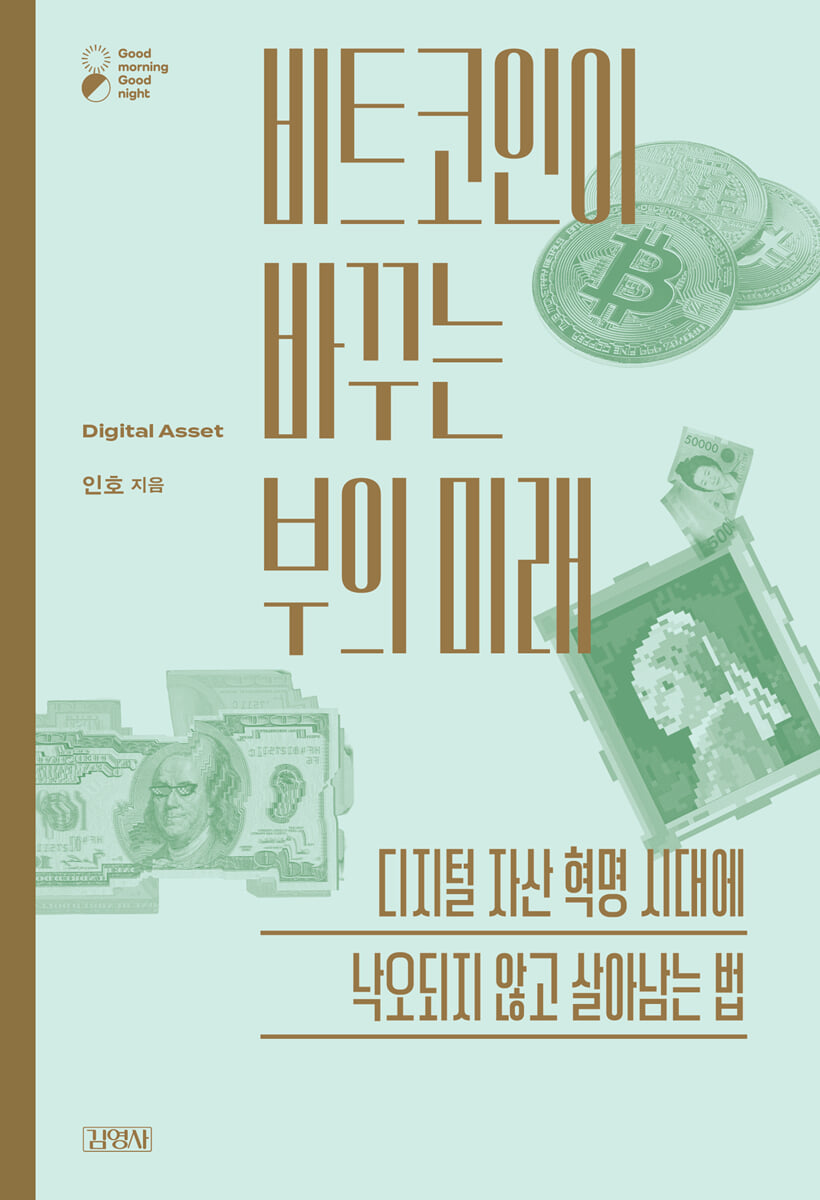
The Future of Wealth: How Bitcoin Is Changing Its Ways
 |
Description
Book Introduction
"The world is divided into those who have Bitcoin and those who don't."
Professor Inho, Korea's leading authority on blockchain research, presents his first popular textbook.
The future of wealth lies at the heart of digital assets!
It is an era where the rich get richer and the poor get poorer.
Currency values fall and asset prices soar endlessly.
How can we protect and grow our money? "The Future of Wealth: Bitcoin's Transformation" answers this question by saying, "Understand the essence of the digital asset revolution and participate directly in its transformation."
Professor Inho defines the present as the "era of the digital asset revolution," emphasizing that understanding this massive shift and seizing opportunities within it is not a matter of choice, but of survival.
The blockchain revolution that began with Bitcoin is now expanding to real-world asset tokenization (RWA).
This book provides a comprehensive overview of blockchain principles, the value of Bitcoin, global RWA market trends, and new opportunities for Korean industry, presenting a three-dimensional view of the present and future of digital assets.
A must-read for those looking to survive and not be left behind in the digital asset revolution.
Professor Inho, Korea's leading authority on blockchain research, presents his first popular textbook.
The future of wealth lies at the heart of digital assets!
It is an era where the rich get richer and the poor get poorer.
Currency values fall and asset prices soar endlessly.
How can we protect and grow our money? "The Future of Wealth: Bitcoin's Transformation" answers this question by saying, "Understand the essence of the digital asset revolution and participate directly in its transformation."
Professor Inho defines the present as the "era of the digital asset revolution," emphasizing that understanding this massive shift and seizing opportunities within it is not a matter of choice, but of survival.
The blockchain revolution that began with Bitcoin is now expanding to real-world asset tokenization (RWA).
This book provides a comprehensive overview of blockchain principles, the value of Bitcoin, global RWA market trends, and new opportunities for Korean industry, presenting a three-dimensional view of the present and future of digital assets.
A must-read for those looking to survive and not be left behind in the digital asset revolution.
- You can preview some of the book's contents.
Preview
index
Prologue: The Future of Wealth Depends on Digital Assets
Chapter 1: Blockchain and Bitcoin: Why is everyone paying attention?
1.
Blockchain: A New World That Runs Like a Game
2.
Bitcoin, money born on the internet
3.
Real Money, Not Fake? The Secret to Bitcoin's Value
4.
How is Bitcoin changing the financial industry?
5.
Why did the US choose Bitcoin as a national strategic asset?
Chapter 2: The Evolution of Money: From Analog to Digital
1.
Smart contracts, contracts that are automatically executed
2.
A world without middlemen is coming.
3.
What if the world was connected through a single financial platform?
4.
Are real assets also digitizing? What is RWA?
5.
Why is BlackRock digitizing real assets?
6.
What if the investment market transformed into one giant platform?
Chapter 3: Tokenizing Every Asset in the World
1.
Stablecoins: Why Do We Need "Value-Stable Coins"?
2.
Current and Future Challenges of Stablecoins
3.
You can even trade a building piece by piece?
4.
Gold, Reborn in the Digital World
5.
A New Way to Own Art and Music: NFTs
6.
The Era of Rights Tokenization: From Bonds to Intellectual Property and Reservation Rights
7.
How does data become an 'asset'?
8.
What determines the value of a token?
Chapter 4: How Will the Future Change in the Digital Asset Era?
1.
Can everyone seize the opportunity to become rich?
2.
What do you need to know now and how should you prepare?
3.
Where are Korea's future jobs and industries headed?
main
Chapter 1: Blockchain and Bitcoin: Why is everyone paying attention?
1.
Blockchain: A New World That Runs Like a Game
2.
Bitcoin, money born on the internet
3.
Real Money, Not Fake? The Secret to Bitcoin's Value
4.
How is Bitcoin changing the financial industry?
5.
Why did the US choose Bitcoin as a national strategic asset?
Chapter 2: The Evolution of Money: From Analog to Digital
1.
Smart contracts, contracts that are automatically executed
2.
A world without middlemen is coming.
3.
What if the world was connected through a single financial platform?
4.
Are real assets also digitizing? What is RWA?
5.
Why is BlackRock digitizing real assets?
6.
What if the investment market transformed into one giant platform?
Chapter 3: Tokenizing Every Asset in the World
1.
Stablecoins: Why Do We Need "Value-Stable Coins"?
2.
Current and Future Challenges of Stablecoins
3.
You can even trade a building piece by piece?
4.
Gold, Reborn in the Digital World
5.
A New Way to Own Art and Music: NFTs
6.
The Era of Rights Tokenization: From Bonds to Intellectual Property and Reservation Rights
7.
How does data become an 'asset'?
8.
What determines the value of a token?
Chapter 4: How Will the Future Change in the Digital Asset Era?
1.
Can everyone seize the opportunity to become rich?
2.
What do you need to know now and how should you prepare?
3.
Where are Korea's future jobs and industries headed?
main
Detailed image

Into the book
We are now entering a new era of assets.
The meaning of money is changing.
In the past, only visible currency was considered 'money'.
But now, a new form of wealth is emerging: "digital assets" that are invisible, yet valuable, claimable, and transferable globally in real time.
The future of wealth starts digital.
Now, understanding the flow and seizing opportunities within it is not a matter of choice, but of survival.
--- p.9
Bitcoin is not simply a digital form of money.
It has raised fundamental questions about the very concept of 'finance' that we have become accustomed to, and is now restructuring it.
Bitcoin was the first example that demonstrated the potential for people to reimagine how money is created, stored, and exchanged in the Internet age.
--- p.43
Ultimately, we come to this question:
"Why should only the state provide the infrastructure for trust and transactions?" "Who can design a global financial system?" Part of the answer lies in smart contracts and blockchain.
Trust is built on code, not central authority, and transactions occur on protocols, not borders.
In this great flow of change, we can become participants, not just witnesses.
--- p.75
Now, global digital asset companies will emerge, like global retailers like Amazon.
I personally sincerely hope that such a company will emerge in South Korea.
If we don't lead, we will be led.
Just as most of the information generated on smartphones, including all of our citizens' location information, is now being seized by companies with operating systems like Apple and Google, the wealth we earn in the future will also be digitalized and flow out to global corporations.
--- p.86
Now, we must move beyond simple "cryptocurrency" and prepare for a new order: digital assets.
The definition of wealth is changing, and the way we trust is being reconfigured.
This change is an inevitable trend, and only those who understand and prepare for it can seize the opportunities of the new era.
The meaning of money is changing.
In the past, only visible currency was considered 'money'.
But now, a new form of wealth is emerging: "digital assets" that are invisible, yet valuable, claimable, and transferable globally in real time.
The future of wealth starts digital.
Now, understanding the flow and seizing opportunities within it is not a matter of choice, but of survival.
--- p.9
Bitcoin is not simply a digital form of money.
It has raised fundamental questions about the very concept of 'finance' that we have become accustomed to, and is now restructuring it.
Bitcoin was the first example that demonstrated the potential for people to reimagine how money is created, stored, and exchanged in the Internet age.
--- p.43
Ultimately, we come to this question:
"Why should only the state provide the infrastructure for trust and transactions?" "Who can design a global financial system?" Part of the answer lies in smart contracts and blockchain.
Trust is built on code, not central authority, and transactions occur on protocols, not borders.
In this great flow of change, we can become participants, not just witnesses.
--- p.75
Now, global digital asset companies will emerge, like global retailers like Amazon.
I personally sincerely hope that such a company will emerge in South Korea.
If we don't lead, we will be led.
Just as most of the information generated on smartphones, including all of our citizens' location information, is now being seized by companies with operating systems like Apple and Google, the wealth we earn in the future will also be digitalized and flow out to global corporations.
--- p.86
Now, we must move beyond simple "cryptocurrency" and prepare for a new order: digital assets.
The definition of wealth is changing, and the way we trust is being reconfigured.
This change is an inevitable trend, and only those who understand and prepare for it can seize the opportunities of the new era.
--- p.148
Publisher's Review
"The world is divided into those who have Bitcoin and those who don't."
Professor Inho, Korea's leading authority on blockchain research, presents his first popular textbook.
The future of wealth lies at the heart of digital assets!
It is an era where the rich get richer and the poor get poorer.
Currency values are falling, national debt is snowballing, and the wealth gap is widening by the day.
With labor income failing to keep pace with rising asset returns, how can we preserve and grow our money? "Bitcoin: The Future of Wealth" provides a clear answer to this question.
"Understand the essence of the digital asset revolution and directly participate in its transformation." Professor Inho, a pioneer in Korean blockchain research and professor of computer science at Korea University, defines the current era as the "digital asset revolution era."
He emphasizes that the future of wealth lies in "digital assets," and that understanding this trend and seizing opportunities within it is not a choice but a matter of survival.
"The Future of Wealth: How Bitcoin Changes Its Future" is an economics textbook that comprehensively explores the origins, present, and future of digital assets.
The blockchain revolution that began with Bitcoin reveals in detail how the "future of wealth" is being reorganized around digital assets.
From the operating principles of blockchain to the value of Bitcoin, the global Real World Asset (RWA) market trends, and the new opportunities facing Korean industries, this must-read book for the digital asset revolution guides readers to develop an eye for the future of wealth through concrete examples and in-depth analysis.
Digital Assets: Where Are We Now?
From cryptocurrencies to tokenization of real assets
From financial and industrial restructuring to job strategies
The form of money is changing from analog to digital.
Real estate, gold, art, data, even bonds and reservation rights.
All assets in the world are fragmented and traded on the blockchain.
The threshold for asset ownership is lowering and opportunities are expanding.
Currency has become code, transactions are recorded as data, and trust is proven by algorithms.
As the form of money and assets changes, what do we need to know and how should we prepare?
Q1.
Why is Bitcoin called "digital gold" rather than "fake money"?
Bitcoin was born within the existing monetary order, which was shaken by inflation.
In the existing monetary system, where the value of currency fluctuates depending on the government's fiscal policy and the central bank's currency issuance, Satoshi Nakamoto shifted the trust structure of currency from the state to mathematics and code.
The Bitcoin he designed cannot be issued arbitrarily by anyone.
The total issuance is limited to 21 million, and the issuance is halved at regular intervals.
It is not an infinitely circulating supply of money, and its value is not diluted by inflation.
That's why people call Bitcoin "digital gold" rather than "fake money," and focus on it as a store of value in the digital asset era.
The technology that supports this value is ‘blockchain.’
Blockchain is a distributed ledger system in which participants around the world share the same ledger and jointly record and verify transaction history, making falsification impossible.
The system that emerged based on this 'code of trust' is the 'smart contract'.
It is a program designed to code the contents of a contract and automatically execute it when the conditions are met.
As a result, a 'decentralized finance' structure that enables transactions between individuals without intermediaries such as banks has become a reality.
Bitcoin is no longer a 'virtual currency'.
It is a digital currency that preserves its value with scarcity and stability like gold, built on trust that operates without government guarantees.
Q2.
Is the era coming when all the world's assets—real estate, gold, data—will be traded in fragments?
The influence of blockchain extends beyond finance to the realm of real assets and data.
A prime example is RWA. RWA converts assets like real estate, gold, and art into digital tokens, demonstrating the potential of a digital asset market where anyone can buy and sell assets anytime, anywhere.
In Korea, the real estate platform 'Casa Korea' tokenized the 'Yeoksam Londonville' building, allowing hundreds of individuals to participate as co-owners, and overseas, the world's largest asset management company 'BlackRock' introduced the Ethereum-based income security fund 'BUIDL', opening the door to a 24-hour asset market.
Going one step further, even data and experiences are being converted into digital assets.
Until now, most personal data has been dependent on platforms and used for corporate profits.
But now, individuals can own their own data and be rewarded with tokens for their activities and contributions.
Wellness NFTs are a representative example.
Transactions of previously invisible rights are now transparently conducted on the blockchain.
In fact, a dinner voucher from a high-end restaurant in LA was issued as an NFT and sold for about $4,250.
Q3.
In the digital asset era, what skills and job strategies are required of individuals?
Digital assets aren't just changing the way we invest.
It is redefining how money stores and moves value, how trust is proven and maintained, and even how humans participate in the economy.
This shift is leading to a restructuring of asset transactions, ownership, and value transfer into a faster, more transparent, and fairer structure, giving rise to new business models.
Of course, challenges remain, such as regulatory uncertainty, security vulnerabilities, and financial literacy gaps.
However, this change is irreversible.
What matters now is not the technology, but the individual who understands and utilizes that technology.
The centralized financial system will gradually collapse, and the trust function that was previously held by the state or institutions will be transferred to individuals.
We must manage our own wallets, take responsibility for the security of our assets, and personally assess the risks and opportunities of our transactions.
Professor Inho further states that now is a crucial time for Korea to redesign the future financial and industrial order.
This is because Korea's creative industries, including K-content, are growing into core business models in the digital asset ecosystem.
New jobs will be created in the "digital assetization field," where data is created, managed, and proven to have value.
Future competitiveness also depends not on the technology itself, but on the individuals and industries that can understand and connect with that technology.
Today's culture, future wisdom, every day
Starting in the morning and ending in the evening
Knowledge Library 'Good Morning, Good Night' Series
'Good Morning, Good Night' sets a new standard for knowledge in the 21st century.
Written by the best writers, we share wisdom on how to view the world.
We take a look at where we are, what changes we are facing, and what we need to prepare for.
The world is changing.
The paradigm is shifting in all fields.
These are uncertain times, where we don't know what will happen tomorrow.
What choices will you make in the face of the great tide of change?
Will you fall into crisis because you can't read the changes, or will you actively respond to the changes and create opportunities?
Where do we stand, what changes are we facing, and what should we prepare for?
Leading scholars and researchers from each field have come together to create a comprehensive collection of knowledge and culture for future generations.
This knowledge library historically examines the changes and issues facing us in this era of transition across all fields, including the humanities, social sciences, economics, natural sciences, and the arts, and comprehensively examines phenomena and their essence to seek solutions and alternatives.
It is a paperback book that can be read by anyone of all generations, from middle school students to college students and the general public, and contains core knowledge and culture in one volume, so you can keep it close by and refer to it every day.
The 'Good Morning, Good Night' library will present a new standard for 21st century knowledge and serve as a guide to providing wisdom for viewing the world.
We await you, seeking wisdom and insight.
Professor Inho, Korea's leading authority on blockchain research, presents his first popular textbook.
The future of wealth lies at the heart of digital assets!
It is an era where the rich get richer and the poor get poorer.
Currency values are falling, national debt is snowballing, and the wealth gap is widening by the day.
With labor income failing to keep pace with rising asset returns, how can we preserve and grow our money? "Bitcoin: The Future of Wealth" provides a clear answer to this question.
"Understand the essence of the digital asset revolution and directly participate in its transformation." Professor Inho, a pioneer in Korean blockchain research and professor of computer science at Korea University, defines the current era as the "digital asset revolution era."
He emphasizes that the future of wealth lies in "digital assets," and that understanding this trend and seizing opportunities within it is not a choice but a matter of survival.
"The Future of Wealth: How Bitcoin Changes Its Future" is an economics textbook that comprehensively explores the origins, present, and future of digital assets.
The blockchain revolution that began with Bitcoin reveals in detail how the "future of wealth" is being reorganized around digital assets.
From the operating principles of blockchain to the value of Bitcoin, the global Real World Asset (RWA) market trends, and the new opportunities facing Korean industries, this must-read book for the digital asset revolution guides readers to develop an eye for the future of wealth through concrete examples and in-depth analysis.
Digital Assets: Where Are We Now?
From cryptocurrencies to tokenization of real assets
From financial and industrial restructuring to job strategies
The form of money is changing from analog to digital.
Real estate, gold, art, data, even bonds and reservation rights.
All assets in the world are fragmented and traded on the blockchain.
The threshold for asset ownership is lowering and opportunities are expanding.
Currency has become code, transactions are recorded as data, and trust is proven by algorithms.
As the form of money and assets changes, what do we need to know and how should we prepare?
Q1.
Why is Bitcoin called "digital gold" rather than "fake money"?
Bitcoin was born within the existing monetary order, which was shaken by inflation.
In the existing monetary system, where the value of currency fluctuates depending on the government's fiscal policy and the central bank's currency issuance, Satoshi Nakamoto shifted the trust structure of currency from the state to mathematics and code.
The Bitcoin he designed cannot be issued arbitrarily by anyone.
The total issuance is limited to 21 million, and the issuance is halved at regular intervals.
It is not an infinitely circulating supply of money, and its value is not diluted by inflation.
That's why people call Bitcoin "digital gold" rather than "fake money," and focus on it as a store of value in the digital asset era.
The technology that supports this value is ‘blockchain.’
Blockchain is a distributed ledger system in which participants around the world share the same ledger and jointly record and verify transaction history, making falsification impossible.
The system that emerged based on this 'code of trust' is the 'smart contract'.
It is a program designed to code the contents of a contract and automatically execute it when the conditions are met.
As a result, a 'decentralized finance' structure that enables transactions between individuals without intermediaries such as banks has become a reality.
Bitcoin is no longer a 'virtual currency'.
It is a digital currency that preserves its value with scarcity and stability like gold, built on trust that operates without government guarantees.
Q2.
Is the era coming when all the world's assets—real estate, gold, data—will be traded in fragments?
The influence of blockchain extends beyond finance to the realm of real assets and data.
A prime example is RWA. RWA converts assets like real estate, gold, and art into digital tokens, demonstrating the potential of a digital asset market where anyone can buy and sell assets anytime, anywhere.
In Korea, the real estate platform 'Casa Korea' tokenized the 'Yeoksam Londonville' building, allowing hundreds of individuals to participate as co-owners, and overseas, the world's largest asset management company 'BlackRock' introduced the Ethereum-based income security fund 'BUIDL', opening the door to a 24-hour asset market.
Going one step further, even data and experiences are being converted into digital assets.
Until now, most personal data has been dependent on platforms and used for corporate profits.
But now, individuals can own their own data and be rewarded with tokens for their activities and contributions.
Wellness NFTs are a representative example.
Transactions of previously invisible rights are now transparently conducted on the blockchain.
In fact, a dinner voucher from a high-end restaurant in LA was issued as an NFT and sold for about $4,250.
Q3.
In the digital asset era, what skills and job strategies are required of individuals?
Digital assets aren't just changing the way we invest.
It is redefining how money stores and moves value, how trust is proven and maintained, and even how humans participate in the economy.
This shift is leading to a restructuring of asset transactions, ownership, and value transfer into a faster, more transparent, and fairer structure, giving rise to new business models.
Of course, challenges remain, such as regulatory uncertainty, security vulnerabilities, and financial literacy gaps.
However, this change is irreversible.
What matters now is not the technology, but the individual who understands and utilizes that technology.
The centralized financial system will gradually collapse, and the trust function that was previously held by the state or institutions will be transferred to individuals.
We must manage our own wallets, take responsibility for the security of our assets, and personally assess the risks and opportunities of our transactions.
Professor Inho further states that now is a crucial time for Korea to redesign the future financial and industrial order.
This is because Korea's creative industries, including K-content, are growing into core business models in the digital asset ecosystem.
New jobs will be created in the "digital assetization field," where data is created, managed, and proven to have value.
Future competitiveness also depends not on the technology itself, but on the individuals and industries that can understand and connect with that technology.
Today's culture, future wisdom, every day
Starting in the morning and ending in the evening
Knowledge Library 'Good Morning, Good Night' Series
'Good Morning, Good Night' sets a new standard for knowledge in the 21st century.
Written by the best writers, we share wisdom on how to view the world.
We take a look at where we are, what changes we are facing, and what we need to prepare for.
The world is changing.
The paradigm is shifting in all fields.
These are uncertain times, where we don't know what will happen tomorrow.
What choices will you make in the face of the great tide of change?
Will you fall into crisis because you can't read the changes, or will you actively respond to the changes and create opportunities?
Where do we stand, what changes are we facing, and what should we prepare for?
Leading scholars and researchers from each field have come together to create a comprehensive collection of knowledge and culture for future generations.
This knowledge library historically examines the changes and issues facing us in this era of transition across all fields, including the humanities, social sciences, economics, natural sciences, and the arts, and comprehensively examines phenomena and their essence to seek solutions and alternatives.
It is a paperback book that can be read by anyone of all generations, from middle school students to college students and the general public, and contains core knowledge and culture in one volume, so you can keep it close by and refer to it every day.
The 'Good Morning, Good Night' library will present a new standard for 21st century knowledge and serve as a guide to providing wisdom for viewing the world.
We await you, seeking wisdom and insight.
GOODS SPECIFICS
- Date of issue: November 11, 2025
- Page count, weight, size: 172 pages | 132*193*20mm
- ISBN13: 9791173323973
- ISBN10: 117332397X
You may also like
카테고리
korean


korean

![GQ KOREA Mark (Monthly): December [2025]](http://librairie.coreenne.fr/cdn/shop/files/8ef265dbbfbf186523ed75ba7319009d.jpg?v=1765340328&width=3840)


