

What to keep, what to throw away, what to keep
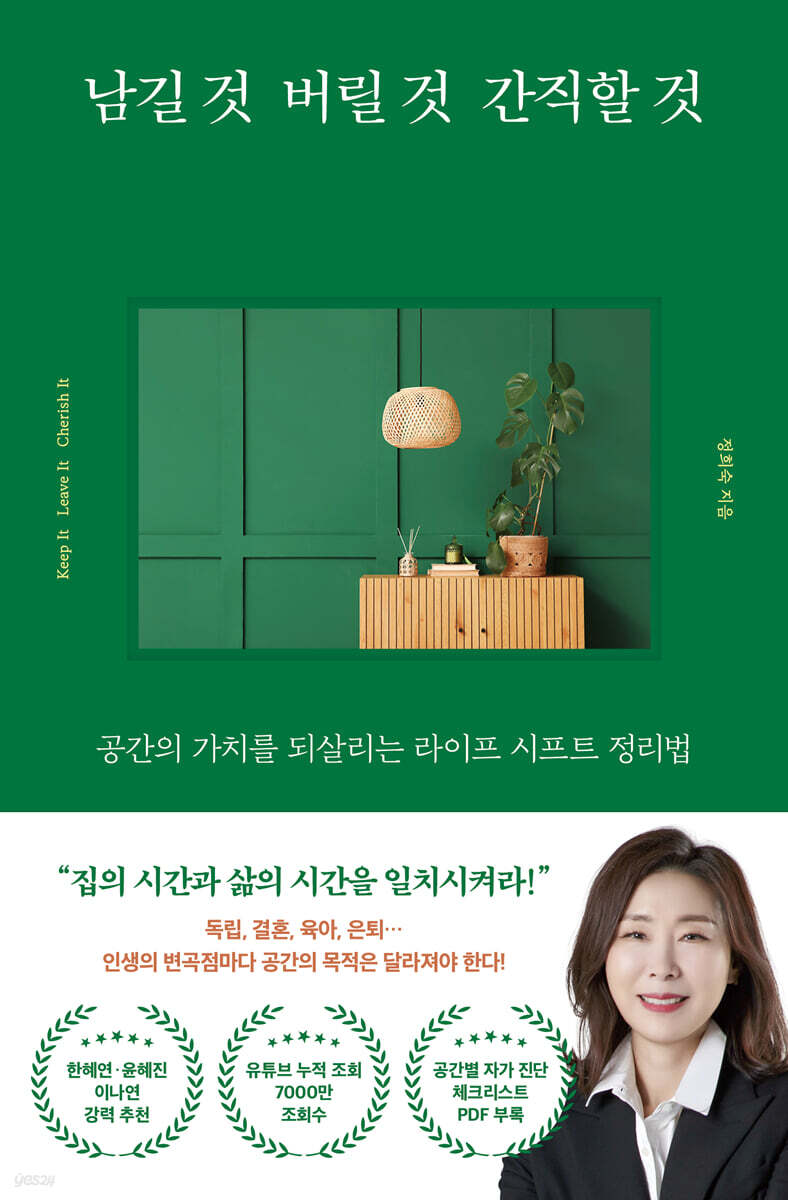 |
Description
Book Introduction
“Time at home and time in life must flow together!”
The principles of space organization learned while organizing the homes of 5,000 households and 10,000 people.
★Strongly recommended by stylist Han Hye-yeon, ballerina Yoon Hye-jin, and announcer Lee Na-yeon
★The latest work from the best-selling author of "The Best Interior is Tidying Up"
★70 million cumulative views on YouTube
★Self-diagnosis checklist by space PDF appendix
A new book by Hee-sook Jeong, Korea's first-generation organizing consultant and operator of the Smart Organizing Channel with 300,000 subscribers.
No matter how much you clean, it still looks messy, and you often end up buying things again because you can't find them.
Pantries and storage rooms are overflowing with household goods.
Did this person end up living in a house like this simply because they can't organize? Jeong Hee-sook, who has visited over 5,000 households and organized 10,000 homes, has a different answer.
This is a situation that occurs because the space called home has lost its purpose.
Since I started working, I have been visiting the site every day for over 10 years and have met countless people struggling with organizing.
In the process of meeting people face-to-face and organizing their homes, I discovered a common thread among most people: time at home and time in life flow differently.
Life cycles flow with the passage of time: independence, marriage, childcare, children's independence, and senior life.
The discomfort caused by organizing and the feeling of not being comfortable in one's own home are mostly due to changes in lifestyle.
The reality is that even though we have reached the next stage of life, 'home', the space where we eat, sleep, and rest, remains in the past and does not reflect our current life at all.
This book goes a step further than the principles of organization, which have been considered as household wisdom or interior design methods, and presents the theory of organization as a principle for properly managing our lives.
Additionally, this book is practical by including organizing tips that can be applied directly to daily life.
You will be able to gain tips to improve your quality of life through items and organizing rules filled with the on-site know-how of an organizing consultant, such as tips for storing clothes and bedding that change with the seasons, tips for arranging furniture and storing everyday items according to your daily routine, and storage standards for pantries and upper and lower cabinets that can easily become warehouses.
The principles of space organization learned while organizing the homes of 5,000 households and 10,000 people.
★Strongly recommended by stylist Han Hye-yeon, ballerina Yoon Hye-jin, and announcer Lee Na-yeon
★The latest work from the best-selling author of "The Best Interior is Tidying Up"
★70 million cumulative views on YouTube
★Self-diagnosis checklist by space PDF appendix
A new book by Hee-sook Jeong, Korea's first-generation organizing consultant and operator of the Smart Organizing Channel with 300,000 subscribers.
No matter how much you clean, it still looks messy, and you often end up buying things again because you can't find them.
Pantries and storage rooms are overflowing with household goods.
Did this person end up living in a house like this simply because they can't organize? Jeong Hee-sook, who has visited over 5,000 households and organized 10,000 homes, has a different answer.
This is a situation that occurs because the space called home has lost its purpose.
Since I started working, I have been visiting the site every day for over 10 years and have met countless people struggling with organizing.
In the process of meeting people face-to-face and organizing their homes, I discovered a common thread among most people: time at home and time in life flow differently.
Life cycles flow with the passage of time: independence, marriage, childcare, children's independence, and senior life.
The discomfort caused by organizing and the feeling of not being comfortable in one's own home are mostly due to changes in lifestyle.
The reality is that even though we have reached the next stage of life, 'home', the space where we eat, sleep, and rest, remains in the past and does not reflect our current life at all.
This book goes a step further than the principles of organization, which have been considered as household wisdom or interior design methods, and presents the theory of organization as a principle for properly managing our lives.
Additionally, this book is practical by including organizing tips that can be applied directly to daily life.
You will be able to gain tips to improve your quality of life through items and organizing rules filled with the on-site know-how of an organizing consultant, such as tips for storing clothes and bedding that change with the seasons, tips for arranging furniture and storing everyday items according to your daily routine, and storage standards for pantries and upper and lower cabinets that can easily become warehouses.
- You can preview some of the book's contents.
Preview
index
[Prologue] Organizing isn't something you do when you're dead, it's something you do when you're alive.
[Checklist] When Your Life Needs Organizing
[Chapter 1] The day will come when everyone looks back on their home.
One day, the house pushed me away.
The day our shared living space collapsed
I started organizing because I was poor and depressed.
From a suffocating space to a breathing space
When it's time to say goodbye
Tidying up brought me back to life
[Chapter 2] What to Leave Behind and What to Let Go
Say goodbye to the things that weigh down your life.
Leave only what you need to leave behind
Organizing without standards is a waste of time.
Throwing it away unconditionally doesn't solve the problem.
Changes brought about by small organizing habits
Make time your ally
Tidying up is the process of reconstructing your life.
[Chapter 3] 5-Step Organizing Principles for Life Balance
Smart Organizing Step 0: Understanding What Organizing Is
Smart Organizing Step 1: Sort Your Stuff
Smart Organizing Step 2: Decluttering to Identify What's Necessary
Smart Organizing Step 3: Organize to Fit Your Lifestyle
Smart Organizing Step 4: Keeping Things in Place
[Chapter 4] Aligning home time with life time
Why Organizing Your Life Cycle Matters
Independence: When you have your own space for the first time
Marriage: When two people's things come together in one space
Parenting: The Explosion of Stuff
Retirement and Your Children's Independence: Organizing for the Next Chapter of Your Life
Seniors: Aging Lightly and Safely
[Epilogue] What will we remember in our final moments?
[Checklist] Am I using space efficiently?
10 Cleanup Kicks You Can Use Today
[Checklist] When Your Life Needs Organizing
[Chapter 1] The day will come when everyone looks back on their home.
One day, the house pushed me away.
The day our shared living space collapsed
I started organizing because I was poor and depressed.
From a suffocating space to a breathing space
When it's time to say goodbye
Tidying up brought me back to life
[Chapter 2] What to Leave Behind and What to Let Go
Say goodbye to the things that weigh down your life.
Leave only what you need to leave behind
Organizing without standards is a waste of time.
Throwing it away unconditionally doesn't solve the problem.
Changes brought about by small organizing habits
Make time your ally
Tidying up is the process of reconstructing your life.
[Chapter 3] 5-Step Organizing Principles for Life Balance
Smart Organizing Step 0: Understanding What Organizing Is
Smart Organizing Step 1: Sort Your Stuff
Smart Organizing Step 2: Decluttering to Identify What's Necessary
Smart Organizing Step 3: Organize to Fit Your Lifestyle
Smart Organizing Step 4: Keeping Things in Place
[Chapter 4] Aligning home time with life time
Why Organizing Your Life Cycle Matters
Independence: When you have your own space for the first time
Marriage: When two people's things come together in one space
Parenting: The Explosion of Stuff
Retirement and Your Children's Independence: Organizing for the Next Chapter of Your Life
Seniors: Aging Lightly and Safely
[Epilogue] What will we remember in our final moments?
[Checklist] Am I using space efficiently?
10 Cleanup Kicks You Can Use Today
Detailed image
.jpg)
Into the book
“It just happened… as I lived.” His words were filled with exhaustion.
Soyeon, who was in her early forties, was the mother of two children.
After seven years of being a stay-at-home mom, I had some free time as my children started elementary school, but I didn't have that free time at home.
The living room was filled with toys and board games, one room was filled with workbooks and textbooks, and the master bedroom was filled with my husband's clothes and bedding.
The person who recommended organizing things for Soyeon, who was having a hard time, was her younger sister.
“Sister, are you really going to live like this? Are you okay?” “Well… it’s always been like this.
“It’s okay…” Soyeon said she was okay, but it didn’t look like that to me at all.
The words, 'I'm okay,' were filled with a sense of loss, of having lost one's place.
I looked at her face quietly without saying anything.
After a moment of silence, she finally spoke.
“Actually, I have almost none of my stuff at home.
“It’s the room I’m in, but it feels like there’s no space for me to write…”
--- p.23
The most impressive part is that people who are good at organizing 'choose without hesitation' what to keep and what to throw away.
People who are good at organizing have different hands.
There is not a single hint of hesitation at the tip of your fingers.
It seems like the hands speak faster than the mouth.
“I know exactly what to keep and what to throw away.” Conversely, people who are bad at organizing have hesitation at their fingertips.
They just keep moving things around, picking them up and putting them down, putting them here and there, and it's hard to even decide whether to keep them or throw them away.
While we dream of lightness by organizing the accumulated stuff, we quickly return to a life where we are overwhelmed by stuff.
The reason is simple.
Because it's not the things that matter, it's the heart that matters.
If your mind doesn't change, organizing is just repetitive physical labor.
--- p.77
According to one study, people spend an average of 10 to 15 minutes a day looking for things.
That's a whopping 60 hours a year.
A cluttered environment also negatively impacts decision-making.
It is said that when the brain is frequently exposed to a cluttered environment, it consumes a lot of energy even when making small decisions.
Because I feel tired and my concentration is reduced.
Organizing a cluttered space is like reclaiming stolen time.
Time is a resource given equally to everyone, but it is up to you to choose how to use that time more valuably.
--- p.119
We often think of organizing, cleaning, storing, and throwing things away as the same thing, but that's just part of organizing, not the whole process.
The cleanup is much bigger than that.
Many people think that organizing and cleaning are the same thing.
This may be because they are similar in that they deal with space.
In fact, organizing and cleaning have one thing in common: they change the physical environment and make the space look better.
However, the purposes and processes of the two are fundamentally different.
Confusing organizing with cleaning can lead to superficial changes and failure to address the fundamental issues of space and life.
--- p.130
Good inventory management will significantly reduce duplicate purchases.
Haven't you ever bought something identical without realizing it already existed? If you don't understand the product, you'll repeat this mistake.
Knowing your inventory clearly can help you reduce unnecessary spending and prevent items from piling up.
Knowing what items you have in excess or in short supply allows you to optimize your space layout and easily determine the right place to store items.
--- p.187
As we go through life, we come across several moments where we have to start over.
Independence, marriage, childbirth, retirement, moving, loss.
For whatever reason, life suddenly changes direction.
The problem is that this change comes without warning and faster than you think.
What you need at that moment isn't a pretty storage unit or expensive organizing supplies.
It's a sense of reorganizing space to fit your current life.
The spaces of people who are not good at organizing often retain traces of their previous life cycles.
My child is an adult and independent, but his baby toys are still in his room. He has been retired for over a year, but his work bag is still in the living room.
--- p.202
“I’ll retire, raise my children, and then when I have time, I can slowly take care of things.” Some people believe this and live their lives, but then they really take things slow, but too late.
The reason why starting late causes problems is simple.
Because at that time, you couldn't do it on your own will.
My body won't keep up.
I can't lift heavy things, I'm afraid to climb onto a chair, and it's difficult to even sit down and stand up.
Things don't decrease, life becomes tiring, and eventually life becomes oppressive at home.
There is no 'later'.
Life becomes easier when you let go now.
Soyeon, who was in her early forties, was the mother of two children.
After seven years of being a stay-at-home mom, I had some free time as my children started elementary school, but I didn't have that free time at home.
The living room was filled with toys and board games, one room was filled with workbooks and textbooks, and the master bedroom was filled with my husband's clothes and bedding.
The person who recommended organizing things for Soyeon, who was having a hard time, was her younger sister.
“Sister, are you really going to live like this? Are you okay?” “Well… it’s always been like this.
“It’s okay…” Soyeon said she was okay, but it didn’t look like that to me at all.
The words, 'I'm okay,' were filled with a sense of loss, of having lost one's place.
I looked at her face quietly without saying anything.
After a moment of silence, she finally spoke.
“Actually, I have almost none of my stuff at home.
“It’s the room I’m in, but it feels like there’s no space for me to write…”
--- p.23
The most impressive part is that people who are good at organizing 'choose without hesitation' what to keep and what to throw away.
People who are good at organizing have different hands.
There is not a single hint of hesitation at the tip of your fingers.
It seems like the hands speak faster than the mouth.
“I know exactly what to keep and what to throw away.” Conversely, people who are bad at organizing have hesitation at their fingertips.
They just keep moving things around, picking them up and putting them down, putting them here and there, and it's hard to even decide whether to keep them or throw them away.
While we dream of lightness by organizing the accumulated stuff, we quickly return to a life where we are overwhelmed by stuff.
The reason is simple.
Because it's not the things that matter, it's the heart that matters.
If your mind doesn't change, organizing is just repetitive physical labor.
--- p.77
According to one study, people spend an average of 10 to 15 minutes a day looking for things.
That's a whopping 60 hours a year.
A cluttered environment also negatively impacts decision-making.
It is said that when the brain is frequently exposed to a cluttered environment, it consumes a lot of energy even when making small decisions.
Because I feel tired and my concentration is reduced.
Organizing a cluttered space is like reclaiming stolen time.
Time is a resource given equally to everyone, but it is up to you to choose how to use that time more valuably.
--- p.119
We often think of organizing, cleaning, storing, and throwing things away as the same thing, but that's just part of organizing, not the whole process.
The cleanup is much bigger than that.
Many people think that organizing and cleaning are the same thing.
This may be because they are similar in that they deal with space.
In fact, organizing and cleaning have one thing in common: they change the physical environment and make the space look better.
However, the purposes and processes of the two are fundamentally different.
Confusing organizing with cleaning can lead to superficial changes and failure to address the fundamental issues of space and life.
--- p.130
Good inventory management will significantly reduce duplicate purchases.
Haven't you ever bought something identical without realizing it already existed? If you don't understand the product, you'll repeat this mistake.
Knowing your inventory clearly can help you reduce unnecessary spending and prevent items from piling up.
Knowing what items you have in excess or in short supply allows you to optimize your space layout and easily determine the right place to store items.
--- p.187
As we go through life, we come across several moments where we have to start over.
Independence, marriage, childbirth, retirement, moving, loss.
For whatever reason, life suddenly changes direction.
The problem is that this change comes without warning and faster than you think.
What you need at that moment isn't a pretty storage unit or expensive organizing supplies.
It's a sense of reorganizing space to fit your current life.
The spaces of people who are not good at organizing often retain traces of their previous life cycles.
My child is an adult and independent, but his baby toys are still in his room. He has been retired for over a year, but his work bag is still in the living room.
--- p.202
“I’ll retire, raise my children, and then when I have time, I can slowly take care of things.” Some people believe this and live their lives, but then they really take things slow, but too late.
The reason why starting late causes problems is simple.
Because at that time, you couldn't do it on your own will.
My body won't keep up.
I can't lift heavy things, I'm afraid to climb onto a chair, and it's difficult to even sit down and stand up.
Things don't decrease, life becomes tiring, and eventually life becomes oppressive at home.
There is no 'later'.
Life becomes easier when you let go now.
--- p.237
Publisher's Review
“There comes a time when everyone looks back on their home.”
Space organization consulting know-how that changed the fate of 10,000 people
A book full of organizing know-how that will make you shout out Jeong Hee-sook again and again.
_Han Hye-yeon, stylist
A house represents the state of the people who live there.
People who are anxious and depressed start having a mess at home.
This is because the body and mind that are depressed fall into a 'groggy' state where they cannot move a single finger.
A disorganized home is the first sign that someone is having a hard time.
The reason I've been going out into the field every day for over 13 years and listening carefully to what people need and what they want to do is to understand their feelings and create the most comfortable home for them.
The author found a common thread among the people he met in the field: they had lost their present selves by being stuck in their past lives.
The reality is that even though I have reached the next stage of life, my 'home', the space where I eat, sleep, and rest, is stuck in the past and does not reflect my current lifestyle at all.
Our bodies, minds, and thoughts change over time.
The same goes for the relationships around me and the things I do.
A home that reflects and helps people manage this life shift well is a home where people feel comfortable and where their lives go well.
Organizing is not about putting something in a certain location or painting it a neat color.
Keeping the space where I and my people stay in the most comfortable condition is what organization is, and it is an essential element for making your life flow well.
This book goes a step further than the principles of organization, which have been considered as household wisdom or interior design methods, and contains the theory of organization as a principle for properly managing our lives.
“What will you leave behind and what will you let go of?”
Independence, marriage, childcare, retirement...
Space organization know-how optimized for Korean-style life shifts
This book suggests that the purpose of space should change as life changes, and provides organizing points that change according to the generational composition and lifestyle of the members.
First, single-person households often fall into the trap of thinking that they need to have everything they need to start living independently when they first have their own space.
There needs to be a standard for stocking items that are necessary for the functioning of the home.
The next case we often encounter is newlyweds.
When two people live in the same space, the first question they face is 'how to organize overlapping items'. In this case, the standard for selecting items is not price or brand, but rather the proportion of items that will be used together, as they are living together.
During the parenting period, when things are exploding, it is important to create a cyclical routine that keeps up with the changing things as quickly as the child grows.
In addition, the book provides detailed guidelines for applying organizational principles to changing lifestyles as life progresses, such as children's independence and senior years.
This book is especially useful for those who have complicated homes and minds, those who want change but don't know where to start, and those who want to find a life that is truly their own, rather than simply living a minimalist life.
The people in the real-life cases the author encountered revived family conversations, recovered their lost selves, and rebuilt their broken hearts through small changes like emptying a chair, a drawer, or a corner of the dining table.
As we encounter through writing the moments when a single entryway rug or light can change the atmosphere of a space and its relationships, we experience the comfort and stability that comes when a space called home adapts to the lives of those who live there.
The author says, “It’s okay if it’s not perfectly organized.
“The important thing is to create space for myself now,” he says.
This book goes beyond simple organizing tips and will serve as a warm guide to a lighter, more balanced life.
Space organization consulting know-how that changed the fate of 10,000 people
A book full of organizing know-how that will make you shout out Jeong Hee-sook again and again.
_Han Hye-yeon, stylist
A house represents the state of the people who live there.
People who are anxious and depressed start having a mess at home.
This is because the body and mind that are depressed fall into a 'groggy' state where they cannot move a single finger.
A disorganized home is the first sign that someone is having a hard time.
The reason I've been going out into the field every day for over 13 years and listening carefully to what people need and what they want to do is to understand their feelings and create the most comfortable home for them.
The author found a common thread among the people he met in the field: they had lost their present selves by being stuck in their past lives.
The reality is that even though I have reached the next stage of life, my 'home', the space where I eat, sleep, and rest, is stuck in the past and does not reflect my current lifestyle at all.
Our bodies, minds, and thoughts change over time.
The same goes for the relationships around me and the things I do.
A home that reflects and helps people manage this life shift well is a home where people feel comfortable and where their lives go well.
Organizing is not about putting something in a certain location or painting it a neat color.
Keeping the space where I and my people stay in the most comfortable condition is what organization is, and it is an essential element for making your life flow well.
This book goes a step further than the principles of organization, which have been considered as household wisdom or interior design methods, and contains the theory of organization as a principle for properly managing our lives.
“What will you leave behind and what will you let go of?”
Independence, marriage, childcare, retirement...
Space organization know-how optimized for Korean-style life shifts
This book suggests that the purpose of space should change as life changes, and provides organizing points that change according to the generational composition and lifestyle of the members.
First, single-person households often fall into the trap of thinking that they need to have everything they need to start living independently when they first have their own space.
There needs to be a standard for stocking items that are necessary for the functioning of the home.
The next case we often encounter is newlyweds.
When two people live in the same space, the first question they face is 'how to organize overlapping items'. In this case, the standard for selecting items is not price or brand, but rather the proportion of items that will be used together, as they are living together.
During the parenting period, when things are exploding, it is important to create a cyclical routine that keeps up with the changing things as quickly as the child grows.
In addition, the book provides detailed guidelines for applying organizational principles to changing lifestyles as life progresses, such as children's independence and senior years.
This book is especially useful for those who have complicated homes and minds, those who want change but don't know where to start, and those who want to find a life that is truly their own, rather than simply living a minimalist life.
The people in the real-life cases the author encountered revived family conversations, recovered their lost selves, and rebuilt their broken hearts through small changes like emptying a chair, a drawer, or a corner of the dining table.
As we encounter through writing the moments when a single entryway rug or light can change the atmosphere of a space and its relationships, we experience the comfort and stability that comes when a space called home adapts to the lives of those who live there.
The author says, “It’s okay if it’s not perfectly organized.
“The important thing is to create space for myself now,” he says.
This book goes beyond simple organizing tips and will serve as a warm guide to a lighter, more balanced life.
GOODS SPECIFICS
- Date of issue: August 18, 2025
- Page count, weight, size: 276 pages | 374g | 138*210*18mm
- ISBN13: 9791194930815
- ISBN10: 1194930816
You may also like
카테고리
korean


korean

![GQ KOREA Mark (Monthly): December [2025]](http://librairie.coreenne.fr/cdn/shop/files/8ef265dbbfbf186523ed75ba7319009d.jpg?v=1765340328&width=3840)


