

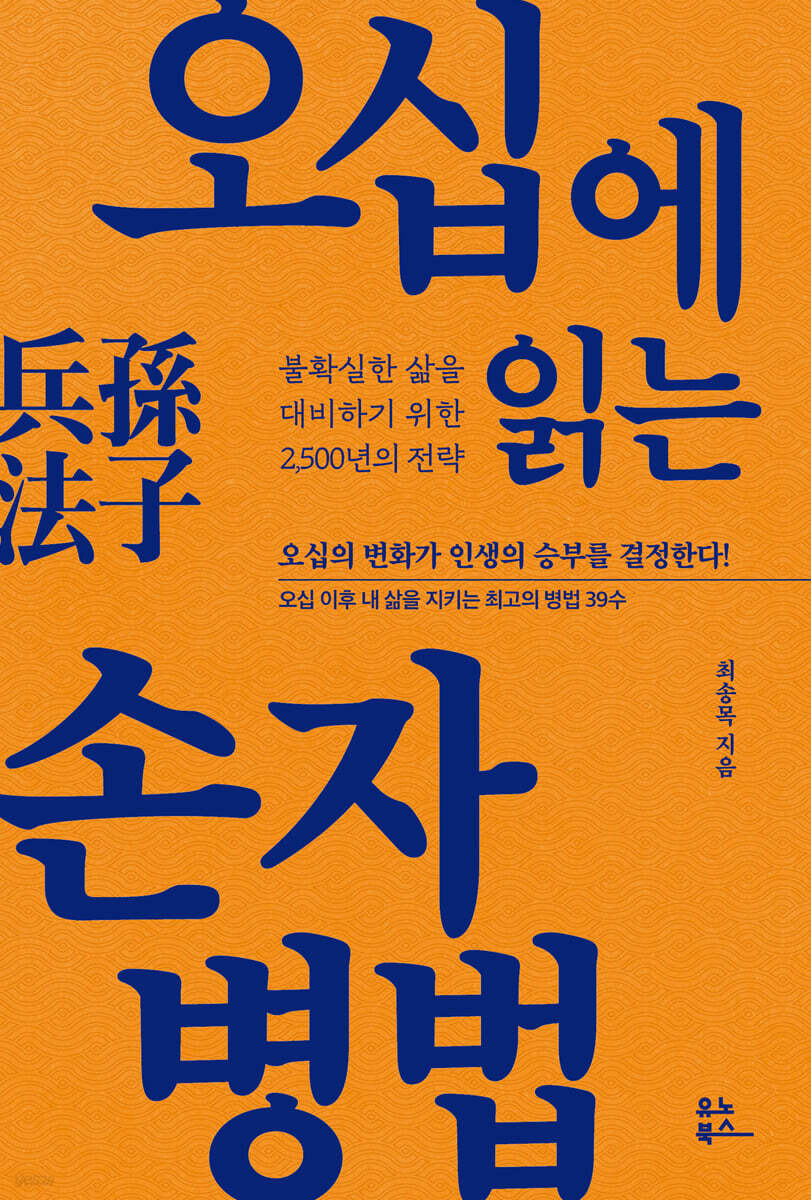
Reading the Art of War at Fifty
 |
Description
Book Introduction
The changes of fifty years determine the outcome of one's life!
2,500 Years of Strategies for Preparing for an Uncertain Life
The 39 Best Strategies to Protect Your Life After Fifty
Sun Tzu, the greatest strategist who defeated the hegemonic state of Chu during the Spring and Autumn Period and led King Helu of Wu to become the ruler of the Central Plains, said:
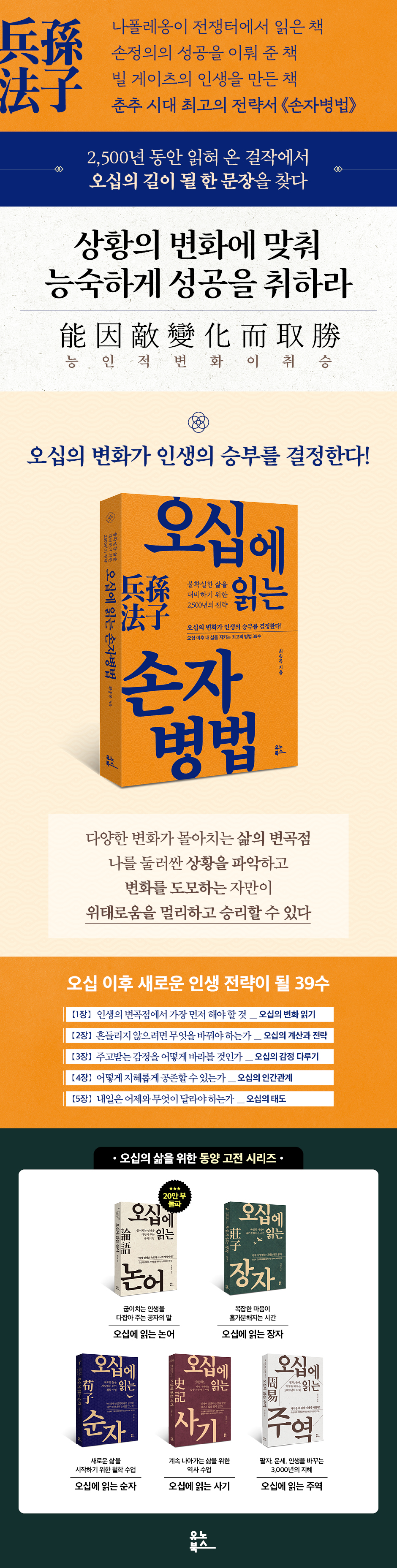
“Act victory by adapting to the changes in the opponent and the situation (能因敵變化而取勝, 능인적변이취승)”.
In a war rife with deception and surprise attacks, quickly assessing the situation and adapting to it is an essential strategy for victory and survival.
This is also true for people in their fifties today.
From the age of fifty, life can easily be swept up in variables you haven't prepared for, such as retirement, reemployment, business, spouse, children, and health.
At this turning point in life, whether or not one changes on one's own determines the difference between those who rise and those who fall.
After fifty, whether or not you change determines your future life.
So how should fifty-year-olds change? The method is contained in "The Art of War."
During the chaotic Spring and Autumn Period and the Warring States Period, Sun Tzu compiled a total of 13 military strategies based on the principle of “Know your enemy, know yourself, and you will not be in danger in a hundred battles.”
It means, 'If you know your enemy and know yourself, you will not be in danger even if you fight a hundred times.'
The first thing to do when you reach the multi-risk zone of your fifty years of life is to be careful.
Reading the flow of change that surrounds you and figuring out how to change yourself means avoiding danger.
Furthermore, developing a new strategy after the age of fifty through the wisdom and insight contained in The Art of War means never giving up in any situation.
"The Art of War for those in their fifties" is a book on life strategy for those in their fifties, and it selects 39 key strategies needed after fiftieth from war strategies from 2,500 years ago.
This was reinterpreted with modern examples.
Through this book, you will learn how to read the circumstances surrounding you and the changes you need, how to develop strategies to find a path that is advantageous to you, how to wisely handle complex emotions, how to coexist and share benefits in relationships, and how to turn a life that is entering a weak phase into a strong one.
Fifty, the afternoon of my life has just begun, and I worry about the future that will tilt as if the final whistle has blown.
To find your bearings in a rapidly changing life, to find a path that benefits you, to face the future with peace of mind, live tomorrow differently than yesterday.
At fifty, you will finally be able to achieve victory in the battle of life.
2,500 Years of Strategies for Preparing for an Uncertain Life
The 39 Best Strategies to Protect Your Life After Fifty
Sun Tzu, the greatest strategist who defeated the hegemonic state of Chu during the Spring and Autumn Period and led King Helu of Wu to become the ruler of the Central Plains, said:
“Act victory by adapting to the changes in the opponent and the situation (能因敵變化而取勝, 능인적변이취승)”.
In a war rife with deception and surprise attacks, quickly assessing the situation and adapting to it is an essential strategy for victory and survival.
This is also true for people in their fifties today.
From the age of fifty, life can easily be swept up in variables you haven't prepared for, such as retirement, reemployment, business, spouse, children, and health.
At this turning point in life, whether or not one changes on one's own determines the difference between those who rise and those who fall.
After fifty, whether or not you change determines your future life.
So how should fifty-year-olds change? The method is contained in "The Art of War."
During the chaotic Spring and Autumn Period and the Warring States Period, Sun Tzu compiled a total of 13 military strategies based on the principle of “Know your enemy, know yourself, and you will not be in danger in a hundred battles.”
It means, 'If you know your enemy and know yourself, you will not be in danger even if you fight a hundred times.'
The first thing to do when you reach the multi-risk zone of your fifty years of life is to be careful.
Reading the flow of change that surrounds you and figuring out how to change yourself means avoiding danger.
Furthermore, developing a new strategy after the age of fifty through the wisdom and insight contained in The Art of War means never giving up in any situation.
"The Art of War for those in their fifties" is a book on life strategy for those in their fifties, and it selects 39 key strategies needed after fiftieth from war strategies from 2,500 years ago.
This was reinterpreted with modern examples.
Through this book, you will learn how to read the circumstances surrounding you and the changes you need, how to develop strategies to find a path that is advantageous to you, how to wisely handle complex emotions, how to coexist and share benefits in relationships, and how to turn a life that is entering a weak phase into a strong one.
Fifty, the afternoon of my life has just begun, and I worry about the future that will tilt as if the final whistle has blown.
To find your bearings in a rapidly changing life, to find a path that benefits you, to face the future with peace of mind, live tomorrow differently than yesterday.
At fifty, you will finally be able to achieve victory in the battle of life.
- You can preview some of the book's contents.
Preview
index
Entering _To smoothly navigate the multiple risk zones of life
Commentary _ Understanding Sun Tzu's Life and The Art of War in 15 Minutes
Chapter 1: The First Thing to Do at a Turning Point in Life _Reading The Changes of Fifty
I change myself according to the situation _Byeon Jung-Byeon
The best thing is not to be in danger _Bultae
The more you know, the better off you are _opponent
There are things that are only visible from outside the camp _ Management
Even at home, calculations are necessary _Home
Look at things you already know in a new way _Couple
Let go of inertia and take the initiative _ Initiative
Thinking about life with death in mind _ Health
Chapter 2: What Must Be Changed to Avoid Being Shaken _ Fifty's Calculations and Strategies
Change the Language of Life _ Identity
Create a favorable situation for me _ Preparation
Walking the path I made _ Life Planning
Have a leisurely pace to see everything _ speed
Get it without fighting _ a victory without a fight
If we share the same purpose, we can coexist.
Even if you have the ability, pretend you don't have it _ Humility
Know a little more than others _Asymmetric
Be quick to make decisions and possess strong strength _Se-Hyeom-Jeol-Dan
Chapter 3: How to View the Emotions You Give and Take _ Dealing with the Emotions of Fifty
Treat people like fire _ warmth
Synchronize desires between superiors and inferiors _Desire
Thinking about the other side of greed _greed
If there is no crisis, create it yourself.
Beware of the moment when you shout victory - arrogance
Separate yourself from your emotions _ Anger
Be moved often _ Confidence
Chapter 4: How to Coexist Wisely _ Human Relationships in Your Fifties
Destiny is something that the other person and I create together _Orbit
Approach with discernment, not prejudice _Nunchi
Choose and Focus _ Friendship
Leave it to the right people _Experts
Repay the favor according to its value _ Repay
When you wish, look at the time and day _Timing
Don't let it be known that you are at the top _Fame
Chapter 5: What Should Be Different Tomorrow from Yesterday? _The Attitude of Fifty
Understanding the present and predicting the future _ Observation
Don't fool yourself _ Rule
See simplicity and know complexity _Simplicity
Remember that tomorrow is a new day _ Don't let your guard down
Don't give meaning to appearances _Armband
Weakness turns to strength _ Momentum
The more dangerous it is, the more you don't stop _Weijukdong
It's not over just because it's over _ Life's Afternoon
References
Commentary _ Understanding Sun Tzu's Life and The Art of War in 15 Minutes
Chapter 1: The First Thing to Do at a Turning Point in Life _Reading The Changes of Fifty
I change myself according to the situation _Byeon Jung-Byeon
The best thing is not to be in danger _Bultae
The more you know, the better off you are _opponent
There are things that are only visible from outside the camp _ Management
Even at home, calculations are necessary _Home
Look at things you already know in a new way _Couple
Let go of inertia and take the initiative _ Initiative
Thinking about life with death in mind _ Health
Chapter 2: What Must Be Changed to Avoid Being Shaken _ Fifty's Calculations and Strategies
Change the Language of Life _ Identity
Create a favorable situation for me _ Preparation
Walking the path I made _ Life Planning
Have a leisurely pace to see everything _ speed
Get it without fighting _ a victory without a fight
If we share the same purpose, we can coexist.
Even if you have the ability, pretend you don't have it _ Humility
Know a little more than others _Asymmetric
Be quick to make decisions and possess strong strength _Se-Hyeom-Jeol-Dan
Chapter 3: How to View the Emotions You Give and Take _ Dealing with the Emotions of Fifty
Treat people like fire _ warmth
Synchronize desires between superiors and inferiors _Desire
Thinking about the other side of greed _greed
If there is no crisis, create it yourself.
Beware of the moment when you shout victory - arrogance
Separate yourself from your emotions _ Anger
Be moved often _ Confidence
Chapter 4: How to Coexist Wisely _ Human Relationships in Your Fifties
Destiny is something that the other person and I create together _Orbit
Approach with discernment, not prejudice _Nunchi
Choose and Focus _ Friendship
Leave it to the right people _Experts
Repay the favor according to its value _ Repay
When you wish, look at the time and day _Timing
Don't let it be known that you are at the top _Fame
Chapter 5: What Should Be Different Tomorrow from Yesterday? _The Attitude of Fifty
Understanding the present and predicting the future _ Observation
Don't fool yourself _ Rule
See simplicity and know complexity _Simplicity
Remember that tomorrow is a new day _ Don't let your guard down
Don't give meaning to appearances _Armband
Weakness turns to strength _ Momentum
The more dangerous it is, the more you don't stop _Weijukdong
It's not over just because it's over _ Life's Afternoon
References
Detailed image
Into the book
We must navigate the multiple dangers of turning fifty smoothly with the insight and wisdom contained in The Art of War.
It can be seen as being in line with the saying, “Even if I fight a hundred times, I will not be in danger” (Baekjeonbultae, 백전불태), which means “I fought by creating a situation where I could win through Jipijigi” (先勝求戰, Seonseunggujeon).
---From "Entering _To smoothly navigate life's multiple risk zones"
In conclusion, it is a 'byeonjungbyeonjipijigi'.
The 'change' I'm talking about isn't simply a change in knowing others and knowing myself.
That's 2 percent short of being able to burn a hundred times.
We must change by not only knowing ourselves and the other person, but also taking into account the surrounding circumstances.
Sun Tzu said in “Terrain”, “As terrain and circumstances change, attitudes and actions must also change.”
I must change myself according to the changes in my opponent and the changes in my situation.
Furthermore, we must change well and change in a good direction.
That way it is safe and not dangerous.
---From "I Change Myself According to the Situation _Byeon Jung-Byeon"
In conclusion, there is no such thing as a sure win in real life.
So, Sun Tzu chose the word "불태" to mean that in a hundred battles, it is best to remain unshaken and unwavering, even if you are defeated once, twice, ten times, or twenty times.
I think the best strategy is realistically to not risk anything rather than to win.
---From "The Best Thing That Is Not Dangerous _Bultae"
There are many analyses of Admiral Yi Sun-sin's secret to victory, but the most convincing one is that he fought battles where he had a high chance of winning.
It was a case of “seeking victory first” with the Jipijigi.
The phrase “winning first and then fighting” in The Art of War literally means “designing the conditions for victory first and then going into battle.”
First, we need to set up a structure that will allow us to win.
In effect, it means that you set up a victory and then fight to confirm it.
From this perspective, the victory of The Art of War is not dramatic.
It is a natural and expected outcome.
The general and his soldiers simply moved as planned, and victory followed naturally.
In contrast, a losing army starts fighting and then finds ways to win.
---From "Create a situation that is advantageous to me _ Preparation"
In short, the war at that time was not a one-on-one death match, but rather a team battle between many against many, and since one of the team members could suddenly turn to one side or how the situation would change, there were no eternal blood alliances or eternal enemies.
So, naturally, it became a situation where I had no choice but to think of my own immortality as more important than the destruction of the other person.
So what was needed in that era was a strategy of coexisting with the opponent, attacking when I was strong, and joining forces, avoiding, or surrendering when I was weak, buying time until I became stronger.
Rather than simply dichotomizing victory and defeat, such as 'winning' or 'destroying the opponent,' we had no choice but to establish a multi-pronged strategy that presupposes coexistence with an opponent that cannot be destroyed.
---From "If we share the same purpose, we can all be together _ Coexistence"
In fact, there is no pleasure as thrilling as pride.
Pride is like a drug.
It's addictive, once you taste it you'll want more and more, and you'll get hooked on it as you increase the amount.
Humans enjoy having others kneel before them.
It's a pleasant primal instinct.
Some might wave their hands and say, "No way, me? That would never happen to me," but the actual feeling in reality is different.
Sun Tzu's non-religious teachings seek to see and exploit the essence of pride that lies deep within human nature.
In other words, it is a sophisticated psychological tactic to make the other person arrogant by humbly lowering oneself or intentionally using a trick to create a situation as one intends.
---From "Beware of the Moment of Shouting Victory _ Pride"
In another aspect, there is the meaning of accumulation, which is the profit of winning.
It's about building up small successes and confidence to achieve great success.
The world usually teaches big successes rather than small victories.
Adults pressure us to dream big.
Everyone pressures us to set goals like becoming a super important person or making a ton of money.
That is how we can find meaning in life and find meaning in being born into this world.
But if your goal is too grand, it's not that it's difficult to achieve, it's that it's impossible to achieve.
If your goal is too big, you will be crushed by the weight of the goal.
Small goals are easier to achieve.
When you achieve a goal easily, you want to achieve another goal.
---From "Be Often Moved _ Confidence"
The bottom line is that I must not be fooled by my opponent's orbit, especially his tricks.
In a war situation, things like backstabbing, night attacks, and surprise attacks happen quite naturally and frequently.
It is not about choosing the means and methods.
It is useless to argue or protest that this is a violation of fair play and agreements during a war.
It is no different from modern real life where we do not feel the reality of war.
It is a reality that can be applied just like war.
Litigation is like a war between individuals.
All kinds of hidden stories come out, and there is a lot of 'law-crazy' (law + loach) such as trial delay strategies, irregularities, and tricks.
Even if I don't use such tricks, I need to have the ability and mentality to deal with my opponent's use of irregularities, fouls, tricks, distractions, and evasive strategies.
Machiavelli said, “The most effective way to heaven is to know the way to hell.”
You have to know to win.
---From "Fate is something that the other person and I create together _Orbit"
Sun Tzu said, “If you guard everywhere, everything becomes weak.”
Now is the time for selection and focus.
Until now, friends were something you 'added' to the relationship you were given, but after fifty, friends are something you 'subtract'.
If friendship was quantitative until now, from now on friendship is qualitative.
In the movie “The Book of Fish,” there is a line that goes, “When I know my friends deeply, I become deeper.”
Even if it's just one friend, it's good to have a deep relationship with them.
---From "Choose and Focus _ Friendship"
At a certain level of success or failure, a conflict arises between the centripetal force that wants to stay where you are and the centrifugal force that wants to break away.
To escape that state, you would need the power to transcend or break the current flow.
That means it takes courage.
Regarding this, 『The Art of War』 says the following:
“It is the momentum that determines courage and cowardice.”
Whether it's success or failure, once you get into the flow, it can be difficult to get out.
Failure and success, good and bad, happiness and unhappiness are all habits.
If possible, ride the wave of success rather than failure, and happiness rather than unhappiness.
The meanings of the words are 180 degrees different, but the number of letters is the same.
The volume of distress in enduring the situation is also the same.
So, while you're at it, get on the red skirt and ride the wave of happiness.
---From "Weakness Turns to Strength _ Momentum"
“It’s not over just because it’s over (終而復始, paper bushi).”
Fifty, the afternoon of life has just begun.
But people are leaving the stadium feeling discouraged, as if the final whistle has blown.
And after retirement, in their sixties, everyone is busy with the thought of enjoying every last moment by eating, drinking, visiting mountains and the sea, and touring the eight provinces.
They are crazy focused, like people who are addicted to playing.
There's nothing wrong with playing, drinking, and resting.
Just don't rush to get out of the jire stadium.
Goethe began writing his famous play, Faust, at the age of 23 and completed it over a period of 60 years, until he was 82, a year before his death.
The work you are doing now is not over yet.
It can be seen as being in line with the saying, “Even if I fight a hundred times, I will not be in danger” (Baekjeonbultae, 백전불태), which means “I fought by creating a situation where I could win through Jipijigi” (先勝求戰, Seonseunggujeon).
---From "Entering _To smoothly navigate life's multiple risk zones"
In conclusion, it is a 'byeonjungbyeonjipijigi'.
The 'change' I'm talking about isn't simply a change in knowing others and knowing myself.
That's 2 percent short of being able to burn a hundred times.
We must change by not only knowing ourselves and the other person, but also taking into account the surrounding circumstances.
Sun Tzu said in “Terrain”, “As terrain and circumstances change, attitudes and actions must also change.”
I must change myself according to the changes in my opponent and the changes in my situation.
Furthermore, we must change well and change in a good direction.
That way it is safe and not dangerous.
---From "I Change Myself According to the Situation _Byeon Jung-Byeon"
In conclusion, there is no such thing as a sure win in real life.
So, Sun Tzu chose the word "불태" to mean that in a hundred battles, it is best to remain unshaken and unwavering, even if you are defeated once, twice, ten times, or twenty times.
I think the best strategy is realistically to not risk anything rather than to win.
---From "The Best Thing That Is Not Dangerous _Bultae"
There are many analyses of Admiral Yi Sun-sin's secret to victory, but the most convincing one is that he fought battles where he had a high chance of winning.
It was a case of “seeking victory first” with the Jipijigi.
The phrase “winning first and then fighting” in The Art of War literally means “designing the conditions for victory first and then going into battle.”
First, we need to set up a structure that will allow us to win.
In effect, it means that you set up a victory and then fight to confirm it.
From this perspective, the victory of The Art of War is not dramatic.
It is a natural and expected outcome.
The general and his soldiers simply moved as planned, and victory followed naturally.
In contrast, a losing army starts fighting and then finds ways to win.
---From "Create a situation that is advantageous to me _ Preparation"
In short, the war at that time was not a one-on-one death match, but rather a team battle between many against many, and since one of the team members could suddenly turn to one side or how the situation would change, there were no eternal blood alliances or eternal enemies.
So, naturally, it became a situation where I had no choice but to think of my own immortality as more important than the destruction of the other person.
So what was needed in that era was a strategy of coexisting with the opponent, attacking when I was strong, and joining forces, avoiding, or surrendering when I was weak, buying time until I became stronger.
Rather than simply dichotomizing victory and defeat, such as 'winning' or 'destroying the opponent,' we had no choice but to establish a multi-pronged strategy that presupposes coexistence with an opponent that cannot be destroyed.
---From "If we share the same purpose, we can all be together _ Coexistence"
In fact, there is no pleasure as thrilling as pride.
Pride is like a drug.
It's addictive, once you taste it you'll want more and more, and you'll get hooked on it as you increase the amount.
Humans enjoy having others kneel before them.
It's a pleasant primal instinct.
Some might wave their hands and say, "No way, me? That would never happen to me," but the actual feeling in reality is different.
Sun Tzu's non-religious teachings seek to see and exploit the essence of pride that lies deep within human nature.
In other words, it is a sophisticated psychological tactic to make the other person arrogant by humbly lowering oneself or intentionally using a trick to create a situation as one intends.
---From "Beware of the Moment of Shouting Victory _ Pride"
In another aspect, there is the meaning of accumulation, which is the profit of winning.
It's about building up small successes and confidence to achieve great success.
The world usually teaches big successes rather than small victories.
Adults pressure us to dream big.
Everyone pressures us to set goals like becoming a super important person or making a ton of money.
That is how we can find meaning in life and find meaning in being born into this world.
But if your goal is too grand, it's not that it's difficult to achieve, it's that it's impossible to achieve.
If your goal is too big, you will be crushed by the weight of the goal.
Small goals are easier to achieve.
When you achieve a goal easily, you want to achieve another goal.
---From "Be Often Moved _ Confidence"
The bottom line is that I must not be fooled by my opponent's orbit, especially his tricks.
In a war situation, things like backstabbing, night attacks, and surprise attacks happen quite naturally and frequently.
It is not about choosing the means and methods.
It is useless to argue or protest that this is a violation of fair play and agreements during a war.
It is no different from modern real life where we do not feel the reality of war.
It is a reality that can be applied just like war.
Litigation is like a war between individuals.
All kinds of hidden stories come out, and there is a lot of 'law-crazy' (law + loach) such as trial delay strategies, irregularities, and tricks.
Even if I don't use such tricks, I need to have the ability and mentality to deal with my opponent's use of irregularities, fouls, tricks, distractions, and evasive strategies.
Machiavelli said, “The most effective way to heaven is to know the way to hell.”
You have to know to win.
---From "Fate is something that the other person and I create together _Orbit"
Sun Tzu said, “If you guard everywhere, everything becomes weak.”
Now is the time for selection and focus.
Until now, friends were something you 'added' to the relationship you were given, but after fifty, friends are something you 'subtract'.
If friendship was quantitative until now, from now on friendship is qualitative.
In the movie “The Book of Fish,” there is a line that goes, “When I know my friends deeply, I become deeper.”
Even if it's just one friend, it's good to have a deep relationship with them.
---From "Choose and Focus _ Friendship"
At a certain level of success or failure, a conflict arises between the centripetal force that wants to stay where you are and the centrifugal force that wants to break away.
To escape that state, you would need the power to transcend or break the current flow.
That means it takes courage.
Regarding this, 『The Art of War』 says the following:
“It is the momentum that determines courage and cowardice.”
Whether it's success or failure, once you get into the flow, it can be difficult to get out.
Failure and success, good and bad, happiness and unhappiness are all habits.
If possible, ride the wave of success rather than failure, and happiness rather than unhappiness.
The meanings of the words are 180 degrees different, but the number of letters is the same.
The volume of distress in enduring the situation is also the same.
So, while you're at it, get on the red skirt and ride the wave of happiness.
---From "Weakness Turns to Strength _ Momentum"
“It’s not over just because it’s over (終而復始, paper bushi).”
Fifty, the afternoon of life has just begun.
But people are leaving the stadium feeling discouraged, as if the final whistle has blown.
And after retirement, in their sixties, everyone is busy with the thought of enjoying every last moment by eating, drinking, visiting mountains and the sea, and touring the eight provinces.
They are crazy focused, like people who are addicted to playing.
There's nothing wrong with playing, drinking, and resting.
Just don't rush to get out of the jire stadium.
Goethe began writing his famous play, Faust, at the age of 23 and completed it over a period of 60 years, until he was 82, a year before his death.
The work you are doing now is not over yet.
---From "It's not over just because it's over _ An Afternoon of Life"
Publisher's Review
The changes of fifty years determine the outcome of one's life!
I ran nonstop for half my life towards the top.
But when he reached the age of fifty, he began to feel in danger.
I need to start preparing for retirement, but my future is uncertain. My confidence is waning as I navigate business and re-employment. I feel a sense of injustice in my relationships, including at home. Along with my declining health, I feel my position in society gradually diminishing.
Fifty is a turning point where life begins to change in a different direction. How can we prepare for an uncertain future and protect our lives?
The answer is in The Art of War.
Fifty-somethings who want to navigate life's multiple risky paths smoothly, change! "The Art of War" is a timeless masterpiece that Napoleon always carried on the battlefield, SoftBank's Masayoshi Son declared it the secret to his success, and shaped the Bill Gates of today.
In the best military strategy book of the Spring and Autumn Period, which has been read for 2,500 years, Sun Tzu wrote, “Seize victory by adapting to the changes and circumstances of your opponent (先勝求戰, seonseunggujeon).”
Just as we must constantly change our strategy to adapt to the enemy's situation during a war, we must also adapt to the various variables in life at fifty.
Change begins with “knowing the enemy and knowing yourself”, which runs through all of “The Art of War”.
'What changes have come over me since I turned fifty?'
How will life change after fifty?
'How can I change myself?'
The result of this kind of self-preservation is “invincible in a hundred battles.”
It means that even if you fight a hundred times, you will not be in danger, and true victory is achieved through fire.
When you reach fifty and start thinking about the future, when you need a plan that won't waver in any situation, when you want to face the post-fifties period with peace of mind, let's seek change with the wisdom contained in "The Art of War."
This is preparation for victory in the battle called life.
2,500 Years of Strategies for Preparing for an Uncertain Life
At the end of the Spring and Autumn Period, when the competition for hegemony among vassal states was fierce and the political situation of the country was constantly changing due to the frequent union and division of capable people, Sun Tzu wrote the war strategy book The Art of War.
It was to survive the chaotic times safely.
The life of a fifty-year-old living in the present is unfolding in a similar way to that of his grandson 2,500 years ago.
This book has selected 39 of the most essential strategic moves from The Art of War for those in their fifties who feel threatened.
Through this, whether or not you develop a new strategy after fifty will determine the outcome of your life.
First, it is a strategy of gaining without fighting.
Sun Tzu said that the best strategy is to capture the enemy 'completely' without getting blood on the sword.
This is because directly striking and destroying the enemy not only incurs a lot of war costs, but also requires a lot of money to restore the occupied territory.
The best strategy is to win without fighting.
One way to do this is through the 'scare' method of Han Xin, the great general of the Han Dynasty.
In order to take over the state of Qi, Han Xin sent a smooth-talking envoy to intimidate the people by saying, “General Han Xin is a famous general who defeated the state of Zhao with 200,000 soldiers with 10,000 soldiers.”
By making the other side feel the gap, they lose their will to fight.
The state of Qi, frightened by Han Xin's power, surrendered immediately.
In your fifties, rather than engaging in petty, visible competition, it is wise to create a 'super gap' so that others cannot look down on what you have in the first place.
Second, it is a strategy to know a little more about something than others.
Sun Tzu argued that in order for a general to lead a war according to his intentions, he should not disclose important military plans to his soldiers.
This asymmetry of information has become a common practice for gaining advantage even in modern times.
At fifty, you should be able to find out what you know better than others and use it positively.
Third, it is a strategy to turn weakness into strength.
According to Sun Tzu, 'force' means creating a situation that is advantageous to me.
This can be understood as a 'flow'.
If I ride a favorable trend, it is easy to continue to be strong, but if I ride a unfavorable trend, it is difficult to turn from weak to strong.
So, the ability to change momentum is necessary.
At fifty, we need the courage to let go of the desire to rest on our laurels or to adapt to failure.
Embodying the spirit of change and renewal at life's turning points
Sun Tzu's favorite strategy is "winning first and seeking victory."
It is no different from the strategy of Admiral Yi Sun-sin, who led the victory in the Battle of Myeongnyang, which involves first creating a situation in which one can win and then fighting.
At that time, Admiral Yi Sun-sin, who faced 330 Japanese warships with 13 panokseons and 32 scout ships, first identified the weaknesses of the Japanese forces and the strengths of the Joseon navy and planned a strategy to maximize them.
It can be said that the old saying is that when you reach fifty, you have to come up with a new life strategy.
Moreover, through a mind that pursues change, one can safely navigate the complex and intertwined turning points of life, and this is the unwavering spirit that is necessary for those in their fifties.
To the fifty-year-old who wants to avoid danger and achieve victory in life, the grandson ultimately has only one message.
Live tomorrow differently than yesterday!
We think of the post-fifty years as the time when life begins to decline from its peak and everything gradually comes to an end, but in fact, we still have the afternoon of our lives left.
If you want to wisely cope with life's changes, if you want to turn weakness into strength after fifty, if you want to overcome anxiety and fill yourself with confidence, gain wisdom from The Art of War.
If I read this book and understand the circumstances surrounding me and find the changes I need, I will finally be able to achieve victory in the afternoon of my life.
I ran nonstop for half my life towards the top.
But when he reached the age of fifty, he began to feel in danger.
I need to start preparing for retirement, but my future is uncertain. My confidence is waning as I navigate business and re-employment. I feel a sense of injustice in my relationships, including at home. Along with my declining health, I feel my position in society gradually diminishing.
Fifty is a turning point where life begins to change in a different direction. How can we prepare for an uncertain future and protect our lives?
The answer is in The Art of War.
Fifty-somethings who want to navigate life's multiple risky paths smoothly, change! "The Art of War" is a timeless masterpiece that Napoleon always carried on the battlefield, SoftBank's Masayoshi Son declared it the secret to his success, and shaped the Bill Gates of today.
In the best military strategy book of the Spring and Autumn Period, which has been read for 2,500 years, Sun Tzu wrote, “Seize victory by adapting to the changes and circumstances of your opponent (先勝求戰, seonseunggujeon).”
Just as we must constantly change our strategy to adapt to the enemy's situation during a war, we must also adapt to the various variables in life at fifty.
Change begins with “knowing the enemy and knowing yourself”, which runs through all of “The Art of War”.
'What changes have come over me since I turned fifty?'
How will life change after fifty?
'How can I change myself?'
The result of this kind of self-preservation is “invincible in a hundred battles.”
It means that even if you fight a hundred times, you will not be in danger, and true victory is achieved through fire.
When you reach fifty and start thinking about the future, when you need a plan that won't waver in any situation, when you want to face the post-fifties period with peace of mind, let's seek change with the wisdom contained in "The Art of War."
This is preparation for victory in the battle called life.
2,500 Years of Strategies for Preparing for an Uncertain Life
At the end of the Spring and Autumn Period, when the competition for hegemony among vassal states was fierce and the political situation of the country was constantly changing due to the frequent union and division of capable people, Sun Tzu wrote the war strategy book The Art of War.
It was to survive the chaotic times safely.
The life of a fifty-year-old living in the present is unfolding in a similar way to that of his grandson 2,500 years ago.
This book has selected 39 of the most essential strategic moves from The Art of War for those in their fifties who feel threatened.
Through this, whether or not you develop a new strategy after fifty will determine the outcome of your life.
First, it is a strategy of gaining without fighting.
Sun Tzu said that the best strategy is to capture the enemy 'completely' without getting blood on the sword.
This is because directly striking and destroying the enemy not only incurs a lot of war costs, but also requires a lot of money to restore the occupied territory.
The best strategy is to win without fighting.
One way to do this is through the 'scare' method of Han Xin, the great general of the Han Dynasty.
In order to take over the state of Qi, Han Xin sent a smooth-talking envoy to intimidate the people by saying, “General Han Xin is a famous general who defeated the state of Zhao with 200,000 soldiers with 10,000 soldiers.”
By making the other side feel the gap, they lose their will to fight.
The state of Qi, frightened by Han Xin's power, surrendered immediately.
In your fifties, rather than engaging in petty, visible competition, it is wise to create a 'super gap' so that others cannot look down on what you have in the first place.
Second, it is a strategy to know a little more about something than others.
Sun Tzu argued that in order for a general to lead a war according to his intentions, he should not disclose important military plans to his soldiers.
This asymmetry of information has become a common practice for gaining advantage even in modern times.
At fifty, you should be able to find out what you know better than others and use it positively.
Third, it is a strategy to turn weakness into strength.
According to Sun Tzu, 'force' means creating a situation that is advantageous to me.
This can be understood as a 'flow'.
If I ride a favorable trend, it is easy to continue to be strong, but if I ride a unfavorable trend, it is difficult to turn from weak to strong.
So, the ability to change momentum is necessary.
At fifty, we need the courage to let go of the desire to rest on our laurels or to adapt to failure.
Embodying the spirit of change and renewal at life's turning points
Sun Tzu's favorite strategy is "winning first and seeking victory."
It is no different from the strategy of Admiral Yi Sun-sin, who led the victory in the Battle of Myeongnyang, which involves first creating a situation in which one can win and then fighting.
At that time, Admiral Yi Sun-sin, who faced 330 Japanese warships with 13 panokseons and 32 scout ships, first identified the weaknesses of the Japanese forces and the strengths of the Joseon navy and planned a strategy to maximize them.
It can be said that the old saying is that when you reach fifty, you have to come up with a new life strategy.
Moreover, through a mind that pursues change, one can safely navigate the complex and intertwined turning points of life, and this is the unwavering spirit that is necessary for those in their fifties.
To the fifty-year-old who wants to avoid danger and achieve victory in life, the grandson ultimately has only one message.
Live tomorrow differently than yesterday!
We think of the post-fifty years as the time when life begins to decline from its peak and everything gradually comes to an end, but in fact, we still have the afternoon of our lives left.
If you want to wisely cope with life's changes, if you want to turn weakness into strength after fifty, if you want to overcome anxiety and fill yourself with confidence, gain wisdom from The Art of War.
If I read this book and understand the circumstances surrounding me and find the changes I need, I will finally be able to achieve victory in the afternoon of my life.
GOODS SPECIFICS
- Date of issue: February 28, 2024
- Page count, weight, size: 328 pages | 500g | 142*210*20mm
- ISBN13: 9791171830114
- ISBN10: 1171830114
You may also like
카테고리
korean


korean

![GQ KOREA Mark (Monthly): December [2025]](http://librairie.coreenne.fr/cdn/shop/files/8ef265dbbfbf186523ed75ba7319009d.jpg?v=1765340328&width=3840)


