

Giant's Note
 |
Description
Book Introduction
“Records help me grow every day!”
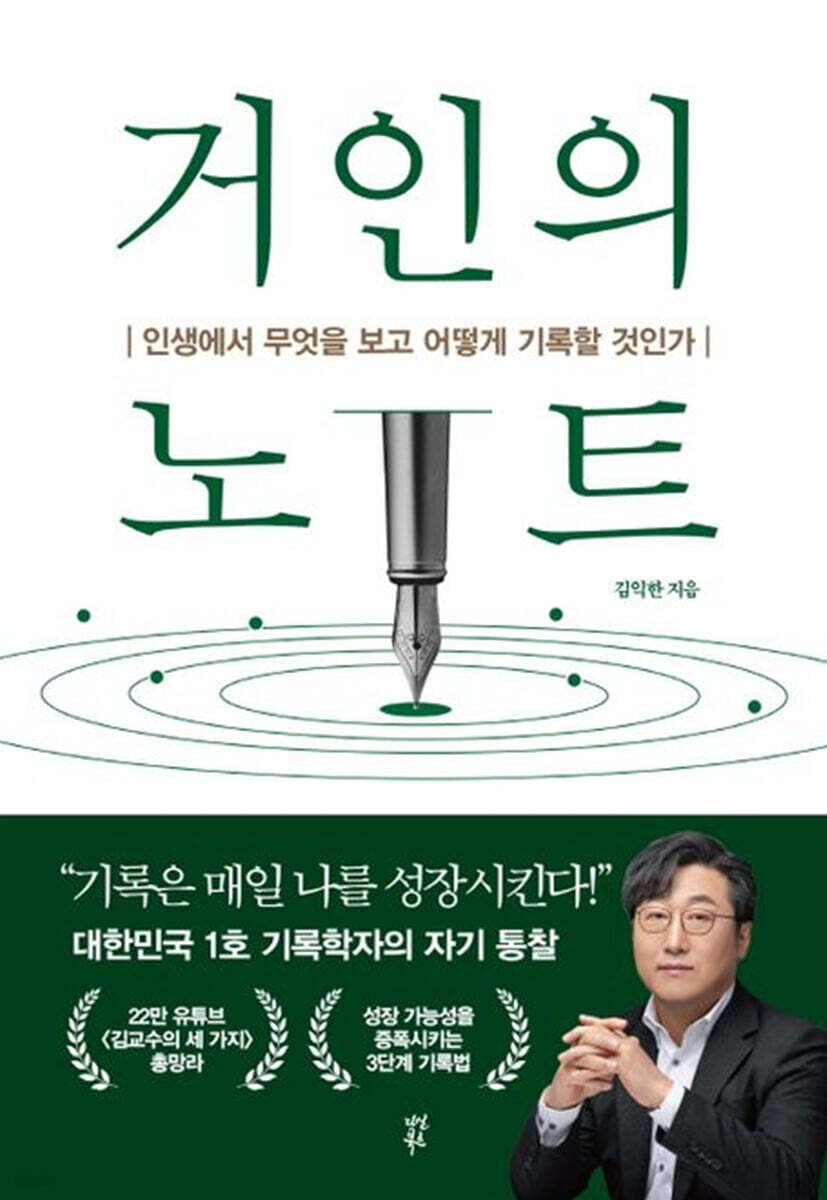
The One Rule of Life from Korea's First Archivist *220,000 YouTube views [Professor Kim's Three] Comprehensive / Includes 3-step, 5-step recording method to maximize growth potential★ As we go through life, we encounter various limitations. If you're stuck on the lonely and arduous path of study, if you haven't found what you want to do yet, if you've been working at a company for nearly 10 years but don't know how to achieve anything more, if you're tired of the repetitive daily routine of raising children, or if you've reached old age and retired and given up on further growth, will you give up on overcoming these limitations and just continue living as you have, or will you try to change your life once again? Professor Kim Ik-han, Korea's first and greatest archivist, says that if you want to do your best at least once in your life and enjoy the joy of success and accomplishment, then records are the fastest and easiest weapon you can use right now. If your grades don't improve no matter how much you study, there's only one answer. You must create your own study method by applying the principles of recording. If you don't remember what you read, learn how to write reading notes and make them your own. If you feel suffocated, write down one by one the situations that are bothering you. If you want to achieve success at work, write down your work records. If you want to be good at conversation, write down your conversation records. This is precisely why it must be recorded now. 『Notes of a Giant』 is the first book by Korea's first archivist, and it conveys the importance and methods of records that he has realized through 25 years of dedicated work in the field of records. When you write things down, your life becomes clearer. What was once considered a problem becomes nothing and worries are easily resolved. Recording is the first step you take to overcome the wall you have reached. Through this book, you will gain the ultimate weapon to awaken the growth potential dormant within you. |
- You can preview some of the book's contents.
Preview
index
If you write down what you enter, you will see the direction of your life.
Part 1: The Recording Human
Chapter 1 Growth
01 Living as a Record-By-Writer
02 You can still grow
03 Create your own growth mechanism
04 Catch the volatile knowledge
05 Thoughts grow in a spiral
06 Leverage your internal assets
* 3-step exercise to develop thinking power
Chapter 2 Freedom
07 Why Your Life Is Empty
08 The process of finding true desire
09 Find the real reason why you don't want to work.
10 If you are anxious about the future, record your experiences.
11 The essence of life is the process of finding freedom.
12 Records expand as they are shared
* Practice recording to get to know myself
Part 2: Summary and Classification of Giants
Chapter 3 Focus
01 The record-keeping master doesn't use it much.
02 Throw away everything but the core.
03 What I don't understand is not mine
04 The Best Way to Magnetize a Book
05 Let go of the fear of misreading
06 The Crucial Difference Between Patchwork and Summary
* The habit of summarizing everything in life
Chapter 4 Expansion
07 If you're feeling lost, share it.
08 If you classify, you will find the answer to your worries.
09 Take notes in one place and organize them into sections.
10 Ways to Organize and Revive Accumulated Records
* Tools that make recording fun
Part 3: The Five Recording Methods of the Giant
Study Chapter 5
01 From information to knowledge, from knowledge to wisdom
02 Read the book and record keywords.
03 How to Read Difficult Books Easily
04 Study records that make memorization easier
05 If you want to write well, write notes.
Chapter 6 Dialogue
06 How does conversation become knowledge?
07 The mystery of dialogue that builds up through exchange
08 To not miss the wisdom hidden in words
09 Record the context of the conversation.
10. Capture the fleeting thoughts that come to mind during a conversation.
Chapter 7 Thoughts
11. When records accumulate, they become ideas.
12 If you have any concerns, write them down.
13 How to Record the Unconscious
14 Genius is made of records
Chapter 8 Daily Life
15 Focus on real life, not mirages.
16 Write down your dreams in the morning, and your past at night.
17 If you record today, it becomes content that sells.
18 How to Use the Record-Type Human Diary
Chapter 9
19 If you want to be competent, write down your work.
20 How to Take Notes on Your Boss's Instructions
21 Monthly Diary Writing Techniques That Changed My Life
Dreaming of a world where we are all masters
Part 1: The Recording Human
Chapter 1 Growth
01 Living as a Record-By-Writer
02 You can still grow
03 Create your own growth mechanism
04 Catch the volatile knowledge
05 Thoughts grow in a spiral
06 Leverage your internal assets
* 3-step exercise to develop thinking power
Chapter 2 Freedom
07 Why Your Life Is Empty
08 The process of finding true desire
09 Find the real reason why you don't want to work.
10 If you are anxious about the future, record your experiences.
11 The essence of life is the process of finding freedom.
12 Records expand as they are shared
* Practice recording to get to know myself
Part 2: Summary and Classification of Giants
Chapter 3 Focus
01 The record-keeping master doesn't use it much.
02 Throw away everything but the core.
03 What I don't understand is not mine
04 The Best Way to Magnetize a Book
05 Let go of the fear of misreading
06 The Crucial Difference Between Patchwork and Summary
* The habit of summarizing everything in life
Chapter 4 Expansion
07 If you're feeling lost, share it.
08 If you classify, you will find the answer to your worries.
09 Take notes in one place and organize them into sections.
10 Ways to Organize and Revive Accumulated Records
* Tools that make recording fun
Part 3: The Five Recording Methods of the Giant
Study Chapter 5
01 From information to knowledge, from knowledge to wisdom
02 Read the book and record keywords.
03 How to Read Difficult Books Easily
04 Study records that make memorization easier
05 If you want to write well, write notes.
Chapter 6 Dialogue
06 How does conversation become knowledge?
07 The mystery of dialogue that builds up through exchange
08 To not miss the wisdom hidden in words
09 Record the context of the conversation.
10. Capture the fleeting thoughts that come to mind during a conversation.
Chapter 7 Thoughts
11. When records accumulate, they become ideas.
12 If you have any concerns, write them down.
13 How to Record the Unconscious
14 Genius is made of records
Chapter 8 Daily Life
15 Focus on real life, not mirages.
16 Write down your dreams in the morning, and your past at night.
17 If you record today, it becomes content that sells.
18 How to Use the Record-Type Human Diary
Chapter 9
19 If you want to be competent, write down your work.
20 How to Take Notes on Your Boss's Instructions
21 Monthly Diary Writing Techniques That Changed My Life
Dreaming of a world where we are all masters
Detailed image

Into the book
“If a dwarf stands on the shoulders of a giant, he can see further than the giant.” The record is the same.
Even though I am a dwarf now, if we accumulate daily records, we can see further and think more deeply.
Using the records I have left as a stepping stone, I will be able to face myself as a giant who stands at the highest place.
---From the introductory text, “Writing Shows the Direction of Life”
If studying, reading, or attending lectures is merely a passive act, then you are not really learning or reading properly.
In order to connect with growth, you must go through the process of ‘thinking.’
Do you ever find yourself reading a book and thinking, "What was I reading so far?" or listening to a lecture and thinking, "What's the point of this person's words?" If you don't, you're studying very inefficiently.
---From Chapter 1, “Growth”
The core of records, which the academic field of archival studies has long understood, is simple.
If 100 records are created, only the important 10 are kept.
Selecting the most useful records and utilizing them is called 'appraising and selecting'.
That is, evaluate whether the records are valuable and then choose which records to continue using.
This is also the most important area in archival studies.
So, we can say that the person who records is the person who selects 10 valuable records out of 100.
Discovering shining jewels among countless elements like grains of sand.
This is an important skill that we must develop throughout our lives, regardless of field.
---From Chapter 3, “Concentration”
When you face a difficult problem in life, simply knowing how to sort through the many pieces can provide a clue to solving the problem.
It's a really simple method.
All we need is to activate the dormant fragments of thought.
Keep this in mind.
The answer to my worries already lies within me.
Again, categorizing and recording your concerns is the easiest and fastest way to find answers to your concerns.
All you need is some time alone to think calmly, some paper, and a pen.
---From Chapter 4, “Expansion”
A conversation record is not a verbatim transcription of the entire content.
It's closer to writing down the context of the conversation based on keywords.
It's enough to be able to recall what conversations you had later when you look back.
(Omitted) People who write down the entire conversation like a stenographer are bound to miss the usefulness and essence of the conversation, just like people who don't write it down at all.
If you're going to write everything down, it might be better to ask the other person for their understanding and record it.
Keep this in mind.
The reason we record conversations is not to submit them as evidence to a court.
The purpose is to understand the information heard in the conversation and then extract only what is necessary to turn it into knowledge.
---From Chapter 6, “Dialogue”
There are records of countless geniuses who left their mark on history, but the best individual record is the classic of classics, Admiral Yi Sun-sin's 『Nanjung Ilgi』.
『Nanjung Ilgi』 contains the essence of the records I would like to recommend to you.
He was a master of records, synthesizing the various skills necessary for life into a diary.
He kept a diary for seven years, from 1592, when the Imjin War broke out, to 1598, when the second war ended.
The principle of record-keeping that proper records can only be kept if they are kept consistently has been practiced for over 430 years.
---From Chapter 7, “Thoughts”
The ultimate purpose of using a planner is to visualize my day.
It's about thinking about things you haven't done yet.
When I imagine myself, it means that I constantly think about and meet myself.
This also helps me a lot in living my true self, which I emphasized earlier.
Let's make sure to take care of the two things I introduced earlier: the core of my life (dream) and the core of today (schedule) every morning.
I'm so used to this routine that I feel uncomfortable if I don't start my day with a journal.
Planning my day allows me to welcome the time given to me with joy and positivity.
Of course, there are days when nothing goes according to plan.
But you can try again the next day.
A new day always comes.
A person who has established a routine of recording is not easily shaken.
---From Chapter 8, “Daily Life”
I bought a notebook with a little over 200 pages and started writing in one volume every month.
I wrote my plan on the left side of the notebook and recorded my execution on the right side.
When I woke up in the morning, I wrote down everything I had to do that day on the left side, and on the right side, I wrote down everything, such as what I studied from what time to what time, and who I met from what time to what time.
And at the end of the day, I wrote down my evaluation of the day, my resolutions, and my compliments.
I also wrote down what I studied, and when I summarized what I studied, it came to about 5-6 pages a day.
After repeating this, at some point I started to feel like I hadn't studied enough that day if I didn't write 5 or 6 pages.
Even though I am a dwarf now, if we accumulate daily records, we can see further and think more deeply.
Using the records I have left as a stepping stone, I will be able to face myself as a giant who stands at the highest place.
---From the introductory text, “Writing Shows the Direction of Life”
If studying, reading, or attending lectures is merely a passive act, then you are not really learning or reading properly.
In order to connect with growth, you must go through the process of ‘thinking.’
Do you ever find yourself reading a book and thinking, "What was I reading so far?" or listening to a lecture and thinking, "What's the point of this person's words?" If you don't, you're studying very inefficiently.
---From Chapter 1, “Growth”
The core of records, which the academic field of archival studies has long understood, is simple.
If 100 records are created, only the important 10 are kept.
Selecting the most useful records and utilizing them is called 'appraising and selecting'.
That is, evaluate whether the records are valuable and then choose which records to continue using.
This is also the most important area in archival studies.
So, we can say that the person who records is the person who selects 10 valuable records out of 100.
Discovering shining jewels among countless elements like grains of sand.
This is an important skill that we must develop throughout our lives, regardless of field.
---From Chapter 3, “Concentration”
When you face a difficult problem in life, simply knowing how to sort through the many pieces can provide a clue to solving the problem.
It's a really simple method.
All we need is to activate the dormant fragments of thought.
Keep this in mind.
The answer to my worries already lies within me.
Again, categorizing and recording your concerns is the easiest and fastest way to find answers to your concerns.
All you need is some time alone to think calmly, some paper, and a pen.
---From Chapter 4, “Expansion”
A conversation record is not a verbatim transcription of the entire content.
It's closer to writing down the context of the conversation based on keywords.
It's enough to be able to recall what conversations you had later when you look back.
(Omitted) People who write down the entire conversation like a stenographer are bound to miss the usefulness and essence of the conversation, just like people who don't write it down at all.
If you're going to write everything down, it might be better to ask the other person for their understanding and record it.
Keep this in mind.
The reason we record conversations is not to submit them as evidence to a court.
The purpose is to understand the information heard in the conversation and then extract only what is necessary to turn it into knowledge.
---From Chapter 6, “Dialogue”
There are records of countless geniuses who left their mark on history, but the best individual record is the classic of classics, Admiral Yi Sun-sin's 『Nanjung Ilgi』.
『Nanjung Ilgi』 contains the essence of the records I would like to recommend to you.
He was a master of records, synthesizing the various skills necessary for life into a diary.
He kept a diary for seven years, from 1592, when the Imjin War broke out, to 1598, when the second war ended.
The principle of record-keeping that proper records can only be kept if they are kept consistently has been practiced for over 430 years.
---From Chapter 7, “Thoughts”
The ultimate purpose of using a planner is to visualize my day.
It's about thinking about things you haven't done yet.
When I imagine myself, it means that I constantly think about and meet myself.
This also helps me a lot in living my true self, which I emphasized earlier.
Let's make sure to take care of the two things I introduced earlier: the core of my life (dream) and the core of today (schedule) every morning.
I'm so used to this routine that I feel uncomfortable if I don't start my day with a journal.
Planning my day allows me to welcome the time given to me with joy and positivity.
Of course, there are days when nothing goes according to plan.
But you can try again the next day.
A new day always comes.
A person who has established a routine of recording is not easily shaken.
---From Chapter 8, “Daily Life”
I bought a notebook with a little over 200 pages and started writing in one volume every month.
I wrote my plan on the left side of the notebook and recorded my execution on the right side.
When I woke up in the morning, I wrote down everything I had to do that day on the left side, and on the right side, I wrote down everything, such as what I studied from what time to what time, and who I met from what time to what time.
And at the end of the day, I wrote down my evaluation of the day, my resolutions, and my compliments.
I also wrote down what I studied, and when I summarized what I studied, it came to about 5-6 pages a day.
After repeating this, at some point I started to feel like I hadn't studied enough that day if I didn't write 5 or 6 pages.
---From Chapter 9, “Work”
Publisher's Review
“Should we continue to live as we have been living, or should we seek change?”
The one weapon that will create a turning point in your life: records!
People grow from the moment they are born.
From simply accumulating knowledge and becoming smarter, to becoming skilled at technical and professional tasks, to becoming able to solve the various problems we face in life on our own, growth never stops, though each person's pace may differ.
But unfortunately, there will inevitably come a time when you hit a wall.
Can we truly overcome the invisible wall blocking our path? How much can we grow beyond it?
Professor Kim Ik-han, Korea's first and foremost archivist, says that if you can keep good records, you can effectively overcome the various limitations you face in life and continue to grow.
In particular, the more I record my life, the clearer my life, school, work, and relationships become, and I can discover clues to the problems that have been bothering me.
I also see a side of myself that I didn't know existed.
Keeping records is essential for living my life.
However, despite the fact that it is the easiest and most effective means of growth to overcome uncertainty in life, most people give up on writing because they do not know how to apply it to their lives or how to write it down properly.
The record is simple.
It's something that leaves a mark on my daily life.
If I write down everything I think, experience, feel, meet, and do, those notes will reveal what values I hold important.
You can discover your true desires hidden deep within your heart and learn how to amplify your dormant growth potential.
Ultimately, records start from ‘thoughts’.
Thoughts become records, and records become life.
It is the surest way to constantly expand your world.
The first record of Korea's first archivist, Professor Kim Ik-han, is the first to be passed down.
Clear answers to what you should record and practice in life!
『The Giant's Notes』 is the first book by Professor Kim Ik-han, the first archivist in Korea who has been responsible for the records of the Republic of Korea.
Having dedicated 25 years to the field of records management, he has now broadened his perspective to include personal lives, and in this book, he reveals how records can transform lives.
It contains the self-insight and changes I have personally experienced, as well as the specific recording methods I have learned through these experiences.
The three-step growth recording method of 'recording, repeating, and continuing' proposed in this book is easy, simple, and applicable to anyone.
This book is divided into three parts.
Part 1, “The Human Who Records,” awakens us to the importance and value of records and suggests ways to overcome the walls that hinder growth.
Part 2, “The Giant’s Summary and Classification Method,” explains how to summarize and organize the endless thoughts swirling around in your head.
It also tells you how to organize your things so that you can easily retrieve them at any time.
The final three parts contain the "Five Giant Recording Methods" that can be of immediate help to anyone.
We introduce how to write to increase efficiency in five major areas of life, from studies to conversations, thoughts, daily life, and work.
The author says that it was 'records' that showed him the path of life when he was wandering between history and practice in his youth.
He also emphasizes that the reason he was able to succeed as a lifelong scholar and as someone who creates and distributes content through a YouTube channel and educational programs is because he 'applied records to life.'
This book helps people use the records they leave behind as stepping stones to become giants who can see further and think more deeply.
When you discover the true power of writing, it will become the most powerful weapon for those who want to grow and achieve their best at least once in their lives.
The one weapon that will create a turning point in your life: records!
People grow from the moment they are born.
From simply accumulating knowledge and becoming smarter, to becoming skilled at technical and professional tasks, to becoming able to solve the various problems we face in life on our own, growth never stops, though each person's pace may differ.
But unfortunately, there will inevitably come a time when you hit a wall.
Can we truly overcome the invisible wall blocking our path? How much can we grow beyond it?
Professor Kim Ik-han, Korea's first and foremost archivist, says that if you can keep good records, you can effectively overcome the various limitations you face in life and continue to grow.
In particular, the more I record my life, the clearer my life, school, work, and relationships become, and I can discover clues to the problems that have been bothering me.
I also see a side of myself that I didn't know existed.
Keeping records is essential for living my life.
However, despite the fact that it is the easiest and most effective means of growth to overcome uncertainty in life, most people give up on writing because they do not know how to apply it to their lives or how to write it down properly.
The record is simple.
It's something that leaves a mark on my daily life.
If I write down everything I think, experience, feel, meet, and do, those notes will reveal what values I hold important.
You can discover your true desires hidden deep within your heart and learn how to amplify your dormant growth potential.
Ultimately, records start from ‘thoughts’.
Thoughts become records, and records become life.
It is the surest way to constantly expand your world.
The first record of Korea's first archivist, Professor Kim Ik-han, is the first to be passed down.
Clear answers to what you should record and practice in life!
『The Giant's Notes』 is the first book by Professor Kim Ik-han, the first archivist in Korea who has been responsible for the records of the Republic of Korea.
Having dedicated 25 years to the field of records management, he has now broadened his perspective to include personal lives, and in this book, he reveals how records can transform lives.
It contains the self-insight and changes I have personally experienced, as well as the specific recording methods I have learned through these experiences.
The three-step growth recording method of 'recording, repeating, and continuing' proposed in this book is easy, simple, and applicable to anyone.
This book is divided into three parts.
Part 1, “The Human Who Records,” awakens us to the importance and value of records and suggests ways to overcome the walls that hinder growth.
Part 2, “The Giant’s Summary and Classification Method,” explains how to summarize and organize the endless thoughts swirling around in your head.
It also tells you how to organize your things so that you can easily retrieve them at any time.
The final three parts contain the "Five Giant Recording Methods" that can be of immediate help to anyone.
We introduce how to write to increase efficiency in five major areas of life, from studies to conversations, thoughts, daily life, and work.
The author says that it was 'records' that showed him the path of life when he was wandering between history and practice in his youth.
He also emphasizes that the reason he was able to succeed as a lifelong scholar and as someone who creates and distributes content through a YouTube channel and educational programs is because he 'applied records to life.'
This book helps people use the records they leave behind as stepping stones to become giants who can see further and think more deeply.
When you discover the true power of writing, it will become the most powerful weapon for those who want to grow and achieve their best at least once in their lives.
GOODS SPECIFICS
- Date of issue: March 8, 2023
- Page count, weight, size: 292 pages | 706g | 145*210*26mm
- ISBN13: 9791130697529
- ISBN10: 1130697525
You may also like
카테고리
korean


korean

![GQ KOREA Mark (Monthly): December [2025]](http://librairie.coreenne.fr/cdn/shop/files/8ef265dbbfbf186523ed75ba7319009d.jpg?v=1765340328&width=3840)


