

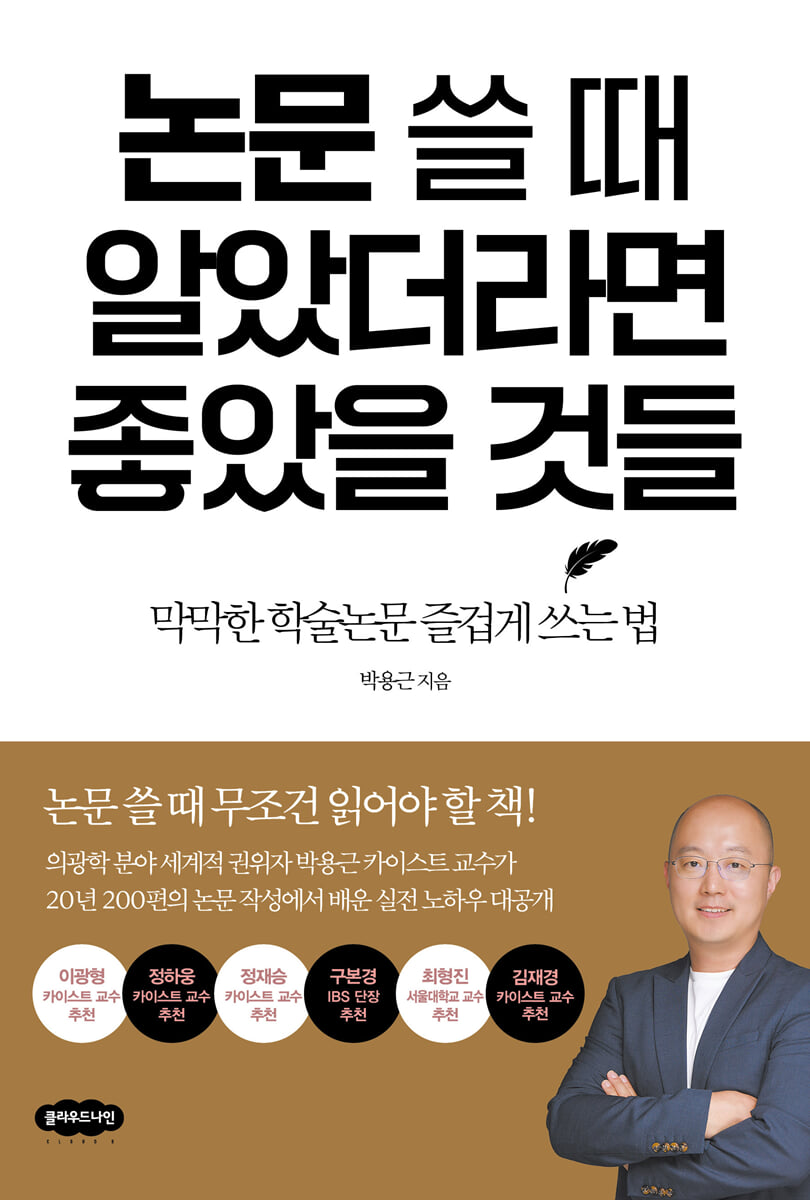
Things I Wish I Knew When Writing My Thesis
 |
Description
Book Introduction
A must-read book when writing a thesis!
Professor Yong-Geun Park of KAIST, a world-renowned authority in the field of biomedical optics
Practical know-how gained from writing 200 papers over 20 years revealed!
Transforming the daunting task of writing academic papers into a fun experience.
Writing a paper is a researcher's essential task and the biggest challenge.
Especially for graduate students and emerging researchers, a thesis is not only the completion of research but also a decisive achievement that determines their career path and evaluation.
However, most researchers begin their research without any writing training and experience a sense of helplessness and fear during the actual paper writing process.
The author of this book, Professor Yong-Geun Park of KAIST, a world-renowned authority in the field of biomedical optometry, also felt lost when faced with writing a thesis during his graduate school years.
Based on that experience, he came to deeply understand the difficulties students face and started with the question, "Why is it so difficult?"
This book is not simply a guide to writing papers.
This book covers how to make your paper a "persuasive story" rather than a "list of information."
What keeps readers reading a paper from beginning to end isn't the data, but the structure and the ability to structure the research as a story.
The author has written 200 papers over 20 years and has extensive experience in supervising and reviewing papers. This author presents specific pitfalls that novice researchers often fall into and strategies to overcome them.
So that researchers who are writing their first paper can start writing right away.
The greatest significance of this book lies in its "structuring of the paper." Even within the IMRaD (Introduction-Methods-Results-Discussion) format, the effectiveness of the presentation can vary dramatically depending on how the first sentence of the introduction is written, the order in which the results are presented, and how figures and tables are designed.
The author presents the key questions needed step by step.
For example, in the introduction, it is emphasized that the questions 'why this research is being conducted' and 'what problem is being solved' should be clearly stated first, and in the conclusion, 'what is new and important' should be impressed upon the reader again.
This book contains practical tips that can be applied immediately in real-world situations in each chapter.
We provide detailed guidance on how to title your paper, the order in which to complete your abstract, how to structure sentences to persuade reviewers, and even how to use AI to refine your first draft.
In particular, AI tools make it clear that while writing speed can be increased, the thought process must always be driven by humans.
Ultimately, this book is a practical manual that transforms the daunting process of "writing a paper" into "the joy of sharing research results with the world."
Any researcher will want to keep this book by their side from the moment they write their first paper.
Professor Yong-Geun Park of KAIST, a world-renowned authority in the field of biomedical optics
Practical know-how gained from writing 200 papers over 20 years revealed!
Transforming the daunting task of writing academic papers into a fun experience.
Writing a paper is a researcher's essential task and the biggest challenge.
Especially for graduate students and emerging researchers, a thesis is not only the completion of research but also a decisive achievement that determines their career path and evaluation.
However, most researchers begin their research without any writing training and experience a sense of helplessness and fear during the actual paper writing process.
The author of this book, Professor Yong-Geun Park of KAIST, a world-renowned authority in the field of biomedical optometry, also felt lost when faced with writing a thesis during his graduate school years.
Based on that experience, he came to deeply understand the difficulties students face and started with the question, "Why is it so difficult?"
This book is not simply a guide to writing papers.
This book covers how to make your paper a "persuasive story" rather than a "list of information."
What keeps readers reading a paper from beginning to end isn't the data, but the structure and the ability to structure the research as a story.
The author has written 200 papers over 20 years and has extensive experience in supervising and reviewing papers. This author presents specific pitfalls that novice researchers often fall into and strategies to overcome them.
So that researchers who are writing their first paper can start writing right away.
The greatest significance of this book lies in its "structuring of the paper." Even within the IMRaD (Introduction-Methods-Results-Discussion) format, the effectiveness of the presentation can vary dramatically depending on how the first sentence of the introduction is written, the order in which the results are presented, and how figures and tables are designed.
The author presents the key questions needed step by step.
For example, in the introduction, it is emphasized that the questions 'why this research is being conducted' and 'what problem is being solved' should be clearly stated first, and in the conclusion, 'what is new and important' should be impressed upon the reader again.
This book contains practical tips that can be applied immediately in real-world situations in each chapter.
We provide detailed guidance on how to title your paper, the order in which to complete your abstract, how to structure sentences to persuade reviewers, and even how to use AI to refine your first draft.
In particular, AI tools make it clear that while writing speed can be increased, the thought process must always be driven by humans.
Ultimately, this book is a practical manual that transforms the daunting process of "writing a paper" into "the joy of sharing research results with the world."
Any researcher will want to keep this book by their side from the moment they write their first paper.
- You can preview some of the book's contents.
Preview
index
Recommendation
A Guide to Navigating the Maze of Logical Thinking
Jaeseung Jeong, Dean of the Department of Brain and Cognitive Sciences at KAIST and Dean of the College of Convergence Studies
Highly recommended! A must-read for graduate students writing their dissertations.
-Choi Hyeong-jin, Professor, Seoul National University College of Medicine
Become a top scientist by following the paper masters
Koo Bon-kyung, Director of the Institute for Basic Science (IBS)
Writing a preface can be a joyful intellectually creative process.
Part 1: Things I Wish I Knew Before Writing My Thesis
Chapter 1: Ten Tips for Researchers
: Practical Guidelines to Solidify Your Research Journey
1.
Attitude is the most important thing
What You Can and Can't Control / From Epictetus to Stephen Covey / Even if Your Paper is Rejected, Even if Your Results Don't Come / Long-Term Vision and Steady Attitude
2.
Don't do research topics that seem interesting.
The allure and pitfalls of established fields / The courage to choose a topic that no one is paying attention to / The impact of choosing a research topic / Your own principles and value judgments
3.
Principles of Judgment: Conditions or My Own Standards?
The Problem of Relying Only on Comparing Pros and Cons / Establishing Your Own Value Standards First / Having a Value Standard Can Help You Endure Hard Times / Example: Should I Go to College? Should I Get a Job? / The Case of Elon Musk and Ray Dalio / Putting My Principles Before External Standards / Fear and Greed: Emotions That Cloud Judgment
4.
How to Build Trust: Don't Be Afraid of Losing
An attitude without fear of loss / Principles that also apply to the relationship between advisors and students / Sharing contributions in joint research / Sincerity and trust in others / Choices for growing together
5.
Overwhelming effort: If you work three times harder than others, you'll get at least twice as much.
More time, more thought, and more efficiency / A shocking experience at MIT / Don't be so quick to say you did your best.
6.
Find a better way
The Correlation Between Browser Choice and Employee Productivity / Toyota's Kaizen Culture / 3M's "15% Time Rule" and Innovation Case Studies / Moving Beyond the Default Options
7.
Focus only on your top priorities and don't multitask.
8.
Don't compare yourself to others; just do better than you did yesterday.
9.
Stress Management: Why You Should Exercise
Stress Hormones and Muscle Movement / Exercise and Brain Science
10.
I truly love my research
Chapter 2: Ten Mistakes Researchers Make
: A clue to avoiding traps that anyone can easily fall into.
1.
"Causation or Correlation?": Don't Confuse Cause and Effect
2.
"I'll show you how smart I am": Explaining simple things in a complex way.
3.
"I'll show you how much I've worked": Listing data unrelated to the flow of the paper.
4.
“You understand without me explaining it, right?”: Not considering the reader’s background knowledge and understanding.
5.
"You'll understand even if I explain it roughly?": Ignoring logical connections and systematic structure.
6.
"I only talk about what I want to talk about": Focusing on the researcher's own interests.
7.
"My research is perfect": Not honestly acknowledging the limitations of the research.
8.
"All previous studies are bad": Disparaging the value of prior research.
9.
"If I just finish it roughly, someone else will edit it for me.": Drafting without a sense of responsibility
10.
"I did it all by myself": Ignoring the contributions of collaborators
Chapter 3: Why Researchers Should Write Papers
: A starting point that starts from 'why' and moves on to 'how'
1.
Reasons and Purpose of Writing a Paper
2.
The format of early academic papers
3.
The evolution of modern scientific journals
4.
New Trials, Side Effects, and Alternatives
5.
The Age of Journal Flood: The Need for Impact Assessment and Future Prospects
6.
The Future of Scientific Journals: Online Platforms and Artificial Intelligence
7.
Types of papers
Original articles / Review articles / Case reports / Methodological articles / Data articles / Editorials and commentaries
8.
Structure of the paper
Title / Abstract / Introduction / Methodology / Results / Discussion / Conclusion / References / Other: Acknowledgements, Conflicts of Interest, Supplementary Materials
9.
The Structure of a Paper: A Case Study
Things I Wish I Knew When Writing Part 2 of My Thesis
Chapter 4: Structuring Your Paper: A Storyboard You Must Review Before Writing
1.
Good paper = good storytelling
2.
Beginning Your Paper: Write Your Conclusion First with a One-Line Summary
Why should you write the conclusion first? / Why is it difficult to summarize the conclusion in one sentence? / Why should storytelling be 'reader-centered'? / The key to writing a thesis is persuasiveness and logic.
3.
Conclusion in one sentence
Clearly state your conclusion in one sentence / Prepare a high-impact conclusion in advance.
4.
From Conclusion to Title: Structuring Titles Using Keywords
5.
Structuring Your Paper: Designing a Story Centered on the Conclusion
6.
Focusing on the Figure: Designing the Structure of a Paper
7.
Structuring a Paper: A Case Study
Chapter 5: Leveraging AI
: How to use smart assistants to improve accuracy
1.
Advantages of Writing Academic Papers Using AI
2.
Guidelines for the Ethical Use of Artificial Intelligence Tools
3.
A model of collaboration between artificial intelligence and humans
4.
Practical Guidelines: Prompts for Writing Papers Using Large-Scale Language Models
Example prompts for brainstorming / Example prompts for writing a conclusion / Example prompts for structuring a paper / Example prompts for writing the body / Example prompts for editing / Example prompts for review
Chapter 6: Writing an Introduction and Abstract: Captivating First Impressions
1.
The introduction is a preview of the paper.
2.
Step 1 (What): Present your research topic clearly.
The power of a short, powerful sentence
3.
Step 2 (Why): Explain the importance of the study.
Careful Emphasis: How to Express the Originality of Your Research / How to Reference Previous Research: Importance vs. Time / Papers Are Not Textbooks / Reiterating Importance
4.
Step 3 (How): Introduce the research method and key results.
Begin with a one-line summary of the conclusion / Summarize the experiment and results / Conclude the introduction: Reemphasize the importance of the study
5.
Writing an Introduction: Examples
6.
Writing an Abstract: A Concise Summary of the Introduction
Basic principles of writing an abstract / Write it as an independent piece.
Chapter 7: Writing Results and Discussion
: Complete the story beyond simple data listing.
1.
Results: All results in the picture are presented in a logical, step-by-step manner.
Explaining the results step by step / Mistake 1: “Let me show you how smart I am.” / Mistake 2: “Let me show you how hard I worked.” / Explaining all the results in the picture without leaving anything out
2.
Structuring paragraphs in the results section
Contain only one content per paragraph / Each paragraph is always enclosed in parentheses
3.
Logical development explaining the results
Logical flow within a paragraph
4.
Writing the Results Section: Example 1
Start with a key summary / Explain the figures and data step by step / Think from the reader's perspective and explain in a conversational manner
5.
Writing the Results Section: Example 2
Creating a natural flow between paragraphs / Going beyond the results to in-depth analysis
6.
Organizing paragraphs in the results section
Sentence tenses in the results section
7.
Writing an Argument: Clearly Communicating the Value of Your Research
Emphasize why this study is important / Repeatedly emphasize new findings and strengths / Introduce previous studies while emphasizing the strengths of this paper / Honestly describe the limitations of the study / The effect of honest description / Address future possibilities and implications
8.
Discussion: Points Not to Miss
Highlights the differences in the lab's ongoing research findings / Concludes the paper: Presents follow-up research and prospects / Suggests ideas to the reader
9.
How to write results and discussion: Keep your paper simple but in-depth
Write in parentheses and from the reader's perspective / Select and select results based on the conclusion / Convey deep content using simple words / Focus on the results rather than revealing the research process / Repeat and emphasize important parts / Write the paper as if you are having a conversation with the reader
Chapter 8 Drawing
: A visual persuasive strategy that presents complex content at a glance.
1.
The Importance of Figures in Research Papers: Visual Communication That Enhances Research Credibility
Organizing Data and Utilizing Software / Designing Figures Using PowerPoint / Creating Final Figures and Managing Files / Common Mistakes When Creating Figures for Your Thesis
2.
Drawing Papers: Effectively and Cleanly in Vector Format
3.
Conciseness and Accuracy: Principles and Tips for Creating Figures for Your Thesis
Maintain aspect ratio but clearly scale / Simplify information / Align, space, and unify
4.
Important results first and foremost
5.
What tools will you use to draw?
The Hidden Potential of PowerPoint / High-Quality Graphics Created with PowerPoint / Utilizing 3D Software / Color and Resolution: Basic Terminology and Standards / Creating Graphics That Fit Column Widths
6.
Correcting drawings during the publishing process
Converting a PowerPoint drawing to TIFF / Adjusting the image resolution and size / Removing blank space from an image / Saving an image / Tips for drawing a great thesis / Using institutional and free licenses
Things I Wish I Knew After Writing Part 3 of My Thesis
Chapter 9 Correction
: Final check from good paper to perfect paper
1.
Paper Proofreading: Small Differences Make Big Differences
Tips for effectively completing the correction steps
2.
Checklist: Detailed Checklists to Improve Completeness
Figure Checklist / Results Section Checklist / Text and Grammar Checklist / References Checklist / Accuracy and Objectivity of Expression Checklist / English Grammar Checklist
Chapter 10: Organizing References
: Ending the research by connecting it to the academic world
1.
Why should you conduct a literature search?
2.
The Flow of Literature Search: From Question to Search
Question-Search-Question Feedback / Key Literature Search Tools / How to Read the Search Results Screen / Evaluating Papers by Citation Count / Useful Features
3.
Innovations in Literature Search: Citation Mapping Tools and AI-Based Approaches
What is Citation Mapping? / Key Citation Mapping Tools / Review Papers: An Effective Guide to Exploring New Fields
4.
Using Bibliographic Management Software: Easily Write Your Paper with EndNote
Why Use Bibliographic Management Software? / Searching and Importing Papers / Integrating Word and EndNote / Changing Reference Formats
Chapter 11: Submitting and Responding to Review Results
: Understanding the system that increases the value and accuracy of papers
1.
Understanding the Peer Review System
Blind Review System / Editor's Role
2.
Things to prepare before submitting a paper
Determining Authorship / Basic Principles for Selecting Co-Authors / Considerations for Selecting Co-Authors / Writing a Cover Letter
3.
Responding after peer review
Types of review results / Revisions and rebuttals / Tips for responding to reviewer comments / Sample revised cover letter / Sample rebuttals / Desirable attitudes researchers should have when a paper is rejected for publication
supplement
Appendix A.
Differences between American and British English expressions
Appendix B.
Recommended books and resources mentioned in this book
References
A Guide to Navigating the Maze of Logical Thinking
Jaeseung Jeong, Dean of the Department of Brain and Cognitive Sciences at KAIST and Dean of the College of Convergence Studies
Highly recommended! A must-read for graduate students writing their dissertations.
-Choi Hyeong-jin, Professor, Seoul National University College of Medicine
Become a top scientist by following the paper masters
Koo Bon-kyung, Director of the Institute for Basic Science (IBS)
Writing a preface can be a joyful intellectually creative process.
Part 1: Things I Wish I Knew Before Writing My Thesis
Chapter 1: Ten Tips for Researchers
: Practical Guidelines to Solidify Your Research Journey
1.
Attitude is the most important thing
What You Can and Can't Control / From Epictetus to Stephen Covey / Even if Your Paper is Rejected, Even if Your Results Don't Come / Long-Term Vision and Steady Attitude
2.
Don't do research topics that seem interesting.
The allure and pitfalls of established fields / The courage to choose a topic that no one is paying attention to / The impact of choosing a research topic / Your own principles and value judgments
3.
Principles of Judgment: Conditions or My Own Standards?
The Problem of Relying Only on Comparing Pros and Cons / Establishing Your Own Value Standards First / Having a Value Standard Can Help You Endure Hard Times / Example: Should I Go to College? Should I Get a Job? / The Case of Elon Musk and Ray Dalio / Putting My Principles Before External Standards / Fear and Greed: Emotions That Cloud Judgment
4.
How to Build Trust: Don't Be Afraid of Losing
An attitude without fear of loss / Principles that also apply to the relationship between advisors and students / Sharing contributions in joint research / Sincerity and trust in others / Choices for growing together
5.
Overwhelming effort: If you work three times harder than others, you'll get at least twice as much.
More time, more thought, and more efficiency / A shocking experience at MIT / Don't be so quick to say you did your best.
6.
Find a better way
The Correlation Between Browser Choice and Employee Productivity / Toyota's Kaizen Culture / 3M's "15% Time Rule" and Innovation Case Studies / Moving Beyond the Default Options
7.
Focus only on your top priorities and don't multitask.
8.
Don't compare yourself to others; just do better than you did yesterday.
9.
Stress Management: Why You Should Exercise
Stress Hormones and Muscle Movement / Exercise and Brain Science
10.
I truly love my research
Chapter 2: Ten Mistakes Researchers Make
: A clue to avoiding traps that anyone can easily fall into.
1.
"Causation or Correlation?": Don't Confuse Cause and Effect
2.
"I'll show you how smart I am": Explaining simple things in a complex way.
3.
"I'll show you how much I've worked": Listing data unrelated to the flow of the paper.
4.
“You understand without me explaining it, right?”: Not considering the reader’s background knowledge and understanding.
5.
"You'll understand even if I explain it roughly?": Ignoring logical connections and systematic structure.
6.
"I only talk about what I want to talk about": Focusing on the researcher's own interests.
7.
"My research is perfect": Not honestly acknowledging the limitations of the research.
8.
"All previous studies are bad": Disparaging the value of prior research.
9.
"If I just finish it roughly, someone else will edit it for me.": Drafting without a sense of responsibility
10.
"I did it all by myself": Ignoring the contributions of collaborators
Chapter 3: Why Researchers Should Write Papers
: A starting point that starts from 'why' and moves on to 'how'
1.
Reasons and Purpose of Writing a Paper
2.
The format of early academic papers
3.
The evolution of modern scientific journals
4.
New Trials, Side Effects, and Alternatives
5.
The Age of Journal Flood: The Need for Impact Assessment and Future Prospects
6.
The Future of Scientific Journals: Online Platforms and Artificial Intelligence
7.
Types of papers
Original articles / Review articles / Case reports / Methodological articles / Data articles / Editorials and commentaries
8.
Structure of the paper
Title / Abstract / Introduction / Methodology / Results / Discussion / Conclusion / References / Other: Acknowledgements, Conflicts of Interest, Supplementary Materials
9.
The Structure of a Paper: A Case Study
Things I Wish I Knew When Writing Part 2 of My Thesis
Chapter 4: Structuring Your Paper: A Storyboard You Must Review Before Writing
1.
Good paper = good storytelling
2.
Beginning Your Paper: Write Your Conclusion First with a One-Line Summary
Why should you write the conclusion first? / Why is it difficult to summarize the conclusion in one sentence? / Why should storytelling be 'reader-centered'? / The key to writing a thesis is persuasiveness and logic.
3.
Conclusion in one sentence
Clearly state your conclusion in one sentence / Prepare a high-impact conclusion in advance.
4.
From Conclusion to Title: Structuring Titles Using Keywords
5.
Structuring Your Paper: Designing a Story Centered on the Conclusion
6.
Focusing on the Figure: Designing the Structure of a Paper
7.
Structuring a Paper: A Case Study
Chapter 5: Leveraging AI
: How to use smart assistants to improve accuracy
1.
Advantages of Writing Academic Papers Using AI
2.
Guidelines for the Ethical Use of Artificial Intelligence Tools
3.
A model of collaboration between artificial intelligence and humans
4.
Practical Guidelines: Prompts for Writing Papers Using Large-Scale Language Models
Example prompts for brainstorming / Example prompts for writing a conclusion / Example prompts for structuring a paper / Example prompts for writing the body / Example prompts for editing / Example prompts for review
Chapter 6: Writing an Introduction and Abstract: Captivating First Impressions
1.
The introduction is a preview of the paper.
2.
Step 1 (What): Present your research topic clearly.
The power of a short, powerful sentence
3.
Step 2 (Why): Explain the importance of the study.
Careful Emphasis: How to Express the Originality of Your Research / How to Reference Previous Research: Importance vs. Time / Papers Are Not Textbooks / Reiterating Importance
4.
Step 3 (How): Introduce the research method and key results.
Begin with a one-line summary of the conclusion / Summarize the experiment and results / Conclude the introduction: Reemphasize the importance of the study
5.
Writing an Introduction: Examples
6.
Writing an Abstract: A Concise Summary of the Introduction
Basic principles of writing an abstract / Write it as an independent piece.
Chapter 7: Writing Results and Discussion
: Complete the story beyond simple data listing.
1.
Results: All results in the picture are presented in a logical, step-by-step manner.
Explaining the results step by step / Mistake 1: “Let me show you how smart I am.” / Mistake 2: “Let me show you how hard I worked.” / Explaining all the results in the picture without leaving anything out
2.
Structuring paragraphs in the results section
Contain only one content per paragraph / Each paragraph is always enclosed in parentheses
3.
Logical development explaining the results
Logical flow within a paragraph
4.
Writing the Results Section: Example 1
Start with a key summary / Explain the figures and data step by step / Think from the reader's perspective and explain in a conversational manner
5.
Writing the Results Section: Example 2
Creating a natural flow between paragraphs / Going beyond the results to in-depth analysis
6.
Organizing paragraphs in the results section
Sentence tenses in the results section
7.
Writing an Argument: Clearly Communicating the Value of Your Research
Emphasize why this study is important / Repeatedly emphasize new findings and strengths / Introduce previous studies while emphasizing the strengths of this paper / Honestly describe the limitations of the study / The effect of honest description / Address future possibilities and implications
8.
Discussion: Points Not to Miss
Highlights the differences in the lab's ongoing research findings / Concludes the paper: Presents follow-up research and prospects / Suggests ideas to the reader
9.
How to write results and discussion: Keep your paper simple but in-depth
Write in parentheses and from the reader's perspective / Select and select results based on the conclusion / Convey deep content using simple words / Focus on the results rather than revealing the research process / Repeat and emphasize important parts / Write the paper as if you are having a conversation with the reader
Chapter 8 Drawing
: A visual persuasive strategy that presents complex content at a glance.
1.
The Importance of Figures in Research Papers: Visual Communication That Enhances Research Credibility
Organizing Data and Utilizing Software / Designing Figures Using PowerPoint / Creating Final Figures and Managing Files / Common Mistakes When Creating Figures for Your Thesis
2.
Drawing Papers: Effectively and Cleanly in Vector Format
3.
Conciseness and Accuracy: Principles and Tips for Creating Figures for Your Thesis
Maintain aspect ratio but clearly scale / Simplify information / Align, space, and unify
4.
Important results first and foremost
5.
What tools will you use to draw?
The Hidden Potential of PowerPoint / High-Quality Graphics Created with PowerPoint / Utilizing 3D Software / Color and Resolution: Basic Terminology and Standards / Creating Graphics That Fit Column Widths
6.
Correcting drawings during the publishing process
Converting a PowerPoint drawing to TIFF / Adjusting the image resolution and size / Removing blank space from an image / Saving an image / Tips for drawing a great thesis / Using institutional and free licenses
Things I Wish I Knew After Writing Part 3 of My Thesis
Chapter 9 Correction
: Final check from good paper to perfect paper
1.
Paper Proofreading: Small Differences Make Big Differences
Tips for effectively completing the correction steps
2.
Checklist: Detailed Checklists to Improve Completeness
Figure Checklist / Results Section Checklist / Text and Grammar Checklist / References Checklist / Accuracy and Objectivity of Expression Checklist / English Grammar Checklist
Chapter 10: Organizing References
: Ending the research by connecting it to the academic world
1.
Why should you conduct a literature search?
2.
The Flow of Literature Search: From Question to Search
Question-Search-Question Feedback / Key Literature Search Tools / How to Read the Search Results Screen / Evaluating Papers by Citation Count / Useful Features
3.
Innovations in Literature Search: Citation Mapping Tools and AI-Based Approaches
What is Citation Mapping? / Key Citation Mapping Tools / Review Papers: An Effective Guide to Exploring New Fields
4.
Using Bibliographic Management Software: Easily Write Your Paper with EndNote
Why Use Bibliographic Management Software? / Searching and Importing Papers / Integrating Word and EndNote / Changing Reference Formats
Chapter 11: Submitting and Responding to Review Results
: Understanding the system that increases the value and accuracy of papers
1.
Understanding the Peer Review System
Blind Review System / Editor's Role
2.
Things to prepare before submitting a paper
Determining Authorship / Basic Principles for Selecting Co-Authors / Considerations for Selecting Co-Authors / Writing a Cover Letter
3.
Responding after peer review
Types of review results / Revisions and rebuttals / Tips for responding to reviewer comments / Sample revised cover letter / Sample rebuttals / Desirable attitudes researchers should have when a paper is rejected for publication
supplement
Appendix A.
Differences between American and British English expressions
Appendix B.
Recommended books and resources mentioned in this book
References
Detailed image
Into the book
"Why do some people succeed and others don't? Are they born geniuses, so everything comes easily to them, and they just get lucky? Or did they develop those abilities through special upbringing and guidance in childhood?" This question plagued me throughout graduate school.
To resolve this curiosity, I carefully observed many seniors, juniors, fellow scientists, and professors, and tried to learn from many examples.
And after graduating from graduate school, I met many people as a professor and CEO of a company.
Ultimately, I realized that attitude is more important than innate circumstances or luck.
--- p.29
Whether you're a graduate student or a professor just starting a new lab, choosing a research topic is a crucial question.
Choosing the wrong topic can significantly impact your future career, your enjoyment and motivation during your research, and can lead to tiring and unsatisfactory results.
That's why you need to think seriously and find an area that you truly enjoy.
However, you should check yourself to see if the fun is not due to being fascinated by the 'result' that someone else has already completed.
--- p.39
Research doesn't always go according to plan.
Sometimes, someone suddenly has to drop out because it's time to graduate, or someone else has to take on most of the project.
Also, people tend to see things they did as bigger and things others did as smaller.
So that's where the conflict arises, like, 'I gave you so much more, why do you want to take more?'
In this case, the method I recommend is to 'increase the other person's contribution slightly more than it actually is.'
For example, if I objectively think, 'I contributed 60%, you contributed 40%,' then ultimately, I compromise by saying, 'I contributed 50%, you contributed 50%,' or 'I contributed 55%, you contributed 45%.'
My belief that the distribution of contributions is fair is my own delusion.
What I consider a fair contribution distribution may appear unfair to others.
At first, you may feel a little wronged or at a loss.
But what will the other person think? Will they appreciate my slightly lower contribution? They won't.
Everyone is selfish and only thinks about themselves.
The other person feels, 'Oh, I've been recognized enough for what I've done!'
But if you feel acknowledged, people will see you as a reasonable and fair person, and they will think, 'I want to work with this person again!'
As a result, the likelihood of unexpected new collaboration opportunities or networking opportunities opening up is much greater.
--- p.51
Your paper should focus on communicating your point well.
Writing a paper is not simply about listing your research results.
You can think of it as a process of storytelling that conveys information in a way that is easy for readers to understand and interesting.
Think about when we talk to our friends in our daily lives.
Some friends explain new concepts in a way that is clear and fun, so I can understand them easily.
Also, some friends' stories are complicated and boring, making them difficult to understand.
The same goes for papers.
The purpose of a paper is to convey the research findings to the reader in a clear and easy-to-understand manner.
If your paper is well structured, readers will find it easy to understand and find it interesting.
On the other hand, if the structure is sloppy or lacks logical flow, the paper may feel difficult and boring.
With the same research results, you can write a paper that is interesting to read, or you can write a paper that is not easy to read.
--- p.147~148
How should I write a paper? I'll list the steps above in chronological order, like this: "We attempted research called A and failed."
So, should I say, "While conducting research called B, I stumbled upon result C?" In reality, readers aren't interested in the order of the research process or the failures.
The important thing is not to tell the story you want to tell, but to tell the story your readers want to hear.
What the reader is wondering is what the final result C is and why it is important.
Therefore, the paper should be structured persuasively around the question, 'What academic significance does the discovery of C have?'
The purpose of storytelling should be to help readers clearly understand and be persuaded by the message of your paper.
--- p.151
Once you have established the conclusions of your paper, the subsequent writing process becomes much easier.
If you think carefully and come to a clear conclusion in advance, the next development will follow naturally.
On the other hand, if you start writing without a clear conclusion, it becomes more and more difficult as you proceed.
If you write with the wrong conclusion, you'll constantly find yourself thinking, "This isn't it?" and end up writing something that you find hard to convince yourself of.
And then you get a lot of stress.
Readers of these papers are unlikely to empathize with what research the authors did and why.
It is difficult to convince others of a paper that you yourself are not convinced of.
Only when your writing moves you can others be moved by it.
Moreover, if you start with a low-impact conclusion, it is difficult to expect high influence no matter how much effort you put into writing the paper.
The conclusion of a paper is a key factor in determining its impact.
To resolve this curiosity, I carefully observed many seniors, juniors, fellow scientists, and professors, and tried to learn from many examples.
And after graduating from graduate school, I met many people as a professor and CEO of a company.
Ultimately, I realized that attitude is more important than innate circumstances or luck.
--- p.29
Whether you're a graduate student or a professor just starting a new lab, choosing a research topic is a crucial question.
Choosing the wrong topic can significantly impact your future career, your enjoyment and motivation during your research, and can lead to tiring and unsatisfactory results.
That's why you need to think seriously and find an area that you truly enjoy.
However, you should check yourself to see if the fun is not due to being fascinated by the 'result' that someone else has already completed.
--- p.39
Research doesn't always go according to plan.
Sometimes, someone suddenly has to drop out because it's time to graduate, or someone else has to take on most of the project.
Also, people tend to see things they did as bigger and things others did as smaller.
So that's where the conflict arises, like, 'I gave you so much more, why do you want to take more?'
In this case, the method I recommend is to 'increase the other person's contribution slightly more than it actually is.'
For example, if I objectively think, 'I contributed 60%, you contributed 40%,' then ultimately, I compromise by saying, 'I contributed 50%, you contributed 50%,' or 'I contributed 55%, you contributed 45%.'
My belief that the distribution of contributions is fair is my own delusion.
What I consider a fair contribution distribution may appear unfair to others.
At first, you may feel a little wronged or at a loss.
But what will the other person think? Will they appreciate my slightly lower contribution? They won't.
Everyone is selfish and only thinks about themselves.
The other person feels, 'Oh, I've been recognized enough for what I've done!'
But if you feel acknowledged, people will see you as a reasonable and fair person, and they will think, 'I want to work with this person again!'
As a result, the likelihood of unexpected new collaboration opportunities or networking opportunities opening up is much greater.
--- p.51
Your paper should focus on communicating your point well.
Writing a paper is not simply about listing your research results.
You can think of it as a process of storytelling that conveys information in a way that is easy for readers to understand and interesting.
Think about when we talk to our friends in our daily lives.
Some friends explain new concepts in a way that is clear and fun, so I can understand them easily.
Also, some friends' stories are complicated and boring, making them difficult to understand.
The same goes for papers.
The purpose of a paper is to convey the research findings to the reader in a clear and easy-to-understand manner.
If your paper is well structured, readers will find it easy to understand and find it interesting.
On the other hand, if the structure is sloppy or lacks logical flow, the paper may feel difficult and boring.
With the same research results, you can write a paper that is interesting to read, or you can write a paper that is not easy to read.
--- p.147~148
How should I write a paper? I'll list the steps above in chronological order, like this: "We attempted research called A and failed."
So, should I say, "While conducting research called B, I stumbled upon result C?" In reality, readers aren't interested in the order of the research process or the failures.
The important thing is not to tell the story you want to tell, but to tell the story your readers want to hear.
What the reader is wondering is what the final result C is and why it is important.
Therefore, the paper should be structured persuasively around the question, 'What academic significance does the discovery of C have?'
The purpose of storytelling should be to help readers clearly understand and be persuaded by the message of your paper.
--- p.151
Once you have established the conclusions of your paper, the subsequent writing process becomes much easier.
If you think carefully and come to a clear conclusion in advance, the next development will follow naturally.
On the other hand, if you start writing without a clear conclusion, it becomes more and more difficult as you proceed.
If you write with the wrong conclusion, you'll constantly find yourself thinking, "This isn't it?" and end up writing something that you find hard to convince yourself of.
And then you get a lot of stress.
Readers of these papers are unlikely to empathize with what research the authors did and why.
It is difficult to convince others of a paper that you yourself are not convinced of.
Only when your writing moves you can others be moved by it.
Moreover, if you start with a low-impact conclusion, it is difficult to expect high influence no matter how much effort you put into writing the paper.
The conclusion of a paper is a key factor in determining its impact.
--- p.158
Publisher's Review
Welcome~ Is this your first time writing a thesis?
A thesis is not something you write with talent, it's something you design!
A research paper is a bridge connecting researchers' achievements to the world and is the most powerful means of communication with the academic community.
However, for graduate students and emerging researchers, writing a thesis can be akin to a never-ending maze.
I have a topic and some data, but I have no idea how to even start my first sentence.
Feedback from advisors is often vague and advice from seniors varies.
Eventually, months pass by with days spent staring at a blank screen.
Professor Yong-Geun Park, the author, has supervised hundreds of papers at KAIST and observed common difficulties faced by students.
I'm good at data analysis, but I don't know 'where' to start writing.
To solve this problem, he redefined paper writing as a matter of structure and strategy, not of "talent" or "inspiration."
He argues that “if research is a building, then a paper is its blueprint.”
A thesis is like building a building.
Just as materials need a blueprint to find their place, the structure must be established for the content to shine.
This book provides a 'blueprint' for what to place in each section from the introduction to the conclusion and what flow to follow to persuade the reader.
The Secret of a Paper That Persuasively Tells a Story from Data
The most common trap that beginners in writing papers fall into is 'listing data'.
If you focus on listing your experimental results in chronological order or recording every single number, your readers will likely end up wondering, "So what's the point?"
Professor Yong-Geu Park, the author, suggests a way of thinking that transforms research into a story as the key to solving this problem.
Why did you undertake this research? What did you discover? What do the results mean? What might change in the future?
These four questions are intertwined with each step of the Introduction-Methods-Results-Discussion (IMRaD) structure.
For example, the introduction draws readers in by presenting the importance of the problem based on figures and previous research.
The method is specific enough for the reader to follow, but without unnecessary details.
The results are arranged in the order of claims and evidence, not in the order of data.
In the discussion, we build trust by honestly describing the limitations of the research and future tasks.
The book contains specific examples comparing faulty and improved structures.
It demonstrates the importance of structural design by showing how the persuasiveness of a paper changes depending on how the same data is arranged.
Strategies you can apply right from your lab desk
This book is not a book about 'how to write well', but rather contains practical guidelines that can be applied immediately.
-How to open the first sentence: How to change the ordinary beginning like 'This study is...' into a form that stimulates the reader's curiosity, such as raising a question or presenting a shocking figure.
-Title and Abstract: How to capture the essence of your research within 15 words, and how to structure your abstract to catch the eye of the reviewer by highlighting your conclusions and contributions.
-Figure and table design: Tips for designing a layout that allows data flow to be seen at a glance, and providing interpretation direction through legends and titles.
- Conclusion writing: The art of repeating and emphasizing key messages to leave them in the reader's memory.
Leveraging AI Tools: Why AI should be used to refine draft sentences and improve expression, but researchers must lead the design of structure and logic.
The author especially strongly recommends 'writing backwards from the conclusion'.
If you first summarize the key message you want to convey in the conclusion and then fill in the introduction, methods, and results that support it, the focus of your paper will not be lost.
A thesis is not something to be feared, but rather the "completion of research."
This book encourages us to view papers not as a gateway to "review and acceptance," but as an opportunity to connect our research with the world.
The author's advice, found throughout the manuscript, is practical and prompts reflection on one's own attitude as a researcher.
You can experience a shift from avoiding and procrastinating on writing a thesis to putting it into action as you learn about the structure and strategy.
This book is a necessary guide for graduate students preparing their first dissertation, researchers going through the process of submitting and revising, and beginning professors supervising students.
This book provides the "map" needed to overcome the enormous obstacle of writing a thesis, transforming the overwhelming feeling of writing into the joy of completing research.
A thesis is not something you write with talent, it's something you design!
A research paper is a bridge connecting researchers' achievements to the world and is the most powerful means of communication with the academic community.
However, for graduate students and emerging researchers, writing a thesis can be akin to a never-ending maze.
I have a topic and some data, but I have no idea how to even start my first sentence.
Feedback from advisors is often vague and advice from seniors varies.
Eventually, months pass by with days spent staring at a blank screen.
Professor Yong-Geun Park, the author, has supervised hundreds of papers at KAIST and observed common difficulties faced by students.
I'm good at data analysis, but I don't know 'where' to start writing.
To solve this problem, he redefined paper writing as a matter of structure and strategy, not of "talent" or "inspiration."
He argues that “if research is a building, then a paper is its blueprint.”
A thesis is like building a building.
Just as materials need a blueprint to find their place, the structure must be established for the content to shine.
This book provides a 'blueprint' for what to place in each section from the introduction to the conclusion and what flow to follow to persuade the reader.
The Secret of a Paper That Persuasively Tells a Story from Data
The most common trap that beginners in writing papers fall into is 'listing data'.
If you focus on listing your experimental results in chronological order or recording every single number, your readers will likely end up wondering, "So what's the point?"
Professor Yong-Geu Park, the author, suggests a way of thinking that transforms research into a story as the key to solving this problem.
Why did you undertake this research? What did you discover? What do the results mean? What might change in the future?
These four questions are intertwined with each step of the Introduction-Methods-Results-Discussion (IMRaD) structure.
For example, the introduction draws readers in by presenting the importance of the problem based on figures and previous research.
The method is specific enough for the reader to follow, but without unnecessary details.
The results are arranged in the order of claims and evidence, not in the order of data.
In the discussion, we build trust by honestly describing the limitations of the research and future tasks.
The book contains specific examples comparing faulty and improved structures.
It demonstrates the importance of structural design by showing how the persuasiveness of a paper changes depending on how the same data is arranged.
Strategies you can apply right from your lab desk
This book is not a book about 'how to write well', but rather contains practical guidelines that can be applied immediately.
-How to open the first sentence: How to change the ordinary beginning like 'This study is...' into a form that stimulates the reader's curiosity, such as raising a question or presenting a shocking figure.
-Title and Abstract: How to capture the essence of your research within 15 words, and how to structure your abstract to catch the eye of the reviewer by highlighting your conclusions and contributions.
-Figure and table design: Tips for designing a layout that allows data flow to be seen at a glance, and providing interpretation direction through legends and titles.
- Conclusion writing: The art of repeating and emphasizing key messages to leave them in the reader's memory.
Leveraging AI Tools: Why AI should be used to refine draft sentences and improve expression, but researchers must lead the design of structure and logic.
The author especially strongly recommends 'writing backwards from the conclusion'.
If you first summarize the key message you want to convey in the conclusion and then fill in the introduction, methods, and results that support it, the focus of your paper will not be lost.
A thesis is not something to be feared, but rather the "completion of research."
This book encourages us to view papers not as a gateway to "review and acceptance," but as an opportunity to connect our research with the world.
The author's advice, found throughout the manuscript, is practical and prompts reflection on one's own attitude as a researcher.
You can experience a shift from avoiding and procrastinating on writing a thesis to putting it into action as you learn about the structure and strategy.
This book is a necessary guide for graduate students preparing their first dissertation, researchers going through the process of submitting and revising, and beginning professors supervising students.
This book provides the "map" needed to overcome the enormous obstacle of writing a thesis, transforming the overwhelming feeling of writing into the joy of completing research.
GOODS SPECIFICS
- Date of issue: August 11, 2025
- Page count, weight, size: 372 pages | 152*225*30mm
- ISBN13: 9791194534341
- ISBN10: 1194534341
You may also like
카테고리
korean


korean

![GQ KOREA Mark (Monthly): December [2025]](http://librairie.coreenne.fr/cdn/shop/files/8ef265dbbfbf186523ed75ba7319009d.jpg?v=1765340328&width=3840)


