

Shohei Ohtani's Showtime
 |
Description
Book Introduction
Life is like Shohei Otani.
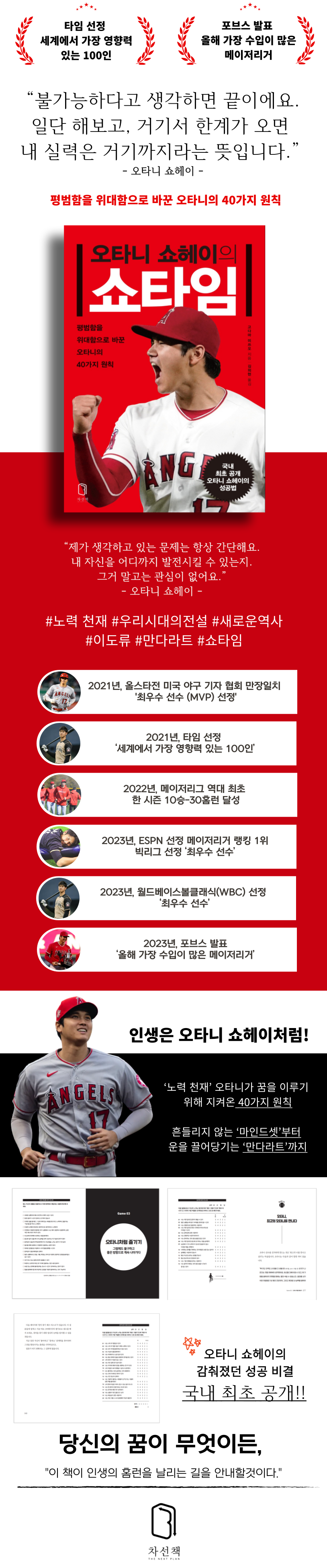
Shohei Ohtani's secret to success revealed for the first time in Korea!
This is the first book in Korea to reveal the success story of Shohei Ohtani, the world's most popular sports star as of 2023, regardless of sport or country.
The author, a passionate fan of Ohtani and a renowned sports psychologist, attributes Ohtani's success to his clever management of what he "loves" and what he "does well." A baseball genius who became MLB's first "$600 million man," a world-class star who played both pitcher and hitter, a five-season NPB dual-purpose player, a world-class star with overwhelming skill... His records, which fall short of "first" and "best," aren't what make him shine.
Ohtani earned the nickname "Showtime" when he entered the major leagues.
It refers to 'SHOWTIME', which is a major league hit, but it is also called 'Sho-Time', which is named after him.
The title of the book, “Shohei Otani’s Showtime,” contains all the ambiguous meanings of “showtime.”
The time Ohtani plays in a game is not only the best time to lead his team to victory, but it is also the best time of his life for his fans and Ohtani himself.
Ohtani fans around the world admire his performance while also applauding Ohtani's character, personality, and charm as a person.
Ohtani, who seems so flawless, how did he become an undeniable, unparalleled world star?
In this book, you can learn how to achieve and advance like Otani.
Shohei Ohtani's secret to success revealed for the first time in Korea!
This is the first book in Korea to reveal the success story of Shohei Ohtani, the world's most popular sports star as of 2023, regardless of sport or country.
The author, a passionate fan of Ohtani and a renowned sports psychologist, attributes Ohtani's success to his clever management of what he "loves" and what he "does well." A baseball genius who became MLB's first "$600 million man," a world-class star who played both pitcher and hitter, a five-season NPB dual-purpose player, a world-class star with overwhelming skill... His records, which fall short of "first" and "best," aren't what make him shine.
Ohtani earned the nickname "Showtime" when he entered the major leagues.
It refers to 'SHOWTIME', which is a major league hit, but it is also called 'Sho-Time', which is named after him.
The title of the book, “Shohei Otani’s Showtime,” contains all the ambiguous meanings of “showtime.”
The time Ohtani plays in a game is not only the best time to lead his team to victory, but it is also the best time of his life for his fans and Ohtani himself.
Ohtani fans around the world admire his performance while also applauding Ohtani's character, personality, and charm as a person.
Ohtani, who seems so flawless, how did he become an undeniable, unparalleled world star?
In this book, you can learn how to achieve and advance like Otani.
- You can preview some of the book's contents.
Preview
index
Opening Address _ Kim Oe-hyeon
Create your own showtime, like Otani _004
Rules of Game
Otani Magic: Transforming Ordinaryness into Greatness _018
Game 01
Dreaming like Otani
: Achieving dreams armed with 'what you like' and 'what you are good at'
Rule 01 If you want to be something, act as if you already are _024
Rule 02: What Doesn't Exist for Otani: The Dream Limiter _029
Rule 03: Finding Your Calling: Turning What You Love into What You Do Best _033
Rule 04: Talent that is not developed is trash, even to geniuses. _037
Rule 05: First-class people make their actions successful _042
Rule 06 It took Otani 12 years to become a top player _047
Rule 07 Focus on "good play" rather than becoming first-class _052
Rule 08 Even Geniuses Don't Just Get What They Want _056
Game 02
Do it like Ohtani
: Never give up even when you feel like you're going to die
Rule 09: Learn to overcome pressure and achieve repeated victories _062
Rule 10: The ultimate goal is to surpass your best self _067
Rule 11: The Power of Giving Your All, Obsession _072
Rule 12: Meet the Best Otani _077
Rule 13: Habits Don't Betray Winners _082
Rule 14: Ohtani's Pattern: Making the Impossible Possible _087
Rule 15: Don't think about things you can't control _092
Game 03
Enjoy it like Otani
: Nevertheless, keep moving in a good direction
Rule 16: A Monster Genius Created by Practice, Not Skill: Otani _098
Rule 17: Moving Forward Every Day with the Excitement of Waiting for 'That Moment' _103
Rule 18: Where Does Ohtani Get His Motivation? _108
Rule 19: Move forward without hesitation toward the person you want to be _112
Rule 20: The Otani Method for Producing Good Results _117
Rule 21: Small achievements add up to big ones _122
Rule 22: Adversity Makes Success Blossom _127
Special Column _ Kim Oe-hyeon
Shohei Otani and Mandala _132
Game 04
Become as good as Ohtani
: Attract 'strong luck' and achieve what you set your mind to
Rule 23: Even in negative things, there is always something positive to be said for. _144
Rule 24: The Power of Self-Suggestion to Get What You Want _149
Rule 25: How Otani Uses "Bad Luck" and "Failure" _154
Rule 26: Encourage Yourself Even in Bad Times _159
Rule 27: Become an Optimist, Not a Perfectionist _164
Rule 28: What is the true power of positivity? _169
Game 05
Look straight ahead like Otani
: Knowing yourself well brings success forward.
Rule 29: Nobody Wants You to Succeed _176
Rule 30: Resilience begins with eating well and sleeping well _181
Rule 31: Think deeply about things that seem pointless _186
Rule 32: Think less, and achieve less _191
Rule 33: Otani's Thoughts on the Conditions of Being an Adult _196
Rule 34: Decide for Yourself What Kind of Person You Will Be _201
Game 06
Moving forward like Otani
No one or nothing can stop Otani.
Rule 35: How to Become a Person Who Exceeds Expectations _208
Rule 36: Luck Comes to Those Who Enjoy It _213
Rule 37: Otani, the Man Who Lives as He Sets His Mind _218
Rule 38 If you want to be a lucky person _223
Rule 39: Act Like You're Doing Well _228
Rule 40: Transcend Luck, Enhance Your Human Power _233
Evaluation Sheet _238
Create your own showtime, like Otani _004
Rules of Game
Otani Magic: Transforming Ordinaryness into Greatness _018
Game 01
Dreaming like Otani
: Achieving dreams armed with 'what you like' and 'what you are good at'
Rule 01 If you want to be something, act as if you already are _024
Rule 02: What Doesn't Exist for Otani: The Dream Limiter _029
Rule 03: Finding Your Calling: Turning What You Love into What You Do Best _033
Rule 04: Talent that is not developed is trash, even to geniuses. _037
Rule 05: First-class people make their actions successful _042
Rule 06 It took Otani 12 years to become a top player _047
Rule 07 Focus on "good play" rather than becoming first-class _052
Rule 08 Even Geniuses Don't Just Get What They Want _056
Game 02
Do it like Ohtani
: Never give up even when you feel like you're going to die
Rule 09: Learn to overcome pressure and achieve repeated victories _062
Rule 10: The ultimate goal is to surpass your best self _067
Rule 11: The Power of Giving Your All, Obsession _072
Rule 12: Meet the Best Otani _077
Rule 13: Habits Don't Betray Winners _082
Rule 14: Ohtani's Pattern: Making the Impossible Possible _087
Rule 15: Don't think about things you can't control _092
Game 03
Enjoy it like Otani
: Nevertheless, keep moving in a good direction
Rule 16: A Monster Genius Created by Practice, Not Skill: Otani _098
Rule 17: Moving Forward Every Day with the Excitement of Waiting for 'That Moment' _103
Rule 18: Where Does Ohtani Get His Motivation? _108
Rule 19: Move forward without hesitation toward the person you want to be _112
Rule 20: The Otani Method for Producing Good Results _117
Rule 21: Small achievements add up to big ones _122
Rule 22: Adversity Makes Success Blossom _127
Special Column _ Kim Oe-hyeon
Shohei Otani and Mandala _132
Game 04
Become as good as Ohtani
: Attract 'strong luck' and achieve what you set your mind to
Rule 23: Even in negative things, there is always something positive to be said for. _144
Rule 24: The Power of Self-Suggestion to Get What You Want _149
Rule 25: How Otani Uses "Bad Luck" and "Failure" _154
Rule 26: Encourage Yourself Even in Bad Times _159
Rule 27: Become an Optimist, Not a Perfectionist _164
Rule 28: What is the true power of positivity? _169
Game 05
Look straight ahead like Otani
: Knowing yourself well brings success forward.
Rule 29: Nobody Wants You to Succeed _176
Rule 30: Resilience begins with eating well and sleeping well _181
Rule 31: Think deeply about things that seem pointless _186
Rule 32: Think less, and achieve less _191
Rule 33: Otani's Thoughts on the Conditions of Being an Adult _196
Rule 34: Decide for Yourself What Kind of Person You Will Be _201
Game 06
Moving forward like Otani
No one or nothing can stop Otani.
Rule 35: How to Become a Person Who Exceeds Expectations _208
Rule 36: Luck Comes to Those Who Enjoy It _213
Rule 37: Otani, the Man Who Lives as He Sets His Mind _218
Rule 38 If you want to be a lucky person _223
Rule 39: Act Like You're Doing Well _228
Rule 40: Transcend Luck, Enhance Your Human Power _233
Evaluation Sheet _238
Detailed image
Into the book
In fact, we can live without making decisions.
You could just go with the flow of the world and end your life.
This is a very comfortable way of life.
But in terms of a sense of accomplishment or satisfaction, I can never convince myself of this kind of life.
After Ohtani joined the Nippon-Ham Fighters, then-manager Hideki Kuriyama said the following:
“Whether this is good or bad is still unknown, but Shohei has definitely shown that ‘there is another way.’
I think that this type of baseball is something that allows everyone to experience the fun and breadth of baseball.
“At a time when baseball needs to change drastically, there were many times when I thought Shohei was truly a man sent from God.” The common thread among “top-notch” people like Ohtani is that they “make their own decisions based on what they like and what they are good at, and then put those decisions into action.”
The result doesn't matter.
For Ohtani, "what he likes" and "what he is good at" are the sources of motivation, so the action itself is pleasurable, regardless of the outcome.
So, whether it works out or not, I have no regrets.
People who immediately decide in their heads, "This won't do," and don't take action may think they've made a wise choice.
But for someone like Ohtani who believes that "action itself is success," such a choice is not only unwise but also meaningless.
It's just a coward's choice.
Furthermore, it is impossible to achieve the feeling of being 'alive' with such a lifestyle.
The only way to succeed is to never give up and keep challenging yourself until you achieve your dreams, armed with what you love and what you are good at.
Even if you don't achieve your dreams by the end of your life, a happy person is someone who can enjoy the process of challenging themselves.
In other words, if you can feel pleasure not from the good 'result' but from the 'process', then you can say that you have truly done your part.
--- p.42 From “First-class people make the act itself a success”
Don't let your 'special skills' rust away by being caught up in the daily grind.
You can't grow by just working hard at the task in front of you.
Like Otani, let's make sure we have our weapons firmly engraved in our heads, and above all, let's make time to hone our weapons our top priority.
Regarding this, Otani said the following:
“I didn’t always think about becoming a first-class pitcher or a first-class hitter when I started playing baseball.
“I want to hit well, I want to pitch well, I always want the same thing.” Work is what takes up the most time in our one and only life.
Let's be grateful for what's right in front of us, and as we look back on it, let's ask ourselves the following questions:
Why does this exist now?
Where does the reward I get from doing this come from?
What is the biggest skill this job requires of me?
I must devote all my energy to thoroughly refining my greatest weapon.
If you don't have a proper weapon, you won't be able to do anything even if the opportunity arises.
--- p.54~55 From “Focusing on ‘good play’ rather than becoming first-class”
Above all, Otani's rival is Otani himself.
His reward lies in surpassing himself.
Ohtani says he often watches videos of his swing or pitching form, and if he gets any hints, he tries them out right away.
Regarding this, Otani says:
“Every day, there are things that were bad and things that were good.
It was there today too.
Think about how you'll do it tomorrow, and try it the next day.
It just keeps repeating itself.
I think that's how I grow little by little." I put my mind to the topic I want to explore, and I devote myself to sharpening my weapon by devoting enough time to focusing on one point.
This is the essence of obsession, the power to see things through to the end.
If you don't get carried away by the ups and downs of everyday life, but find value in the process itself and immerse yourself in it, you too can surpass yourself like Ohtani.
Obsession is essential to surpassing yourself.
The word "obsession" might conjure up images of someone desperately trying to keep at the task at hand, but that might just be an illusion.
Only by having the attitude of looking for hints for a leap forward in the task at hand, with a topic in mind, can you voluntarily immerse yourself in your work.
This is the true nature of obsession.
--- p.72~73 From “The Power of Giving Your All, the Power of Obsession”
Shohei Ohtani's daily routine during his time with the Nippon Ham Fighters was surprisingly meticulous and scientific.
Above all, Ohtani did this brilliantly.
For example, the day after climbing a mountain, I jog or ride a bike to get rid of fatigue, and the day after that, I completely rest.
And from the third day onwards, I thoroughly completed the training set for the next appearance.
This habit did not change even after becoming a major leaguer.
Pre-season training is meticulously planned.
There is also a set number of catch balls with interpreter Mizuhara Ippei and balls thrown against the wall.
Of course, Ohtani also has a well-organized off-season routine.
Speaking about how he spent his offseason ahead of the shortened 2020 season due to the coronavirus pandemic, Ohtani said:
“Today we played catch starting at 10:45 am.
To do that, I go to the baseball stadium at 10 o'clock, start moving, and warm up my body for 45 minutes.
First, I play catch, then I go to the bullpen, run, bat, do weight training, and then I come back.
As for practice, I think I'm doing it without any regrets." Many people underestimate the importance of 'routine' (repetitive tasks).
But routines should not be taken lightly.
'Doing the same thing at the same time in the same place every day' - no matter how grand your dreams and goals are, if you ignore this routine, it will be impossible to achieve them.
--- p.82~83 From “Habits Never Betray the Winner”
Otani always calmly assessed the situation he was in, set his goals based on what he could do, and took actions that he could understand.
Otani said:
“I cannot eliminate the coronavirus on my own.
You can't put your heart and soul into it.
But even without an audience, you can still experience a heart-warming play just by watching it on TV.
So, let's focus our efforts on that." I hope you too can clearly distinguish between the "controllable elements" and the "uncontrollable elements" in your daily life.
Many people find it difficult to enjoy life because they overreact and harbor negative feelings about things they cannot control.
Otani always focuses on the elements he can control.
In other words, successful people were able to attract luck and achieve tremendous results because they focused solely on what they could control, rather than focusing on what they couldn't control.
Try to check as many items as possible on the 'Emotion Control Checklist' on the next page.
Then, like Otani, you will be able to maintain stable emotional control in any situation.
You could just go with the flow of the world and end your life.
This is a very comfortable way of life.
But in terms of a sense of accomplishment or satisfaction, I can never convince myself of this kind of life.
After Ohtani joined the Nippon-Ham Fighters, then-manager Hideki Kuriyama said the following:
“Whether this is good or bad is still unknown, but Shohei has definitely shown that ‘there is another way.’
I think that this type of baseball is something that allows everyone to experience the fun and breadth of baseball.
“At a time when baseball needs to change drastically, there were many times when I thought Shohei was truly a man sent from God.” The common thread among “top-notch” people like Ohtani is that they “make their own decisions based on what they like and what they are good at, and then put those decisions into action.”
The result doesn't matter.
For Ohtani, "what he likes" and "what he is good at" are the sources of motivation, so the action itself is pleasurable, regardless of the outcome.
So, whether it works out or not, I have no regrets.
People who immediately decide in their heads, "This won't do," and don't take action may think they've made a wise choice.
But for someone like Ohtani who believes that "action itself is success," such a choice is not only unwise but also meaningless.
It's just a coward's choice.
Furthermore, it is impossible to achieve the feeling of being 'alive' with such a lifestyle.
The only way to succeed is to never give up and keep challenging yourself until you achieve your dreams, armed with what you love and what you are good at.
Even if you don't achieve your dreams by the end of your life, a happy person is someone who can enjoy the process of challenging themselves.
In other words, if you can feel pleasure not from the good 'result' but from the 'process', then you can say that you have truly done your part.
--- p.42 From “First-class people make the act itself a success”
Don't let your 'special skills' rust away by being caught up in the daily grind.
You can't grow by just working hard at the task in front of you.
Like Otani, let's make sure we have our weapons firmly engraved in our heads, and above all, let's make time to hone our weapons our top priority.
Regarding this, Otani said the following:
“I didn’t always think about becoming a first-class pitcher or a first-class hitter when I started playing baseball.
“I want to hit well, I want to pitch well, I always want the same thing.” Work is what takes up the most time in our one and only life.
Let's be grateful for what's right in front of us, and as we look back on it, let's ask ourselves the following questions:
Why does this exist now?
Where does the reward I get from doing this come from?
What is the biggest skill this job requires of me?
I must devote all my energy to thoroughly refining my greatest weapon.
If you don't have a proper weapon, you won't be able to do anything even if the opportunity arises.
--- p.54~55 From “Focusing on ‘good play’ rather than becoming first-class”
Above all, Otani's rival is Otani himself.
His reward lies in surpassing himself.
Ohtani says he often watches videos of his swing or pitching form, and if he gets any hints, he tries them out right away.
Regarding this, Otani says:
“Every day, there are things that were bad and things that were good.
It was there today too.
Think about how you'll do it tomorrow, and try it the next day.
It just keeps repeating itself.
I think that's how I grow little by little." I put my mind to the topic I want to explore, and I devote myself to sharpening my weapon by devoting enough time to focusing on one point.
This is the essence of obsession, the power to see things through to the end.
If you don't get carried away by the ups and downs of everyday life, but find value in the process itself and immerse yourself in it, you too can surpass yourself like Ohtani.
Obsession is essential to surpassing yourself.
The word "obsession" might conjure up images of someone desperately trying to keep at the task at hand, but that might just be an illusion.
Only by having the attitude of looking for hints for a leap forward in the task at hand, with a topic in mind, can you voluntarily immerse yourself in your work.
This is the true nature of obsession.
--- p.72~73 From “The Power of Giving Your All, the Power of Obsession”
Shohei Ohtani's daily routine during his time with the Nippon Ham Fighters was surprisingly meticulous and scientific.
Above all, Ohtani did this brilliantly.
For example, the day after climbing a mountain, I jog or ride a bike to get rid of fatigue, and the day after that, I completely rest.
And from the third day onwards, I thoroughly completed the training set for the next appearance.
This habit did not change even after becoming a major leaguer.
Pre-season training is meticulously planned.
There is also a set number of catch balls with interpreter Mizuhara Ippei and balls thrown against the wall.
Of course, Ohtani also has a well-organized off-season routine.
Speaking about how he spent his offseason ahead of the shortened 2020 season due to the coronavirus pandemic, Ohtani said:
“Today we played catch starting at 10:45 am.
To do that, I go to the baseball stadium at 10 o'clock, start moving, and warm up my body for 45 minutes.
First, I play catch, then I go to the bullpen, run, bat, do weight training, and then I come back.
As for practice, I think I'm doing it without any regrets." Many people underestimate the importance of 'routine' (repetitive tasks).
But routines should not be taken lightly.
'Doing the same thing at the same time in the same place every day' - no matter how grand your dreams and goals are, if you ignore this routine, it will be impossible to achieve them.
--- p.82~83 From “Habits Never Betray the Winner”
Otani always calmly assessed the situation he was in, set his goals based on what he could do, and took actions that he could understand.
Otani said:
“I cannot eliminate the coronavirus on my own.
You can't put your heart and soul into it.
But even without an audience, you can still experience a heart-warming play just by watching it on TV.
So, let's focus our efforts on that." I hope you too can clearly distinguish between the "controllable elements" and the "uncontrollable elements" in your daily life.
Many people find it difficult to enjoy life because they overreact and harbor negative feelings about things they cannot control.
Otani always focuses on the elements he can control.
In other words, successful people were able to attract luck and achieve tremendous results because they focused solely on what they could control, rather than focusing on what they couldn't control.
Try to check as many items as possible on the 'Emotion Control Checklist' on the next page.
Then, like Otani, you will be able to maintain stable emotional control in any situation.
--- p.94~95 From “I Don’t Think About What I Can’t Control”
Publisher's Review
“Don’t think what Otani is doing is normal.
Because it's not normal.” _MLB.COM
From an unwavering mindset to a mandala that attracts luck.
Shohei Ohtani, a baseball player for the LA Angels of Major League Baseball (MLB).
Despite many people trying to dissuade him, he insisted on playing both as a pitcher and a hitter.
His remarkable performance earned him the nickname "Double Swordsmanship." He won Rookie of the Year in his MLB debut and unanimously won the American League MVP in 2021. He holds several MLB records, including becoming the first player in MLB history to reach 10 wins and 30 home runs in a single season, the first to reach 30 home runs and 200 strikeouts in a single season, and the first player to appear in an All-Star Game as both a pitcher and hitter. As of 2023, he is the No. 1 player in the ESPN Major League Baseball rankings.
The media describes Ohtani as a "baseball genius that comes once in a century."
The word genius might make you think that Ohtani's success is due to innate ability, but he is actually an incredibly hard worker.
If you ask him what he thinks his talent is, he would answer, “The ability to work hard at something you like.”
The 'Mandalat' schedule, which he personally created and implemented in high school, clearly demonstrated Otani's sincerity and became the catalyst for Mandalat's rise to fame.
"If you think it's impossible, that's it. Just try." _Shohei Ohtani
He started playing baseball in the local Little League in the third grade, and by the fifth grade he was recording a fastball speed of 110 km/h.
Although he had amazing skills, he had a disappointing time because his elementary school did not even qualify for the national competition.
In middle school, he began to show his fighting spirit by leading his school to national competitions, and after entering high school, he became a pitcher starting in the fall season of his first year, and he received public attention by recording a top speed of 147 km/h, 151 km/h in his second year, and 160 km/h in his third year, the first in amateur baseball history.
Was Shohei Ohtani born to sports-loving parents, inheriting a superior DNA, and following a smooth path to elite athleticism to achieve his current greatness? It's difficult to view his achievements as so natural and simple.
Longtime fans of Ohtani will know that he is not a "baseball genius" but a "hardworking genius."
The 40 Principles of "Hardworking Genius" Ohtani: Transforming Ordinaryness into Greatness
Shohei Ohtani, who has lived his life turning 'impossible' into 'possible'.
What did he value in life, and what habits did he maintain? As a renowned sports psychologist and Ohtani fan, the author analyzed Ohtani's success habits using psychology, management, and data science theories, and distilled them into 40 principles.
Ohtani's principles, such as "If you want to be something, act as if you have already become one," "Don't think about things you can't control," and "Be an optimist rather than a perfectionist," prove that he is a monster who is not satisfied with his natural talent and constantly strives to overcome only himself.
Beyond being a fan of Ohtani, don't you want to know 'how to live like Ohtani'?
If you're ready to break free from the anxiety and lethargy that plagues you every day and meet a completely new you, open this book with the mindset of Ohtani on the mound.
Your own showtime will unfold.
Because it's not normal.” _MLB.COM
From an unwavering mindset to a mandala that attracts luck.
Shohei Ohtani, a baseball player for the LA Angels of Major League Baseball (MLB).
Despite many people trying to dissuade him, he insisted on playing both as a pitcher and a hitter.
His remarkable performance earned him the nickname "Double Swordsmanship." He won Rookie of the Year in his MLB debut and unanimously won the American League MVP in 2021. He holds several MLB records, including becoming the first player in MLB history to reach 10 wins and 30 home runs in a single season, the first to reach 30 home runs and 200 strikeouts in a single season, and the first player to appear in an All-Star Game as both a pitcher and hitter. As of 2023, he is the No. 1 player in the ESPN Major League Baseball rankings.
The media describes Ohtani as a "baseball genius that comes once in a century."
The word genius might make you think that Ohtani's success is due to innate ability, but he is actually an incredibly hard worker.
If you ask him what he thinks his talent is, he would answer, “The ability to work hard at something you like.”
The 'Mandalat' schedule, which he personally created and implemented in high school, clearly demonstrated Otani's sincerity and became the catalyst for Mandalat's rise to fame.
"If you think it's impossible, that's it. Just try." _Shohei Ohtani
He started playing baseball in the local Little League in the third grade, and by the fifth grade he was recording a fastball speed of 110 km/h.
Although he had amazing skills, he had a disappointing time because his elementary school did not even qualify for the national competition.
In middle school, he began to show his fighting spirit by leading his school to national competitions, and after entering high school, he became a pitcher starting in the fall season of his first year, and he received public attention by recording a top speed of 147 km/h, 151 km/h in his second year, and 160 km/h in his third year, the first in amateur baseball history.
Was Shohei Ohtani born to sports-loving parents, inheriting a superior DNA, and following a smooth path to elite athleticism to achieve his current greatness? It's difficult to view his achievements as so natural and simple.
Longtime fans of Ohtani will know that he is not a "baseball genius" but a "hardworking genius."
The 40 Principles of "Hardworking Genius" Ohtani: Transforming Ordinaryness into Greatness
Shohei Ohtani, who has lived his life turning 'impossible' into 'possible'.
What did he value in life, and what habits did he maintain? As a renowned sports psychologist and Ohtani fan, the author analyzed Ohtani's success habits using psychology, management, and data science theories, and distilled them into 40 principles.
Ohtani's principles, such as "If you want to be something, act as if you have already become one," "Don't think about things you can't control," and "Be an optimist rather than a perfectionist," prove that he is a monster who is not satisfied with his natural talent and constantly strives to overcome only himself.
Beyond being a fan of Ohtani, don't you want to know 'how to live like Ohtani'?
If you're ready to break free from the anxiety and lethargy that plagues you every day and meet a completely new you, open this book with the mindset of Ohtani on the mound.
Your own showtime will unfold.
GOODS SPECIFICS
- Date of issue: May 20, 2023
- Page count, weight, size: 244 pages | 140*210*20mm
- ISBN13: 9791197919848
- ISBN10: 1197919848
You may also like
카테고리
korean


korean

![ELLE 엘르 스페셜 에디션 A형 : 12월 [2025]](http://librairie.coreenne.fr/cdn/shop/files/b8e27a3de6c9538896439686c6b0e8fb.jpg?v=1766436872&width=3840)


