

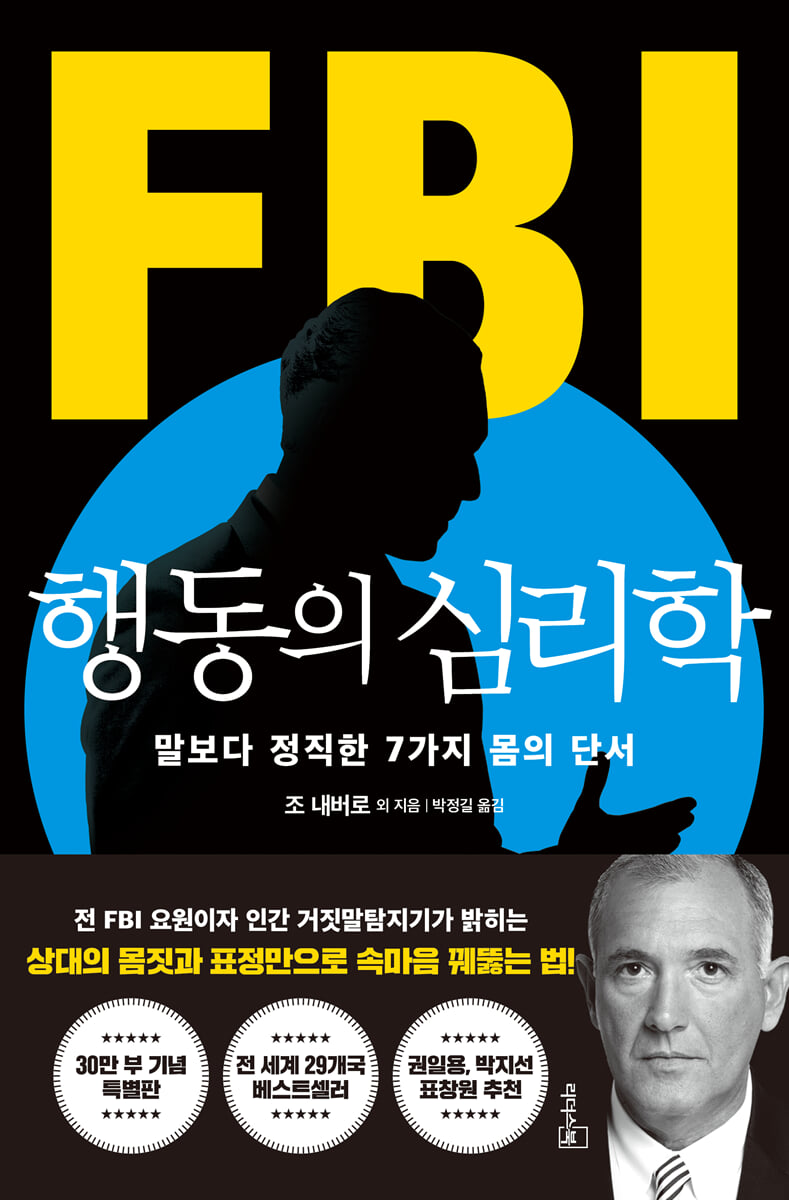
The Psychology of FBI Behavior (Recover Special Edition)
 |
Description
Book Introduction
* The bible of nonverbal behavior analysis chosen by 1 million readers worldwide
* Special recover edition to commemorate the sale of 300,000 copies in Korea
* Highly recommended by Korea's top criminal psychology experts Kwon Il-yong, Park Ji-seon, and Pyo Chang-won.
Former FBI agent reveals 'human lie detector'
How to see through someone's feelings just by looking at their body language and facial expressions
“Don’t miss the body’s clues, which are clearer than words!”
A commemorative reissue edition of "FBI Behavioral Psychology," which has established itself as the world's "bible of nonverbal communication," has been published to commemorate the 300,000-copy milestone.
The author of this book, Joe Navarro, a former FBI special agent, was known within the FBI as a "human lie detector" for his ability to see through the minds of highly trained spies and sophisticated criminals behind poker faces.
This book, which analyzes the meaning of gestures and the mechanisms of behavior based on 25 years of FBI field experience and the latest research in psychology, biology, and sociology, has been translated and published in 29 countries and has created a great stir. It is also considered a must-read in the field of psychology in Korea.
Why do we ask people to look at their feet to capture their true feelings and intentions? Which body part reacts first when they feel threatened? Can we sense someone's discomfort just by their sitting posture? Humans constantly send thousands of signals through body language and facial expressions, without even realizing it.
* Special recover edition to commemorate the sale of 300,000 copies in Korea
* Highly recommended by Korea's top criminal psychology experts Kwon Il-yong, Park Ji-seon, and Pyo Chang-won.
Former FBI agent reveals 'human lie detector'
How to see through someone's feelings just by looking at their body language and facial expressions
“Don’t miss the body’s clues, which are clearer than words!”
A commemorative reissue edition of "FBI Behavioral Psychology," which has established itself as the world's "bible of nonverbal communication," has been published to commemorate the 300,000-copy milestone.
The author of this book, Joe Navarro, a former FBI special agent, was known within the FBI as a "human lie detector" for his ability to see through the minds of highly trained spies and sophisticated criminals behind poker faces.
This book, which analyzes the meaning of gestures and the mechanisms of behavior based on 25 years of FBI field experience and the latest research in psychology, biology, and sociology, has been translated and published in 29 countries and has created a great stir. It is also considered a must-read in the field of psychology in Korea.
Why do we ask people to look at their feet to capture their true feelings and intentions? Which body part reacts first when they feel threatened? Can we sense someone's discomfort just by their sitting posture? Humans constantly send thousands of signals through body language and facial expressions, without even realizing it.
- You can preview some of the book's contents.
Preview
index
Recommendation
Prologue: The Secrets of Communication Revealed by "Human Lie Detector" Joe Navarro
1.
The truth you leak through your actions
Who is responsible for the Puerto Rico hotel arson?
Actions speak louder than words.
Why Doctors Should Pay More Attention to Patients' Actions Than Their Words
7 Commandments for Reading People's Minds Through Body Language
A person's psychology is revealed through their actions alone.
2.
Brain, the behavior control center
The secret to behavior lies in the limbic system.
The three-step survival mechanism that protects humans
Freeze Reaction: Stop if it's dangerous
Flight response: When stopping and not solving the problem don't work, run away.
Fight Response: If You Can't Run, Fight
Why can't painful wounds be forgotten?
If you suspect a lie, look at the other person's neck.
Typical behaviors that appear when anxious
Men and women have different ways of relieving stress.
Read about the changes in your body caused by stress.
Things to avoid during an interview
8 Guidelines for Understanding Stress Information
3.
Face, the litmus test of emotions
Catch the inner thoughts that pass by your face
Thoughts and intentions are reflected in facial wrinkles.
Very small pupils tell the truth
Double play of eyebrows and squint
The Secret of Blindfolding Action
How do our eyes change when we fall in love?
Keep an eye on those in power
Is the secret to Hugh Grant's acting skills in his eyes?
How is a fake smile different from a genuine smile?
The more you purse your lips, the more your confidence disappears.
Why did that person purse his lips when I spoke?
Laughter is a strong signal of a breakup.
Emotions expressed through the tongue
What the various facial changes say
Disgust is first revealed on the face.
As self-esteem increases, the nose and chin rise together.
What do we believe when words and actions differ?
4.
Arms, a tool to increase survival
Arms that show joy and frustration
Reading the marks left on the arms of abused children
When you are not confident, your arms become stiff.
How people pick up baby diapers
The realm of the individual is power.
Area representations appearing in the conference room
Love is a battle for dominance
What do adults think about tattoos?
How to show intimacy
Arm movements expressing emotions
5.
Hands, the art of seizing success
Don't hide your hands under the table
Don't use force when shaking hands
When traveling abroad, learn how to greet people first.
Point with your palm open instead of pointing your finger.
Don't polish your appearance in front of others.
Are you lying when you say your hands are sweaty?
Stress intensity that your hands can tell you
A lawyer's confidence is evident in his hands.
How do you create a charismatic image for a police officer?
A powerful expression of masculine superiority
Behaviors that appear when confidence is lost
When in doubt, look at your hands.
Keep your middle finger as straight as possible.
Notice when the hand stops
Emotions are conveyed through hands
6.
Bridge, where truth and lies are revealed
Legs more honest than the face
A gambler's perfect poker face, but his legs are speaking for themselves.
How do you know when someone is uncomfortable?
When you're happy, your legs also jump up and down.
How a guard can show authority just by standing there
Why do humans want more space?
When you feel comfortable, your legs form an X shape.
How do your legs change when you fall in love?
To determine if someone likes you, shake their hand and wait.
A criminal's gait is different.
How Airport Customs Inspectors Read People
Kim Basinger's Nervous Interview
When stressed, your legs reach for a chair.
7.
The torso, the front line of survival
In dangerous situations, people turn their backs.
Why do women hug cushions?
How to interpret the multiple meanings of crossed arms
Why can't I digest food in uncomfortable situations?
Eisenhower bows to MacArthur
Dressing is more than just strategy
Grooming is another message
8. Detecting FBI Agents' Deception
The subtle difference between truth and lies
The FBI's Four Models for Approaching Deception
When we feel comfortable, our bodies lean toward the other person.
If you want to know the sincerity of a smile, pay attention to the movement of the head.
The 12 Commandments I Keep in Mind When Conducting Investigations
Focus on concurrency
A liar cannot emphasize something twice.
False statements are followed by passive actions.
The deceiver and the deceived
The language for the best relationships is honesty.
Epilogue: For Better Interpersonal Relationships
Translator's Note: How to Be Competitive in an Age of Persuasion and Communication
References
Prologue: The Secrets of Communication Revealed by "Human Lie Detector" Joe Navarro
1.
The truth you leak through your actions
Who is responsible for the Puerto Rico hotel arson?
Actions speak louder than words.
Why Doctors Should Pay More Attention to Patients' Actions Than Their Words
7 Commandments for Reading People's Minds Through Body Language
A person's psychology is revealed through their actions alone.
2.
Brain, the behavior control center
The secret to behavior lies in the limbic system.
The three-step survival mechanism that protects humans
Freeze Reaction: Stop if it's dangerous
Flight response: When stopping and not solving the problem don't work, run away.
Fight Response: If You Can't Run, Fight
Why can't painful wounds be forgotten?
If you suspect a lie, look at the other person's neck.
Typical behaviors that appear when anxious
Men and women have different ways of relieving stress.
Read about the changes in your body caused by stress.
Things to avoid during an interview
8 Guidelines for Understanding Stress Information
3.
Face, the litmus test of emotions
Catch the inner thoughts that pass by your face
Thoughts and intentions are reflected in facial wrinkles.
Very small pupils tell the truth
Double play of eyebrows and squint
The Secret of Blindfolding Action
How do our eyes change when we fall in love?
Keep an eye on those in power
Is the secret to Hugh Grant's acting skills in his eyes?
How is a fake smile different from a genuine smile?
The more you purse your lips, the more your confidence disappears.
Why did that person purse his lips when I spoke?
Laughter is a strong signal of a breakup.
Emotions expressed through the tongue
What the various facial changes say
Disgust is first revealed on the face.
As self-esteem increases, the nose and chin rise together.
What do we believe when words and actions differ?
4.
Arms, a tool to increase survival
Arms that show joy and frustration
Reading the marks left on the arms of abused children
When you are not confident, your arms become stiff.
How people pick up baby diapers
The realm of the individual is power.
Area representations appearing in the conference room
Love is a battle for dominance
What do adults think about tattoos?
How to show intimacy
Arm movements expressing emotions
5.
Hands, the art of seizing success
Don't hide your hands under the table
Don't use force when shaking hands
When traveling abroad, learn how to greet people first.
Point with your palm open instead of pointing your finger.
Don't polish your appearance in front of others.
Are you lying when you say your hands are sweaty?
Stress intensity that your hands can tell you
A lawyer's confidence is evident in his hands.
How do you create a charismatic image for a police officer?
A powerful expression of masculine superiority
Behaviors that appear when confidence is lost
When in doubt, look at your hands.
Keep your middle finger as straight as possible.
Notice when the hand stops
Emotions are conveyed through hands
6.
Bridge, where truth and lies are revealed
Legs more honest than the face
A gambler's perfect poker face, but his legs are speaking for themselves.
How do you know when someone is uncomfortable?
When you're happy, your legs also jump up and down.
How a guard can show authority just by standing there
Why do humans want more space?
When you feel comfortable, your legs form an X shape.
How do your legs change when you fall in love?
To determine if someone likes you, shake their hand and wait.
A criminal's gait is different.
How Airport Customs Inspectors Read People
Kim Basinger's Nervous Interview
When stressed, your legs reach for a chair.
7.
The torso, the front line of survival
In dangerous situations, people turn their backs.
Why do women hug cushions?
How to interpret the multiple meanings of crossed arms
Why can't I digest food in uncomfortable situations?
Eisenhower bows to MacArthur
Dressing is more than just strategy
Grooming is another message
8. Detecting FBI Agents' Deception
The subtle difference between truth and lies
The FBI's Four Models for Approaching Deception
When we feel comfortable, our bodies lean toward the other person.
If you want to know the sincerity of a smile, pay attention to the movement of the head.
The 12 Commandments I Keep in Mind When Conducting Investigations
Focus on concurrency
A liar cannot emphasize something twice.
False statements are followed by passive actions.
The deceiver and the deceived
The language for the best relationships is honesty.
Epilogue: For Better Interpersonal Relationships
Translator's Note: How to Be Competitive in an Age of Persuasion and Communication
References
Detailed image

Into the book
One day, a young woman was sexually assaulted on the Parker Indian Reservation in Arizona.
The suspect in the case was brought in for questioning, and he was very confident and his statement was plausible.
He claimed he never saw the victim and that he had followed the cotton field into the field, turned left and entered the house straight away.
As I continued to observe the suspect while my colleagues recorded his statement, I noticed that his hand unconsciously pointed to the right when he said he turned left and entered the house.
The direction he unconsciously pointed was exactly the way to the scene of the sexual assault.
If I hadn't observed him, I wouldn't have caught the discrepancy between his verbal (turning to the left) and nonverbal (pointing to the right with his hand).
As soon as I discovered his actions, I knew he was lying, so I waited for a while and questioned him intently.
Eventually, he confessed to the crime.
--- p.23~24
Touching or stroking the neck is one of the most common calming behaviors in response to stress.
The cervical spine refers to the concave area between the scapula and clavicle, and is also called the cervical spine.
When a woman touches or covers this area with her hand, it usually means she is feeling distressed, threatened, anxious, or scared.
This is an important behavioral cue that can be detected when someone is lying or hiding important information.
--- p.63~64
When I was an intern, not long after I started my investigative career, I was assigned to identify shoplifters at a large bookstore.
I realized that it was surprisingly easy to spot criminals high above the store.
Surprisingly, they looked around a lot as soon as they entered the bookstore and moved their arms less than other shoppers.
They seemed to be trying to make themselves invisible.
But restricting my arm movements actually made them more noticeable, and I focused on them more.
--- p.137~138
A survey of jurors found that they disliked it when their lawyer's hands were hidden behind the desk.
The jurors wanted to see the lawyer's hands so they could evaluate his arguments more accurately.
Additionally, jurors perceived witnesses who hid their hands negatively, believing they were hiding something or even lying.
If hands are not visible or are not expressive, the perceived quality of the information being conveyed is lowered and honesty is questioned.
--- p.166
Interestingly, lawyers have found that when their witnesses testify, their testimony becomes more valuable if they make it look like a spire.
Because it conveys that the lawyer is confident in the witness's statement.
When a witness clasps his or her hands or fists together, jurors associate such behavior with nervousness or deception.
Generally, when giving testimony, it is best to make a tower shape with your hands or a cup shape with both hands.
This behavior is perceived as more authoritative, confident, and authentic.
--- p.
180
The face is the part of the body that most often hides and deceives emotions.
Yet, when people read body language, they usually start with the face and work their way down.
My approach is the exact opposite.
During my time working on thousands of investigations for the FBI, I realized that I had to focus on the suspect's feet and legs first.
As you go from bottom to top, that is, from feet to head, truthfulness decreases.
If you want to accurately observe the behavior of people around you, observe their feet and legs.
Feet and legs provide surprisingly honest nonverbal information.
--- p.204
A while ago, while watching a poker tournament on television, I noticed one player's legs waving uncontrollably under the table.
His legs were moving up and down, left and right, like the excited legs of a child going to Disneyland.
The attitude at the table was calm and cool, but chaos was brewing below.
I mentally urged the other players to quickly shake off their bets and give up, but two players raised the stakes and they all lost.
The player who swept up the money with a cool expression showed the best poker face.
But it certainly wasn't the best poker feet.
---p.206
If someone suddenly starts to act protectively, it means they are uncomfortable or have sensed that they are in a threatening situation.
In 1992, I and a group of FBI agents interviewed a young man and his father at a Boston hotel.
At that time, the young man picked up a sofa cushion and hugged it throughout the three hours of questioning.
Even though his father was by his side, he tried to protect himself with another layer of protection.
However, the young man put the cushion down next to him when the topic of conversation was neutral, such as a sports activity he was participating in.
Then, when we brought up his possible complicity in a violent crime, he hugged the cushion tightly again.
Clearly he felt threatened by the question.
He didn't reveal anything in that investigation, but there was no cushion to protect him the next time he was questioned.
The suspect in the case was brought in for questioning, and he was very confident and his statement was plausible.
He claimed he never saw the victim and that he had followed the cotton field into the field, turned left and entered the house straight away.
As I continued to observe the suspect while my colleagues recorded his statement, I noticed that his hand unconsciously pointed to the right when he said he turned left and entered the house.
The direction he unconsciously pointed was exactly the way to the scene of the sexual assault.
If I hadn't observed him, I wouldn't have caught the discrepancy between his verbal (turning to the left) and nonverbal (pointing to the right with his hand).
As soon as I discovered his actions, I knew he was lying, so I waited for a while and questioned him intently.
Eventually, he confessed to the crime.
--- p.23~24
Touching or stroking the neck is one of the most common calming behaviors in response to stress.
The cervical spine refers to the concave area between the scapula and clavicle, and is also called the cervical spine.
When a woman touches or covers this area with her hand, it usually means she is feeling distressed, threatened, anxious, or scared.
This is an important behavioral cue that can be detected when someone is lying or hiding important information.
--- p.63~64
When I was an intern, not long after I started my investigative career, I was assigned to identify shoplifters at a large bookstore.
I realized that it was surprisingly easy to spot criminals high above the store.
Surprisingly, they looked around a lot as soon as they entered the bookstore and moved their arms less than other shoppers.
They seemed to be trying to make themselves invisible.
But restricting my arm movements actually made them more noticeable, and I focused on them more.
--- p.137~138
A survey of jurors found that they disliked it when their lawyer's hands were hidden behind the desk.
The jurors wanted to see the lawyer's hands so they could evaluate his arguments more accurately.
Additionally, jurors perceived witnesses who hid their hands negatively, believing they were hiding something or even lying.
If hands are not visible or are not expressive, the perceived quality of the information being conveyed is lowered and honesty is questioned.
--- p.166
Interestingly, lawyers have found that when their witnesses testify, their testimony becomes more valuable if they make it look like a spire.
Because it conveys that the lawyer is confident in the witness's statement.
When a witness clasps his or her hands or fists together, jurors associate such behavior with nervousness or deception.
Generally, when giving testimony, it is best to make a tower shape with your hands or a cup shape with both hands.
This behavior is perceived as more authoritative, confident, and authentic.
--- p.
180
The face is the part of the body that most often hides and deceives emotions.
Yet, when people read body language, they usually start with the face and work their way down.
My approach is the exact opposite.
During my time working on thousands of investigations for the FBI, I realized that I had to focus on the suspect's feet and legs first.
As you go from bottom to top, that is, from feet to head, truthfulness decreases.
If you want to accurately observe the behavior of people around you, observe their feet and legs.
Feet and legs provide surprisingly honest nonverbal information.
--- p.204
A while ago, while watching a poker tournament on television, I noticed one player's legs waving uncontrollably under the table.
His legs were moving up and down, left and right, like the excited legs of a child going to Disneyland.
The attitude at the table was calm and cool, but chaos was brewing below.
I mentally urged the other players to quickly shake off their bets and give up, but two players raised the stakes and they all lost.
The player who swept up the money with a cool expression showed the best poker face.
But it certainly wasn't the best poker feet.
---p.206
If someone suddenly starts to act protectively, it means they are uncomfortable or have sensed that they are in a threatening situation.
In 1992, I and a group of FBI agents interviewed a young man and his father at a Boston hotel.
At that time, the young man picked up a sofa cushion and hugged it throughout the three hours of questioning.
Even though his father was by his side, he tried to protect himself with another layer of protection.
However, the young man put the cushion down next to him when the topic of conversation was neutral, such as a sports activity he was participating in.
Then, when we brought up his possible complicity in a violent crime, he hugged the cushion tightly again.
Clearly he felt threatened by the question.
He didn't reveal anything in that investigation, but there was no cushion to protect him the next time he was questioned.
---p.251
Publisher's Review
"Quickly capture and interpret your opponent's actions! The situation will be in your favor."
Why Everything You Do Needs a Strategy
The most powerful communication language: body language
Do people's true feelings really show on their faces? Civilized humans have become quite adept at hiding facial expressions. This is why the FBI focuses more on leg movements than facial expressions when uncovering the truth.
Our legs are the part of our body that can't hide our emotions the most.
Good relationships can be built through efforts to read each other's minds and prevent emotional conflicts in advance.
If a woman keeps fiddling with the pendant near her neck on a blind date, it's a sign that she's uncomfortable or doesn't like the other person.
Touching or stroking the neck is a common behavior in stressful situations.
If you want to give weight to your argument in an important meeting, spread your fingers, touch your fingertips together, and speak.
It will help the other person see you as authoritative and confident.
A book containing the FBI's original techniques for penetrating human psychology.
Recently, violent crimes have become more sophisticated and the criminals' poker faces have become more skillful, but the investigative nets of profilers pursuing them are also becoming more solid and detailed.
What's the secret to psychological investigation, finding the key to solving a criminal case that's been mired in a maze? The answer lies in behavior and facial expressions. Regardless of race, culture, or language, humans express emotions like anger, fear, joy, and pleasure through facial and bodily movements.
"The Psychology of FBI Behavior" is a book written by former FBI agent and behavioral expert Joe Navarro that contains techniques for effective communication by reading other people's body language and facial expressions to understand their minds.
The author, who became a topic of conversation in the United States by analyzing the speeches of Barack Obama and Hillary Clinton during the Democratic primary, uncovered the truth hidden in poker faces while dealing with highly trained spies and intelligent criminals at the FBI for 25 years.
Drawing on research in psychology, biology, sociology, and communication with psychologist and co-author Dr. Marvin Collins, this book analyzes the meaning of gestures and the mechanisms of behavior. It will help you increase your nonverbal communication intelligence and read others' minds.
It contains essential life skills such as negotiation, meetings, dating, and interviews, as well as advanced knowledge that is beneficial to frontline police officers investigating crimes.
Gestures are also strategies
This book goes beyond simply informing us of the characteristics of behavior.
By comprehensively analyzing the mechanisms and psychology of the human body, it provides methods to eliminate unnecessary misunderstandings and communicate effectively.
Let your body speak strategically too.
It will be a great help in achieving your goals in persuasion and negotiation.
John F.
Kennedy was often seen with his hands in his coat pockets, his thumbs sticking out, an instinctive expression of high confidence and status.
Historically, successful speakers have used hand movements appropriately.
This book says that lawyers' credibility increases when they make statements with their hands in the shape of a spire.
This is a useful gesture to reinforce your point in a presentation, interview, or speech. Don't hide your hands under the table when you're trying to convey your sincerity.
There are also experimental results that show that hiding your hands while speaking is perceived negatively as hiding your true feelings or lying.
The author emphasizes that the more active the hand expression, the higher the quality of information transmission.
In Korea, as well as in the United States, no one likes to point at others with their finger.
It is better to point with your palm facing up rather than with your fingers.
It is an expression of eliminating misunderstandings and respecting the other person.
Limbic mechanisms that expose lies
Even if your face is skillfully lying, your limbic system dictates a different biological response.
In our brain, the limbic system is the brain responsible for survival and cannot lie.
The '3F' response - freeze, flight, fight - is an instinctive response of the limbic system to ensure survival and respond to threats.
In fact, during the 1999 Columbine High School shooting and the 2007 Virginia Tech shooting, some students were able to save their lives by instinctively freezing (playing dead). The pallor of the face in difficult or dangerous situations is also a limbic system response.
The limbic system sends blood to the muscles of the arms and legs in preparation for escape when faced with a dangerous situation.
Then the face turns pale.
As blood flows from the skin to the deeper muscles, the body also becomes cold, which is why you shiver or feel chills in unfamiliar places.
The truth is revealed in the legs, not the face.
No matter how perfect a poker face a professional gambler displays, it's difficult to hide their true feelings behind the table.
When you are suspicious of your opponent, focus on the movement of their legs rather than their eyes.
The author reveals that the most honest parts of the human body are the feet and legs.
A fundamental principle of FBI psychological investigations is that the truth is revealed from top to bottom, from head to toe. Crossing one's legs is a sign of comfort.
This is because crossing your legs causes you to lose your balance, making it difficult to quickly escape when real danger arises.
You can't display this behavior unless you feel very comfortable. Learning to properly read and utilize this silent language allows you to communicate in a much more effective and nuanced way.
Make your own the FBI profiler's original technique that penetrates human psychology.
You will gain a powerful weapon to turn the situation in your favor without the other person knowing.
The body's responses are incredibly honest and are the most powerful language for communicating human intentions.
Why Everything You Do Needs a Strategy
The most powerful communication language: body language
Do people's true feelings really show on their faces? Civilized humans have become quite adept at hiding facial expressions. This is why the FBI focuses more on leg movements than facial expressions when uncovering the truth.
Our legs are the part of our body that can't hide our emotions the most.
Good relationships can be built through efforts to read each other's minds and prevent emotional conflicts in advance.
If a woman keeps fiddling with the pendant near her neck on a blind date, it's a sign that she's uncomfortable or doesn't like the other person.
Touching or stroking the neck is a common behavior in stressful situations.
If you want to give weight to your argument in an important meeting, spread your fingers, touch your fingertips together, and speak.
It will help the other person see you as authoritative and confident.
A book containing the FBI's original techniques for penetrating human psychology.
Recently, violent crimes have become more sophisticated and the criminals' poker faces have become more skillful, but the investigative nets of profilers pursuing them are also becoming more solid and detailed.
What's the secret to psychological investigation, finding the key to solving a criminal case that's been mired in a maze? The answer lies in behavior and facial expressions. Regardless of race, culture, or language, humans express emotions like anger, fear, joy, and pleasure through facial and bodily movements.
"The Psychology of FBI Behavior" is a book written by former FBI agent and behavioral expert Joe Navarro that contains techniques for effective communication by reading other people's body language and facial expressions to understand their minds.
The author, who became a topic of conversation in the United States by analyzing the speeches of Barack Obama and Hillary Clinton during the Democratic primary, uncovered the truth hidden in poker faces while dealing with highly trained spies and intelligent criminals at the FBI for 25 years.
Drawing on research in psychology, biology, sociology, and communication with psychologist and co-author Dr. Marvin Collins, this book analyzes the meaning of gestures and the mechanisms of behavior. It will help you increase your nonverbal communication intelligence and read others' minds.
It contains essential life skills such as negotiation, meetings, dating, and interviews, as well as advanced knowledge that is beneficial to frontline police officers investigating crimes.
Gestures are also strategies
This book goes beyond simply informing us of the characteristics of behavior.
By comprehensively analyzing the mechanisms and psychology of the human body, it provides methods to eliminate unnecessary misunderstandings and communicate effectively.
Let your body speak strategically too.
It will be a great help in achieving your goals in persuasion and negotiation.
John F.
Kennedy was often seen with his hands in his coat pockets, his thumbs sticking out, an instinctive expression of high confidence and status.
Historically, successful speakers have used hand movements appropriately.
This book says that lawyers' credibility increases when they make statements with their hands in the shape of a spire.
This is a useful gesture to reinforce your point in a presentation, interview, or speech. Don't hide your hands under the table when you're trying to convey your sincerity.
There are also experimental results that show that hiding your hands while speaking is perceived negatively as hiding your true feelings or lying.
The author emphasizes that the more active the hand expression, the higher the quality of information transmission.
In Korea, as well as in the United States, no one likes to point at others with their finger.
It is better to point with your palm facing up rather than with your fingers.
It is an expression of eliminating misunderstandings and respecting the other person.
Limbic mechanisms that expose lies
Even if your face is skillfully lying, your limbic system dictates a different biological response.
In our brain, the limbic system is the brain responsible for survival and cannot lie.
The '3F' response - freeze, flight, fight - is an instinctive response of the limbic system to ensure survival and respond to threats.
In fact, during the 1999 Columbine High School shooting and the 2007 Virginia Tech shooting, some students were able to save their lives by instinctively freezing (playing dead). The pallor of the face in difficult or dangerous situations is also a limbic system response.
The limbic system sends blood to the muscles of the arms and legs in preparation for escape when faced with a dangerous situation.
Then the face turns pale.
As blood flows from the skin to the deeper muscles, the body also becomes cold, which is why you shiver or feel chills in unfamiliar places.
The truth is revealed in the legs, not the face.
No matter how perfect a poker face a professional gambler displays, it's difficult to hide their true feelings behind the table.
When you are suspicious of your opponent, focus on the movement of their legs rather than their eyes.
The author reveals that the most honest parts of the human body are the feet and legs.
A fundamental principle of FBI psychological investigations is that the truth is revealed from top to bottom, from head to toe. Crossing one's legs is a sign of comfort.
This is because crossing your legs causes you to lose your balance, making it difficult to quickly escape when real danger arises.
You can't display this behavior unless you feel very comfortable. Learning to properly read and utilize this silent language allows you to communicate in a much more effective and nuanced way.
Make your own the FBI profiler's original technique that penetrates human psychology.
You will gain a powerful weapon to turn the situation in your favor without the other person knowing.
The body's responses are incredibly honest and are the most powerful language for communicating human intentions.
GOODS SPECIFICS
- Publication date: November 20, 2022
- Page count, weight, size: 316 pages | 564g | 148*225*18mm
- ISBN13: 9788901266497
- ISBN10: 8901266490
You may also like
카테고리
korean


korean

![ELLE 엘르 스페셜 에디션 A형 : 12월 [2025]](http://librairie.coreenne.fr/cdn/shop/files/b8e27a3de6c9538896439686c6b0e8fb.jpg?v=1766436872&width=3840)


