

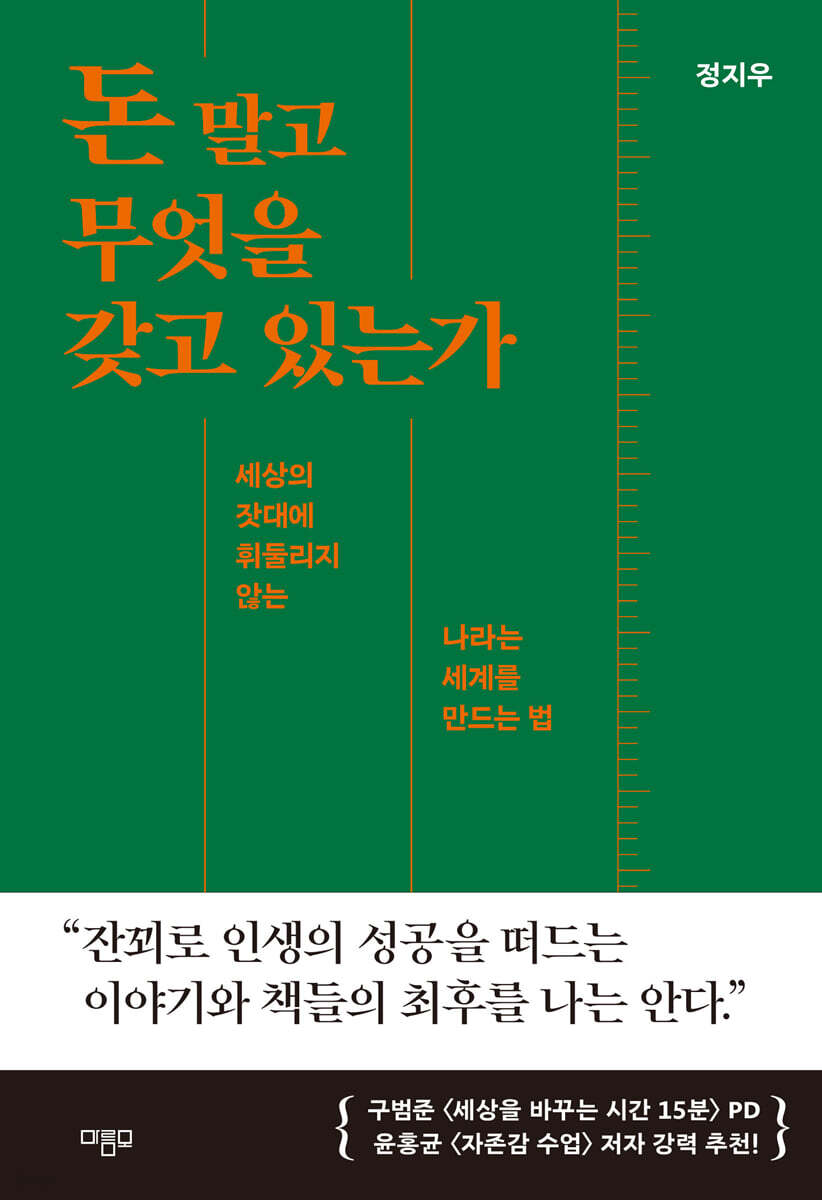
What do you have besides money?
 |
Description
Book Introduction
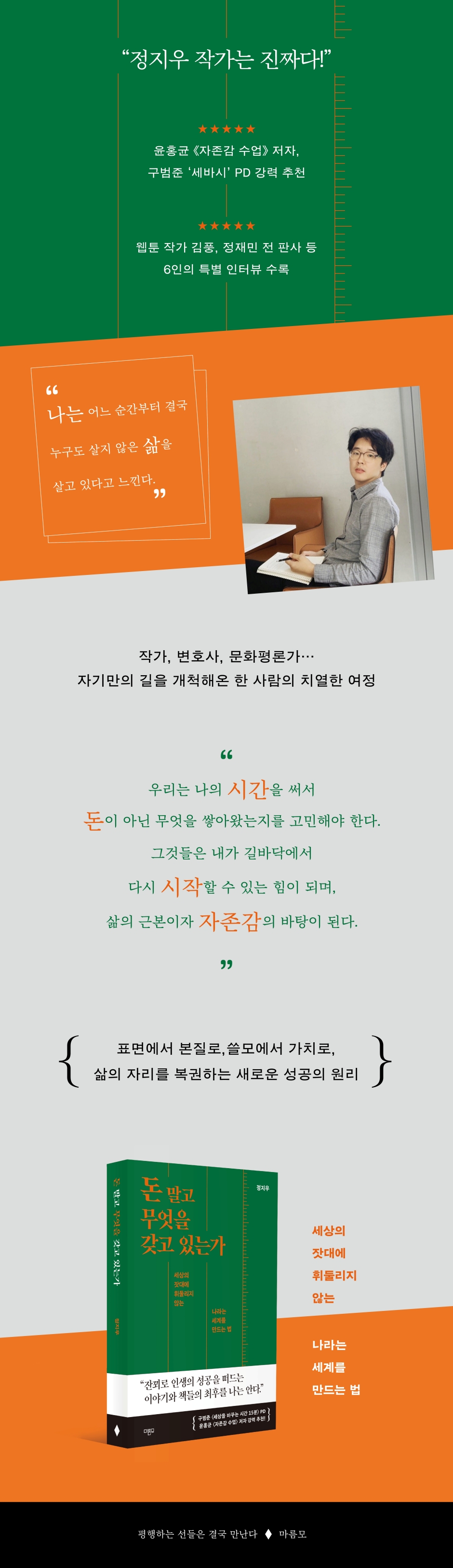
Author of "Self-Esteem Class" Yoon Hong-gyun, PD of "Sebashi" Koo Beom-jun strongly recommends!
Webtoon artist Kim Poong, former judge Jeong Jae-min, and publishing critic Kim Seong-shin, among others.
Includes special interviews with six people representing various fields!
Writer, lawyer, cultural critic…
The fierce journey of one man who forged his own path
“We are experiencing something unprecedented on this planet, something that has never existed before,
“We must live our own lives, which began for the first time in this life.”
_p.139
Jiwoo Jeong, a writer, cultural critic, and lawyer who has continuously expanded his field and forged his own path, has published a book filled with his intense reflections on how to live a "good life."
Jiwoo Jeong, who began his writing career by publishing 『Youth Humanities』 during his college years and has published over 20 books including 『There is no despair on Instagram』, 『We don't take writing too seriously』, and 『Copyright law you need to know now』, is famous as an author who has written every day for 20 years.
As a writer and a human being, his unwavering consistency and sincerity have been a source of inspiration to many people beyond writers.
As I established myself as a writer, I published the newsletter “All Cultures of the World” with like-minded colleagues and published several co-authored works, going beyond solo writing to living a life of solidarity.
As part of this, he is expanding his influence as a cultural critic by speaking out on various issues in our society through cultural criticism programs on KBS, MBC, JTBC, etc.
After starting a family and entering law school at the age of over 30, he has been actively working as a lawyer in the copyright field.
This book captures the story of an aspiring writer who started writing alone in his room and grew into a writer, cultural critic, and lawyer over the past 20 years, along with the hidden know-how.
The author, who says, “At some point, I felt like I was living a life that no one else had lived,” reveals every nook and cranny of his life, which at first glance appears flat and “successful,” and emphasizes the invisible “process” rather than the visible “result.”
The author's story, which puts the simple yet truly difficult proposition of living one's own life into action, not just in words, provides direction and solid support to all lives that waver without standards.
Webtoon artist Kim Poong, former judge Jeong Jae-min, and publishing critic Kim Seong-shin, among others.
Includes special interviews with six people representing various fields!
Writer, lawyer, cultural critic…
The fierce journey of one man who forged his own path
“We are experiencing something unprecedented on this planet, something that has never existed before,
“We must live our own lives, which began for the first time in this life.”
_p.139
Jiwoo Jeong, a writer, cultural critic, and lawyer who has continuously expanded his field and forged his own path, has published a book filled with his intense reflections on how to live a "good life."
Jiwoo Jeong, who began his writing career by publishing 『Youth Humanities』 during his college years and has published over 20 books including 『There is no despair on Instagram』, 『We don't take writing too seriously』, and 『Copyright law you need to know now』, is famous as an author who has written every day for 20 years.
As a writer and a human being, his unwavering consistency and sincerity have been a source of inspiration to many people beyond writers.
As I established myself as a writer, I published the newsletter “All Cultures of the World” with like-minded colleagues and published several co-authored works, going beyond solo writing to living a life of solidarity.
As part of this, he is expanding his influence as a cultural critic by speaking out on various issues in our society through cultural criticism programs on KBS, MBC, JTBC, etc.
After starting a family and entering law school at the age of over 30, he has been actively working as a lawyer in the copyright field.
This book captures the story of an aspiring writer who started writing alone in his room and grew into a writer, cultural critic, and lawyer over the past 20 years, along with the hidden know-how.
The author, who says, “At some point, I felt like I was living a life that no one else had lived,” reveals every nook and cranny of his life, which at first glance appears flat and “successful,” and emphasizes the invisible “process” rather than the visible “result.”
The author's story, which puts the simple yet truly difficult proposition of living one's own life into action, not just in words, provides direction and solid support to all lives that waver without standards.
- You can preview some of the book's contents.
Preview
index
prolog
Part 1.
Going through the stages of life
1.
Know-how for getting started
No prior preparation is required.
courage to try
The 30-minute rule
The rhythm of rise and fall
2.
The law of the middle
Crossing the middle hell
To know the value, you have to invest time and persistence.
When crossing the middle, cross with 'sincerity'
Creating a flexible system
The system protects life
Being an adult means having a system.
3.
The Power of Failure
Just because we didn't achieve our original goal
The 10 percent rule
Plan A with Plan B in mind
Success is achieved without experiencing failure.
Perspective on self-development 1: Even if you read just one self-development book
Part 2.
Back to my life
1.
To choose your own life
Extracting the best from my choices
Life is a game won by those who are grateful.
Reasons to be grateful
You have to choose the difficult one
Desire the desire I choose
2.
We must reach the 'meta-self'
Everyone has a way of finding weaknesses.
The ability to disconnect
How to solve problems that take a long time to solve
One way to reach the 'meta-self': writing.
Keep a sense of the big picture
The rhythm of seeing life broadly and narrowly
3.
Leading life from the perspective of 'me'
I shouldn't let others define me.
Be your own role model
What do you have besides money?
Confidence gained through accurate experience
To avoid becoming prey to other people's desires
Perspective 2 on Self-Development: There's No Such Thing as Success
Part 3.
How to create a world called 'me'
1.
Fighting and winning against your inner emotions
I try to be precise about my feelings.
How to Fight and Win Against Mood Swings
Not 'forgetting', but 'immersing'
Spontaneity overcomes deprivation
How to Deal with Injustice
2.
How to Cope When Passing Through the 'Valley of Unhappiness'
Thinking back 10 years
Actively imagine the end
Don't look at the whole picture, take one step at a time
Focus on my better side
3.
Finding Balance for Your Own Life
Between two contradictory perspectives
Between adaptation and maladaptation
Between coolness and empathy
Between stubbornness and flexibility
4.
Viewing life from a production perspective
From consumption to production
Finding colleagues with similar values
With the expansion of production
Perspective on Self-Development 3: The Ant Hell of Infinite Self-Development
Epilogue
Appendix | Interview: People Who Created Their Own Worlds
1.
Webtoon artist Kim Poong's self-experimental mind
2.
Publishing critic Kim Seong-shin's desire to win
3.
Architect Jeon I-seo's Dream of "Beyond This"
4.
Hip-hop journalist Kim Bong-hyun's "Just Do It" mentality
5.
A heart that follows the meaning of Sebashi PD Gu Beom-jun
6.
Former Judge Jeong Jae-min's Wall-Breaking Heart
Part 1.
Going through the stages of life
1.
Know-how for getting started
No prior preparation is required.
courage to try
The 30-minute rule
The rhythm of rise and fall
2.
The law of the middle
Crossing the middle hell
To know the value, you have to invest time and persistence.
When crossing the middle, cross with 'sincerity'
Creating a flexible system
The system protects life
Being an adult means having a system.
3.
The Power of Failure
Just because we didn't achieve our original goal
The 10 percent rule
Plan A with Plan B in mind
Success is achieved without experiencing failure.
Perspective on self-development 1: Even if you read just one self-development book
Part 2.
Back to my life
1.
To choose your own life
Extracting the best from my choices
Life is a game won by those who are grateful.
Reasons to be grateful
You have to choose the difficult one
Desire the desire I choose
2.
We must reach the 'meta-self'
Everyone has a way of finding weaknesses.
The ability to disconnect
How to solve problems that take a long time to solve
One way to reach the 'meta-self': writing.
Keep a sense of the big picture
The rhythm of seeing life broadly and narrowly
3.
Leading life from the perspective of 'me'
I shouldn't let others define me.
Be your own role model
What do you have besides money?
Confidence gained through accurate experience
To avoid becoming prey to other people's desires
Perspective 2 on Self-Development: There's No Such Thing as Success
Part 3.
How to create a world called 'me'
1.
Fighting and winning against your inner emotions
I try to be precise about my feelings.
How to Fight and Win Against Mood Swings
Not 'forgetting', but 'immersing'
Spontaneity overcomes deprivation
How to Deal with Injustice
2.
How to Cope When Passing Through the 'Valley of Unhappiness'
Thinking back 10 years
Actively imagine the end
Don't look at the whole picture, take one step at a time
Focus on my better side
3.
Finding Balance for Your Own Life
Between two contradictory perspectives
Between adaptation and maladaptation
Between coolness and empathy
Between stubbornness and flexibility
4.
Viewing life from a production perspective
From consumption to production
Finding colleagues with similar values
With the expansion of production
Perspective on Self-Development 3: The Ant Hell of Infinite Self-Development
Epilogue
Appendix | Interview: People Who Created Their Own Worlds
1.
Webtoon artist Kim Poong's self-experimental mind
2.
Publishing critic Kim Seong-shin's desire to win
3.
Architect Jeon I-seo's Dream of "Beyond This"
4.
Hip-hop journalist Kim Bong-hyun's "Just Do It" mentality
5.
A heart that follows the meaning of Sebashi PD Gu Beom-jun
6.
Former Judge Jeong Jae-min's Wall-Breaking Heart
Detailed image
Into the book
At some point, I started to feel like I was living a life that no one else had lived.
When I was twenty, I wanted to live my life creating my own works like novelists like Haruki Murakami, Hesse, Camus, and Le Guin, and as my twenties drew to a close, I also wanted to live as a scholar like a philosopher or semiotician.
Then, around the age of thirty, I started to worry about how to live, and then I fell down a rabbit hole I had never imagined before and ended up becoming a lawyer in Wonderland.
But it also feels like this life is finally fitting me, like a tailor-made suit rather than a ready-made suit.
Humans must discover their own lives in this way in every era, every generation, and every birth.
---From "Becoming Your Own Role Model"
We need to think about what we have accumulated and what we will accumulate with our time, other than money.
That something might actually make you more money.
However, if you become obsessed with money, your life will literally be one where there is nothing left but money, and if even money disappears, there will be nothing to prove your life.
However, any skills, tastes, abilities, attitudes, or knowledge that I have accumulated over time will remain even if the money disappears.
They give me the strength to start over again on the road, and they become the foundation of life and the basis of my self-esteem.
So, someone who has accumulated things other than money can say this.
'There's something about my life that I would never trade for theirs.
There are times when I have gained the truth with all my heart, and it stands strong and solid in the face of anything.
I become stronger with the times I spend with my heart.'
---From "What Do You Have Other Than Money?"
Experience is definitely an asset to us.
It becomes the basis of our confidence.
Rather than relying on money that can disappear, 'growing' based on our own experiences that can never disappear is what truly gives us strength in life.
---From "Confidence Gained Through Accurate Experience"
As I turned 30, became a father, and began my 10th year as a writer and lawyer, this is exactly the kind of mindset I felt I needed most.
No matter what the opposing lawyer or prosecutor says, I must go my own way for my client.
No matter what temptations or betrayals there may be, I must go my own way.
No matter what problems arise in life that make me fearful or anxious, I must go my own way.
No matter what absurd reason someone may use to insult me and sabotage me behind my back, I must continue writing and following my own path.
---From "To avoid becoming prey to other people's desires"
Many of the hardships we experience in life come from ‘other people’s values.’
What is needed in such times is to immerse yourself in values that suit you better and to continue to seek out and spend time with people whose values align with yours.
I like people who focus on production rather than consumption, and in fact, I'm surrounded by almost no one like that.
They serve as a bulwark against a society that prioritizes consumption over production.
---From "In Search of Colleagues with the Same Values"
I'm a fundamentally pro-growth person, and I don't think there's anything wrong with self-improvement, whether mental or physical.
However, if you don't create your own standards of satisfaction, growth and development become a kind of ant hell.
That anthill is made of the sand of other people's gaze.
Children who have not learned contentment and happiness will live unhappy lives no matter how much they are improved.
We must remember that another name for growth is sometimes lack, and that we must confront our own real lack.
And we need to realize that we must fill that void not with the standards of infinite others, but by becoming our true selves.
When I was twenty, I wanted to live my life creating my own works like novelists like Haruki Murakami, Hesse, Camus, and Le Guin, and as my twenties drew to a close, I also wanted to live as a scholar like a philosopher or semiotician.
Then, around the age of thirty, I started to worry about how to live, and then I fell down a rabbit hole I had never imagined before and ended up becoming a lawyer in Wonderland.
But it also feels like this life is finally fitting me, like a tailor-made suit rather than a ready-made suit.
Humans must discover their own lives in this way in every era, every generation, and every birth.
---From "Becoming Your Own Role Model"
We need to think about what we have accumulated and what we will accumulate with our time, other than money.
That something might actually make you more money.
However, if you become obsessed with money, your life will literally be one where there is nothing left but money, and if even money disappears, there will be nothing to prove your life.
However, any skills, tastes, abilities, attitudes, or knowledge that I have accumulated over time will remain even if the money disappears.
They give me the strength to start over again on the road, and they become the foundation of life and the basis of my self-esteem.
So, someone who has accumulated things other than money can say this.
'There's something about my life that I would never trade for theirs.
There are times when I have gained the truth with all my heart, and it stands strong and solid in the face of anything.
I become stronger with the times I spend with my heart.'
---From "What Do You Have Other Than Money?"
Experience is definitely an asset to us.
It becomes the basis of our confidence.
Rather than relying on money that can disappear, 'growing' based on our own experiences that can never disappear is what truly gives us strength in life.
---From "Confidence Gained Through Accurate Experience"
As I turned 30, became a father, and began my 10th year as a writer and lawyer, this is exactly the kind of mindset I felt I needed most.
No matter what the opposing lawyer or prosecutor says, I must go my own way for my client.
No matter what temptations or betrayals there may be, I must go my own way.
No matter what problems arise in life that make me fearful or anxious, I must go my own way.
No matter what absurd reason someone may use to insult me and sabotage me behind my back, I must continue writing and following my own path.
---From "To avoid becoming prey to other people's desires"
Many of the hardships we experience in life come from ‘other people’s values.’
What is needed in such times is to immerse yourself in values that suit you better and to continue to seek out and spend time with people whose values align with yours.
I like people who focus on production rather than consumption, and in fact, I'm surrounded by almost no one like that.
They serve as a bulwark against a society that prioritizes consumption over production.
---From "In Search of Colleagues with the Same Values"
I'm a fundamentally pro-growth person, and I don't think there's anything wrong with self-improvement, whether mental or physical.
However, if you don't create your own standards of satisfaction, growth and development become a kind of ant hell.
That anthill is made of the sand of other people's gaze.
Children who have not learned contentment and happiness will live unhappy lives no matter how much they are improved.
We must remember that another name for growth is sometimes lack, and that we must confront our own real lack.
And we need to realize that we must fill that void not with the standards of infinite others, but by becoming our true selves.
---From "The Ant Hell of Infinite Self-Development"
Publisher's Review
In the end, those who have their own world will survive.
A new principle of success that restores your place in life
“We need to think about what we have accumulated and what we will accumulate with our time, other than money.
They give me the strength to start over again, and they become the foundation of my life and my self-esteem.”
_p.
142
The author, who says, “In a way, my youth was a history of failure,” unhesitatingly shares in this book the know-how he gained as a professional and everyday person through countless trials and errors.
Not only as a writer and lawyer, but also as someone who runs a writing network, a reading group, and YouTube, he has been very active enough to be reminiscent of an 'N-jobber'. Based on his extensive experience, he provides specific suggestions on how to start all of these things efficiently, what systems are needed to 'constantly' do them, and how to deal with failure to achieve goals.
But what the author is most wary of is that all of this know-how is read as a shortcut to immediate 'success' or a 'secret recipe' that will make a lot of money.
As stated in the preface, “This book is about the journey to a good life, not about sacrificing one’s life for blind success.” The author persistently asks what the “success” that so many people desire is.
Is earning 10 billion won a year success? Having a respectable job and living in a luxury apartment? Playing games, drinking, and shopping to your heart's content? The images that easily come to mind when we think of the word "success" reflect how obsessed we are with money and how we rank ourselves based on it.
A life that blindly follows the world's standards represented by 'money' is vulnerable.
The 'success' obtained in this way is different from the 'happiness' that was desired, and the time spent in this way feels empty.
The author ultimately says that we must spend some of our time in life to acquire something that cannot be bought with money and is irreplaceable.
The skills, tastes, abilities, attitudes, and knowledge that you have built up over time will remain even if you lose your money.
They are what form my unique world, the world I would never want to exchange for anyone else's, and what makes me completely satisfied with myself.
This book also answers the question of how to find your center and protect yourself from the intangible things called 'worldly standards'.
From surface to essence, from utility to value,
Self-Development to Overcome 'Life Imbalance'
“To be number one, you have to become a sociopath or trample on other people’s rights,
“If self-development is something that makes you forget what is most precious to you, it is better not to do it.”
_p.
153
At this point, this book stands out from other self-help books that blindly pursue success.
Many self-help books define success too narrowly, inevitably leading to 'life imbalance.'
For example, there aren't many self-help books that tell you that weekends should be used for greater success, such as going on outings with your family, taking up a hobby, or taking care of your home.
Typically, such 'success' does not include 'home care'.
These books are at least aimed at single people, or assume a spouse who makes sacrifices as a stay-at-home mom.
And it is also explained that this imbalance can be healed later when some ultimate success is achieved.
The author says:
“There is no single success in life that is so important that everything is solved with just that one success.” So, if we need a self-help book, it should be one that helps us recover the ‘totality of life.’
This book contains various life skills to overcome everyday laziness, increase work productivity and efficiency, and skillfully overcome failure.
But at the same time, it makes us constantly ask, stop, and take stock of what is truly valuable in life.
So, it encourages us to move forward, but also reminds us of what we have been missing, and instills in us a vivid will to live.
It is true self-development that leads to reflection, growth, and ultimately success.
A new principle of success that restores your place in life
“We need to think about what we have accumulated and what we will accumulate with our time, other than money.
They give me the strength to start over again, and they become the foundation of my life and my self-esteem.”
_p.
142
The author, who says, “In a way, my youth was a history of failure,” unhesitatingly shares in this book the know-how he gained as a professional and everyday person through countless trials and errors.
Not only as a writer and lawyer, but also as someone who runs a writing network, a reading group, and YouTube, he has been very active enough to be reminiscent of an 'N-jobber'. Based on his extensive experience, he provides specific suggestions on how to start all of these things efficiently, what systems are needed to 'constantly' do them, and how to deal with failure to achieve goals.
But what the author is most wary of is that all of this know-how is read as a shortcut to immediate 'success' or a 'secret recipe' that will make a lot of money.
As stated in the preface, “This book is about the journey to a good life, not about sacrificing one’s life for blind success.” The author persistently asks what the “success” that so many people desire is.
Is earning 10 billion won a year success? Having a respectable job and living in a luxury apartment? Playing games, drinking, and shopping to your heart's content? The images that easily come to mind when we think of the word "success" reflect how obsessed we are with money and how we rank ourselves based on it.
A life that blindly follows the world's standards represented by 'money' is vulnerable.
The 'success' obtained in this way is different from the 'happiness' that was desired, and the time spent in this way feels empty.
The author ultimately says that we must spend some of our time in life to acquire something that cannot be bought with money and is irreplaceable.
The skills, tastes, abilities, attitudes, and knowledge that you have built up over time will remain even if you lose your money.
They are what form my unique world, the world I would never want to exchange for anyone else's, and what makes me completely satisfied with myself.
This book also answers the question of how to find your center and protect yourself from the intangible things called 'worldly standards'.
From surface to essence, from utility to value,
Self-Development to Overcome 'Life Imbalance'
“To be number one, you have to become a sociopath or trample on other people’s rights,
“If self-development is something that makes you forget what is most precious to you, it is better not to do it.”
_p.
153
At this point, this book stands out from other self-help books that blindly pursue success.
Many self-help books define success too narrowly, inevitably leading to 'life imbalance.'
For example, there aren't many self-help books that tell you that weekends should be used for greater success, such as going on outings with your family, taking up a hobby, or taking care of your home.
Typically, such 'success' does not include 'home care'.
These books are at least aimed at single people, or assume a spouse who makes sacrifices as a stay-at-home mom.
And it is also explained that this imbalance can be healed later when some ultimate success is achieved.
The author says:
“There is no single success in life that is so important that everything is solved with just that one success.” So, if we need a self-help book, it should be one that helps us recover the ‘totality of life.’
This book contains various life skills to overcome everyday laziness, increase work productivity and efficiency, and skillfully overcome failure.
But at the same time, it makes us constantly ask, stop, and take stock of what is truly valuable in life.
So, it encourages us to move forward, but also reminds us of what we have been missing, and instills in us a vivid will to live.
It is true self-development that leads to reflection, growth, and ultimately success.
GOODS SPECIFICS
- Date of issue: August 9, 2024
- Page count, weight, size: 312 pages | 356g | 130*190*20mm
- ISBN13: 9791198506580
- ISBN10: 119850658X
You may also like
카테고리
korean


korean

![ELLE 엘르 스페셜 에디션 A형 : 12월 [2025]](http://librairie.coreenne.fr/cdn/shop/files/b8e27a3de6c9538896439686c6b0e8fb.jpg?v=1766436872&width=3840)


