

The one question that moves the heart
 |
Description
Book Introduction
Depending on how you ask
It can be 'criticism' or 'interest'
Among people who exchange words but do not communicate,
The power of questions discovered over 20 years in education and counseling!
Even though it is a question with the same content, depending on the expression, it can be expressed warmly and open the other person's heart, or it can be expressed coldly and make the other person shrink.
Asking, “Why did you make this decision?” can sound accusatory, but if you ask, “I’m curious about the background to your decision,” the other person will feel respected and will speak with much more confidence.
Ultimately, even if the content is the same, the atmosphere of the relationship and the outcome of the conversation can change depending on how you ask the question.
Author Lee Soo-kyung has personally confirmed that the attitude of asking questions is more important than words, having met thousands of parents, teachers, students, and workers in the field of education and counseling for over 20 years.
Having witnessed the recurring misunderstandings and conflicts between parents and children, teachers and students, and bosses and employees, he discovered that the root of the problem was not a lack of words, but a lack of appropriate questions.
There is a clear temperature to the question.
The brain detects that temperature and reacts immediately.
A question asked with a warm tone and gaze can be considered as interest, but if asked with a sharp and cold tone, it can be perceived as suspicion or criticism.
Therefore, the author emphasizes that questions are the simplest yet most powerful tool for restoring relationships and leading to growth. Even in an age where AI can accurately exchange information, the uniquely human ability to communicate cannot be replaced.
Rather, in the age of AI, the power of questions that open up emotions and empathy becomes more urgent.
This book shows how conversations change through questions, using neuroscientific principles and real-world examples.
If the question, "Why?" increases conflict, the inquiry, "How?" opens the door to the heart.
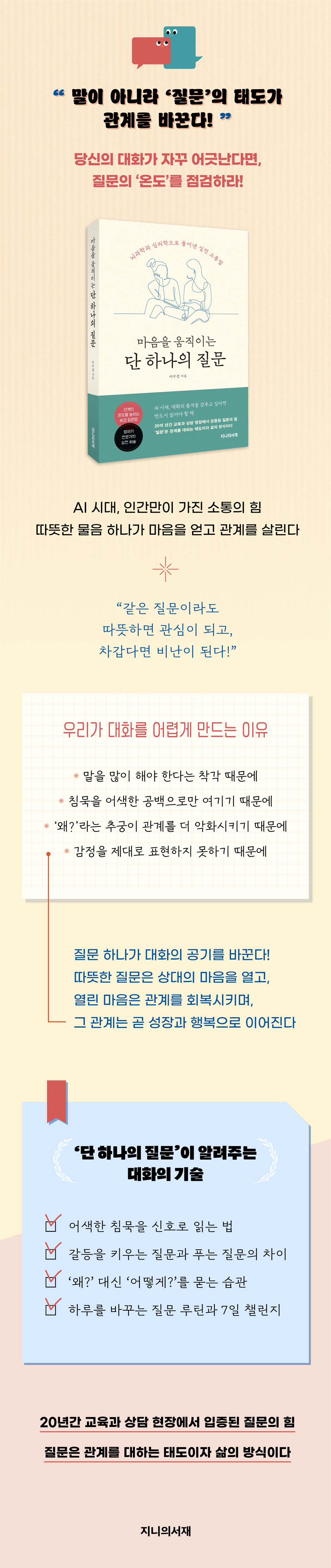
It contains the process of reading silence not as an uncomfortable void but as an inner signal, how to listen empathically to capture the other person's heart, and how to create new conversation habits by practicing a questioning routine and a 7-day challenge in daily life.
Readers do not simply learn conversation skills; they are confronted with the larger question of how to live in relationships.
Ultimately, the message the author wants to convey is clear.
One question opens your heart, an open heart brings growth, and that growth ultimately leads to happiness.
This book makes readers reflect on the weight of each word they say every day.
And today, I ask myself what temperature question I would ask someone.
This is the final question this book leaves us with, and the first step toward changing our lives.
It can be 'criticism' or 'interest'
Among people who exchange words but do not communicate,
The power of questions discovered over 20 years in education and counseling!
Even though it is a question with the same content, depending on the expression, it can be expressed warmly and open the other person's heart, or it can be expressed coldly and make the other person shrink.
Asking, “Why did you make this decision?” can sound accusatory, but if you ask, “I’m curious about the background to your decision,” the other person will feel respected and will speak with much more confidence.
Ultimately, even if the content is the same, the atmosphere of the relationship and the outcome of the conversation can change depending on how you ask the question.
Author Lee Soo-kyung has personally confirmed that the attitude of asking questions is more important than words, having met thousands of parents, teachers, students, and workers in the field of education and counseling for over 20 years.
Having witnessed the recurring misunderstandings and conflicts between parents and children, teachers and students, and bosses and employees, he discovered that the root of the problem was not a lack of words, but a lack of appropriate questions.
There is a clear temperature to the question.
The brain detects that temperature and reacts immediately.
A question asked with a warm tone and gaze can be considered as interest, but if asked with a sharp and cold tone, it can be perceived as suspicion or criticism.
Therefore, the author emphasizes that questions are the simplest yet most powerful tool for restoring relationships and leading to growth. Even in an age where AI can accurately exchange information, the uniquely human ability to communicate cannot be replaced.
Rather, in the age of AI, the power of questions that open up emotions and empathy becomes more urgent.
This book shows how conversations change through questions, using neuroscientific principles and real-world examples.
If the question, "Why?" increases conflict, the inquiry, "How?" opens the door to the heart.
It contains the process of reading silence not as an uncomfortable void but as an inner signal, how to listen empathically to capture the other person's heart, and how to create new conversation habits by practicing a questioning routine and a 7-day challenge in daily life.
Readers do not simply learn conversation skills; they are confronted with the larger question of how to live in relationships.
Ultimately, the message the author wants to convey is clear.
One question opens your heart, an open heart brings growth, and that growth ultimately leads to happiness.
This book makes readers reflect on the weight of each word they say every day.
And today, I ask myself what temperature question I would ask someone.
This is the final question this book leaves us with, and the first step toward changing our lives.
- You can preview some of the book's contents.
Preview
index
Prologue _ That One Question Opened My Heart
Chapter 1: Words and Conversation Are Different _ Words are abundant, but conversations are gone.
1 Why do we have difficulty communicating?
2 Words 'convey', but conversation 'connects'.
3 Why do misunderstandings repeat themselves?
4 Words that save relationships, words that ruin relationships
5. Talking to yourself is the beginning of a conversation.
Chapter 2: If You Don't Listen, You Can't Ask: How to Become a Listener Before Asking Questions
1 'Listening' doesn't mean understanding everything.
2. A brain that seeks to 'evaluate' rather than understand others
3 The Real Signal of Silence
4 Listening is a silent question
5 Empathic Listening: The Power of Creating Emotional Space
Chapter 3: The Principles of Conversation as Seen Through Neuroscience: Conversation Connects to the Emotional Brain
1 The brain changes when we empathize.
2. Conversation is impossible under stress.
3 Questions are tools to awaken the brain
4. How speech moves the brain
Chapter 4: Questions are the Keys that Open the Doors of the Heart - Questions that Change Relationships
1. Good questions make conversations come alive.
2 “How?” rather than “Why?”
3 Havruta, the art of opening thoughts through questions
4 Questions that resolve conflicts vs. questions that escalate conflicts
5 The Power of “What Do You Think?”
6 Questions also have a temperature
Chapter 5: Conversations Only Humans Can Have in the AI Era - Information to AI, Heart to Humans
1 AI asks for information, humans ask for the heart.
2. Connections increased, but relationships decreased.
3 Loneliness in the Digital Age
4 A society that doesn't ask questions is dangerous.
5 Questions Only Humans Can Ask
6 Conversations with AI vs. Conversations with Humans
Chapter 6: Relationship-Saving Conversation Practice: Recovery Begins in the Emotional Space, Not in Words
1 What happens in your brain when you get angry?
2 Practice expressing emotions in words
3. Let go of the illusion that 'I am right'
4. It's not too late to start studying now.
5 How to Resolve Conflicts Using Restorative Questions
Chapter 7: Shifting to a Life of Questions _Questions are not a skill, they are a way of life.
1. Questions are more about attitude than words.
2 Questions to open the day, questions to close the day
3 Questions are mirrors that expand me.
4. Patterns of People Growing Through Questions
5-Question Routine & 7-Day Challenge Practice Notes
Epilogue
Chapter 1: Words and Conversation Are Different _ Words are abundant, but conversations are gone.
1 Why do we have difficulty communicating?
2 Words 'convey', but conversation 'connects'.
3 Why do misunderstandings repeat themselves?
4 Words that save relationships, words that ruin relationships
5. Talking to yourself is the beginning of a conversation.
Chapter 2: If You Don't Listen, You Can't Ask: How to Become a Listener Before Asking Questions
1 'Listening' doesn't mean understanding everything.
2. A brain that seeks to 'evaluate' rather than understand others
3 The Real Signal of Silence
4 Listening is a silent question
5 Empathic Listening: The Power of Creating Emotional Space
Chapter 3: The Principles of Conversation as Seen Through Neuroscience: Conversation Connects to the Emotional Brain
1 The brain changes when we empathize.
2. Conversation is impossible under stress.
3 Questions are tools to awaken the brain
4. How speech moves the brain
Chapter 4: Questions are the Keys that Open the Doors of the Heart - Questions that Change Relationships
1. Good questions make conversations come alive.
2 “How?” rather than “Why?”
3 Havruta, the art of opening thoughts through questions
4 Questions that resolve conflicts vs. questions that escalate conflicts
5 The Power of “What Do You Think?”
6 Questions also have a temperature
Chapter 5: Conversations Only Humans Can Have in the AI Era - Information to AI, Heart to Humans
1 AI asks for information, humans ask for the heart.
2. Connections increased, but relationships decreased.
3 Loneliness in the Digital Age
4 A society that doesn't ask questions is dangerous.
5 Questions Only Humans Can Ask
6 Conversations with AI vs. Conversations with Humans
Chapter 6: Relationship-Saving Conversation Practice: Recovery Begins in the Emotional Space, Not in Words
1 What happens in your brain when you get angry?
2 Practice expressing emotions in words
3. Let go of the illusion that 'I am right'
4. It's not too late to start studying now.
5 How to Resolve Conflicts Using Restorative Questions
Chapter 7: Shifting to a Life of Questions _Questions are not a skill, they are a way of life.
1. Questions are more about attitude than words.
2 Questions to open the day, questions to close the day
3 Questions are mirrors that expand me.
4. Patterns of People Growing Through Questions
5-Question Routine & 7-Day Challenge Practice Notes
Epilogue
Detailed image
Into the book
** The moment we sit down with someone, our brain makes a judgment first.
"Is this person trying to attack me? Is he trying to judge me?" When the brain detects a hint of criticism in their tone, facial expression, speed and intonation of speech, or even the subtle energy in the atmosphere, the amygdala immediately switches into defensive mode.
From that moment on, the other person only 'pretends' to listen, but actually does not receive anything.
And if this experience is repeated, you will eventually say to yourself:
“Talking is useless.” “Silence is better.” So how can we break this cycle of non-communication?
** There is a story that is often heard in counseling settings.
“It’s not that these words are difficult to say now, but it’s more painful because past emotions come up together.” People who have been ignored in the past may perceive even simple advice as “ignorance,” and people who grew up constantly being compared to others may instantly feel a sense of resentment and anger at a single phrase like, “Other people did this…”
** Talking to yourself is not just a habit.
It is the most 'honest' language that reveals how I see myself, and it is the deepest point where all conversations begin.
We learn language and practice expressions to communicate with others.
But how often and honestly do we confront ourselves? The way we treat ourselves directly extends to how we treat others.
A person who is warm to himself can convey warmth to others, and a person who is always critical of himself can easily become cold to the mistakes of others.
** We often mistakenly believe that we are listening well.
But if we look closely, we see that we are not listening, we are 'thinking'.
Thinking in advance about 'how I will react to this', 'what opinion I will express', and 'when I will bring up a similar story that I have experienced'.
Even at the moment we listen, we are preparing to speak.
I listen not to understand what the other person is saying, but to respond.
** People who really listen slow down.
When a thought pops into your head, catch it and put it aside for a moment.
Whenever I get the response, "Why did you say that?", I think about what went through that person's mind before they said those words.
I try to carefully feel the emotional color that permeates those words.
**Listening with empathy goes beyond simply understanding what is being said.
It is about feeling the hidden emotions in those words and carrying the burden of unspoken feelings and suppressed emotions.
In other words, listening is 'giving space for the other person's emotions to stay for a while.'
** “That sounds so lonely.”, “You must be very tired.”, “That must have made you feel helpless.” This is true listening, ‘naming’ those feelings.
It is not a simple agreement, but an act of ‘fully acknowledging the other person’s feelings.’
Our brains open and our hearts move when we feel empathy.
This is why the attitude of listening is the first step to changing the other person's mind.
** As my counseling experience grows, there is something I have become more certain of.
People are more hurt by the tone of voice they use to convey their words than by the content of their words.
Speech is not just about intonation.
It touches the emotional circuits deep within the opponent's brain, unconsciously sending a signal that says, 'This is a threat.'
** Psychologist Marshall Rosenberg says, “Good questions help the other person understand themselves more deeply.”
A question may seem like the beginning of a conversation, but it is actually a preparation for listening.
The warmer and more relaxed the question, the deeper the listening will be.
A good question doesn't elicit an answer, but rather creates a "psychological space" that allows the other person to safely express their feelings.
So, a good question doesn't push the other person, but rather sends the message, "I'm ready to hear what you have to say."
**Truly strong self-esteem does not lie in pushing your own opinions to the limit.
It is about fully understanding the other person's position without losing yourself.
The stronger the heart of a person, the softer his words tend to be.
Because they don't find their worth in the recognition or success of others.
Psychologist Adam Grant says in Think Again:
“Only those who have the courage to let go of their own convictions can lead better conversations.”
"Is this person trying to attack me? Is he trying to judge me?" When the brain detects a hint of criticism in their tone, facial expression, speed and intonation of speech, or even the subtle energy in the atmosphere, the amygdala immediately switches into defensive mode.
From that moment on, the other person only 'pretends' to listen, but actually does not receive anything.
And if this experience is repeated, you will eventually say to yourself:
“Talking is useless.” “Silence is better.” So how can we break this cycle of non-communication?
** There is a story that is often heard in counseling settings.
“It’s not that these words are difficult to say now, but it’s more painful because past emotions come up together.” People who have been ignored in the past may perceive even simple advice as “ignorance,” and people who grew up constantly being compared to others may instantly feel a sense of resentment and anger at a single phrase like, “Other people did this…”
** Talking to yourself is not just a habit.
It is the most 'honest' language that reveals how I see myself, and it is the deepest point where all conversations begin.
We learn language and practice expressions to communicate with others.
But how often and honestly do we confront ourselves? The way we treat ourselves directly extends to how we treat others.
A person who is warm to himself can convey warmth to others, and a person who is always critical of himself can easily become cold to the mistakes of others.
** We often mistakenly believe that we are listening well.
But if we look closely, we see that we are not listening, we are 'thinking'.
Thinking in advance about 'how I will react to this', 'what opinion I will express', and 'when I will bring up a similar story that I have experienced'.
Even at the moment we listen, we are preparing to speak.
I listen not to understand what the other person is saying, but to respond.
** People who really listen slow down.
When a thought pops into your head, catch it and put it aside for a moment.
Whenever I get the response, "Why did you say that?", I think about what went through that person's mind before they said those words.
I try to carefully feel the emotional color that permeates those words.
**Listening with empathy goes beyond simply understanding what is being said.
It is about feeling the hidden emotions in those words and carrying the burden of unspoken feelings and suppressed emotions.
In other words, listening is 'giving space for the other person's emotions to stay for a while.'
** “That sounds so lonely.”, “You must be very tired.”, “That must have made you feel helpless.” This is true listening, ‘naming’ those feelings.
It is not a simple agreement, but an act of ‘fully acknowledging the other person’s feelings.’
Our brains open and our hearts move when we feel empathy.
This is why the attitude of listening is the first step to changing the other person's mind.
** As my counseling experience grows, there is something I have become more certain of.
People are more hurt by the tone of voice they use to convey their words than by the content of their words.
Speech is not just about intonation.
It touches the emotional circuits deep within the opponent's brain, unconsciously sending a signal that says, 'This is a threat.'
** Psychologist Marshall Rosenberg says, “Good questions help the other person understand themselves more deeply.”
A question may seem like the beginning of a conversation, but it is actually a preparation for listening.
The warmer and more relaxed the question, the deeper the listening will be.
A good question doesn't elicit an answer, but rather creates a "psychological space" that allows the other person to safely express their feelings.
So, a good question doesn't push the other person, but rather sends the message, "I'm ready to hear what you have to say."
**Truly strong self-esteem does not lie in pushing your own opinions to the limit.
It is about fully understanding the other person's position without losing yourself.
The stronger the heart of a person, the softer his words tend to be.
Because they don't find their worth in the recognition or success of others.
Psychologist Adam Grant says in Think Again:
“Only those who have the courage to let go of their own convictions can lead better conversations.”
--- From the text
Publisher's Review
“One question can change the atmosphere of a conversation,
“It determines the flow of the relationship”
The moment you read this book, your conversations will take on a new dimension.
● Why do some questions close the mind of the other person, while others open it?
● What is the essence of conversation that only humans can have even in the AI era?
● What questioning habits can restore relationships and enable growth?
We often try to learn only how to speak well.
Focus only on how to persuade in meetings and how to get attention in presentations.
But what really matters is when to stop and how to ask.
The nuances of attitude, more than the art of speaking, make or break a relationship.
As an educator and counselor, the author has repeatedly confirmed this simple truth in countless settings over the past 20 years.
An elementary school teacher was deeply hurt when a parent asked, “Aren’t you discriminating against your child?”
He tried to defend himself in his anger and resentment, but suddenly he asked himself, “Why am I angry?”
Only then did I realize.
The truth is that I was 'afraid of being evaluated as not being a good teacher.'
This realization changed the focus of the conflict.
When I shifted my focus to the question, “What kind of teacher do I want to be?”, my mind was freed and my relationship with parents was restored.
A single sentence of self-questioning unravels the knot of conflict.
A similar scene unfolds at work.
Team leader Han, who had become sharper under pressure to perform, became increasingly feared by his colleagues.
But the turning point came when he asked himself a simple question: “What am I protecting now?”
Realizing that trust and teamwork were more important than performance, he introduced a new routine called the "emotional report."
We had team members share their feelings and check in on each other's condition every week.
Surprisingly, the atmosphere in the conference room changed little by little, and everyone realized that the temperature of relationships, just as much as work performance, was a driving force in sustaining the organization.
This book records these moments of change.
It shows how a single question posed to oneself and an attitude of respect for the other person can change the flow of a conversation and develop a relationship, rather than using flowery words or clever persuasive techniques.
Using neuroscientific principles, it also explains how questions can disarm the brain's defense circuits, stabilize emotions, and open up new thoughts.
It also provides a question routine and a 7-day challenge that can be used immediately in everyday life, helping readers examine and change their conversation habits today.
The author speaks decisively.
The power to change a relationship doesn't lie in talking more.
True power lies in knowing when to stop and with what mindset to ask.
A single word, spoken with a warm gaze, can open the other person's heart. That open heart can restore relationships, and those relationships can be restored, leading to growth and happiness. Even in an age where AI accurately exchanges information, this unique human ability to communicate will never be replaced and will only become more precious.
For those who exchange words but fail to have a heart-to-heart conversation, for those who need a single word filled with emotion, and for those who are contemplating a uniquely human way of communicating in the age of AI, what is needed now is 'questions.'
Through various examples, we learn about the power of questions to connect us with the world, change and expand our relationships, and how to ask questions.
Ultimately, through this book, you will come to realize the weight of every word you say.
And at the same time, I can't help but ask:
Did the words I said today hurt the other person, or did they give them courage?
The Effectiveness of Listening and Questioning: Brain Science Confirms
Learn how to ask questions that open your mind!
The question isn't about technology, it's about attitude toward relationships.
We talk countless times every day, but rarely do we feel like we're actually having a conversation.
The author finds the reason in the clear distinction that 'words are information, conversation is emotion.'
So, in the prologue, we point out the difference between speech and conversation, and ask about the true essence of communication that we are missing.
Chapter 1 deals with this difference in detail.
The reason why a parent's words of concern for their child sound like nagging, and a friend's consolation feels like criticism, is not because of the words, but because of the interpretation of emotions.
Eventually, you come to realize that talking to yourself is your first conversation with yourself and the starting point of all relationships.
The next two chapters turn to the topic of listening.
Good questions come from listening.
Because we tend to evaluate rather than understand others, we miss listening and see silence as mere blankness.
However, the author says that silence is an inner signal that the other person is sorting out their emotions.
Just waiting quietly opens the door to conversation.
Chapter 3 adds a neuroscience perspective.
Conversation is not just an exchange of information; it is an emotional interaction that involves the entire brain.
The brain interprets nonverbal signals such as facial expressions and intonation before words, and in stressful situations, the defense circuits are activated, making conversation impossible.
Conversely, respectful questions stimulate the frontal lobe, expanding thinking and opening up relationships.
Chapter 4 unfolds the core theme that connects with the title of this book.
Questions are the keys that open the door of the mind.
The question 'why?' invites defense, but the question 'how?' opens up exploration.
Like the Jewish Havruta, question-centered conversations expand thinking and relationships, and the question, “What do you think?” becomes a signal of respect.
Questions have a temperature, and that temperature determines the air of the conversation and the flow of the relationship.
Chapter 5 connects to the AI era. While AI can provide information, the power to inquire and empathize is uniquely human.
As digital connectivity increases, loneliness deepens, and a society without questions halts thought and democracy.
That's why the author emphasizes that, especially in the AI era, questions are humanity's unique communication weapon.
Chapter 6 presents conversation exercises to restore relationships.
Understand what happens in your brain when you get angry, and practice expressing your feelings verbally to let go of the illusion that you are right.
It is at this very moment that one restorative question resolves the conflict and changes the temperature of the relationship.
The final seven chapters expand the question to an attitude toward life.
Small questions in the morning and evening open and close the day.
Questions like, “What emotion do I value most today?” can change the start of your day, and questions like, “What emotion did I miss today?” can change the end of your day.
Furthermore, if you make questioning a habit through the 7-day challenge, questions will gradually become a driving force in your entire life.
“I have trouble communicating with my child.” “I have feelings for him, but I can’t express them well.” “Why doesn’t he understand how I feel?” These complaints are heard everywhere.
In a world where words abound but real conversations are fading away, this book, drawing on examples from brain science, psychology, and education, shows how questions can transform relationships and transform lives.
If you follow the flow of the book, the conclusion is clear.
A warm word opens the other person's heart, an open heart revives a relationship, and the restoration of that relationship leads to growth and happiness.
In the end, what matters is not how much you talk, but what attitude you have when you ask.
“It determines the flow of the relationship”
The moment you read this book, your conversations will take on a new dimension.
● Why do some questions close the mind of the other person, while others open it?
● What is the essence of conversation that only humans can have even in the AI era?
● What questioning habits can restore relationships and enable growth?
We often try to learn only how to speak well.
Focus only on how to persuade in meetings and how to get attention in presentations.
But what really matters is when to stop and how to ask.
The nuances of attitude, more than the art of speaking, make or break a relationship.
As an educator and counselor, the author has repeatedly confirmed this simple truth in countless settings over the past 20 years.
An elementary school teacher was deeply hurt when a parent asked, “Aren’t you discriminating against your child?”
He tried to defend himself in his anger and resentment, but suddenly he asked himself, “Why am I angry?”
Only then did I realize.
The truth is that I was 'afraid of being evaluated as not being a good teacher.'
This realization changed the focus of the conflict.
When I shifted my focus to the question, “What kind of teacher do I want to be?”, my mind was freed and my relationship with parents was restored.
A single sentence of self-questioning unravels the knot of conflict.
A similar scene unfolds at work.
Team leader Han, who had become sharper under pressure to perform, became increasingly feared by his colleagues.
But the turning point came when he asked himself a simple question: “What am I protecting now?”
Realizing that trust and teamwork were more important than performance, he introduced a new routine called the "emotional report."
We had team members share their feelings and check in on each other's condition every week.
Surprisingly, the atmosphere in the conference room changed little by little, and everyone realized that the temperature of relationships, just as much as work performance, was a driving force in sustaining the organization.
This book records these moments of change.
It shows how a single question posed to oneself and an attitude of respect for the other person can change the flow of a conversation and develop a relationship, rather than using flowery words or clever persuasive techniques.
Using neuroscientific principles, it also explains how questions can disarm the brain's defense circuits, stabilize emotions, and open up new thoughts.
It also provides a question routine and a 7-day challenge that can be used immediately in everyday life, helping readers examine and change their conversation habits today.
The author speaks decisively.
The power to change a relationship doesn't lie in talking more.
True power lies in knowing when to stop and with what mindset to ask.
A single word, spoken with a warm gaze, can open the other person's heart. That open heart can restore relationships, and those relationships can be restored, leading to growth and happiness. Even in an age where AI accurately exchanges information, this unique human ability to communicate will never be replaced and will only become more precious.
For those who exchange words but fail to have a heart-to-heart conversation, for those who need a single word filled with emotion, and for those who are contemplating a uniquely human way of communicating in the age of AI, what is needed now is 'questions.'
Through various examples, we learn about the power of questions to connect us with the world, change and expand our relationships, and how to ask questions.
Ultimately, through this book, you will come to realize the weight of every word you say.
And at the same time, I can't help but ask:
Did the words I said today hurt the other person, or did they give them courage?
The Effectiveness of Listening and Questioning: Brain Science Confirms
Learn how to ask questions that open your mind!
The question isn't about technology, it's about attitude toward relationships.
We talk countless times every day, but rarely do we feel like we're actually having a conversation.
The author finds the reason in the clear distinction that 'words are information, conversation is emotion.'
So, in the prologue, we point out the difference between speech and conversation, and ask about the true essence of communication that we are missing.
Chapter 1 deals with this difference in detail.
The reason why a parent's words of concern for their child sound like nagging, and a friend's consolation feels like criticism, is not because of the words, but because of the interpretation of emotions.
Eventually, you come to realize that talking to yourself is your first conversation with yourself and the starting point of all relationships.
The next two chapters turn to the topic of listening.
Good questions come from listening.
Because we tend to evaluate rather than understand others, we miss listening and see silence as mere blankness.
However, the author says that silence is an inner signal that the other person is sorting out their emotions.
Just waiting quietly opens the door to conversation.
Chapter 3 adds a neuroscience perspective.
Conversation is not just an exchange of information; it is an emotional interaction that involves the entire brain.
The brain interprets nonverbal signals such as facial expressions and intonation before words, and in stressful situations, the defense circuits are activated, making conversation impossible.
Conversely, respectful questions stimulate the frontal lobe, expanding thinking and opening up relationships.
Chapter 4 unfolds the core theme that connects with the title of this book.
Questions are the keys that open the door of the mind.
The question 'why?' invites defense, but the question 'how?' opens up exploration.
Like the Jewish Havruta, question-centered conversations expand thinking and relationships, and the question, “What do you think?” becomes a signal of respect.
Questions have a temperature, and that temperature determines the air of the conversation and the flow of the relationship.
Chapter 5 connects to the AI era. While AI can provide information, the power to inquire and empathize is uniquely human.
As digital connectivity increases, loneliness deepens, and a society without questions halts thought and democracy.
That's why the author emphasizes that, especially in the AI era, questions are humanity's unique communication weapon.
Chapter 6 presents conversation exercises to restore relationships.
Understand what happens in your brain when you get angry, and practice expressing your feelings verbally to let go of the illusion that you are right.
It is at this very moment that one restorative question resolves the conflict and changes the temperature of the relationship.
The final seven chapters expand the question to an attitude toward life.
Small questions in the morning and evening open and close the day.
Questions like, “What emotion do I value most today?” can change the start of your day, and questions like, “What emotion did I miss today?” can change the end of your day.
Furthermore, if you make questioning a habit through the 7-day challenge, questions will gradually become a driving force in your entire life.
“I have trouble communicating with my child.” “I have feelings for him, but I can’t express them well.” “Why doesn’t he understand how I feel?” These complaints are heard everywhere.
In a world where words abound but real conversations are fading away, this book, drawing on examples from brain science, psychology, and education, shows how questions can transform relationships and transform lives.
If you follow the flow of the book, the conclusion is clear.
A warm word opens the other person's heart, an open heart revives a relationship, and the restoration of that relationship leads to growth and happiness.
In the end, what matters is not how much you talk, but what attitude you have when you ask.
GOODS SPECIFICS
- Date of issue: October 15, 2025
- Page count, weight, size: 256 pages | 147*212*20mm
- ISBN13: 9791194620174
- ISBN10: 1194620175
You may also like
카테고리
korean


korean

![GQ KOREA Mark (Monthly): December [2025]](http://librairie.coreenne.fr/cdn/shop/files/8ef265dbbfbf186523ed75ba7319009d.jpg?v=1765340328&width=3840)


