

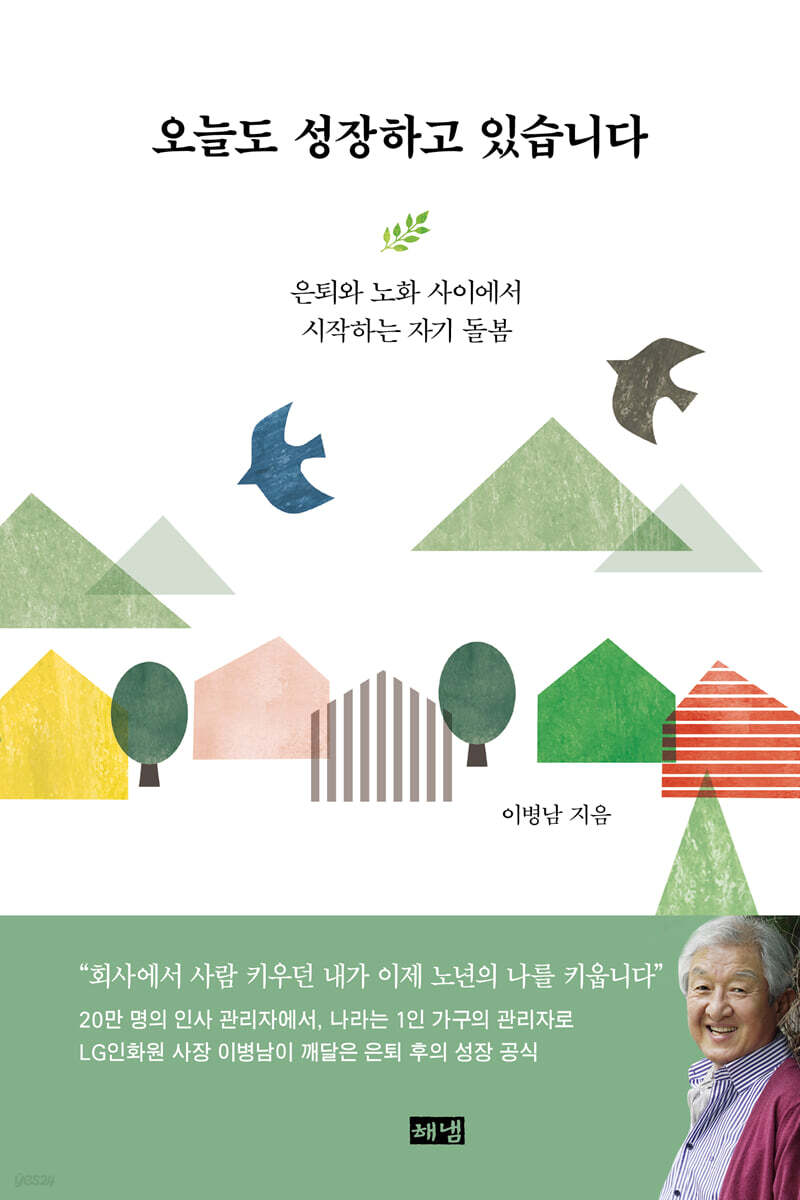
We are growing today too
 |
Description
Book Introduction
A message to those who are wavering and holding on until they reach retirement.
How to organize myself outside the organization
The retirement of the 'second baby boomers' is accelerating.
About 9.54 million people, or one-fifth of the population of South Korea.
Regardless of how well an individual prepares for retirement, this period, intertwined with physical aging, is a time of turmoil for both the body and mind.
A strong mentor has appeared for those who are starting their second life with both a sense of relief and a sense of hopelessness.
This is Lee Byeong-nam, the former president of LG Inhwawon.
He joined LG Group in 1995 at the age of 40 and took charge of HR. After serving as the head of the human resources team responsible for the personnel affairs of approximately 200,000 employees, he was appointed as the president of LG Human Resources in 2008.
Until his retirement in 2016, he worked harder than anyone else on the front lines of human resources management for 21 years.
He thought he was well prepared for retirement, both financially and psychologically, but when it actually arrived, he experienced anxiety and depression as if his social self was being cut off along with his physical aging.
And then you realize that you need to change the pace and direction of your life, which used to feel like you were speeding down an eight-lane highway in a large sedan, to the pace and direction of driving on an unpaved national road.
Based on these experiences and reflections, I have included in this book, "I am growing today, too," a life attitude that would be good for those who are wandering after retirement or for those in their later years who are about to retire.
How to organize myself outside the organization
The retirement of the 'second baby boomers' is accelerating.
About 9.54 million people, or one-fifth of the population of South Korea.
Regardless of how well an individual prepares for retirement, this period, intertwined with physical aging, is a time of turmoil for both the body and mind.
A strong mentor has appeared for those who are starting their second life with both a sense of relief and a sense of hopelessness.
This is Lee Byeong-nam, the former president of LG Inhwawon.
He joined LG Group in 1995 at the age of 40 and took charge of HR. After serving as the head of the human resources team responsible for the personnel affairs of approximately 200,000 employees, he was appointed as the president of LG Human Resources in 2008.
Until his retirement in 2016, he worked harder than anyone else on the front lines of human resources management for 21 years.
He thought he was well prepared for retirement, both financially and psychologically, but when it actually arrived, he experienced anxiety and depression as if his social self was being cut off along with his physical aging.
And then you realize that you need to change the pace and direction of your life, which used to feel like you were speeding down an eight-lane highway in a large sedan, to the pace and direction of driving on an unpaved national road.
Based on these experiences and reflections, I have included in this book, "I am growing today, too," a life attitude that would be good for those who are wandering after retirement or for those in their later years who are about to retire.
- You can preview some of the book's contents.
Preview
index
Recommendation
Prologue | To those who still question their usefulness
Chapter 1.
I promised myself that I would decide my retirement.
1 If you had energy, what would you do with it?
2 I don't deserve to be treated like this...
3 “Member, you have grown again today.”
4 Mode Switching, from Chi-Chi-Jip to Ne-Jo-Sim
5. The wisdom of living while distinguishing between aging and degeneration
To me who struggled to survive inside and outside of 6
Chapter 2.
From President Lee Byeong-nam to adult Lee Byeong-nam
7 Ways to Relate to Younger Generations
8 I must become small to be able to seep into others.
9 It's important to break up well
10 From lead to supporting role, from player to coach
To raise a person, you must first trust him.
Chapter 3.
Who will you be with?
12 If you want to live anew, you must cut the umbilical cord.
13 Allow new social families
14 Good alone, good together
15 The power of understanding and consideration learned from a junior couple
16 A trip to Rome with my daughter
17 If I could hold a farewell ceremony with my loved ones
Chapter 4.
Seventy-one, the perfect age to grow up
18 It is not childish to desire the approval of others.
19 Growth in old age is a curve, not a straight line
20 Don't confine yourself to existing boundaries.
21 Meeting the Young Man in the Mugshot
22 People I Wouldn't Have Met If I Hadn't Written
23 Young Fifty, What You Need Is Inner Youth
24 Growing pains are unavoidable as long as you live.
Chapter 5.
To you who will one day approach retirement
25 Stop quietly and meet me.
26 What I Learned from a Soprano in Her 30s
27 If you can take a deep breath, you've succeeded.
28 Things I learned from watching my daughter change her life's course
29 Crisis and limitations are opportunities to ask questions toward a new life.
30 It's natural to feel sad and anxious
Prologue | To those who still question their usefulness
Chapter 1.
I promised myself that I would decide my retirement.
1 If you had energy, what would you do with it?
2 I don't deserve to be treated like this...
3 “Member, you have grown again today.”
4 Mode Switching, from Chi-Chi-Jip to Ne-Jo-Sim
5. The wisdom of living while distinguishing between aging and degeneration
To me who struggled to survive inside and outside of 6
Chapter 2.
From President Lee Byeong-nam to adult Lee Byeong-nam
7 Ways to Relate to Younger Generations
8 I must become small to be able to seep into others.
9 It's important to break up well
10 From lead to supporting role, from player to coach
To raise a person, you must first trust him.
Chapter 3.
Who will you be with?
12 If you want to live anew, you must cut the umbilical cord.
13 Allow new social families
14 Good alone, good together
15 The power of understanding and consideration learned from a junior couple
16 A trip to Rome with my daughter
17 If I could hold a farewell ceremony with my loved ones
Chapter 4.
Seventy-one, the perfect age to grow up
18 It is not childish to desire the approval of others.
19 Growth in old age is a curve, not a straight line
20 Don't confine yourself to existing boundaries.
21 Meeting the Young Man in the Mugshot
22 People I Wouldn't Have Met If I Hadn't Written
23 Young Fifty, What You Need Is Inner Youth
24 Growing pains are unavoidable as long as you live.
Chapter 5.
To you who will one day approach retirement
25 Stop quietly and meet me.
26 What I Learned from a Soprano in Her 30s
27 If you can take a deep breath, you've succeeded.
28 Things I learned from watching my daughter change her life's course
29 Crisis and limitations are opportunities to ask questions toward a new life.
30 It's natural to feel sad and anxious
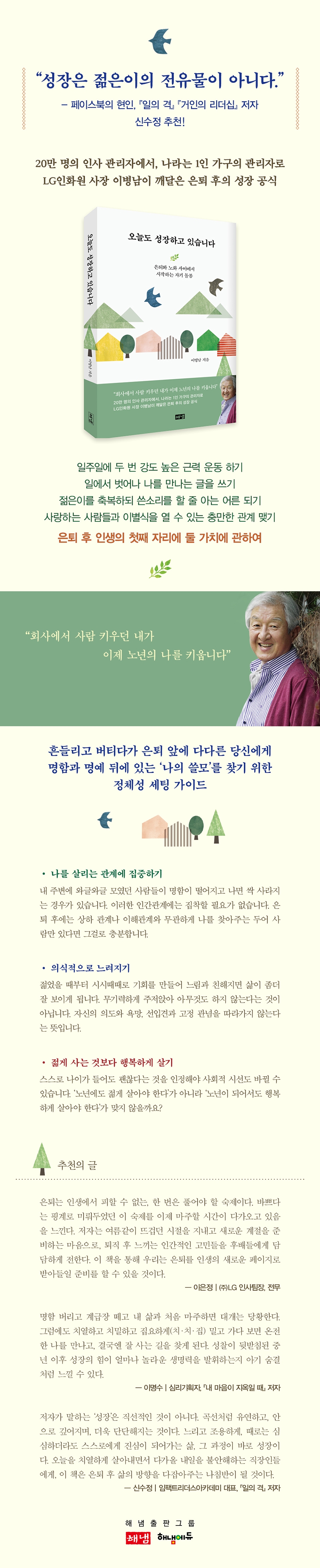
Detailed image
Into the book
To those who still question my usefulness
It seems that the social role of a retired person should be different from that of a young person who was still working.
Put aside money, power, and fame and only have the heart to help others, especially your juniors.
Rather than boasting about the achievements or knowledge they have accumulated in their current positions, I hope that their lives will become brighter and richer by sharing the small insights they have gleaned from their lives.
Instead of making a strong argument, I should just give them hints so they can think differently.
---From the "Prologue"
There is no such thing as eternal active duty.
Someday, everyone will retire and end their life without exception.
“Teacher, I don’t want to do anything.
I've never been like this before... ... "After retiring from the company I had given my all to for 21 years, I felt my energy levels hit rock bottom as I began to feel my physical limitations at the same time.
After much thought, I decided to visit a counselor who had previously run a psychological health support program for company executives.
The teacher listened intently to me for a long time as I complained about how I had no motivation, how deep my feelings of helplessness and depression were, and how I had no energy to do anything. Then he asked me a question.
“But if you have that energy, where will you use it?” I was momentarily speechless.
I even felt sad.
No, rather than warmly comforting a client who is complaining about how difficult it is, you ask such provocative and reprimanding questions… … .
I even started to think that they no longer respected me and ignored me like they did when I was in office.
---From "1-1 'What would you do with energy?'"
Slowing down is a natural change that comes with aging.
It's not that I'm being lazy.
So, I thought, maybe we should accept that slowness and be able to enjoy it.
(Omitted) 'Ah, spending your old age slowly, quietly, and boringly after retirement is to become gentle!' Yes, the essence of life is growth, and growth means change.
The essence of change is curve.
When I was younger, I only thought about moving in a straight line between a starting point and a destination.
But growth in aging is about approaching and becoming accustomed to the curve that is the essence of change.
So it has to be soft.
(Omitted) The evolution from the artificial strictness of straight lines to the softness of nature is the growth of old age.
---From "1-3 '"Member, you have grown today"'"
Being a coach is no longer about shining yourself, but about helping your juniors shine.
To do that, you need to have character and leadership in addition to the skills you demonstrated during your active years.
When you are active, it is natural to want to show off your abilities and achievements and stand out.
However, as you approach retirement, it would be great if you could shift your mindset to helping your juniors.
It's about changing your role from a lead role to a supporting role, from a player to a coach.
In fact, this kind of feeling doesn't just suddenly appear one day when you retire.
It is necessary to cultivate this kind of mindset little by little from your active days.
You have to practice in advance.
---From "2-10 'From Leading Role to Supporting Role, From Player to Coach'"
Earlier this year, I had to stay in the hospital for two nights and three days to undergo a cardiovascular stent procedure.
The procedure itself was enough to make me anxious and nervous, but there was one more stressor.
This is because the hospital requested a guardian when obtaining consent for surgery or treatment during the admission process.
It was stated that the guardian must be a spouse or blood relative.
(Omitted) It is a very difficult situation for people like me who live abroad with their whole family.
After much deliberation, I was finally able to appoint a close friend as my guardian.
It was a real shame that a 'neighbor' could not be a guardian.
---From "3-13 'Allow a New Social Family'"
We are reminded of the truth that growth involves pain.
Growing pains are essential even in the growth of old age.
Not only that, but in the process, I learned again from my younger colleagues that pure curiosity is truly important.
(Omitted) It is the attitude of having the mindset of 'I don't know!' but also being open to the idea of 'Oh, but I'm curious?' and being willing to change the path if necessary.
Even though I've lived for over 70 years, there's still so much I don't know about the world.
But when I think, "Even if it's slow, if I can figure it out one by one, there's still so much to learn in the future!", I feel a new sense of hope and am energized.
---From "4-24, 'Growing Pains Are Unavoidable As Long As We Live'"
Part of my role involved visiting executives who had decided to retire around the end of the year to explain and discuss various issues, especially the changes in treatment.
However, when I visited and talked with them, without exception, every single person showed a longing for their current position and was sad to leave.
At the time, I was a bit puzzled, thinking, 'Why would anyone be upset when they've achieved incredible success by the age of 60, even becoming a CEO and retiring with honor?'
So I decided that I would decide when I would retire and notify the company, and that I would not be pushed out.
(Omitted) As the year that had been added like that was coming to an end, I was thinking about this and that and realized that an expectation was slowly stirring inside my heart, 'Maybe he'll ask me to stay for another year?'
When I finally retired at the end of that year, I was surprised to find myself feeling resentful toward the company that no longer held me.
Yes, I was no different.
It seems that the social role of a retired person should be different from that of a young person who was still working.
Put aside money, power, and fame and only have the heart to help others, especially your juniors.
Rather than boasting about the achievements or knowledge they have accumulated in their current positions, I hope that their lives will become brighter and richer by sharing the small insights they have gleaned from their lives.
Instead of making a strong argument, I should just give them hints so they can think differently.
---From the "Prologue"
There is no such thing as eternal active duty.
Someday, everyone will retire and end their life without exception.
“Teacher, I don’t want to do anything.
I've never been like this before... ... "After retiring from the company I had given my all to for 21 years, I felt my energy levels hit rock bottom as I began to feel my physical limitations at the same time.
After much thought, I decided to visit a counselor who had previously run a psychological health support program for company executives.
The teacher listened intently to me for a long time as I complained about how I had no motivation, how deep my feelings of helplessness and depression were, and how I had no energy to do anything. Then he asked me a question.
“But if you have that energy, where will you use it?” I was momentarily speechless.
I even felt sad.
No, rather than warmly comforting a client who is complaining about how difficult it is, you ask such provocative and reprimanding questions… … .
I even started to think that they no longer respected me and ignored me like they did when I was in office.
---From "1-1 'What would you do with energy?'"
Slowing down is a natural change that comes with aging.
It's not that I'm being lazy.
So, I thought, maybe we should accept that slowness and be able to enjoy it.
(Omitted) 'Ah, spending your old age slowly, quietly, and boringly after retirement is to become gentle!' Yes, the essence of life is growth, and growth means change.
The essence of change is curve.
When I was younger, I only thought about moving in a straight line between a starting point and a destination.
But growth in aging is about approaching and becoming accustomed to the curve that is the essence of change.
So it has to be soft.
(Omitted) The evolution from the artificial strictness of straight lines to the softness of nature is the growth of old age.
---From "1-3 '"Member, you have grown today"'"
Being a coach is no longer about shining yourself, but about helping your juniors shine.
To do that, you need to have character and leadership in addition to the skills you demonstrated during your active years.
When you are active, it is natural to want to show off your abilities and achievements and stand out.
However, as you approach retirement, it would be great if you could shift your mindset to helping your juniors.
It's about changing your role from a lead role to a supporting role, from a player to a coach.
In fact, this kind of feeling doesn't just suddenly appear one day when you retire.
It is necessary to cultivate this kind of mindset little by little from your active days.
You have to practice in advance.
---From "2-10 'From Leading Role to Supporting Role, From Player to Coach'"
Earlier this year, I had to stay in the hospital for two nights and three days to undergo a cardiovascular stent procedure.
The procedure itself was enough to make me anxious and nervous, but there was one more stressor.
This is because the hospital requested a guardian when obtaining consent for surgery or treatment during the admission process.
It was stated that the guardian must be a spouse or blood relative.
(Omitted) It is a very difficult situation for people like me who live abroad with their whole family.
After much deliberation, I was finally able to appoint a close friend as my guardian.
It was a real shame that a 'neighbor' could not be a guardian.
---From "3-13 'Allow a New Social Family'"
We are reminded of the truth that growth involves pain.
Growing pains are essential even in the growth of old age.
Not only that, but in the process, I learned again from my younger colleagues that pure curiosity is truly important.
(Omitted) It is the attitude of having the mindset of 'I don't know!' but also being open to the idea of 'Oh, but I'm curious?' and being willing to change the path if necessary.
Even though I've lived for over 70 years, there's still so much I don't know about the world.
But when I think, "Even if it's slow, if I can figure it out one by one, there's still so much to learn in the future!", I feel a new sense of hope and am energized.
---From "4-24, 'Growing Pains Are Unavoidable As Long As We Live'"
Part of my role involved visiting executives who had decided to retire around the end of the year to explain and discuss various issues, especially the changes in treatment.
However, when I visited and talked with them, without exception, every single person showed a longing for their current position and was sad to leave.
At the time, I was a bit puzzled, thinking, 'Why would anyone be upset when they've achieved incredible success by the age of 60, even becoming a CEO and retiring with honor?'
So I decided that I would decide when I would retire and notify the company, and that I would not be pushed out.
(Omitted) As the year that had been added like that was coming to an end, I was thinking about this and that and realized that an expectation was slowly stirring inside my heart, 'Maybe he'll ask me to stay for another year?'
When I finally retired at the end of that year, I was surprised to find myself feeling resentful toward the company that no longer held me.
Yes, I was no different.
---From "5-30, 'It's Natural to Feel Sad and Anxious'"
Publisher's Review
Seventy-one, the perfect age to grow up
A journey to find my 'usefulness' behind business cards and fame
This book is a vivid record of the growth of 'CEO Lee Byeong-nam', who stood at the forefront of human resources management at a large corporation, into 'person Lee Byeong-nam', who, like everyone else, experiences the inconveniences of aging and seeks wisdom in the quiet of everyday life.
The author, after losing the social privileges accorded to executives at large corporations and choosing to cease for-profit activities, wanders in a state of helplessness, feeling as if “all ties to society have been severed.”
When hiking, traveling, and meeting people became burdensome, I started strength training, and one day, I felt joy at the encouragement from my coach, saying, "You've grown today!" and started writing.
As he gradually began to listen to his inner voice rather than the outer one, he realized that growth in the latter half of life was not a straight line, but a curve with ups and downs.
While in an organization, you ran straight ahead with fierce persistence and tenacity to achieve results, but after retirement, as an individual, you learn how to live in relationships with others through repetitions of development and stagnation.
The post-retirement growth formula introduced by the author is largely divided into three parts.
It is about shifting the focus of life from doing to being, changing the pace of life from fiercely, meticulously, and persistently to slowly, quietly, and leisurely, and spending old age with a soft heart, blessing the younger generation and nurturing them unconditionally.
About the values that should be placed first in life
This book is divided into five chapters and contains the life wisdom acquired by the author after 10 years of retirement.
In Chapter 1, “I Promised to Decide My Retirement,” he confesses to the confusion of identity and emotions that came after stepping down from his once-glorious position.
Chapter 2, “From President Lee Byeong-nam to Adult Lee Byeong-nam,” introduces how to build relationships with the younger generation by letting go of authority and “practicing changing your mindset from player to coach.”
Chapter 3, “Who Will You Be With?” confronts death, which comes equally to everyone regardless of wealth or fame, and highlights the importance of true relationships, the need for social care, and a new form of family.
Chapter 4, “Seventy-one: The Perfect Age to Grow Up,” introduces the wisdom of taking care of one’s own body and mind, willingly embracing new experiences and relationships, and distinguishing between old age and worn-outness.
In the final chapter 5, “To You Who Will Someday Retire,” he encourages those who will follow his path in life and advises them to make time to stop quietly and take a deep breath.
The author realizes that living slowly, carefully, and thoughtfully is “to become gentle.”
Gentleness is the most important attitude that those who are gradually approaching old age must have to approach the essence of change.
Because a person's growth does not stop just because their social activities decrease and they grow older.
In particular, this book goes beyond the record of one individual and addresses issues that our society, which has entered a super-aged society (as of December 2024), will need to actively discuss in the future.
As we follow the author's insights into issues like lonely deaths and assisted deaths, and the need for new families beyond blood ties, we will encounter opportunities to deeply reflect on what individuals and communities need to consider and prepare for.
In a warm and simple tone, the author advises people in their 50s and 60s approaching retirement to begin taking care of themselves.
It also provides an opportunity for those who have already walked the path to retirement and experienced the same sense of loss as I did to reflect on themselves.
A journey to find my 'usefulness' behind business cards and fame
This book is a vivid record of the growth of 'CEO Lee Byeong-nam', who stood at the forefront of human resources management at a large corporation, into 'person Lee Byeong-nam', who, like everyone else, experiences the inconveniences of aging and seeks wisdom in the quiet of everyday life.
The author, after losing the social privileges accorded to executives at large corporations and choosing to cease for-profit activities, wanders in a state of helplessness, feeling as if “all ties to society have been severed.”
When hiking, traveling, and meeting people became burdensome, I started strength training, and one day, I felt joy at the encouragement from my coach, saying, "You've grown today!" and started writing.
As he gradually began to listen to his inner voice rather than the outer one, he realized that growth in the latter half of life was not a straight line, but a curve with ups and downs.
While in an organization, you ran straight ahead with fierce persistence and tenacity to achieve results, but after retirement, as an individual, you learn how to live in relationships with others through repetitions of development and stagnation.
The post-retirement growth formula introduced by the author is largely divided into three parts.
It is about shifting the focus of life from doing to being, changing the pace of life from fiercely, meticulously, and persistently to slowly, quietly, and leisurely, and spending old age with a soft heart, blessing the younger generation and nurturing them unconditionally.
About the values that should be placed first in life
This book is divided into five chapters and contains the life wisdom acquired by the author after 10 years of retirement.
In Chapter 1, “I Promised to Decide My Retirement,” he confesses to the confusion of identity and emotions that came after stepping down from his once-glorious position.
Chapter 2, “From President Lee Byeong-nam to Adult Lee Byeong-nam,” introduces how to build relationships with the younger generation by letting go of authority and “practicing changing your mindset from player to coach.”
Chapter 3, “Who Will You Be With?” confronts death, which comes equally to everyone regardless of wealth or fame, and highlights the importance of true relationships, the need for social care, and a new form of family.
Chapter 4, “Seventy-one: The Perfect Age to Grow Up,” introduces the wisdom of taking care of one’s own body and mind, willingly embracing new experiences and relationships, and distinguishing between old age and worn-outness.
In the final chapter 5, “To You Who Will Someday Retire,” he encourages those who will follow his path in life and advises them to make time to stop quietly and take a deep breath.
The author realizes that living slowly, carefully, and thoughtfully is “to become gentle.”
Gentleness is the most important attitude that those who are gradually approaching old age must have to approach the essence of change.
Because a person's growth does not stop just because their social activities decrease and they grow older.
In particular, this book goes beyond the record of one individual and addresses issues that our society, which has entered a super-aged society (as of December 2024), will need to actively discuss in the future.
As we follow the author's insights into issues like lonely deaths and assisted deaths, and the need for new families beyond blood ties, we will encounter opportunities to deeply reflect on what individuals and communities need to consider and prepare for.
In a warm and simple tone, the author advises people in their 50s and 60s approaching retirement to begin taking care of themselves.
It also provides an opportunity for those who have already walked the path to retirement and experienced the same sense of loss as I did to reflect on themselves.
GOODS SPECIFICS
- Date of issue: August 25, 2025
- Page count, weight, size: 236 pages | 370g | 140*210*15mm
- ISBN13: 9791167141248
- ISBN10: 1167141245
You may also like
카테고리
korean


korean

![GQ KOREA Mark (Monthly): December [2025]](http://librairie.coreenne.fr/cdn/shop/files/8ef265dbbfbf186523ed75ba7319009d.jpg?v=1765340328&width=3840)


