

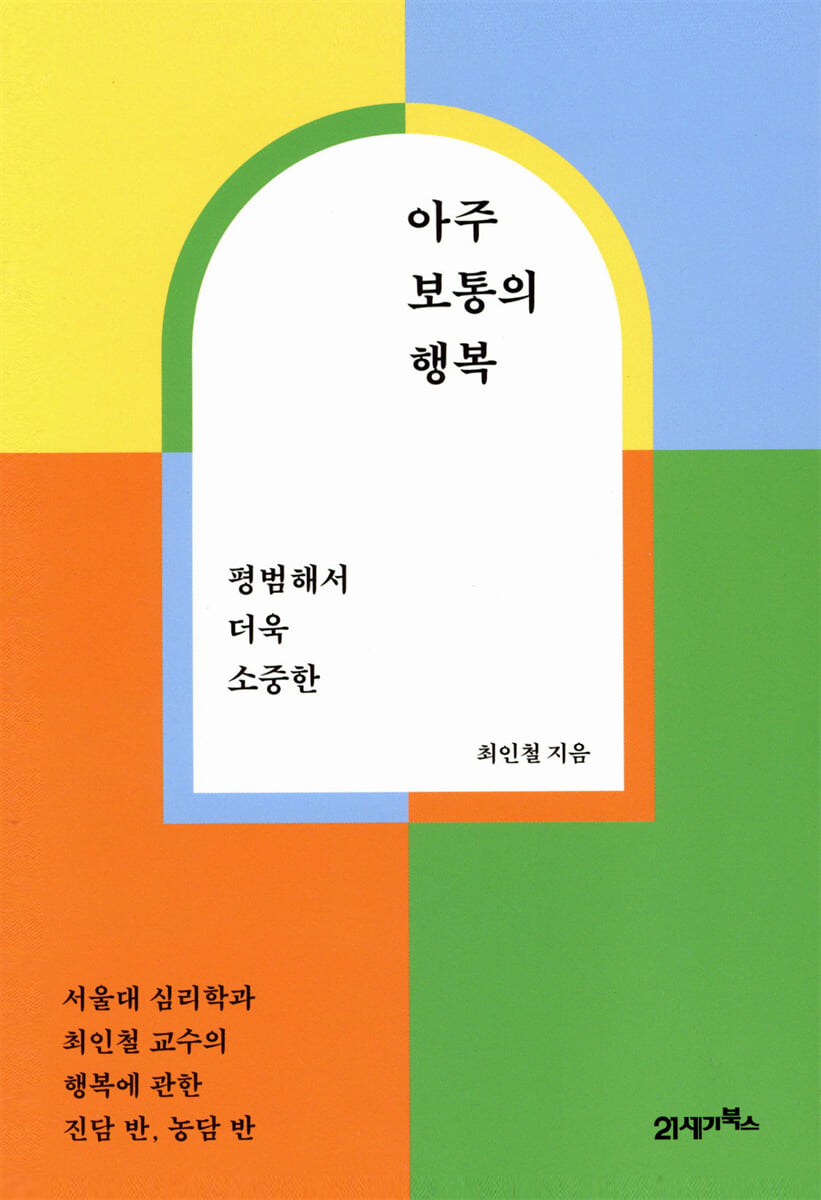
Very ordinary happiness
 |
Description
Book Introduction
Bestsellers "Frame" and "Good Life," chosen by 600,000 readers Professor Choi In-cheol of Seoul National University's Department of Psychology's Theory of Happiness The New Definition of Happiness Shifted by COVID-19 Happiness is knowing the value of ordinary, everyday life. Professor Choi In-cheol of Seoul National University, who followed up the bestsellers “Frame” and “Good Life,” has released his new book, “Very Ordinary Happiness,” which explores the theory of happiness in the post-corona era. The social changes caused by COVID-19 have also led to changes within ourselves. Because it gave me an opportunity to think again about a happy life. Professor Choi In-cheol, who has taught students and researched happiness at Seoul National University for over 20 years, focuses on the “ordinariness of happiness” in this book. “Happiness is simply living your daily life well. “Eating, working, talking… Happiness is going deeper and more fully into the trivial things of daily life that repeat themselves every day.” ― From the text Part 1 of "Very Ordinary Happiness" introduces three changes in happiness due to COVID-19, and Part 2 contains the author's witty reflections on life. The message of 'ordinary happiness that is more precious because it is ordinary' is serious, but the format is not heavy at all. The writings, which are lighthearted and like a joke about life, leave a deep impression. We worry every day. ‘Am I living well? Is my life happy?’ There is no set answer. Because the form of happiness is different for each person. This book will be a valuable guide to helping you find your own answers on how to define and create happiness. |
- You can preview some of the book's contents.
Preview
index
PREFACE The Happiness of the Ordinary
PART 1 A Light Thought on Happiness
CHAPTER 1: The Geniuses of Happiness
― Their secret to making ordinary everyday life happy
The Secret Weapon of Happy Geniuses: Just
Happy Geniuses Go to the Baseball Stadium
Happy geniuses have many favorite things.
Happy geniuses don't interfere
Happiness Geniuses Have a Hideout
Happy geniuses don't know things they don't need to know.
Happy geniuses go on a trip
Happiness geniuses don't misunderstand
Happy geniuses are attackers
Happiness Geniuses Have 4 Special Insurance Plans
CHAPTER 2 The Underdogs of Happiness
― The non-mainstream happiness that has been suppressed for so long is rising.
An introvert is coming
The Meaningful Man is Coming
The Hapjok are coming
The one who doesn't make up his mind wins
The person who is anxious that his prime is over wins.
The one who practices moderation wins
The balanced one wins
CHAPTER 3 Apostles of Happiness
In an age where morality and happiness are separate, adding dignity and ethics to happiness.
You are also a fool to someone
Even selfish people sometimes want to be altruistic.
I hate people who don't support me
We need a community that builds heaven over hell.
The mental world of others is also deep.
An open mind is deep, wide, and unique.
I like people who don't try to explain everything.
I'm attracted to people who have their own questions.
Others are as moral as I am.
You're just lucky
Hope also requires dignity
PART 2 A Serious Joke About Happiness
CHAPTER 1 There's nothing special about happiness.
There is nothing special about happiness.
joke
Why being rich is dangerous
The happy genius is a sleepyhead
Fact and belief are a draw
The Words of Happiness Geniuses: "Thanks" Over "Blame"
The Secret of Life
poverty of mind
Every time I fall
Gift of the Dead
Overweight, Overthinking and Overstuff
Are you inspired?
Attitude toward suffering
The decisive moment that changes from 'I' to 'we'
A thread of hope
Aging: A Panacea
The difference between love and happiness
CHAPTER 2 If you want to fill your life with exclamations
If you want to fill your life with exclamations
The boss's short answer
Uncommon occurrence
Chicken Vegetarian Happiness
Stop when you feel a little regretful
He just ate well
You're in big trouble.
Like cherry blossoms in spring, sometimes it's okay to break the time.
A being that raises the bar
Speed of thought violation
free-spirited human
Success of meaning
Jokes are a measure of relationships
Happiness of reversal
Underlining life
On the last bed before ending life
PART 1 A Light Thought on Happiness
CHAPTER 1: The Geniuses of Happiness
― Their secret to making ordinary everyday life happy
The Secret Weapon of Happy Geniuses: Just
Happy Geniuses Go to the Baseball Stadium
Happy geniuses have many favorite things.
Happy geniuses don't interfere
Happiness Geniuses Have a Hideout
Happy geniuses don't know things they don't need to know.
Happy geniuses go on a trip
Happiness geniuses don't misunderstand
Happy geniuses are attackers
Happiness Geniuses Have 4 Special Insurance Plans
CHAPTER 2 The Underdogs of Happiness
― The non-mainstream happiness that has been suppressed for so long is rising.
An introvert is coming
The Meaningful Man is Coming
The Hapjok are coming
The one who doesn't make up his mind wins
The person who is anxious that his prime is over wins.
The one who practices moderation wins
The balanced one wins
CHAPTER 3 Apostles of Happiness
In an age where morality and happiness are separate, adding dignity and ethics to happiness.
You are also a fool to someone
Even selfish people sometimes want to be altruistic.
I hate people who don't support me
We need a community that builds heaven over hell.
The mental world of others is also deep.
An open mind is deep, wide, and unique.
I like people who don't try to explain everything.
I'm attracted to people who have their own questions.
Others are as moral as I am.
You're just lucky
Hope also requires dignity
PART 2 A Serious Joke About Happiness
CHAPTER 1 There's nothing special about happiness.
There is nothing special about happiness.
joke
Why being rich is dangerous
The happy genius is a sleepyhead
Fact and belief are a draw
The Words of Happiness Geniuses: "Thanks" Over "Blame"
The Secret of Life
poverty of mind
Every time I fall
Gift of the Dead
Overweight, Overthinking and Overstuff
Are you inspired?
Attitude toward suffering
The decisive moment that changes from 'I' to 'we'
A thread of hope
Aging: A Panacea
The difference between love and happiness
CHAPTER 2 If you want to fill your life with exclamations
If you want to fill your life with exclamations
The boss's short answer
Uncommon occurrence
Chicken Vegetarian Happiness
Stop when you feel a little regretful
He just ate well
You're in big trouble.
Like cherry blossoms in spring, sometimes it's okay to break the time.
A being that raises the bar
Speed of thought violation
free-spirited human
Success of meaning
Jokes are a measure of relationships
Happiness of reversal
Underlining life
On the last bed before ending life
Detailed image
.jpg)
Into the book
The act of simply giving a gift is an act of giving a gift of chance.
Humans feel happiness from good things that happen by chance.
It is no coincidence that the Chinese character interpretation of the word happiness (幸福) means ‘a good thing that happens by chance.’
The level of happiness cannot go beyond the level of relationships, and the level of relationships cannot go beyond the level of 'just'.
If you have friends who just contact you without any reason, you are not lonely.
If there are people you want to give gifts to for no reason, you are already a happy person.
--- p.18 From “The Secret Weapon of Happy Geniuses, ‘Just’”
We should not only nurture geniuses with outstanding intelligence, but also geniuses who love what they do.
Preferences for likes and dislikes are both innate and largely acquired.
If you hang out with people who like a lot of things, you'll end up liking a lot of things.
When you live in a society where asking what you like is commonplace, your likes become clear.
The question we should ask each other is not our children's academic background or the balance in our bank accounts, but the balance of the things we like.
--- p.32 From “Happy Geniuses Have Many Things They Like”
When everyone is obsessed with real-time, you have to decide to be one beat behind.
We need to rebel against the habit of turning on our smartphones.
It may seem like you're constantly busy being online, but you're actually lazy. It may seem like you're actively exploring the world, but you're actually indolent, never taking a single step toward the world.
It's just busyness for the sake of being busy.
Indifference to things that do not necessarily need to be known is the most active interest in the world.
Another secret weapon of happiness geniuses.
--- p.51 From “Happy Geniuses Don’t Know What They Don’t Need to Know”
The decisive factor that made the empire of extroversion impregnable is psychology.
The status of extroversion, which was once considered arrogant, has been further elevated by the proliferation of studies showing that extroversion is beneficial to happiness.
Are you saying that it is difficult for introverts to be happy?
(…) Signs of a virus-induced collapse began to appear in this seemingly impregnable empire of extroversion.
The optimal environment has been created for introverts.
As their signature 'social distancing' emerged as the new rule of the game, the extroverted rule of narrowing social distance was pushed to the back burner.
--- p.80 From “An Introvert Comes”
There is absolutely no need for 'meaningful people' to be discouraged.
People who quietly fulfill their calling even if they are not particularly happy, people who endure their daily lives without any small happiness to boast of, people who fight against injustice and absurdity, people who suffer for their religious beliefs – these meaningful people have the same strength as the fun-loving people.
--- p.85 From “The Meaningful Man Comes”
The right person is someone who doesn't discourage others by tossing around the name of happiness, who doesn't instill the fear that if you're not happy, you'll be a loser, who always takes a step back because loud happiness campaigns don't suit their constitution, and who simply finds satisfaction in each moment.
How alienated have we been, mistaking constant excitement and excitement for happiness? The age of contentment is now upon us.
--- p.90 From “The Hapjok (洽族) is Coming”
'The people who harass me must be strange people.
How else could they misunderstand someone like me? Could that really be true? How strange must I have seemed to them? Wouldn't a world where only I was normal be a truly strange world?
I might be a fool to someone too.
If everyone around you starts to look strange, you need to realize that you yourself look strange in the eyes of others.
Additionally, you must acknowledge that you have mental senility.
The eyes that see people are clouded.
The world is still full of good people, better people, and really better people.
--- p.126 From “You Are Someone’s Too”
The world only gives us practice in winning.
The habit of winning has become a symbol of success, and embracing the pain of those who lost has become a virtue of the successful.
But the world's great problems are not caused by those who fail to win, but by those who fail to support.
How many times have problems that could have been resolved amicably been aggravated by the emotional struggles of those who have never lost and do not know how to lose?
Isn't the misconduct of those in power and the elite due to their chronic disease of not being able to support themselves?
--- p.139 From “I Hate People Who Don’t Support”
The questions our society primarily asks are about economic wealth and social status.
They ask if you earn a lot of money, but they don't ask if you live autonomously.
They ask if you work for a big company, but they don't ask if you are respected.
They ask about the size of your apartment, but they don't ask if you're lonely.
It is a society where questions about the inner self have disappeared.
You have to ask your own questions.
A country must create a signature question that reveals the essence of its existence.
Because the dignity of an individual or a society cannot exceed the dignity of the questions it poses.
--- p.169 From “I am attracted to people who have their own questions”
My boss's texts are always short.
When a subordinate sends a long document detailing the circumstances, the superior simply responds with a 'okay'.
Power is inversely proportional to the length of the reply.
Are bosses so busy they can't even finish a single sentence? Thinking about my son's texts, which are always filled with "yes" and "no," I don't think being busy is the answer.
It is clear that it is a severe disease of power that one knows about but cannot fix.
I want to be someone who writes long replies.
People who work with such a boss may be blessed.
Humans feel happiness from good things that happen by chance.
It is no coincidence that the Chinese character interpretation of the word happiness (幸福) means ‘a good thing that happens by chance.’
The level of happiness cannot go beyond the level of relationships, and the level of relationships cannot go beyond the level of 'just'.
If you have friends who just contact you without any reason, you are not lonely.
If there are people you want to give gifts to for no reason, you are already a happy person.
--- p.18 From “The Secret Weapon of Happy Geniuses, ‘Just’”
We should not only nurture geniuses with outstanding intelligence, but also geniuses who love what they do.
Preferences for likes and dislikes are both innate and largely acquired.
If you hang out with people who like a lot of things, you'll end up liking a lot of things.
When you live in a society where asking what you like is commonplace, your likes become clear.
The question we should ask each other is not our children's academic background or the balance in our bank accounts, but the balance of the things we like.
--- p.32 From “Happy Geniuses Have Many Things They Like”
When everyone is obsessed with real-time, you have to decide to be one beat behind.
We need to rebel against the habit of turning on our smartphones.
It may seem like you're constantly busy being online, but you're actually lazy. It may seem like you're actively exploring the world, but you're actually indolent, never taking a single step toward the world.
It's just busyness for the sake of being busy.
Indifference to things that do not necessarily need to be known is the most active interest in the world.
Another secret weapon of happiness geniuses.
--- p.51 From “Happy Geniuses Don’t Know What They Don’t Need to Know”
The decisive factor that made the empire of extroversion impregnable is psychology.
The status of extroversion, which was once considered arrogant, has been further elevated by the proliferation of studies showing that extroversion is beneficial to happiness.
Are you saying that it is difficult for introverts to be happy?
(…) Signs of a virus-induced collapse began to appear in this seemingly impregnable empire of extroversion.
The optimal environment has been created for introverts.
As their signature 'social distancing' emerged as the new rule of the game, the extroverted rule of narrowing social distance was pushed to the back burner.
--- p.80 From “An Introvert Comes”
There is absolutely no need for 'meaningful people' to be discouraged.
People who quietly fulfill their calling even if they are not particularly happy, people who endure their daily lives without any small happiness to boast of, people who fight against injustice and absurdity, people who suffer for their religious beliefs – these meaningful people have the same strength as the fun-loving people.
--- p.85 From “The Meaningful Man Comes”
The right person is someone who doesn't discourage others by tossing around the name of happiness, who doesn't instill the fear that if you're not happy, you'll be a loser, who always takes a step back because loud happiness campaigns don't suit their constitution, and who simply finds satisfaction in each moment.
How alienated have we been, mistaking constant excitement and excitement for happiness? The age of contentment is now upon us.
--- p.90 From “The Hapjok (洽族) is Coming”
'The people who harass me must be strange people.
How else could they misunderstand someone like me? Could that really be true? How strange must I have seemed to them? Wouldn't a world where only I was normal be a truly strange world?
I might be a fool to someone too.
If everyone around you starts to look strange, you need to realize that you yourself look strange in the eyes of others.
Additionally, you must acknowledge that you have mental senility.
The eyes that see people are clouded.
The world is still full of good people, better people, and really better people.
--- p.126 From “You Are Someone’s Too”
The world only gives us practice in winning.
The habit of winning has become a symbol of success, and embracing the pain of those who lost has become a virtue of the successful.
But the world's great problems are not caused by those who fail to win, but by those who fail to support.
How many times have problems that could have been resolved amicably been aggravated by the emotional struggles of those who have never lost and do not know how to lose?
Isn't the misconduct of those in power and the elite due to their chronic disease of not being able to support themselves?
--- p.139 From “I Hate People Who Don’t Support”
The questions our society primarily asks are about economic wealth and social status.
They ask if you earn a lot of money, but they don't ask if you live autonomously.
They ask if you work for a big company, but they don't ask if you are respected.
They ask about the size of your apartment, but they don't ask if you're lonely.
It is a society where questions about the inner self have disappeared.
You have to ask your own questions.
A country must create a signature question that reveals the essence of its existence.
Because the dignity of an individual or a society cannot exceed the dignity of the questions it poses.
--- p.169 From “I am attracted to people who have their own questions”
My boss's texts are always short.
When a subordinate sends a long document detailing the circumstances, the superior simply responds with a 'okay'.
Power is inversely proportional to the length of the reply.
Are bosses so busy they can't even finish a single sentence? Thinking about my son's texts, which are always filled with "yes" and "no," I don't think being busy is the answer.
It is clear that it is a severe disease of power that one knows about but cannot fix.
I want to be someone who writes long replies.
People who work with such a boss may be blessed.
--- p.229 From "The Boss's Short Answer"
Publisher's Review
20 years of happiness research and moments encountered in life
Sometimes it unfolds as a lighthearted joke, sometimes as a serious joke.
In 2007, Professor Choi In-cheol of the Department of Psychology at Seoul National University published his third book, "Very Ordinary Happiness" (published by 21st Century Books), following "Frame," which established itself as the psychology bible by introducing a new keyword called "frame" to our society, and "Good Life," a steady seller that synthesized his 10 years of research on happiness and human psychology.
This book is Professor Choi In-cheol's theory of happiness, which summarizes his thoughts and feelings from over 20 years of research on happiness.
The author, who has studied human psychological changes resulting from social change, says the COVID-19 pandemic that has swept the world has provided an opportunity to rethink the concept of happiness.
This book explains how the external factors that have been called conditions for happiness so far are insignificant, what is truly important in life and what is unnecessary, and why we need to reexamine the various values in life that we have been disparaging.
The most striking feature of this book is the author's skill in presenting a clear message based on the latest research data on happiness, yet presenting it in a light-hearted manner.
It can be seen as an essay that can be read without burden as it draws stories from everyday cases.
But the feeling you get after reading this book will be different from that of other essays.
Because it makes me ask myself what kind of life I am living now.
“I want to live as an ordinary person.”
About 'ordinary happiness', which is all the more precious because it is ordinary.
The book begins with a preface containing the author's confession, "I want to live as an ordinary person."
The reason the author focused on the keyword “ordinary” is because he believed that “psychology is the work of creating a manual about humans for the happiness of oneself and the community,” and the lesson he learned through long-term research was “the ordinariness of happiness.”
“The reason I was able to become an ordinary person is entirely thanks to psychology.
“Now, I have become a mediocre person, to the point where I order ‘regular’ rather than ‘special’ even at seolleongtang restaurants.” - From the author’s preface
The moments when we feel happy are not grand.
When you feel respected and not ignored by others, when you feel like you have learned something and grown, when you do your work well without feeling inferior, when you feel secure that you have someone to trust no matter what happens, and when you are taking charge of your life.
Happiness is determined by inner needs such as respect, growth, competence, support, and freedom.
In other words, the author says that happiness is something that can be experienced in extremely everyday life.
"The marginalized, marginalized, and marginalized segments of happiness are emerging."
The concept of happiness has changed due to COVID-19.
This book is largely divided into two parts.
Part 1, "Light Thoughts on Happiness," introduces three changes in happiness since COVID-19.
1) The Secret of Happy Geniuses
First, we redefine the ‘characteristics of a happy person.’
In particular, there are many stories that overturn the conventional wisdom that “this kind of person is happy.”
In this day and age, it is said that the true "happiness geniuses" are those who are indifferent to things they don't necessarily need to know, those who don't make firm decisions about everything, and those who know the value of "just being," and it introduces that the forms of happiness have become more diverse than before.
2) The underdog of happiness is coming
The second change is that the era has arrived where the non-mainstream of happiness, which had been cowed for so long, can straighten their shoulders.
Before COVID-19, extroverts were known to be happier, but after COVID-19, introverts who were accustomed to 'social distancing' showed higher happiness levels.
It also speaks to the value of a life that pursues meaning rather than fun, such as a life that is not particularly enjoyable but quietly carries out the calling given to it, and a life that endures daily life well even though there are no small pleasures to boast about.
3) Happiness also requires dignity.
The third change is that a life that adds dignity to happiness has become more important than happiness separated from morality.
We must be interested in the 'growth of meaning', not just the growth of wealth and status.
We've been taught that beating others is the only shortcut to success, but the author says that our society will be happier if more people learn to put aside their pride and boldly lose in areas they don't know well.
Part 2, 'A Serious Joke About Happiness', consists of the author's daily thoughts about life.
It evokes empathy based on common examples such as conversations between family members, episodes with bosses at work, why we miss traveling, the value of jokes, and the wisdom of aging.
In particular, the insights captured in everyday moments that could otherwise be missed remind us that happiness is not something grandiose.
There is no magic to becoming happy.
The author says that there is no private education or magical elixir for happiness.
Just living a good everyday life.
Happiness is about going deeper and more fully into the trivial things of daily life, such as eating, working, and talking.
Sometimes it unfolds as a lighthearted joke, sometimes as a serious joke.
In 2007, Professor Choi In-cheol of the Department of Psychology at Seoul National University published his third book, "Very Ordinary Happiness" (published by 21st Century Books), following "Frame," which established itself as the psychology bible by introducing a new keyword called "frame" to our society, and "Good Life," a steady seller that synthesized his 10 years of research on happiness and human psychology.
This book is Professor Choi In-cheol's theory of happiness, which summarizes his thoughts and feelings from over 20 years of research on happiness.
The author, who has studied human psychological changes resulting from social change, says the COVID-19 pandemic that has swept the world has provided an opportunity to rethink the concept of happiness.
This book explains how the external factors that have been called conditions for happiness so far are insignificant, what is truly important in life and what is unnecessary, and why we need to reexamine the various values in life that we have been disparaging.
The most striking feature of this book is the author's skill in presenting a clear message based on the latest research data on happiness, yet presenting it in a light-hearted manner.
It can be seen as an essay that can be read without burden as it draws stories from everyday cases.
But the feeling you get after reading this book will be different from that of other essays.
Because it makes me ask myself what kind of life I am living now.
“I want to live as an ordinary person.”
About 'ordinary happiness', which is all the more precious because it is ordinary.
The book begins with a preface containing the author's confession, "I want to live as an ordinary person."
The reason the author focused on the keyword “ordinary” is because he believed that “psychology is the work of creating a manual about humans for the happiness of oneself and the community,” and the lesson he learned through long-term research was “the ordinariness of happiness.”
“The reason I was able to become an ordinary person is entirely thanks to psychology.
“Now, I have become a mediocre person, to the point where I order ‘regular’ rather than ‘special’ even at seolleongtang restaurants.” - From the author’s preface
The moments when we feel happy are not grand.
When you feel respected and not ignored by others, when you feel like you have learned something and grown, when you do your work well without feeling inferior, when you feel secure that you have someone to trust no matter what happens, and when you are taking charge of your life.
Happiness is determined by inner needs such as respect, growth, competence, support, and freedom.
In other words, the author says that happiness is something that can be experienced in extremely everyday life.
"The marginalized, marginalized, and marginalized segments of happiness are emerging."
The concept of happiness has changed due to COVID-19.
This book is largely divided into two parts.
Part 1, "Light Thoughts on Happiness," introduces three changes in happiness since COVID-19.
1) The Secret of Happy Geniuses
First, we redefine the ‘characteristics of a happy person.’
In particular, there are many stories that overturn the conventional wisdom that “this kind of person is happy.”
In this day and age, it is said that the true "happiness geniuses" are those who are indifferent to things they don't necessarily need to know, those who don't make firm decisions about everything, and those who know the value of "just being," and it introduces that the forms of happiness have become more diverse than before.
2) The underdog of happiness is coming
The second change is that the era has arrived where the non-mainstream of happiness, which had been cowed for so long, can straighten their shoulders.
Before COVID-19, extroverts were known to be happier, but after COVID-19, introverts who were accustomed to 'social distancing' showed higher happiness levels.
It also speaks to the value of a life that pursues meaning rather than fun, such as a life that is not particularly enjoyable but quietly carries out the calling given to it, and a life that endures daily life well even though there are no small pleasures to boast about.
3) Happiness also requires dignity.
The third change is that a life that adds dignity to happiness has become more important than happiness separated from morality.
We must be interested in the 'growth of meaning', not just the growth of wealth and status.
We've been taught that beating others is the only shortcut to success, but the author says that our society will be happier if more people learn to put aside their pride and boldly lose in areas they don't know well.
Part 2, 'A Serious Joke About Happiness', consists of the author's daily thoughts about life.
It evokes empathy based on common examples such as conversations between family members, episodes with bosses at work, why we miss traveling, the value of jokes, and the wisdom of aging.
In particular, the insights captured in everyday moments that could otherwise be missed remind us that happiness is not something grandiose.
There is no magic to becoming happy.
The author says that there is no private education or magical elixir for happiness.
Just living a good everyday life.
Happiness is about going deeper and more fully into the trivial things of daily life, such as eating, working, and talking.
GOODS SPECIFICS
- Date of issue: July 21, 2021
- Page count, weight, size: 264 pages | 362g | 128*188*16mm
- ISBN13: 9788950996437
- ISBN10: 895099643X
You may also like
카테고리
korean


korean

![GQ KOREA Mark (Monthly): December [2025]](http://librairie.coreenne.fr/cdn/shop/files/8ef265dbbfbf186523ed75ba7319009d.jpg?v=1765340328&width=3840)


