

Barbara Minto's The Art of Logic
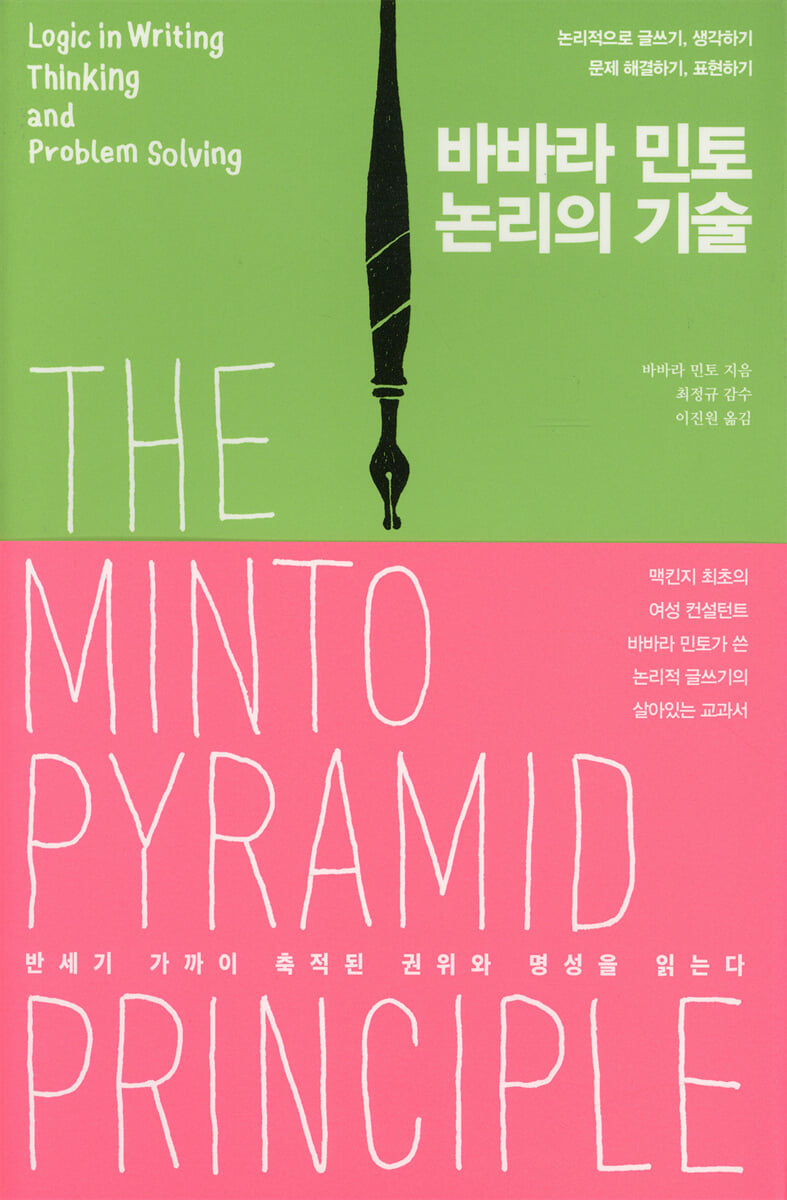 |
Description
Book Introduction
Written by Barbara Minto, McKinsey's first female consultant
A living textbook on logical writing
We face various problems every day and experience various types of communication in the process of solving them.
Especially in the business world, problems requiring complex communication frequently arise.
Since most such issues are directly related to the organization's interests or the survival of the business, the optimal alternative must be devised through accurate analysis of the situation and cool-headed judgment.
"Barbara Minto's The Art of Logic" is a book that covers the logical thinking and communication skills necessary to solve problems in the business world.
Barbara Minto points out that the reason why someone's writing or speech is not clearly understood is because the way the writer or speaker organizes his or her thoughts, that is, the way the writing is structured, and the way the reader thinks do not match, and she says that if you organize your thoughts according to the pyramid principle, you can write clearly that anyone can easily understand, and you can also have a persuasive conversation with anyone.
The Minto Pyramid Principle can be very useful not only in writing, but also in all communication activities, such as persuasion, negotiation, and presentations.
Whether you're writing a plan to solve a critical problem, needing to concisely report key points to your boss, explaining a product to a customer and getting them to buy it, or simply wanting to articulate your ideas in a meeting, the Minto Pyramid Principle can be used in both business and everyday life to help you make your point across clearly and powerfully.
A living textbook on logical writing
We face various problems every day and experience various types of communication in the process of solving them.
Especially in the business world, problems requiring complex communication frequently arise.
Since most such issues are directly related to the organization's interests or the survival of the business, the optimal alternative must be devised through accurate analysis of the situation and cool-headed judgment.
"Barbara Minto's The Art of Logic" is a book that covers the logical thinking and communication skills necessary to solve problems in the business world.
Barbara Minto points out that the reason why someone's writing or speech is not clearly understood is because the way the writer or speaker organizes his or her thoughts, that is, the way the writing is structured, and the way the reader thinks do not match, and she says that if you organize your thoughts according to the pyramid principle, you can write clearly that anyone can easily understand, and you can also have a persuasive conversation with anyone.
The Minto Pyramid Principle can be very useful not only in writing, but also in all communication activities, such as persuasion, negotiation, and presentations.
Whether you're writing a plan to solve a critical problem, needing to concisely report key points to your boss, explaining a product to a customer and getting them to buy it, or simply wanting to articulate your ideas in a meeting, the Minto Pyramid Principle can be used in both business and everyday life to help you make your point across clearly and powerfully.
- You can preview some of the book's contents.
Preview
index
Reviewer's Note: A Must-Read for Logical Problem Solving
Introduction: Why Write in a Pyramid Structure
Part 1: Writing Logically
Chapter 1: Why a Pyramid Structure?
Chapter 2: Examining the Internal Structure of the Pyramid
Chapter 3: How to Create a Pyramid Structure
Chapter 4: How to structure the introduction
Chapter 5: How are deductive and inductive reasoning different?
Part 2: Thinking Logically
Chapter 6: Establishing a Logical Order
Chapter 7: Summarizing Group Thoughts
Part 3: Solving Problems Logically
Chapter 8 Defining the Problem
Chapter 9: Structuring Problem Analysis
Part 4: Expressing Logically
Chapter 10: Writing Documents Using the Pyramid Principle
Chapter 11 Presenting Using the Pyramid Principle
Chapter 12: Expressing Sentences Using the Pyramid Principle
Appendix A_Troubleshooting in Unstructured Situations
Appendix B_ Introductory Case
Translator's Note: The Joy of Logical Writing
Introduction: Why Write in a Pyramid Structure
Part 1: Writing Logically
Chapter 1: Why a Pyramid Structure?
Chapter 2: Examining the Internal Structure of the Pyramid
Chapter 3: How to Create a Pyramid Structure
Chapter 4: How to structure the introduction
Chapter 5: How are deductive and inductive reasoning different?
Part 2: Thinking Logically
Chapter 6: Establishing a Logical Order
Chapter 7: Summarizing Group Thoughts
Part 3: Solving Problems Logically
Chapter 8 Defining the Problem
Chapter 9: Structuring Problem Analysis
Part 4: Expressing Logically
Chapter 10: Writing Documents Using the Pyramid Principle
Chapter 11 Presenting Using the Pyramid Principle
Chapter 12: Expressing Sentences Using the Pyramid Principle
Appendix A_Troubleshooting in Unstructured Situations
Appendix B_ Introductory Case
Translator's Note: The Joy of Logical Writing
Detailed image
.jpg)
Into the book
In 1963, I was selected as McKinsey's first female consultant among eight bold women who had graduated from Harvard Business School.
McKinsey concluded that I was weak in numbers but had excellent writing skills, and transferred me to the London office.
There, I was responsible for providing writing guidance to consultants from various European countries who were struggling to write reports in English.
While researching how to write reports, I came across countless books that outlined how to create flowing, clear sentences, but not a single one explained how to structure your thoughts.
This was a very shocking fact for me, who knew that writing was originally a tool for conveying thoughts.
Even if it was a book about how to write a report, all it did was say things like, “Write logically” or “Have a logical outline.”
How do you derive a logical outline from a vague situation? I decided to find the answer to this question myself.
The result was the Minto Pyramid Principle.
--- p.9
All intellectual processes, such as thinking, remembering, and problem solving, involve the thought processes of grouping and summarizing.
In that sense, the information in our heads can be said to be a huge complex made up of several pyramids with relationships.
Writing is an act of conveying something to the brain.
Therefore, when writing, you must organize the content you want to convey in a way that fits the pyramid structure of the other person's brain.
This is where the fundamental problem of communication arises.
You have a good idea of how the various objects you want to convey to the other person are grouped.
To properly convey this to the other person, the other person must also group and accept it in the same way as you.
However, you can only transmit one object at a time.
Therefore, in order to convey it accurately and efficiently, you must first explain the overall structure of how it was grouped, and then convey each target.
This is the pyramid method of arranging thoughts from top to bottom.
--- pp.29-30
In a text structured like a pyramid, the logic develops through a question-and-answer format conversation with the reader.
In this case, if the introduction contains content that is irrelevant to the reader, it will not be able to generate interest even if the writing is developed in a question-and-answer format.
The only way is to begin the introduction with a statement that directly answers a question that already exists in the reader's mind.
We write to convey something the reader does not know.
However, readers only want to know something they don't know when necessary, and they don't have any questions if they don't need to know it.
Therefore, to generate interest, you must write an article that answers questions that already exist in the reader's mind or questions that he or she might naturally think of when observing events occurring around him or her.
--- pp.49-50
Using the deductive method not only forces the reader to spend a lot of time trying to figure out what to do, but also requires them to repeat the problem-solving process many times until they get what they want to know.
It's as if you're saying to the reader, "I want you to know how much effort I put into reaching that conclusion."
However, if the same message is expressed inductively, anyone can easily understand it.
Inductive reasoning, unlike deductive reasoning, begins by answering the question "How?" and then answers the question "Why?" This is because ideas are clearly grouped by subject area.
Even so, at the very bottom of the pyramid, deductive reasoning is used to directly answer the reader's questions.
People often ask, “Isn’t deductive reasoning a stronger method of argument than induction?” but that is not true at all.
Deductive and inductive methods are identical in nature; they are just described in different ways.
--- p.126
The process of developing a diagnostic framework is called 'issue analysis'.
However, the term issue analysis is used in a very vague and broad sense and includes various logic trees.
This can lead to confusion about how to use the diagnostic framework and the logic tree.
Why does this confusion arise? First, it's because of the word "issue."
Strictly speaking, the issue takes the form of a question designed to elicit a 'yes' or 'no' answer.
The word 'issue' originally came from the legal term 'controversy'.
It implies that there are two different arguments going on about one point, with one side potentially gaining the upper hand.
In that sense, “How should we rebuild?” cannot be considered an issue.
Because there is no issue at stake.
On the other hand, the question is, “Should the function be rebuilt?”
Because the entire thinking has developed sufficiently to the point where it can make a single decision.
'Yes' and 'no' questions are a very important factor in problem solving because they lead to clear answers.
How effectively you can solve a problem depends on how clearly you can formulate 'yes' or 'no' questions.
Therefore, to avoid linguistic confusion, we recommend using the word "concern" when listing the topics that customers are concerned about, and limiting the use of the word "issue" to "yes" or "no" questions.
--- p.299
If given a choice, people would rather communicate their pyramid-structured ideas verbally than in writing.
Because deep down, we assume that a visual presentation is just a report in slide format.
So people think that if they just put the pyramid on a neat text slide with a few diagrams to stand around and explain, their visual presentation will be complete.
Is that really the case? The problem is that you have to deliver a visual presentation to a live audience, who often sit in a very uncomfortable atmosphere, wishing they could listen somewhere else.
Such audiences can react unpredictably and are easily distracted.
Therefore, you must focus your efforts on predicting their reactions, capturing their attention, and making them want to hear your message.
In other words, we have to entertain them.
Additionally, entertaining an audience while giving a business presentation requires the same level of artistry as any other form of entertainment.
You have to put on a 'show'.
To put on a show, you need to consider stars, scripts, storyboards, technically compelling visual elements, and intangibles like timing, pacing, and thrills.
Suddenly, you need a whole new set of skills beyond slide presentations.
McKinsey concluded that I was weak in numbers but had excellent writing skills, and transferred me to the London office.
There, I was responsible for providing writing guidance to consultants from various European countries who were struggling to write reports in English.
While researching how to write reports, I came across countless books that outlined how to create flowing, clear sentences, but not a single one explained how to structure your thoughts.
This was a very shocking fact for me, who knew that writing was originally a tool for conveying thoughts.
Even if it was a book about how to write a report, all it did was say things like, “Write logically” or “Have a logical outline.”
How do you derive a logical outline from a vague situation? I decided to find the answer to this question myself.
The result was the Minto Pyramid Principle.
--- p.9
All intellectual processes, such as thinking, remembering, and problem solving, involve the thought processes of grouping and summarizing.
In that sense, the information in our heads can be said to be a huge complex made up of several pyramids with relationships.
Writing is an act of conveying something to the brain.
Therefore, when writing, you must organize the content you want to convey in a way that fits the pyramid structure of the other person's brain.
This is where the fundamental problem of communication arises.
You have a good idea of how the various objects you want to convey to the other person are grouped.
To properly convey this to the other person, the other person must also group and accept it in the same way as you.
However, you can only transmit one object at a time.
Therefore, in order to convey it accurately and efficiently, you must first explain the overall structure of how it was grouped, and then convey each target.
This is the pyramid method of arranging thoughts from top to bottom.
--- pp.29-30
In a text structured like a pyramid, the logic develops through a question-and-answer format conversation with the reader.
In this case, if the introduction contains content that is irrelevant to the reader, it will not be able to generate interest even if the writing is developed in a question-and-answer format.
The only way is to begin the introduction with a statement that directly answers a question that already exists in the reader's mind.
We write to convey something the reader does not know.
However, readers only want to know something they don't know when necessary, and they don't have any questions if they don't need to know it.
Therefore, to generate interest, you must write an article that answers questions that already exist in the reader's mind or questions that he or she might naturally think of when observing events occurring around him or her.
--- pp.49-50
Using the deductive method not only forces the reader to spend a lot of time trying to figure out what to do, but also requires them to repeat the problem-solving process many times until they get what they want to know.
It's as if you're saying to the reader, "I want you to know how much effort I put into reaching that conclusion."
However, if the same message is expressed inductively, anyone can easily understand it.
Inductive reasoning, unlike deductive reasoning, begins by answering the question "How?" and then answers the question "Why?" This is because ideas are clearly grouped by subject area.
Even so, at the very bottom of the pyramid, deductive reasoning is used to directly answer the reader's questions.
People often ask, “Isn’t deductive reasoning a stronger method of argument than induction?” but that is not true at all.
Deductive and inductive methods are identical in nature; they are just described in different ways.
--- p.126
The process of developing a diagnostic framework is called 'issue analysis'.
However, the term issue analysis is used in a very vague and broad sense and includes various logic trees.
This can lead to confusion about how to use the diagnostic framework and the logic tree.
Why does this confusion arise? First, it's because of the word "issue."
Strictly speaking, the issue takes the form of a question designed to elicit a 'yes' or 'no' answer.
The word 'issue' originally came from the legal term 'controversy'.
It implies that there are two different arguments going on about one point, with one side potentially gaining the upper hand.
In that sense, “How should we rebuild?” cannot be considered an issue.
Because there is no issue at stake.
On the other hand, the question is, “Should the function be rebuilt?”
Because the entire thinking has developed sufficiently to the point where it can make a single decision.
'Yes' and 'no' questions are a very important factor in problem solving because they lead to clear answers.
How effectively you can solve a problem depends on how clearly you can formulate 'yes' or 'no' questions.
Therefore, to avoid linguistic confusion, we recommend using the word "concern" when listing the topics that customers are concerned about, and limiting the use of the word "issue" to "yes" or "no" questions.
--- p.299
If given a choice, people would rather communicate their pyramid-structured ideas verbally than in writing.
Because deep down, we assume that a visual presentation is just a report in slide format.
So people think that if they just put the pyramid on a neat text slide with a few diagrams to stand around and explain, their visual presentation will be complete.
Is that really the case? The problem is that you have to deliver a visual presentation to a live audience, who often sit in a very uncomfortable atmosphere, wishing they could listen somewhere else.
Such audiences can react unpredictably and are easily distracted.
Therefore, you must focus your efforts on predicting their reactions, capturing their attention, and making them want to hear your message.
In other words, we have to entertain them.
Additionally, entertaining an audience while giving a business presentation requires the same level of artistry as any other form of entertainment.
You have to put on a 'show'.
To put on a show, you need to consider stars, scripts, storyboards, technically compelling visual elements, and intangibles like timing, pacing, and thrills.
Suddenly, you need a whole new set of skills beyond slide presentations.
--- pp.344-346
Publisher's Review
Written by Barbara Minto, McKinsey's first female consultant
A living textbook on logical writing
“Read the authority and reputation accumulated over nearly half a century!”
First published in 1973, it has been read by millions of readers worldwide.
A long-running bestseller that has received rave reviews
McKinsey's foundation of logical thinking and the most authoritative theory on logical writing
Uncovering the secrets of the Minto Pyramid Principle!
We face various problems every day and experience various types of communication in the process of solving them.
Especially in the business world, problems requiring complex communication frequently arise.
Since most such issues are directly related to the organization's interests or the survival of the business, the optimal alternative must be devised through accurate analysis of the situation and cool-headed judgment.
"Barbara Minto's The Art of Logic" is a book that covers the logical thinking and communication skills necessary to solve problems in the business world.
Barbara Minto, who graduated from Harvard Business School in 1963 and joined the consulting firm McKinsey as the first female consultant, teaches the concepts necessary for logical thinking, systematic problem solving, and effective communication based on the 'Minto Pyramid Principle' that she herself devised.
The Minto Pyramid Principle is the foundation theory of McKinsey's logical thinking method, known as MECE and logic trees, and is known as the oldest and most authoritative theory on logical writing.
A plan that highlights the key points at a glance, a clean report without any unnecessary details, and a clear presentation that instantly captivates bosses and clients all embody the Minto Pyramid Principle.
In addition, the introductory structure, deductive and inductive thinking, logical prioritization, problem definition and structuring, and various presentation techniques presented in this book are fundamental and core concepts of logical thinking, widely used in leading companies and organizations around the world.
Since its first publication in 1973, this book has been translated into major countries around the world, including the United States, France, Italy, China, and Japan, and has remained a long-term bestseller, still receiving enthusiastic praise from millions of readers worldwide, nearly half a century later.
It was first introduced in Korea in 1996 and went out of print for a while, but it has been recognized for its reputation and authority for a long time, to the point where readers have been flooding in with inquiries and requests for its republication.
The first edition of Barbara Minto's The Art of Logic, published in 2004, was translated based on the revised version published in the United States in 1996. This revised edition includes Chapter 11, "Presenting Using the Pyramid Principle," which was omitted from the first edition, and has undergone extensive editing and design revisions.
The Minto Pyramid Principle
The best tool for logical writing!
"How can I write something that is clear and easy to understand?" Whether you're a professional preparing a presentation at work, a student writing a report for college, or a high school student preparing for an essay exam to get into college, anyone who has ever written a relatively long piece of writing has probably pondered this question at least once.
Many people believe that writing concisely and in a flowing style is the key to writing logically, easily readable, and understandable.
However, the decisive factor that distinguishes good writing from bad writing is not whether the sentences are good or bad, but the order in which the sentences are arranged, that is, the way the writing is structured.
Barbara Minto points out that the reason why someone's writing or speech is not clearly understood is because the way the writer or speaker organizes his or her thoughts, that is, the way the writing is structured, and the way the reader thinks do not match, and she says that if you organize your thoughts according to the pyramid principle, you can write clearly that anyone can easily understand, and you can also have a persuasive conversation with anyone.
When we read or have a conversation, our brains think by first receiving the main idea and then grouping similar related details together.
Therefore, when writing or speaking, you should structure your logic in a pyramid shape that develops from top to bottom, stating the main point first, then discussing the supporting details that make up the main point, and then discussing more detailed information. This way, the other person can easily understand and accept your argument.
This is the essence of the Minto Pyramid Principle.
The reason we need to communicate according to the Minto Pyramid Principle is because the human thought structure itself is shaped like a pyramid.
The Minto Pyramid Principle can be very useful not only in writing, but also in all communication activities, such as persuasion, negotiation, and presentations.
Whether you're writing a plan to solve a critical problem, needing to concisely report key points to your boss, explaining a product to a customer and getting them to buy it, or simply wanting to articulate your ideas in a meeting, the Minto Pyramid Principle can be used in both business and everyday life to help you make your point across clearly and powerfully.
A complex web of reports, plans, and presentations…
Let's solve it clearly using the Minto Pyramid Principle!
Modern workers living in the information age have many opportunities to create various documents, such as plans, reports, and presentation materials, for companies and organizations regardless of whether they are in the East or the West.
Especially today, when email has become a vital means of communication in the business world, it's safe to say that we write letters almost every day.
Accordingly, a working person's writing skills become a measure of his or her ability, and it is no exaggeration to say that the speed of success depends on "how one writes."
Logical thinking is the ability to collect, digest, and process complex and specialized knowledge and information, and then use it in decision-making or convey it to others.
When writing reports or proposals, many office workers struggle with how to organize the vast amount of data they have, ultimately resulting in documents that are voluminous but lack useful content.
The Minto Pyramid Principle will help these people effectively learn how to present their message in a "clear, uncluttered, and concise report."
This book will be of great help to those in positions of problem-solving and decision-making within organizations, particularly those responsible for strategic planning, organizing extensive research findings to solve complex problems, producing creative results, and reporting these findings to superiors.
It can also serve as an excellent work guide for anyone working in the consulting industry.
It also contains practical content that will be helpful to team members of task forces, which are often formed by companies or government agencies to address specific issues, in defining and resolving the issues in a given case and preparing a final report.
In addition, it will serve as a foundation for improving planning and presentation skills for everyone who solves problems and writes reports in various organizations.
A classic book in the industry that trains sound management thinking.
-Maeil Business Newspaper
A book like "The Secret Document of Logic," which teaches logical persuasion and problem-solving techniques.
-Korea Economic Daily
A book that will help office workers overcome their fear of writing by creating various types of documents.
-Financial News
A book that develops communication skills to think, express, and write logically.
-Segye Ilbo
A living textbook on logical writing
“Read the authority and reputation accumulated over nearly half a century!”
First published in 1973, it has been read by millions of readers worldwide.
A long-running bestseller that has received rave reviews
McKinsey's foundation of logical thinking and the most authoritative theory on logical writing
Uncovering the secrets of the Minto Pyramid Principle!
We face various problems every day and experience various types of communication in the process of solving them.
Especially in the business world, problems requiring complex communication frequently arise.
Since most such issues are directly related to the organization's interests or the survival of the business, the optimal alternative must be devised through accurate analysis of the situation and cool-headed judgment.
"Barbara Minto's The Art of Logic" is a book that covers the logical thinking and communication skills necessary to solve problems in the business world.
Barbara Minto, who graduated from Harvard Business School in 1963 and joined the consulting firm McKinsey as the first female consultant, teaches the concepts necessary for logical thinking, systematic problem solving, and effective communication based on the 'Minto Pyramid Principle' that she herself devised.
The Minto Pyramid Principle is the foundation theory of McKinsey's logical thinking method, known as MECE and logic trees, and is known as the oldest and most authoritative theory on logical writing.
A plan that highlights the key points at a glance, a clean report without any unnecessary details, and a clear presentation that instantly captivates bosses and clients all embody the Minto Pyramid Principle.
In addition, the introductory structure, deductive and inductive thinking, logical prioritization, problem definition and structuring, and various presentation techniques presented in this book are fundamental and core concepts of logical thinking, widely used in leading companies and organizations around the world.
Since its first publication in 1973, this book has been translated into major countries around the world, including the United States, France, Italy, China, and Japan, and has remained a long-term bestseller, still receiving enthusiastic praise from millions of readers worldwide, nearly half a century later.
It was first introduced in Korea in 1996 and went out of print for a while, but it has been recognized for its reputation and authority for a long time, to the point where readers have been flooding in with inquiries and requests for its republication.
The first edition of Barbara Minto's The Art of Logic, published in 2004, was translated based on the revised version published in the United States in 1996. This revised edition includes Chapter 11, "Presenting Using the Pyramid Principle," which was omitted from the first edition, and has undergone extensive editing and design revisions.
The Minto Pyramid Principle
The best tool for logical writing!
"How can I write something that is clear and easy to understand?" Whether you're a professional preparing a presentation at work, a student writing a report for college, or a high school student preparing for an essay exam to get into college, anyone who has ever written a relatively long piece of writing has probably pondered this question at least once.
Many people believe that writing concisely and in a flowing style is the key to writing logically, easily readable, and understandable.
However, the decisive factor that distinguishes good writing from bad writing is not whether the sentences are good or bad, but the order in which the sentences are arranged, that is, the way the writing is structured.
Barbara Minto points out that the reason why someone's writing or speech is not clearly understood is because the way the writer or speaker organizes his or her thoughts, that is, the way the writing is structured, and the way the reader thinks do not match, and she says that if you organize your thoughts according to the pyramid principle, you can write clearly that anyone can easily understand, and you can also have a persuasive conversation with anyone.
When we read or have a conversation, our brains think by first receiving the main idea and then grouping similar related details together.
Therefore, when writing or speaking, you should structure your logic in a pyramid shape that develops from top to bottom, stating the main point first, then discussing the supporting details that make up the main point, and then discussing more detailed information. This way, the other person can easily understand and accept your argument.
This is the essence of the Minto Pyramid Principle.
The reason we need to communicate according to the Minto Pyramid Principle is because the human thought structure itself is shaped like a pyramid.
The Minto Pyramid Principle can be very useful not only in writing, but also in all communication activities, such as persuasion, negotiation, and presentations.
Whether you're writing a plan to solve a critical problem, needing to concisely report key points to your boss, explaining a product to a customer and getting them to buy it, or simply wanting to articulate your ideas in a meeting, the Minto Pyramid Principle can be used in both business and everyday life to help you make your point across clearly and powerfully.
A complex web of reports, plans, and presentations…
Let's solve it clearly using the Minto Pyramid Principle!
Modern workers living in the information age have many opportunities to create various documents, such as plans, reports, and presentation materials, for companies and organizations regardless of whether they are in the East or the West.
Especially today, when email has become a vital means of communication in the business world, it's safe to say that we write letters almost every day.
Accordingly, a working person's writing skills become a measure of his or her ability, and it is no exaggeration to say that the speed of success depends on "how one writes."
Logical thinking is the ability to collect, digest, and process complex and specialized knowledge and information, and then use it in decision-making or convey it to others.
When writing reports or proposals, many office workers struggle with how to organize the vast amount of data they have, ultimately resulting in documents that are voluminous but lack useful content.
The Minto Pyramid Principle will help these people effectively learn how to present their message in a "clear, uncluttered, and concise report."
This book will be of great help to those in positions of problem-solving and decision-making within organizations, particularly those responsible for strategic planning, organizing extensive research findings to solve complex problems, producing creative results, and reporting these findings to superiors.
It can also serve as an excellent work guide for anyone working in the consulting industry.
It also contains practical content that will be helpful to team members of task forces, which are often formed by companies or government agencies to address specific issues, in defining and resolving the issues in a given case and preparing a final report.
In addition, it will serve as a foundation for improving planning and presentation skills for everyone who solves problems and writes reports in various organizations.
A classic book in the industry that trains sound management thinking.
-Maeil Business Newspaper
A book like "The Secret Document of Logic," which teaches logical persuasion and problem-solving techniques.
-Korea Economic Daily
A book that will help office workers overcome their fear of writing by creating various types of documents.
-Financial News
A book that develops communication skills to think, express, and write logically.
-Segye Ilbo
GOODS SPECIFICS
- Date of issue: August 19, 2019
- Page count, weight, size: 396 pages | 638g | 140*215*25mm
- ISBN13: 9788984059719
- ISBN10: 8984059714
You may also like
카테고리
korean


korean

![GQ KOREA Mark (Monthly): December [2025]](http://librairie.coreenne.fr/cdn/shop/files/8ef265dbbfbf186523ed75ba7319009d.jpg?v=1765340328&width=3840)


