

The technology that makes everything okay
 |
Description
Book Introduction
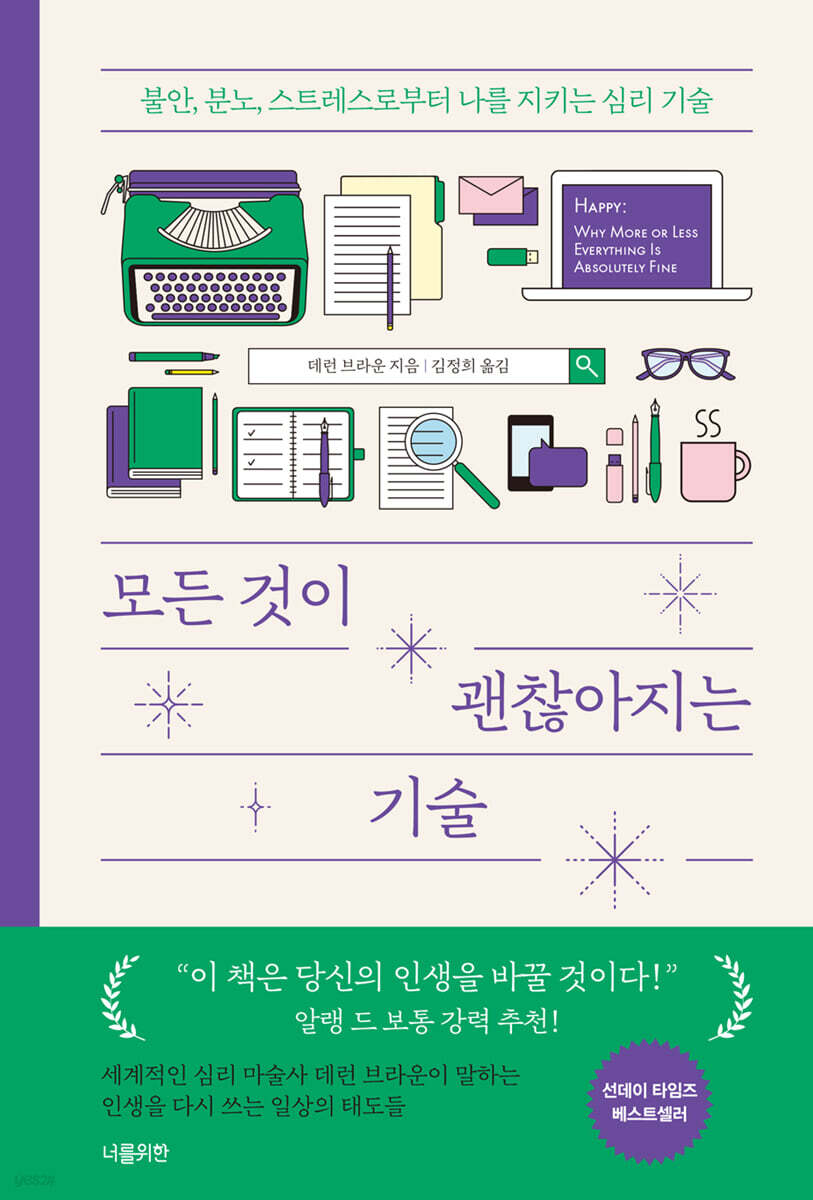
Derren Brown's "Sacrifice," "Push," and "Miracle" are streaming now on Netflix! World-renowned mentalist Derren Brown shares tips for avoiding unhappiness. 'Psychological Techniques' to Reclaim Authorship of My Story Derren Brown, a world-renowned mentalist and psychological magician who uses psychology to control the emotions and behavior of others. In this book, "The Art of Making Everything Alright," he magically unfolds the life wisdom imparted by ancient philosophies judged by the times, such as those of Marcus, Epictetus, and Seneca, and modern psychology, which has been constantly verified, into a single story. In particular, it emphasizes authorship in a way that is not swayed by anxiety, anger, or stress. Only when we take ownership of our lives and begin to consciously and proactively write our own stories can we protect ourselves from all kinds of negative emotions, become masters of our lives, and achieve true happiness. |
- You can preview some of the book's contents.
Preview
index
Chapter 1 | The Pattern of Unhappiness Created
How to Fail in 5 Minutes for a Child with Low Self-Esteem
Placebo effect and confirmation bias
Are you happy now? Or are you unhappy?
Chapter 2 | How to Become Master of Your Life
Find the author
Experiencing Self vs.
The remembering self
If you are being swayed here and there
My story, no one else's
The beginning of the worry of 'living well'
The art of loving life
Chapter 3 | The Misfortune-Avoiding Techniques of Philosophical Geniuses
A concept difficult to define
Edward Norton and Brad Pitt
The most important thing in our hearts
How to Live a Joyful Life Like Epicurus
If it's more painful than ever
Advisor in an era where Tess disappeared
We deserve a better life
Living without God's help
How to become a god yourself
The question, 'What do you do?'
Nietzsche said this
Back to normal misery
We now live in the age of happiness pills.
Chapter 4 | I Have the Right Not to Destroy Myself
I don't need it, but I want it.
Simplify your desires
The psychological power that protects me
Why am I tormenting myself?
We create our own suffering
Reinterpret negative events
Things that make us angry
Chapter 5 | The Moment Everything Becomes Alright
That's nothing
If you try to control your relationships
The outcome is beyond our control.
Irrelevant things outside the line
Fate is sawdust scattered on the floor
If you don't want to become the protagonist of a tragedy
Chapter 6 | Nothing Can Hurt Me
Connect in the best way
Why Stoic Philosophy Still Relevant
Two questions to ask myself
Don't add anything to the first impression
All misfortune lies in the past and future.
How to Get 200% Out of Predictive Meditation
Sometimes you need a third-person perspective
How to live 24 hours a day
Chapter 7 | Practical Advice for Letting Go of Anger
If you end up getting angry again today
The less you worry, the happier you will be.
3 Reasons Why You Should Avoid Anger
Reject anything
Just wait a minute
Don't be swayed by common curiosity.
Question your judgment
Summon your imaginary friends
Don't trust yourself too much
Don't forget that we are the same
Understand your opponent's motivations
Lower your expectations. Empathy, connection, and…
References
How to Fail in 5 Minutes for a Child with Low Self-Esteem
Placebo effect and confirmation bias
Are you happy now? Or are you unhappy?
Chapter 2 | How to Become Master of Your Life
Find the author
Experiencing Self vs.
The remembering self
If you are being swayed here and there
My story, no one else's
The beginning of the worry of 'living well'
The art of loving life
Chapter 3 | The Misfortune-Avoiding Techniques of Philosophical Geniuses
A concept difficult to define
Edward Norton and Brad Pitt
The most important thing in our hearts
How to Live a Joyful Life Like Epicurus
If it's more painful than ever
Advisor in an era where Tess disappeared
We deserve a better life
Living without God's help
How to become a god yourself
The question, 'What do you do?'
Nietzsche said this
Back to normal misery
We now live in the age of happiness pills.
Chapter 4 | I Have the Right Not to Destroy Myself
I don't need it, but I want it.
Simplify your desires
The psychological power that protects me
Why am I tormenting myself?
We create our own suffering
Reinterpret negative events
Things that make us angry
Chapter 5 | The Moment Everything Becomes Alright
That's nothing
If you try to control your relationships
The outcome is beyond our control.
Irrelevant things outside the line
Fate is sawdust scattered on the floor
If you don't want to become the protagonist of a tragedy
Chapter 6 | Nothing Can Hurt Me
Connect in the best way
Why Stoic Philosophy Still Relevant
Two questions to ask myself
Don't add anything to the first impression
All misfortune lies in the past and future.
How to Get 200% Out of Predictive Meditation
Sometimes you need a third-person perspective
How to live 24 hours a day
Chapter 7 | Practical Advice for Letting Go of Anger
If you end up getting angry again today
The less you worry, the happier you will be.
3 Reasons Why You Should Avoid Anger
Reject anything
Just wait a minute
Don't be swayed by common curiosity.
Question your judgment
Summon your imaginary friends
Don't trust yourself too much
Don't forget that we are the same
Understand your opponent's motivations
Lower your expectations. Empathy, connection, and…
References
Into the book
Think about the moment you become independent from your parents.
Until then, we lived like children within the framework of our family.
Then, finally, he comes out of the box as a proud adult.
Finally, independence.
At this time, we are clearly breaking out of an egg, shedding the shell of the past and moving toward a new future, but our unconsciousness ends up reproducing the patterns of the past.
First, find a new role model or authority figure to replace your parents.
Even when we physically leave the confines of our family, we remain children and cannot take a single step forward.
---From "Living Without God's Help"
We cling to unnecessary things.
Every single thing carries the risk of causing us pain or ultimately affecting our well-being.
It might be a stretch—even an undesirable—to follow the Epicurean strategy so strictly that we don't fill our lives with more than the simplest desires, but simply remembering the usefulness of this approach can be helpful.
When you want to buy something that is not absolutely necessary and is too expensive, you can use Epicurean logic to shake off that desire.
Buying such things may make you feel good for a while, but in the end, you will suffer from pain that lasts longer than that short-lived pleasure - the pain of coming home and thinking about it and realizing that you spent money you didn't deserve, the anxiety that it will break or be stolen, and the bitter guilt of admitting that you thought that if you just had that, you would be happy as if you owned the world.
---From "I don't need it, but I want it"
“You don’t go to auditions to get a job.
I'm going to show my acting skills.
You are actors.
So, all you have to do is act.
And come out.
There's power in that attitude… it's a way of saying with your body, 'This is all I can do.'
The decision of who plays that role is beyond your control.
(…) It’s useless to obsess over it… Since I developed this philosophy of life, I’ve never looked back.
“I’ve never been so busy in my life.”
---From "The Results Are Uncontrollable"
Our brains become attached to such objects and present the image to ourselves in a first-person perspective, making the emotions feel more vivid.
So, if you want to distance your mind from a memory or thoughts about an upcoming event, it can be very helpful to visualize the image as if it were captured by a CCTV installed in a corner of the room.
Imagining a scene with yourself in it can help you take a step back from the emotions it evokes.
This social distancing training is also a therapeutic technique used by psychologists today.
People with strong narcissistic tendencies to recall past events more emotionally and from a first-person perspective.
An area in our brain called Brodmann Area 25 is associated with this self-oriented perspective, and when this area is overly active, it can lead to depression.
---From "Sometimes a Third-Person Point of View is Necessary"
We can sometimes be an unshakable rock and at other times a rolling stone.
Anything can be helpful.
Taking this a step further, we can breathe life into the tension of Stoic philosophy with the image of a stone riddled with holes.
This approach, proposed by Martha Nussbaum, is extremely useful.
We no longer intend to confront the provocations of others and the emotions they evoke.
Instead, imagine a comfortable and free relationship with them.
The perforated stone symbolizes strength and unity.
As the water (fate and the influence of others) flows through us, we remain where we are without resistance.
Until then, we lived like children within the framework of our family.
Then, finally, he comes out of the box as a proud adult.
Finally, independence.
At this time, we are clearly breaking out of an egg, shedding the shell of the past and moving toward a new future, but our unconsciousness ends up reproducing the patterns of the past.
First, find a new role model or authority figure to replace your parents.
Even when we physically leave the confines of our family, we remain children and cannot take a single step forward.
---From "Living Without God's Help"
We cling to unnecessary things.
Every single thing carries the risk of causing us pain or ultimately affecting our well-being.
It might be a stretch—even an undesirable—to follow the Epicurean strategy so strictly that we don't fill our lives with more than the simplest desires, but simply remembering the usefulness of this approach can be helpful.
When you want to buy something that is not absolutely necessary and is too expensive, you can use Epicurean logic to shake off that desire.
Buying such things may make you feel good for a while, but in the end, you will suffer from pain that lasts longer than that short-lived pleasure - the pain of coming home and thinking about it and realizing that you spent money you didn't deserve, the anxiety that it will break or be stolen, and the bitter guilt of admitting that you thought that if you just had that, you would be happy as if you owned the world.
---From "I don't need it, but I want it"
“You don’t go to auditions to get a job.
I'm going to show my acting skills.
You are actors.
So, all you have to do is act.
And come out.
There's power in that attitude… it's a way of saying with your body, 'This is all I can do.'
The decision of who plays that role is beyond your control.
(…) It’s useless to obsess over it… Since I developed this philosophy of life, I’ve never looked back.
“I’ve never been so busy in my life.”
---From "The Results Are Uncontrollable"
Our brains become attached to such objects and present the image to ourselves in a first-person perspective, making the emotions feel more vivid.
So, if you want to distance your mind from a memory or thoughts about an upcoming event, it can be very helpful to visualize the image as if it were captured by a CCTV installed in a corner of the room.
Imagining a scene with yourself in it can help you take a step back from the emotions it evokes.
This social distancing training is also a therapeutic technique used by psychologists today.
People with strong narcissistic tendencies to recall past events more emotionally and from a first-person perspective.
An area in our brain called Brodmann Area 25 is associated with this self-oriented perspective, and when this area is overly active, it can lead to depression.
---From "Sometimes a Third-Person Point of View is Necessary"
We can sometimes be an unshakable rock and at other times a rolling stone.
Anything can be helpful.
Taking this a step further, we can breathe life into the tension of Stoic philosophy with the image of a stone riddled with holes.
This approach, proposed by Martha Nussbaum, is extremely useful.
We no longer intend to confront the provocations of others and the emotions they evoke.
Instead, imagine a comfortable and free relationship with them.
The perforated stone symbolizes strength and unity.
As the water (fate and the influence of others) flows through us, we remain where we are without resistance.
---From “Empathy, Bonding, and…”
Publisher's Review
“Reclaim the authorship of my story!”
World-renowned mentalist Derren Brown
How to manage stress and emotions?
World-renowned mentalist and mind magician Derren Brown.
He is no ordinary magician.
He is a very special magician who uses psychology to move people's minds.
For example, suggestion and psychological induction can be used to get people to choose certain cards, to get a man with a fear of heights to voluntarily take a plane, or even to turn an ordinary person into a thief.
How does Derren Brown, who can so easily control the emotions and actions of others, deal with his own stress and anxiety?
His answer is surprisingly simple.
It is authorship.
Only when we consciously and proactively begin to write our own stories can we live as masters of our lives without being swayed by anxiety, anger, and stress.
He says that if you can rewrite 'the story about yourself' with the copyright, you can achieve true happiness.
As Jung pointed out, the heaviest burden a child must bear is the life his parents did not live.
The worst thing is when we decide how we will live based on how others have treated us, and we give control of our lives to those who have wronged us, both in the past and in the present.
(Pages 37-38)
The life that parents were unable to live is the 'story frame' that parents pass on to their children.
The framework of our parents' stories, such as 'You must go to a good university,' 'You must get married and live happily,' and 'You must live a good life,' often does not fit us.
The same goes for other narrative frameworks recommended by schools, teachers, and those around us. Derren Brown argues that these narrative frameworks prevent us from living our true lives, and we become swayed by all sorts of stress, including depression, loneliness, anger, and rage.
So how can we break free from negative emotions? And how can we write our own narrative, within our own framework? The philosophers of the Greco-Roman era can help us answer these questions.
√ How to Simplify Epicurean Desires
“Don’t spoil what you have by desiring what you don’t have.
“You must remember that what you have now is something you once wanted.” (Page 147)
√How to eliminate Marcus's suffering
If you suffer from external things, it is not the external things that are causing you pain, but your own judgment about them.
You have the power within you to stop that judgment immediately and eliminate the suffering.
(Page 155)
√Epictetus's Way to Achieve Peace of Mind
“Therefore, cultivate yourself.
Try to say to every harsh phenomenon, 'You are only a phenomenon, you are not what you appear to be.'
Then review it according to your rules and, above all, discern whether it is something you can control or not.
“If you can’t control it, be prepared to say it has nothing to do with you.” (Page 178)
√Seneca's How to Avoid Today's Misfortune
“Fear and hope do not allow us to adapt to the present, but rather project us into the distant future.
Because of this, the ability to predict the future turns into a curse.
Wild animals run away when danger approaches, and do not worry once they are out of danger.
But we are equally troubled by the past and the future.
Many of the blessings we enjoy harm us, as memories revive the pain of fear and anticipate the future, bringing that pain to a head.
“No one confines their misfortune to the present.” (Page 229)
Derren Brown magically unravels the life wisdom of ancient philosophy, judged by its time, and modern psychology, constantly tested, into a single story.
It contains very realistic advice on how we should live.
And that's not all.
Marcus advised himself to look ahead each morning and imagine meeting unpleasant people.
It may seem a bit off topic, but using predictive meditation, which you can practice right now, can provide valuable hints on how to reclaim your authorship.
“Before you start your day, say to yourself:
“Today too I will meet people who are inquisitive, ungrateful, violent, deceitful, envious, and heartless.” (…) None of them can harm me, none can lead me into wrongdoing, and I cannot be angry or hateful toward them, my own people.” (Main text, pp. 233-234)
Derren Brown also recommends taking just five minutes every morning to visualize what you're going to do that day, what might disappoint you, and what awkward situations you might encounter.
"Is there a risk today that I might do something disappointing and regretful?" "What alternatives can I rehearse in my head so I can easily apply them then?" Anticipatory meditation is a time to anticipate the day with an open mind, embracing mindfulness meditation, commonly known as meditation.
This time will help you reduce the stress and anxiety that recur every day, and get to know yourself and your story frame.
Marcus said, “No one is unhappy because he doesn’t know what other people are thinking.
But he also offered advice: “If we don’t know what we are thinking, we will inevitably become unhappy.”
This means that our own thoughts, or ‘my story frame’, are important.
If we regain our authorship and acquire a daily attitude to rewrite our lives through this book, “The Art of Making Everything Okay,” we will be able to encounter a magical moment in our difficult lives where everything truly becomes okay.
World-renowned mentalist Derren Brown
How to manage stress and emotions?
World-renowned mentalist and mind magician Derren Brown.
He is no ordinary magician.
He is a very special magician who uses psychology to move people's minds.
For example, suggestion and psychological induction can be used to get people to choose certain cards, to get a man with a fear of heights to voluntarily take a plane, or even to turn an ordinary person into a thief.
How does Derren Brown, who can so easily control the emotions and actions of others, deal with his own stress and anxiety?
His answer is surprisingly simple.
It is authorship.
Only when we consciously and proactively begin to write our own stories can we live as masters of our lives without being swayed by anxiety, anger, and stress.
He says that if you can rewrite 'the story about yourself' with the copyright, you can achieve true happiness.
As Jung pointed out, the heaviest burden a child must bear is the life his parents did not live.
The worst thing is when we decide how we will live based on how others have treated us, and we give control of our lives to those who have wronged us, both in the past and in the present.
(Pages 37-38)
The life that parents were unable to live is the 'story frame' that parents pass on to their children.
The framework of our parents' stories, such as 'You must go to a good university,' 'You must get married and live happily,' and 'You must live a good life,' often does not fit us.
The same goes for other narrative frameworks recommended by schools, teachers, and those around us. Derren Brown argues that these narrative frameworks prevent us from living our true lives, and we become swayed by all sorts of stress, including depression, loneliness, anger, and rage.
So how can we break free from negative emotions? And how can we write our own narrative, within our own framework? The philosophers of the Greco-Roman era can help us answer these questions.
√ How to Simplify Epicurean Desires
“Don’t spoil what you have by desiring what you don’t have.
“You must remember that what you have now is something you once wanted.” (Page 147)
√How to eliminate Marcus's suffering
If you suffer from external things, it is not the external things that are causing you pain, but your own judgment about them.
You have the power within you to stop that judgment immediately and eliminate the suffering.
(Page 155)
√Epictetus's Way to Achieve Peace of Mind
“Therefore, cultivate yourself.
Try to say to every harsh phenomenon, 'You are only a phenomenon, you are not what you appear to be.'
Then review it according to your rules and, above all, discern whether it is something you can control or not.
“If you can’t control it, be prepared to say it has nothing to do with you.” (Page 178)
√Seneca's How to Avoid Today's Misfortune
“Fear and hope do not allow us to adapt to the present, but rather project us into the distant future.
Because of this, the ability to predict the future turns into a curse.
Wild animals run away when danger approaches, and do not worry once they are out of danger.
But we are equally troubled by the past and the future.
Many of the blessings we enjoy harm us, as memories revive the pain of fear and anticipate the future, bringing that pain to a head.
“No one confines their misfortune to the present.” (Page 229)
Derren Brown magically unravels the life wisdom of ancient philosophy, judged by its time, and modern psychology, constantly tested, into a single story.
It contains very realistic advice on how we should live.
And that's not all.
Marcus advised himself to look ahead each morning and imagine meeting unpleasant people.
It may seem a bit off topic, but using predictive meditation, which you can practice right now, can provide valuable hints on how to reclaim your authorship.
“Before you start your day, say to yourself:
“Today too I will meet people who are inquisitive, ungrateful, violent, deceitful, envious, and heartless.” (…) None of them can harm me, none can lead me into wrongdoing, and I cannot be angry or hateful toward them, my own people.” (Main text, pp. 233-234)
Derren Brown also recommends taking just five minutes every morning to visualize what you're going to do that day, what might disappoint you, and what awkward situations you might encounter.
"Is there a risk today that I might do something disappointing and regretful?" "What alternatives can I rehearse in my head so I can easily apply them then?" Anticipatory meditation is a time to anticipate the day with an open mind, embracing mindfulness meditation, commonly known as meditation.
This time will help you reduce the stress and anxiety that recur every day, and get to know yourself and your story frame.
Marcus said, “No one is unhappy because he doesn’t know what other people are thinking.
But he also offered advice: “If we don’t know what we are thinking, we will inevitably become unhappy.”
This means that our own thoughts, or ‘my story frame’, are important.
If we regain our authorship and acquire a daily attitude to rewrite our lives through this book, “The Art of Making Everything Okay,” we will be able to encounter a magical moment in our difficult lives where everything truly becomes okay.
GOODS SPECIFICS
- Publication date: November 19, 2022
- Page count, weight, size: 336 pages | 458g | 147*217*17mm
- ISBN13: 9791198035509
- ISBN10: 1198035501
You may also like
카테고리
korean


korean

![GQ KOREA Mark (Monthly): December [2025]](http://librairie.coreenne.fr/cdn/shop/files/8ef265dbbfbf186523ed75ba7319009d.jpg?v=1765340328&width=3840)


