

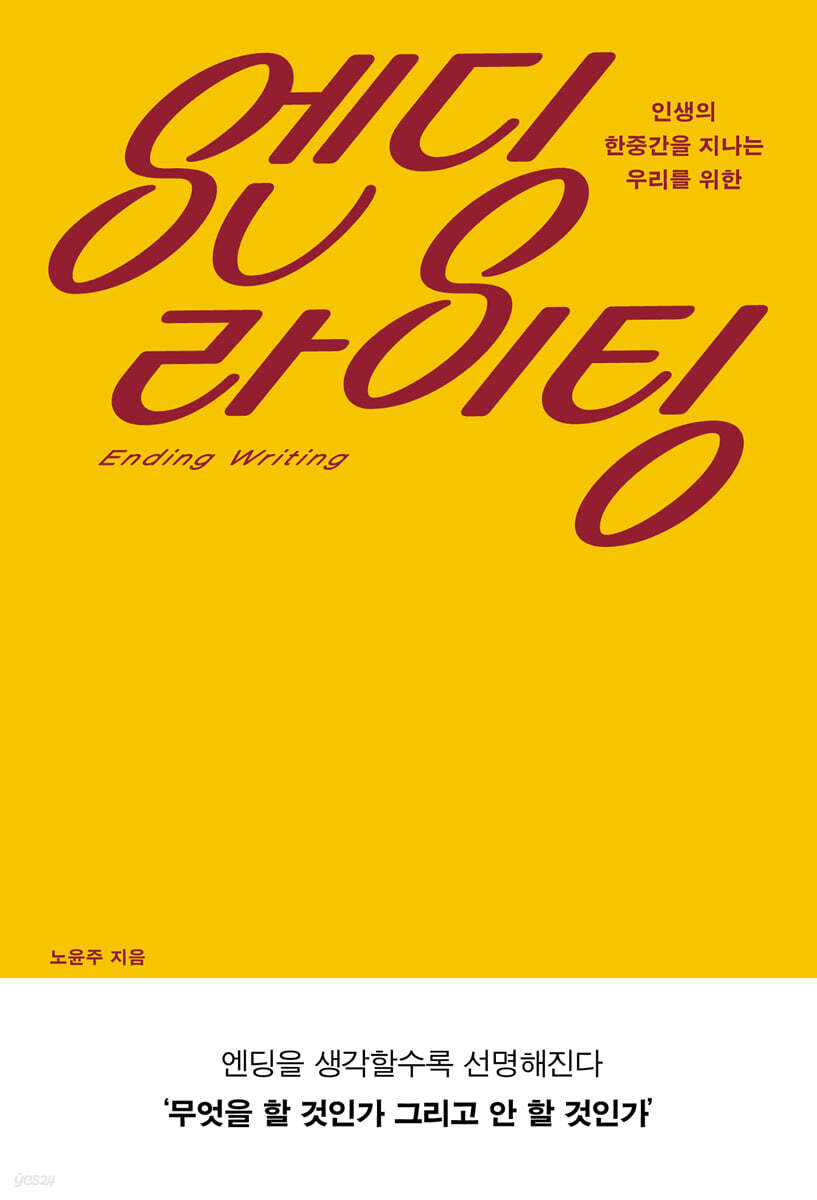
Ending lighting
 |
Description
Book Introduction
When you think of the end in a moment of hesitation
The life you want to live is clearly depicted!
I work hard because I have to get off work, I go for a brisk walk because I know spring and fall are short, I gain strength when I see the sign that I'm almost at my destination, and I cherish every moment by counting down the days of vacation left.
As we live, we can do many things better and more willingly because we keep the end in mind.
Life is the same.
There is nothing more motivating than the thought of death being near to us, to live each day to the fullest.
This book suggests that those who want to find out 'what kind of life I truly want' think about the 'end'.
The author, who has worked as a copywriter and advertising planner for over 20 years, calls the process of thinking about the end of the year, the end of this work, and the end of life "ending writing," and guides through six activities.
As you follow the process, it becomes clear what you should do and what you should not do in the future.
The author, who faced the end of a life halfway through its journey with the decision to quit his job, fearfully but courageously began the second act of his life, is proof of this.
The life you want to live is clearly depicted!
I work hard because I have to get off work, I go for a brisk walk because I know spring and fall are short, I gain strength when I see the sign that I'm almost at my destination, and I cherish every moment by counting down the days of vacation left.
As we live, we can do many things better and more willingly because we keep the end in mind.
Life is the same.
There is nothing more motivating than the thought of death being near to us, to live each day to the fullest.
This book suggests that those who want to find out 'what kind of life I truly want' think about the 'end'.
The author, who has worked as a copywriter and advertising planner for over 20 years, calls the process of thinking about the end of the year, the end of this work, and the end of life "ending writing," and guides through six activities.
As you follow the process, it becomes clear what you should do and what you should not do in the future.
The author, who faced the end of a life halfway through its journey with the decision to quit his job, fearfully but courageously began the second act of his life, is proof of this.
- You can preview some of the book's contents.
Preview
index
Prologue: "Ending Lighting" for Those of Us Passing Through the Midpoint of Life
Ending Lighting Warm-up Exercise: Pressing the 4th floor doesn't mean you die.
Chapter 1 “How do you want to die?”
Episode I I Want to Live and Die Like a Lioness
Ending Wrting I One-Line Definition of My Death with Unfamiliar Words
Chapter 2 “How do you want to live?”
Episode Ⅱ Decision to live as I learned at work
Ending Writing II How & What: Finding Life in Your Favorite Sentences
Chapter 3 “How do you want to be recorded?”
Episode Ⅲ It's Embarrassing, But I Keep Going
Ending Writing III: Writing a 6-Line Obituary with Comparing It to the Life You Adore
Chapter 4 “How do you want to be remembered?”
Episode Ⅳ The Man Who Digged a Well Capriciously
Ending Writing IV: Finding the Pros and Cons of Writing Epitaphs in a Korean Dictionary
Chapter 5 “How do you want to break up?”
Episode V If you know how to make a cup of tea, you can do anything.
Ending Wrting V Funeral Planning with 10 Fill-in-the-Blank Questions
Chapter 6 “How do you want to love?”
Episode Ⅵ I fell in love with a country with many shortcomings.
Ending Wrting Ⅵ Funeral Rehearsal with Funeral Scenario Writing
Ending Talk: Talking about death
Epilogue When will I ever live like this?
Ending Lighting Warm-up Exercise: Pressing the 4th floor doesn't mean you die.
Chapter 1 “How do you want to die?”
Episode I I Want to Live and Die Like a Lioness
Ending Wrting I One-Line Definition of My Death with Unfamiliar Words
Chapter 2 “How do you want to live?”
Episode Ⅱ Decision to live as I learned at work
Ending Writing II How & What: Finding Life in Your Favorite Sentences
Chapter 3 “How do you want to be recorded?”
Episode Ⅲ It's Embarrassing, But I Keep Going
Ending Writing III: Writing a 6-Line Obituary with Comparing It to the Life You Adore
Chapter 4 “How do you want to be remembered?”
Episode Ⅳ The Man Who Digged a Well Capriciously
Ending Writing IV: Finding the Pros and Cons of Writing Epitaphs in a Korean Dictionary
Chapter 5 “How do you want to break up?”
Episode V If you know how to make a cup of tea, you can do anything.
Ending Wrting V Funeral Planning with 10 Fill-in-the-Blank Questions
Chapter 6 “How do you want to love?”
Episode Ⅵ I fell in love with a country with many shortcomings.
Ending Wrting Ⅵ Funeral Rehearsal with Funeral Scenario Writing
Ending Talk: Talking about death
Epilogue When will I ever live like this?
Detailed image
Into the book
So, what's the secret to living well? There's only one secret.
It means living as if today is your 'last day'.
Professor Kim Young-min wrote it like this:
“The texture of life for those who are mindful of mortality is different from that for those who are not.” That’s really cool.
--- 「Prologue¬.
From “Ending Lighting” for those of us passing through the middle of life
Life is the same.
Everyone dies, and I die too.
Not knowing when you might die doesn't mean you'll die in the very distant future.
It's scary, but you can think about it this way.
There is nothing more powerful than the thought that the end of life is near to make us live each day to the fullest.
Only those who have been to the brink of death can truly understand the meaning of life.
Isn't becoming a person proof of that?
--- 「Prologue¬.
From “Ending Lighting” for those of us passing through the middle of life
From the day I joined the company to the day I left, the company gave me many opportunities.
So many opportunities.
When I woke up and went to work, there was an opportunity on my desk, and when I came home from lunch, another opportunity came along.
It also gave me the opportunity to choose which opportunity to take between this one and that one.
A chance to fight, a chance to lose, a chance to win, a chance to lose sleep, a chance I've never seen before, a chance that felt like it, a chance to get cursed at, a chance to curse, a chance to feel upset, a chance to feel heartbroken, a chance to drink, a chance to buy alcohol, a chance to applaud, a chance to be applauded...
Going through those opportunities taught me which of my talents sold and which didn't.
I tried to sell things that weren't selling, and some of them eventually did, but I also learned that there are things that don't make you happy even if they do sell.
It was all thanks to the opportunities the company gave me.
(···) I left the company with things I wanted to sell among the things I had and things I didn't have yet but wanted to sell.
--- 「Episode.
From "Decision to Live as I Learned at Work"
I just wanted to write in English, but I had no intention of learning interpretation and translation.
I just wanted to learn English properly, but I had no intention of sitting in a classroom for six hours on a golden Saturday.
Moreover, the tuition fee was burdensome for a freelancer who had quit his job and whose income was unstable.
Every line of the instructions made me hesitate.
Yes, that's right.
I was hesitating.
If I were working at a company, I would have given up right away without hesitation.
If you take a day off on the weekend to study, you've probably neatly postponed it to some unknown date.
But
Now I'm hesitating.
Hesitating means thinking it's worth a try.
It is an action that contains possibility.
--- 「Episode.
From "It's embarrassing, but I keep going"
But why should I write my own obituary? Across the Pacific, in America, there's an actor named Timothée Chalamet.
If you don't know this brilliant actor, you might want to look him up.
Timmy (whom I've been calling him by his nickname) is famous for really loving clothes and dressing well, but unlike other celebrities, he doesn't get help from a stylist.
A reporter asked why she didn't hire a stylist, as she was rumored to personally choose the clothes she would wear to important events like award ceremonies.
Timmy answers with a smile.
“Why would I leave it to someone else when I can do it best?” I love his answer as much as his acting.
Yes, that's right.
This is why we should write our own obituaries.
My life review, there is no one in the world who can write this as well as I can.
And another thing, it's fun to write my own obituary.
Don't leave this fun stuff in someone else's hands.
--- 「Ending Wrting.
From "Writing a 6-line obituary"
This book started with “The End of Life Copy.”
I've been talking about the topic of death for the past few years.
I wanted to.
But I couldn't find the justification for it myself.
I am not a doctor, an undertaker, or a philosopher.
But I still wanted to try.
As a copywriter, advertising planner, and writer, I wanted to create content that would address this topic well and speak to it in my own way.
I had to think deeply and study a lot.
So I put this off until after I quit my job.
It was an uneasy endeavor, and I didn't know what it would be like, so I wanted to do it in a community that was kind to me.
(···) I prepared the workshop after thinking about it for half a year.
I had read so many books about death that I wanted to stop, but then I realized that what I wanted to talk about was not death, but life.
I went to work on Thursdays in room 501 of the beautiful building in Jeongdong, carrying a story I had long wanted to tell.
--- 「Episode.
From "The Man Who Digs a Well Capriciously"
Unlike the graves in our country, instead of burial mounds, you can see tombstones of various shapes.
In addition to the name and dates of birth and death, the tombstone also had a short phrase engraved on it.
Some of the deceased's accomplishments were written down, while others contained poignant words about what kind of person he was to his family.
Even though it's a short sentence, as I read it, I can imagine what kind of person he was, and just by looking at the font in which the sentence is written, I can picture the person's atmosphere.
I felt like I was in a library with a great view.
--- 「Ending Wrting.
From "Writing Epitaphs"
I guess I expected that volunteering would give me a great sense of accomplishment.
I think I just wanted to sweat and help people in need, then come home and fall into a deep sleep, proud of myself for having had a hard but rewarding day.
But whenever I tried to feel that way, the Mother Teresa House nuns would appear like ghosts and nip it in the bud.
Every time I got ready to charge, he came up to me without a sound, tripped me up, and even covered me with a blanket.
Didn't give me a chance to get tired.
It seemed to convey, silently but loudly, that volunteering is not something special, that it can be done without much effort, and that helping others is part of everyday life.
--- 「Episode.
From "If you know how to make a cup of tea, you can do anything"
In the kitchen of 'That Store in Sajik-dong', there is this writing.
“If you know how to make a cup of chai, you can do anything.” There is only one technique for making a delicious chai: standing in front of the fire and stirring constantly but slowly.
What you can do if you know how to make a cup of tea like that is to tell your colleagues that it's okay, to take it easy, to say thank you for your hard work.
When I become kind to others, my difficult heart becomes my own.
You will be able to do anything.
--- 「Episode.
From "If you know how to make a cup of tea, you can do anything"
Planning a funeral is like saying goodbye to your life up to this day.
Consider planning a funeral at every turning point in your life—leaving a job, starting a new career, starting a family, or resolving a relationship. It can be a better way to reflect on your life than writing a diary.
Start planning your funeral now.
And meet again with life starting tomorrow.
--- 「Ending Wrting.
From "Funeral Planning"
I realized this while walking home, thinking about my conversation with Hyunsu.
It's not the fancy house that makes me feel so good, it's the fancy life.
At my age, I think I shouldn't fall behind even if I can't get ahead.
In my heart, where anxiety has invaded, my self-confidence has been the first to be taken away.
But when I saw Hyunsu, he didn't seem anxious, even though he was in his 50s and living the way he wanted to.
Rather, it looked comfortable.
Even as an adult, I felt a tremendous sense of liberation knowing that I could live my life thinking, "When will I ever get to live like this again?" rather than thinking, "I shouldn't live like this anymore."
As we grow up, we come to realize that simply living differently from others gives courage to the next generation.
I decided to live in my strange and unique home for a while longer.
Fire again
When I come to visit, I try to say this.
When will I ever live like this?
--- 「Epilogue.
From "When will I ever live like this again?"
It's hard to know what you want in life.
But once you know what you want, it's scary to live it out.
《Ending Writing》 is a book about a rather extreme experiment: using the most powerful weapon we are all born with—death—as a tool to live the life we want, despite our fears.
As a wise reader, you will know that living your life like me doesn't just mean quitting your job, moving to Africa, and buying a car.
I don't know what kind of life you want to live.
I just wish we were different.
So I hope that by seeing each other's unique lives, we can gain the courage to live a life that doesn't have to be one-size-fits-all.
It means living as if today is your 'last day'.
Professor Kim Young-min wrote it like this:
“The texture of life for those who are mindful of mortality is different from that for those who are not.” That’s really cool.
--- 「Prologue¬.
From “Ending Lighting” for those of us passing through the middle of life
Life is the same.
Everyone dies, and I die too.
Not knowing when you might die doesn't mean you'll die in the very distant future.
It's scary, but you can think about it this way.
There is nothing more powerful than the thought that the end of life is near to make us live each day to the fullest.
Only those who have been to the brink of death can truly understand the meaning of life.
Isn't becoming a person proof of that?
--- 「Prologue¬.
From “Ending Lighting” for those of us passing through the middle of life
From the day I joined the company to the day I left, the company gave me many opportunities.
So many opportunities.
When I woke up and went to work, there was an opportunity on my desk, and when I came home from lunch, another opportunity came along.
It also gave me the opportunity to choose which opportunity to take between this one and that one.
A chance to fight, a chance to lose, a chance to win, a chance to lose sleep, a chance I've never seen before, a chance that felt like it, a chance to get cursed at, a chance to curse, a chance to feel upset, a chance to feel heartbroken, a chance to drink, a chance to buy alcohol, a chance to applaud, a chance to be applauded...
Going through those opportunities taught me which of my talents sold and which didn't.
I tried to sell things that weren't selling, and some of them eventually did, but I also learned that there are things that don't make you happy even if they do sell.
It was all thanks to the opportunities the company gave me.
(···) I left the company with things I wanted to sell among the things I had and things I didn't have yet but wanted to sell.
--- 「Episode.
From "Decision to Live as I Learned at Work"
I just wanted to write in English, but I had no intention of learning interpretation and translation.
I just wanted to learn English properly, but I had no intention of sitting in a classroom for six hours on a golden Saturday.
Moreover, the tuition fee was burdensome for a freelancer who had quit his job and whose income was unstable.
Every line of the instructions made me hesitate.
Yes, that's right.
I was hesitating.
If I were working at a company, I would have given up right away without hesitation.
If you take a day off on the weekend to study, you've probably neatly postponed it to some unknown date.
But
Now I'm hesitating.
Hesitating means thinking it's worth a try.
It is an action that contains possibility.
--- 「Episode.
From "It's embarrassing, but I keep going"
But why should I write my own obituary? Across the Pacific, in America, there's an actor named Timothée Chalamet.
If you don't know this brilliant actor, you might want to look him up.
Timmy (whom I've been calling him by his nickname) is famous for really loving clothes and dressing well, but unlike other celebrities, he doesn't get help from a stylist.
A reporter asked why she didn't hire a stylist, as she was rumored to personally choose the clothes she would wear to important events like award ceremonies.
Timmy answers with a smile.
“Why would I leave it to someone else when I can do it best?” I love his answer as much as his acting.
Yes, that's right.
This is why we should write our own obituaries.
My life review, there is no one in the world who can write this as well as I can.
And another thing, it's fun to write my own obituary.
Don't leave this fun stuff in someone else's hands.
--- 「Ending Wrting.
From "Writing a 6-line obituary"
This book started with “The End of Life Copy.”
I've been talking about the topic of death for the past few years.
I wanted to.
But I couldn't find the justification for it myself.
I am not a doctor, an undertaker, or a philosopher.
But I still wanted to try.
As a copywriter, advertising planner, and writer, I wanted to create content that would address this topic well and speak to it in my own way.
I had to think deeply and study a lot.
So I put this off until after I quit my job.
It was an uneasy endeavor, and I didn't know what it would be like, so I wanted to do it in a community that was kind to me.
(···) I prepared the workshop after thinking about it for half a year.
I had read so many books about death that I wanted to stop, but then I realized that what I wanted to talk about was not death, but life.
I went to work on Thursdays in room 501 of the beautiful building in Jeongdong, carrying a story I had long wanted to tell.
--- 「Episode.
From "The Man Who Digs a Well Capriciously"
Unlike the graves in our country, instead of burial mounds, you can see tombstones of various shapes.
In addition to the name and dates of birth and death, the tombstone also had a short phrase engraved on it.
Some of the deceased's accomplishments were written down, while others contained poignant words about what kind of person he was to his family.
Even though it's a short sentence, as I read it, I can imagine what kind of person he was, and just by looking at the font in which the sentence is written, I can picture the person's atmosphere.
I felt like I was in a library with a great view.
--- 「Ending Wrting.
From "Writing Epitaphs"
I guess I expected that volunteering would give me a great sense of accomplishment.
I think I just wanted to sweat and help people in need, then come home and fall into a deep sleep, proud of myself for having had a hard but rewarding day.
But whenever I tried to feel that way, the Mother Teresa House nuns would appear like ghosts and nip it in the bud.
Every time I got ready to charge, he came up to me without a sound, tripped me up, and even covered me with a blanket.
Didn't give me a chance to get tired.
It seemed to convey, silently but loudly, that volunteering is not something special, that it can be done without much effort, and that helping others is part of everyday life.
--- 「Episode.
From "If you know how to make a cup of tea, you can do anything"
In the kitchen of 'That Store in Sajik-dong', there is this writing.
“If you know how to make a cup of chai, you can do anything.” There is only one technique for making a delicious chai: standing in front of the fire and stirring constantly but slowly.
What you can do if you know how to make a cup of tea like that is to tell your colleagues that it's okay, to take it easy, to say thank you for your hard work.
When I become kind to others, my difficult heart becomes my own.
You will be able to do anything.
--- 「Episode.
From "If you know how to make a cup of tea, you can do anything"
Planning a funeral is like saying goodbye to your life up to this day.
Consider planning a funeral at every turning point in your life—leaving a job, starting a new career, starting a family, or resolving a relationship. It can be a better way to reflect on your life than writing a diary.
Start planning your funeral now.
And meet again with life starting tomorrow.
--- 「Ending Wrting.
From "Funeral Planning"
I realized this while walking home, thinking about my conversation with Hyunsu.
It's not the fancy house that makes me feel so good, it's the fancy life.
At my age, I think I shouldn't fall behind even if I can't get ahead.
In my heart, where anxiety has invaded, my self-confidence has been the first to be taken away.
But when I saw Hyunsu, he didn't seem anxious, even though he was in his 50s and living the way he wanted to.
Rather, it looked comfortable.
Even as an adult, I felt a tremendous sense of liberation knowing that I could live my life thinking, "When will I ever get to live like this again?" rather than thinking, "I shouldn't live like this anymore."
As we grow up, we come to realize that simply living differently from others gives courage to the next generation.
I decided to live in my strange and unique home for a while longer.
Fire again
When I come to visit, I try to say this.
When will I ever live like this?
--- 「Epilogue.
From "When will I ever live like this again?"
It's hard to know what you want in life.
But once you know what you want, it's scary to live it out.
《Ending Writing》 is a book about a rather extreme experiment: using the most powerful weapon we are all born with—death—as a tool to live the life we want, despite our fears.
As a wise reader, you will know that living your life like me doesn't just mean quitting your job, moving to Africa, and buying a car.
I don't know what kind of life you want to live.
I just wish we were different.
So I hope that by seeing each other's unique lives, we can gain the courage to live a life that doesn't have to be one-size-fits-all.
--- 「Epilogue.
From "When will I ever live like this again?"
From "When will I ever live like this again?"
Publisher's Review
Taking stock of your life during times of worry is something only you can do.
As I've worked hard, there are more things I can do, and I'm at an age where I've realized to some extent what I'm good at and what I'm not.
You can't just blindly jump into your dreams like you used to, but if you put your mind to it, you can achieve the dreams you've forgotten.
For those in this situation, I recommend ending lighting as an opportunity for a 'mid-life check-up.'
Whether you're in your 30s or 60s, it's not too late for anyone who wants to build on their past experiences and envision a new future.
Since only I can truly understand the efforts and earnest wishes I have put in so far, no one else can help me plan the next step in life.
Now, this is why I have to do the ending lighting with my own hands.
Let's prepare for the next with the strength within me.
6 Ending Writings: A Time to Re-Prioritize Your Life by Writing About the End
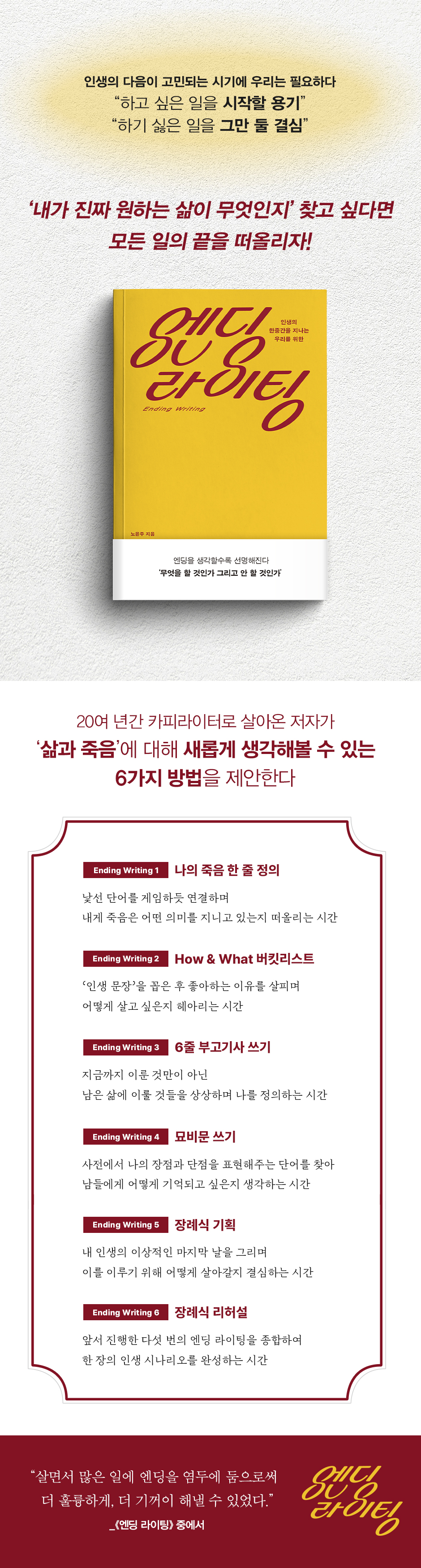
The book suggests ending writing, such as defining my death, how and what bucket list, writing an obituary, writing an epitaph, planning a funeral, and rehearsing a funeral.
After I feel comfortable writing down my thoughts in an interesting way, instead of introducing myself in a flat way like [job, age, where I live], I define myself in a three-dimensional way by bringing in things like [things I'm still scared of but really want to try, the lifestyle I'm aiming for, where I want to live].
Then, you will want to live your one life more colorfully.
Episode 6: The author's story of starting a new life after 20 years of work.
Each chapter is paired with one author's episode and one ending writing workshop.
After reading the author's vivid life story, it is structured to guide you to recall your own story in detail.
The author, who has built a solid career as an employee by working in the advertising industry for over 20 years, decides to quit without any specific plans for his next step.
I leave the company half anxious and half excited, as I am bombarded with questions from people around me about my middle-aged resignation for no clear reason.
Afterwards, he goes on a trip to Africa, a place full of inconveniences, begins studying interpretation and translation, a dream he had put off, and does unpaid volunteer work at a local restaurant.
At the crossroads of 'should I do it or not', I live with more courage than before, thinking that 'hesitating means thinking that it's worth a try'.
Watching episodes from such authors gives me the strength to either quit something or start something new.
Even if it's not a huge change, your attitude towards your repetitive daily life will change.
As I've worked hard, there are more things I can do, and I'm at an age where I've realized to some extent what I'm good at and what I'm not.
You can't just blindly jump into your dreams like you used to, but if you put your mind to it, you can achieve the dreams you've forgotten.
For those in this situation, I recommend ending lighting as an opportunity for a 'mid-life check-up.'
Whether you're in your 30s or 60s, it's not too late for anyone who wants to build on their past experiences and envision a new future.
Since only I can truly understand the efforts and earnest wishes I have put in so far, no one else can help me plan the next step in life.
Now, this is why I have to do the ending lighting with my own hands.
Let's prepare for the next with the strength within me.
6 Ending Writings: A Time to Re-Prioritize Your Life by Writing About the End
The book suggests ending writing, such as defining my death, how and what bucket list, writing an obituary, writing an epitaph, planning a funeral, and rehearsing a funeral.
After I feel comfortable writing down my thoughts in an interesting way, instead of introducing myself in a flat way like [job, age, where I live], I define myself in a three-dimensional way by bringing in things like [things I'm still scared of but really want to try, the lifestyle I'm aiming for, where I want to live].
Then, you will want to live your one life more colorfully.
Episode 6: The author's story of starting a new life after 20 years of work.
Each chapter is paired with one author's episode and one ending writing workshop.
After reading the author's vivid life story, it is structured to guide you to recall your own story in detail.
The author, who has built a solid career as an employee by working in the advertising industry for over 20 years, decides to quit without any specific plans for his next step.
I leave the company half anxious and half excited, as I am bombarded with questions from people around me about my middle-aged resignation for no clear reason.
Afterwards, he goes on a trip to Africa, a place full of inconveniences, begins studying interpretation and translation, a dream he had put off, and does unpaid volunteer work at a local restaurant.
At the crossroads of 'should I do it or not', I live with more courage than before, thinking that 'hesitating means thinking that it's worth a try'.
Watching episodes from such authors gives me the strength to either quit something or start something new.
Even if it's not a huge change, your attitude towards your repetitive daily life will change.
GOODS SPECIFICS
- Date of issue: October 31, 2025
- Page count, weight, size: 232 pages | 264g | 128*188*16mm
- ISBN13: 9791175230170
- ISBN10: 1175230170
You may also like
카테고리
korean


korean

![GQ KOREA Mark (Monthly): December [2025]](http://librairie.coreenne.fr/cdn/shop/files/8ef265dbbfbf186523ed75ba7319009d.jpg?v=1765340328&width=3840)


