

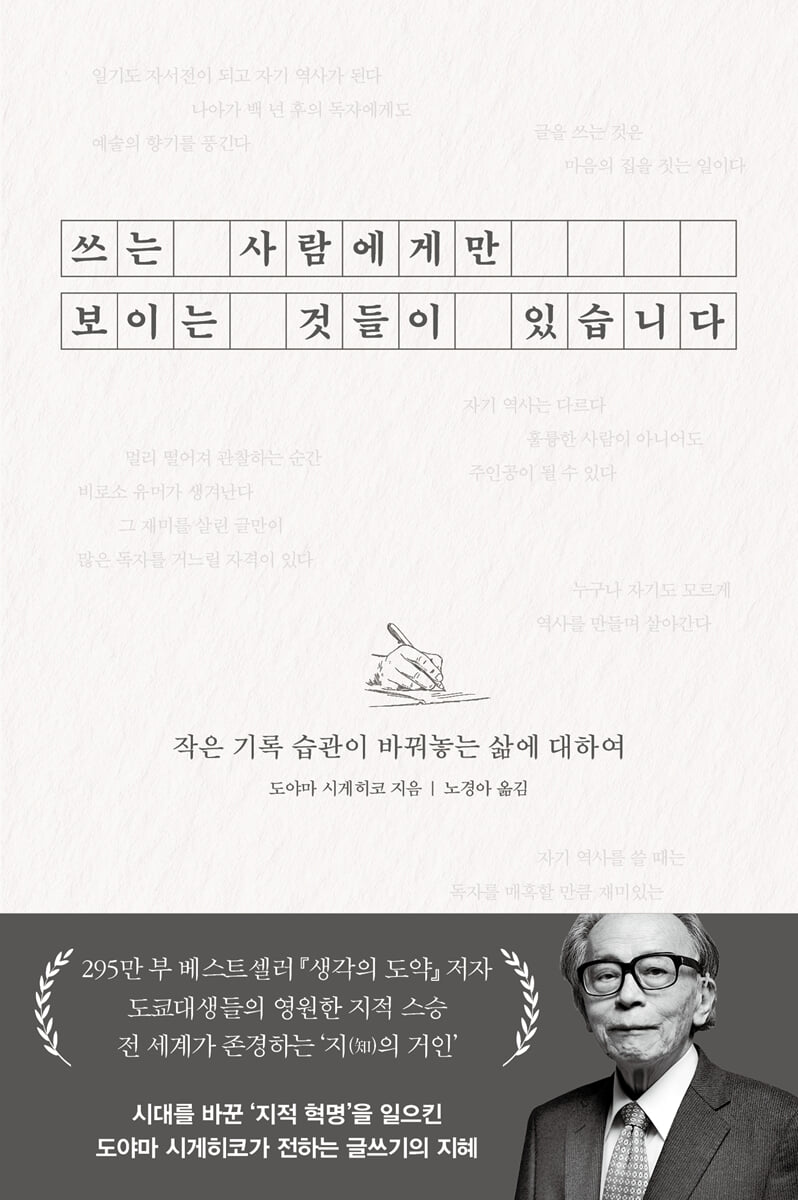
There are things that are only visible to the writer.
 |
Description
Book Introduction
Author of the 2.95 million-copy bestseller "Leap of Thought"
A "giant of knowledge" who led the global humanities for 40 years
University of Tokyo, Kyoto University, Waseda University
The eternal intellectual mentor of students from prestigious Japanese universities
Shigehiko Toyama's Life-Changing Writing Philosophy
Shigehiko Toyama, born in 1923 and passed away in 2020, lived for nearly a century and was revered as a “giant of knowledge” for nearly half a century.
In "There are things that only the writer can see," which he wrote in his later years, he explains the writing method that allows one to reflect on one's life through writing one's own history and to bring out the values hidden within it.
The author's writing philosophy, which contains the humanistic insight that we can discover the direction of our future lives from the records of our past lives, sounds an alarm to our lives, which are like mayflies, working whatever comes our way and not being able to see even an inch ahead.
The master who has led the world's humanities says that wisdom in life is not something you acquire through great study or from a great teacher, but rather something you naturally acquire through the process of calmly organizing your life and writing in a way that not only you but anyone can relate to and enjoy reading.
Through this book, you will discover that seemingly insignificant record-keeping habits, when repeated daily and accumulated, can become milestones in your life.
A "giant of knowledge" who led the global humanities for 40 years
University of Tokyo, Kyoto University, Waseda University
The eternal intellectual mentor of students from prestigious Japanese universities
Shigehiko Toyama's Life-Changing Writing Philosophy
Shigehiko Toyama, born in 1923 and passed away in 2020, lived for nearly a century and was revered as a “giant of knowledge” for nearly half a century.
In "There are things that only the writer can see," which he wrote in his later years, he explains the writing method that allows one to reflect on one's life through writing one's own history and to bring out the values hidden within it.
The author's writing philosophy, which contains the humanistic insight that we can discover the direction of our future lives from the records of our past lives, sounds an alarm to our lives, which are like mayflies, working whatever comes our way and not being able to see even an inch ahead.
The master who has led the world's humanities says that wisdom in life is not something you acquire through great study or from a great teacher, but rather something you naturally acquire through the process of calmly organizing your life and writing in a way that not only you but anyone can relate to and enjoy reading.
Through this book, you will discover that seemingly insignificant record-keeping habits, when repeated daily and accumulated, can become milestones in your life.
- You can preview some of the book's contents.
Preview
index
The Alchemy of Writing: Transforming Everyday Life into History
Part 1
All life is history
A house of the heart built with words
Know me and write
Writing with a change in order
Metaphor of life
Part 2
Smart Reading for Good Writing
Borrowing wisdom from the classics
This is not an autobiography
A life that becomes literature
The most plain diary
Refreshing and lively humor
The lover of my life
The aesthetics of simplicity
The rewards of writing a diary
The Crossroads of Life and History
Capture memories in photos
My old story
A record that becomes flesh and blood
A secret that cannot be told
Death in one line
Part 3
The joy of sharing records
The most mysterious paper
Writing Tools
A life made in one volume
My life that everyone wants to read as I go out
Part 1
All life is history
A house of the heart built with words
Know me and write
Writing with a change in order
Metaphor of life
Part 2
Smart Reading for Good Writing
Borrowing wisdom from the classics
This is not an autobiography
A life that becomes literature
The most plain diary
Refreshing and lively humor
The lover of my life
The aesthetics of simplicity
The rewards of writing a diary
The Crossroads of Life and History
Capture memories in photos
My old story
A record that becomes flesh and blood
A secret that cannot be told
Death in one line
Part 3
The joy of sharing records
The most mysterious paper
Writing Tools
A life made in one volume
My life that everyone wants to read as I go out
Detailed image

Into the book
Even people who have lived half-forgotten themselves seem to want to stop and look back on their past lives when they can catch their breath for a moment.
Introduction: The Alchemy of Writing: Transforming Everyday Life into History (p. 4)
Anyone can write their own history.
But if you want to have a lot of readers, it's natural to write with them in mind.
Writing your own history that others will want to read.
That's the story I want to tell most in this book.
--- p.6-7, from “Introduction: The Alchemy of Writing that Turns Everyday Life into History”
But his own history is different.
You can be a protagonist even if you are not a 'great' person.
There is no reason to be hesitant because you can write your own story.
There is no need to worry about whether it is worth using or not, as it is difficult to judge for yourself.
So anyone can use it comfortably.
In this respect, it is similar to a diary.
--- p.16, from “Part 1: All Life is History”
… humans are beings with hearts, so they usually cannot live on bread alone.
Not everything can be solved with a material called home.
Doesn't a dog have a home too?
Humans can live like humans only when their hearts are rich.
--- p.25, from “Part 1: A House of the Heart Built with Words”
One's own history is an extension of one's diary.
Although it is called an extension, you can create a great self-history in a diary by taking a concise form that trims away the fat rather than adding unnecessary things.
(Omitted) When you write your own history without any intention of showing it to others, it becomes the most natural and excellent writing.
Isn't this the greatest irony of self-expression?
--- p.105, from “Part 2: The Most Plain Diary”
My own history is clearly written for me.
However, the act of writing necessarily involves an object called a reader.
As you write your autobiography, it's easy to forget that fact, so you'll need to be more mindful.
Introduction: The Alchemy of Writing: Transforming Everyday Life into History (p. 4)
Anyone can write their own history.
But if you want to have a lot of readers, it's natural to write with them in mind.
Writing your own history that others will want to read.
That's the story I want to tell most in this book.
--- p.6-7, from “Introduction: The Alchemy of Writing that Turns Everyday Life into History”
But his own history is different.
You can be a protagonist even if you are not a 'great' person.
There is no reason to be hesitant because you can write your own story.
There is no need to worry about whether it is worth using or not, as it is difficult to judge for yourself.
So anyone can use it comfortably.
In this respect, it is similar to a diary.
--- p.16, from “Part 1: All Life is History”
… humans are beings with hearts, so they usually cannot live on bread alone.
Not everything can be solved with a material called home.
Doesn't a dog have a home too?
Humans can live like humans only when their hearts are rich.
--- p.25, from “Part 1: A House of the Heart Built with Words”
One's own history is an extension of one's diary.
Although it is called an extension, you can create a great self-history in a diary by taking a concise form that trims away the fat rather than adding unnecessary things.
(Omitted) When you write your own history without any intention of showing it to others, it becomes the most natural and excellent writing.
Isn't this the greatest irony of self-expression?
--- p.105, from “Part 2: The Most Plain Diary”
My own history is clearly written for me.
However, the act of writing necessarily involves an object called a reader.
As you write your autobiography, it's easy to forget that fact, so you'll need to be more mindful.
--- p.230-231, from "Going Out: My Life That Everyone Wants to Read"
Publisher's Review
“How should we live in this complex and dangerous world?”
Discover the wisdom of writing that turns your past life into history.
Most of us today run from day to day to survive, forgetting ourselves.
Time passes relentlessly in our busy days, and the days of childhood filled with dreams seem to fade away.
We've all had that experience where, when we suddenly stop in our tracks to catch our breath, the days we've lived seem vague and the days ahead feel bleak.
The world forces us to live a life that is set in stone, but it doesn't give us an answer to the question, "How can we live a life like this?"
For many modern people who feel an inexplicable emptiness in the midst of their intense lives, Shigehiko Toyama, the "intellectual of the century" respected worldwide, suggests writing "your own history"—writing that will establish a solid center in your life.
Self-history is literally a history about myself, that is, writing my story.
Unlike autobiographies or biographies, which can only be written by socially respected people, self-history is something that can be written by any ordinary person.
The author argues that even these seemingly ordinary days contain greater wisdom for life.
The author emphasizes that writing one's own history is about consistently recording the small details of daily life to create a great history, and that anyone can write to turn their daily lives into history.
As we write our own history, we first reflect on ourselves, such as what kind of person we are and what our good and bad points are.
Following the author's advice that one should judge from a third-person perspective when writing, I was able to complete my self-image with a calm and composed attitude, and based on that self-image, I was able to look back on the path I had taken.
As I write down the days I thought I had let slip away in a single sentence, my shaken life becomes stronger and I see the direction I should take going forward.
“Go beyond a diary written and read alone and communicate with your story.”
Life-changing writing is even more brilliant when it has readers.
Shigehiko Toyama, who emphasized the "intellectual revolution in everyday life" that anyone can think and act wisely if they have the will, also begins his book "There are things that only those who write can see" in a light and simple way so that anyone can begin writing their own history.
Part 1 provides motivation by explaining the significance and usefulness of the genre of autohistory, and Part 2 introduces various autohistory writings, indirectly revealing the author's writing philosophy that "to write well, you must first read."
Finally, Part 3 introduces several practical techniques that will be helpful to those just starting out in writing.
Throughout the book, the author repeatedly emphasizes the importance of considering the reader in any piece of writing, a point often overlooked by beginning writers.
Even if it is a personal history that contains my story, it is difficult to discover the true value of life if I write something that only satisfies me.
Emphasizing that only writing that is interesting and informative when read by others will be beneficial to you, the author, a renowned doctor of literature, introduces carefully selected works in his own historical genre to help you complete writing that "everyone wants to read."
Although self-history is still an unfamiliar genre to us, it is one that more and more people will seek out as time goes by.
In these times when aging gracefully is more important than ever, the writing philosophy of Shigehiko Toyama, the "sage of the century," who lived a wise life for nearly a century before passing away, is the most necessary teaching.
I hope that through this book, you can look back on the days you have lived and discover milestones for the days to come.
Discover the wisdom of writing that turns your past life into history.
Most of us today run from day to day to survive, forgetting ourselves.
Time passes relentlessly in our busy days, and the days of childhood filled with dreams seem to fade away.
We've all had that experience where, when we suddenly stop in our tracks to catch our breath, the days we've lived seem vague and the days ahead feel bleak.
The world forces us to live a life that is set in stone, but it doesn't give us an answer to the question, "How can we live a life like this?"
For many modern people who feel an inexplicable emptiness in the midst of their intense lives, Shigehiko Toyama, the "intellectual of the century" respected worldwide, suggests writing "your own history"—writing that will establish a solid center in your life.
Self-history is literally a history about myself, that is, writing my story.
Unlike autobiographies or biographies, which can only be written by socially respected people, self-history is something that can be written by any ordinary person.
The author argues that even these seemingly ordinary days contain greater wisdom for life.
The author emphasizes that writing one's own history is about consistently recording the small details of daily life to create a great history, and that anyone can write to turn their daily lives into history.
As we write our own history, we first reflect on ourselves, such as what kind of person we are and what our good and bad points are.
Following the author's advice that one should judge from a third-person perspective when writing, I was able to complete my self-image with a calm and composed attitude, and based on that self-image, I was able to look back on the path I had taken.
As I write down the days I thought I had let slip away in a single sentence, my shaken life becomes stronger and I see the direction I should take going forward.
“Go beyond a diary written and read alone and communicate with your story.”
Life-changing writing is even more brilliant when it has readers.
Shigehiko Toyama, who emphasized the "intellectual revolution in everyday life" that anyone can think and act wisely if they have the will, also begins his book "There are things that only those who write can see" in a light and simple way so that anyone can begin writing their own history.
Part 1 provides motivation by explaining the significance and usefulness of the genre of autohistory, and Part 2 introduces various autohistory writings, indirectly revealing the author's writing philosophy that "to write well, you must first read."
Finally, Part 3 introduces several practical techniques that will be helpful to those just starting out in writing.
Throughout the book, the author repeatedly emphasizes the importance of considering the reader in any piece of writing, a point often overlooked by beginning writers.
Even if it is a personal history that contains my story, it is difficult to discover the true value of life if I write something that only satisfies me.
Emphasizing that only writing that is interesting and informative when read by others will be beneficial to you, the author, a renowned doctor of literature, introduces carefully selected works in his own historical genre to help you complete writing that "everyone wants to read."
Although self-history is still an unfamiliar genre to us, it is one that more and more people will seek out as time goes by.
In these times when aging gracefully is more important than ever, the writing philosophy of Shigehiko Toyama, the "sage of the century," who lived a wise life for nearly a century before passing away, is the most necessary teaching.
I hope that through this book, you can look back on the days you have lived and discover milestones for the days to come.
GOODS SPECIFICS
- Date of issue: September 24, 2025
- Page count, weight, size: 232 pages | 286g | 125*188*15mm
- ISBN13: 9791194530664
- ISBN10: 1194530664
You may also like
카테고리
korean


korean

![GQ KOREA Mark (Monthly): December [2025]](http://librairie.coreenne.fr/cdn/shop/files/8ef265dbbfbf186523ed75ba7319009d.jpg?v=1765340328&width=3840)


