

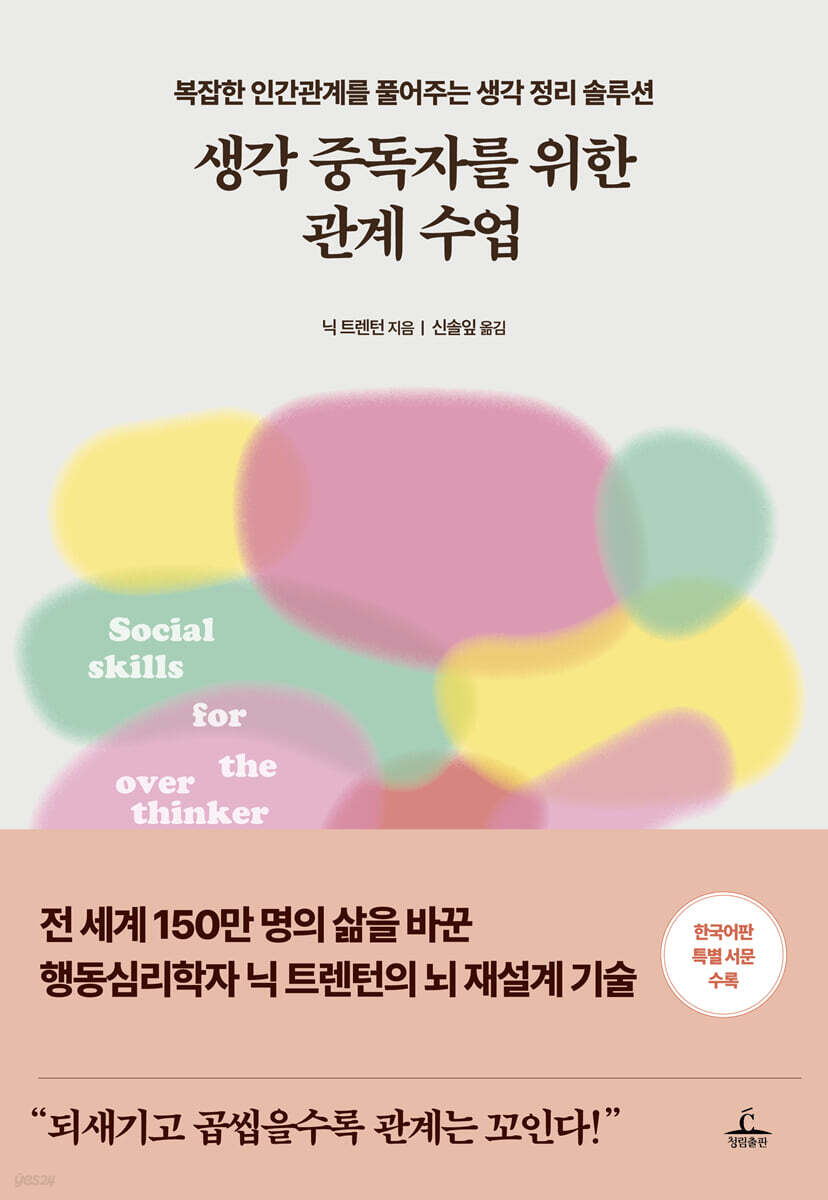
Relationship Classes for Thought Addicts
 |
Description
Book Introduction
★★★ New book by Nick Trenton, bestselling author with 1.5 million copies sold worldwide
“Get rid of the illusion that I am ruining the relationship!”
A brain rewiring class for those who can't sleep because they're overthinking.
Nick Trenton, an Amazon bestselling author with 1.5 million copies sold worldwide, confronts the problem of overthinking that modern people face, and introduces a way for thought addicts to wisely build 'human relationships'.
This new work, “Relationship Class for Thought Addicts,” contains a comprehensive solution to the anxiety problems of modern people, which was addressed in the previous works, “Thought Addiction” and “Fake Anxiety,” and applies it to interpersonal relationships.
Nick Trenton, a behavioral psychologist, draws on his own real-life experience and clear psychological and neuroscientific insights to pinpoint the unique interpersonal patterns of thought addicts, delve into their problems, and propose solutions.
This book provides techniques for relieving anxiety and building healthy relationships, including how to naturally carry on conversations in awkward situations, how to get along with strangers in unfamiliar situations, how to effectively manage social energy, and how to build lasting relationships without feeling burdened.
Now, let's apply the practical techniques in "Relationship Lessons for Thought Addicts" to experience the amazing joy and opportunities that lie within human relationships.
“This book contains small, actionable steps that will help you feel more comfortable in social settings and build the meaningful connections you deserve.” (Page 8, from the special introduction to the Korean edition)
“Get rid of the illusion that I am ruining the relationship!”
A brain rewiring class for those who can't sleep because they're overthinking.
Nick Trenton, an Amazon bestselling author with 1.5 million copies sold worldwide, confronts the problem of overthinking that modern people face, and introduces a way for thought addicts to wisely build 'human relationships'.
This new work, “Relationship Class for Thought Addicts,” contains a comprehensive solution to the anxiety problems of modern people, which was addressed in the previous works, “Thought Addiction” and “Fake Anxiety,” and applies it to interpersonal relationships.
Nick Trenton, a behavioral psychologist, draws on his own real-life experience and clear psychological and neuroscientific insights to pinpoint the unique interpersonal patterns of thought addicts, delve into their problems, and propose solutions.
This book provides techniques for relieving anxiety and building healthy relationships, including how to naturally carry on conversations in awkward situations, how to get along with strangers in unfamiliar situations, how to effectively manage social energy, and how to build lasting relationships without feeling burdened.
Now, let's apply the practical techniques in "Relationship Lessons for Thought Addicts" to experience the amazing joy and opportunities that lie within human relationships.
“This book contains small, actionable steps that will help you feel more comfortable in social settings and build the meaningful connections you deserve.” (Page 8, from the special introduction to the Korean edition)
- You can preview some of the book's contents.
Preview
index
Special Preface to the Korean Edition
Chapter 1: What Happens Inside a Thought Addict's Head
Rumination: the tendency to mull over and reflect on one's own thoughts
The Spotlight Effect: The Distortion of Being Watched
Generalization: Automatic inference based on limited data
Chapter 2: How to Escape from Your Own Complicated Mind
It sparks curiosity
Do the opposite
Challenge your inner critic
Chapter 3: Three Mental Skills That Begin Change
Mastering Your Inner Self Through Visualization
Changing Negative Beliefs Through Role Play
Building positive bonds through random acts of kindness
Chapter 4 Four Behavioral Strategies for Creating Comfortable Relationships
Don't fight overthinking
Overcoming Anxiety with Exposure Therapy
Stop safety-seeking behavior
Distinguishing between social anxiety and social burnout
Chapter 5: Three Principles of Communication That Apply to All Relationships
Find your own way to start a conversation.
Interact with others in an improvisational manner.
The more assertive you are, the less conflict there is.
Summary: Redesigning Your Thinking to Avoid Getting Hurt in Relationships
Chapter 1: What Happens Inside a Thought Addict's Head
Rumination: the tendency to mull over and reflect on one's own thoughts
The Spotlight Effect: The Distortion of Being Watched
Generalization: Automatic inference based on limited data
Chapter 2: How to Escape from Your Own Complicated Mind
It sparks curiosity
Do the opposite
Challenge your inner critic
Chapter 3: Three Mental Skills That Begin Change
Mastering Your Inner Self Through Visualization
Changing Negative Beliefs Through Role Play
Building positive bonds through random acts of kindness
Chapter 4 Four Behavioral Strategies for Creating Comfortable Relationships
Don't fight overthinking
Overcoming Anxiety with Exposure Therapy
Stop safety-seeking behavior
Distinguishing between social anxiety and social burnout
Chapter 5: Three Principles of Communication That Apply to All Relationships
Find your own way to start a conversation.
Interact with others in an improvisational manner.
The more assertive you are, the less conflict there is.
Summary: Redesigning Your Thinking to Avoid Getting Hurt in Relationships
Detailed image

Into the book
I hope this book feels more like the voice of a warm friend, offering encouragement and practical guidance, than a strict guide.
This book contains small, actionable steps that will help you feel more comfortable in social settings and build the meaningful connections you deserve.
---From the “Special Preface to the Korean Edition”
Let me introduce you to Jamie.
He 'hated small talk' and always had difficulty socializing with people.
I found it difficult to make friends, tiring to maintain them, and often wondered if it was all worth it.
Why does he struggle so much more than others? After pondering this question for decades, he finally concluded that it was because he was overly sensitive, introverted, and had low self-esteem.
But in fact, these aren't the real reasons why Jamie has trouble getting along with people.
Let's look at the following scenario and think about what the real cause might be.
---From "Chapter 1: What Happens in the Head of a Thought Addict"
We must accept that it is normal for human relationships to be imperfect.
There is no such thing as flawless communication, and some friction is normal.
We should not give it any significance, considering that it may slip up once in a while.
We need to shift from an attitude of striving for perfection to one of cherishing genuine connections with others.
---From "Chapter 1: What Happens in the Head of a Thought Addict"
If you're experiencing a truly unpleasant social situation, I hope you don't miss the opportunity.
Because it gives you the opportunity to be fully present with your emotions rather than running away from them.
Just be aware of what you are feeling, accept it, and move on.
Even if social situations are sometimes difficult or boring, the key is to not perceive them as situations to be run away from or avoided.
---From "Chapter 2_How to escape from your own complicated mind"
When we give and receive our hearts, when we focus on gratitude and compassion, our minds do not think of threats.
Ultimately, underlying all conversation and all human interaction is the desire to be acknowledged and respected by others.
There is a need for intimacy, understanding, and respect.
Once you understand this, the rest will fall into place quickly.
---From "Chapter 3: Three Mental Techniques That Begin Change"
Actions matter.
Being sociable, confident, calm, and competent is not a feeling, it's an action.
Ultimately, it is social activities, not thoughts, plans, imaginations, or desires, that improve social skills.
This is why it's important to set boundaries around your rumination and not think about ways to break free from it.
---From "Chapter 4: Four Behavioral Strategies for Creating Comfortable Relationships"
Learning to get along comfortably with others means opening yourself up to the amazing world of opportunities that lies within human relationships.
When we let go of fear, we are given the choice to feel countless other things.
Excitement, curiosity, excitement, joy, connection, love, gratitude, pride, comfort… the list goes on.
This book contains small, actionable steps that will help you feel more comfortable in social settings and build the meaningful connections you deserve.
---From the “Special Preface to the Korean Edition”
Let me introduce you to Jamie.
He 'hated small talk' and always had difficulty socializing with people.
I found it difficult to make friends, tiring to maintain them, and often wondered if it was all worth it.
Why does he struggle so much more than others? After pondering this question for decades, he finally concluded that it was because he was overly sensitive, introverted, and had low self-esteem.
But in fact, these aren't the real reasons why Jamie has trouble getting along with people.
Let's look at the following scenario and think about what the real cause might be.
---From "Chapter 1: What Happens in the Head of a Thought Addict"
We must accept that it is normal for human relationships to be imperfect.
There is no such thing as flawless communication, and some friction is normal.
We should not give it any significance, considering that it may slip up once in a while.
We need to shift from an attitude of striving for perfection to one of cherishing genuine connections with others.
---From "Chapter 1: What Happens in the Head of a Thought Addict"
If you're experiencing a truly unpleasant social situation, I hope you don't miss the opportunity.
Because it gives you the opportunity to be fully present with your emotions rather than running away from them.
Just be aware of what you are feeling, accept it, and move on.
Even if social situations are sometimes difficult or boring, the key is to not perceive them as situations to be run away from or avoided.
---From "Chapter 2_How to escape from your own complicated mind"
When we give and receive our hearts, when we focus on gratitude and compassion, our minds do not think of threats.
Ultimately, underlying all conversation and all human interaction is the desire to be acknowledged and respected by others.
There is a need for intimacy, understanding, and respect.
Once you understand this, the rest will fall into place quickly.
---From "Chapter 3: Three Mental Techniques That Begin Change"
Actions matter.
Being sociable, confident, calm, and competent is not a feeling, it's an action.
Ultimately, it is social activities, not thoughts, plans, imaginations, or desires, that improve social skills.
This is why it's important to set boundaries around your rumination and not think about ways to break free from it.
---From "Chapter 4: Four Behavioral Strategies for Creating Comfortable Relationships"
Learning to get along comfortably with others means opening yourself up to the amazing world of opportunities that lies within human relationships.
When we let go of fear, we are given the choice to feel countless other things.
Excitement, curiosity, excitement, joy, connection, love, gratitude, pride, comfort… the list goes on.
---From "Chapter 5: Three Principles of Communication Applicable to All Relationships"
Publisher's Review
“Change your thinking and your relationship will become easier!”
How to calm anxiety and improve interpersonal relationships
Many modern people suffer from excessive thinking due to anxiety, which causes significant disruption in their daily lives as well as interpersonal relationships.
At this time, rather than trying to find the cause of our anxiety and thoughts, we should focus on 'what is maintaining this cycle of thoughts.'
Because only by breaking the vicious cycle of chronic brain dysfunction can we effectively redesign our thinking.
The book also focuses on strategies that can help you let go of old thought patterns and change your thinking.
Chapter 1 categorizes the characteristics that occur in the minds of thought addicts into three categories: rumination, spotlight effect, and generalization, and shows how these manifest in interactions with others.
It allows us to look at the common types of thought addicts from a third-party perspective, such as ‘a person who ruminates on the day and blames himself’, ‘a person who suffers from the distortion that people are watching him’, and ‘a person who mistakenly believes that everyone around him hates him’.
In this process, we become objectively aware of the errors and pitfalls that arise from overthinking, and we gain an "Aha!" insight into what the problem is.
Chapters 2-5 teach practical skills that can be immediately applied in interpersonal relationships.
These include 'visualization', which creates one's own safe space to calm the body and mind, 'random acts of kindness', which lowers hostility and wariness toward others, and 'counteraction', which deliberately takes actions that are opposite to the desired behavior.
It also includes step-by-step instructions for communicating comfortably with people, helping anyone with the will to take on the challenge and make a difference in their relationships.
By trying out the various exercises in "Relationship Classes for Thought Addicts," you will not only understand your own complex inner self but also be able to connect with others more authentically.
Anxiety will naturally disappear, and you will learn what has been holding you back, how to overcome it, and what a successful action plan for the future will be.
“The more you think about it and ruminate on it, the more complicated the relationship becomes!”
A step-by-step mindset that helps you break free from negative patterns and engage in relationships.
Thought addicts often get caught up in negative self-talk driven by anxiety, preventing them from being present in the moment.
Conversely, people who have smooth interpersonal relationships and actively interact with those around them have the characteristic of "immersing themselves in the current situation and emotions as they are," and the author suggests several ways to cultivate this ability.
First, Nick Trenton suggests consciously setting your mind to be curious about everything you encounter.
A mind armed with curiosity redirects energy that was previously directed inward, releases anxiety, and allows us to see the world from a new perspective.
Next, I recommend learning "conversation openers" and blurting them out when you first meet someone to start a conversation.
This is a great way to fully immerse yourself in the other person before your eyes without having to think too much.
If you practice starting conversations naturally rather than thinking deeply about what to say, you will encounter new conversational opportunities.
In addition, the book contains specific guidelines and steps for focusing on relationships. As you take on these challenges one by one, you will notice a significant reduction in stress.
Now, let's take courage and change the way we've been thinking so far and immerse ourselves in the present situation.
You may find yourself feeling proud of yourself for being less nervous and more resourceful than you thought.
You are completely present in the moment and enjoying the time, so you no longer need to dwell on anxiety or ruminate.
“It’s not that I lack social skills, it’s that I think too much.”
How to Use Your Overthinking Advantages to Build Successful Relationships
What if the very traits of thought addicts actually help them communicate effectively with others? Trenton argues that thought addicts excel at the qualities essential for building healthy relationships: authenticity, empathy, and the effort to put others at ease.
So, if you have a little more confidence in expressing your opinion to the world, approaching people and talking to them, you will find that you are a thought addict who can build relationships more comfortably than anyone else.
Building on this foundation, the book provides immediately applicable "mental skills," "behavioral strategies," and "communication principles" using examples that even thought addicts can relate to.
From now on, let's approach the person who seems the loneliest at a gathering and give them a friendly smile and hello.
How about cracking a joke to lighten the mood when a colleague seems flustered during a meeting? Or running an errand for a neighbor with limited mobility on your way out? You'll be able to empathize with and understand the feelings of someone struggling in a relationship better than anyone else, fostering a closer bond.
If you feel you have low self-esteem or lack social skills, it's time to stop your habitual self-criticism, censorship, and safety-seeking behaviors and use the shifting mindset techniques suggested in "Relationship Lessons for Thought Addicts."
You're not socially awkward, you're just overthinking.
How to calm anxiety and improve interpersonal relationships
Many modern people suffer from excessive thinking due to anxiety, which causes significant disruption in their daily lives as well as interpersonal relationships.
At this time, rather than trying to find the cause of our anxiety and thoughts, we should focus on 'what is maintaining this cycle of thoughts.'
Because only by breaking the vicious cycle of chronic brain dysfunction can we effectively redesign our thinking.
The book also focuses on strategies that can help you let go of old thought patterns and change your thinking.
Chapter 1 categorizes the characteristics that occur in the minds of thought addicts into three categories: rumination, spotlight effect, and generalization, and shows how these manifest in interactions with others.
It allows us to look at the common types of thought addicts from a third-party perspective, such as ‘a person who ruminates on the day and blames himself’, ‘a person who suffers from the distortion that people are watching him’, and ‘a person who mistakenly believes that everyone around him hates him’.
In this process, we become objectively aware of the errors and pitfalls that arise from overthinking, and we gain an "Aha!" insight into what the problem is.
Chapters 2-5 teach practical skills that can be immediately applied in interpersonal relationships.
These include 'visualization', which creates one's own safe space to calm the body and mind, 'random acts of kindness', which lowers hostility and wariness toward others, and 'counteraction', which deliberately takes actions that are opposite to the desired behavior.
It also includes step-by-step instructions for communicating comfortably with people, helping anyone with the will to take on the challenge and make a difference in their relationships.
By trying out the various exercises in "Relationship Classes for Thought Addicts," you will not only understand your own complex inner self but also be able to connect with others more authentically.
Anxiety will naturally disappear, and you will learn what has been holding you back, how to overcome it, and what a successful action plan for the future will be.
“The more you think about it and ruminate on it, the more complicated the relationship becomes!”
A step-by-step mindset that helps you break free from negative patterns and engage in relationships.
Thought addicts often get caught up in negative self-talk driven by anxiety, preventing them from being present in the moment.
Conversely, people who have smooth interpersonal relationships and actively interact with those around them have the characteristic of "immersing themselves in the current situation and emotions as they are," and the author suggests several ways to cultivate this ability.
First, Nick Trenton suggests consciously setting your mind to be curious about everything you encounter.
A mind armed with curiosity redirects energy that was previously directed inward, releases anxiety, and allows us to see the world from a new perspective.
Next, I recommend learning "conversation openers" and blurting them out when you first meet someone to start a conversation.
This is a great way to fully immerse yourself in the other person before your eyes without having to think too much.
If you practice starting conversations naturally rather than thinking deeply about what to say, you will encounter new conversational opportunities.
In addition, the book contains specific guidelines and steps for focusing on relationships. As you take on these challenges one by one, you will notice a significant reduction in stress.
Now, let's take courage and change the way we've been thinking so far and immerse ourselves in the present situation.
You may find yourself feeling proud of yourself for being less nervous and more resourceful than you thought.
You are completely present in the moment and enjoying the time, so you no longer need to dwell on anxiety or ruminate.
“It’s not that I lack social skills, it’s that I think too much.”
How to Use Your Overthinking Advantages to Build Successful Relationships
What if the very traits of thought addicts actually help them communicate effectively with others? Trenton argues that thought addicts excel at the qualities essential for building healthy relationships: authenticity, empathy, and the effort to put others at ease.
So, if you have a little more confidence in expressing your opinion to the world, approaching people and talking to them, you will find that you are a thought addict who can build relationships more comfortably than anyone else.
Building on this foundation, the book provides immediately applicable "mental skills," "behavioral strategies," and "communication principles" using examples that even thought addicts can relate to.
From now on, let's approach the person who seems the loneliest at a gathering and give them a friendly smile and hello.
How about cracking a joke to lighten the mood when a colleague seems flustered during a meeting? Or running an errand for a neighbor with limited mobility on your way out? You'll be able to empathize with and understand the feelings of someone struggling in a relationship better than anyone else, fostering a closer bond.
If you feel you have low self-esteem or lack social skills, it's time to stop your habitual self-criticism, censorship, and safety-seeking behaviors and use the shifting mindset techniques suggested in "Relationship Lessons for Thought Addicts."
You're not socially awkward, you're just overthinking.
GOODS SPECIFICS
- Date of issue: July 9, 2025
- Page count, weight, size: 224 pages | 390g | 145*210*15mm
- ISBN13: 9788935214761
- ISBN10: 8935214760
You may also like
카테고리
korean


korean

![GQ KOREA Mark (Monthly): December [2025]](http://librairie.coreenne.fr/cdn/shop/files/8ef265dbbfbf186523ed75ba7319009d.jpg?v=1765340328&width=3840)


