

I only study to pass the exam no matter what.
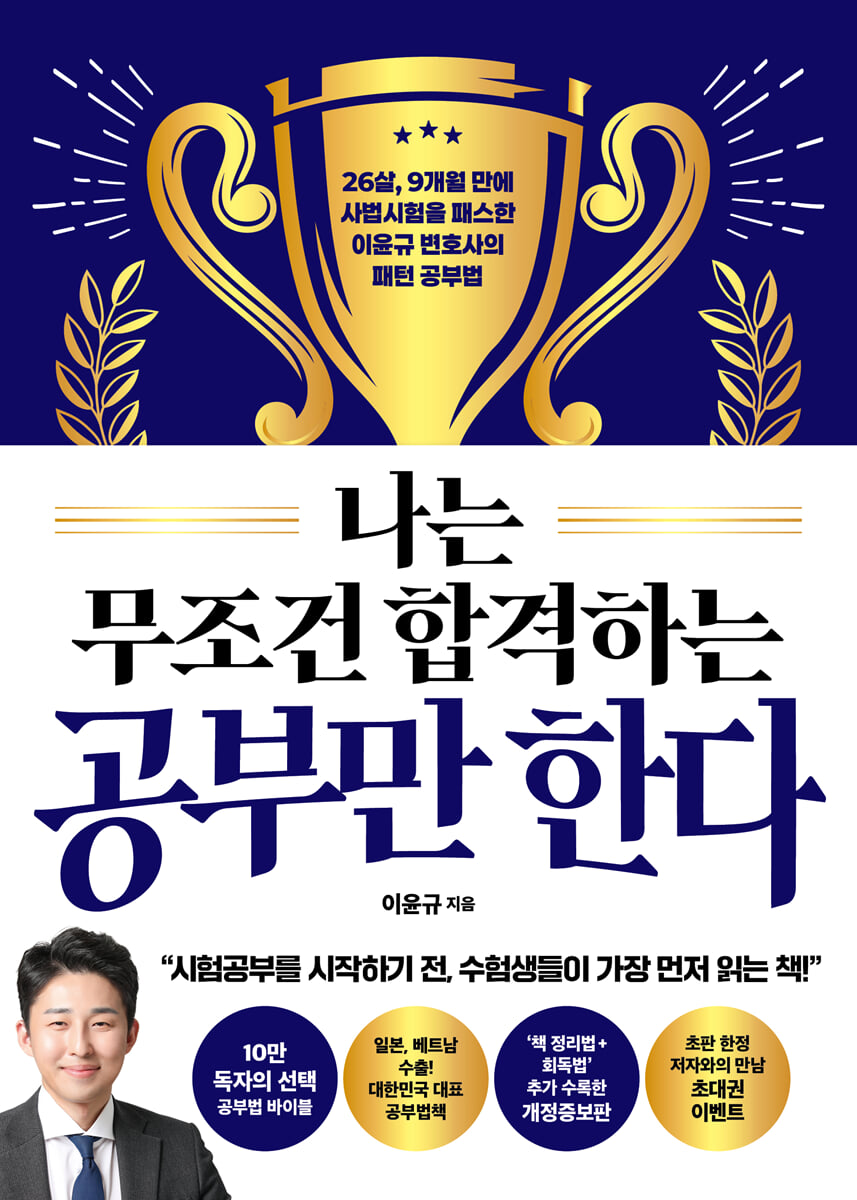 |
Description
Book Introduction
Before starting to study for the exam, the first thing that test takers look for is
Attorney Lee Yoon-gyu's Pattern Study Method
Based on the verified content from operating 430,000 YouTube and study method societies
We're back with a more detailed and evolved study method!
Attorney Lee Yoon-gyu, who runs the study method YouTube channel 'DreamSchool Attorney Lee Yoon-gyu' and serves as co-chairman of the Study Method Society, is a leading expert in the field of study methods.
He published "I Only Study to Pass the Exam", which summarizes his study know-how based on his experience of passing the bar exam in just 9 months at the age of 26.
This book systematically contains strategic study methods aimed at 'passing', and has been loved by 100,000 readers. It has also been exported to Japan, Taiwan, and Vietnam, and has become Korea's representative study guide.
This revised and expanded edition, published thanks to the support of readers, is based on the study methods researched and verified by the author, who formed the Study Method Society after the first edition, in collaboration with experts in learning skills (a branch of educational psychology), field educators, and mental health professionals. This has been further refined through a thorough review of the entire book and revisions and additions to some of the content.
In particular, by adding 'book organization methods' and 'reading methods', which test takers were most curious about, we provide a systematic study method that is easy to apply in real life.
We will provide a more in-depth, practical study guide for all those who wish to overcome the hurdle of exams and achieve their dreams.
Attorney Lee Yoon-gyu's Pattern Study Method
Based on the verified content from operating 430,000 YouTube and study method societies
We're back with a more detailed and evolved study method!
Attorney Lee Yoon-gyu, who runs the study method YouTube channel 'DreamSchool Attorney Lee Yoon-gyu' and serves as co-chairman of the Study Method Society, is a leading expert in the field of study methods.
He published "I Only Study to Pass the Exam", which summarizes his study know-how based on his experience of passing the bar exam in just 9 months at the age of 26.
This book systematically contains strategic study methods aimed at 'passing', and has been loved by 100,000 readers. It has also been exported to Japan, Taiwan, and Vietnam, and has become Korea's representative study guide.
This revised and expanded edition, published thanks to the support of readers, is based on the study methods researched and verified by the author, who formed the Study Method Society after the first edition, in collaboration with experts in learning skills (a branch of educational psychology), field educators, and mental health professionals. This has been further refined through a thorough review of the entire book and revisions and additions to some of the content.
In particular, by adding 'book organization methods' and 'reading methods', which test takers were most curious about, we provide a systematic study method that is easy to apply in real life.
We will provide a more in-depth, practical study guide for all those who wish to overcome the hurdle of exams and achieve their dreams.
- You can preview some of the book's contents.
Preview
index
Preface to the Revised Edition
To begin with, everyone who lives in Korea studies for their dreams at least once.
Chapter 1: People Who Get Things Done Think Differently: Motivation
(Motivation)
Studying hard won't get you through.
I chose to study to be happy
The source of study lies in the allure of dreams.
Strategic self-interest is necessary
How to start with confidence
Chapter 2: Plan Like a Successful Candidate: Selecting and Planning Textbooks
(Analysis of passing scores, selection of textbooks)
There are only three types of exams in South Korea.
The first thing I did was collect passing scores.
Find the best path to success
The kinder the book, the weaker the weapon
Which book should I choose?
(plan)
You have to throw away your points to pass.
The three stages of study: planning, executing, and checking.
How to make an effective study plan
Why Plan on Two Tracks
Chapter 3: Studying to Memorize Entire Books: Understanding and Memorization
(Input)
Studying is divided into input and output.
Define the scope of your study
Two tools to put knowledge into your head
Know the answer and look at the book
The order in which books are read for exam study
Why I always carry a copy of the table of contents with me
Let's start with the concept and system_ The basics of input
Create a folder in your head_ Leveling
Connect the table of contents to understand the story_ Imaging
Adding Flesh to the Basic Knowledge skeleton_ Trimming
Connect the Knowledge_Coloring
10-minute review that will be imprinted on your brain_ Loading
Timing of review that determines passing
Distinguish between understanding and memorization
The End of Studying: How to Organize Your Books
Organizing books is reorganizing knowledge according to my standards.
The Key to Organizing Your Books for Passing
Be addicted to the feeling of accomplishment
The skill of listening to lectures that no one teaches you
Avoid this study method
Group study: Should I do it or not?
Stay away from stopwatches
(Mental management)
Self-management is like an athlete
Characteristics of people who live long lives
Attitude that invites passing
My mental health management secret
Everything is set, so it's free
Even studying has priorities
If you suffer from insomnia
If you are someone who has a hard time waking up in the morning
The secret to studying on just three hours of sleep a day
How to deal with feelings of inferiority that suddenly arise
Don't be 'optimistic', be 'positive'
The present me can change everything
Tough times are just another reason to be strong.
Why I Wasn't Stressed: The Law of Total Suffering
Today's painful day is just a line in the passing story.
If you push the limits little by little, you will become a monster.
To be stingy with rest is to be stingy with study.
Time and Mental Management Tips for Office Workers
Chapter 4: How to Find the Answer in 1 Second: Problem Solving
(Output)
Distinguish between training and practice
Use your brain efficiently by moving in two directions.
Problem-solving method that shows the answer without having to look for it_ Multiple choice
A problem-solving method that allows you to write fluently without having to memorize everything_ Descriptive
Problem-solving method of taking out and combining the right items at the right time_ Oral type
A one-volume method to fill in the gaps in your knowledge
Explain like a daily lecturer
Why Creating a Wrong Answer Notebook Doesn't Increase Your Score
Let's take the mock exam knowing why we're taking it.
Last-minute preparation, reading method
The 5 Steps to Passing the Exam That No One Tells You About
The disaster that occurs when you only read
The meaning of the saying that studying ends with past exam questions
(Maintain mental health)
Time management techniques that use the same amount of time twice as densely
'Expected pain' is less painful
A slump is proof that you worked hard.
You have to face your anxiety to get rid of it.
Let's create a psychological mouse hole
Chapter 5: Last-Minute Turnarounds: Testing Strategies
(Testing Strategy)
Things to do one month before the exam
Tips for preparing for the exam in a short period of time
Think about what to eat and what to wear_ Macro Routine
Things to do the day before the exam
Test Day 1_ Techniques for Solving Multiple Choice Questions
Test Day 2_ Skills for Solving Descriptive Questions
If you have distracting thoughts in the exam room
The sooner you give up, the sooner you pass.
Take the exam like you've already passed.
In conclusion, what you truly wish for will come true.
Appendix: Success Stories That Guided My Exam Preparation
To begin with, everyone who lives in Korea studies for their dreams at least once.
Chapter 1: People Who Get Things Done Think Differently: Motivation
(Motivation)
Studying hard won't get you through.
I chose to study to be happy
The source of study lies in the allure of dreams.
Strategic self-interest is necessary
How to start with confidence
Chapter 2: Plan Like a Successful Candidate: Selecting and Planning Textbooks
(Analysis of passing scores, selection of textbooks)
There are only three types of exams in South Korea.
The first thing I did was collect passing scores.
Find the best path to success
The kinder the book, the weaker the weapon
Which book should I choose?
(plan)
You have to throw away your points to pass.
The three stages of study: planning, executing, and checking.
How to make an effective study plan
Why Plan on Two Tracks
Chapter 3: Studying to Memorize Entire Books: Understanding and Memorization
(Input)
Studying is divided into input and output.
Define the scope of your study
Two tools to put knowledge into your head
Know the answer and look at the book
The order in which books are read for exam study
Why I always carry a copy of the table of contents with me
Let's start with the concept and system_ The basics of input
Create a folder in your head_ Leveling
Connect the table of contents to understand the story_ Imaging
Adding Flesh to the Basic Knowledge skeleton_ Trimming
Connect the Knowledge_Coloring
10-minute review that will be imprinted on your brain_ Loading
Timing of review that determines passing
Distinguish between understanding and memorization
The End of Studying: How to Organize Your Books
Organizing books is reorganizing knowledge according to my standards.
The Key to Organizing Your Books for Passing
Be addicted to the feeling of accomplishment
The skill of listening to lectures that no one teaches you
Avoid this study method
Group study: Should I do it or not?
Stay away from stopwatches
(Mental management)
Self-management is like an athlete
Characteristics of people who live long lives
Attitude that invites passing
My mental health management secret
Everything is set, so it's free
Even studying has priorities
If you suffer from insomnia
If you are someone who has a hard time waking up in the morning
The secret to studying on just three hours of sleep a day
How to deal with feelings of inferiority that suddenly arise
Don't be 'optimistic', be 'positive'
The present me can change everything
Tough times are just another reason to be strong.
Why I Wasn't Stressed: The Law of Total Suffering
Today's painful day is just a line in the passing story.
If you push the limits little by little, you will become a monster.
To be stingy with rest is to be stingy with study.
Time and Mental Management Tips for Office Workers
Chapter 4: How to Find the Answer in 1 Second: Problem Solving
(Output)
Distinguish between training and practice
Use your brain efficiently by moving in two directions.
Problem-solving method that shows the answer without having to look for it_ Multiple choice
A problem-solving method that allows you to write fluently without having to memorize everything_ Descriptive
Problem-solving method of taking out and combining the right items at the right time_ Oral type
A one-volume method to fill in the gaps in your knowledge
Explain like a daily lecturer
Why Creating a Wrong Answer Notebook Doesn't Increase Your Score
Let's take the mock exam knowing why we're taking it.
Last-minute preparation, reading method
The 5 Steps to Passing the Exam That No One Tells You About
The disaster that occurs when you only read
The meaning of the saying that studying ends with past exam questions
(Maintain mental health)
Time management techniques that use the same amount of time twice as densely
'Expected pain' is less painful
A slump is proof that you worked hard.
You have to face your anxiety to get rid of it.
Let's create a psychological mouse hole
Chapter 5: Last-Minute Turnarounds: Testing Strategies
(Testing Strategy)
Things to do one month before the exam
Tips for preparing for the exam in a short period of time
Think about what to eat and what to wear_ Macro Routine
Things to do the day before the exam
Test Day 1_ Techniques for Solving Multiple Choice Questions
Test Day 2_ Skills for Solving Descriptive Questions
If you have distracting thoughts in the exam room
The sooner you give up, the sooner you pass.
Take the exam like you've already passed.
In conclusion, what you truly wish for will come true.
Appendix: Success Stories That Guided My Exam Preparation
Detailed image

Into the book
Any student needs strategic selfishness.
Otherwise, you will end up sacrificing your study time or wasting your energy because you are swayed by circumstances and requests from those around you.
At least while studying for the exam, I must thoroughly focus on myself and act accordingly.
Aren't people who are constantly shaken and lose their dreams and happiness at any given moment truly 'selfish and bad' people who make those around them unhappy?
--- From "Chapter 1: Those who ultimately succeed have a different way of thinking"
The reason I searched for success stories was because I thought I could find study methods and habits for passing the exam in the stories, and that they were already 'proven methods'.
The method that 'many people' say is good may not be the study method that will help you pass the exam.
The methods that 'successful people' talk about are the ones that have been statistically and empirically proven to be successful.
In fact, among the collected essays, there were similar commonalities and certain patterns in the study methods and habits of those who passed the exam.
--- From "Chapter 2: Plan Like a Successful Applicant"
If you experience the life of a test taker, you will realize that it is very difficult to maintain the motivation and stamina you had when you started.
Some days, I feel so heartbroken that I can't even read a single sentence, and some days, I'm so sick that just sitting down is painful.
Taking these points into account, I planned for two scenarios, one best-case scenario and one worst-case scenario, with maximum and minimum scenarios. I created PLAN A and PLAN B.
--- From "Chapter 2: Plan Like a Successful Applicant"
Let's talk about structured reading in earnest.
The key to structured reading is to create a logical hierarchical relationship between the contents.
This task is defined as leveling in the sense of dividing the layers of content.
The key to leveling is to read the content in order from the highest level to the lowest level.
First, let's read the book with the table of contents organized at the highest level and the copied table of contents next to us.
At this point, don't try to understand the meaning of the book.
You should not read the contents, but only the 'table of contents'.
If this is your first time reading this book and you are not sure what the topic is about, you can refer to the text below.
However, this leveling should be considered as a preliminary step to efficiently acquire knowledge.
The real acquisition of knowledge comes next.
--- From "Chapter 3: Study Methods for Memorizing Entire Books"
Another point of organizing books is to 'compress' the information.
So, how should we compress the contents of a book? There are only two things to compress.
The first is the ‘reason’.
If you organize your book by underlining, you should be able to recall the reason for the underlined part when you look at it.
This has to do with the principle of memory.
Long-term memory is formed only when I can break down new information into my existing knowledge, and is then strengthened through the process of breaking it down and reassembling it.
--- From "Chapter 3: Study Methods for Memorizing Entire Books"
In the third stage of reading, you should not just read the book, but also solve problems and review your existing knowledge.
Let me explain with an example.
If the book explains that "zebras are striped animals," but the workbook explains that "zebras are herbivores," then these two facts can be combined to create a complete knowledge that "zebras are striped herbivores."
The third step is the process of reading the book while appropriately supplementing information that is not written in the book or correcting unclear or incorrect parts.
Therefore, in the third stage of reading, you should not read the book right away, but rather try to solve the problems proactively.
I need to read while thinking about what questions appear among the material I studied, what parts are being asked, how the book addresses these, and how I need to change my thinking to understand the book, including the questions.
--- From "Chapter 4: How to Find the Answer in 1 Second"
In fact, I was taking the first period constitutional exam, and about 40 minutes later, I realized that the exam I was taking was not practice, but the real thing, and I panicked.
My arms began to shake so much that it was noticeable.
I was so badly hurt that I couldn't write at all, even if I held my right arm with my left hand.
(Omitted) After repeating that a few times, my mind became at ease.
I thought about what to do next, but there was no other way than to relax my arms.
So I bit my arm.
Fortunately, the shaking in my arms stopped and I was able to finish the test without any problems.
After I safely passed the first period, the glory of passing the exam came to me.
Otherwise, you will end up sacrificing your study time or wasting your energy because you are swayed by circumstances and requests from those around you.
At least while studying for the exam, I must thoroughly focus on myself and act accordingly.
Aren't people who are constantly shaken and lose their dreams and happiness at any given moment truly 'selfish and bad' people who make those around them unhappy?
--- From "Chapter 1: Those who ultimately succeed have a different way of thinking"
The reason I searched for success stories was because I thought I could find study methods and habits for passing the exam in the stories, and that they were already 'proven methods'.
The method that 'many people' say is good may not be the study method that will help you pass the exam.
The methods that 'successful people' talk about are the ones that have been statistically and empirically proven to be successful.
In fact, among the collected essays, there were similar commonalities and certain patterns in the study methods and habits of those who passed the exam.
--- From "Chapter 2: Plan Like a Successful Applicant"
If you experience the life of a test taker, you will realize that it is very difficult to maintain the motivation and stamina you had when you started.
Some days, I feel so heartbroken that I can't even read a single sentence, and some days, I'm so sick that just sitting down is painful.
Taking these points into account, I planned for two scenarios, one best-case scenario and one worst-case scenario, with maximum and minimum scenarios. I created PLAN A and PLAN B.
--- From "Chapter 2: Plan Like a Successful Applicant"
Let's talk about structured reading in earnest.
The key to structured reading is to create a logical hierarchical relationship between the contents.
This task is defined as leveling in the sense of dividing the layers of content.
The key to leveling is to read the content in order from the highest level to the lowest level.
First, let's read the book with the table of contents organized at the highest level and the copied table of contents next to us.
At this point, don't try to understand the meaning of the book.
You should not read the contents, but only the 'table of contents'.
If this is your first time reading this book and you are not sure what the topic is about, you can refer to the text below.
However, this leveling should be considered as a preliminary step to efficiently acquire knowledge.
The real acquisition of knowledge comes next.
--- From "Chapter 3: Study Methods for Memorizing Entire Books"
Another point of organizing books is to 'compress' the information.
So, how should we compress the contents of a book? There are only two things to compress.
The first is the ‘reason’.
If you organize your book by underlining, you should be able to recall the reason for the underlined part when you look at it.
This has to do with the principle of memory.
Long-term memory is formed only when I can break down new information into my existing knowledge, and is then strengthened through the process of breaking it down and reassembling it.
--- From "Chapter 3: Study Methods for Memorizing Entire Books"
In the third stage of reading, you should not just read the book, but also solve problems and review your existing knowledge.
Let me explain with an example.
If the book explains that "zebras are striped animals," but the workbook explains that "zebras are herbivores," then these two facts can be combined to create a complete knowledge that "zebras are striped herbivores."
The third step is the process of reading the book while appropriately supplementing information that is not written in the book or correcting unclear or incorrect parts.
Therefore, in the third stage of reading, you should not read the book right away, but rather try to solve the problems proactively.
I need to read while thinking about what questions appear among the material I studied, what parts are being asked, how the book addresses these, and how I need to change my thinking to understand the book, including the questions.
--- From "Chapter 4: How to Find the Answer in 1 Second"
In fact, I was taking the first period constitutional exam, and about 40 minutes later, I realized that the exam I was taking was not practice, but the real thing, and I panicked.
My arms began to shake so much that it was noticeable.
I was so badly hurt that I couldn't write at all, even if I held my right arm with my left hand.
(Omitted) After repeating that a few times, my mind became at ease.
I thought about what to do next, but there was no other way than to relax my arms.
So I bit my arm.
Fortunately, the shaking in my arms stopped and I was able to finish the test without any problems.
After I safely passed the first period, the glory of passing the exam came to me.
--- From "Chapter 5: A Last-Minute Turnaround"
Publisher's Review
★★★★★★ The Study Bible, chosen by 100,000 readers!
★★★★★★ Exported to Japan, Taiwan, and Vietnam! Korea's leading study method book.
★★★★★★ A Mecca for 430,000 Test Takers, Korea's No. 1 Study Method YouTuber
★★★★★★ Revised and expanded edition with additional 'Book Organizing + Reading Methods'
“If you decide to study, you must pass!”
Entrance exams, public exams, civil service exams, employment exams, certification exams, etc.
The unchanging technique that applies to all exams
Living in Korea, everyone takes an exam at least once to achieve their dreams.
People take the exam for different reasons: for a better future, to get a stable job, to get promoted, because they like the work, to prepare for a second career, or to help people.
But the test has no interest in the test taker's dreams or the process of effort.
Passing is determined solely by your score, not by the amount of passion or effort you put into studying.
Despite this, many people prepare for the exam with the mindset that 'all they have to do is study hard'.
Regarding this, attorney Lee Yoon-gyu emphasizes that in order to pass the test, not just simple studying but also 'strategic studying' is necessary.
This book, based on the author's experience of passing the bar exam in just nine months, contains the most reliable techniques for passing the exam, not studying to improve your intellectual level, but to achieve a high score.
Pass the bar exam, the ultimate exam, by studying on your own without any online lectures
Passed the first test in 1.5 months, passed the second test in 7 months!
The most reliable study method for passing the exam quickly
How should you study to "pass" the exam? The author emphasizes that studying should be tailored to the exam and its question patterns.
Success in studying for a test lies in getting the correct answer, and to do this, you must be able to accurately output the knowledge you have entered into your head (input).
To effectively learn and utilize more content while studying the same amount of time, it is important to organize knowledge by type.
It's just like organizing similar items into folders rather than leaving them scattered across your computer desktop, which is faster and more efficient.
The learning method that applies these principles is called the ‘pattern study method.’
To put the pattern study method into practice, analyzing past exam questions is the first step.
This allows you to set the scope of your studies, identify test and question patterns, and establish criteria for prioritizing which types of knowledge to learn.
Next, based on the analysis of past exam questions, determine the order in which to read the textbook in order of importance of knowledge.
At this time, rather than simply reading the book from beginning to end, you should utilize 'structured reading'.
Structured reading is a method of reading a book by organizing the knowledge to be remembered into layers and organizing it as if creating folders in your head.
Rather than trying to thoroughly understand everything from the beginning, you can maximize learning efficiency by first establishing a framework of knowledge and then adding necessary parts as you learn.
This is also a core know-how that the author was able to remember naturally without having to deliberately memorize it.
After organizing your knowledge through structured reading, you should practice outputting your knowledge by pattern through problem solving.
The important thing here is to learn the order and techniques for solving problems by pattern.
Mastering this will dramatically speed up your problem-solving speed, and even when you encounter an unfamiliar problem, you can increase your chances of getting the correct answer by utilizing the pattern.
In other words, the pattern study method is not simple memorization, but a strategic study method that maximizes scores through a systematic learning flow.
To properly implement this study method, thorough planning and execution are required.
The author covers in detail not only how to establish a plan, select textbooks, and utilize online lectures to ensure 100% application of the pattern study method, but also how to overcome slumps that test takers often experience, and how to manage pure study time (time spent purely studying) to increase concentration.
If you're curious about a strategic study method that will help you pass the exam, rather than simply studying hard, this book will be the most reliable guide.
It reflects the verified contents while operating 430,000 YouTube and study method societies.
Contains a more detailed and evolved study method!
This revised edition maintains the original's goal of providing a concise, essential text that can be repeatedly referenced as needed, while also incorporating more precise and practical learning methods and the latest research.
In reality, we have invested a lot of time and effort into reinforcing skills such as mental management and time management (in study skills, this is called 'secondary study skills [Support Strategy]') that have a huge impact on whether or not one passes the exam, but whose importance is not fully recognized in the current study environment in our country.
And by dividing the types of tests in Korea into three, we presented the optimal study method for each type, and clearly defined the method of utilizing intrinsic motivation, the difference between understanding and memorization, and the concepts of practice and training.
Additionally, we have significantly strengthened the time management methods for office workers and the preparation methods for descriptive and oral exams, so that students preparing for various exams can study more effectively.
In particular, we have added new book organizing and reading methods that many readers have requested, covering the core of 'study methods for passing the exam' in more detail.
Additionally, we have supplemented study utilization methods and time management methods tailored to office workers so that they can be applied immediately in real life.
The word 'pass' is a combination of the character '格' meaning qualification and the character '合' meaning fit.
In other words, it means a state that meets certain qualifications.
If you want to pass, you don't need to get a perfect score or a high score, you just need to reach a level that satisfies the qualifications.
Anyone who has chosen to study for their dreams and happiness will be able to reach a state worthy of passing the exam faster than anyone else through "I Only Study to Pass Unconditionally," a truly "evolved passing technique book."
★★★★★★ Exported to Japan, Taiwan, and Vietnam! Korea's leading study method book.
★★★★★★ A Mecca for 430,000 Test Takers, Korea's No. 1 Study Method YouTuber
★★★★★★ Revised and expanded edition with additional 'Book Organizing + Reading Methods'
“If you decide to study, you must pass!”
Entrance exams, public exams, civil service exams, employment exams, certification exams, etc.
The unchanging technique that applies to all exams
Living in Korea, everyone takes an exam at least once to achieve their dreams.
People take the exam for different reasons: for a better future, to get a stable job, to get promoted, because they like the work, to prepare for a second career, or to help people.
But the test has no interest in the test taker's dreams or the process of effort.
Passing is determined solely by your score, not by the amount of passion or effort you put into studying.
Despite this, many people prepare for the exam with the mindset that 'all they have to do is study hard'.
Regarding this, attorney Lee Yoon-gyu emphasizes that in order to pass the test, not just simple studying but also 'strategic studying' is necessary.
This book, based on the author's experience of passing the bar exam in just nine months, contains the most reliable techniques for passing the exam, not studying to improve your intellectual level, but to achieve a high score.
Pass the bar exam, the ultimate exam, by studying on your own without any online lectures
Passed the first test in 1.5 months, passed the second test in 7 months!
The most reliable study method for passing the exam quickly
How should you study to "pass" the exam? The author emphasizes that studying should be tailored to the exam and its question patterns.
Success in studying for a test lies in getting the correct answer, and to do this, you must be able to accurately output the knowledge you have entered into your head (input).
To effectively learn and utilize more content while studying the same amount of time, it is important to organize knowledge by type.
It's just like organizing similar items into folders rather than leaving them scattered across your computer desktop, which is faster and more efficient.
The learning method that applies these principles is called the ‘pattern study method.’
To put the pattern study method into practice, analyzing past exam questions is the first step.
This allows you to set the scope of your studies, identify test and question patterns, and establish criteria for prioritizing which types of knowledge to learn.
Next, based on the analysis of past exam questions, determine the order in which to read the textbook in order of importance of knowledge.
At this time, rather than simply reading the book from beginning to end, you should utilize 'structured reading'.
Structured reading is a method of reading a book by organizing the knowledge to be remembered into layers and organizing it as if creating folders in your head.
Rather than trying to thoroughly understand everything from the beginning, you can maximize learning efficiency by first establishing a framework of knowledge and then adding necessary parts as you learn.
This is also a core know-how that the author was able to remember naturally without having to deliberately memorize it.
After organizing your knowledge through structured reading, you should practice outputting your knowledge by pattern through problem solving.
The important thing here is to learn the order and techniques for solving problems by pattern.
Mastering this will dramatically speed up your problem-solving speed, and even when you encounter an unfamiliar problem, you can increase your chances of getting the correct answer by utilizing the pattern.
In other words, the pattern study method is not simple memorization, but a strategic study method that maximizes scores through a systematic learning flow.
To properly implement this study method, thorough planning and execution are required.
The author covers in detail not only how to establish a plan, select textbooks, and utilize online lectures to ensure 100% application of the pattern study method, but also how to overcome slumps that test takers often experience, and how to manage pure study time (time spent purely studying) to increase concentration.
If you're curious about a strategic study method that will help you pass the exam, rather than simply studying hard, this book will be the most reliable guide.
It reflects the verified contents while operating 430,000 YouTube and study method societies.
Contains a more detailed and evolved study method!
This revised edition maintains the original's goal of providing a concise, essential text that can be repeatedly referenced as needed, while also incorporating more precise and practical learning methods and the latest research.
In reality, we have invested a lot of time and effort into reinforcing skills such as mental management and time management (in study skills, this is called 'secondary study skills [Support Strategy]') that have a huge impact on whether or not one passes the exam, but whose importance is not fully recognized in the current study environment in our country.
And by dividing the types of tests in Korea into three, we presented the optimal study method for each type, and clearly defined the method of utilizing intrinsic motivation, the difference between understanding and memorization, and the concepts of practice and training.
Additionally, we have significantly strengthened the time management methods for office workers and the preparation methods for descriptive and oral exams, so that students preparing for various exams can study more effectively.
In particular, we have added new book organizing and reading methods that many readers have requested, covering the core of 'study methods for passing the exam' in more detail.
Additionally, we have supplemented study utilization methods and time management methods tailored to office workers so that they can be applied immediately in real life.
The word 'pass' is a combination of the character '格' meaning qualification and the character '合' meaning fit.
In other words, it means a state that meets certain qualifications.
If you want to pass, you don't need to get a perfect score or a high score, you just need to reach a level that satisfies the qualifications.
Anyone who has chosen to study for their dreams and happiness will be able to reach a state worthy of passing the exam faster than anyone else through "I Only Study to Pass Unconditionally," a truly "evolved passing technique book."
GOODS SPECIFICS
- Date of issue: April 24, 2025
- Page count, weight, size: 392 pages | 654g | 150*210*25mm
- ISBN13: 9791140713097
- ISBN10: 1140713094
You may also like
카테고리
korean


korean

![GQ KOREA Mark (Monthly): December [2025]](http://librairie.coreenne.fr/cdn/shop/files/8ef265dbbfbf186523ed75ba7319009d.jpg?v=1765340328&width=3840)


