

First translation of the Analects
 |
Description
Book Introduction
“When life is shaken and difficulties come crashing down like waves,
When your mind is noisy and things are not going well
For thousands of years, mankind has read the Analects.”
Ayumu Yasutomi, a professor at Tokyo University, has interpreted the immortal classic Analects of Confucius for modern readers.
This book contains 213 verses from the Analects of Confucius, grouped into 10 themes, that offer empathy and enlightenment to people living today.
By including the core and most famous sentences of the Analects, one phrase per page, anyone can easily approach the Analects without any burden. By selecting only teachings that are still relevant today, it gives the feeling of reading the aphorisms of a modern philosopher rather than an outdated classic.
When your mind is noisy and things are not going well
For thousands of years, mankind has read the Analects.”
Ayumu Yasutomi, a professor at Tokyo University, has interpreted the immortal classic Analects of Confucius for modern readers.
This book contains 213 verses from the Analects of Confucius, grouped into 10 themes, that offer empathy and enlightenment to people living today.
By including the core and most famous sentences of the Analects, one phrase per page, anyone can easily approach the Analects without any burden. By selecting only teachings that are still relevant today, it gives the feeling of reading the aphorisms of a modern philosopher rather than an outdated classic.
- You can preview some of the book's contents.
Preview
index
Introductory remarks.
To find clues to the problems that govern life, I meditate on the Analects again.
Before reading.
What kind of book is the Analects of Confucius?
Chapter 1.
Learn - From the student's perspective
Chapter 2.
Knowing and Governing - From the Political Section
Chapter 3.
Becoming a Good Person - Palil Chapter, Lee In Chapter
Chapter 4.
Enjoying Beyond Knowing - From the Gongyajang and Ongya chapters
Chapter 5.
Keeping the Way - From the Sul-i side and the Taebaek side
Chapter 6.
Practice what you know - Jahan, Hyangdang, Seonjin, and Anyeon
Chapter 7.
There is goodness and honesty - from Jaro's side
Chapter 8.
Learning the words and actions of a gentleman - from the Heonmun section
Chapter 9.
Sharing Knowledge - From the Wiryunggong Chapter
Chapter 10.
With good people - Gye-ssi's side, Yang-hwa's side, Mi-ja's side, Ja-jang's side, Yo-wal's side
Translator's note.
The Analects of Confucius finally touched my heart after 2,500 years
To find clues to the problems that govern life, I meditate on the Analects again.
Before reading.
What kind of book is the Analects of Confucius?
Chapter 1.
Learn - From the student's perspective
Chapter 2.
Knowing and Governing - From the Political Section
Chapter 3.
Becoming a Good Person - Palil Chapter, Lee In Chapter
Chapter 4.
Enjoying Beyond Knowing - From the Gongyajang and Ongya chapters
Chapter 5.
Keeping the Way - From the Sul-i side and the Taebaek side
Chapter 6.
Practice what you know - Jahan, Hyangdang, Seonjin, and Anyeon
Chapter 7.
There is goodness and honesty - from Jaro's side
Chapter 8.
Learning the words and actions of a gentleman - from the Heonmun section
Chapter 9.
Sharing Knowledge - From the Wiryunggong Chapter
Chapter 10.
With good people - Gye-ssi's side, Yang-hwa's side, Mi-ja's side, Ja-jang's side, Yo-wal's side
Translator's note.
The Analects of Confucius finally touched my heart after 2,500 years
Detailed image
Into the book
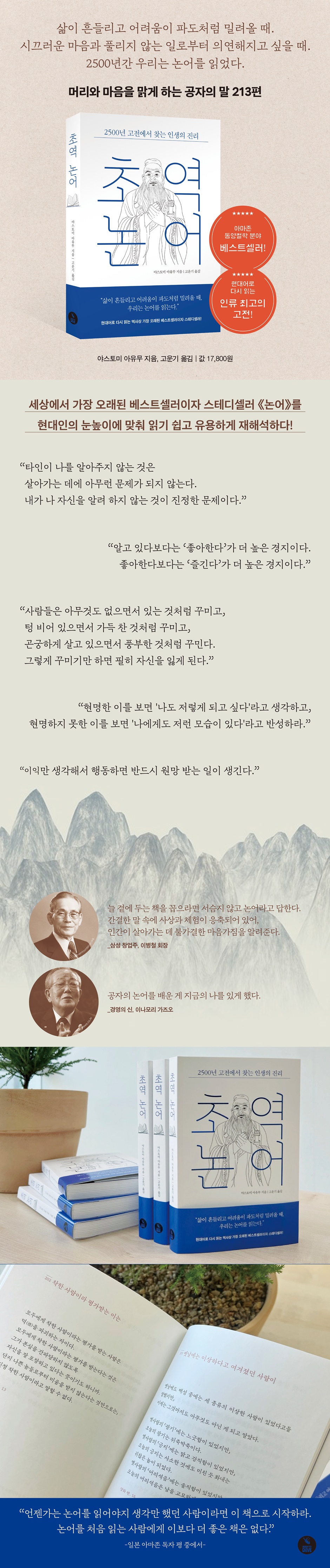
What does it mean to read the Analects subjectively? It means to accept the truth contained in the words with your whole body and embrace it tightly until you are completely convinced.
That is how we wait for the echo of the words of the ancient sages.
Through this process, I read the Analects dozens of times, finding clues to solving the problems I face in life.
As someone who has studied the classics for a long time, as an economics expert, and as someone who has lived in this world, this book is thoroughly objective and at the same time very subjective.
That's why I added the word 'super translation' to the title.
Rather than publishing the original text as is, it has been summarized and interpreted, and reorganized to make it easier for modern people like me to read and understand.
--- From "Introductory Remarks"
Reflect three times a day
Every day, look back at yourself and reflect on whether you are doing these three things.
First, am I not deceiving myself out of a desire to look good to my superiors?
Second, haven't you ever said something you didn't mean to please your friend?
Third, we take things too lightly, without sufficient knowledge or familiarity.
Didn't you convey this to your subordinates as if it were your own opinion?
(School's side.
4)
--- 「Chapter 1.
From "Learning"
When I turned 40
When I turned 40, I began to doubt the path I had been convinced I should take.
I realized that I was just wandering the world.
(The government side.
4-3)
--- 「Chapter 2.
From “Know and Rule”
A subject who only has 'propriety' becomes a flatterer.
When serving your lord, you must be loyal.
If you ignore it and only think about doing your best,
It gives the impression of being a flatterer.
'Yes' is the feeling a lord should have toward his subjects.
(Eight days.
18)
--- Chapter 3.
From "Becoming a Good Person"
The knowing and the virtuous
Those who know like to flow like water.
Those who know move, and those who are virtuous remain calm.
Those who know enjoy, and those who are virtuous wish for it.
(Ongya side.
23)
--- 「Chapter 4.
From "Enjoying Beyond Knowing"
Things I'm worried about
The inability to attach virtue to my body.
Not knowing what it means to learn.
Knowing what you should do, but not doing it.
Knowing something is not good but not correcting it.
This is what worries me.
(Alcohol is convenient.
3)
--- Chapter 5.
From “Keeping the Way”
Four Things You Should Let Go of
Confucius rejected the four things of will, necessity, certainty, and ego.
'Of' is the intention to do this and that in advance.
'Phil' is the stubbornness to want to do something like this.
'Go' is stubbornness and staleness that does not change one's firmly held thoughts.
'Ah' is egocentrism, which means 'I am I'.
(The other side.
4)
--- Chapter 6.
From "Do what you know"
The difference between harmony and sympathy
A gentleman only associates with people in harmony,
Do not adjust your opinion to the other person's opinion.
The small person only adjusts his own opinion to the opinions of others, and does not get along harmoniously.
(Jaro side.
23)
--- From “Chapter 7: There is Goodness and Honesty”
The direction of the gentleman and the mean man
A gentleman raises his thoughts upward.
The little man suppresses his thoughts.
(Constitutional text.
24)
--- Chapter 8.
From “Learning the words and actions of a gentleman”
It has nothing to do with me
Something that seems to have something to do with me
If you ignore it by saying, "It has nothing to do with me,"
Bad things will inevitably happen to me and those around me.
(Wiryeonggong side.
12)
--- Chapter 9.
From “Sharing Knowledge”
Beneficial friends, harmful friends
There are three kinds of good friends and three kinds of bad friends.
An honest friend, a friend who knows the truth, a friend who is knowledgeable are beneficial.
A friend who sweet-talks you, a friend who is kind but timid, a friend who is talkative are all harmful.
(Gye's side.
4)
That is how we wait for the echo of the words of the ancient sages.
Through this process, I read the Analects dozens of times, finding clues to solving the problems I face in life.
As someone who has studied the classics for a long time, as an economics expert, and as someone who has lived in this world, this book is thoroughly objective and at the same time very subjective.
That's why I added the word 'super translation' to the title.
Rather than publishing the original text as is, it has been summarized and interpreted, and reorganized to make it easier for modern people like me to read and understand.
--- From "Introductory Remarks"
Reflect three times a day
Every day, look back at yourself and reflect on whether you are doing these three things.
First, am I not deceiving myself out of a desire to look good to my superiors?
Second, haven't you ever said something you didn't mean to please your friend?
Third, we take things too lightly, without sufficient knowledge or familiarity.
Didn't you convey this to your subordinates as if it were your own opinion?
(School's side.
4)
--- 「Chapter 1.
From "Learning"
When I turned 40
When I turned 40, I began to doubt the path I had been convinced I should take.
I realized that I was just wandering the world.
(The government side.
4-3)
--- 「Chapter 2.
From “Know and Rule”
A subject who only has 'propriety' becomes a flatterer.
When serving your lord, you must be loyal.
If you ignore it and only think about doing your best,
It gives the impression of being a flatterer.
'Yes' is the feeling a lord should have toward his subjects.
(Eight days.
18)
--- Chapter 3.
From "Becoming a Good Person"
The knowing and the virtuous
Those who know like to flow like water.
Those who know move, and those who are virtuous remain calm.
Those who know enjoy, and those who are virtuous wish for it.
(Ongya side.
23)
--- 「Chapter 4.
From "Enjoying Beyond Knowing"
Things I'm worried about
The inability to attach virtue to my body.
Not knowing what it means to learn.
Knowing what you should do, but not doing it.
Knowing something is not good but not correcting it.
This is what worries me.
(Alcohol is convenient.
3)
--- Chapter 5.
From “Keeping the Way”
Four Things You Should Let Go of
Confucius rejected the four things of will, necessity, certainty, and ego.
'Of' is the intention to do this and that in advance.
'Phil' is the stubbornness to want to do something like this.
'Go' is stubbornness and staleness that does not change one's firmly held thoughts.
'Ah' is egocentrism, which means 'I am I'.
(The other side.
4)
--- Chapter 6.
From "Do what you know"
The difference between harmony and sympathy
A gentleman only associates with people in harmony,
Do not adjust your opinion to the other person's opinion.
The small person only adjusts his own opinion to the opinions of others, and does not get along harmoniously.
(Jaro side.
23)
--- From “Chapter 7: There is Goodness and Honesty”
The direction of the gentleman and the mean man
A gentleman raises his thoughts upward.
The little man suppresses his thoughts.
(Constitutional text.
24)
--- Chapter 8.
From “Learning the words and actions of a gentleman”
It has nothing to do with me
Something that seems to have something to do with me
If you ignore it by saying, "It has nothing to do with me,"
Bad things will inevitably happen to me and those around me.
(Wiryeonggong side.
12)
--- Chapter 9.
From “Sharing Knowledge”
Beneficial friends, harmful friends
There are three kinds of good friends and three kinds of bad friends.
An honest friend, a friend who knows the truth, a friend who is knowledgeable are beneficial.
A friend who sweet-talks you, a friend who is kind but timid, a friend who is talkative are all harmful.
(Gye's side.
4)
--- 「Chapter 10.
From "Being with good people"
From "Being with good people"
Publisher's Review
From Samsung Chairman Lee Byung-chul to Ive's Jang Won-young, a book loved across time and generations.
Reread the world's oldest bestseller and steady seller, the Analects, in modern language!
If Confucius lived in our time, what would he do when things were going poorly in business, when he was stressed at work, when his relationships weren't what he wanted, or when he was suffering from troubles with his superiors or juniors? Professor Yasutomi Ayumu of Tokyo University, an economist and expert in Eastern culture, has published a book reinterpreting the 2,500-year-old classic "The Analects" for a modern audience.
What makes this book different from other Analects books published so far is that it is a 'first translation' of the Analects, reinterpreted in modern language.
No matter how famous a sentence is, if it is difficult to understand its meaning and cannot be applied to our lives, it is meaningless.
In this book, the author breathes life into a 2,500-year-old classic by interpreting the essential themes of the Analects, such as benevolence, knowledge, filial piety, loyalty, and virtue, in a way that is easy and flexible to fit the modern environment.
Here, the refined and profound language of Professor Go Woon-ki, a poet and classical scholar, provides an opportunity to feel the resonance of the classics.
When you want to be free from noisy thoughts and unresolved issues
Leaders have always sought the Analects.
Confucius' teachings are still valid 2500 years later!
The words of Confucius two thousand years ago resonated with many people.
Even after he passed away, his resonance did not disappear, and over the course of a hundred years, it was recorded in books and passed down from heart to heart in many people, continuing to resonate to this day.
What is the secret behind the Analects' ability to captivate people for thousands of years? It's because it embodies a quest for human truth.
Confucius, a scholar of the Spring and Autumn Period of China, lost his father at the age of three and his mother at the age of seventeen.
It is said that Confucius, who became an orphan, lived a poor life doing rough and menial work during his childhood.
In the book, Confucius tells his disciples that through this experience, he 'became a man skilled in many things.'
Confucius, who had not received higher education but had become a self-taught scholar, had numerous disciples and was sought out by ministers for advice, yet he humbly engaged in conversations with those around him.
The truth that I realized was clearly stated, and although I did not reach the level of knowing, I sought wisdom about what I was struggling with.
The Analects are a record of Confucius and his disciples' exploration of human nature through this process.
Some people say that the Analects of Confucius is an old book that conveys outdated ideas.
They say, "There are so many scholars who convey better philosophy and ideas, and so many good books, so why are we holding on to books from two thousand years ago?"
This is a misconception that comes from reading the Analects literally.
The Analects are more like a book that refutes point by point what is considered right in modern society and makes you think about what is truly right.
Let's look at a passage from the 'Government' section.
A gentleman with an open learning circuit
Depending on the situation, it is possible to change yourself.
This kind of person believes that nothing is fixed.
We point fingers at people who keep changing their minds, saying they have no backbone.
But Confucius interprets it differently.
People who are accustomed to learning are bound to change their behavior as they gain enlightenment, so they are constantly renewing themselves.
Rather than criticizing them for being unpredictable, I praise their openness to breaking free from stereotypes and trying new things.
How unfortunate that someone with such a progressive perspective is being branded a byword for conservatism! Leaders who shaped their times were already well aware of the revolutionary teachings of the Analects. To wisely address the challenges they faced each day, they turned to the Analects, seeking a beacon to illuminate their dark and troubled minds. They found a profound resonance within.
To the person who thought, 'I should read it someday'
There is no better Analects book than this!
The Analects of Confucius are considered by many to be a must-read classic before they die.
But why haven't you read the Analects before? Perhaps you were intimidated by its complex interpretations, a jumble of difficult Chinese characters and archaic words, its tedious background explanations that are completely out of reach for those of us living in modern society, and, above all, its sheer volume of over 500 pages, and you simply held it back as a "goal to achieve someday." If so, I hope this book will help you achieve one of your life's goals.
As the title of the book suggests, this book is a ‘super-translation’ of the Analects.
Rather than publishing the classics in their original form, they have been summarized and interpreted to make them easier for modern people to read and understand.
We read classics to understand the hidden meanings in the words and writings of our ancestors and apply them to our lives.
Therefore, it is wiser to understand the Analects by adding subjective interpretations rather than reading them by analyzing each word academically.
The author, who has studied the classics for a long time, is an economic expert, and is also a person who lives in this world, reads the Analects through the eyes of a modern person.
And we have thoroughly explained it so that we, living in the 2020s, can easily understand it and apply it to every aspect of our lives.
The entire contents of the Analects were not included.
Some parts that do not fit with modern times have been deleted, and parts that were true in Confucius' time but are now considered contradictory have been ignored.
This was well-received by readers, and as soon as it was published, it became a bestseller in the Oriental classics category in Japan, receiving favorable reviews from readers who said, "There is no better book for someone new to the Analects."
"The Analects of Confucius," a first translation, is a welcome guide to life for readers who wish to reread the classics with a contemporary perspective, as well as for those seeking clues to life's problems. It is a book that suddenly awakens us to the joy of learning and its profound resonance conveyed by the Analects.
Let's bring the classic Analects of Confucius, a legacy of humanity, into the center of our lives through this book, which is the easiest, lightest, and most enjoyable way to read it.
Reread the world's oldest bestseller and steady seller, the Analects, in modern language!
If Confucius lived in our time, what would he do when things were going poorly in business, when he was stressed at work, when his relationships weren't what he wanted, or when he was suffering from troubles with his superiors or juniors? Professor Yasutomi Ayumu of Tokyo University, an economist and expert in Eastern culture, has published a book reinterpreting the 2,500-year-old classic "The Analects" for a modern audience.
What makes this book different from other Analects books published so far is that it is a 'first translation' of the Analects, reinterpreted in modern language.
No matter how famous a sentence is, if it is difficult to understand its meaning and cannot be applied to our lives, it is meaningless.
In this book, the author breathes life into a 2,500-year-old classic by interpreting the essential themes of the Analects, such as benevolence, knowledge, filial piety, loyalty, and virtue, in a way that is easy and flexible to fit the modern environment.
Here, the refined and profound language of Professor Go Woon-ki, a poet and classical scholar, provides an opportunity to feel the resonance of the classics.
When you want to be free from noisy thoughts and unresolved issues
Leaders have always sought the Analects.
Confucius' teachings are still valid 2500 years later!
The words of Confucius two thousand years ago resonated with many people.
Even after he passed away, his resonance did not disappear, and over the course of a hundred years, it was recorded in books and passed down from heart to heart in many people, continuing to resonate to this day.
What is the secret behind the Analects' ability to captivate people for thousands of years? It's because it embodies a quest for human truth.
Confucius, a scholar of the Spring and Autumn Period of China, lost his father at the age of three and his mother at the age of seventeen.
It is said that Confucius, who became an orphan, lived a poor life doing rough and menial work during his childhood.
In the book, Confucius tells his disciples that through this experience, he 'became a man skilled in many things.'
Confucius, who had not received higher education but had become a self-taught scholar, had numerous disciples and was sought out by ministers for advice, yet he humbly engaged in conversations with those around him.
The truth that I realized was clearly stated, and although I did not reach the level of knowing, I sought wisdom about what I was struggling with.
The Analects are a record of Confucius and his disciples' exploration of human nature through this process.
Some people say that the Analects of Confucius is an old book that conveys outdated ideas.
They say, "There are so many scholars who convey better philosophy and ideas, and so many good books, so why are we holding on to books from two thousand years ago?"
This is a misconception that comes from reading the Analects literally.
The Analects are more like a book that refutes point by point what is considered right in modern society and makes you think about what is truly right.
Let's look at a passage from the 'Government' section.
A gentleman with an open learning circuit
Depending on the situation, it is possible to change yourself.
This kind of person believes that nothing is fixed.
We point fingers at people who keep changing their minds, saying they have no backbone.
But Confucius interprets it differently.
People who are accustomed to learning are bound to change their behavior as they gain enlightenment, so they are constantly renewing themselves.
Rather than criticizing them for being unpredictable, I praise their openness to breaking free from stereotypes and trying new things.
How unfortunate that someone with such a progressive perspective is being branded a byword for conservatism! Leaders who shaped their times were already well aware of the revolutionary teachings of the Analects. To wisely address the challenges they faced each day, they turned to the Analects, seeking a beacon to illuminate their dark and troubled minds. They found a profound resonance within.
To the person who thought, 'I should read it someday'
There is no better Analects book than this!
The Analects of Confucius are considered by many to be a must-read classic before they die.
But why haven't you read the Analects before? Perhaps you were intimidated by its complex interpretations, a jumble of difficult Chinese characters and archaic words, its tedious background explanations that are completely out of reach for those of us living in modern society, and, above all, its sheer volume of over 500 pages, and you simply held it back as a "goal to achieve someday." If so, I hope this book will help you achieve one of your life's goals.
As the title of the book suggests, this book is a ‘super-translation’ of the Analects.
Rather than publishing the classics in their original form, they have been summarized and interpreted to make them easier for modern people to read and understand.
We read classics to understand the hidden meanings in the words and writings of our ancestors and apply them to our lives.
Therefore, it is wiser to understand the Analects by adding subjective interpretations rather than reading them by analyzing each word academically.
The author, who has studied the classics for a long time, is an economic expert, and is also a person who lives in this world, reads the Analects through the eyes of a modern person.
And we have thoroughly explained it so that we, living in the 2020s, can easily understand it and apply it to every aspect of our lives.
The entire contents of the Analects were not included.
Some parts that do not fit with modern times have been deleted, and parts that were true in Confucius' time but are now considered contradictory have been ignored.
This was well-received by readers, and as soon as it was published, it became a bestseller in the Oriental classics category in Japan, receiving favorable reviews from readers who said, "There is no better book for someone new to the Analects."
"The Analects of Confucius," a first translation, is a welcome guide to life for readers who wish to reread the classics with a contemporary perspective, as well as for those seeking clues to life's problems. It is a book that suddenly awakens us to the joy of learning and its profound resonance conveyed by the Analects.
Let's bring the classic Analects of Confucius, a legacy of humanity, into the center of our lives through this book, which is the easiest, lightest, and most enjoyable way to read it.
GOODS SPECIFICS
- Date of issue: November 13, 2024
- Page count, weight, size: 272 pages | 130*188*20mm
- ISBN13: 9791198999108
- ISBN10: 1198999101
You may also like
카테고리
korean


korean

![GQ KOREA Mark (Monthly): December [2025]](http://librairie.coreenne.fr/cdn/shop/files/8ef265dbbfbf186523ed75ba7319009d.jpg?v=1765340328&width=3840)


