

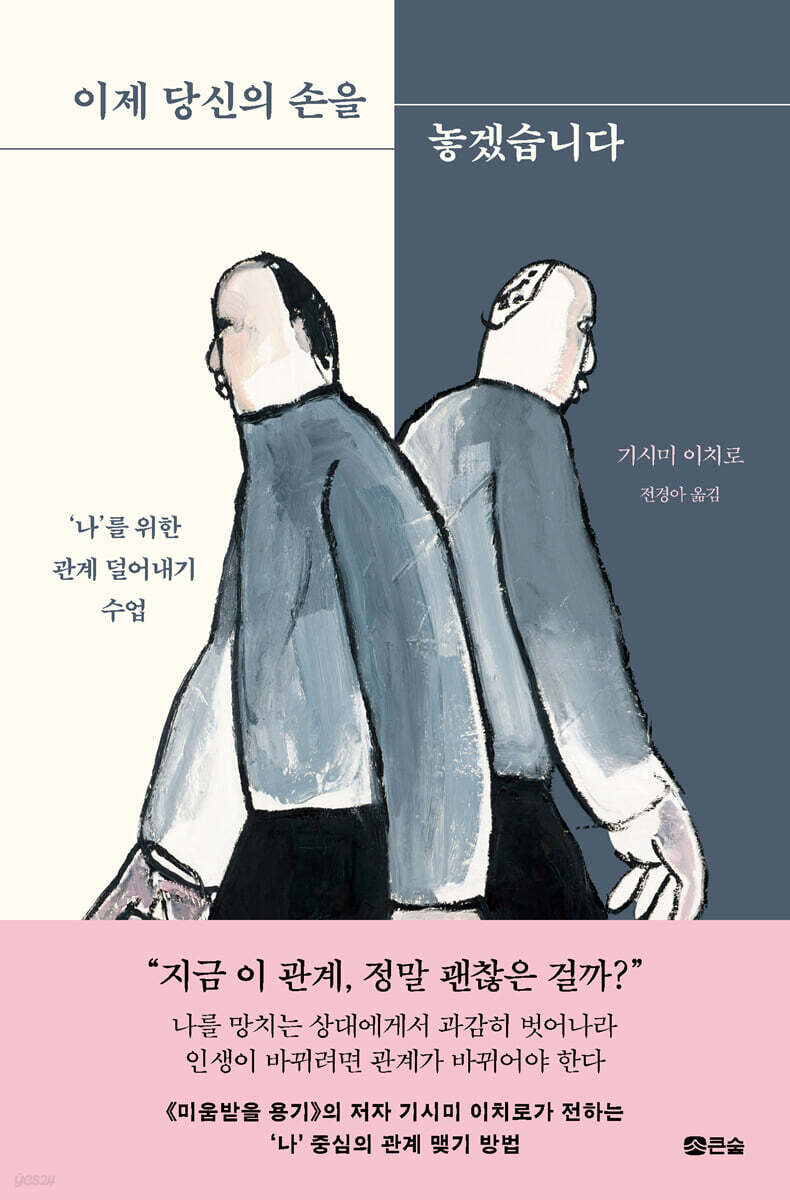
I'll let go of your hand now
 |
Description
Book Introduction
If you always check the other person's feelings...
If it seems like I'm the only one trying...
If you try too hard to be recognized and praised…
“Is this relationship really okay right now?”
The One Must-Read Book for Anyone Having a Difficult Relationship
"I'll Let Go of Your Hand", a relationship guidebook perfect for looking back on the relationships around you and taking the first step toward forming new ones, has been published by Big Forest.
Modern people, living in a densely entangled web of relationships, are bound to find themselves in contradictory situations because of those relationships.
Sometimes we suffer from unresolved relationships, and sometimes we experience joy and happiness by sharing our hearts with someone who fits us well.
While we want to live as completely independent individuals, we also want to live relying on and depending on others.
Do we want to be alone or do we want to connect with someone?
"Letting Go of Your Hand" explores the complexities of modern relationships and brings together the author's insights from personal experience and his own definitions based on the theories of various psychologists to help us break free from dysfunctional relationships and pursue true connection.
What we need to carefully examine in this book is the dark side of relationships we have formed without thinking, and the positive impact that true relationships, not difficult ones, can have on our lives.
Ichiro Kishimi, who delivered an important message to many Korean readers to live free and happy lives through "The Courage to be Hated," once again sharply challenges Korean society to the topic of building free and happy relationships.
If you are in a relationship of dependence and dominance, you need to be prepared to break it off.
Some people willingly follow others, but others are drawn into relationships without even realizing it.
Realizing this fact, you must be prepared to cut ties with people you don't need to associate with, and not get involved with them more than necessary.
―From the text
If it seems like I'm the only one trying...
If you try too hard to be recognized and praised…
“Is this relationship really okay right now?”
The One Must-Read Book for Anyone Having a Difficult Relationship
"I'll Let Go of Your Hand", a relationship guidebook perfect for looking back on the relationships around you and taking the first step toward forming new ones, has been published by Big Forest.
Modern people, living in a densely entangled web of relationships, are bound to find themselves in contradictory situations because of those relationships.
Sometimes we suffer from unresolved relationships, and sometimes we experience joy and happiness by sharing our hearts with someone who fits us well.
While we want to live as completely independent individuals, we also want to live relying on and depending on others.
Do we want to be alone or do we want to connect with someone?
"Letting Go of Your Hand" explores the complexities of modern relationships and brings together the author's insights from personal experience and his own definitions based on the theories of various psychologists to help us break free from dysfunctional relationships and pursue true connection.
What we need to carefully examine in this book is the dark side of relationships we have formed without thinking, and the positive impact that true relationships, not difficult ones, can have on our lives.
Ichiro Kishimi, who delivered an important message to many Korean readers to live free and happy lives through "The Courage to be Hated," once again sharply challenges Korean society to the topic of building free and happy relationships.
If you are in a relationship of dependence and dominance, you need to be prepared to break it off.
Some people willingly follow others, but others are drawn into relationships without even realizing it.
Realizing this fact, you must be prepared to cut ties with people you don't need to associate with, and not get involved with them more than necessary.
―From the text
- You can preview some of the book's contents.
Preview
index
To begin with
Listening to the worries of a young stranger | Building beneficial relationships | Ready to be disconnected
Chapter 1: If You Have No Choice But to Get Into a Relationship
No one can live alone | I am complete only through others | When we don't treat people as human beings | Why we help strangers | People who are indifferent to others
Chapter 2: Characteristics of a Dependent Person
Everyone lives dependent on others | When it is difficult to make the right judgment | Be wary of people who say, “It’s not your fault” | The lie that you need to be scolded to get better | Praise also creates dependent relationships | Relationships that require effort to break | People who don’t say what they want to say | If you want to follow authority, make your own judgment | Looking in the same direction | If you follow everyone, you lose yourself | Ask questions and seek answers | Answers that only you can find
Chapter 3: Characteristics of a Dominant Person
Domination and dependence go hand in hand | For those who need to be confrontational | Why we force connection | How the state exploits anxiety | Those who call themselves judges
Chapter 4: How to Check Your Surrounding Relationships
Who is trying to control me? | You need to know to solve it. | Pay attention to those who are trying to silence you. | Are voluntary choices truly voluntary? | Throw a knife into your relationship. | Those who are on the 'doing' side. | Should you be tolerant of those who are intolerant? | Look back at relationships that are fine.
Chapter 5: You Must Let Go to Start Again
Let's explore different relationships | Independence begins with rebellion | Yes-men are not competent employees | Realize that I, too, can make mistakes | Courage not to obey | Rebel, for your own sake
Chapter 6: Willing to Be Lonely
What We Need Now | Being "I" | Can We Stand Up to Authority | People Who Are Not Lonely Even When Alone | Question Everything | Follow the Voice Within | How to Get Properly Angry
Chapter 7: To Live My Own Life
Don't live up to expectations | People who only care about themselves | They only help because they want to help | When you act kind | Don't be swayed by others' opinions | There is no life without risk | How to enjoy failure | It's okay if you don't succeed | Each person has their own unique happiness
Chapter 8: Relationships Mistaken for Love
The illusion of being good friends | Relationships require appropriate distance | The freedom to solve your own problems | Being on the same level
Chapter 9 You Don't Have to Understand It Completely
To not be dependent | Realize for yourself and solve it yourself | See it as it is | Accept the reality in front of you | Know that you cannot understand others | The dynamics of understanding and love | Understanding is not about dominating | The courage to decide again | Love begins with surprise | Understand and accept | Everyone changes | The ability to understand others
Chapter 10: Humanity First
I am you | Accepting others changes my world | Helping others even when I know they are my 'enemy' | Connected to everyone | Believing that you will help me
Chapter 11: What it means to truly love
Encountering the one and only "you" | Love is not exclusive | True love seeks freedom | Existence itself is love | Giving myself as I am | Think of yourself as valuable.
Chapter 12: Connecting with the People You Want to Connect with
If you don't like it, cut it off. If you want to meet, meet. | Life's priorities | Life itself is worth living | The moment you break free from a relationship | Live in resonance | Don't struggle alone | Asking for help also takes courage | Belief that you can form a true relationship
main
Listening to the worries of a young stranger | Building beneficial relationships | Ready to be disconnected
Chapter 1: If You Have No Choice But to Get Into a Relationship
No one can live alone | I am complete only through others | When we don't treat people as human beings | Why we help strangers | People who are indifferent to others
Chapter 2: Characteristics of a Dependent Person
Everyone lives dependent on others | When it is difficult to make the right judgment | Be wary of people who say, “It’s not your fault” | The lie that you need to be scolded to get better | Praise also creates dependent relationships | Relationships that require effort to break | People who don’t say what they want to say | If you want to follow authority, make your own judgment | Looking in the same direction | If you follow everyone, you lose yourself | Ask questions and seek answers | Answers that only you can find
Chapter 3: Characteristics of a Dominant Person
Domination and dependence go hand in hand | For those who need to be confrontational | Why we force connection | How the state exploits anxiety | Those who call themselves judges
Chapter 4: How to Check Your Surrounding Relationships
Who is trying to control me? | You need to know to solve it. | Pay attention to those who are trying to silence you. | Are voluntary choices truly voluntary? | Throw a knife into your relationship. | Those who are on the 'doing' side. | Should you be tolerant of those who are intolerant? | Look back at relationships that are fine.
Chapter 5: You Must Let Go to Start Again
Let's explore different relationships | Independence begins with rebellion | Yes-men are not competent employees | Realize that I, too, can make mistakes | Courage not to obey | Rebel, for your own sake
Chapter 6: Willing to Be Lonely
What We Need Now | Being "I" | Can We Stand Up to Authority | People Who Are Not Lonely Even When Alone | Question Everything | Follow the Voice Within | How to Get Properly Angry
Chapter 7: To Live My Own Life
Don't live up to expectations | People who only care about themselves | They only help because they want to help | When you act kind | Don't be swayed by others' opinions | There is no life without risk | How to enjoy failure | It's okay if you don't succeed | Each person has their own unique happiness
Chapter 8: Relationships Mistaken for Love
The illusion of being good friends | Relationships require appropriate distance | The freedom to solve your own problems | Being on the same level
Chapter 9 You Don't Have to Understand It Completely
To not be dependent | Realize for yourself and solve it yourself | See it as it is | Accept the reality in front of you | Know that you cannot understand others | The dynamics of understanding and love | Understanding is not about dominating | The courage to decide again | Love begins with surprise | Understand and accept | Everyone changes | The ability to understand others
Chapter 10: Humanity First
I am you | Accepting others changes my world | Helping others even when I know they are my 'enemy' | Connected to everyone | Believing that you will help me
Chapter 11: What it means to truly love
Encountering the one and only "you" | Love is not exclusive | True love seeks freedom | Existence itself is love | Giving myself as I am | Think of yourself as valuable.
Chapter 12: Connecting with the People You Want to Connect with
If you don't like it, cut it off. If you want to meet, meet. | Life's priorities | Life itself is worth living | The moment you break free from a relationship | Live in resonance | Don't struggle alone | Asking for help also takes courage | Belief that you can form a true relationship
main
Detailed image

Into the book
No relationship is established automatically.
Having a child doesn't necessarily mean that family relationships will improve.
Just because you start dating someone you like doesn't mean your relationship will immediately get better.
Loving alone is not enough.
You have to act for good relationships, think about what kind of relationships you want to have, and know how to build them.
--- From "Building Beneficial Relationships"
Many parents are reluctant to ask their children to do things on their own.
Because they don't want their children to experience failure, and they think it's faster for parents to do it themselves.
But the truth is, the child is afraid of leaving his or her hands.
Parents like this continue to raise their children as spoiled brats.
If a child does not refuse his parents' help, he will continue to live as a spoiled brat.
So why can't we stop relying on our parents? It's because it's easier to rely on others than to do it alone.
Also, because they believe that if they follow their parents without thinking for themselves, they will not have to take responsibility when problems arise.
If you decide on your own, that decision
With love comes responsibility.
If things go wrong, there's no one to blame.
People who want to avoid this situation leave their lives to their parents instead of making their own decisions, and end up living their parents' lives instead of their own.
--- From "Everyone lives dependent on others"
This kind of relationship needs to be broken at least once.
It doesn't mean that it will make the relationship bad.
I'm not saying it's okay for children to rebel and turn their backs on their parents.
This means that in order for people to truly connect, it is necessary to examine existing relationships.
A good relationship cannot be established simply because they are parents and children.
Even if it seems like a good relationship, you must first recognize the nature of the relationship.
That is what Jesus meant by 'throwing the sword' and 'splitting' the relationship between parents and children.
In other words, it means re-examining the relationship.
Breaking up a relationship is not the ultimate goal.
We need to look at the way relationships exist and build good relationships from there.
--- From "Throw a Knife into Relationships"
Erich Fromm's credo is that one must doubt everything.
Fromm told himself that after World War I, he had to question everything.
Nothing is certain and everything must be questioned.
Doubt is the starting point of philosophy.
What if, while many people do what they think is right, no one questions it and asks, "Is that really true?"
Fromm says that our ability to doubt, criticize, and disobey may determine the future of humanity and the end of civilization.
If we do not criticize and question at this point in history, there is no future for humanity.
No, civilization is over.
You must always stay awake.
Many people seem to be awake, but are actually asleep.
He doesn't understand the situation he's in.
--- From "Doubt Everything"
The form of happiness is different for each person.
If so, there is no need for your life to be the same as someone else's, nor is there any point in comparing it.
I told the young man that it was his life and he could live it as he pleased.
If we live the same life as others, we can roughly imagine what kind of life we will live, but it is difficult to imagine what kind of life we will live because we cannot see the future of a life where each person has their own unique happiness.
But what's the point of living a life that isn't 'unique' just because you can't imagine it?
Let's say you don't like your personality or appearance and you try to change yourself to be bright and beautiful like other people.
Even if it actually changes like that, it is not your life
no.
Therefore, in order to live your own life, it is better to live your own unique life without being afraid of living differently from others.
--- From "Each One's Own Happiness"
Can people truly understand each other? It's a mistake to think we can never understand each other, nor to think we can.
If you think you understand the other person, you may feel close to them, but that feeling of closeness itself may be an illusion.
Even if you think you can understand, you can't.
Even if we are close, not everyone feels and thinks the same way.
There is a world of difference between knowing it and not knowing it.
Author Kim Yeon-su said.
“I am skeptical about the possibility of understanding others.” He also said that a “humble sentence” is a good sentence, saying, “You cannot write about others. It is impossible to understand others. A sentence written under this awareness is a humble sentence.”
In other words, Kim Yeon-su says that if you know that you cannot write about others and that it is impossible to understand others, you can write 'humble sentences'.
--- From "Knowing That You Can't Understand Others"
The reason love seeks freedom is because when we feel unbound, we feel loved.
If you are being watched for who you are, where you are, and what you are doing, you will feel untrusted and unloved.
Mori said that if the community of two people is open to the outside world, attention will be drawn to others and the crisis of love will deepen, but this is not true.
Rather, the bond between the two becomes stronger through freedom.
Those who believe that bonding with others can only be achieved by restraining and dominating them may disagree.
--- From "True Love Seeks Freedom"
If you are in a relationship of dependence and dominance, you need to be prepared to break it off.
Some people willingly follow others, but others are drawn into relationships without even realizing it.
Realizing this fact, you must be prepared to cut ties with people you don't need to associate with, and not get involved with them more than necessary.
On the other hand, it is good to connect with people who need to be connected.
I hope to meet the person I really want to meet.
During the COVID-19 pandemic, it was difficult not being able to see family members in hospitals or facilities.
At the same time, we realized who we really wanted to meet and who we didn't necessarily need to meet.
Having a child doesn't necessarily mean that family relationships will improve.
Just because you start dating someone you like doesn't mean your relationship will immediately get better.
Loving alone is not enough.
You have to act for good relationships, think about what kind of relationships you want to have, and know how to build them.
--- From "Building Beneficial Relationships"
Many parents are reluctant to ask their children to do things on their own.
Because they don't want their children to experience failure, and they think it's faster for parents to do it themselves.
But the truth is, the child is afraid of leaving his or her hands.
Parents like this continue to raise their children as spoiled brats.
If a child does not refuse his parents' help, he will continue to live as a spoiled brat.
So why can't we stop relying on our parents? It's because it's easier to rely on others than to do it alone.
Also, because they believe that if they follow their parents without thinking for themselves, they will not have to take responsibility when problems arise.
If you decide on your own, that decision
With love comes responsibility.
If things go wrong, there's no one to blame.
People who want to avoid this situation leave their lives to their parents instead of making their own decisions, and end up living their parents' lives instead of their own.
--- From "Everyone lives dependent on others"
This kind of relationship needs to be broken at least once.
It doesn't mean that it will make the relationship bad.
I'm not saying it's okay for children to rebel and turn their backs on their parents.
This means that in order for people to truly connect, it is necessary to examine existing relationships.
A good relationship cannot be established simply because they are parents and children.
Even if it seems like a good relationship, you must first recognize the nature of the relationship.
That is what Jesus meant by 'throwing the sword' and 'splitting' the relationship between parents and children.
In other words, it means re-examining the relationship.
Breaking up a relationship is not the ultimate goal.
We need to look at the way relationships exist and build good relationships from there.
--- From "Throw a Knife into Relationships"
Erich Fromm's credo is that one must doubt everything.
Fromm told himself that after World War I, he had to question everything.
Nothing is certain and everything must be questioned.
Doubt is the starting point of philosophy.
What if, while many people do what they think is right, no one questions it and asks, "Is that really true?"
Fromm says that our ability to doubt, criticize, and disobey may determine the future of humanity and the end of civilization.
If we do not criticize and question at this point in history, there is no future for humanity.
No, civilization is over.
You must always stay awake.
Many people seem to be awake, but are actually asleep.
He doesn't understand the situation he's in.
--- From "Doubt Everything"
The form of happiness is different for each person.
If so, there is no need for your life to be the same as someone else's, nor is there any point in comparing it.
I told the young man that it was his life and he could live it as he pleased.
If we live the same life as others, we can roughly imagine what kind of life we will live, but it is difficult to imagine what kind of life we will live because we cannot see the future of a life where each person has their own unique happiness.
But what's the point of living a life that isn't 'unique' just because you can't imagine it?
Let's say you don't like your personality or appearance and you try to change yourself to be bright and beautiful like other people.
Even if it actually changes like that, it is not your life
no.
Therefore, in order to live your own life, it is better to live your own unique life without being afraid of living differently from others.
--- From "Each One's Own Happiness"
Can people truly understand each other? It's a mistake to think we can never understand each other, nor to think we can.
If you think you understand the other person, you may feel close to them, but that feeling of closeness itself may be an illusion.
Even if you think you can understand, you can't.
Even if we are close, not everyone feels and thinks the same way.
There is a world of difference between knowing it and not knowing it.
Author Kim Yeon-su said.
“I am skeptical about the possibility of understanding others.” He also said that a “humble sentence” is a good sentence, saying, “You cannot write about others. It is impossible to understand others. A sentence written under this awareness is a humble sentence.”
In other words, Kim Yeon-su says that if you know that you cannot write about others and that it is impossible to understand others, you can write 'humble sentences'.
--- From "Knowing That You Can't Understand Others"
The reason love seeks freedom is because when we feel unbound, we feel loved.
If you are being watched for who you are, where you are, and what you are doing, you will feel untrusted and unloved.
Mori said that if the community of two people is open to the outside world, attention will be drawn to others and the crisis of love will deepen, but this is not true.
Rather, the bond between the two becomes stronger through freedom.
Those who believe that bonding with others can only be achieved by restraining and dominating them may disagree.
--- From "True Love Seeks Freedom"
If you are in a relationship of dependence and dominance, you need to be prepared to break it off.
Some people willingly follow others, but others are drawn into relationships without even realizing it.
Realizing this fact, you must be prepared to cut ties with people you don't need to associate with, and not get involved with them more than necessary.
On the other hand, it is good to connect with people who need to be connected.
I hope to meet the person I really want to meet.
During the COVID-19 pandemic, it was difficult not being able to see family members in hospitals or facilities.
At the same time, we realized who we really wanted to meet and who we didn't necessarily need to meet.
--- From "If you don't like it, break up, if you want to meet, meet up"
Publisher's Review
Boldly break away from the person who ruins you.
If your life is to change, your relationships must change.
Reinterpreting ‘relationships’ from a historical context and philosophical perspective
Ichiro Kishimi's latest work
As we live, we constantly form relationships.
Relationships formed within organizations where one must belong, such as school or the military, are fundamental, but relationships formed within organizations such as workplaces or hobby groups are also formed out of necessity to make a living, or voluntarily for a more fulfilling life.
Family is the first group we belong to when we are born, and most of us cannot escape from that group.
Modern people meet and form relationships with countless people, including friends, lovers, and colleagues, unless they choose to live a life of isolation.
Staying in touch with someone and looking into someone's life through your smartphone is another form of connection.
Perhaps because of the weariness of this phenomenon, the economic term 'sell at an appropriate time even if it means taking a loss', which has long been widely used as a slang term meaning to end a relationship with someone.
A social atmosphere has been created in which it is best to analyze one's personality type and distance oneself from people who do not suit one's personality type.
The message that we should only have relationships that don't hurt us and that preserve our self-esteem is constantly circulating on the Internet.
To this extent, we can guess how much stress is caused in human relationships.
So, is it really the right thing to do to just cut off a relationship you don't like? While the author advocates for breaking away from relationships, he makes a clear premise from the beginning of the book.
“Humans cannot live alone,” and “I am only complete when I have others.”
A person is neither complete nor perfect in himself.
It means that I can survive only when others fill in some part of me.
The author emphasizes the necessity and importance of relationships, and emphasizes the need for proper relationships rather than complete denial of relationships.
Look back at a relationship that seems to have no problems.
You will discover clues for a new relationship.
Through this book, we can identify the blind spots in relationships that we tend to miss and discover the true nature of our relationships.
Do you often get complimented by someone for little things?
If so, then the other person is trying to dominate you by exploiting your need for recognition.
Do you ever get annoyed by your partner or friend's attitude of always trying to please them while secretly seeming to ignore them?
They are trying to manipulate you by taking advantage of your good nature.
Additionally, if you are a child who is struggling because your parents want to know everything about you, from eating and sleeping to schoolwork and relationships with friends, this book will be helpful.
Not only for the children, but also for such parents.
In this way, the author makes us look back at the true nature of our relationships based on the theories of renowned psychologists such as Erich Fromm and Alfred Adler.
Because you need to be able to see the relationship clearly to be able to take it to the next level.
Identifying what is wrong with the relationships surrounding me and making an effort to change them, even if it means risking change.
"Letting Go of Your Hand" is a book to be read at the beginning of a bold journey toward a changing relationship.
Let go of wrong relationships and set your life straight.
The author suggests the following sequence as a way to escape from a bad relationship:
First, notice the forced connection.
It is a priority to check whether the relationship I am forming without thinking is the right relationship for me.
Next, re-examine the relationship.
If you feel that the relationship is wrong, you need to take a closer look at it.
Next, it is advisable to try to understand the other person, accept that you cannot fully understand them, and if the relationship is still not easy, have the courage to be lonely and let go of the relationship.
When we let go of a bad relationship, a new relationship comes to us.
To borrow the author's term, it is a connection in a state of 'new harmony'.
Once we reach that stage, we can connect with the person we truly want to connect with.
The author concludes that the direction our relationships should ultimately pursue is love and freedom.
If you can't live outside of a relationship, you have to redesign the shape of that relationship to suit your needs.
Because it is clear that looking at the relationships that dominate your life with an objective eye and knowing how to boldly let go of problematic relationships will lead your life in a better direction.
"I'll Let Go of Your Hand Now" is a guidebook that redefines all our relationships: couples and lovers who interfere with each other in the name of love, parents and children who shackle their children with praise and scolding, friends who treat each other carelessly without consideration, rigid organizations where it's difficult to express any opinions, and even countries that exploit the people's anxiety for political purposes.
The new relationships we create will take our lives in a completely different direction, giving us a much more stable and satisfying life, whether we live alone or together.
If your life is to change, your relationships must change.
Reinterpreting ‘relationships’ from a historical context and philosophical perspective
Ichiro Kishimi's latest work
As we live, we constantly form relationships.
Relationships formed within organizations where one must belong, such as school or the military, are fundamental, but relationships formed within organizations such as workplaces or hobby groups are also formed out of necessity to make a living, or voluntarily for a more fulfilling life.
Family is the first group we belong to when we are born, and most of us cannot escape from that group.
Modern people meet and form relationships with countless people, including friends, lovers, and colleagues, unless they choose to live a life of isolation.
Staying in touch with someone and looking into someone's life through your smartphone is another form of connection.
Perhaps because of the weariness of this phenomenon, the economic term 'sell at an appropriate time even if it means taking a loss', which has long been widely used as a slang term meaning to end a relationship with someone.
A social atmosphere has been created in which it is best to analyze one's personality type and distance oneself from people who do not suit one's personality type.
The message that we should only have relationships that don't hurt us and that preserve our self-esteem is constantly circulating on the Internet.
To this extent, we can guess how much stress is caused in human relationships.
So, is it really the right thing to do to just cut off a relationship you don't like? While the author advocates for breaking away from relationships, he makes a clear premise from the beginning of the book.
“Humans cannot live alone,” and “I am only complete when I have others.”
A person is neither complete nor perfect in himself.
It means that I can survive only when others fill in some part of me.
The author emphasizes the necessity and importance of relationships, and emphasizes the need for proper relationships rather than complete denial of relationships.
Look back at a relationship that seems to have no problems.
You will discover clues for a new relationship.
Through this book, we can identify the blind spots in relationships that we tend to miss and discover the true nature of our relationships.
Do you often get complimented by someone for little things?
If so, then the other person is trying to dominate you by exploiting your need for recognition.
Do you ever get annoyed by your partner or friend's attitude of always trying to please them while secretly seeming to ignore them?
They are trying to manipulate you by taking advantage of your good nature.
Additionally, if you are a child who is struggling because your parents want to know everything about you, from eating and sleeping to schoolwork and relationships with friends, this book will be helpful.
Not only for the children, but also for such parents.
In this way, the author makes us look back at the true nature of our relationships based on the theories of renowned psychologists such as Erich Fromm and Alfred Adler.
Because you need to be able to see the relationship clearly to be able to take it to the next level.
Identifying what is wrong with the relationships surrounding me and making an effort to change them, even if it means risking change.
"Letting Go of Your Hand" is a book to be read at the beginning of a bold journey toward a changing relationship.
Let go of wrong relationships and set your life straight.
The author suggests the following sequence as a way to escape from a bad relationship:
First, notice the forced connection.
It is a priority to check whether the relationship I am forming without thinking is the right relationship for me.
Next, re-examine the relationship.
If you feel that the relationship is wrong, you need to take a closer look at it.
Next, it is advisable to try to understand the other person, accept that you cannot fully understand them, and if the relationship is still not easy, have the courage to be lonely and let go of the relationship.
When we let go of a bad relationship, a new relationship comes to us.
To borrow the author's term, it is a connection in a state of 'new harmony'.
Once we reach that stage, we can connect with the person we truly want to connect with.
The author concludes that the direction our relationships should ultimately pursue is love and freedom.
If you can't live outside of a relationship, you have to redesign the shape of that relationship to suit your needs.
Because it is clear that looking at the relationships that dominate your life with an objective eye and knowing how to boldly let go of problematic relationships will lead your life in a better direction.
"I'll Let Go of Your Hand Now" is a guidebook that redefines all our relationships: couples and lovers who interfere with each other in the name of love, parents and children who shackle their children with praise and scolding, friends who treat each other carelessly without consideration, rigid organizations where it's difficult to express any opinions, and even countries that exploit the people's anxiety for political purposes.
The new relationships we create will take our lives in a completely different direction, giving us a much more stable and satisfying life, whether we live alone or together.
GOODS SPECIFICS
- Date of issue: March 19, 2025
- Page count, weight, size: 248 pages | 316g | 135*205*20mm
- ISBN13: 9791194293347
- ISBN10: 1194293344
You may also like
카테고리
korean


korean

![GQ KOREA Mark (Monthly): December [2025]](http://librairie.coreenne.fr/cdn/shop/files/8ef265dbbfbf186523ed75ba7319009d.jpg?v=1765340328&width=3840)


