

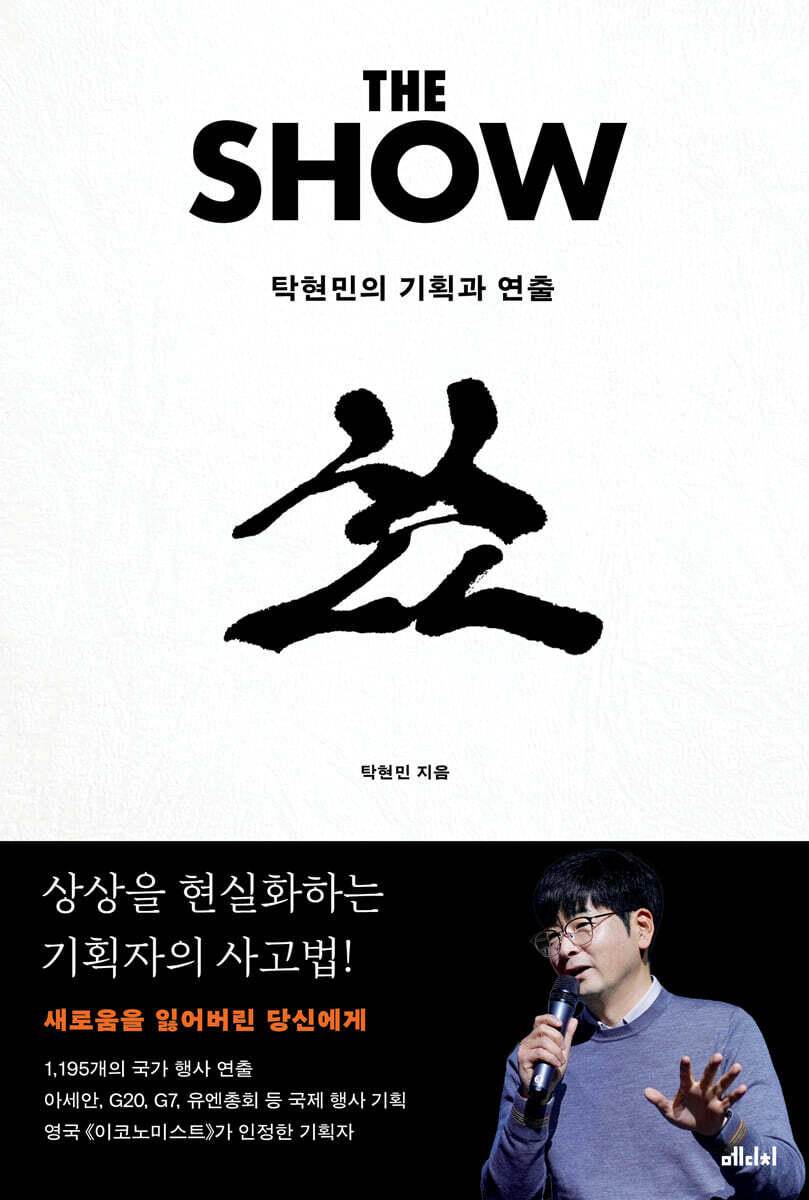
The Show
 |
Description
Book Introduction
The planner's way of thinking that turns imagination into reality!
Adding details to the idea, planning, and directing
A story for all planners around the world
In a world where everyone must be a planner and director, planning and directing are not limited to the realm of culture and art, but are something we each carry out in our own professions.
"The Show" is a book about how to turn imagination into reality, a weapon in an era where "everything is planned."
How can we create innovative ideas that break free from stereotypes? What makes a successful project that resonates with people? What kind of story and narrative should we use to construct the message we want to convey? This book offers answers to all these questions.
Author Tak Hyun-min, Korea's leading planning and directing expert, has worked in the cultural content field for 25 years, including event planning, performance directing, PI (President Identity), and bestselling authorship, and has carried out numerous planning projects.
"The Show" is a book filled with the author's 25 years of expertise in bringing imagination to life, from planning and conception to directing. It is a must-read for any planner seeking innovation.
Adding details to the idea, planning, and directing
A story for all planners around the world
In a world where everyone must be a planner and director, planning and directing are not limited to the realm of culture and art, but are something we each carry out in our own professions.
"The Show" is a book about how to turn imagination into reality, a weapon in an era where "everything is planned."
How can we create innovative ideas that break free from stereotypes? What makes a successful project that resonates with people? What kind of story and narrative should we use to construct the message we want to convey? This book offers answers to all these questions.
Author Tak Hyun-min, Korea's leading planning and directing expert, has worked in the cultural content field for 25 years, including event planning, performance directing, PI (President Identity), and bestselling authorship, and has carried out numerous planning projects.
"The Show" is a book filled with the author's 25 years of expertise in bringing imagination to life, from planning and conception to directing. It is a must-read for any planner seeking innovation.
- You can preview some of the book's contents.
Preview
index
Opening_Finding my own way
Part 1_From idea to planning
He who has the story has everything
In search of beauty
Cut the new
Beyond 'Kuse'
The power of the obvious
Intuition and Objectification
Become an archaeologist or an alchemist
As you wish, consistently
The power of observation, the power of imagination
Attitude is power
Original bones
The other side of imagination
Part 2_From Planning to Directing
From near and far
Clearly or vaguely
Parables and Symbols
The birth of a format
Text and pictures
Location is everything
Highlight, hook, sabi
Empathy in the details
The truth of simple things
Light and Darkness
Music and Coordinates
What is directing?
Ending_I wish I could be a firefly
Part 1_From idea to planning
He who has the story has everything
In search of beauty
Cut the new
Beyond 'Kuse'
The power of the obvious
Intuition and Objectification
Become an archaeologist or an alchemist
As you wish, consistently
The power of observation, the power of imagination
Attitude is power
Original bones
The other side of imagination
Part 2_From Planning to Directing
From near and far
Clearly or vaguely
Parables and Symbols
The birth of a format
Text and pictures
Location is everything
Highlight, hook, sabi
Empathy in the details
The truth of simple things
Light and Darkness
Music and Coordinates
What is directing?
Ending_I wish I could be a firefly
Detailed image

Into the book
There is no need to think of planning or directing as something particularly special.
All plans are planning, and the realization of the plan is directing.
We already plan and direct our lives every day.
So we are all planners and directors.
And if possible, I will try to make my planning and directing new, fresh, fun, and cool for myself and others, and memorable for a long time.
--- From "Finding My Own Way"
Not all narratives have power, but narratives, big or small, do have power.
Any plausible work, whether a photograph, painting, song, film, or performance, must have a plausible narrative.
If there is a narrative, a single photograph or painting can create a saga, a ten-part drama, or a feature-length film.
The power of narrative makes the ideal feel real and leads reality into the ideal world.
Create a tale and become a legend.
--- From "He who has a story has everything"
‘Novelty’ can be interpreted much more richly when interpreted as ‘bringing forth something new.’
Newness always begins with the legacy of the past.
When we say something is new, we mean it is new from something in the past.
Novel projects are always created with a debt to precedent and convention.
There is no novelty that is not based on the past.
This is why the Bible says, “There is nothing new under the sun.”
All history, including the creation and evolution of all things in heaven and earth, is like that.
Anything created in the planner's mind cannot help but be greatly indebted to what already existed.
--- From "Cutting the New"
The sentiments of our time are deeply connected to those of previous eras.
The beginning and the end are connected, and there can be no beginning without an end, nor an end without a beginning.
The same goes for culture and art.
The newness of popular music owes a great debt to the Beatles and Michael Jackson.
All genres of art, including literature and music, that we call classics, continue to influence contemporary popular art and are being analyzed, reinterpreted, and created.
If you want to create new ideas, pictures that no one else has ever imagined, you must become an avid archaeologist who explores archetypes and an excellent alchemist who knows how to combine them.
--- From "Let's Become an Archaeologist or an Alchemist"
There is a deep misconception about creative work.
The idea is that 'it's not difficult to create something that meets the public's tastes and the demands of the times, but rather, what's difficult about doing it the way you want?'
But it's exactly the opposite.
It's not easy to live the way you want.
You have to give up a lot and turn your back on a lot.
In many ways, it is easier and safer to live according to others.
When doing creative work, it's much easier to follow the times, the public, and the client's demands than to do it my way.
Meeting the needs of others is entirely possible with experience and skill.
--- From "As You Wish, Steadily"
I believe that only by adding something new to what already exists, to what we have now, can my task, which has reached its limit, be transformed in a surprising way.
But the imagination I experienced was exactly the opposite.
You have to run in exactly the opposite direction.
The essence of imagination is to leave behind only the root, the cause, the core.
It starts from there.
It's not about adding, it's about taking away.
--- From "The Original Bones"
The same goes for any event, from Olympic eve ceremonies to public dialogue.
There are moments when you need to get everyone's attention and moments when you need to get the audience or attendees lost in their own thoughts.
You can't keep the attention of the people sitting at the event the whole time.
You have to think that it can't be done.
Trying to force attention by forcefully creates an excessive stage, an unnecessarily excited host, and forces endless reactions from the audience.
--- From "Clearly or Vaguely"
Text is a technique that has the virtue of respecting each person's interpretation, but images tend to rush towards someone's interpretation when it has been preempted.
So, in the case of text, diversity is acknowledged to a certain extent depending on the interpretation of the recipient, but if anyone can interpret and publish an image first, the leading interpretation will be more popular than the individual appreciation of the recipient.
Images are a more persuasive way to do this.
Understanding this will help you decide when to use video at your event, what images to display, and how to display them, when to add subtitles for effective results, and where to include speeches and comments.
You will learn the so-called production grammar.
--- From "Writing and Drawing"
There are some things you need to do first to find the perfect fit.
Before focusing on the scale of the event, its program, or the detailed staging techniques, attention should be paid to the theme.
First, what kind of story are you trying to tell, and what can be associated with standing in that place?
It must be relatable not only to those who will be sitting there watching the event, but also to those who will be watching it through broadcast or video.
--- From "Place is Everything"
When I direct an event, I tend to prefer solo pieces or unaccompanied instruments.
When the national flag is raised or a moment of silence is observed, playing a trumpet solo makes the national anthem played by the orchestra later much more magnificent.
Arranging the introduction of a song to be played unaccompanied, placing a heavy theme after a light story, or adding a humorous device after a sad part are all ways to increase the emotional contrast through extreme changes.
If that process is repeated successfully, the viewers will focus on the stage.
From that moment on, it becomes a fairy tale.
--- From "Light and Darkness"
There are many cases where directing is simply considered to be an artificial creation, and there are also many cases where directors are considered to be people who just make things up.
The word '연演' in the director's language means 'to flow' or 'to communicate'.
Directing is 'direction' and a director is 'director'.
There is no meaning in decorating or creating anything.
I think of a director as someone who “leads the audience to the world he dreams of.”
All plans are planning, and the realization of the plan is directing.
We already plan and direct our lives every day.
So we are all planners and directors.
And if possible, I will try to make my planning and directing new, fresh, fun, and cool for myself and others, and memorable for a long time.
--- From "Finding My Own Way"
Not all narratives have power, but narratives, big or small, do have power.
Any plausible work, whether a photograph, painting, song, film, or performance, must have a plausible narrative.
If there is a narrative, a single photograph or painting can create a saga, a ten-part drama, or a feature-length film.
The power of narrative makes the ideal feel real and leads reality into the ideal world.
Create a tale and become a legend.
--- From "He who has a story has everything"
‘Novelty’ can be interpreted much more richly when interpreted as ‘bringing forth something new.’
Newness always begins with the legacy of the past.
When we say something is new, we mean it is new from something in the past.
Novel projects are always created with a debt to precedent and convention.
There is no novelty that is not based on the past.
This is why the Bible says, “There is nothing new under the sun.”
All history, including the creation and evolution of all things in heaven and earth, is like that.
Anything created in the planner's mind cannot help but be greatly indebted to what already existed.
--- From "Cutting the New"
The sentiments of our time are deeply connected to those of previous eras.
The beginning and the end are connected, and there can be no beginning without an end, nor an end without a beginning.
The same goes for culture and art.
The newness of popular music owes a great debt to the Beatles and Michael Jackson.
All genres of art, including literature and music, that we call classics, continue to influence contemporary popular art and are being analyzed, reinterpreted, and created.
If you want to create new ideas, pictures that no one else has ever imagined, you must become an avid archaeologist who explores archetypes and an excellent alchemist who knows how to combine them.
--- From "Let's Become an Archaeologist or an Alchemist"
There is a deep misconception about creative work.
The idea is that 'it's not difficult to create something that meets the public's tastes and the demands of the times, but rather, what's difficult about doing it the way you want?'
But it's exactly the opposite.
It's not easy to live the way you want.
You have to give up a lot and turn your back on a lot.
In many ways, it is easier and safer to live according to others.
When doing creative work, it's much easier to follow the times, the public, and the client's demands than to do it my way.
Meeting the needs of others is entirely possible with experience and skill.
--- From "As You Wish, Steadily"
I believe that only by adding something new to what already exists, to what we have now, can my task, which has reached its limit, be transformed in a surprising way.
But the imagination I experienced was exactly the opposite.
You have to run in exactly the opposite direction.
The essence of imagination is to leave behind only the root, the cause, the core.
It starts from there.
It's not about adding, it's about taking away.
--- From "The Original Bones"
The same goes for any event, from Olympic eve ceremonies to public dialogue.
There are moments when you need to get everyone's attention and moments when you need to get the audience or attendees lost in their own thoughts.
You can't keep the attention of the people sitting at the event the whole time.
You have to think that it can't be done.
Trying to force attention by forcefully creates an excessive stage, an unnecessarily excited host, and forces endless reactions from the audience.
--- From "Clearly or Vaguely"
Text is a technique that has the virtue of respecting each person's interpretation, but images tend to rush towards someone's interpretation when it has been preempted.
So, in the case of text, diversity is acknowledged to a certain extent depending on the interpretation of the recipient, but if anyone can interpret and publish an image first, the leading interpretation will be more popular than the individual appreciation of the recipient.
Images are a more persuasive way to do this.
Understanding this will help you decide when to use video at your event, what images to display, and how to display them, when to add subtitles for effective results, and where to include speeches and comments.
You will learn the so-called production grammar.
--- From "Writing and Drawing"
There are some things you need to do first to find the perfect fit.
Before focusing on the scale of the event, its program, or the detailed staging techniques, attention should be paid to the theme.
First, what kind of story are you trying to tell, and what can be associated with standing in that place?
It must be relatable not only to those who will be sitting there watching the event, but also to those who will be watching it through broadcast or video.
--- From "Place is Everything"
When I direct an event, I tend to prefer solo pieces or unaccompanied instruments.
When the national flag is raised or a moment of silence is observed, playing a trumpet solo makes the national anthem played by the orchestra later much more magnificent.
Arranging the introduction of a song to be played unaccompanied, placing a heavy theme after a light story, or adding a humorous device after a sad part are all ways to increase the emotional contrast through extreme changes.
If that process is repeated successfully, the viewers will focus on the stage.
From that moment on, it becomes a fairy tale.
--- From "Light and Darkness"
There are many cases where directing is simply considered to be an artificial creation, and there are also many cases where directors are considered to be people who just make things up.
The word '연演' in the director's language means 'to flow' or 'to communicate'.
Directing is 'direction' and a director is 'director'.
There is no meaning in decorating or creating anything.
I think of a director as someone who “leads the audience to the world he dreams of.”
--- From "What is Directing"
Publisher's Review
Planning and directing are the work of turning imagination into reality.
Directing 1,195 national events
Planning international events such as ASEAN, G20, G7, and UN General Assembly
A planner recognized by the British magazine The Economist
“Isn’t there anything new?” Any planner who has submitted a plan every Monday knows.
How difficult it is to come up with a novel idea.
This is the answer that comes back from the boss's mouth after seeing the plan that was worked on all night.
“Can I have this again?”
Even when presenting a plan that was written with difficulty, there are many cases where you have to explain it in detail after the presentation is over.
However, if you have to explain this and that after the presentation is over, it means that the persuasion has already failed.
At this point, no matter how hard you try to explain, in the end it will just be an explanation for the sake of explanation.
How can we create a project that captures people's attention with new ideas and a compelling message?
Author Tak Hyun-min, who has created content in various fields including planning, public relations, and directing, returns with 24 ways of thinking that will lead to the imagination that enables innovative planning.
The author, who has planned and directed popular music concerts, 1,195 national events, and numerous international events such as the ASEAN, G20, G7, and UN General Assembly, has been praised as an outstanding "showman" by domestic and international media outlets, including the British magazine The Economist.
I want to overcome the wall of habitual thinking
For all planners in the world
24 ways of thinking
"The Show" encompasses the author's way of thinking, from conception to production, of turning imagination into reality.
It also contains vivid examples of productions applying each principle.
This book corrects the definition of 'imagination' that we have only vaguely thought of.
The author emphasizes that we should not assume that imagination is something that transcends reality or is something greater than reality.
Imagination can sometimes be a hidden part of reality, smaller and more insignificant than what is visible.
When we discover something hidden and unfold it before our eyes, our imagination is reborn as a great plan and production.
Part 1 of this book, "From Idea to Planning," introduces how the author, as a planner, begins to think and imagine, including "starting from the past," "denying myself," "focusing on the obvious," "creating the familiar new," and "observing with affection."
In addition, Part 2, “From Planning to Directing,” thoroughly explains how a director expresses planning, including “using metaphors and symbols,” “selecting a location appropriate to the theme,” “giving details,” “simplifying,” and “preparing.”
From cultural concerts to events that elevate the nation's prestige, "The Show," which embodies Tak Hyun-min's planning and directing philosophy, is not just for a select few planners or directors.
This book is for the majority of content creators who are struggling with the limits of their abilities and want to further upgrade their planning skills.
Readers will be able to acquire their own weapons to survive in the battlefield of their own industry through the author's way of thinking, who has constantly pondered the meaning of creative planning and created various contents.
Finally, the author emphasizes:
All the stories in the book are personal cases, so please use them for reference only.
And he adds:
Refer to your own case and create your own case.
Directing 1,195 national events
Planning international events such as ASEAN, G20, G7, and UN General Assembly
A planner recognized by the British magazine The Economist
“Isn’t there anything new?” Any planner who has submitted a plan every Monday knows.
How difficult it is to come up with a novel idea.
This is the answer that comes back from the boss's mouth after seeing the plan that was worked on all night.
“Can I have this again?”
Even when presenting a plan that was written with difficulty, there are many cases where you have to explain it in detail after the presentation is over.
However, if you have to explain this and that after the presentation is over, it means that the persuasion has already failed.
At this point, no matter how hard you try to explain, in the end it will just be an explanation for the sake of explanation.
How can we create a project that captures people's attention with new ideas and a compelling message?
Author Tak Hyun-min, who has created content in various fields including planning, public relations, and directing, returns with 24 ways of thinking that will lead to the imagination that enables innovative planning.
The author, who has planned and directed popular music concerts, 1,195 national events, and numerous international events such as the ASEAN, G20, G7, and UN General Assembly, has been praised as an outstanding "showman" by domestic and international media outlets, including the British magazine The Economist.
I want to overcome the wall of habitual thinking
For all planners in the world
24 ways of thinking
"The Show" encompasses the author's way of thinking, from conception to production, of turning imagination into reality.
It also contains vivid examples of productions applying each principle.
This book corrects the definition of 'imagination' that we have only vaguely thought of.
The author emphasizes that we should not assume that imagination is something that transcends reality or is something greater than reality.
Imagination can sometimes be a hidden part of reality, smaller and more insignificant than what is visible.
When we discover something hidden and unfold it before our eyes, our imagination is reborn as a great plan and production.
Part 1 of this book, "From Idea to Planning," introduces how the author, as a planner, begins to think and imagine, including "starting from the past," "denying myself," "focusing on the obvious," "creating the familiar new," and "observing with affection."
In addition, Part 2, “From Planning to Directing,” thoroughly explains how a director expresses planning, including “using metaphors and symbols,” “selecting a location appropriate to the theme,” “giving details,” “simplifying,” and “preparing.”
From cultural concerts to events that elevate the nation's prestige, "The Show," which embodies Tak Hyun-min's planning and directing philosophy, is not just for a select few planners or directors.
This book is for the majority of content creators who are struggling with the limits of their abilities and want to further upgrade their planning skills.
Readers will be able to acquire their own weapons to survive in the battlefield of their own industry through the author's way of thinking, who has constantly pondered the meaning of creative planning and created various contents.
Finally, the author emphasizes:
All the stories in the book are personal cases, so please use them for reference only.
And he adds:
Refer to your own case and create your own case.
GOODS SPECIFICS
- Date of issue: September 3, 2024
- Page count, weight, size: 272 pages | 135*200*16mm
- ISBN13: 9791157063635
You may also like
카테고리
korean


korean

![GQ KOREA Mark (Monthly): December [2025]](http://librairie.coreenne.fr/cdn/shop/files/8ef265dbbfbf186523ed75ba7319009d.jpg?v=1765340328&width=3840)


