

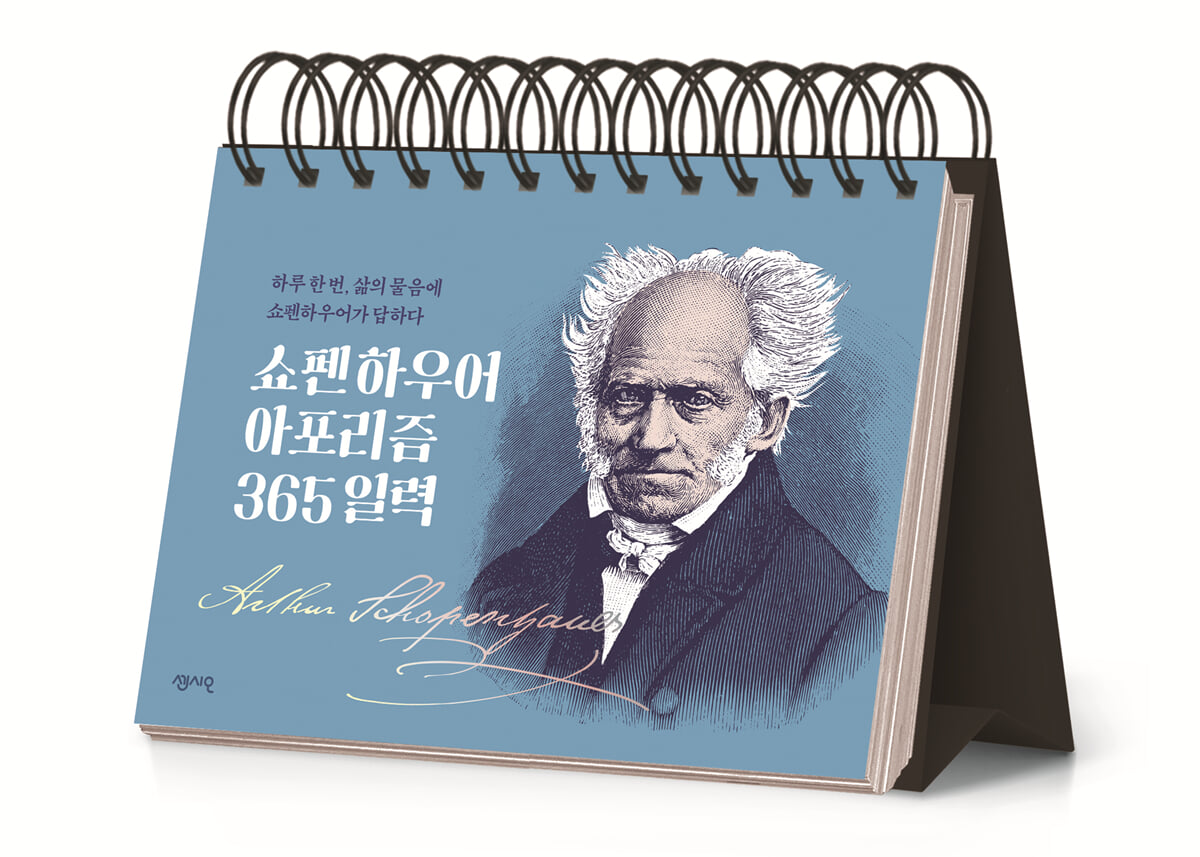
Schopenhauer's Aphorisms 365 Day Calendar
 |
Description
Book Introduction
Schopenhauer's life quotes, as sharp as a razor, come to your desk! Schopenhauer lived a lonely life, but left behind a brilliant intellectual legacy to the world. Why do his quotes still resonate with us today, even after all this time? Perhaps it's the power of their cynical, intuitive, yet paradoxically hopeful message, their heartfelt advice to break free from the exhaustion of desire and relationships and find true meaning in life. The perpetual calendar, “Schopenhauer’s Aphorisms 365 Daily Calendar,” which contains vivid quotes from Schopenhauer, who can be called the spiritual teacher of intellectuals around the world, has been published. An important feature of this calendar is that, unlike many previously known quotations, it is taken from all of Schopenhauer's works. 365 aphorisms were cited from all of his works, including 『On Life』, 『On Happiness』, 『Proverbs』, and 『The World as Will and Representation』, and were colorfully arranged according to monthly themes. Another feature is that it has taken exact sentences from the original text, which was rigorously translated by the Gutenberg Project, and includes both English and Korean translations. Considering that Schopenhauer's writings known in Korea have been altered and distorted through the hands of many people, this is a work of special value. Throughout the calendar, landscape paintings by Jacob van Ruisdael, a painter Schopenhauer loved, are included, and QR codes are included for original sentences he frequently quoted, allowing readers to directly hear the original pronunciation in Latin, Greek, Italian, German, French, Spanish, and Hindi. Schopenhauer's aphorisms contain both a sharp criticism of the world and a warm gaze and love for humanity and life. Let's enjoy a time of asking and answering Schopenhauer once a day about various topics such as attitude to life and wisdom, wealth and fame, loneliness and wounds, relationships and love. |
- You can preview some of the book's contents.
Preview
index
January | Plan of Life
It's okay if things don't go as planned
February | Wisdom of Life
The world doesn't always go the way you want it to.
March | Meaning of Life
Life is inherently difficult and miserable
April | Wound and Suffering
When you feel like you're the only one suffering and making sacrifices
May | Human Relations
Why is it so hard to get along with people?
June | Life's Attitude
What kind of life should I strive to live?
July | Caring for the Mind
When emotions run wild and sway from moment to moment
August | Work and Relax
I hope you will read it well so that your soul does not dry out.
September | Fruit of Life
How much wealth and fame do you need to be happy?
October | Stand Alone
Solitude is the ultimate goal of human life.
November | Fruitful Life
The way to live humanely, intellectually, and artistically
December | Love and Peace
A life where gentle love and peace flow gently
It's okay if things don't go as planned
February | Wisdom of Life
The world doesn't always go the way you want it to.
March | Meaning of Life
Life is inherently difficult and miserable
April | Wound and Suffering
When you feel like you're the only one suffering and making sacrifices
May | Human Relations
Why is it so hard to get along with people?
June | Life's Attitude
What kind of life should I strive to live?
July | Caring for the Mind
When emotions run wild and sway from moment to moment
August | Work and Relax
I hope you will read it well so that your soul does not dry out.
September | Fruit of Life
How much wealth and fame do you need to be happy?
October | Stand Alone
Solitude is the ultimate goal of human life.
November | Fruitful Life
The way to live humanely, intellectually, and artistically
December | Love and Peace
A life where gentle love and peace flow gently
Detailed image

Into the book
“How precious, valuable, and beautiful is this moment called the present?”
Seneca once said:
“Singulas dice singulas vitas puta, each day given to me is like a lifetime given to me!” I hope to live each day as if I were living a lifetime.
Because the present is the only real time we have.
Regard to the present let us remember Seneca's advice “singulas dies singulas vitas puta” and live each day as if it were our whole life: let us make it as agreeable as possible, it is the only real time we have.
--- From June 13th
"Who's keeping score on your life? You or someone else?"
We reflexively think, 'What will people say?'
Half of life's problems and suffering come from worrying about what other people think of us.
The feeling of anxiety that is stuck at the bottom of self-esteem is so pathologically sensitive that it often leads to shame.
In all we do, almost the first thing we think about is, what will people say, and nearly half the troubles and bothers of life may be traced to our anxiety on this score; it is the anxiety which is at the bottom of all that feeling of self-importance, which is so often mortified because it is so very morbidly sensitive.
--- From July 5th
“Right now, this moment is the life you’ve been longing to live.”
You will be surprised when you look back later.
How long have you lived your life?
The days I passed by without enjoying them were the life I had been longing for.
Humans are pitiful creatures who dance in the arms of death, harboring vain hopes.
Most people will find if they look back, that they have lived their lifelong ad interim, that something they were allowed to pass by unnoticed and unenjoyed was just their life-it was the very thing in the expectation of which they lived.
And so it may be said of man in general that, be fooled by hope, he dances into the arms of death.
--- From July 16th
“Isn’t the reason human life is so difficult because of endless longing?”
From desire to desire, like the Danaides in Greek mythology, drawing water from a bottomless pit.
The Roman philosopher Lucretius said, "Sed, doom avest quod abemus, id exuperare bidetur kaitera; post aloud, quoum kontijit ilud, abemus; et citis ekua tenet vitai semper haians, is it okay if desires are satisfied? When you get what you want, you want something else.
“An endless thirst grips me, panting.”
For we strive from wish to wish; yet we do not see that we draw water with the sieve of the Danaides, but ever hasten to new desires.
“Sed, dum abest quod avemus, id exsuperare videtur Cætera; post aliud, quum contigitillud, avemus; Et sitis æqua tenet vitai semper hiantes.”
--- From September 16th
“Live without worry, because worrying won’t change anything.”
An enlightened person has no great expectations from life.
He doesn't waste his passion on anything in the world, and he doesn't care much even if he fails.
Plato said:
“Ou ti tan antropinon haksion on megalas spodes, nothing human is worth worrying about.”
He will have no great expectations from anything or any condition in life.
he will spend passion upon nothing in the world, nor lament over-much if he fails in any of his undertakings.
He will feel the deep truth of what Plato says “oute ti ton anthropopinon haxion on megalaes spondaes.”
--- From October 13th
“Cultivate a beautiful life filled with self-esteem and fulfillment.”
Don't be tempted by office, money, benefits and applause.
Horace wrote a letter to his friend Maecenas.
“Neck somnum plebis laudo, satul altilium, neck otia dipitis arabum liberima muto, even if I fill my stomach with simple food, I will not envy the dwellings of the vulgar, and even if you give me all the wealth of Arab, I will not exchange my comfort and freedom!”
He will not be misled by expectations of office, money, the favor and applause of his fellowmen, into surrendering himself; he will follow the advice that Horace gives to Maecenas “Nec somnum plebis laudo, satur altilium, nec Otia divitiis Arabum liberrima muto.”
Seneca once said:
“Singulas dice singulas vitas puta, each day given to me is like a lifetime given to me!” I hope to live each day as if I were living a lifetime.
Because the present is the only real time we have.
Regard to the present let us remember Seneca's advice “singulas dies singulas vitas puta” and live each day as if it were our whole life: let us make it as agreeable as possible, it is the only real time we have.
--- From June 13th
"Who's keeping score on your life? You or someone else?"
We reflexively think, 'What will people say?'
Half of life's problems and suffering come from worrying about what other people think of us.
The feeling of anxiety that is stuck at the bottom of self-esteem is so pathologically sensitive that it often leads to shame.
In all we do, almost the first thing we think about is, what will people say, and nearly half the troubles and bothers of life may be traced to our anxiety on this score; it is the anxiety which is at the bottom of all that feeling of self-importance, which is so often mortified because it is so very morbidly sensitive.
--- From July 5th
“Right now, this moment is the life you’ve been longing to live.”
You will be surprised when you look back later.
How long have you lived your life?
The days I passed by without enjoying them were the life I had been longing for.
Humans are pitiful creatures who dance in the arms of death, harboring vain hopes.
Most people will find if they look back, that they have lived their lifelong ad interim, that something they were allowed to pass by unnoticed and unenjoyed was just their life-it was the very thing in the expectation of which they lived.
And so it may be said of man in general that, be fooled by hope, he dances into the arms of death.
--- From July 16th
“Isn’t the reason human life is so difficult because of endless longing?”
From desire to desire, like the Danaides in Greek mythology, drawing water from a bottomless pit.
The Roman philosopher Lucretius said, "Sed, doom avest quod abemus, id exuperare bidetur kaitera; post aloud, quoum kontijit ilud, abemus; et citis ekua tenet vitai semper haians, is it okay if desires are satisfied? When you get what you want, you want something else.
“An endless thirst grips me, panting.”
For we strive from wish to wish; yet we do not see that we draw water with the sieve of the Danaides, but ever hasten to new desires.
“Sed, dum abest quod avemus, id exsuperare videtur Cætera; post aliud, quum contigitillud, avemus; Et sitis æqua tenet vitai semper hiantes.”
--- From September 16th
“Live without worry, because worrying won’t change anything.”
An enlightened person has no great expectations from life.
He doesn't waste his passion on anything in the world, and he doesn't care much even if he fails.
Plato said:
“Ou ti tan antropinon haksion on megalas spodes, nothing human is worth worrying about.”
He will have no great expectations from anything or any condition in life.
he will spend passion upon nothing in the world, nor lament over-much if he fails in any of his undertakings.
He will feel the deep truth of what Plato says “oute ti ton anthropopinon haxion on megalaes spondaes.”
--- From October 13th
“Cultivate a beautiful life filled with self-esteem and fulfillment.”
Don't be tempted by office, money, benefits and applause.
Horace wrote a letter to his friend Maecenas.
“Neck somnum plebis laudo, satul altilium, neck otia dipitis arabum liberima muto, even if I fill my stomach with simple food, I will not envy the dwellings of the vulgar, and even if you give me all the wealth of Arab, I will not exchange my comfort and freedom!”
He will not be misled by expectations of office, money, the favor and applause of his fellowmen, into surrendering himself; he will follow the advice that Horace gives to Maecenas “Nec somnum plebis laudo, satur altilium, nec Otia divitiis Arabum liberrima muto.”
--- From December 31st
Publisher's Review
Korea's first complete excerpts from Schopenhauer, translated into English and Korean, and featuring aphorisms in multiple languages.
Hear Schopenhauer's voice directly through carefully translated sentences!
Schopenhauer, who can be called the spiritual teacher of intellectuals around the world.
His craze continues unabated.
Not only modern philosophers such as Nietzsche, Freud, and Wittgenstein, but also numerous intellectuals of the time, including Tolstoy, Einstein, Hermann Hesse, and Bernard Shaw, counted Schopenhauer as the person they most admired and considered him the root of their academic studies.
It is clear why so many geniuses have confessed to being 'indebted to Schopenhauer for his intelligence.'
Schopenhauer's cool-headed gaze and sharp insight into life and death are so unique that no one can match them.
The reason his sayings have become so popular, especially recently, is probably because his cynical and intuitive message to the world resonates with the hectic and breathless daily lives of modern people.
Countless readers still listen to Schopenhauer and seek out his writings because of the power of his heartfelt advice to break free from the weariness of delusion, desire, and relationships and find true meaning in life.
『Schopenhauer's Aphorisms 365-Day Calendar』 is a perpetual calendar filled with Schopenhauer's vivid sayings.
What makes this calendar different from the previously known Schopenhauer quotes is that it is excerpted from all of his works.
365 aphorisms were taken from all of his works, including the commonly cited 『On Life』, 『On Happiness』, and 『Proverbs』, as well as 『The World as Will and Representation』, and colorfully arranged according to monthly themes.
This calendar is filled with hidden phrases and life advice from Schopenhauer that many people are unaware of.
All the aphorisms included in the calendar are taken directly from Schopenhauer's works translated into English through Project Gutenberg, and the Korean translations and original English texts are included together.
Considering that Schopenhauer's writings have been altered and distorted over the course of many hands, the fact that they are taken exactly from the original English text, which was rigorously translated by the Gutenberg Project, is of particular value.
Schopenhauer was a man who was proficient in not only Latin and ancient Greek, but also English, French, Italian, Spanish, and even Hindi, and he created his own thoughts by reading a wide range of classics from both the East and the West.
Based on this, 『Schopenhauer Aphorisms 365 Daily Calendar』 includes the original language sentences that Schopenhauer loved and frequently quoted, including Latin, Greek, Italian, German, French, Spanish, and Hindi, to preserve the feeling, and includes QR codes so that readers can directly hear the original pronunciation.
Additionally, at the start of each new month of the calendar, a landscape painting by Jacob van Ruisdael, whom Schopenhauer loved, was included, and each page was designed to allow the viewer to appreciate the 17th- and 18th-century Dutch still life paintings that he so admired.
It is to help today's readers fully experience the artistic inspiration he must have felt at the time.
Once a day, on my desk
The doors to the 'Schopenhauer Life Counseling Center' are open.
"Schopenhauer's Aphorisms 365-Day Calendar" can be said to be a "Schopenhauer Life Counseling Center" set up on my desk.
Get one sentence of advice a day from Schopenhauer, one of the greatest intellectuals of our time, on the worries and conflicts we face every day.
Schopenhauer's characteristically realistic and poignant counseling provides paradoxical comfort, including perspectives on the world and human relationships, how to understand a reality that doesn't always go as planned, and how to soothe the weary soul that is rushing toward success and wealth.
Schopenhauer's aphorisms contain both a sharp criticism of the world and a warm gaze and love for humanity and life.
It also contains great advice on how to protect yourself from the noise of the world and enjoy life as a true artist and thinker.
People often call him a cynic, but listening to his cynicism, you can feel a paradoxical happiness.
His voice, which describes humans as pitiful and vain beings “dancing in the arms of death,” also tells this story.
Life has meaning only because of suffering, and 'the days we pass by without a second thought are the shining life we so desperately long for.'
Schopenhauer's 365 sharp and aphoristic sayings serve as a textbook for modern minds on a variety of topics, including attitudes toward life and wisdom, wealth and fame, loneliness and wounds, relationships and love.
By reading his sentences once a day and transcribing them in your own notebook, you will be able to find hope and love even in the midst of the difficult present.
As Schopenhauer himself wrote, “Greatness of soul makes man happy, and happy thoughts are imprinted on his works.
By doing so, he gains true respect and becomes a source of study and enjoyment for the most noble of generations to come.”
Hear Schopenhauer's voice directly through carefully translated sentences!
Schopenhauer, who can be called the spiritual teacher of intellectuals around the world.
His craze continues unabated.
Not only modern philosophers such as Nietzsche, Freud, and Wittgenstein, but also numerous intellectuals of the time, including Tolstoy, Einstein, Hermann Hesse, and Bernard Shaw, counted Schopenhauer as the person they most admired and considered him the root of their academic studies.
It is clear why so many geniuses have confessed to being 'indebted to Schopenhauer for his intelligence.'
Schopenhauer's cool-headed gaze and sharp insight into life and death are so unique that no one can match them.
The reason his sayings have become so popular, especially recently, is probably because his cynical and intuitive message to the world resonates with the hectic and breathless daily lives of modern people.
Countless readers still listen to Schopenhauer and seek out his writings because of the power of his heartfelt advice to break free from the weariness of delusion, desire, and relationships and find true meaning in life.
『Schopenhauer's Aphorisms 365-Day Calendar』 is a perpetual calendar filled with Schopenhauer's vivid sayings.
What makes this calendar different from the previously known Schopenhauer quotes is that it is excerpted from all of his works.
365 aphorisms were taken from all of his works, including the commonly cited 『On Life』, 『On Happiness』, and 『Proverbs』, as well as 『The World as Will and Representation』, and colorfully arranged according to monthly themes.
This calendar is filled with hidden phrases and life advice from Schopenhauer that many people are unaware of.
All the aphorisms included in the calendar are taken directly from Schopenhauer's works translated into English through Project Gutenberg, and the Korean translations and original English texts are included together.
Considering that Schopenhauer's writings have been altered and distorted over the course of many hands, the fact that they are taken exactly from the original English text, which was rigorously translated by the Gutenberg Project, is of particular value.
Schopenhauer was a man who was proficient in not only Latin and ancient Greek, but also English, French, Italian, Spanish, and even Hindi, and he created his own thoughts by reading a wide range of classics from both the East and the West.
Based on this, 『Schopenhauer Aphorisms 365 Daily Calendar』 includes the original language sentences that Schopenhauer loved and frequently quoted, including Latin, Greek, Italian, German, French, Spanish, and Hindi, to preserve the feeling, and includes QR codes so that readers can directly hear the original pronunciation.
Additionally, at the start of each new month of the calendar, a landscape painting by Jacob van Ruisdael, whom Schopenhauer loved, was included, and each page was designed to allow the viewer to appreciate the 17th- and 18th-century Dutch still life paintings that he so admired.
It is to help today's readers fully experience the artistic inspiration he must have felt at the time.
Once a day, on my desk
The doors to the 'Schopenhauer Life Counseling Center' are open.
"Schopenhauer's Aphorisms 365-Day Calendar" can be said to be a "Schopenhauer Life Counseling Center" set up on my desk.
Get one sentence of advice a day from Schopenhauer, one of the greatest intellectuals of our time, on the worries and conflicts we face every day.
Schopenhauer's characteristically realistic and poignant counseling provides paradoxical comfort, including perspectives on the world and human relationships, how to understand a reality that doesn't always go as planned, and how to soothe the weary soul that is rushing toward success and wealth.
Schopenhauer's aphorisms contain both a sharp criticism of the world and a warm gaze and love for humanity and life.
It also contains great advice on how to protect yourself from the noise of the world and enjoy life as a true artist and thinker.
People often call him a cynic, but listening to his cynicism, you can feel a paradoxical happiness.
His voice, which describes humans as pitiful and vain beings “dancing in the arms of death,” also tells this story.
Life has meaning only because of suffering, and 'the days we pass by without a second thought are the shining life we so desperately long for.'
Schopenhauer's 365 sharp and aphoristic sayings serve as a textbook for modern minds on a variety of topics, including attitudes toward life and wisdom, wealth and fame, loneliness and wounds, relationships and love.
By reading his sentences once a day and transcribing them in your own notebook, you will be able to find hope and love even in the midst of the difficult present.
As Schopenhauer himself wrote, “Greatness of soul makes man happy, and happy thoughts are imprinted on his works.
By doing so, he gains true respect and becomes a source of study and enjoyment for the most noble of generations to come.”
GOODS SPECIFICS
- Date of issue: August 21, 2024
- Format: Springbook book binding method guide
- Page count, weight, size: 384 pages | 546g | 170*130*30mm
- ISBN13: 9791166571602
- ISBN10: 1166571602
You may also like
카테고리
korean


korean

![GQ KOREA Mark (Monthly): December [2025]](http://librairie.coreenne.fr/cdn/shop/files/8ef265dbbfbf186523ed75ba7319009d.jpg?v=1765340328&width=3840)


