

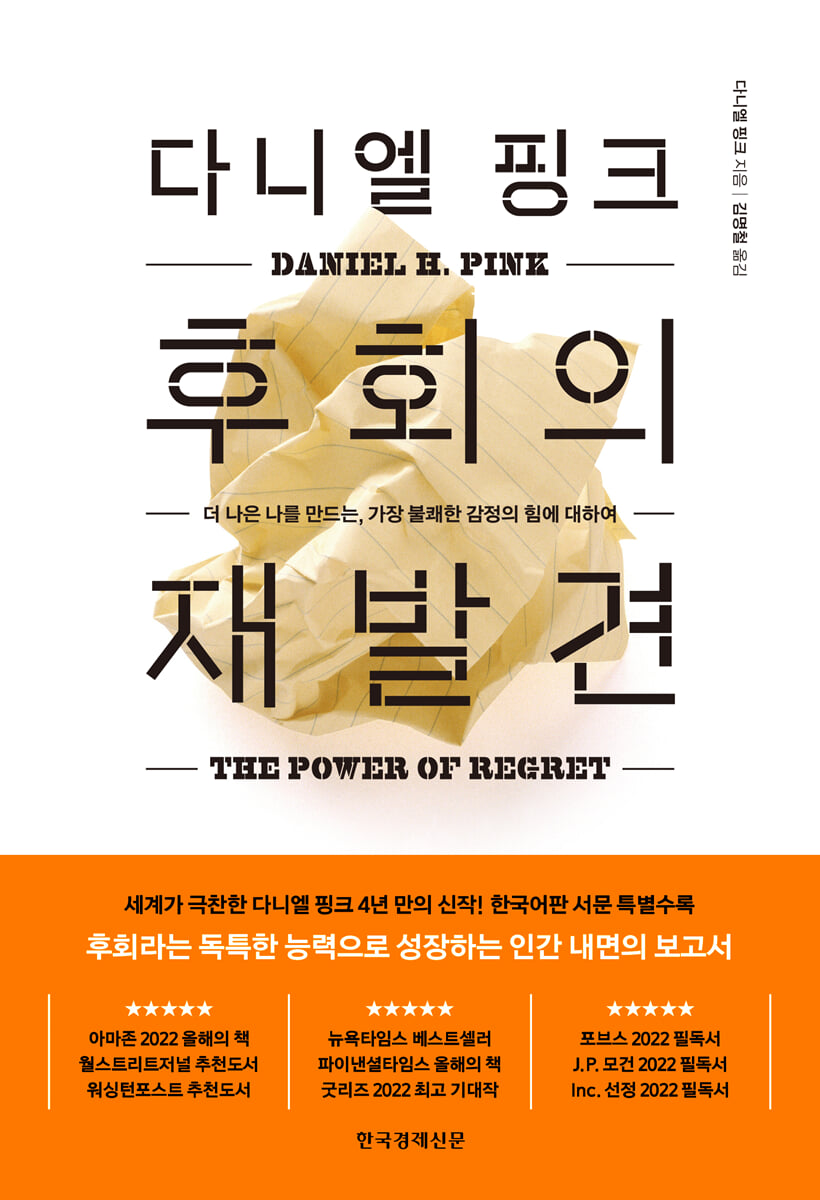
Daniel Pink's Rediscovery of Regret
 |
Description
Book Introduction
Translated into 27 languages immediately after publication! World-renowned business thinker Daniel Pink's new book, his first in four years. The greatest project of all time, analyzing the regrets of over 20,000 people across 105 countries. A report on the inner workings of a human being, growing through the unique ability to regret. Amazon's 2022 Book of the Year * Wall Street Journal Recommended * Washington Post Recommended A New York Times bestseller, a Financial Times Book of the Year, and a Goodreads Most Anticipated Book of 2022. Forbes 2022 Must-Reads * J. P. Morgan 2022 Essential Reading * Inc. Selected 2022 Must-Reads Daniel Pink, a world-renowned futurist and business thinker who has inspired generations, returns with a new work after four years. The new topic he raised was the emotion that humans most want to avoid: 'regret'. The author, a longtime business thinker who has addressed hard-nosed topics like motivation, persuasion, and timing, has expanded his scope into the new realm of emotional power, deepening his understanding of humanity. Daniel Pink opens with the regret-filled life of Edith Piaf, the queen of chanson famous for her song "No, I Regret Nothing," and the regrets of young people from around the world who have tattooed "No Regrets," showing how much we are mistaken about the emotion of regret. And by summarizing all the research on regret conducted to date in the fields of psychology, neuroscience, and economics, and adding the results of two projects conducted by the author himself, it reveals the 'four core regrets' of humans. Through this process, Daniel Pink argues that regret is what makes humans human and is the key to human development. The ability to regret is a kind of privilege that only higher animals have. This ability has enabled humans to become superior to other animals. Regret is not an emotion to be avoided, but rather an emotion to be 'optimized' and utilized. We have built our present self on the foundation of the regrets we faced yesterday. Tomorrow I will be like that too. This book is scientific evidence of humanity's remarkable ability to upgrade itself, and a hopeful suggestion to fearlessly regret and willingly move forward as a better being. |
- You can preview some of the book's contents.
Preview
index
Recommended Reading | How to Regret Wisely - Jaeseung Jeong (Neuroscientist)
Introduction | To Korean Readers
Part 1 Regret Rewatch
Chapter 1: The phrase "I have no regrets" is a life-ruining nonsense.
Chapter 2: Why Regret Makes Us Human
Chapter 3: "At Least" and "If I Had"
Chapter 4: Why Regrets Make Us Better People
Part 2: Digging into Regrets
Chapter 5: The Surface of Regret
Chapter 6: Four Key Regrets
Chapter 7: Regrets on Foundations_If I Had Done That
Chapter 8: Boldness Regrets_If I Had Taken a Risk
Chapter 9 Morality Regrets_If I Had Done the Right Thing
Chapter 10: Relationship Regrets: If I Had Reached Out
Chapter 11 Opportunities and Obligations
Part 3: Using Regrets
Chapter 12 Undo (Ctrl+Z) and 'At Least' Do
Chapter 13: Self-Disclosure, Self-Compassion, and Self-Distancing
Chapter 14 Regret Optimization Framework
Coming out | Regret and salvation
Acknowledgements
Translator's Note
main
Introduction | To Korean Readers
Part 1 Regret Rewatch
Chapter 1: The phrase "I have no regrets" is a life-ruining nonsense.
Chapter 2: Why Regret Makes Us Human
Chapter 3: "At Least" and "If I Had"
Chapter 4: Why Regrets Make Us Better People
Part 2: Digging into Regrets
Chapter 5: The Surface of Regret
Chapter 6: Four Key Regrets
Chapter 7: Regrets on Foundations_If I Had Done That
Chapter 8: Boldness Regrets_If I Had Taken a Risk
Chapter 9 Morality Regrets_If I Had Done the Right Thing
Chapter 10: Relationship Regrets: If I Had Reached Out
Chapter 11 Opportunities and Obligations
Part 3: Using Regrets
Chapter 12 Undo (Ctrl+Z) and 'At Least' Do
Chapter 13: Self-Disclosure, Self-Compassion, and Self-Distancing
Chapter 14 Regret Optimization Framework
Coming out | Regret and salvation
Acknowledgements
Translator's Note
main
Detailed image
.jpg)
Into the book
The tattoo that Telles got that day was almost identical to the one Bruno Santos got inked in Lisbon, Portugal, in 2013.
Santos, unbeknownst to Chase, Batista, and Teles, is a human resources executive at a certain company.
One afternoon, feeling frustrated with his work, he stormed out of the office and headed straight to the tattoo parlor.
He also had a three-syllable phrase tattooed on his right forearm.
These four people live on three continents.
They all have tattoos of the following two words:
'No regrets.'
---From "Chapter 1: 'I have no regrets' is nonsense that ruins life"
Humans can visit the past and future in their minds.
And we can talk about things that never actually happened.
We are seasoned time travelers and skilled storytellers.
These two abilities form a cognitive double helix that creates regrets in life.
(…) The combination of time travel and fiction is a human superpower.
Just as it's hard to imagine a jellyfish composing a sonnet or a raccoon rewiring a floor lamp, it's hard to imagine any other species besides humans capable of such complex tasks.
On the other hand, we easily exercise this superpower.
In fact, this ability is so deeply ingrained in the human brain that the only people who lack it are children whose brains are not fully developed and adults who have suffered brain damage due to illness or injury. (…) That’s why most children don’t understand regret until they are six years old.
But by age eight, the ability to anticipate regret also develops.
And during adolescence, the cognitive abilities needed to experience regret are fully developed.
Regret is a sign of a healthy and mature mind.
---From "Chapter 2: Why Regret Makes Us Human"
Counterfactual statements like "at least" may protect your feelings in the present, but they rarely lead to better decisions or better outcomes in the future.
Counterfactual statements like "if only I had done it" may make us feel worse in the moment, but they can improve our lives later.
This is the key.
Regret is a classic bottom-up counterfactual narrative (ultimately a 'what if' thought).
Scientists are discovering that the source of regret's power confounds the traditional pain/pleasure calculus.
The purpose of regret is to make us feel worse.
Because by making us feel bad today, we can help ourselves do better tomorrow.
---From "Chapter 3 'At least' and 'If I had done it'"
If foundational regrets arise from failing to plan ahead, work hard, execute, and build a stable foundation for life, bold regrets arise from failing to use that foundation as a stepping stone to a more abundant life.
Boldness Regret can arise from the accumulation of decisions and indecisions, or it can explode from a single trigger.
But whatever its source, the question it poses to us is always the same.
Should we play it safe or take a chance? Boldness: Regret comes when we make the safe choice.
Making safe choices can give you peace of mind at first.
Because the changes we are grappling with can seem too big, too disruptive, too challenging, and too difficult.
But ultimately, that choice causes us to suffer because it triggers counterfactual thinking that if we had made a bolder decision, the outcome would have been more fulfilling.
Santos, unbeknownst to Chase, Batista, and Teles, is a human resources executive at a certain company.
One afternoon, feeling frustrated with his work, he stormed out of the office and headed straight to the tattoo parlor.
He also had a three-syllable phrase tattooed on his right forearm.
These four people live on three continents.
They all have tattoos of the following two words:
'No regrets.'
---From "Chapter 1: 'I have no regrets' is nonsense that ruins life"
Humans can visit the past and future in their minds.
And we can talk about things that never actually happened.
We are seasoned time travelers and skilled storytellers.
These two abilities form a cognitive double helix that creates regrets in life.
(…) The combination of time travel and fiction is a human superpower.
Just as it's hard to imagine a jellyfish composing a sonnet or a raccoon rewiring a floor lamp, it's hard to imagine any other species besides humans capable of such complex tasks.
On the other hand, we easily exercise this superpower.
In fact, this ability is so deeply ingrained in the human brain that the only people who lack it are children whose brains are not fully developed and adults who have suffered brain damage due to illness or injury. (…) That’s why most children don’t understand regret until they are six years old.
But by age eight, the ability to anticipate regret also develops.
And during adolescence, the cognitive abilities needed to experience regret are fully developed.
Regret is a sign of a healthy and mature mind.
---From "Chapter 2: Why Regret Makes Us Human"
Counterfactual statements like "at least" may protect your feelings in the present, but they rarely lead to better decisions or better outcomes in the future.
Counterfactual statements like "if only I had done it" may make us feel worse in the moment, but they can improve our lives later.
This is the key.
Regret is a classic bottom-up counterfactual narrative (ultimately a 'what if' thought).
Scientists are discovering that the source of regret's power confounds the traditional pain/pleasure calculus.
The purpose of regret is to make us feel worse.
Because by making us feel bad today, we can help ourselves do better tomorrow.
---From "Chapter 3 'At least' and 'If I had done it'"
If foundational regrets arise from failing to plan ahead, work hard, execute, and build a stable foundation for life, bold regrets arise from failing to use that foundation as a stepping stone to a more abundant life.
Boldness Regret can arise from the accumulation of decisions and indecisions, or it can explode from a single trigger.
But whatever its source, the question it poses to us is always the same.
Should we play it safe or take a chance? Boldness: Regret comes when we make the safe choice.
Making safe choices can give you peace of mind at first.
Because the changes we are grappling with can seem too big, too disruptive, too challenging, and too difficult.
But ultimately, that choice causes us to suffer because it triggers counterfactual thinking that if we had made a bolder decision, the outcome would have been more fulfilling.
---From "Chapter 8: Boldness and Regret_If I Had Taken the Risk"
Publisher's Review
How Regret Becomes a Human Privilege
Only humans look back, regret, and grow.
The Secret of Humanity: Upgrading Yourself Through the Power of Regret
"You want to live without regrets? That's nonsense." Everyone dreams of a life without regrets.
I want to become someone with a strong mentality who can coolly shake off the past and move forward with 'no regrets'.
However, Daniel Pink points out that this thinking is wrong.
Returning after four years, he argues in this book that regret is a special ability that only humans possess, and that humans have continued to develop thanks to the ability to regret.
Regret begins with two unique human capacities.
First, we have the ability to 'time travel', to visit the past and future in our minds.
Second, we have the ability to 'storytell', to talk about things that never actually happened.
When these two abilities meet, a surprising phenomenon called regret occurs.
It involves going back in time, denying what actually happened, making different choices, then returning to the present and imagining the satisfaction you would feel now if the past were changed.
This is a power that is almost supernatural.
Just as it's hard to imagine a jellyfish composing music or a raccoon doing electrical work, it's hard to imagine any other species besides humans being capable of such complex tasks.
On the other hand, we easily exercise this superpower.
In fact, this ability is so deeply ingrained in the human brain that studies have shown that the only people who lack the ability to regret are children under the age of six, whose brains are not fully developed, and adults who have suffered brain damage due to illness or injury.
Simply put, people who have no regrets do not have a strong mentality.
They are usually people with serious illnesses.
In other words, all normal adults with healthy brains regret it.
Contrary to our desire to avoid regret, regret is one of the most common and frequently mentioned emotions among humans.
According to the survey, regret was the second most common emotion.
The number one emotion was love (and as a result, the number one negative emotion was regret).
Yet, we want to run away from regret.
Because regret is too painful.
As the superpower of regret is activated, a process of 'comparison' takes place within us, in which we think that if we had made different choices in the past, we could have enjoyed a better present, and a process of 'blame' takes place, in which we cannot help but blame ourselves because we are the ones who made those choices.
Is there anything more bitter than comparison and self-reproach? The pain is so intense that we fool ourselves into thinking we have no regrets.
But that's a lie.
According to the author's American Regret Project (2021), 82 percent of respondents regretted flossing far more often than they did brushing their teeth.
So why did humans develop the capacity for regret? Are we self-destructive masochists? No.
We are organisms programmed for survival.
The pain of regret strengthens our ability to improve our lives.
The purpose of regret is to make us feel terribly bad.
So that it leads to making better choices tomorrow.
The secret to regret is that it helps us upgrade ourselves using the pain that hurts our bones as a stepping stone, and that is how we develop into better beings.
What is your biggest regret in life?
Your regrets tell you what you want
The largest-ever "regret project" that collected the regrets of over 20,000 people around the world and the four core regrets
As regret is one of the most common emotions felt by humans, there are many different ways in which it is expressed.
After analyzing research on regret in psychology, neuroscience, and economics, the author conducted two projects to gain a clearer understanding of the nature of regret.
These are the 'American Regret Project' mentioned above, which surveyed 4,824 Americans, and the 'World Regret Survey (www.worldregretsurvey.com)', which collected stories from 16,000 people in 105 countries.
The author categorized and analyzed numerous regrets and identified their deep structure, and summarized the most common regrets felt by humans into the 'four core regrets.'
First, foundation regrets are regrets about areas that form the foundation of our lives, such as health, assets, and education, such as “If only I had exercised harder” or “If only I had saved more consistently.”
This regret, which is related to integrity, shows that we are beings who pursue physical well-being and material security.
Second, boldness regrets are regrets that arise when you anticipate that you would have achieved more if you had made a bolder decision, such as "If only I had asked her out on a date" or "If only I had started a business then."
This regret, which is linked to courage, shows that we are beings who pursue growth.
Third, moral regrets are the regrets that come when you do something that goes against your conscience, such as, "If only I hadn't lied" or "If only I hadn't bullied that kid."
This regret is somewhat more complex than other regrets because we all have different standards for morality, and it shows that we are beings who pursue goodness.
Fourth, connection regrets are regrets that arise when precious relationships with spouses, parents, children, or friends are severed or damaged, such as “I wish I had told my parents I loved them” or “I wish I had reached out to that friend first.”
This is the most common of the four core regrets, and it shows that we are beings who pursue love above all else.
In conclusion, no emotion reveals who we are as much as regret.
We pursue stability as a solid foundation for material, physical, and spiritual well-being.
We hope to explore and grow by pursuing new things and acting boldly.
We want to do the right thing (keep our moral commitments, be good people).
We long to connect with others to form friendships and family relationships that are bound by love.
In this way, the negative emotion of regret paradoxically acts as a mirror image that shows a positive direction in life.
Don't "minimize" your regrets; "optimize" them.
The Regret Optimization Framework: Leading to the Best Choice
So how can we harness its power without running away from regret?
The author divides the response into two types: 'regret that has already occurred' and 'regret that is expected to occur' but has not yet occurred.
The author recommends going through a three-step process of 'self-disclosure, self-compassion, and self-distancing' for regrets that have already occurred.
Because it is possible to develop appropriate strategies only after making regret fully your own, I argue that you must fully embrace your regret through a self-disclosure stage where you reveal your regret, and a self-compassion stage where you realize how common and normal your regret is.
It shows that you can develop a wise strategy by taking a step back and analyzing your regrets, such as thinking about what advice you would give to someone else who had the same regret as you, or imagining what choices you would make if you looked back on the present 10 years from now.
Meanwhile, let me first issue an important warning about the expected regret.
By predicting regret, we can create a better future, but if we get caught up in prediction, we can end up remaining passive, avoiding decisions and risk, as we only try to minimize regret.
Therefore, we propose a framework that 'optimizes' regret rather than minimizing it.
The author's "regret optimization framework" is as follows:
If the decision you have to make right now doesn't involve one of your four core regrets, make it easy and be moderately satisfied.
That decision will not leave you with any major regrets in life.
If you find yourself struggling with any of the four core regrets, consider this:
Project yourself to a specific point in the future and anticipate which of your current decisions will lead to one of your four core regrets.
The choice you make after that much time will be the best decision.
Our daily lives are made up of hundreds of decisions.
Some of them are crucial to our happiness, but many are insignificant.
Understanding the difference can make a big difference.
When we know what we truly regret, we discover what we truly value.
Regret shows us the way to a good life.
Only humans look back, regret, and grow.
The Secret of Humanity: Upgrading Yourself Through the Power of Regret
"You want to live without regrets? That's nonsense." Everyone dreams of a life without regrets.
I want to become someone with a strong mentality who can coolly shake off the past and move forward with 'no regrets'.
However, Daniel Pink points out that this thinking is wrong.
Returning after four years, he argues in this book that regret is a special ability that only humans possess, and that humans have continued to develop thanks to the ability to regret.
Regret begins with two unique human capacities.
First, we have the ability to 'time travel', to visit the past and future in our minds.
Second, we have the ability to 'storytell', to talk about things that never actually happened.
When these two abilities meet, a surprising phenomenon called regret occurs.
It involves going back in time, denying what actually happened, making different choices, then returning to the present and imagining the satisfaction you would feel now if the past were changed.
This is a power that is almost supernatural.
Just as it's hard to imagine a jellyfish composing music or a raccoon doing electrical work, it's hard to imagine any other species besides humans being capable of such complex tasks.
On the other hand, we easily exercise this superpower.
In fact, this ability is so deeply ingrained in the human brain that studies have shown that the only people who lack the ability to regret are children under the age of six, whose brains are not fully developed, and adults who have suffered brain damage due to illness or injury.
Simply put, people who have no regrets do not have a strong mentality.
They are usually people with serious illnesses.
In other words, all normal adults with healthy brains regret it.
Contrary to our desire to avoid regret, regret is one of the most common and frequently mentioned emotions among humans.
According to the survey, regret was the second most common emotion.
The number one emotion was love (and as a result, the number one negative emotion was regret).
Yet, we want to run away from regret.
Because regret is too painful.
As the superpower of regret is activated, a process of 'comparison' takes place within us, in which we think that if we had made different choices in the past, we could have enjoyed a better present, and a process of 'blame' takes place, in which we cannot help but blame ourselves because we are the ones who made those choices.
Is there anything more bitter than comparison and self-reproach? The pain is so intense that we fool ourselves into thinking we have no regrets.
But that's a lie.
According to the author's American Regret Project (2021), 82 percent of respondents regretted flossing far more often than they did brushing their teeth.
So why did humans develop the capacity for regret? Are we self-destructive masochists? No.
We are organisms programmed for survival.
The pain of regret strengthens our ability to improve our lives.
The purpose of regret is to make us feel terribly bad.
So that it leads to making better choices tomorrow.
The secret to regret is that it helps us upgrade ourselves using the pain that hurts our bones as a stepping stone, and that is how we develop into better beings.
What is your biggest regret in life?
Your regrets tell you what you want
The largest-ever "regret project" that collected the regrets of over 20,000 people around the world and the four core regrets
As regret is one of the most common emotions felt by humans, there are many different ways in which it is expressed.
After analyzing research on regret in psychology, neuroscience, and economics, the author conducted two projects to gain a clearer understanding of the nature of regret.
These are the 'American Regret Project' mentioned above, which surveyed 4,824 Americans, and the 'World Regret Survey (www.worldregretsurvey.com)', which collected stories from 16,000 people in 105 countries.
The author categorized and analyzed numerous regrets and identified their deep structure, and summarized the most common regrets felt by humans into the 'four core regrets.'
First, foundation regrets are regrets about areas that form the foundation of our lives, such as health, assets, and education, such as “If only I had exercised harder” or “If only I had saved more consistently.”
This regret, which is related to integrity, shows that we are beings who pursue physical well-being and material security.
Second, boldness regrets are regrets that arise when you anticipate that you would have achieved more if you had made a bolder decision, such as "If only I had asked her out on a date" or "If only I had started a business then."
This regret, which is linked to courage, shows that we are beings who pursue growth.
Third, moral regrets are the regrets that come when you do something that goes against your conscience, such as, "If only I hadn't lied" or "If only I hadn't bullied that kid."
This regret is somewhat more complex than other regrets because we all have different standards for morality, and it shows that we are beings who pursue goodness.
Fourth, connection regrets are regrets that arise when precious relationships with spouses, parents, children, or friends are severed or damaged, such as “I wish I had told my parents I loved them” or “I wish I had reached out to that friend first.”
This is the most common of the four core regrets, and it shows that we are beings who pursue love above all else.
In conclusion, no emotion reveals who we are as much as regret.
We pursue stability as a solid foundation for material, physical, and spiritual well-being.
We hope to explore and grow by pursuing new things and acting boldly.
We want to do the right thing (keep our moral commitments, be good people).
We long to connect with others to form friendships and family relationships that are bound by love.
In this way, the negative emotion of regret paradoxically acts as a mirror image that shows a positive direction in life.
Don't "minimize" your regrets; "optimize" them.
The Regret Optimization Framework: Leading to the Best Choice
So how can we harness its power without running away from regret?
The author divides the response into two types: 'regret that has already occurred' and 'regret that is expected to occur' but has not yet occurred.
The author recommends going through a three-step process of 'self-disclosure, self-compassion, and self-distancing' for regrets that have already occurred.
Because it is possible to develop appropriate strategies only after making regret fully your own, I argue that you must fully embrace your regret through a self-disclosure stage where you reveal your regret, and a self-compassion stage where you realize how common and normal your regret is.
It shows that you can develop a wise strategy by taking a step back and analyzing your regrets, such as thinking about what advice you would give to someone else who had the same regret as you, or imagining what choices you would make if you looked back on the present 10 years from now.
Meanwhile, let me first issue an important warning about the expected regret.
By predicting regret, we can create a better future, but if we get caught up in prediction, we can end up remaining passive, avoiding decisions and risk, as we only try to minimize regret.
Therefore, we propose a framework that 'optimizes' regret rather than minimizing it.
The author's "regret optimization framework" is as follows:
If the decision you have to make right now doesn't involve one of your four core regrets, make it easy and be moderately satisfied.
That decision will not leave you with any major regrets in life.
If you find yourself struggling with any of the four core regrets, consider this:
Project yourself to a specific point in the future and anticipate which of your current decisions will lead to one of your four core regrets.
The choice you make after that much time will be the best decision.
Our daily lives are made up of hundreds of decisions.
Some of them are crucial to our happiness, but many are insignificant.
Understanding the difference can make a big difference.
When we know what we truly regret, we discover what we truly value.
Regret shows us the way to a good life.
GOODS SPECIFICS
- Publication date: September 15, 2022
- Page count, weight, size: 328 pages | 536g | 147*215*20mm
- ISBN13: 9788947548441
- ISBN10: 8947548448
You may also like
카테고리
korean


korean

![GQ KOREA Mark (Monthly): December [2025]](http://librairie.coreenne.fr/cdn/shop/files/8ef265dbbfbf186523ed75ba7319009d.jpg?v=1765340328&width=3840)


