

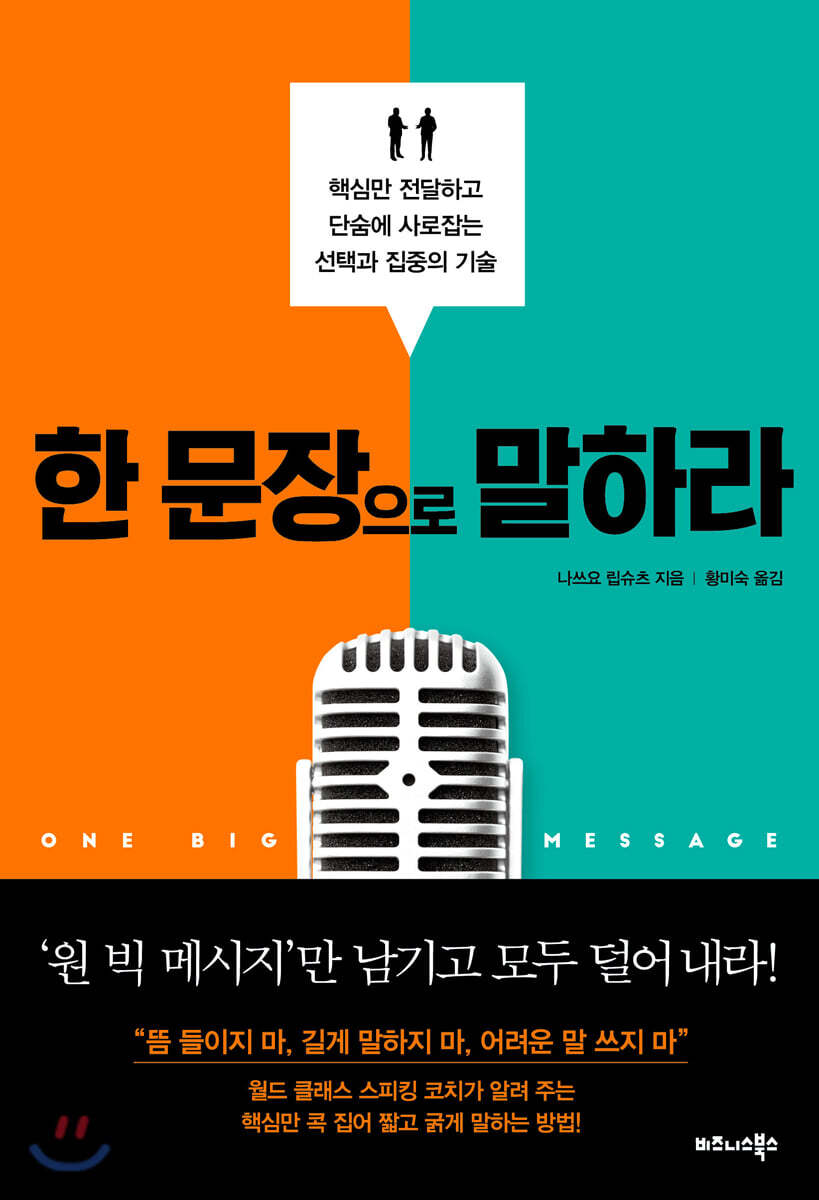
Say it in one sentence
 |
Description
Book Introduction
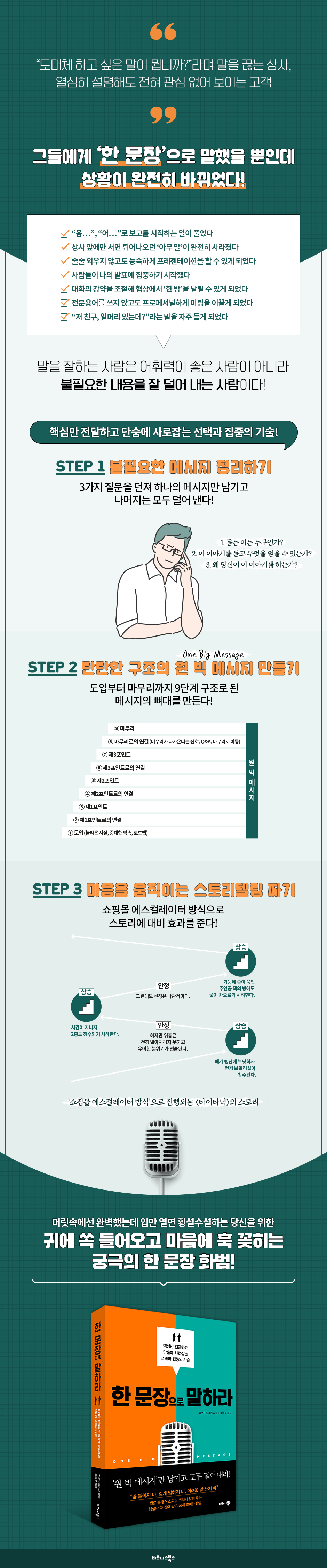
The boss cuts me off by saying, “What on earth are you trying to say?”
No matter how hard I explain, the customer doesn't seem interested at all...
I just said 'one sentence' to them and the situation completely changed!
The power of 'One Big Message', stronger than words!
One of the most common mistakes employees make when reporting to their superiors or giving presentations is to ramble on and on in an attempt to convey as much information as possible.
But the more you try to convey, the less messages will remain in the other person's mind.
As a result, I end up hearing, “So, what are you trying to say?”
Natsuo Lipshutz, a world-renowned professional speaker and TEDx speaker, says, "The most important thing in business communication is the ability to grasp the core and organize it neatly into one big message without any unnecessary details."
If you can't get rid of unnecessary messages, you can never make the other person understand even if you change your tone, write a manuscript, and recite it sweetly.
"Say It in One Sentence" is a book that contains methods for clearly conveying what you want to say in various business situations such as presentations, meetings, sales, and interviews, moving the hearts of others, and achieving the desired results.
The author uses examples of failed catchphrases and presentations to explain seven reasons why messages fail to get across, no matter how much you explain them.
Next, we will explain how to clearly convey the message in three steps: Step 1: Clearing out unnecessary messages, Step 2: Creating a solid, structured, one-big message, and Step 3: Weaving a story that moves hearts.
In addition, it details nonverbal techniques that increase the effectiveness of message delivery, such as facial expressions, eye contact, timing of breaks, and how to use gestures.
Will you be someone who tires with lengthy explanations, or someone who moves the hearts of others with short, impactful remarks? This book will teach readers how to convey their thoughts in simple, clear "one-liners," and leverage this as a powerful business tool.
No matter how hard I explain, the customer doesn't seem interested at all...
I just said 'one sentence' to them and the situation completely changed!
The power of 'One Big Message', stronger than words!
One of the most common mistakes employees make when reporting to their superiors or giving presentations is to ramble on and on in an attempt to convey as much information as possible.
But the more you try to convey, the less messages will remain in the other person's mind.
As a result, I end up hearing, “So, what are you trying to say?”
Natsuo Lipshutz, a world-renowned professional speaker and TEDx speaker, says, "The most important thing in business communication is the ability to grasp the core and organize it neatly into one big message without any unnecessary details."
If you can't get rid of unnecessary messages, you can never make the other person understand even if you change your tone, write a manuscript, and recite it sweetly.
"Say It in One Sentence" is a book that contains methods for clearly conveying what you want to say in various business situations such as presentations, meetings, sales, and interviews, moving the hearts of others, and achieving the desired results.
The author uses examples of failed catchphrases and presentations to explain seven reasons why messages fail to get across, no matter how much you explain them.
Next, we will explain how to clearly convey the message in three steps: Step 1: Clearing out unnecessary messages, Step 2: Creating a solid, structured, one-big message, and Step 3: Weaving a story that moves hearts.
In addition, it details nonverbal techniques that increase the effectiveness of message delivery, such as facial expressions, eye contact, timing of breaks, and how to use gestures.
Will you be someone who tires with lengthy explanations, or someone who moves the hearts of others with short, impactful remarks? This book will teach readers how to convey their thoughts in simple, clear "one-liners," and leverage this as a powerful business tool.
- You can preview some of the book's contents.
Preview
index
Do you have the courage to 'let go' when publishing a book?
Prologue: Simple words that make you nod and get lost in them are always the best.
Chapter 1.
Why Your Message Doesn't Get Through No Matter How Much You Explain
Unnecessary messages lead to misunderstandings.
You are not the main character of the story
No one will focus on the ramblings
Are you selling a product or a possibility?
The other person isn't interested in your success story.
Don't try to convey nuance
The blind spot of speech that emphasizes only logical correctness
Chapter 2.
[STEP 1: Organizing Unnecessary Messages] What to Eliminate
Information organization determines the success or failure of speaking.
Possess the trifecta of logic, emotion, and trust.
Find common ground with your listeners.
Question 1: Finding commonalities with the listener Who is the listener?
Question 2: Finding common ground with the listener What can the listener gain?
Question to find common ground with the listener ③ Why are you talking?
Question ④ Finding common ground with the listener What is the purpose of the story?
One Big Message Speech Technique You Can Use in Interviews
Chapter 3.
[STEP 2: Creating a Strong, One-Big Message] What to Convey
A 9-Step Structure for Creating One Big Message
The Golden Ratio for Creating an Impressive Introduction
Expand your ideas with divergent thinking
Narrow your message with convergent thinking
Support your message with three reasons.
Check your logic with 'Why So?'
Elevate Your Message with 'So What?'
The 'sticky' point varies depending on the opponent.
Chapter 4.
[STEP 3: Crafting a Story that Moves] How to Captivate
Start the conversation without any formalities.
The power of storytelling that compels anyone to listen
Add excitement and suspense to your story.
Presentations are entertainment
The story structure of 'setting the situation - crisis - change'
Will it give hope or threaten?
No one will be impressed by just listing examples.
The 7-30 Second Rule That Determines Focus
3 Ways to Captivate Your Opponent in 7 Seconds
4 Tips for a Memorable Finish
Chapter 5.
Nonverbal skills are just as important as the one big message.
Exchange emotions with your listeners.
93% of communication is nonverbal information
Use an analogy like Steve Jobs.
The biggest enemy of communication is 'no change'.
Take a break to focus
Distinguish words by weight
Give meaning to actions
3-Step Technique to Eliminate “Um…” and “There…”
The best rehearsal is 'recording'
Appendix One: Checklist for a Big Message Strategy
The Courage to Let Go of Epilogue: A Powerful Business Weapon
Prologue: Simple words that make you nod and get lost in them are always the best.
Chapter 1.
Why Your Message Doesn't Get Through No Matter How Much You Explain
Unnecessary messages lead to misunderstandings.
You are not the main character of the story
No one will focus on the ramblings
Are you selling a product or a possibility?
The other person isn't interested in your success story.
Don't try to convey nuance
The blind spot of speech that emphasizes only logical correctness
Chapter 2.
[STEP 1: Organizing Unnecessary Messages] What to Eliminate
Information organization determines the success or failure of speaking.
Possess the trifecta of logic, emotion, and trust.
Find common ground with your listeners.
Question 1: Finding commonalities with the listener Who is the listener?
Question 2: Finding common ground with the listener What can the listener gain?
Question to find common ground with the listener ③ Why are you talking?
Question ④ Finding common ground with the listener What is the purpose of the story?
One Big Message Speech Technique You Can Use in Interviews
Chapter 3.
[STEP 2: Creating a Strong, One-Big Message] What to Convey
A 9-Step Structure for Creating One Big Message
The Golden Ratio for Creating an Impressive Introduction
Expand your ideas with divergent thinking
Narrow your message with convergent thinking
Support your message with three reasons.
Check your logic with 'Why So?'
Elevate Your Message with 'So What?'
The 'sticky' point varies depending on the opponent.
Chapter 4.
[STEP 3: Crafting a Story that Moves] How to Captivate
Start the conversation without any formalities.
The power of storytelling that compels anyone to listen
Add excitement and suspense to your story.
Presentations are entertainment
The story structure of 'setting the situation - crisis - change'
Will it give hope or threaten?
No one will be impressed by just listing examples.
The 7-30 Second Rule That Determines Focus
3 Ways to Captivate Your Opponent in 7 Seconds
4 Tips for a Memorable Finish
Chapter 5.
Nonverbal skills are just as important as the one big message.
Exchange emotions with your listeners.
93% of communication is nonverbal information
Use an analogy like Steve Jobs.
The biggest enemy of communication is 'no change'.
Take a break to focus
Distinguish words by weight
Give meaning to actions
3-Step Technique to Eliminate “Um…” and “There…”
The best rehearsal is 'recording'
Appendix One: Checklist for a Big Message Strategy
The Courage to Let Go of Epilogue: A Powerful Business Weapon
Detailed image
Into the book
Whether it's a presentation, a report to your boss, or a sales meeting, every business talk has a message you want to convey to the other person.
In the Breakthrough Method, that single, important message is called the "One Big Message."
If you put what you want to say into one big message, it will be much more effective in conveying it to the other person.
And it is most important to summarize the one big message in one sentence and convey it more clearly as intended.
You might think that it is absolutely impossible to convey a message in one sentence.
Of course, this doesn't mean that you have to finish everything you say in one sentence.
This means condensing the one big message you want to leave in the listener's mind into one sentence.
--- 「Chapter 1.
From "Why Your Message Doesn't Get Through No Matter How Much You Explain"
In the Breakthrough Method, the listener is the main character.
A good presenter is someone who can talk from the listener's perspective without making himself the main character.
For example, students often just gloss over what the principal says during class assembly.
At this point, if the principal were to simply say, “I attended a hip-hop class yesterday…” the students would suddenly pay attention.
In other words, if you make the listener the main character, he or she can accept other people's business as his or her own.
So, when preparing a presentation, meeting, or report, first throw away the idea that you are the main character and write and speak as if you were the listener and the main character of every story.
--- 「Chapter 1.
From "Why Your Message Doesn't Get Through No Matter How Much You Explain"
Let's start with the basics.
What is business speaking? Craig Valentine, a world-class speaking expert who also appeared in Chapter 1, said, "Business speaking, including presentations and speeches, is about making the listeners TALL."
'TALL' is an acronym for 'Think, Act, Learn, Laugh'.
That is, through speaking, we make the other person think, act, learn, and laugh.
If I were to put it in one sentence, I would say it is 'entertainment of information.'
If you want to move the minds and hearts of others by providing valuable information that you have, you must make them think, act, learn, and enjoy it for themselves.
When I say this, people often say that work can't be fun because it's just work.
However, if you give the listener a new insight, they will think, "That was helpful," or "It was good to listen."
You have to provide valuable information that allows the other person to think that way.
--- 「Chapter 2.
From "STEP 1: Organizing Unnecessary Messages" to "What to Get Rid of"
It is said that three elements are usually needed to elicit human behavior.
These are ethos (trust), pathos (emotion), and logos (logic).
It is also evidence that human nature has not changed much since the Greek era, as evidenced by Aristotle's 'three elements of persuasion'.
In other words, only when ethos, pathos, and logos are present can one move the human head and heart.
If you want your audience to feel like they're worth coming to see or hear, you need to present something that appeals to their emotions as well as their reason.
--- 「Chapter 2.
From "STEP 1: Organizing Unnecessary Messages" to "What to Get Rid of"
To move the other person's head and heart, you must use information strategically and in detail.
In particular, all information must flow coherently, connected by lines rather than dots.
What makes this possible is the nine-step structure presented in the Breakthrough Method.
Let's break down what you want to convey into 9 steps and move the hearts and minds of your listeners like the world's best speakers.
There are three elements that make the nine-step structure rich.
① Everything points toward one big message.
② Each main point includes a 'connection' step.
③ The introduction and conclusion are each divided into three parts.
--- Chapter 3.
From "STEP 2 Creating a One Big Message with a Solid Structure" What to Convey
Hopeful scenarios that suggest a bright future awaits the other person are often used in advertising and promotional texts.
Conversely, there are also intimidation scenarios that use words that stab the heart and instill fear in the listener.
It is mainly a way to encourage the idea that a dangerous future awaits.
People who don't get at least five hours of quality sleep a night are more likely to develop Alzheimer's.
If you make the wrong investment choices here, your chances of spending your old age in poverty increase by 50 percent.
By creating a sense of crisis like this, you can easily attract people's attention.
We often come across headlines in weekly magazines that incite a sense of crisis, such as, "If we continue like this, the domestic economy will collapse."
However, if you mix hopeful and threatening scenarios appropriately, the contrast effect is maximized.
--- 「Chapter 4.
From "STEP 3: Crafting a Storytelling That Moves the Heart" How to Captivate
Of course, everyone naturally uses nonverbal communication in everyday life, but in important situations, the words and expressions that come out of our mouths can be out of sync without us even realizing it.
Especially in cultures that do not express emotions with as much facial expression and gestures as the West, it is highly likely that the message will be 'not conveyed' or 'lacking emotional appeal.'
For example, consider saying, “I am very pleased to have the opportunity to speak at this meeting today.”
It's not a good idea from the perspective of the 7-second and 30-second rules, but have you ever seen someone say this line with genuine joy?
In most cases, this is said in a tone of voice without any emotion.
Then, of course, it would give the impression that it was said as a courtesy.
First impressions are often determined by the introduction.
So, unless it's a really happy greeting for a particularly personal reason, it's better to avoid such sentences.
In the Breakthrough Method, that single, important message is called the "One Big Message."
If you put what you want to say into one big message, it will be much more effective in conveying it to the other person.
And it is most important to summarize the one big message in one sentence and convey it more clearly as intended.
You might think that it is absolutely impossible to convey a message in one sentence.
Of course, this doesn't mean that you have to finish everything you say in one sentence.
This means condensing the one big message you want to leave in the listener's mind into one sentence.
--- 「Chapter 1.
From "Why Your Message Doesn't Get Through No Matter How Much You Explain"
In the Breakthrough Method, the listener is the main character.
A good presenter is someone who can talk from the listener's perspective without making himself the main character.
For example, students often just gloss over what the principal says during class assembly.
At this point, if the principal were to simply say, “I attended a hip-hop class yesterday…” the students would suddenly pay attention.
In other words, if you make the listener the main character, he or she can accept other people's business as his or her own.
So, when preparing a presentation, meeting, or report, first throw away the idea that you are the main character and write and speak as if you were the listener and the main character of every story.
--- 「Chapter 1.
From "Why Your Message Doesn't Get Through No Matter How Much You Explain"
Let's start with the basics.
What is business speaking? Craig Valentine, a world-class speaking expert who also appeared in Chapter 1, said, "Business speaking, including presentations and speeches, is about making the listeners TALL."
'TALL' is an acronym for 'Think, Act, Learn, Laugh'.
That is, through speaking, we make the other person think, act, learn, and laugh.
If I were to put it in one sentence, I would say it is 'entertainment of information.'
If you want to move the minds and hearts of others by providing valuable information that you have, you must make them think, act, learn, and enjoy it for themselves.
When I say this, people often say that work can't be fun because it's just work.
However, if you give the listener a new insight, they will think, "That was helpful," or "It was good to listen."
You have to provide valuable information that allows the other person to think that way.
--- 「Chapter 2.
From "STEP 1: Organizing Unnecessary Messages" to "What to Get Rid of"
It is said that three elements are usually needed to elicit human behavior.
These are ethos (trust), pathos (emotion), and logos (logic).
It is also evidence that human nature has not changed much since the Greek era, as evidenced by Aristotle's 'three elements of persuasion'.
In other words, only when ethos, pathos, and logos are present can one move the human head and heart.
If you want your audience to feel like they're worth coming to see or hear, you need to present something that appeals to their emotions as well as their reason.
--- 「Chapter 2.
From "STEP 1: Organizing Unnecessary Messages" to "What to Get Rid of"
To move the other person's head and heart, you must use information strategically and in detail.
In particular, all information must flow coherently, connected by lines rather than dots.
What makes this possible is the nine-step structure presented in the Breakthrough Method.
Let's break down what you want to convey into 9 steps and move the hearts and minds of your listeners like the world's best speakers.
There are three elements that make the nine-step structure rich.
① Everything points toward one big message.
② Each main point includes a 'connection' step.
③ The introduction and conclusion are each divided into three parts.
--- Chapter 3.
From "STEP 2 Creating a One Big Message with a Solid Structure" What to Convey
Hopeful scenarios that suggest a bright future awaits the other person are often used in advertising and promotional texts.
Conversely, there are also intimidation scenarios that use words that stab the heart and instill fear in the listener.
It is mainly a way to encourage the idea that a dangerous future awaits.
People who don't get at least five hours of quality sleep a night are more likely to develop Alzheimer's.
If you make the wrong investment choices here, your chances of spending your old age in poverty increase by 50 percent.
By creating a sense of crisis like this, you can easily attract people's attention.
We often come across headlines in weekly magazines that incite a sense of crisis, such as, "If we continue like this, the domestic economy will collapse."
However, if you mix hopeful and threatening scenarios appropriately, the contrast effect is maximized.
--- 「Chapter 4.
From "STEP 3: Crafting a Storytelling That Moves the Heart" How to Captivate
Of course, everyone naturally uses nonverbal communication in everyday life, but in important situations, the words and expressions that come out of our mouths can be out of sync without us even realizing it.
Especially in cultures that do not express emotions with as much facial expression and gestures as the West, it is highly likely that the message will be 'not conveyed' or 'lacking emotional appeal.'
For example, consider saying, “I am very pleased to have the opportunity to speak at this meeting today.”
It's not a good idea from the perspective of the 7-second and 30-second rules, but have you ever seen someone say this line with genuine joy?
In most cases, this is said in a tone of voice without any emotion.
Then, of course, it would give the impression that it was said as a courtesy.
First impressions are often determined by the introduction.
So, unless it's a really happy greeting for a particularly personal reason, it's better to avoid such sentences.
--- Chapter 5.
From "Nonverbal skills are as important as the one big message"
From "Nonverbal skills are as important as the one big message"
Publisher's Review
“A person who speaks well is not one who has a good vocabulary,
“He is a person who is good at removing unnecessary content.”
The ultimate one-sentence idiom that gets right into your ears and hits the heart!
One of the misconceptions most people have is that a good vocabulary means you can speak well.
However, the ability to convey one's thoughts clearly and persuasively is never determined by vocabulary level or speaking skills.
Vocabulary is just one of the many tools you have to convey what you want to say, and even if you are shy and reserved, you can easily move people's hearts with your words if you have a vocabulary level equivalent to that of a first grader.
Natsuo Lipshutz, the author of "Say It in One Sentence," is also from a non-English speaking background and has an English vocabulary of only 10,000 words (the vocabulary of an adult native English speaker is 20,000 to 35,000 words). Despite this, she has swept numerous international English speaking competitions and is active as a speaking expert who teaches business speaking on the world stage.
So what is the most important requirement for effective speaking? Natsuo Lipshutz argues that it's the "ability to convey a message."
People don't capture as much information when listening to other people's stories as they do when watching movies or television, and the human brain's ability to remember information it first hears through hearing is far less than we might expect.
The more messages and information you try to convey, the less likely you are to focus on the truly important information.
Therefore, we must thoroughly eliminate unnecessary information and deliver the message that will reach the other person's ears simply, concisely, and clearly.
“Presentations, reports, sales meetings…
“Let every word contain only one message!”
Speaking skills used in real-world situations by the top 1% of workers!
However, even if you know this theory in your head, it is not easy to apply it in practice.
In the greed to convey as much information as possible, we sometimes unconsciously make mistakes, and in important situations, we get so nervous that we end up saying a jumbled, random thing.
When speaking, especially in business settings, try to consciously ask yourself the following questions:
What is the one message that must be conveyed in the story?
Is the information you are about to share absolutely necessary to tell this story?
Every story has a message that it wants to convey to the other person.
The author names the way of thinking that organizes what you want to convey to the other person into a single message through 'subtraction' the 'Breakthrough Method' and says, "In all business speaking, use the Breakthrough Method to express what you want to say as one big message."
In addition, it emphasizes that the intended message should be summarized in 'one sentence' to make it clearer.
The Breakthrough Method consists of three steps: ① clearing out unnecessary messages, ② creating one big message with a solid structure, and ③ adding storytelling that moves the heart.
Step 1 is to ask yourself three questions: "Who is the listener?", "What can they get out of this story?", and "Why are you telling this story?", and then strip away all the rest of the information, leaving only the single message you want to convey.
Step 2 is the stage of creating the skeleton of the message, which consists of a nine-step structure from introduction to conclusion, and the final step 3 is the stage of adding an entertaining story that captures the hearts of the listeners.
What this book conveys is not the fragmentary techniques used by people with a smooth sense of humor.
By mastering the author's unique Breakthrough Method, anyone can master the "one-sentence method" of clearly inserting their message into the minds of others.
Based on this, if you learn the author's KISS law, low-context speaking, 4F principle, divergent and convergent thinking, 7-30 second rule, etc., anyone will be able to successfully 'communicate' in important situations such as presentations, meetings, negotiations, and reports, and feel the joy of moving the other person as they wish.
“He is a person who is good at removing unnecessary content.”
The ultimate one-sentence idiom that gets right into your ears and hits the heart!
One of the misconceptions most people have is that a good vocabulary means you can speak well.
However, the ability to convey one's thoughts clearly and persuasively is never determined by vocabulary level or speaking skills.
Vocabulary is just one of the many tools you have to convey what you want to say, and even if you are shy and reserved, you can easily move people's hearts with your words if you have a vocabulary level equivalent to that of a first grader.
Natsuo Lipshutz, the author of "Say It in One Sentence," is also from a non-English speaking background and has an English vocabulary of only 10,000 words (the vocabulary of an adult native English speaker is 20,000 to 35,000 words). Despite this, she has swept numerous international English speaking competitions and is active as a speaking expert who teaches business speaking on the world stage.
So what is the most important requirement for effective speaking? Natsuo Lipshutz argues that it's the "ability to convey a message."
People don't capture as much information when listening to other people's stories as they do when watching movies or television, and the human brain's ability to remember information it first hears through hearing is far less than we might expect.
The more messages and information you try to convey, the less likely you are to focus on the truly important information.
Therefore, we must thoroughly eliminate unnecessary information and deliver the message that will reach the other person's ears simply, concisely, and clearly.
“Presentations, reports, sales meetings…
“Let every word contain only one message!”
Speaking skills used in real-world situations by the top 1% of workers!
However, even if you know this theory in your head, it is not easy to apply it in practice.
In the greed to convey as much information as possible, we sometimes unconsciously make mistakes, and in important situations, we get so nervous that we end up saying a jumbled, random thing.
When speaking, especially in business settings, try to consciously ask yourself the following questions:
What is the one message that must be conveyed in the story?
Is the information you are about to share absolutely necessary to tell this story?
Every story has a message that it wants to convey to the other person.
The author names the way of thinking that organizes what you want to convey to the other person into a single message through 'subtraction' the 'Breakthrough Method' and says, "In all business speaking, use the Breakthrough Method to express what you want to say as one big message."
In addition, it emphasizes that the intended message should be summarized in 'one sentence' to make it clearer.
The Breakthrough Method consists of three steps: ① clearing out unnecessary messages, ② creating one big message with a solid structure, and ③ adding storytelling that moves the heart.
Step 1 is to ask yourself three questions: "Who is the listener?", "What can they get out of this story?", and "Why are you telling this story?", and then strip away all the rest of the information, leaving only the single message you want to convey.
Step 2 is the stage of creating the skeleton of the message, which consists of a nine-step structure from introduction to conclusion, and the final step 3 is the stage of adding an entertaining story that captures the hearts of the listeners.
What this book conveys is not the fragmentary techniques used by people with a smooth sense of humor.
By mastering the author's unique Breakthrough Method, anyone can master the "one-sentence method" of clearly inserting their message into the minds of others.
Based on this, if you learn the author's KISS law, low-context speaking, 4F principle, divergent and convergent thinking, 7-30 second rule, etc., anyone will be able to successfully 'communicate' in important situations such as presentations, meetings, negotiations, and reports, and feel the joy of moving the other person as they wish.
GOODS SPECIFICS
- Date of issue: July 22, 2020
- Page count, weight, size: 240 pages | 338g | 140*205*20mm
- ISBN13: 9791162541555
- ISBN10: 1162541555
You may also like
카테고리
korean


korean

![GQ KOREA Mark (Monthly): December [2025]](http://librairie.coreenne.fr/cdn/shop/files/8ef265dbbfbf186523ed75ba7319009d.jpg?v=1765340328&width=3840)


