

Execution is the answer
 |
Description
Book Introduction
20 Practical Levers that Turn Ideas into Results
“Thoughts become reality only when put into practice!”
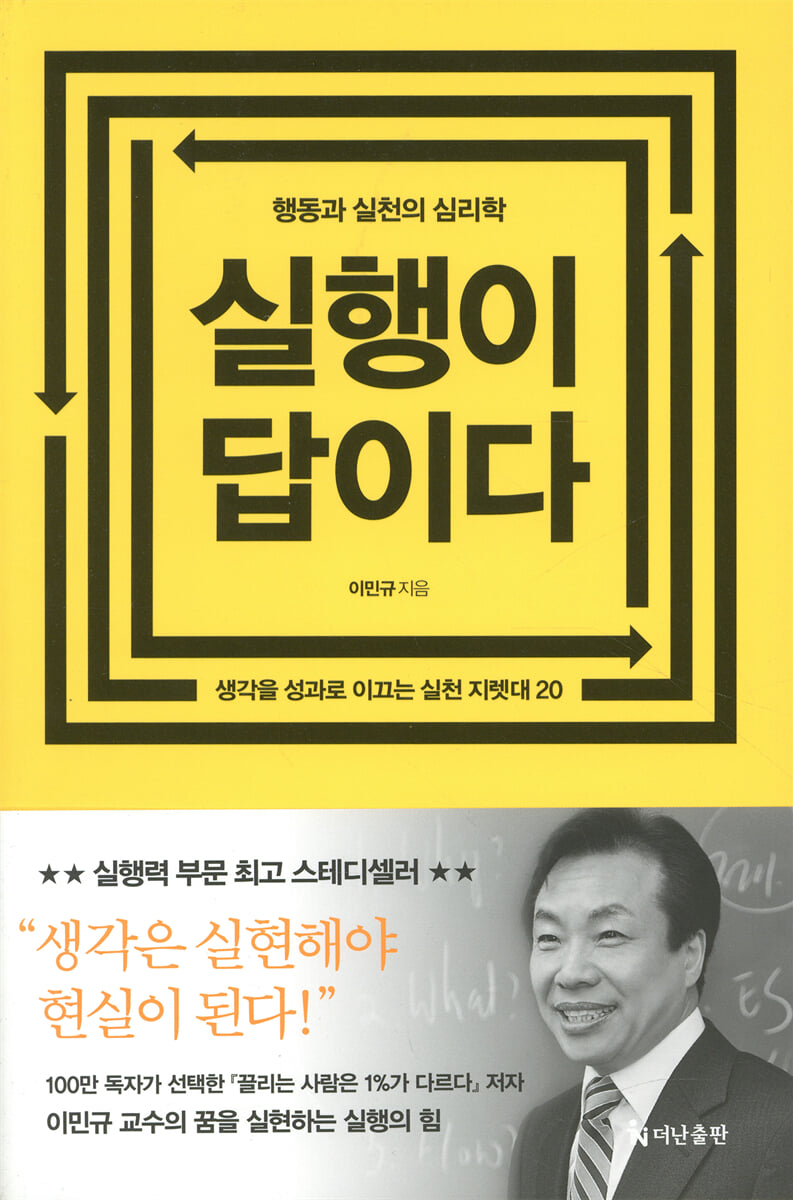
"Execution is the greatest competitive edge!" The special cover edition of "Execution is the Answer," the best-selling book in the domestic execution category, has been published.
Professor Lee Min-gyu, author of "Attractive People Are 1% Different," which has captured the hearts of 1 million readers in Korea, introduces the driving force behind success that turns thoughts into results.
Based on the case studies of numerous counselors, we analyze the reasons why people have been unable to put their actions into practice and present a 'practice lever' that can produce results.
The author explains that the reason people fail to execute brilliant ideas or perfect plans is not because of a lack of will or persistence.
High-performing people use the "practice lever," and even ordinary people can develop their execution skills by using this.
Professor Lee Min-gyu establishes the formula 'Performance = Competence × Execution Ability' and states that "no matter how outstanding the talent, knowledge, or ideas are, if the execution ability is 0, the performance will also be zero."
Execution power depends on the three stages of decision, practice, and maintenance, and by using the 'practice lever', you can achieve greater results more easily.
This book is organized into three chapters, and at the end of each chapter there is a 'Stop, Think & Action' corner to help anyone put this into practice.
“Thoughts become reality only when put into practice!”
"Execution is the greatest competitive edge!" The special cover edition of "Execution is the Answer," the best-selling book in the domestic execution category, has been published.
Professor Lee Min-gyu, author of "Attractive People Are 1% Different," which has captured the hearts of 1 million readers in Korea, introduces the driving force behind success that turns thoughts into results.
Based on the case studies of numerous counselors, we analyze the reasons why people have been unable to put their actions into practice and present a 'practice lever' that can produce results.
The author explains that the reason people fail to execute brilliant ideas or perfect plans is not because of a lack of will or persistence.
High-performing people use the "practice lever," and even ordinary people can develop their execution skills by using this.
Professor Lee Min-gyu establishes the formula 'Performance = Competence × Execution Ability' and states that "no matter how outstanding the talent, knowledge, or ideas are, if the execution ability is 0, the performance will also be zero."
Execution power depends on the three stages of decision, practice, and maintenance, and by using the 'practice lever', you can achieve greater results more easily.
This book is organized into three chapters, and at the end of each chapter there is a 'Stop, Think & Action' corner to help anyone put this into practice.
- You can preview some of the book's contents.
Preview
index
Prologue: Stop Blaming Willpower, Find the Lever
Chapter 1 Decision Making
- Decide on your destination clearly.
Draw a roadmap.
I see a shortcut
Get to the heart of the matter.
The answer appears on its own.
Try reverse scheduling.
Things to do become clear
Make a contingency plan.
I'm not afraid of unexpected situations.
Declare it publicly.
I have no choice but to do it
Find out the urgent reason.
No one can stop me
Chapter 2: Taking Action
- Take action immediately
Put it into practice now.
The best time is now
Start small.
It will be greatly accomplished
Set a death line.
Challenges become fun
Think of it as an experiment.
Amazing things happen
Observe and record.
It changes on its own
Don't fall for the easy stuff.
You'll miss out on important things
Chapter 3 Maintaining Habit
-Never give up until the end
Define it more broadly.
You will do bigger things
Try saying 'No'.
'Yes' becomes easier
Block the escape route.
I can't think of anything else
Don't just live hard.
Consider the added value
Don't take your eyes off the goal.
It will eventually come true
Go one step further.
The game is decided by that one step difference.
Teach execution skills.
It becomes easier to practice
Epilogue_ Read, feel, and then forget
Chapter 1 Decision Making
- Decide on your destination clearly.
Draw a roadmap.
I see a shortcut
Get to the heart of the matter.
The answer appears on its own.
Try reverse scheduling.
Things to do become clear
Make a contingency plan.
I'm not afraid of unexpected situations.
Declare it publicly.
I have no choice but to do it
Find out the urgent reason.
No one can stop me
Chapter 2: Taking Action
- Take action immediately
Put it into practice now.
The best time is now
Start small.
It will be greatly accomplished
Set a death line.
Challenges become fun
Think of it as an experiment.
Amazing things happen
Observe and record.
It changes on its own
Don't fall for the easy stuff.
You'll miss out on important things
Chapter 3 Maintaining Habit
-Never give up until the end
Define it more broadly.
You will do bigger things
Try saying 'No'.
'Yes' becomes easier
Block the escape route.
I can't think of anything else
Don't just live hard.
Consider the added value
Don't take your eyes off the goal.
It will eventually come true
Go one step further.
The game is decided by that one step difference.
Teach execution skills.
It becomes easier to practice
Epilogue_ Read, feel, and then forget
Into the book
If you don't define the problem clearly, you'll end up wasting a lot of time and energy trying to solve something that isn't even a problem.
If you're working hard but not seeing any results, you're probably wasting your time solving the wrong problem.
If your relationship doesn't improve despite your best efforts, it's simply because you haven't properly defined the problem.
If you understand the problem properly, the answer will often come naturally.
So, to solve a problem, you must first understand what the problem is.
--- p.34, “Understand the core of the problem.
From "The answer will reveal itself"
If you have a habit of giving up halfway through the process of achieving your goals, you need to create a strong countermeasure against that.
There are three steps to follow:
First, have a specific action plan (Plan A) to achieve your goals.
Second, during the implementation process, anticipate and make a list of unexpected events that may interfere with the implementation.
Third, find a contingency plan (Plan B) for each emergency.
If possible, also find a contingency plan (Plan C).
--- p.
60, “Make a contingency plan.
From “I’m not afraid of unexpected situations”
Our body and mind are like machines that operate automatically once they are triggered, and once we do something we don't want to do, it becomes a trigger and we continue to do it.
Psychiatrist Emil Kraepelin named this mental phenomenon the "operational arousal theory."
According to this theory, our brain determines that once the body starts moving, it is more rational to continue what we were doing because it also consumes energy to stop.
So, even if you don't want to do something, once you start doing it, your brain is stimulated and you quickly become focused on it.
Therefore, the saying, ‘well begun is half done’ is psychologically very true.
--- p.118, “Start small.
From "You will achieve great things"
When you are observed in whatever you do, you become more conscious of the activity and try to do it better.
It's only natural that paying attention to something will yield much better results than doing it mindlessly.
Therefore, if you consciously focus on the important activities you are doing, you will be able to achieve better and better results.
If you want to change behavior reliably through observation and recording, you need to make the results as visible as possible.
--- p.
179, “Observe and record.
From "It changes on its own"
If your behavior doesn't change no matter how hard you try, you should redefine your self-image instead of trying to change your behavior.
When your self-regulation changes, your behavior will naturally change.
No one can climb higher than he thinks.
Nothing limits your achievements as much as you think, and nothing increases your possibilities as much as you think.
If you want to do greater things, define yourself more, and if you want to reach higher, put yourself in a higher place.
Let us remember that our destiny is created by our thoughts and that we are the first ones to give ourselves a chance.
--- p.
210, “Definition should be broader.
From "You will do bigger things"
Victor Hugo, author of Les Misérables and The Hunchback of Notre Dame and one of the greatest French writers of the 19th century, would take off all his clothes and ask his servant to bring them to him after sunset when he was writing.
It was to restrain myself from the temptation to play and force myself to write.
Our country's novelist, Lee Oisoo, also installed prison bars in his home and, when writing a manuscript, he would go inside and ask his wife to lock the door from the outside, thus locking himself in.
Not only ordinary people, but also those who have accomplished great things are subject to various temptations.
It wasn't because they had exceptionally strong willpower that they were able to escape temptation.
Because they had their own wise methods.
They had a 'lever' that controlled the situation so that they could not do what they should not do and had no choice but to do what they had to do.
In psychology, the method of controlling oneself by controlling the environment is called a 'preemptive strategy'.
People with high executive power often have these effective preemptive strategies rather than extraordinary willpower.
If you're working hard but not seeing any results, you're probably wasting your time solving the wrong problem.
If your relationship doesn't improve despite your best efforts, it's simply because you haven't properly defined the problem.
If you understand the problem properly, the answer will often come naturally.
So, to solve a problem, you must first understand what the problem is.
--- p.34, “Understand the core of the problem.
From "The answer will reveal itself"
If you have a habit of giving up halfway through the process of achieving your goals, you need to create a strong countermeasure against that.
There are three steps to follow:
First, have a specific action plan (Plan A) to achieve your goals.
Second, during the implementation process, anticipate and make a list of unexpected events that may interfere with the implementation.
Third, find a contingency plan (Plan B) for each emergency.
If possible, also find a contingency plan (Plan C).
--- p.
60, “Make a contingency plan.
From “I’m not afraid of unexpected situations”
Our body and mind are like machines that operate automatically once they are triggered, and once we do something we don't want to do, it becomes a trigger and we continue to do it.
Psychiatrist Emil Kraepelin named this mental phenomenon the "operational arousal theory."
According to this theory, our brain determines that once the body starts moving, it is more rational to continue what we were doing because it also consumes energy to stop.
So, even if you don't want to do something, once you start doing it, your brain is stimulated and you quickly become focused on it.
Therefore, the saying, ‘well begun is half done’ is psychologically very true.
--- p.118, “Start small.
From "You will achieve great things"
When you are observed in whatever you do, you become more conscious of the activity and try to do it better.
It's only natural that paying attention to something will yield much better results than doing it mindlessly.
Therefore, if you consciously focus on the important activities you are doing, you will be able to achieve better and better results.
If you want to change behavior reliably through observation and recording, you need to make the results as visible as possible.
--- p.
179, “Observe and record.
From "It changes on its own"
If your behavior doesn't change no matter how hard you try, you should redefine your self-image instead of trying to change your behavior.
When your self-regulation changes, your behavior will naturally change.
No one can climb higher than he thinks.
Nothing limits your achievements as much as you think, and nothing increases your possibilities as much as you think.
If you want to do greater things, define yourself more, and if you want to reach higher, put yourself in a higher place.
Let us remember that our destiny is created by our thoughts and that we are the first ones to give ourselves a chance.
--- p.
210, “Definition should be broader.
From "You will do bigger things"
Victor Hugo, author of Les Misérables and The Hunchback of Notre Dame and one of the greatest French writers of the 19th century, would take off all his clothes and ask his servant to bring them to him after sunset when he was writing.
It was to restrain myself from the temptation to play and force myself to write.
Our country's novelist, Lee Oisoo, also installed prison bars in his home and, when writing a manuscript, he would go inside and ask his wife to lock the door from the outside, thus locking himself in.
Not only ordinary people, but also those who have accomplished great things are subject to various temptations.
It wasn't because they had exceptionally strong willpower that they were able to escape temptation.
Because they had their own wise methods.
They had a 'lever' that controlled the situation so that they could not do what they should not do and had no choice but to do what they had to do.
In psychology, the method of controlling oneself by controlling the environment is called a 'preemptive strategy'.
People with high executive power often have these effective preemptive strategies rather than extraordinary willpower.
--- p.229, “Block the retreat.
From "I can't think of anything else"
From "I can't think of anything else"
Publisher's Review
From the Age of Discovery to the Age of Action
“NO ACTION, NO CHANGE!!”
“The difference between an ordinary person and a successful person is not knowledge, but practice; the difference between a successful company and an unsuccessful one is not strategy, but execution!” _Tom Peters
How did Mother Teresa dedicate her life to serving the poor? What gave Helen Keller the strength to overcome triple hardship and become a university lecturer? What was the driving force behind Steve Jobs's creation of the iPhone? Their greatness wasn't solely due to their extraordinary ideas.
Because he put that special idea into action and produced results.
All great achievements are made through action.
Your lack of success so far wasn't due to ideas or luck.
It's just because I couldn't act.
This book provides a way of thinking and execution know-how to improve the lack of "execution skills"—that is, the "method of achieving"—to those who have always made resolutions but have never been able to put them into action.
The person who runs it is 1% different,
The power of action that turns dreams into reality!
The iPhone is full of Apple's brilliant ideas.
But could the iPhone have been born from a brilliant idea alone? What was the driving force behind Bill Gates's dream of "one day giving everyone their own personal computer"? What was the driving force behind Oprah Winfrey, a Harlem native, becoming the talk show queen? Was it a brilliant idea alone that fueled their remarkable legacy?
The reason they are great is not because of their knowledge or ideas, but because of their actions.
99% of ordinary people also have thousands of good ideas.
But they don't practice it.
On the other hand, the 1% of special people are different.
They always put their thoughts into action.
In "Execution is the Answer," the key word for success for individuals and businesses is analyzed as "execution."
Successful people and top companies have the 'practical lever' to push good ideas into action.
When we have good ideas but are unable to put them into practice, successful people are different.
They planned in advance, put it into action, and eliminated obstacles to execution one by one.
The author, a psychologist, introduces 20 'levers of action' to people and companies that hesitate and fail to take action.
If you practice step by step as instructed in this book, you will soon see yourself abandoning the habit of procrastination and acquiring the "execution skills" of successful people.
Moreover, the company you work for will also break free from its stagnant performance, overcome its competitors, and leap forward to become the number one company.
A masterpiece by Professor Lee Min-gyu, a 1% behavioral psychologist!
How to dramatically improve individual and organizational performance
We introduce the driving force behind success that leads to results through the idea that "execution is the answer."
The author doesn't simply attribute your inability to execute to a lack of will or persistence.
Rather than whipping them, they console themselves by saying that they were unable to put it into practice because they did not know the 'leverage of action'.
And I argue that anyone can easily put this into practice and maintain it by using this lever from now on.
In this book, Professor Lee Min-gyu analyzes the reasons why people have been unable to put their actions into practice, focusing on the cases of several readers who have counseled him, and presents a "practice lever" that leads to success.
Like "People Who Are Attractive Are 1% Different," this book offers solutions based on the author's own experiences and the psychological factors hidden within our hearts, making it unique and persuasive compared to other self-help books.
The author establishes the formula 'Performance = Competence × Execution Power' and argues that no matter how outstanding one's talent, knowledge, or ideas are, if one's execution power is 0, then performance will also be zero.
He also says that if you teach them the practical levers that outstanding people have, anyone can naturally implement and maintain them.
Therefore, he persuades readers that they should not blame themselves for being weak-willed, scold their children for lacking patience, or push their employees too hard for lack of execution.
“Why can’t we do it?”
Execution is also a skill: Decide, do, and stick with it.
Anyone can obtain good information or know-how, but not everyone can put it into practice.
Why on earth do we hesitate to take action? It's because we haven't learned effective methods.
I have been putting off doing it until now because I have not learned and practiced it.
This book proves that execution is also a skill.
By using the 'practice lever', anyone can easily break the habit of procrastination and start taking action right away, and even maintain it.
This book is divided into three chapters: resolution, practice, and maintenance, and introduces methods to increase execution power at each stage.
In each topic, we first introduce a case study related to practice, analyze the psychological issues that hinder practice, and then work with readers to find solutions.
At the end of each topic, we have created a corner so that readers can go beyond what they read and feel and immediately put it into practice.
In addition, in the 'ONE MORE' corner, we used illustrations that add depth to thoughts to help readers understand the content and summarize the key points of the chapter.
Chapter 1: Resolution: To put thoughts into action, you need resolution.
If your resolution is vague or abstract, you may end up postponing or even giving up on it altogether.
This chapter presents specifics on what to resolve and how to plan for the future.
Chapter 2: Practice: Now that you've made your decision, it's time to put it into practice.
When you decide to do something, do you tend to act immediately without hesitation? This chapter will teach you how to improve your execution index.
Chapter 3 Maintenance: Change is never a one-time thing.
Are you consistently taking action to turn your thoughts into results? This chapter explains how to control yourself so you don't make excuses and stop taking action.
“NO ACTION, NO CHANGE!!”
“The difference between an ordinary person and a successful person is not knowledge, but practice; the difference between a successful company and an unsuccessful one is not strategy, but execution!” _Tom Peters
How did Mother Teresa dedicate her life to serving the poor? What gave Helen Keller the strength to overcome triple hardship and become a university lecturer? What was the driving force behind Steve Jobs's creation of the iPhone? Their greatness wasn't solely due to their extraordinary ideas.
Because he put that special idea into action and produced results.
All great achievements are made through action.
Your lack of success so far wasn't due to ideas or luck.
It's just because I couldn't act.
This book provides a way of thinking and execution know-how to improve the lack of "execution skills"—that is, the "method of achieving"—to those who have always made resolutions but have never been able to put them into action.
The person who runs it is 1% different,
The power of action that turns dreams into reality!
The iPhone is full of Apple's brilliant ideas.
But could the iPhone have been born from a brilliant idea alone? What was the driving force behind Bill Gates's dream of "one day giving everyone their own personal computer"? What was the driving force behind Oprah Winfrey, a Harlem native, becoming the talk show queen? Was it a brilliant idea alone that fueled their remarkable legacy?
The reason they are great is not because of their knowledge or ideas, but because of their actions.
99% of ordinary people also have thousands of good ideas.
But they don't practice it.
On the other hand, the 1% of special people are different.
They always put their thoughts into action.
In "Execution is the Answer," the key word for success for individuals and businesses is analyzed as "execution."
Successful people and top companies have the 'practical lever' to push good ideas into action.
When we have good ideas but are unable to put them into practice, successful people are different.
They planned in advance, put it into action, and eliminated obstacles to execution one by one.
The author, a psychologist, introduces 20 'levers of action' to people and companies that hesitate and fail to take action.
If you practice step by step as instructed in this book, you will soon see yourself abandoning the habit of procrastination and acquiring the "execution skills" of successful people.
Moreover, the company you work for will also break free from its stagnant performance, overcome its competitors, and leap forward to become the number one company.
A masterpiece by Professor Lee Min-gyu, a 1% behavioral psychologist!
How to dramatically improve individual and organizational performance
We introduce the driving force behind success that leads to results through the idea that "execution is the answer."
The author doesn't simply attribute your inability to execute to a lack of will or persistence.
Rather than whipping them, they console themselves by saying that they were unable to put it into practice because they did not know the 'leverage of action'.
And I argue that anyone can easily put this into practice and maintain it by using this lever from now on.
In this book, Professor Lee Min-gyu analyzes the reasons why people have been unable to put their actions into practice, focusing on the cases of several readers who have counseled him, and presents a "practice lever" that leads to success.
Like "People Who Are Attractive Are 1% Different," this book offers solutions based on the author's own experiences and the psychological factors hidden within our hearts, making it unique and persuasive compared to other self-help books.
The author establishes the formula 'Performance = Competence × Execution Power' and argues that no matter how outstanding one's talent, knowledge, or ideas are, if one's execution power is 0, then performance will also be zero.
He also says that if you teach them the practical levers that outstanding people have, anyone can naturally implement and maintain them.
Therefore, he persuades readers that they should not blame themselves for being weak-willed, scold their children for lacking patience, or push their employees too hard for lack of execution.
“Why can’t we do it?”
Execution is also a skill: Decide, do, and stick with it.
Anyone can obtain good information or know-how, but not everyone can put it into practice.
Why on earth do we hesitate to take action? It's because we haven't learned effective methods.
I have been putting off doing it until now because I have not learned and practiced it.
This book proves that execution is also a skill.
By using the 'practice lever', anyone can easily break the habit of procrastination and start taking action right away, and even maintain it.
This book is divided into three chapters: resolution, practice, and maintenance, and introduces methods to increase execution power at each stage.
In each topic, we first introduce a case study related to practice, analyze the psychological issues that hinder practice, and then work with readers to find solutions.
At the end of each topic, we have created a corner so that readers can go beyond what they read and feel and immediately put it into practice.
In addition, in the 'ONE MORE' corner, we used illustrations that add depth to thoughts to help readers understand the content and summarize the key points of the chapter.
Chapter 1: Resolution: To put thoughts into action, you need resolution.
If your resolution is vague or abstract, you may end up postponing or even giving up on it altogether.
This chapter presents specifics on what to resolve and how to plan for the future.
Chapter 2: Practice: Now that you've made your decision, it's time to put it into practice.
When you decide to do something, do you tend to act immediately without hesitation? This chapter will teach you how to improve your execution index.
Chapter 3 Maintenance: Change is never a one-time thing.
Are you consistently taking action to turn your thoughts into results? This chapter explains how to control yourself so you don't make excuses and stop taking action.
GOODS SPECIFICS
- Date of issue: September 6, 2019
- Page count, weight, size: 304 pages | 512g | 143*215*19mm
- ISBN13: 9788984059702
- ISBN10: 8984059706
You may also like
카테고리
korean


korean

![GQ KOREA Mark (Monthly): December [2025]](http://librairie.coreenne.fr/cdn/shop/files/8ef265dbbfbf186523ed75ba7319009d.jpg?v=1765340328&width=3840)


