

The Power of Habit
 |
Description
Book Introduction
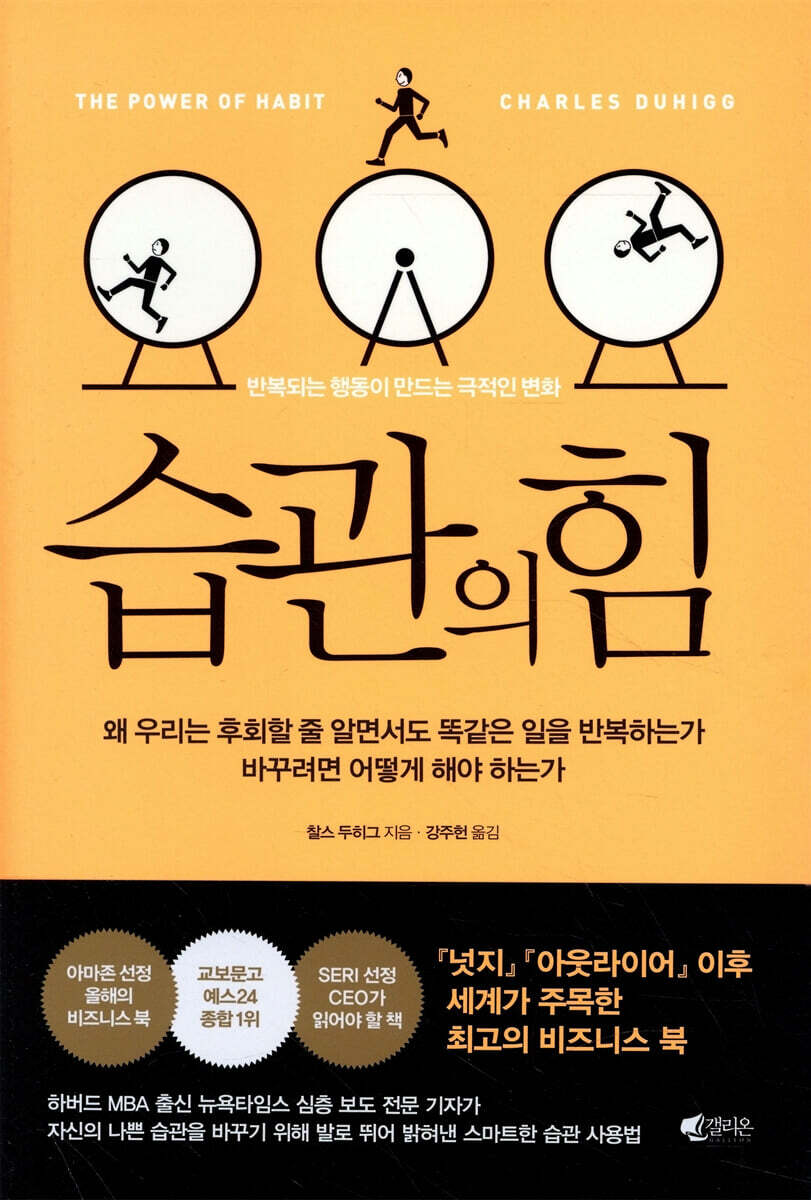
After 『Nudge』 and 『Outliers』, The Best Business Books of 2012 That Gained Global Attention A Harvard MBA and New York Times in-depth reporter reveals how to use smart habits to break his bad habits. To do this, we analyzed over 700 academic papers and unpublished research data from dozens of multinational corporations, and interviewed over 300 scientists and executives. Understanding the principles of habits proves that we can easily and perfectly change ourselves and the world, which is difficult to change. Among people, companies, and societies, there are those who change overnight, and there are those who desperately want change but never change. This book explores the causes and solutions to these differences through neuroscience, brain science, and various case studies. Through stories like Rick Warren's Saddleback Church, which started with seven members and became the largest church in the United States, and the American Civil Rights Movement, which began with a small dispute in a small town in the American South, it shows how small changes in habits can make a big difference in outcomes for individuals, businesses, and society. Organizations like the British Underground and America's top general hospitals have suffered devastating consequences because they neglected bad habits, demonstrating how bad habits can destroy organizations. You will be surprised to learn that habits are not something you can change or not change, but rather they hold the key to success and failure, life and death. And you'll be surprised to learn that changing your habits to your liking is much easier than you think. You need to understand how habits work to master them, and mastering your habits will help you get what you want. At the heart of things we all want to do but can't always achieve—exercising regularly, losing weight, raising children well, doing better at work, starting an innovative company, reforming society—are habits. After reading this book, you will realize why we keep repeating the same mistakes even though we know we will regret them, and how foolish our efforts to change have been. Click here to see the book trailer ▶ |
- You can preview some of the book's contents.
Preview
index
Prologue -
The power to change myself and the world
Part 1: Personal Habits: How Repeated Behaviors Create Dramatic Change
1 Why do we repeat the same things even though we know we will regret it?
The man who completely changed our understanding of habits
Habit Loops: The Three Steps to Building a Habit
How Habits Rule Us
Memories fade, but habits remain.
2 Aspirations: How New Habits Are Born
How Brushing Your Teeth Became a Global Habit
The worst failure, Febreze
Why We Can't Resist the Temptation of Chicken and Fries
Febreze's twist captures unexpected desires
If you want to succeed, stimulate your desires.
3 Repetitive Behaviors: The Golden Rules You Need to Know to Change Habits
Coach Tony Dungy's training habits that transformed a last-place team that even fans had given up on into a powerhouse.
The Secret of AA That Cured 10 Million Alcoholics
The shadow of old habits inevitably appears at crucial moments
Habit Replacement Technique: How to Make a Changed Habit Yours
What People Who Changed Their Lives Have in Common: How to Change Habits
Part 2: Corporate Habits: How Successful Companies Use Habits
4. If you want sure victory, focus on one key habit.
The Secret of Alcoa's Rapid Growth
Core Habits: Paul O'Neill's Habit Management Guide to Five-Fold Growth in a Crisis
The One Tiny Habit That Made Michael Phelps an Olympic Hero
Key habits are hidden in surprising places.
5 Willpower is a Habit - Starbucks' Willpower Training
From a troublemaker at McDonald's to a star employee at Starbucks
Why Our Willpower So Easily Fragments
The Latte Rule: Starbucks' Unfailing Willpower Training Method
Commonalities of Companies with High Employee Focus
If only I knew then what I know now
6 People Who Rule Their Habits, People Who Are Ruled by Their Habits - Bad Habits Ruin Organizations
The worst medical accident at America's top hospital
Why Smart People Make Stupid Decisions
Lessons from the London Underground Fire
What You Need to Know to Change Your Organization's Habits
7 How They Open Customers' Wallets - Companies That Profit by Selling Habits
Why Fruits and Vegetables Are Always Sold at the Entrance of Hypermarkets
How did a song that people hated become a hit?
The Sandwich Technique: How to Make New Habits Feel Familiar
They know what you need a year from now
Part 3: The Habits of Society: The Power to Change a World That Never Changes
8 How Social Change Happens - The Civil Rights Movement and Saddleback Church
The beginning of the civil rights movement that shook America
The power of weak solidarity to bring about social change
Saddleback Church Leverages Social Habits to Become America's Best Church
9 Things to Do First to Change Your Habits - The Difference Between a Gambler and a Sleepwalker
Confessions of an Ordinary Housewife Addicted to Gambling
A sleepwalker who killed his beloved wife
The irresistible temptation of habit
The first thing you need to do to change your habits
Appendix Anyone Can Change Habits - The 4-Step Rule for Developing Good Habits
The power to change myself and the world
Part 1: Personal Habits: How Repeated Behaviors Create Dramatic Change
1 Why do we repeat the same things even though we know we will regret it?
The man who completely changed our understanding of habits
Habit Loops: The Three Steps to Building a Habit
How Habits Rule Us
Memories fade, but habits remain.
2 Aspirations: How New Habits Are Born
How Brushing Your Teeth Became a Global Habit
The worst failure, Febreze
Why We Can't Resist the Temptation of Chicken and Fries
Febreze's twist captures unexpected desires
If you want to succeed, stimulate your desires.
3 Repetitive Behaviors: The Golden Rules You Need to Know to Change Habits
Coach Tony Dungy's training habits that transformed a last-place team that even fans had given up on into a powerhouse.
The Secret of AA That Cured 10 Million Alcoholics
The shadow of old habits inevitably appears at crucial moments
Habit Replacement Technique: How to Make a Changed Habit Yours
What People Who Changed Their Lives Have in Common: How to Change Habits
Part 2: Corporate Habits: How Successful Companies Use Habits
4. If you want sure victory, focus on one key habit.
The Secret of Alcoa's Rapid Growth
Core Habits: Paul O'Neill's Habit Management Guide to Five-Fold Growth in a Crisis
The One Tiny Habit That Made Michael Phelps an Olympic Hero
Key habits are hidden in surprising places.
5 Willpower is a Habit - Starbucks' Willpower Training
From a troublemaker at McDonald's to a star employee at Starbucks
Why Our Willpower So Easily Fragments
The Latte Rule: Starbucks' Unfailing Willpower Training Method
Commonalities of Companies with High Employee Focus
If only I knew then what I know now
6 People Who Rule Their Habits, People Who Are Ruled by Their Habits - Bad Habits Ruin Organizations
The worst medical accident at America's top hospital
Why Smart People Make Stupid Decisions
Lessons from the London Underground Fire
What You Need to Know to Change Your Organization's Habits
7 How They Open Customers' Wallets - Companies That Profit by Selling Habits
Why Fruits and Vegetables Are Always Sold at the Entrance of Hypermarkets
How did a song that people hated become a hit?
The Sandwich Technique: How to Make New Habits Feel Familiar
They know what you need a year from now
Part 3: The Habits of Society: The Power to Change a World That Never Changes
8 How Social Change Happens - The Civil Rights Movement and Saddleback Church
The beginning of the civil rights movement that shook America
The power of weak solidarity to bring about social change
Saddleback Church Leverages Social Habits to Become America's Best Church
9 Things to Do First to Change Your Habits - The Difference Between a Gambler and a Sleepwalker
Confessions of an Ordinary Housewife Addicted to Gambling
A sleepwalker who killed his beloved wife
The irresistible temptation of habit
The first thing you need to do to change your habits
Appendix Anyone Can Change Habits - The 4-Step Rule for Developing Good Habits
Publisher's Review
A New York Times in-depth reporter with a Harvard MBA
Smart Habits Revealed Through Running
Imagine you have a habit of buying chocolate chip cookies every day.
If so, you will gain about 4 kilograms in no time.
I made a resolution several times a day to break the habit, and even stuck a post-it note in front of my monitor that said, "No more cookies!"
But every day I fall for the temptation of cookies.
Why are bad habits so hard to break?
This habit was actually the habit of Charles Duhigg, the author of this book.
He is a star reporter for the New York Times who graduated from Harvard Business School (MBA) and has won almost every award an American journalist can receive.
He said it was really hard to break his habit of buying cookies every afternoon.
So I set out to uncover the secrets of habits to find out why they're so powerful and how to easily change them.
We dug into over 700 academic papers and unpublished research from dozens of multinational corporations, and interviewed over 300 scientists and executives.
In the process, we discovered that habits have a huge impact beyond personal life to organizations, businesses, and society.
This book created a buzz in the American publishing world even before its publication, and after its publication it received extensive attention from the American media.
It also gained explosive popularity on the online bookstore Amazon, with paper books, e-books, and audio books taking the first, second, and third places in the economics and management category.
How did that large supermarket find out about the pregnancy of a high school girl that even her parents and friends didn't know about?
A man asked to see a manager at a Target store, the fifth-largest discount store in the United States.
He was holding a mailing list from Target and looked very angry.
“Does it make sense to send my high school daughter discount coupons for baby clothes and a crib?”
When the manager checked the mail, he found advertisements for maternity clothes and baby furniture addressed to the male customer's daughter.
The manager apologized to the man again and again.
A few days later, the manager called again to apologize.
But the man said this in an awkward voice.
“I talked to my daughter.
The due date is August.
“I’m really sorry for causing a fuss.”
How did the target know the high school girl's secret? Pregnant women tend to buy large quantities of unscented lotion starting in their fourth trimester.
And around the 20th week of pregnancy, many pregnant women take supplements that supplement calcium, magnesium, zinc, etc.
Target is growing rapidly by accurately predicting consumer patterns through sophisticated habit analysis programs and establishing marketing strategies accordingly.
They can guess whether a customer is pregnant, whether they are buying a gift for a pregnant friend, or even how many months pregnant they are.
They cleverly use that information to force those consumers to come back to Target.
Not only Target, but also McDonald's, Microsoft, Walmart, and Victoria's Secret are studying consumers' every move.
In other words, they are taking money out of our wallets through our habits without us even realizing it.
How did toothpaste, once used by only 7 percent of Americans, become a global staple?
During World War I, the U.S. military was concerned that the dental health of its soldiers had a serious impact on their combat effectiveness.
At that time, there were hardly any people who brushed their teeth.
American legendary advertising figure Claude Hopkins, who was commissioned to advertise Pepsodent toothpaste, advertised that brushing your teeth with Pepsodent would remove plaque that could be felt on the tongue and result in whiter teeth.
Plaque is a thin film that forms naturally on your teeth, regardless of what you eat or how often you brush.
In fact, it had nothing to do with white teeth, as it disappeared just by rubbing the teeth with a finger or rinsing them with water.
In any case, the ad was a huge success, and for the next 30 years, Pepsodent reigned as the world's best-selling toothpaste.
But the real reason Pepsodent was successful wasn't because of its advertising.
Pepsodent uses additives that provide a refreshing feeling after brushing your teeth.
The foam that comes from brushing your teeth and the refreshing feeling afterward are the biggest contributors to forming the habit of brushing your teeth.
The number of people brushing their teeth, which was only 6% before the Pepsodent campaign, increased to 60% after the advertisement.
The foam of toothpaste, shampoo, or detergent actually has nothing to do with cleaning power.
It is only used for the purpose of taming us so that we feel clean when there is foam.
How Febreze, the worst flop in P&G history, became a hit product with annual sales of hundreds of billions of won.
Febreze, created from a substance accidentally discovered by a researcher at Procter & Gamble, the world's leading consumer goods company that makes Gillette razors, Pringles potato chips, and Duracell batteries, was a product that eliminated unpleasant odors from fabrics and received huge expectations from the company even before its launch.
But despite the massive marketing, the initial response was poor.
People didn't feel the need for this product.
The marketing team closely reviewed the consumer data they had collected.
People didn't use Febreze to get rid of bad smells.
Instead, it was used to provide a pleasant scent after cleaning or laundry.
After realizing that people wanted a scent (a reward) after cleaning or doing laundry, the Febreze marketing team revamped their entire strategy and was able to achieve a dramatic turnaround.
It was much later that Febreze was advertised as eliminating odors.
How Starbucks turned a troublemaker into a top employee in just one year
When Starbucks was just beginning to grow, executives realized the importance of self-discipline in their employees and wondered how to teach it.
Customers who pay 5,000 or 6,000 won for a cup of coffee want to be treated well and expect top-notch service.
They developed and trained the "Latte Method" to help employees develop self-control habits by repetitively responding to specific signals (such as customers expressing harsh complaints) so that they could develop habits.
This also helped instill self-control in hot-tempered employees who would yell at customers to "get out" when they made harsh demands.
They discovered how to turn willpower into a habit, which dramatically improved customer satisfaction and employee focus.
A total of 1 million employees have worked at Starbucks in the US so far, and the current number of employees is approximately 140,000.
In a sense, Starbucks is America's best educational institution.
It's all about the power of habit.
What do these stories have in common? They all achieved success by focusing on a pattern that impacts every aspect of our lives.
That pattern is a habit.
A habit is an unconscious and repetitive action or thought.
Many everyday actions, like driving a car, checking your phone, checking your email, or buying a cup of coffee, are not actions we consciously choose, but rather the product of habit.
Because we have habits, our brains can save energy and focus on more productive tasks.
Recent research suggests that 40 percent of all behavior is determined by habits.
While each individual habit may seem relatively insignificant in itself, the food you eat each day, the words you speak to your children each night, whether you save or spend, how often you exercise, and how you organize your thoughts and routine ultimately have a profound impact on your health, productivity, financial stability, and happiness.
The problem is that the brain cannot distinguish between bad habits and good habits.
Why do we repeat the same things even though we know we will regret it?
How to change
To master your habits, you must first know them.
In fact, all habits in this world, such as sleeping in, shopping, eating late at night, smoking, and drinking, are formed through a three-step process.
Cue - Repeated Behavior - Reward
First, there is some signal.
It's like a trigger that automatically triggers a specific action, such as a place, time, or person you're with.
For Charles Duhigg, the cookie temptation always came between 3 and 3:30 p.m.
A specific time was a signal of habit.
In the next stage, repetitive behaviors appear.
At around 3:30, the author felt like eating cookies, so he took the elevator to the cafe on the 14th floor of the New York Times building, bought some cookies, and chatted with his colleagues.
The final step is compensation.
Rewards are the most powerful factor in forming habits.
The author says it wasn't easy to figure out what rewards the cookie-eating habit provided.
So I tried various experiments.
When I wanted cookies, instead of going to a cafe, I took a walk around the neighborhood, tried eating chocolate instead of cookies, and even chatted with colleagues without eating anything.
As it turned out, his habit had nothing to do with cookies.
The truth is, I just wanted to hang out with people.
Having figured out the cues, the repetitions, and the rewards, he redesigned his habits.
At around 3:30, I get up, look around the office, and if I see a friend, I go over to them and chat for 10 minutes before coming back.
It's just changing the repetitive behavior while keeping the signal and reward the same.
Thanks to this, the temptation of cookies was completely gone and the new behavior became a habit.
Thanks to this, he lost 4 kilograms and his wife's nagging stopped.
If you can accurately identify your habits like this, you can change yourself as you wish.
But habits don't just change your personal life.
The power of habit is so powerful that it can influence groups, organizations, businesses, and entire societies.
Core Habit: Change One, and Everything Else Will Change
Duhigg first witnessed the amazing power of habit while serving as a war correspondent in Iraq in 2000.
At the time, I heard a groundbreaking story about an American officer who peacefully dispersed protesters in Kufa, 150 kilometers from Baghdad.
He asked the mayor of Kufa to remove all street vendors from the square in front of the mosque, where violent protests were always taking place.
The square was always crowded with people, and at someone's instigation, the crowd could easily turn into an angry protest.
However, after the street vendors were removed, the crowd's cohesion weakened noticeably.
The hungry, simple participants returned home early, and no matter how much the agitators shouted, people did not gather.
Duhigg says that even changing just one very small habit can lead to dramatic, unimaginable changes.
That's what a 'core habit' is.
It refers to a habit that causes a chain reaction in an individual's life or organizational activities.
The best example is exercise.
If you make it a habit to exercise regularly even once a week, your lifestyle will change significantly.
Exercising makes you eat better food, and if you exercise in the morning, you get to work a little earlier.
For smokers, it reduces the number of cigarettes they smoke and improves endurance (or patience).
So, you can curb your shopping urge to buy unnecessary items a little more, and that will significantly reduce your financial stress.
Not everyone follows this pattern, but a significant number of people have experienced life-changing changes through the core habit of exercise.
Michael Phelps, who won the most medals in Olympic history with 22 (18 gold), won a gold medal in a world record-breaking situation by visualizing his performances in his head like a videotape every night before going to bed. Alcoa, an aluminum company facing a management crisis, grew more than fivefold by focusing on the core habit of safety.
What habit do you want to change?
Among people, companies, and societies, there are those who change overnight, and there are those who desperately want change but never change.
This book explores the causes and solutions to these differences through neuroscience, brain science, and various case studies.
Through stories like Rick Warren's Saddleback Church, which started with seven members and became the largest church in the United States, and the American Civil Rights Movement, which began with a small dispute in a small town in the American South, it shows how small changes in habits can make a big difference in outcomes for individuals, businesses, and society.
Organizations like the British Underground and America's top general hospitals have suffered devastating consequences because they neglected bad habits, demonstrating how bad habits can ruin organizations.
You will be surprised to learn that habits are not something that can be changed or not, but rather they are the key to success and failure, life and death.
And you'll be surprised to learn that changing your habits to your liking is much easier than you think.
You need to understand how habits work to master them, and mastering your habits will help you get what you want.
At the heart of things we all want to do but can't always achieve—exercising regularly, losing weight, raising children well, doing better at work, starting an innovative company, reforming society—are habits.
After reading this book, you will realize why we keep repeating the same mistakes even though we know we will regret them, and how foolish our efforts to change have been.
What habits would you like to change? What kind of company would you like to see?
If you want the most tangible change, read this book.
Smart Habits Revealed Through Running
Imagine you have a habit of buying chocolate chip cookies every day.
If so, you will gain about 4 kilograms in no time.
I made a resolution several times a day to break the habit, and even stuck a post-it note in front of my monitor that said, "No more cookies!"
But every day I fall for the temptation of cookies.
Why are bad habits so hard to break?
This habit was actually the habit of Charles Duhigg, the author of this book.
He is a star reporter for the New York Times who graduated from Harvard Business School (MBA) and has won almost every award an American journalist can receive.
He said it was really hard to break his habit of buying cookies every afternoon.
So I set out to uncover the secrets of habits to find out why they're so powerful and how to easily change them.
We dug into over 700 academic papers and unpublished research from dozens of multinational corporations, and interviewed over 300 scientists and executives.
In the process, we discovered that habits have a huge impact beyond personal life to organizations, businesses, and society.
This book created a buzz in the American publishing world even before its publication, and after its publication it received extensive attention from the American media.
It also gained explosive popularity on the online bookstore Amazon, with paper books, e-books, and audio books taking the first, second, and third places in the economics and management category.
How did that large supermarket find out about the pregnancy of a high school girl that even her parents and friends didn't know about?
A man asked to see a manager at a Target store, the fifth-largest discount store in the United States.
He was holding a mailing list from Target and looked very angry.
“Does it make sense to send my high school daughter discount coupons for baby clothes and a crib?”
When the manager checked the mail, he found advertisements for maternity clothes and baby furniture addressed to the male customer's daughter.
The manager apologized to the man again and again.
A few days later, the manager called again to apologize.
But the man said this in an awkward voice.
“I talked to my daughter.
The due date is August.
“I’m really sorry for causing a fuss.”
How did the target know the high school girl's secret? Pregnant women tend to buy large quantities of unscented lotion starting in their fourth trimester.
And around the 20th week of pregnancy, many pregnant women take supplements that supplement calcium, magnesium, zinc, etc.
Target is growing rapidly by accurately predicting consumer patterns through sophisticated habit analysis programs and establishing marketing strategies accordingly.
They can guess whether a customer is pregnant, whether they are buying a gift for a pregnant friend, or even how many months pregnant they are.
They cleverly use that information to force those consumers to come back to Target.
Not only Target, but also McDonald's, Microsoft, Walmart, and Victoria's Secret are studying consumers' every move.
In other words, they are taking money out of our wallets through our habits without us even realizing it.
How did toothpaste, once used by only 7 percent of Americans, become a global staple?
During World War I, the U.S. military was concerned that the dental health of its soldiers had a serious impact on their combat effectiveness.
At that time, there were hardly any people who brushed their teeth.
American legendary advertising figure Claude Hopkins, who was commissioned to advertise Pepsodent toothpaste, advertised that brushing your teeth with Pepsodent would remove plaque that could be felt on the tongue and result in whiter teeth.
Plaque is a thin film that forms naturally on your teeth, regardless of what you eat or how often you brush.
In fact, it had nothing to do with white teeth, as it disappeared just by rubbing the teeth with a finger or rinsing them with water.
In any case, the ad was a huge success, and for the next 30 years, Pepsodent reigned as the world's best-selling toothpaste.
But the real reason Pepsodent was successful wasn't because of its advertising.
Pepsodent uses additives that provide a refreshing feeling after brushing your teeth.
The foam that comes from brushing your teeth and the refreshing feeling afterward are the biggest contributors to forming the habit of brushing your teeth.
The number of people brushing their teeth, which was only 6% before the Pepsodent campaign, increased to 60% after the advertisement.
The foam of toothpaste, shampoo, or detergent actually has nothing to do with cleaning power.
It is only used for the purpose of taming us so that we feel clean when there is foam.
How Febreze, the worst flop in P&G history, became a hit product with annual sales of hundreds of billions of won.
Febreze, created from a substance accidentally discovered by a researcher at Procter & Gamble, the world's leading consumer goods company that makes Gillette razors, Pringles potato chips, and Duracell batteries, was a product that eliminated unpleasant odors from fabrics and received huge expectations from the company even before its launch.
But despite the massive marketing, the initial response was poor.
People didn't feel the need for this product.
The marketing team closely reviewed the consumer data they had collected.
People didn't use Febreze to get rid of bad smells.
Instead, it was used to provide a pleasant scent after cleaning or laundry.
After realizing that people wanted a scent (a reward) after cleaning or doing laundry, the Febreze marketing team revamped their entire strategy and was able to achieve a dramatic turnaround.
It was much later that Febreze was advertised as eliminating odors.
How Starbucks turned a troublemaker into a top employee in just one year
When Starbucks was just beginning to grow, executives realized the importance of self-discipline in their employees and wondered how to teach it.
Customers who pay 5,000 or 6,000 won for a cup of coffee want to be treated well and expect top-notch service.
They developed and trained the "Latte Method" to help employees develop self-control habits by repetitively responding to specific signals (such as customers expressing harsh complaints) so that they could develop habits.
This also helped instill self-control in hot-tempered employees who would yell at customers to "get out" when they made harsh demands.
They discovered how to turn willpower into a habit, which dramatically improved customer satisfaction and employee focus.
A total of 1 million employees have worked at Starbucks in the US so far, and the current number of employees is approximately 140,000.
In a sense, Starbucks is America's best educational institution.
It's all about the power of habit.
What do these stories have in common? They all achieved success by focusing on a pattern that impacts every aspect of our lives.
That pattern is a habit.
A habit is an unconscious and repetitive action or thought.
Many everyday actions, like driving a car, checking your phone, checking your email, or buying a cup of coffee, are not actions we consciously choose, but rather the product of habit.
Because we have habits, our brains can save energy and focus on more productive tasks.
Recent research suggests that 40 percent of all behavior is determined by habits.
While each individual habit may seem relatively insignificant in itself, the food you eat each day, the words you speak to your children each night, whether you save or spend, how often you exercise, and how you organize your thoughts and routine ultimately have a profound impact on your health, productivity, financial stability, and happiness.
The problem is that the brain cannot distinguish between bad habits and good habits.
Why do we repeat the same things even though we know we will regret it?
How to change
To master your habits, you must first know them.
In fact, all habits in this world, such as sleeping in, shopping, eating late at night, smoking, and drinking, are formed through a three-step process.
Cue - Repeated Behavior - Reward
First, there is some signal.
It's like a trigger that automatically triggers a specific action, such as a place, time, or person you're with.
For Charles Duhigg, the cookie temptation always came between 3 and 3:30 p.m.
A specific time was a signal of habit.
In the next stage, repetitive behaviors appear.
At around 3:30, the author felt like eating cookies, so he took the elevator to the cafe on the 14th floor of the New York Times building, bought some cookies, and chatted with his colleagues.
The final step is compensation.
Rewards are the most powerful factor in forming habits.
The author says it wasn't easy to figure out what rewards the cookie-eating habit provided.
So I tried various experiments.
When I wanted cookies, instead of going to a cafe, I took a walk around the neighborhood, tried eating chocolate instead of cookies, and even chatted with colleagues without eating anything.
As it turned out, his habit had nothing to do with cookies.
The truth is, I just wanted to hang out with people.
Having figured out the cues, the repetitions, and the rewards, he redesigned his habits.
At around 3:30, I get up, look around the office, and if I see a friend, I go over to them and chat for 10 minutes before coming back.
It's just changing the repetitive behavior while keeping the signal and reward the same.
Thanks to this, the temptation of cookies was completely gone and the new behavior became a habit.
Thanks to this, he lost 4 kilograms and his wife's nagging stopped.
If you can accurately identify your habits like this, you can change yourself as you wish.
But habits don't just change your personal life.
The power of habit is so powerful that it can influence groups, organizations, businesses, and entire societies.
Core Habit: Change One, and Everything Else Will Change
Duhigg first witnessed the amazing power of habit while serving as a war correspondent in Iraq in 2000.
At the time, I heard a groundbreaking story about an American officer who peacefully dispersed protesters in Kufa, 150 kilometers from Baghdad.
He asked the mayor of Kufa to remove all street vendors from the square in front of the mosque, where violent protests were always taking place.
The square was always crowded with people, and at someone's instigation, the crowd could easily turn into an angry protest.
However, after the street vendors were removed, the crowd's cohesion weakened noticeably.
The hungry, simple participants returned home early, and no matter how much the agitators shouted, people did not gather.
Duhigg says that even changing just one very small habit can lead to dramatic, unimaginable changes.
That's what a 'core habit' is.
It refers to a habit that causes a chain reaction in an individual's life or organizational activities.
The best example is exercise.
If you make it a habit to exercise regularly even once a week, your lifestyle will change significantly.
Exercising makes you eat better food, and if you exercise in the morning, you get to work a little earlier.
For smokers, it reduces the number of cigarettes they smoke and improves endurance (or patience).
So, you can curb your shopping urge to buy unnecessary items a little more, and that will significantly reduce your financial stress.
Not everyone follows this pattern, but a significant number of people have experienced life-changing changes through the core habit of exercise.
Michael Phelps, who won the most medals in Olympic history with 22 (18 gold), won a gold medal in a world record-breaking situation by visualizing his performances in his head like a videotape every night before going to bed. Alcoa, an aluminum company facing a management crisis, grew more than fivefold by focusing on the core habit of safety.
What habit do you want to change?
Among people, companies, and societies, there are those who change overnight, and there are those who desperately want change but never change.
This book explores the causes and solutions to these differences through neuroscience, brain science, and various case studies.
Through stories like Rick Warren's Saddleback Church, which started with seven members and became the largest church in the United States, and the American Civil Rights Movement, which began with a small dispute in a small town in the American South, it shows how small changes in habits can make a big difference in outcomes for individuals, businesses, and society.
Organizations like the British Underground and America's top general hospitals have suffered devastating consequences because they neglected bad habits, demonstrating how bad habits can ruin organizations.
You will be surprised to learn that habits are not something that can be changed or not, but rather they are the key to success and failure, life and death.
And you'll be surprised to learn that changing your habits to your liking is much easier than you think.
You need to understand how habits work to master them, and mastering your habits will help you get what you want.
At the heart of things we all want to do but can't always achieve—exercising regularly, losing weight, raising children well, doing better at work, starting an innovative company, reforming society—are habits.
After reading this book, you will realize why we keep repeating the same mistakes even though we know we will regret them, and how foolish our efforts to change have been.
What habits would you like to change? What kind of company would you like to see?
If you want the most tangible change, read this book.
GOODS SPECIFICS
- Date of publication: October 30, 2012
- Page count, weight, size: 464 pages | 664g | 153*224*30mm
- ISBN13: 9788901150598
- ISBN10: 890115059X
You may also like
카테고리
korean


korean

![GQ KOREA Mark (Monthly): December [2025]](http://librairie.coreenne.fr/cdn/shop/files/8ef265dbbfbf186523ed75ba7319009d.jpg?v=1765340328&width=3840)


