

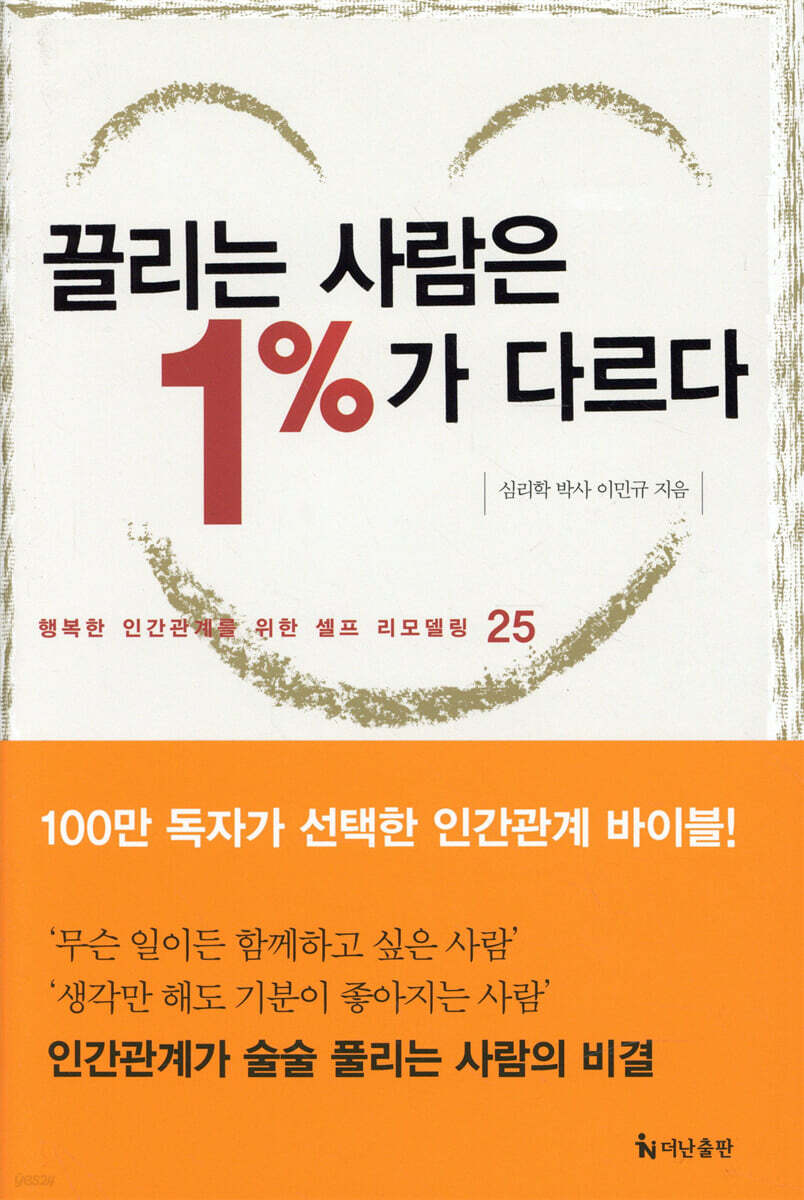
The people I'm attracted to are 1% different
 |
Description
Book Introduction
“There’s something about that guy that’s appealing!”
Don't take small things lightly
No one knows how big a deal that little thing will lead to.
As you live, you are bound to meet all kinds of people.
Some people easily hurt us, embarrass us, and sometimes even trample on our self-esteem.
There are times when just maintaining some relationships can be exhausting.
On the other hand, there are some people who don't give me any special benefits or advantages, but I somehow like them and keep thinking about them.
I naturally relax in front of that person, feel like I can be honest about my feelings, and want to be the first to tell them when something good happens.
Is there a special secret to those who are somehow attractive, those who find themselves thinking about them involuntarily, and those who want to contact them at least once? Of course there is.
That is exactly what this book is trying to tell you.
Since its publication in 2005, this book has been loved by over 1 million readers and has established itself as a bible on human relationships.
A book that will help you gain favor with those around you and break through blocked interpersonal relationships with just a small difference, without putting in much effort.
A book that was selected as the 'Book of the Year' by several bookstores and numerous organizations in 2006 and has been enthusiastically loved by readers for 20 years.
Psychology PhD author Lee Min-gyu's "Attractive People Are 1% Different" has come to readers in a limited edition to celebrate its 200th printing.
As life becomes more difficult and uncertainty about the future grows, the comfort, encouragement, and courage we receive from those around us can be a great strength.
This special limited edition of 200 prints, published to commemorate the book's 20 years of consistent readership, allows us to once again recall the core and essence of human relationships, which never change no matter how much the times change.
The book's core message, "There's a connection behind everything," is a value we need to remember even more in an era where "non-face-to-face" and "alone" have become the norm.
In an age where it's easy to pursue only immediate benefits and convenience, let's not forget that the power that allows us to go the distance, for the long haul, and to endure comes from human relationships.
Don't take small things lightly
No one knows how big a deal that little thing will lead to.
As you live, you are bound to meet all kinds of people.
Some people easily hurt us, embarrass us, and sometimes even trample on our self-esteem.
There are times when just maintaining some relationships can be exhausting.
On the other hand, there are some people who don't give me any special benefits or advantages, but I somehow like them and keep thinking about them.
I naturally relax in front of that person, feel like I can be honest about my feelings, and want to be the first to tell them when something good happens.
Is there a special secret to those who are somehow attractive, those who find themselves thinking about them involuntarily, and those who want to contact them at least once? Of course there is.
That is exactly what this book is trying to tell you.
Since its publication in 2005, this book has been loved by over 1 million readers and has established itself as a bible on human relationships.
A book that will help you gain favor with those around you and break through blocked interpersonal relationships with just a small difference, without putting in much effort.
A book that was selected as the 'Book of the Year' by several bookstores and numerous organizations in 2006 and has been enthusiastically loved by readers for 20 years.
Psychology PhD author Lee Min-gyu's "Attractive People Are 1% Different" has come to readers in a limited edition to celebrate its 200th printing.
As life becomes more difficult and uncertainty about the future grows, the comfort, encouragement, and courage we receive from those around us can be a great strength.
This special limited edition of 200 prints, published to commemorate the book's 20 years of consistent readership, allows us to once again recall the core and essence of human relationships, which never change no matter how much the times change.
The book's core message, "There's a connection behind everything," is a value we need to remember even more in an era where "non-face-to-face" and "alone" have become the norm.
In an age where it's easy to pursue only immediate benefits and convenience, let's not forget that the power that allows us to go the distance, for the long haul, and to endure comes from human relationships.
- You can preview some of the book's contents.
Preview
index
Prologue _ There's a connection behind everything.
Chapter 1.
Every choice has its own attraction _ First meeting Starting Relationship
1.
First impressions are all about how you manage them.
2.
If you like it, there's no need to judge.
3.
God looks at the heart first, man looks at the outward appearance.
4.
Green is the same color, crayfish is crab
5.
If you see each other often, you will become attached to each other, and if you meet each other often, you will like each other.
6.
Changing the way you compliment others can change your relationships.
7.
Why do people gather around smiling people?
8.
If you miss body language, you lose people.
Chapter 2.
The 1% Difference That Maintains Attraction _ Developing Relationships
1.
Why should I love myself?
2.
Acknowledging differences makes empathy easier.
3.
The Simplest Law of Human Motion: 1:2:3
4.
A small gap opens the heart
5.
If you don't know, say you don't know.
6.
Gossip: Satisfaction is short, regret is long.
7.
“I like you”
8.
Be someone people want to eat with
Chapter 3.
This is how people who are attracted maintain relationships _ Staying Relationship
1.
Be the person you want to make your relationship known to.
2.
Even a stone Buddha will turn away if you touch its complex.
3.
Great people have people who believe in them.
4.
Small, unexpected considerations add to intimacy.
5.
Not too far, not too close
6.
Apology first, excuses later
7.
Find something to be grateful for, even in the obvious.
8.
There is no business that has failed by giving away money.
9.
The end is always another beginning
Epilogue _ 'Knowledge' is not 'power'
Chapter 1.
Every choice has its own attraction _ First meeting Starting Relationship
1.
First impressions are all about how you manage them.
2.
If you like it, there's no need to judge.
3.
God looks at the heart first, man looks at the outward appearance.
4.
Green is the same color, crayfish is crab
5.
If you see each other often, you will become attached to each other, and if you meet each other often, you will like each other.
6.
Changing the way you compliment others can change your relationships.
7.
Why do people gather around smiling people?
8.
If you miss body language, you lose people.
Chapter 2.
The 1% Difference That Maintains Attraction _ Developing Relationships
1.
Why should I love myself?
2.
Acknowledging differences makes empathy easier.
3.
The Simplest Law of Human Motion: 1:2:3
4.
A small gap opens the heart
5.
If you don't know, say you don't know.
6.
Gossip: Satisfaction is short, regret is long.
7.
“I like you”
8.
Be someone people want to eat with
Chapter 3.
This is how people who are attracted maintain relationships _ Staying Relationship
1.
Be the person you want to make your relationship known to.
2.
Even a stone Buddha will turn away if you touch its complex.
3.
Great people have people who believe in them.
4.
Small, unexpected considerations add to intimacy.
5.
Not too far, not too close
6.
Apology first, excuses later
7.
Find something to be grateful for, even in the obvious.
8.
There is no business that has failed by giving away money.
9.
The end is always another beginning
Epilogue _ 'Knowledge' is not 'power'
Detailed image

Into the book
“I forgot my wallet, could you please give me some bus fare?” You’ve probably encountered someone like this at least once.
If a well-dressed person and a shabbily dressed person made this request, who would you give the money to? There's no doubt that the well-dressed person is more easily persuaded.
An experiment conducted in Texas, USA, showed that it is much easier than you think to encourage others to jaywalk if you are properly dressed.
It's not very mature to judge someone based solely on their appearance.
But the world is full of such immature people.
Those who think that only the inside is important and not the outside should keep this in mind.
“God looks at your inner self, but people look at your outer appearance first.”
--- p.39~42
The person who can throw us into the mud and the person who can raise us up from it are ourselves.
So, you must love yourself before anyone else.
That is the shortcut to good relationships and the secret to success and happiness.
People who are stuck in feelings of inferiority and self-pity always have a serious, frowning expression and rarely smile.
He is slow-moving, sighs frequently, and has a gloomy voice.
He mutters this while lamenting his fate.
“This damn world.” “Why bother with something that won’t work?” “Who would love me?” “I don’t know why I’m living.” They are uncurious about the world and people, yet they feel anxious when alone.
When I see people like this, I get annoyed too.
If you want to get along well with others, you must first get along well with yourself.
If you want to be loved, you must love yourself first.
Love for the world or love received from the world always comes from love for oneself.
--- p.
101~102
Soldiers also have things they don't want to hear.
According to a survey published in the Defense Journal, the things new recruits hate hearing most from their seniors are, “What can you do?” and “You’re so stupid.
“What are you doing now?” “Everything you do is like that.”
On the other hand, veterans responded that they felt the most upset when newcomers responded with, “Do it right” or “Why are you doing that?”
Even a mature gentleman who seems like he would accept anything you say gets angry sometimes.
Even a stone Buddha can't stand being touched in certain parts.
Everyone has a sensitive area that they absolutely do not want to be stimulated by, that is, their own complex.
--- p.185~186
Many people believe that maintaining good relationships requires a lot of grandiose 'work'.
They believe that maintaining a romantic relationship requires extremely exciting and grandiose events.
But maintaining a relationship doesn't necessarily require a lot of 'work'.
Rather, good relationships are maintained by the small pleasures of everyday life.
If you're a blunt person, try giving a small gift to your subordinate's child on their birthday.
If you are usually indifferent, try waking up in the morning and quietly holding your spouse's hand.
Let's send letters to the children and wash their indoor shoes.
Small, unexpected acts of kindness can have unexpectedly big effects.
When you do small acts of kindness, they will see you as a thoughtful boss, a loving husband, and a respectful father.
It's no small feat to develop the habit of doing small, unexpected acts of kindness to those close to you.
If a well-dressed person and a shabbily dressed person made this request, who would you give the money to? There's no doubt that the well-dressed person is more easily persuaded.
An experiment conducted in Texas, USA, showed that it is much easier than you think to encourage others to jaywalk if you are properly dressed.
It's not very mature to judge someone based solely on their appearance.
But the world is full of such immature people.
Those who think that only the inside is important and not the outside should keep this in mind.
“God looks at your inner self, but people look at your outer appearance first.”
--- p.39~42
The person who can throw us into the mud and the person who can raise us up from it are ourselves.
So, you must love yourself before anyone else.
That is the shortcut to good relationships and the secret to success and happiness.
People who are stuck in feelings of inferiority and self-pity always have a serious, frowning expression and rarely smile.
He is slow-moving, sighs frequently, and has a gloomy voice.
He mutters this while lamenting his fate.
“This damn world.” “Why bother with something that won’t work?” “Who would love me?” “I don’t know why I’m living.” They are uncurious about the world and people, yet they feel anxious when alone.
When I see people like this, I get annoyed too.
If you want to get along well with others, you must first get along well with yourself.
If you want to be loved, you must love yourself first.
Love for the world or love received from the world always comes from love for oneself.
--- p.
101~102
Soldiers also have things they don't want to hear.
According to a survey published in the Defense Journal, the things new recruits hate hearing most from their seniors are, “What can you do?” and “You’re so stupid.
“What are you doing now?” “Everything you do is like that.”
On the other hand, veterans responded that they felt the most upset when newcomers responded with, “Do it right” or “Why are you doing that?”
Even a mature gentleman who seems like he would accept anything you say gets angry sometimes.
Even a stone Buddha can't stand being touched in certain parts.
Everyone has a sensitive area that they absolutely do not want to be stimulated by, that is, their own complex.
--- p.185~186
Many people believe that maintaining good relationships requires a lot of grandiose 'work'.
They believe that maintaining a romantic relationship requires extremely exciting and grandiose events.
But maintaining a relationship doesn't necessarily require a lot of 'work'.
Rather, good relationships are maintained by the small pleasures of everyday life.
If you're a blunt person, try giving a small gift to your subordinate's child on their birthday.
If you are usually indifferent, try waking up in the morning and quietly holding your spouse's hand.
Let's send letters to the children and wash their indoor shoes.
Small, unexpected acts of kindness can have unexpectedly big effects.
When you do small acts of kindness, they will see you as a thoughtful boss, a loving husband, and a respectful father.
It's no small feat to develop the habit of doing small, unexpected acts of kindness to those close to you.
--- p.205~206
Publisher's Review
Behind success in life is attraction.
Even when unemployment is said to be at an all-time high, some people are receiving job offers.
While others are taking pay cuts, some people are getting promoted and even receiving incentives.
Daniel Kahneman, a Nobel Prize winner in economics, says that what determines success or failure is not intelligence, academic background, or luck, but rather likability, or "attraction."
This is because humans are not rational beings who move according to objective figures and set manuals, but rather beings who move according to emotions.
The most important thing you need when becoming a CEO is interpersonal skills.
The Samsung Economic Research Institute once conducted a survey of 527 Korean CEOs and published the results on the question, "What is the most crucial intelligence in becoming a CEO?"
According to the survey results, the answer that came in first was 'the ability to build good interpersonal relationships.'
Because people who can easily interact with others are also good at leadership.
People who attract people around them like a magnet can easily solve problems that cause headaches for others.
On the other hand, people who sweat over things that are not a big deal to others will meet bad people wherever they go.
If you look at the types of people who say things like, “Why am I like this?” or “Even I think I’m pathetic,” they all have one thing in common: they are people who turn their backs on others.
They fail to realize that many of the problems they face in life are not due to other people, but rather to their own attitudes.
This book is for people who want to live a better life by improving their relationships.
A project to improve human relationships for happiness and success!
Every effect must have a cause.
Whether it's a failed life or a successful life, there's a reason for it.
If you feel like you're not happy despite doing your best, if you feel like you've worked harder than anyone else but haven't succeeded, you should first look back at your relationships with other people.
According to a survey, the main reason why Korean workers consider changing jobs is not because of working conditions or work, but because of conflicts arising from interpersonal relationships in the workplace.
The same goes for the biggest reason for leaving a company within three years of joining.
At the heart of every conflict, from business issues big and small to family and friends, are relationship issues.
From mild depression to severe mental illness, many psychological disorders also involve relationship problems.
Behind everything in our lives, our relationships with others are intertwined like warp and weft.
If you want to improve your relationships with others, you must first change your perspective on yourself and others and start with small changes.
Written on the theme that small changes make a big difference, this book presents a project to improve human relationships for successful human relationships.
Anyone who wants to be a better version of themselves and have a higher quality of life will be able to look back on their relationship patterns and implement more effective alternatives through this book.
The best part about this book is that it's not a guide to life that forces you to do something, but rather, it makes you reflect on your own behavior and the behavior of those around you through everyday examples that everyone has likely experienced at least once in their lives and can therefore relate to, and it helps you see the difference between people who attract you and those who turn you away.
Another major feature is that it provides an opportunity to reflect on one's own behavior and implement various alternatives through the 'Stop & Think' section provided in each chapter.
Becoming a better person doesn't necessarily require grandiose tasks.
We can change ourselves for the better simply by changing how and how often we make phone calls, greet people, compliment them, apologize, and thank them.
If you're having a difficult time with other people, think about who was there.
There is always yourself there.
If you want a good relationship, you must change yourself first, not try to change other people.
_From the prologue
Even when unemployment is said to be at an all-time high, some people are receiving job offers.
While others are taking pay cuts, some people are getting promoted and even receiving incentives.
Daniel Kahneman, a Nobel Prize winner in economics, says that what determines success or failure is not intelligence, academic background, or luck, but rather likability, or "attraction."
This is because humans are not rational beings who move according to objective figures and set manuals, but rather beings who move according to emotions.
The most important thing you need when becoming a CEO is interpersonal skills.
The Samsung Economic Research Institute once conducted a survey of 527 Korean CEOs and published the results on the question, "What is the most crucial intelligence in becoming a CEO?"
According to the survey results, the answer that came in first was 'the ability to build good interpersonal relationships.'
Because people who can easily interact with others are also good at leadership.
People who attract people around them like a magnet can easily solve problems that cause headaches for others.
On the other hand, people who sweat over things that are not a big deal to others will meet bad people wherever they go.
If you look at the types of people who say things like, “Why am I like this?” or “Even I think I’m pathetic,” they all have one thing in common: they are people who turn their backs on others.
They fail to realize that many of the problems they face in life are not due to other people, but rather to their own attitudes.
This book is for people who want to live a better life by improving their relationships.
A project to improve human relationships for happiness and success!
Every effect must have a cause.
Whether it's a failed life or a successful life, there's a reason for it.
If you feel like you're not happy despite doing your best, if you feel like you've worked harder than anyone else but haven't succeeded, you should first look back at your relationships with other people.
According to a survey, the main reason why Korean workers consider changing jobs is not because of working conditions or work, but because of conflicts arising from interpersonal relationships in the workplace.
The same goes for the biggest reason for leaving a company within three years of joining.
At the heart of every conflict, from business issues big and small to family and friends, are relationship issues.
From mild depression to severe mental illness, many psychological disorders also involve relationship problems.
Behind everything in our lives, our relationships with others are intertwined like warp and weft.
If you want to improve your relationships with others, you must first change your perspective on yourself and others and start with small changes.
Written on the theme that small changes make a big difference, this book presents a project to improve human relationships for successful human relationships.
Anyone who wants to be a better version of themselves and have a higher quality of life will be able to look back on their relationship patterns and implement more effective alternatives through this book.
The best part about this book is that it's not a guide to life that forces you to do something, but rather, it makes you reflect on your own behavior and the behavior of those around you through everyday examples that everyone has likely experienced at least once in their lives and can therefore relate to, and it helps you see the difference between people who attract you and those who turn you away.
Another major feature is that it provides an opportunity to reflect on one's own behavior and implement various alternatives through the 'Stop & Think' section provided in each chapter.
Becoming a better person doesn't necessarily require grandiose tasks.
We can change ourselves for the better simply by changing how and how often we make phone calls, greet people, compliment them, apologize, and thank them.
If you're having a difficult time with other people, think about who was there.
There is always yourself there.
If you want a good relationship, you must change yourself first, not try to change other people.
_From the prologue
GOODS SPECIFICS
- Date of issue: July 1, 2025
- Page count, weight, size: 260 pages | 476g | 153*223*18mm
- ISBN13: 9788984053229
- ISBN10: 8984053228
You may also like
카테고리
korean


korean

![GQ KOREA Mark (Monthly): December [2025]](http://librairie.coreenne.fr/cdn/shop/files/8ef265dbbfbf186523ed75ba7319009d.jpg?v=1765340328&width=3840)


