

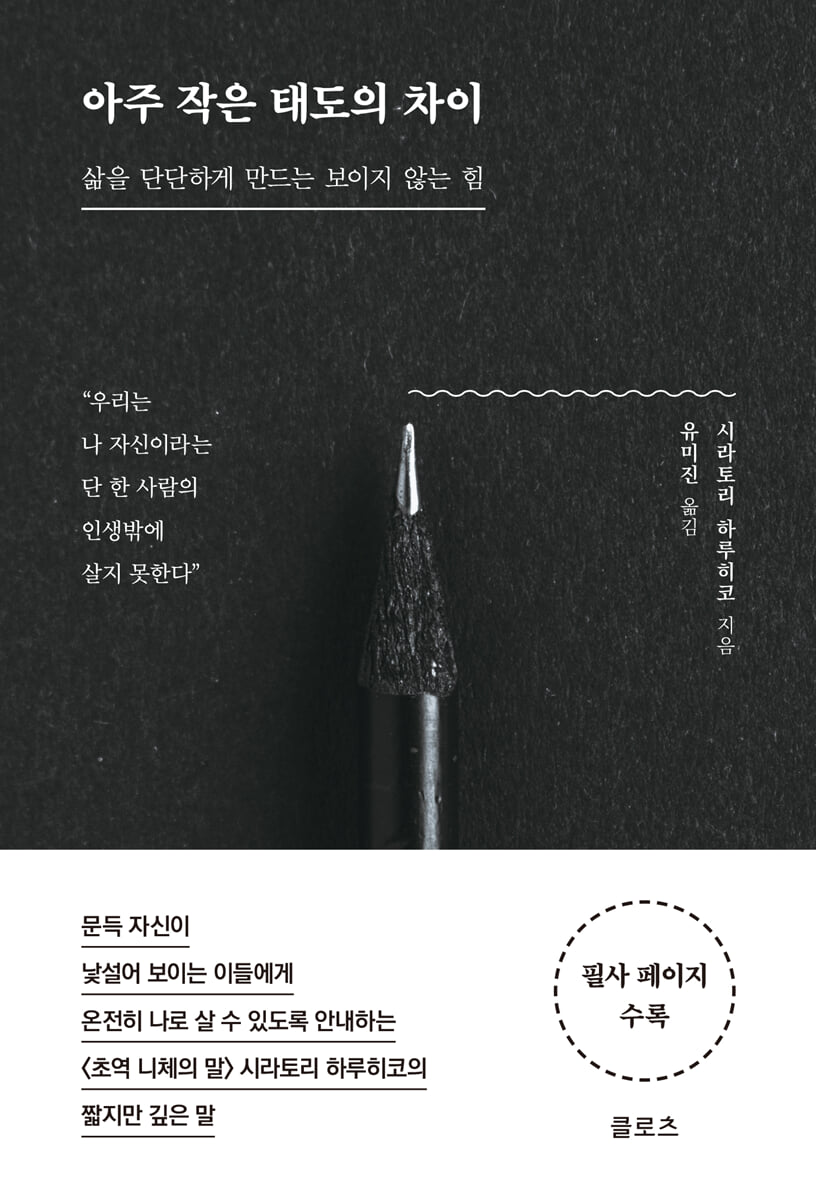
A very small difference in attitude
 |
Description
Book Introduction
Philosopher Haruhiko Shiratori tells us
A record of 47 attitudes for living unwaveringly as yourself.
“Life is not painful.
“It is suffering because we neglect our own lives.”
Philosopher Haruhiko Shiratori's approach to living without losing yourself.
The author, who has passed the peak of his life, has summarized in 47 short words the advice he wanted to give to his past self, who was afraid of each day, thinking that today was no different from yesterday and tomorrow would be worse than today.
Haruhiko Shiratori says this to modern people who resemble his younger self.
The way to find myself again, which I have lost little by little in the rush to live, is simple.
Rather than stubbornly holding on to yourself for fear of losing it, it is about changing yourself from your old self to a new self every day with the attitude that there is no fixed self.
A record of 47 attitudes for living unwaveringly as yourself.
“Life is not painful.
“It is suffering because we neglect our own lives.”
Philosopher Haruhiko Shiratori's approach to living without losing yourself.
The author, who has passed the peak of his life, has summarized in 47 short words the advice he wanted to give to his past self, who was afraid of each day, thinking that today was no different from yesterday and tomorrow would be worse than today.
Haruhiko Shiratori says this to modern people who resemble his younger self.
The way to find myself again, which I have lost little by little in the rush to live, is simple.
Rather than stubbornly holding on to yourself for fear of losing it, it is about changing yourself from your old self to a new self every day with the attitude that there is no fixed self.
- You can preview some of the book's contents.
Preview
index
preface
Chapter 1: Life is determined by small, invisible attitudes.
01 Regret not having regretted it
02 To empty, you must first fill.
03 Do not desire designed desires instead.
04 The only being that creates me is myself.
05 Every emotion has a reason
06 It's good to hear the story of someone who has been told.
07 One person can only live one life.
08 Create a space for your thoughts to dwell.
09 Immersion, when time and me are aligned
10 Books Contain the Universe of Authors and Readers
Chapter 2: The attitude you take each day becomes your life.
11 If you're an adult, dress like an adult.
12 Don't cover up your self-hatred with your hatred for the world.
13. The destination, not the starting point, proves the path taken.
14 Talent is inherent in everyone.
15 The proud face that has overcome the waves is full of wrinkles.
16 I dare not guess at myself.
17 Life is a process of replacing experience with experience.
18 Meaning arises from relationships.
Chapter 3: If you want to change your thinking, start by changing your attitude.
19 Adulthood is not about 'having' but 'becoming'
The idea that we should let go of stereotypes can also be a stereotype.
21 Only those who have broken themselves can break the world.
22 Don't try to find shortcuts
23 If you've never been denied, it's not a novel idea.
24 Words are not something you give, but something you receive.
25 To think differently, you must speak differently.
26 Have 'questions', not 'doubts'
27 Just look out the window, not at me reflected in the window.
28 Do not count people by their numbers.
29 Self-esteem comes from not making excuses for myself.
Chapter 4: A moment of lapse in attitude can destroy a lifetime of accumulated strength.
30 People criticize others because they are afraid of being criticized.
31 If you fall off a cliff, don't pray to fly.
32 Hours exist within me, not outside.
33 The deepest encounters are in silence.
34 The world expands only as far as you can see.
35 The me of today is the result of the choices I made in the past.
36 Words are vessels of thought.
37 Words that pass from mouth to mouth are that light and shallow.
38 Treat others as you would treat yourself.
39 Wisdom is knowing how to distinguish between small and big things.
Chapter 5: You Can't Choose Your Fate, But You Can Choose Your Attitude Toward It
40 Luxury is not excess, but rather the creation of leisure.
41 Worries can only be resolved by worrying about them.
42 Suffering is also a part of me, not someone else's.
43 Bookstores are hospitals of thought.
44 The mind is mine, but it is not mine to control.
45. The master takes pain as a challenge.
46 Life is inherently unstable
47 Life is fun because no matter how much you prepare, you never know the way.
Chapter 1: Life is determined by small, invisible attitudes.
01 Regret not having regretted it
02 To empty, you must first fill.
03 Do not desire designed desires instead.
04 The only being that creates me is myself.
05 Every emotion has a reason
06 It's good to hear the story of someone who has been told.
07 One person can only live one life.
08 Create a space for your thoughts to dwell.
09 Immersion, when time and me are aligned
10 Books Contain the Universe of Authors and Readers
Chapter 2: The attitude you take each day becomes your life.
11 If you're an adult, dress like an adult.
12 Don't cover up your self-hatred with your hatred for the world.
13. The destination, not the starting point, proves the path taken.
14 Talent is inherent in everyone.
15 The proud face that has overcome the waves is full of wrinkles.
16 I dare not guess at myself.
17 Life is a process of replacing experience with experience.
18 Meaning arises from relationships.
Chapter 3: If you want to change your thinking, start by changing your attitude.
19 Adulthood is not about 'having' but 'becoming'
The idea that we should let go of stereotypes can also be a stereotype.
21 Only those who have broken themselves can break the world.
22 Don't try to find shortcuts
23 If you've never been denied, it's not a novel idea.
24 Words are not something you give, but something you receive.
25 To think differently, you must speak differently.
26 Have 'questions', not 'doubts'
27 Just look out the window, not at me reflected in the window.
28 Do not count people by their numbers.
29 Self-esteem comes from not making excuses for myself.
Chapter 4: A moment of lapse in attitude can destroy a lifetime of accumulated strength.
30 People criticize others because they are afraid of being criticized.
31 If you fall off a cliff, don't pray to fly.
32 Hours exist within me, not outside.
33 The deepest encounters are in silence.
34 The world expands only as far as you can see.
35 The me of today is the result of the choices I made in the past.
36 Words are vessels of thought.
37 Words that pass from mouth to mouth are that light and shallow.
38 Treat others as you would treat yourself.
39 Wisdom is knowing how to distinguish between small and big things.
Chapter 5: You Can't Choose Your Fate, But You Can Choose Your Attitude Toward It
40 Luxury is not excess, but rather the creation of leisure.
41 Worries can only be resolved by worrying about them.
42 Suffering is also a part of me, not someone else's.
43 Bookstores are hospitals of thought.
44 The mind is mine, but it is not mine to control.
45. The master takes pain as a challenge.
46 Life is inherently unstable
47 Life is fun because no matter how much you prepare, you never know the way.
Detailed image

Into the book
No matter how many choices there are, in the end it is just a road blocked by walls on both sides.
We live by making choices along the given path.
The ruling system, the trend of the times, the unique way of thinking and values of the time, or what Michel Foucault called the 'episteme', are what control our lives.
If you go outside over that fence, you might be accused of being unethical.
You might be teased for being abnormal or treated as an outcast.
Then, how about climbing up that wall and taking a precarious step while teetering on the edge like a tightrope walker?
--- p.22, from “Do not desire designed desires instead”
Ultimately, we can only live one life: our own.
So, will you be lonely?
Or maybe it's not enough.
The saying that one person experiences as many experiences as another person means that one person's life is that vast and deep.
So, wouldn't it be possible to say that it is rather abundant?
--- p.39, from “One person can only live one life”
Talent is not some special power or energy that is innate or accumulated without anyone knowing.
Talent is not something vague.
Talent is something that is very obvious, something that is actually visible.
In other words, talent is 'achieving' something.
You don't become a painter because you have talent for drawing.
You become a painter because you draw pictures.
If you write novels, it means you have a talent for writing novels, and if you do business, it means you have a talent for business.
Talent is not an innate ability, but rather a proof of having accomplished something.
--- p.71, from “Talent is in everyone”
When we own something, we firmly believe that it is ours.
Furthermore, the owner thinks of himself as a special person.
But whatever you own, you will eventually lose it.
That is why we become hostile to others and try to protect ourselves from them.
If you continue to be tied down by what you own, it becomes impossible to 'become' anything.
Because what makes a person human is not the constant possession of something, but the constant becoming of something.
--- p.95, from “Adulthood is not something you ‘have’ but something you ‘become’”
The true self-esteem we yearn for is not respect for ourselves.
It is just vanity that wants to package oneself in a good way and be recognized for one's abilities.
You have to get rid of that useless pride.
Instead, what we should have is pride.
--- p.135, from “Self-esteem comes from an attitude of not making excuses for myself”
When we choose something, we are not choosing just one possibility.
It's about choosing one possibility and discarding all the rest.
If you deeply realize this, you will cherish the work you have chosen and will not regret it no matter what happens.
This is human ethics.
--- p.162, from “The me of today is the result of the choices I made in the past”
If you accept secular language at face value, you will unconsciously begin to view yourself and the world through the standards of secular language.
Secular language always considers words like beauty, strength, and youth as good values, and contains an aggressiveness that rejects the opposite.
Swayed by these words, people begin to view aging negatively and even feel ashamed of it.
The reason why philosophy books are difficult to read is because they are not written in the language of the world.
--- p.169~170, from “Words that pass from mouth to mouth are that light and shallow”
Suffering can also be divided into two types.
One is self-created suffering, and the other is suffering that inevitably happens to everyone.
If it is suffering that you have created, you must either take responsibility and deal with it, or run away.
However, if it is a hardship that happens to everyone in life, we must accept it and endure it.
That too is a part of life.
--- p.193~194, from “Suffering is also a part of me, not someone else’s”
Everything changes and flows.
Since nothing can be fixed on the sea, you have no choice but to move forward.
If you turn off the engine and just sit there in the sun, you will be swept away by bad weather and waves and end up sinking.
Just as waves must surge to exist, we too give here and receive there, scheme and challenge, fail and rise again, fall and rise again.
None of these are without anxiety.
Life is inherently uncertain.
So, if things go as you wish, you can have a good laugh.
That's life.
We live by making choices along the given path.
The ruling system, the trend of the times, the unique way of thinking and values of the time, or what Michel Foucault called the 'episteme', are what control our lives.
If you go outside over that fence, you might be accused of being unethical.
You might be teased for being abnormal or treated as an outcast.
Then, how about climbing up that wall and taking a precarious step while teetering on the edge like a tightrope walker?
--- p.22, from “Do not desire designed desires instead”
Ultimately, we can only live one life: our own.
So, will you be lonely?
Or maybe it's not enough.
The saying that one person experiences as many experiences as another person means that one person's life is that vast and deep.
So, wouldn't it be possible to say that it is rather abundant?
--- p.39, from “One person can only live one life”
Talent is not some special power or energy that is innate or accumulated without anyone knowing.
Talent is not something vague.
Talent is something that is very obvious, something that is actually visible.
In other words, talent is 'achieving' something.
You don't become a painter because you have talent for drawing.
You become a painter because you draw pictures.
If you write novels, it means you have a talent for writing novels, and if you do business, it means you have a talent for business.
Talent is not an innate ability, but rather a proof of having accomplished something.
--- p.71, from “Talent is in everyone”
When we own something, we firmly believe that it is ours.
Furthermore, the owner thinks of himself as a special person.
But whatever you own, you will eventually lose it.
That is why we become hostile to others and try to protect ourselves from them.
If you continue to be tied down by what you own, it becomes impossible to 'become' anything.
Because what makes a person human is not the constant possession of something, but the constant becoming of something.
--- p.95, from “Adulthood is not something you ‘have’ but something you ‘become’”
The true self-esteem we yearn for is not respect for ourselves.
It is just vanity that wants to package oneself in a good way and be recognized for one's abilities.
You have to get rid of that useless pride.
Instead, what we should have is pride.
--- p.135, from “Self-esteem comes from an attitude of not making excuses for myself”
When we choose something, we are not choosing just one possibility.
It's about choosing one possibility and discarding all the rest.
If you deeply realize this, you will cherish the work you have chosen and will not regret it no matter what happens.
This is human ethics.
--- p.162, from “The me of today is the result of the choices I made in the past”
If you accept secular language at face value, you will unconsciously begin to view yourself and the world through the standards of secular language.
Secular language always considers words like beauty, strength, and youth as good values, and contains an aggressiveness that rejects the opposite.
Swayed by these words, people begin to view aging negatively and even feel ashamed of it.
The reason why philosophy books are difficult to read is because they are not written in the language of the world.
--- p.169~170, from “Words that pass from mouth to mouth are that light and shallow”
Suffering can also be divided into two types.
One is self-created suffering, and the other is suffering that inevitably happens to everyone.
If it is suffering that you have created, you must either take responsibility and deal with it, or run away.
However, if it is a hardship that happens to everyone in life, we must accept it and endure it.
That too is a part of life.
--- p.193~194, from “Suffering is also a part of me, not someone else’s”
Everything changes and flows.
Since nothing can be fixed on the sea, you have no choice but to move forward.
If you turn off the engine and just sit there in the sun, you will be swept away by bad weather and waves and end up sinking.
Just as waves must surge to exist, we too give here and receive there, scheme and challenge, fail and rise again, fall and rise again.
None of these are without anxiety.
Life is inherently uncertain.
So, if things go as you wish, you can have a good laugh.
That's life.
--- p.221~222, from “Life is fun because no matter how much you prepare, you don’t know the way”
Publisher's Review
One minor difference in attitude:
Each human being can only live one life.
The reason modern people find life burdensome is because they live their lives mistaking the desires of others for their own.
We contrast our real selves with the ideal selves displayed on the Internet, and we come to believe that who we are here and now is not who we truly are.
Furthermore, he is constantly worried that his true self hidden behind such a decorated ideal will be revealed.
However, in “A Very Small Difference in Attitude,” philosopher Haruhiko Shiratori argues that such a life is nothing more than an attitude of being swayed by the desires of others, invented for the sake of desire.
If we are swayed by an ideal created by chimera-like culmination of the many good things in life that are considered successful by worldly standards, life soon becomes a process of losing ourselves.
This is because, rather than living the life you want, you end up living a life focused on avoiding failure and minimizing mistakes.
He says this:
“It takes a lifetime to experience the life of just one person.
But why do people want to live other people’s lives for them?”
This attitude toward life is not much different from the self-centered mindset of teenagers who mistakenly believe that their every move is being evaluated by others at every moment.
That is why the author advises that adults should live like adults.
The maturity he speaks of here is a mature attitude that firmly recognizes that failure and frustration are the essence of life, and that knows how to accept the anxiety and instability that come from them as a part of life.
One might take this advice on life attitudes as nothing more than a bit of wisdom.
However, the standards that distinguish adults from children, and between a life that is true to oneself and a life that has lost oneself, are not grandiose, but rather stem from differences in small attitudes toward life.
Two minor differences in attitude:
Life is a process of constantly replacing old shells with new ones.
This book is the result of the author, who became a philosopher after seeking answers from philosophers when he was at a loss about how to live, organizing the advice he wanted to give to his past self.
Furthermore, it is a handwritten book written like a heartfelt letter to myself, with a margin at the end of each chapter, so that I can once again reflect on his thoughts on self-discovery.
If you take his advice, contained in 47 short phrases, and engrave it into your mind every day, you will become a better person today than yesterday, and as these small changes accumulate, you will soon find yourself becoming stronger.
So then, what exactly is the ‘attitude to life that is unique to me’ that I can cultivate every day?
It is about breaking free from the self-consciousness that 'I am special' and letting go of the self that I stubbornly held onto to protect myself.
None of us can be free from the gaze of others.
However, even the idea of not being swayed by others is based on others, and there is no interest whatsoever in who the 'others' are or how they think and live.
It's just a vain effort to differentiate yourself through the value of being 'special' that sets you apart from others. If you truly want to live as yourself, you must be able to see yourself as you are.
Also, the advice to keep myself true to myself is not advice to hold on to myself tightly and fixate myself.
Rather, the author emphasizes that there is no such thing as an unchanging self.
He says that because humans are beings who are constantly becoming something else until the last moment of their lives, in order to keep myself true to myself, I must be able to face and embrace the self that is constantly changing, with some parts shining and others fading over time, paradoxically.
Haruhiko Shiratori says this.
“Life is a process of constantly replacing old experiences with new ones.
If I stop doing this, I will remain a strange, bound being for a moment.”
Three minor differences in attitude:
Very rarely do I imagine a road outside the one I'm on.
So how can we embrace our ever-changing selves and live the way we want? The approach to life the author proposes in this book is simple.
It is about consistently taking small amounts of time each day to look back on the path you have drawn.
We think we choose our own path in life, but in reality we are simply choosing one of several paths that have already been created.
Even though the choices may be relatively more diverse, in the end, we are forced to live within a given path that is blocked on both sides by walls.
The author asks us whether it is okay to live a life where we are content to choose from the given options, “like picking out food from a buffet,” and just live as we go.
However, this book does not urge a break from the norm by saying, "Jump out the fence right now."
However, I encourage you to occasionally imagine that there are other paths besides the one you are on.
To change yourself enough to climb a wall, you don't have to wake up early in the morning like a great monk and meditate, or have a dramatic experience like being struck by lightning.
It is enough to slowly accumulate the experience of savoring the philosopher's short but profound sentences with your own hands for a very short time.
As the author says, if you read this thin book slowly in a quiet place and take notes when you have time, you will feel “a refreshing feeling, like washing your face with cold, clear water. You will be freed from the thoughts and values you have held onto, and things will appear clearer, as if you were wearing new glasses.”
Each human being can only live one life.
The reason modern people find life burdensome is because they live their lives mistaking the desires of others for their own.
We contrast our real selves with the ideal selves displayed on the Internet, and we come to believe that who we are here and now is not who we truly are.
Furthermore, he is constantly worried that his true self hidden behind such a decorated ideal will be revealed.
However, in “A Very Small Difference in Attitude,” philosopher Haruhiko Shiratori argues that such a life is nothing more than an attitude of being swayed by the desires of others, invented for the sake of desire.
If we are swayed by an ideal created by chimera-like culmination of the many good things in life that are considered successful by worldly standards, life soon becomes a process of losing ourselves.
This is because, rather than living the life you want, you end up living a life focused on avoiding failure and minimizing mistakes.
He says this:
“It takes a lifetime to experience the life of just one person.
But why do people want to live other people’s lives for them?”
This attitude toward life is not much different from the self-centered mindset of teenagers who mistakenly believe that their every move is being evaluated by others at every moment.
That is why the author advises that adults should live like adults.
The maturity he speaks of here is a mature attitude that firmly recognizes that failure and frustration are the essence of life, and that knows how to accept the anxiety and instability that come from them as a part of life.
One might take this advice on life attitudes as nothing more than a bit of wisdom.
However, the standards that distinguish adults from children, and between a life that is true to oneself and a life that has lost oneself, are not grandiose, but rather stem from differences in small attitudes toward life.
Two minor differences in attitude:
Life is a process of constantly replacing old shells with new ones.
This book is the result of the author, who became a philosopher after seeking answers from philosophers when he was at a loss about how to live, organizing the advice he wanted to give to his past self.
Furthermore, it is a handwritten book written like a heartfelt letter to myself, with a margin at the end of each chapter, so that I can once again reflect on his thoughts on self-discovery.
If you take his advice, contained in 47 short phrases, and engrave it into your mind every day, you will become a better person today than yesterday, and as these small changes accumulate, you will soon find yourself becoming stronger.
So then, what exactly is the ‘attitude to life that is unique to me’ that I can cultivate every day?
It is about breaking free from the self-consciousness that 'I am special' and letting go of the self that I stubbornly held onto to protect myself.
None of us can be free from the gaze of others.
However, even the idea of not being swayed by others is based on others, and there is no interest whatsoever in who the 'others' are or how they think and live.
It's just a vain effort to differentiate yourself through the value of being 'special' that sets you apart from others. If you truly want to live as yourself, you must be able to see yourself as you are.
Also, the advice to keep myself true to myself is not advice to hold on to myself tightly and fixate myself.
Rather, the author emphasizes that there is no such thing as an unchanging self.
He says that because humans are beings who are constantly becoming something else until the last moment of their lives, in order to keep myself true to myself, I must be able to face and embrace the self that is constantly changing, with some parts shining and others fading over time, paradoxically.
Haruhiko Shiratori says this.
“Life is a process of constantly replacing old experiences with new ones.
If I stop doing this, I will remain a strange, bound being for a moment.”
Three minor differences in attitude:
Very rarely do I imagine a road outside the one I'm on.
So how can we embrace our ever-changing selves and live the way we want? The approach to life the author proposes in this book is simple.
It is about consistently taking small amounts of time each day to look back on the path you have drawn.
We think we choose our own path in life, but in reality we are simply choosing one of several paths that have already been created.
Even though the choices may be relatively more diverse, in the end, we are forced to live within a given path that is blocked on both sides by walls.
The author asks us whether it is okay to live a life where we are content to choose from the given options, “like picking out food from a buffet,” and just live as we go.
However, this book does not urge a break from the norm by saying, "Jump out the fence right now."
However, I encourage you to occasionally imagine that there are other paths besides the one you are on.
To change yourself enough to climb a wall, you don't have to wake up early in the morning like a great monk and meditate, or have a dramatic experience like being struck by lightning.
It is enough to slowly accumulate the experience of savoring the philosopher's short but profound sentences with your own hands for a very short time.
As the author says, if you read this thin book slowly in a quiet place and take notes when you have time, you will feel “a refreshing feeling, like washing your face with cold, clear water. You will be freed from the thoughts and values you have held onto, and things will appear clearer, as if you were wearing new glasses.”
GOODS SPECIFICS
- Date of issue: November 19, 2025
- Page count, weight, size: 224 pages | 300g | 128*188*15mm
- ISBN13: 9791199516601
- ISBN10: 1199516600
You may also like
카테고리
korean


korean

![GQ KOREA Mark (Monthly): December [2025]](http://librairie.coreenne.fr/cdn/shop/files/8ef265dbbfbf186523ed75ba7319009d.jpg?v=1765340328&width=3840)


