

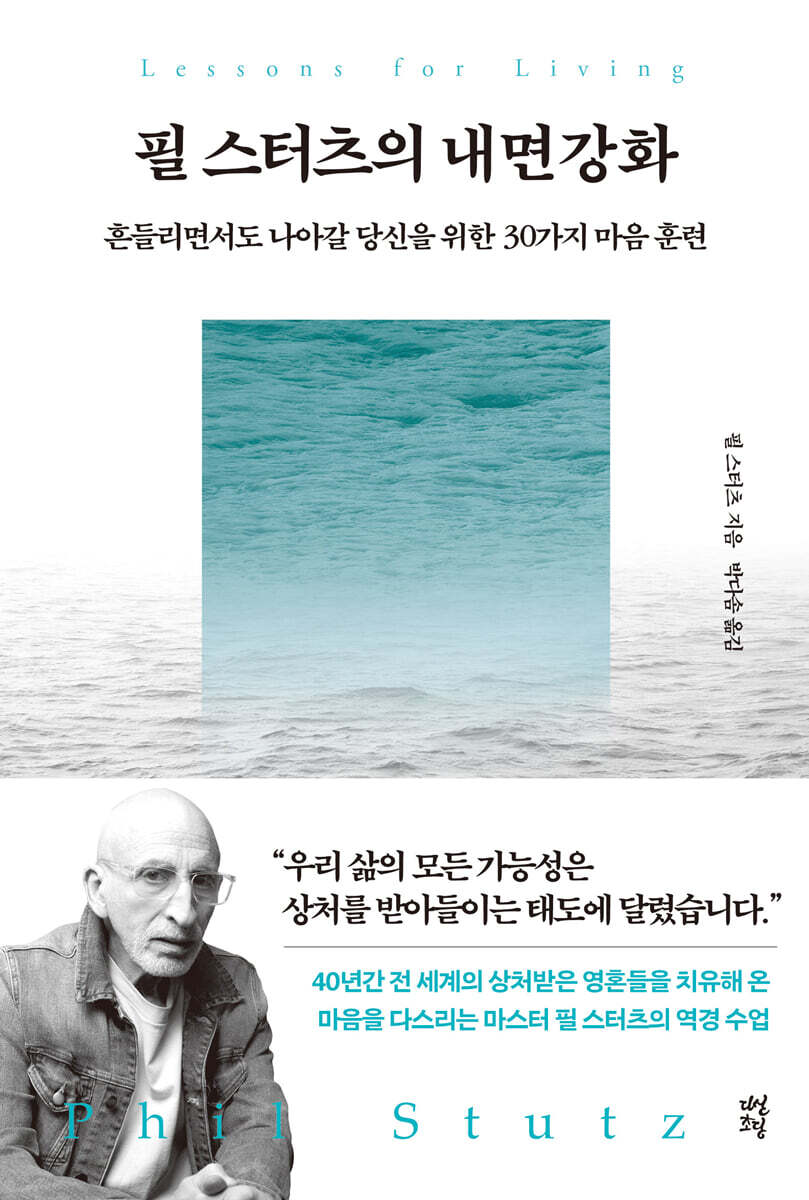
Phil Stutz's Inner Strength
 |
Description
Book Introduction
- A word from MD
- Phil Touche, a psychiatrist who has been counseling prisoners for 40 years, realizes the limitations of modern medicine.
He asserts that what we need is not medical knowledge, but a philosophy to determine the direction of our lives.
Is life tiring and painful? Take a breather and open this book.
You may be shaken, but you can move forward.
- Son Min-gyu, humanities PD
Healing wounded souls around the world for 40 years
Adversity Lessons from Master Phil Stutz on Mastering the Mind
“Let’s put the past behind us,
“Let’s change your life starting now.”
Suffering may be inevitable in life.
But the problem is that it brings about pain that we can avoid.
Phil Stutz has spent 40 years working with countless clients, from inmates to the top 0.01 percent. He has learned that while life has its challenges, our attitudes can either stagnate our lives or expand and propel us forward.
And the key was in today's actions.
Rather than trying to stop the thoughts that were causing me pain, wisdom and inner strength naturally followed when I moved in the direction I wanted to go.
He began to practice the most practical and effective method to bring about similar changes in the lives of clients who lacked the mental strength to engage in self-reflection.
This book contains 30 crucial insights from the treatment that has transformed thousands of lives.
Adversity Lessons from Master Phil Stutz on Mastering the Mind
“Let’s put the past behind us,
“Let’s change your life starting now.”
Suffering may be inevitable in life.
But the problem is that it brings about pain that we can avoid.
Phil Stutz has spent 40 years working with countless clients, from inmates to the top 0.01 percent. He has learned that while life has its challenges, our attitudes can either stagnate our lives or expand and propel us forward.
And the key was in today's actions.
Rather than trying to stop the thoughts that were causing me pain, wisdom and inner strength naturally followed when I moved in the direction I wanted to go.
He began to practice the most practical and effective method to bring about similar changes in the lives of clients who lacked the mental strength to engage in self-reflection.
This book contains 30 crucial insights from the treatment that has transformed thousands of lives.
- You can preview some of the book's contents.
Preview
index
Preface_ The Key You Were Holding
Chapter 1: A Life of Shaking Progress
If I had prepared my life with philosophy
That's what needs to happen to you
All I need is to take action.
I'm a good person, why did this happen?
It's already inside me
Chapter 2: The Road of No Return
You can never make the right decision
The most powerful tool we have
What Pain Tells Me
You might get angry at this, but
We live the same way, so what do you want to be different about?
Chapter 3: The True Form of Freedom
A fish is free to swim in the direction it wants.
Something that feels better than all the money in the world
A life with rhythm
Authority will set us free
How to love the person next to you
Chapter 4: How to Bring More Power into Your Life
Practice loving shadows
Willingness to lose everything
A life not driven by pressure
Pick up the philosopher's stone
Something stronger than the truth
Chapter 5: What Only Darkness Can Tell Us
The key to conflict
If your life were mine
Two consequences of false hope
How not to waste the words of the wise
What to do when everything falls apart
Chapter 6: Relationships Beyond Pain
The hardest job in the world
When you can only convey it with your life, not with words
Three Qualities for a Life Partner
The difference between dependence and intimacy
To love, not to endure
Acknowledgements
Chapter 1: A Life of Shaking Progress
If I had prepared my life with philosophy
That's what needs to happen to you
All I need is to take action.
I'm a good person, why did this happen?
It's already inside me
Chapter 2: The Road of No Return
You can never make the right decision
The most powerful tool we have
What Pain Tells Me
You might get angry at this, but
We live the same way, so what do you want to be different about?
Chapter 3: The True Form of Freedom
A fish is free to swim in the direction it wants.
Something that feels better than all the money in the world
A life with rhythm
Authority will set us free
How to love the person next to you
Chapter 4: How to Bring More Power into Your Life
Practice loving shadows
Willingness to lose everything
A life not driven by pressure
Pick up the philosopher's stone
Something stronger than the truth
Chapter 5: What Only Darkness Can Tell Us
The key to conflict
If your life were mine
Two consequences of false hope
How not to waste the words of the wise
What to do when everything falls apart
Chapter 6: Relationships Beyond Pain
The hardest job in the world
When you can only convey it with your life, not with words
Three Qualities for a Life Partner
The difference between dependence and intimacy
To love, not to endure
Acknowledgements
Detailed image
.jpg)
Into the book
I felt that the psychiatry I was practicing was not really helping my clients.
I was determined to find a better way, but I was lost and wandering around with no one to ask for advice.
As I searched around relentlessly for ideas and answers, I stumbled upon a key in a place I hadn't even thought to look.
The key was held by the clients who came to see me.
If I first set aside the psychiatric treatment rules and respected my clients as human beings—that is, if I saw them not as a collection of genetic and mental abnormalities but simply as individuals—then they were willing to follow my intuition wherever it led them.
Thankfully, they fully trusted me to continue my trial and error journey to forge a new path.
With the encouragement of my clients, I finally developed a completely different approach to psychotherapy than I had before.
--- From "The Key You Were Holding"
Is there a way to live differently? Can we somehow live through the conflicts, uncertainties, and disappointments of life, yet still consider ourselves pretty good people? It's possible.
But to do that, you have to completely change the direction of your life.
The first step is to realize that life is a process.
The culture we live in constantly blinds us to this fact.
By making the destructive claim that once you've somehow perfected your life, you can be fixed in that state.
The ideal world where superior people live is nothing more than a fleeting moment, like a snapshot or a postcard, frozen in time.
But real life is a process, it has depth and moves constantly.
--- From "If I had prepared my life with philosophy"
There are more implications to evaluating the world itself.
The implication is that something bad is better off not existing in the first place.
When we think we know what should and should not be in the world, we are acting like gods.
It is said that our evaluations should determine the nature of reality, and that nothing is higher than our thoughts.
The moment we think we are that important, we lose sight of something bigger than ourselves.
--- From "That's What Has to Happen to You"
Nothing in the world can be born in a completely certain state.
Anyone who wants to create must first boldly take a step into the unknown.
Harold could act before he 'knew' he was doing the right thing.
Any dynamic person has this ability.
They believe in action itself.
You can have that kind of faith because you feel that the information you need comes from your actions, not from the thoughts in your head.
Will is more than just the energy that moves us to action; it is also a perception.
As you put the philosophy of action into practice, your perspective on your goals will also begin to change.
Since the information we need is obtained through the process of carrying out the action, goals only serve to stimulate that process.
So there is no such thing as a right goal or a rational goal.
When setting goals, anything that can be used immediately is sufficient.
All goals are temporary.
When we commit to our goals through action, our life force becomes stronger and gives us the intelligence to set our next goal.
--- From "All I need is to know when I act"
The child inside us who craves recognition is not our true self.
It is precisely when the part of us that longs for recognition doesn't receive the recognition we desire, that we discover another part of us, hidden deeper within, that doesn't live as an image projected onto someone else's mind.
--- From "I'm a good person, so why did this happen?"
We hope that our decisions are 'right' and that the world will stop changing and become fixed so that we never have to face uncertainty again.
Because we harbor such a desire in our hearts, we feel the pressure to make even the smallest decisions, as if they were a matter of life and death.
We feel that if we make good decisions, we will be saved, and if we make bad decisions, our lives will be ruined.
But the truth is, life goes on, whether the decisions we make are good or bad.
We try to protect ourselves from the feeling that we have lost something because of the choices we made by discounting the paths we did not choose.
But the truth is, every decision involves loss.
Decisions are inherently limited.
If you live in Florida, you lose the ability to live in Colorado.
If you become a teacher, there is no chance of becoming a technician.
If you see one movie, you can't see any other movies showing that night.
We often forget this fact, which seems so obvious.
In a sense, every decision we make constrains the world we live in.
There is no way to avoid this.
Fortunately, it is precisely this sense of acknowledging these external limitations that makes us spiritually stronger.
--- From "You Can Never Make the Right Decision"
People who insist that the world treats them fairly end up believing they are victims.
But the victim's anger is not constructive anger.
Such anger feeds on an unconscious desire for the status quo to remain the same so that we can continue to be justifiably angry.
When anger and a sense of victimization become so familiar that we become attached to those emotions, they become a kind of identity.
In this sense, a person who is consumed by anger finds it difficult to move on to the next stage of life.
Anger is like an anchor, holding my ankles tightly.
--- From "I know you might be angry at this"
Narcissism isn't just giving up and telling yourself it's okay.
It's simply a denial.
People who never put in the effort in the first place get no meaning from accepting failure.
People who are too lazy to dedicate themselves to their own lives do not have the energy needed to truly love themselves.
Narcissism is not the same as self-absorption.
A narcissist who is intoxicated with himself can never accept or love his own shadow.
We don't have the courage to admit our weaknesses, nor the discipline to learn to accept them.
Narcissism is a kind of spiritual laziness.
All love requires effort.
Loving yourself takes even more effort.
--- From "Practice of Loving Shadows"
Why couldn't he be happy even when he had what he so desperately wanted? The truth is, true satisfaction has nothing to do with what you have or don't have.
Our happiness depends solely on what kind of world we choose to live in.
--- From "If Your Life Were Mine"
If you think about it, the power of life is nothing more than a series of habits.
If you have a habit of looking outside yourself whenever you need stimulation or validation, you will become depressed whenever you don't get what you want.
But if you live with an inner responsibility to take responsibility for your own feelings, and if you take action to connect with a higher power whenever you feel a hole in your life, you will develop the habit of gaining a new level of energy and vitality.
--- From "Two Consequences of False Hope"
The secret to coping with pain is remembering that it comes in waves.
At the peak of your suffering, it may feel like the world is ending at any moment.
But remember, this moment won't last long.
Then you can learn to broaden your perspective even in the most daunting moments.
I was determined to find a better way, but I was lost and wandering around with no one to ask for advice.
As I searched around relentlessly for ideas and answers, I stumbled upon a key in a place I hadn't even thought to look.
The key was held by the clients who came to see me.
If I first set aside the psychiatric treatment rules and respected my clients as human beings—that is, if I saw them not as a collection of genetic and mental abnormalities but simply as individuals—then they were willing to follow my intuition wherever it led them.
Thankfully, they fully trusted me to continue my trial and error journey to forge a new path.
With the encouragement of my clients, I finally developed a completely different approach to psychotherapy than I had before.
--- From "The Key You Were Holding"
Is there a way to live differently? Can we somehow live through the conflicts, uncertainties, and disappointments of life, yet still consider ourselves pretty good people? It's possible.
But to do that, you have to completely change the direction of your life.
The first step is to realize that life is a process.
The culture we live in constantly blinds us to this fact.
By making the destructive claim that once you've somehow perfected your life, you can be fixed in that state.
The ideal world where superior people live is nothing more than a fleeting moment, like a snapshot or a postcard, frozen in time.
But real life is a process, it has depth and moves constantly.
--- From "If I had prepared my life with philosophy"
There are more implications to evaluating the world itself.
The implication is that something bad is better off not existing in the first place.
When we think we know what should and should not be in the world, we are acting like gods.
It is said that our evaluations should determine the nature of reality, and that nothing is higher than our thoughts.
The moment we think we are that important, we lose sight of something bigger than ourselves.
--- From "That's What Has to Happen to You"
Nothing in the world can be born in a completely certain state.
Anyone who wants to create must first boldly take a step into the unknown.
Harold could act before he 'knew' he was doing the right thing.
Any dynamic person has this ability.
They believe in action itself.
You can have that kind of faith because you feel that the information you need comes from your actions, not from the thoughts in your head.
Will is more than just the energy that moves us to action; it is also a perception.
As you put the philosophy of action into practice, your perspective on your goals will also begin to change.
Since the information we need is obtained through the process of carrying out the action, goals only serve to stimulate that process.
So there is no such thing as a right goal or a rational goal.
When setting goals, anything that can be used immediately is sufficient.
All goals are temporary.
When we commit to our goals through action, our life force becomes stronger and gives us the intelligence to set our next goal.
--- From "All I need is to know when I act"
The child inside us who craves recognition is not our true self.
It is precisely when the part of us that longs for recognition doesn't receive the recognition we desire, that we discover another part of us, hidden deeper within, that doesn't live as an image projected onto someone else's mind.
--- From "I'm a good person, so why did this happen?"
We hope that our decisions are 'right' and that the world will stop changing and become fixed so that we never have to face uncertainty again.
Because we harbor such a desire in our hearts, we feel the pressure to make even the smallest decisions, as if they were a matter of life and death.
We feel that if we make good decisions, we will be saved, and if we make bad decisions, our lives will be ruined.
But the truth is, life goes on, whether the decisions we make are good or bad.
We try to protect ourselves from the feeling that we have lost something because of the choices we made by discounting the paths we did not choose.
But the truth is, every decision involves loss.
Decisions are inherently limited.
If you live in Florida, you lose the ability to live in Colorado.
If you become a teacher, there is no chance of becoming a technician.
If you see one movie, you can't see any other movies showing that night.
We often forget this fact, which seems so obvious.
In a sense, every decision we make constrains the world we live in.
There is no way to avoid this.
Fortunately, it is precisely this sense of acknowledging these external limitations that makes us spiritually stronger.
--- From "You Can Never Make the Right Decision"
People who insist that the world treats them fairly end up believing they are victims.
But the victim's anger is not constructive anger.
Such anger feeds on an unconscious desire for the status quo to remain the same so that we can continue to be justifiably angry.
When anger and a sense of victimization become so familiar that we become attached to those emotions, they become a kind of identity.
In this sense, a person who is consumed by anger finds it difficult to move on to the next stage of life.
Anger is like an anchor, holding my ankles tightly.
--- From "I know you might be angry at this"
Narcissism isn't just giving up and telling yourself it's okay.
It's simply a denial.
People who never put in the effort in the first place get no meaning from accepting failure.
People who are too lazy to dedicate themselves to their own lives do not have the energy needed to truly love themselves.
Narcissism is not the same as self-absorption.
A narcissist who is intoxicated with himself can never accept or love his own shadow.
We don't have the courage to admit our weaknesses, nor the discipline to learn to accept them.
Narcissism is a kind of spiritual laziness.
All love requires effort.
Loving yourself takes even more effort.
--- From "Practice of Loving Shadows"
Why couldn't he be happy even when he had what he so desperately wanted? The truth is, true satisfaction has nothing to do with what you have or don't have.
Our happiness depends solely on what kind of world we choose to live in.
--- From "If Your Life Were Mine"
If you think about it, the power of life is nothing more than a series of habits.
If you have a habit of looking outside yourself whenever you need stimulation or validation, you will become depressed whenever you don't get what you want.
But if you live with an inner responsibility to take responsibility for your own feelings, and if you take action to connect with a higher power whenever you feel a hole in your life, you will develop the habit of gaining a new level of energy and vitality.
--- From "Two Consequences of False Hope"
The secret to coping with pain is remembering that it comes in waves.
At the peak of your suffering, it may feel like the world is ending at any moment.
But remember, this moment won't last long.
Then you can learn to broaden your perspective even in the most daunting moments.
--- From "The Difference Between Dependence and Intimacy"
Publisher's Review
★The main character of the popular documentary "Stutz"
★“My life, which no psychiatrist could change, changed qualitatively after I met him.” _Jonah Hill
Presented by the world's best psychiatrist
30 Mind Exercises for an Unhurt-Free Soul
“I didn’t want to see patients suffer.
“I wanted to put something in their hands right now.”
Phil Stutz is one of the world's best-known psychiatrists, having changed thousands of lives over a period of over 40 years.
Beginning his career as a psychiatrist at Rikers Prison, he was forced to become acutely aware that not all clients possess the mental strength and environmental resources to engage in gradual self-reflection.
For people who are experiencing inner turmoil and pain in real time, rapid change, even if it is very small, is needed.
That change gave me the motivation to keep trying.
He wanted to give his patients something to hold onto as they left his clinic.
Wanting to make real, if possible rapid, changes in his clients' lives, he began to devise his own treatment method, drawing on visualization, behavioral therapy, intuition, and experience.
His new treatment brought about dramatic changes in the lives of clients who had previously failed psychiatric treatment, and the old apartment building that served as his long-time clinic began to bustle with clients including Gwyneth Paltrow, Drew Barrymore, and Joaquin Phoenix.
His longtime client, Jonah Hill, wanted to spread the word about Phil Stutz's healing power, so he created the 2022 documentary "Stutz," which chronicled their relationship and his philosophy, and garnered worldwide attention.
What clients unanimously say is that their lives were completely changed after meeting him.
"Phil Stutz's Inner Strength" provides life-changing insights and worldviews for 30 situations in life, enabling readers to bring about change in their own lives.
Phil Stutz's clear and profound insights into the countless dilemmas surrounding life—success, failure, love, loss, regret, and death—provide a fresh perspective on the journey we have lived and the path we will take in the future.
Instead of avoiding the truths we hate to swallow, such as the inevitability of adversity and hardship, he shows us how suffering can lead to true freedom and joy.
For those who want to know the true potential of their lives, this book contains wisdom that will serve as a guide for life.
“All the possibilities of our lives
“It depends on your attitude toward pain.”
If you happened to meet Phil Stutz and pour out your deepest anxieties, regrets, and feelings of inferiority, he would probably say something like this:
Your thoughts are somewhat true.
And that's what living is like.
It's not cynicism.
However, he met with clients ranging from inmates in prison to the top 0.01 percent, and he learned that there are unavoidable adversities in life no matter what external circumstances, and he himself experienced them firsthand as he suffered from Parkinson's disease since his 20s.
But still, life can be beautiful and meaningful enough.
It may not be what you thought it would be.
What we need to realize that is accurate advice rather than comfort that turns into empty consolation when you turn away.
He wants people to first see the world as it is.
Life is constantly changing, and its direction is often different from what I wanted.
That fact doesn't change.
But there are things that can be changed.
That is exactly my reaction to the world.
When the world doesn't go our way, people often become frustrated, judge the world for what it is, or harbor delusions about a more just world, resenting and avoiding reality.
But such reactions waste energy and time, and stagnate life.
At that time, Stutz vividly exposes the mental barriers we may not have even known we had, and presents a new perspective on those painful moments and specific mental tools that can help us overcome the pain.
If we learn and apply it to our lives, we can choose our reactions instead of being swayed by those emotions.
At that moment, adversity becomes the driving force of life.
The One Wisdom Taught by 40 Years of Healing
We move forward to shake
Many psychotherapies begin by revisiting childhood and past traumas.
This is also an area that many clients who have received psychotherapy find distressing.
Phil Stutz is a rare psychiatrist who doesn't focus on the past.
Sometimes I tell my clients this.
“Let’s leave the past behind and start changing your life from now on.” It doesn’t mean that the past is meaningless.
However, our goal is not to fully understand and realize the past, but to move forward in an imperfect manner, to know and realize myself more deeply.
He says that when we understand the nature of the world, we can see how we should live.
Life must go on, whether it's as successful as a dream or as desperate as hell.
That is the irresistible nature and power of the world.
When we take steps today in the direction our lives want to take, whether they lead to success or failure, those actions will imbue our lives with the wisdom we most need and draw in a greater power to the world.
Moving forward despite doubts and wavering.
That's when our inner self becomes truly strong.
Of course, it is not an easy task.
But if we hold onto Phil Stutz's philosophy and the tools of the mind that will help us not lose our sense of direction in life, we will soon find ourselves ready to face the world with a humble yet bold heart.
★“My life, which no psychiatrist could change, changed qualitatively after I met him.” _Jonah Hill
Presented by the world's best psychiatrist
30 Mind Exercises for an Unhurt-Free Soul
“I didn’t want to see patients suffer.
“I wanted to put something in their hands right now.”
Phil Stutz is one of the world's best-known psychiatrists, having changed thousands of lives over a period of over 40 years.
Beginning his career as a psychiatrist at Rikers Prison, he was forced to become acutely aware that not all clients possess the mental strength and environmental resources to engage in gradual self-reflection.
For people who are experiencing inner turmoil and pain in real time, rapid change, even if it is very small, is needed.
That change gave me the motivation to keep trying.
He wanted to give his patients something to hold onto as they left his clinic.
Wanting to make real, if possible rapid, changes in his clients' lives, he began to devise his own treatment method, drawing on visualization, behavioral therapy, intuition, and experience.
His new treatment brought about dramatic changes in the lives of clients who had previously failed psychiatric treatment, and the old apartment building that served as his long-time clinic began to bustle with clients including Gwyneth Paltrow, Drew Barrymore, and Joaquin Phoenix.
His longtime client, Jonah Hill, wanted to spread the word about Phil Stutz's healing power, so he created the 2022 documentary "Stutz," which chronicled their relationship and his philosophy, and garnered worldwide attention.
What clients unanimously say is that their lives were completely changed after meeting him.
"Phil Stutz's Inner Strength" provides life-changing insights and worldviews for 30 situations in life, enabling readers to bring about change in their own lives.
Phil Stutz's clear and profound insights into the countless dilemmas surrounding life—success, failure, love, loss, regret, and death—provide a fresh perspective on the journey we have lived and the path we will take in the future.
Instead of avoiding the truths we hate to swallow, such as the inevitability of adversity and hardship, he shows us how suffering can lead to true freedom and joy.
For those who want to know the true potential of their lives, this book contains wisdom that will serve as a guide for life.
“All the possibilities of our lives
“It depends on your attitude toward pain.”
If you happened to meet Phil Stutz and pour out your deepest anxieties, regrets, and feelings of inferiority, he would probably say something like this:
Your thoughts are somewhat true.
And that's what living is like.
It's not cynicism.
However, he met with clients ranging from inmates in prison to the top 0.01 percent, and he learned that there are unavoidable adversities in life no matter what external circumstances, and he himself experienced them firsthand as he suffered from Parkinson's disease since his 20s.
But still, life can be beautiful and meaningful enough.
It may not be what you thought it would be.
What we need to realize that is accurate advice rather than comfort that turns into empty consolation when you turn away.
He wants people to first see the world as it is.
Life is constantly changing, and its direction is often different from what I wanted.
That fact doesn't change.
But there are things that can be changed.
That is exactly my reaction to the world.
When the world doesn't go our way, people often become frustrated, judge the world for what it is, or harbor delusions about a more just world, resenting and avoiding reality.
But such reactions waste energy and time, and stagnate life.
At that time, Stutz vividly exposes the mental barriers we may not have even known we had, and presents a new perspective on those painful moments and specific mental tools that can help us overcome the pain.
If we learn and apply it to our lives, we can choose our reactions instead of being swayed by those emotions.
At that moment, adversity becomes the driving force of life.
The One Wisdom Taught by 40 Years of Healing
We move forward to shake
Many psychotherapies begin by revisiting childhood and past traumas.
This is also an area that many clients who have received psychotherapy find distressing.
Phil Stutz is a rare psychiatrist who doesn't focus on the past.
Sometimes I tell my clients this.
“Let’s leave the past behind and start changing your life from now on.” It doesn’t mean that the past is meaningless.
However, our goal is not to fully understand and realize the past, but to move forward in an imperfect manner, to know and realize myself more deeply.
He says that when we understand the nature of the world, we can see how we should live.
Life must go on, whether it's as successful as a dream or as desperate as hell.
That is the irresistible nature and power of the world.
When we take steps today in the direction our lives want to take, whether they lead to success or failure, those actions will imbue our lives with the wisdom we most need and draw in a greater power to the world.
Moving forward despite doubts and wavering.
That's when our inner self becomes truly strong.
Of course, it is not an easy task.
But if we hold onto Phil Stutz's philosophy and the tools of the mind that will help us not lose our sense of direction in life, we will soon find ourselves ready to face the world with a humble yet bold heart.
GOODS SPECIFICS
- Date of issue: March 21, 2025
- Page count, weight, size: 344 pages | 506g | 135*200*23mm
- ISBN13: 9791130664934
- ISBN10: 1130664937
You may also like
카테고리
korean


korean

![GQ KOREA Mark (Monthly): December [2025]](http://librairie.coreenne.fr/cdn/shop/files/8ef265dbbfbf186523ed75ba7319009d.jpg?v=1765340328&width=3840)


