

I decided to be the best person I could be.
 |
Description
Book Introduction
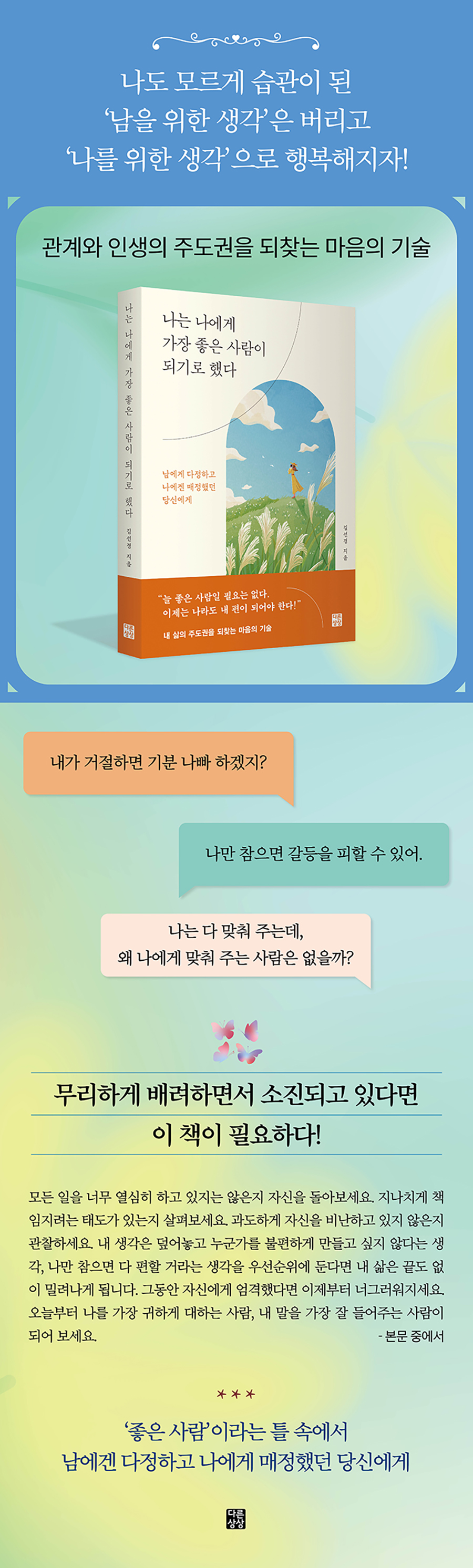
“You don’t always have to be a good person.
Now the country must be on my side!”
To a life that respects myself without being overly considerate anymore
The Art of the Mind to Regain Control of Relationships and Life
This book asks those who have consumed themselves in the name of 'consideration' and 'devotion'.
“How kind are you to yourself?”
This book was written for those who have always put others first and put their own feelings on the back burner, and those who have wanted to be good people but ended up feeling exhausted and empty.
Now, we will guide you on the path to creating healthy relationships and a balanced mind by placing 'me' at the center of your life.
Based on psychological insights, it helps you reflect on yourself by examining how the tendencies and emotions formed through childhood experiences affect your current life.
It guides you step-by-step through the process of letting go of the habit of trying to look good to others and transitioning from being a “good person” to being a “good person to myself” and into an attitude of respecting and caring for yourself.
In the process, you can understand yourself, heal your wounded inner self, and liberate your mind.
Now, before anyone else, please be on my side.
Let's take the first step through this book.
Now the country must be on my side!”
To a life that respects myself without being overly considerate anymore
The Art of the Mind to Regain Control of Relationships and Life
This book asks those who have consumed themselves in the name of 'consideration' and 'devotion'.
“How kind are you to yourself?”
This book was written for those who have always put others first and put their own feelings on the back burner, and those who have wanted to be good people but ended up feeling exhausted and empty.
Now, we will guide you on the path to creating healthy relationships and a balanced mind by placing 'me' at the center of your life.
Based on psychological insights, it helps you reflect on yourself by examining how the tendencies and emotions formed through childhood experiences affect your current life.
It guides you step-by-step through the process of letting go of the habit of trying to look good to others and transitioning from being a “good person” to being a “good person to myself” and into an attitude of respecting and caring for yourself.
In the process, you can understand yourself, heal your wounded inner self, and liberate your mind.
Now, before anyone else, please be on my side.
Let's take the first step through this book.
index
Introduction The most precious person in this world is me
Chapter 1: Why Do We Have Difficult Relationships?
Finding the root of the wound
My emotions are holding me back
There is a wound behind the avoidant mind.
The more you avoid conflict, the more other emotions accumulate.
A lack of trust in myself creates misunderstandings in relationships.
Keeping a proper distance is the secret to a respectful relationship.
If expectations of each other become the spark of conflict
When you truly understand yourself, you can understand others.
Chapter 2 You Don't Always Have to Be a Good Person
If you put others first, there is no life for you.
When the thought that I 'must be good' binds me
If you let go of your need for recognition, life becomes a little lighter.
The good guy complex is a survival instinct.
My sincerity comes before other people's feelings.
The mask I wear to be loved erases me.
To the heart that hoped for the happiness of others through my sacrifice
My heart is breaking in endless devotion
Let's put aside excessive consideration and re-establish the central axis of "me."
Chapter 3: How to Read the Signals of My Hurt in Relationships
The saying 'knowledge is power' applies to me too.
Asking Yourself: A Habit That Uncovers Ambiguous Emotions
The thought that it's okay to be lacking liberates the mind.
Am I a rejection sensitive person?
Rejection is not a rejection of my existence.
My wounds that can be found in the patterns of relationships
The moment you say, "I know you well," a rift appears in your relationship.
Let's understand the different waves of emotion.
Chapter 4: Focusing Life on 'Me'
Naming the emotions that bother me
The courage to see yourself as you are
Let's focus on the signals in my heart, not the signals of feeling sorry.
Even if you get hurt and fall, just get up and that's it
Let's distinguish between what we can and cannot do.
What I hate is also a part of me
A moment to be generous to myself
If you don't love yourself, you will crave it from others.
Create your own safe base
Chapter 5: I Decided to Be a Good Person to Myself
Return to being my whole self
Be generous to me
Say goodbye to the days when my voice was ignored
Let's adjust our lifestyle to center ourselves, not the world.
The person who can treat me most preciously is 'me'
The starting point of happiness is within me.
Let us color our lives with love for ourselves and others.
The decision to love myself first at every moment
Chapter 1: Why Do We Have Difficult Relationships?
Finding the root of the wound
My emotions are holding me back
There is a wound behind the avoidant mind.
The more you avoid conflict, the more other emotions accumulate.
A lack of trust in myself creates misunderstandings in relationships.
Keeping a proper distance is the secret to a respectful relationship.
If expectations of each other become the spark of conflict
When you truly understand yourself, you can understand others.
Chapter 2 You Don't Always Have to Be a Good Person
If you put others first, there is no life for you.
When the thought that I 'must be good' binds me
If you let go of your need for recognition, life becomes a little lighter.
The good guy complex is a survival instinct.
My sincerity comes before other people's feelings.
The mask I wear to be loved erases me.
To the heart that hoped for the happiness of others through my sacrifice
My heart is breaking in endless devotion
Let's put aside excessive consideration and re-establish the central axis of "me."
Chapter 3: How to Read the Signals of My Hurt in Relationships
The saying 'knowledge is power' applies to me too.
Asking Yourself: A Habit That Uncovers Ambiguous Emotions
The thought that it's okay to be lacking liberates the mind.
Am I a rejection sensitive person?
Rejection is not a rejection of my existence.
My wounds that can be found in the patterns of relationships
The moment you say, "I know you well," a rift appears in your relationship.
Let's understand the different waves of emotion.
Chapter 4: Focusing Life on 'Me'
Naming the emotions that bother me
The courage to see yourself as you are
Let's focus on the signals in my heart, not the signals of feeling sorry.
Even if you get hurt and fall, just get up and that's it
Let's distinguish between what we can and cannot do.
What I hate is also a part of me
A moment to be generous to myself
If you don't love yourself, you will crave it from others.
Create your own safe base
Chapter 5: I Decided to Be a Good Person to Myself
Return to being my whole self
Be generous to me
Say goodbye to the days when my voice was ignored
Let's adjust our lifestyle to center ourselves, not the world.
The person who can treat me most preciously is 'me'
The starting point of happiness is within me.
Let us color our lives with love for ourselves and others.
The decision to love myself first at every moment
Detailed image
Into the book
If you guess what the other person is thinking and give up when it's time to make a request or refuse, you will end up being the only one who feels uncomfortable and hurt.
If you reject a request for personal reasons and the other person is overly upset, it's the other person's fault for not considering your circumstances and not being able to process their emotions in a healthy way.
People who are sensitive to others' reactions become discouraged when others express anger or frustration, and instead of asserting themselves, they try to accommodate the other person.
The other person's anger and resentment are emotions he has to deal with.
It's not my part.
It's important in life to assert your thoughts, to say no to requests, to ask for favors sometimes, and to try things out.
--- p.46 From “Not trusting myself creates misunderstandings in relationships”
As I lived my life trying to do something for someone, trying to be a good person to others, while ignoring my own heart and desires, I gradually forgot myself.
As I tried to satisfy someone whose standards of satisfaction I had no idea about, I couldn't help but push myself harder and harder.
It's about leading me into a perfection that has no end in sight.
Perfectionism and responsibility.
You have a kind and honest nature, but what if you started caring about your own well-being instead of worrying about the well-being of others? I hope you can see the real me you've been forgetting for a while.
--- p.102 From “The most meaningful growth comes when no one notices”
There is one area where I put a lot of effort when consulting.
It is an exposure of weaknesses.
I feel better after exposing my weaknesses.
Because you don't have to try to hide it anymore.
There's no need to wear a mask or worry about what others think of me.
This will give you peace of mind.
I have the freedom to show myself naturally and look at others.
Relationships become more comfortable when you can see each other.
--- p.130 From “The thought that it’s okay to be lacking liberates the mind”
Molecular biologist Sydney Brenner coined the term "Ockham's broom."
It's a term that refers to the act of sweeping an inconvenient truth under the rug and hiding it.
A society that says being considerate of others is admirable, parents' values that tell us certain behaviors are absolutely unacceptable, and my desire to be loved have become Occam's brooms that sweep my true feelings under the rug.
We need to relearn how to listen to our inner voice.
The countless hours I spend ignoring my intuition come back to me like a boomerang.
If you reject a request for personal reasons and the other person is overly upset, it's the other person's fault for not considering your circumstances and not being able to process their emotions in a healthy way.
People who are sensitive to others' reactions become discouraged when others express anger or frustration, and instead of asserting themselves, they try to accommodate the other person.
The other person's anger and resentment are emotions he has to deal with.
It's not my part.
It's important in life to assert your thoughts, to say no to requests, to ask for favors sometimes, and to try things out.
--- p.46 From “Not trusting myself creates misunderstandings in relationships”
As I lived my life trying to do something for someone, trying to be a good person to others, while ignoring my own heart and desires, I gradually forgot myself.
As I tried to satisfy someone whose standards of satisfaction I had no idea about, I couldn't help but push myself harder and harder.
It's about leading me into a perfection that has no end in sight.
Perfectionism and responsibility.
You have a kind and honest nature, but what if you started caring about your own well-being instead of worrying about the well-being of others? I hope you can see the real me you've been forgetting for a while.
--- p.102 From “The most meaningful growth comes when no one notices”
There is one area where I put a lot of effort when consulting.
It is an exposure of weaknesses.
I feel better after exposing my weaknesses.
Because you don't have to try to hide it anymore.
There's no need to wear a mask or worry about what others think of me.
This will give you peace of mind.
I have the freedom to show myself naturally and look at others.
Relationships become more comfortable when you can see each other.
--- p.130 From “The thought that it’s okay to be lacking liberates the mind”
Molecular biologist Sydney Brenner coined the term "Ockham's broom."
It's a term that refers to the act of sweeping an inconvenient truth under the rug and hiding it.
A society that says being considerate of others is admirable, parents' values that tell us certain behaviors are absolutely unacceptable, and my desire to be loved have become Occam's brooms that sweep my true feelings under the rug.
We need to relearn how to listen to our inner voice.
The countless hours I spend ignoring my intuition come back to me like a boomerang.
--- p.202 From “Let’s not feel sorry out of habit, but focus on the signals in our hearts”
Publisher's Review
It became a habit without me knowing
Let go of ‘thinking for others’
Let's be happy with 'Thinking for myself'!
From a young age, we are taught to live up to the expectations of our parents and teachers and to suppress our uncomfortable feelings.
That attitude reduced conflict, but as time went on, the person called 'me' was pushed to the back burner.
Now that I've discovered that I've been suppressing my desires and emotions under the guise of being a "good person," out of habit, I feel empty.
This book starts from this very point.
We examine why we begin to consider others' feelings first and why we lose ourselves in relationships, based on our upbringing, experiences, and the emotions formed along the way.
Only by reflecting on my childhood memories, the behavior patterns I learned in my family, and the choices I made within the framework of what society expects of a "good person" can I finally listen to my own voice.
The process of reflecting on the past is not a simple recollection, but rather a key to understanding my present self.
When you become more sensitive to the needs of others and realize why you have always sacrificed yourself because you were unable to say no, you can begin to change.
Based on this, it offers practical guidance on how to connect healthily with others while respecting your own feelings, how to let go of the habit of being self-conscious, how to balance your own needs with those of others, and how to practice setting firm boundaries when necessary.
Freedom and peace come to your heart when you can break free from a life of trying to meet someone else's expectations and build relationships that are aligned with your own desires.
Through this book, readers can understand and heal their past selves and live their lives with a new attitude.
You can now turn your resolution to “become the best person you can be” into reality.
Let go of ‘thinking for others’
Let's be happy with 'Thinking for myself'!
From a young age, we are taught to live up to the expectations of our parents and teachers and to suppress our uncomfortable feelings.
That attitude reduced conflict, but as time went on, the person called 'me' was pushed to the back burner.
Now that I've discovered that I've been suppressing my desires and emotions under the guise of being a "good person," out of habit, I feel empty.
This book starts from this very point.
We examine why we begin to consider others' feelings first and why we lose ourselves in relationships, based on our upbringing, experiences, and the emotions formed along the way.
Only by reflecting on my childhood memories, the behavior patterns I learned in my family, and the choices I made within the framework of what society expects of a "good person" can I finally listen to my own voice.
The process of reflecting on the past is not a simple recollection, but rather a key to understanding my present self.
When you become more sensitive to the needs of others and realize why you have always sacrificed yourself because you were unable to say no, you can begin to change.
Based on this, it offers practical guidance on how to connect healthily with others while respecting your own feelings, how to let go of the habit of being self-conscious, how to balance your own needs with those of others, and how to practice setting firm boundaries when necessary.
Freedom and peace come to your heart when you can break free from a life of trying to meet someone else's expectations and build relationships that are aligned with your own desires.
Through this book, readers can understand and heal their past selves and live their lives with a new attitude.
You can now turn your resolution to “become the best person you can be” into reality.
GOODS SPECIFICS
- Date of issue: October 15, 2025
- Page count, weight, size: 248 pages | 145*210*20mm
- ISBN13: 9791193808382
- ISBN10: 1193808383
You may also like
카테고리
korean


korean

![GQ KOREA Mark (Monthly): December [2025]](http://librairie.coreenne.fr/cdn/shop/files/8ef265dbbfbf186523ed75ba7319009d.jpg?v=1765340328&width=3840)


