

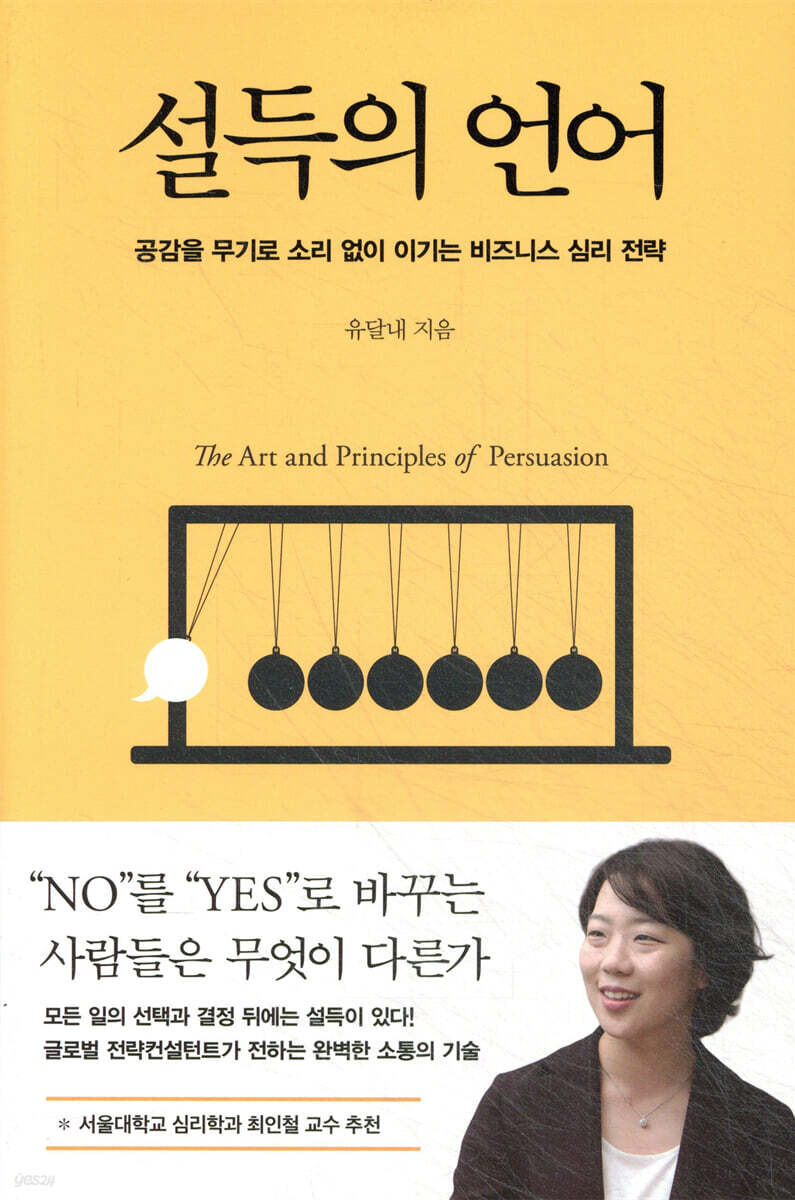
The language of persuasion
 |
Description
Book Introduction
“Persuasion is not just a skill,
“It is a sophisticated strategy for human behavior.”
Behind every choice and decision is persuasion!
The Principles of Perfect Communication from a Global Strategy Consultant
Recommended by Professor Choi In-cheol of the Department of Psychology at Seoul National University
We face many situations where we must influence others in the direction we desire.
What tactics are needed to influence others? You can appeal to their emotions, seduce them, or even negotiate a deal.
However, the most effective form of communication used to win over others in work and daily life is 'persuasion'.
The goal of persuasion is to make the target feel like they have made a rational decision, rather than being 'persuaded'.
Especially in the case of business persuasion, because it deals with complex decisions involving multiple interests, it is necessary to organize sound grounds and logic to solve the problem.
So, can perfect logic alone be the key to persuasion success? Successful persuasion also requires psychological strategies to sway the minds of those being persuaded.
Even if the content is logically correct, it is of no use if the other person is not willing to listen or is not convinced.
The Language of Persuasion covers the principles of effective business communication that uses logic and psychological theories to influence the hearts of others.
Author Dal-nae Yoo, a psychology major who has worked as a strategy consultant at Bain & Company for over 20 years, has developed successful persuasive communication techniques through the seven principles of persuasion she created.
The psychological strategy of making the other person accept your argument naturally and make a decision can be applied not only to business but also to important decisions in everyday life, and will be of great help to many readers.
“It is a sophisticated strategy for human behavior.”
Behind every choice and decision is persuasion!
The Principles of Perfect Communication from a Global Strategy Consultant
Recommended by Professor Choi In-cheol of the Department of Psychology at Seoul National University
We face many situations where we must influence others in the direction we desire.
What tactics are needed to influence others? You can appeal to their emotions, seduce them, or even negotiate a deal.
However, the most effective form of communication used to win over others in work and daily life is 'persuasion'.
The goal of persuasion is to make the target feel like they have made a rational decision, rather than being 'persuaded'.
Especially in the case of business persuasion, because it deals with complex decisions involving multiple interests, it is necessary to organize sound grounds and logic to solve the problem.
So, can perfect logic alone be the key to persuasion success? Successful persuasion also requires psychological strategies to sway the minds of those being persuaded.
Even if the content is logically correct, it is of no use if the other person is not willing to listen or is not convinced.
The Language of Persuasion covers the principles of effective business communication that uses logic and psychological theories to influence the hearts of others.
Author Dal-nae Yoo, a psychology major who has worked as a strategy consultant at Bain & Company for over 20 years, has developed successful persuasive communication techniques through the seven principles of persuasion she created.
The psychological strategy of making the other person accept your argument naturally and make a decision can be applied not only to business but also to important decisions in everyday life, and will be of great help to many readers.
index
Prologue | The Art of Effective Persuasion: Logic and Heart-Winning
Chapter 1: Not persuading
- Why is it difficult to change one's mind?
- Make the other person think it's 'my decision'
- Structuring the choices that complete the puzzle of persuasion
How Deadlines Become Persuasive Tools
- CASE) When persuading someone whose confidence is sky-high
Chapter 2: Start with Empathy
- The beginning of persuasion is to put yourself in the other person's shoes.
- Explore the other person's mind with an empathy map
- Double-headed vs.
How should a story of persuasion unfold?
- Secure a strong supporter who will be on your side.
- What are the other person's needs that influence the decision?
- CASE) When persuading someone to take on a difficult task
- CASE) When persuading an innovative attempt
Chapter 3: Tell the other person's story
- Who will the story focus on?
- Effective persuasion makes the other person's decision the best one.
- Prepare the story from the next boss's perspective.
- CASE) When persuading someone to lower their target level
Chapter 4: Persuade with simplicity
- The easier it is to understand, the more likely it is to be persuaded.
- The basis structure of persuasion is not the more the better.
- A persuasive method that simplifies complex content.
- Understand the person behind the words
- CASE) When persuading to increase the budget
- CASE) When you need to beat your competitors and be chosen
Chapter 5: Become a Perfect Persuasive Director
- Persuasion aimed at one room is doomed to failure.
- Design a persuasion process with a stakeholder map.
- Which person will play which role?
- Connect episodes according to the persuasion roadmap.
- In what format will we communicate?
- Masters of persuasion find the perfect reporting moment.
- CASE) When a problem with complex interests must be solved
Chapter 6: Set the Frame
- Through which window will you look at the problem?
- Effective approaches to loss and gain frames
- The best choice depends on your purpose.
- To avoid falling into the sunk cost fallacy
- CASE) When delivering bad news
- CASE) When persuading someone to accept uncertainty and make a decision
Chapter 7: Create an environment conducive to persuasion
- Cognitive biases that increase the likelihood of successful persuasion
- Messenger effect that adds a halo to messages
- When does persuasion become easier?
- The probability of success varies depending on the location.
- CASE) When the other person's interest is low
- CASE) When giving feedback on mistakes
Epilogue | Can AI Replace Persuasion?
Note
Chapter 1: Not persuading
- Why is it difficult to change one's mind?
- Make the other person think it's 'my decision'
- Structuring the choices that complete the puzzle of persuasion
How Deadlines Become Persuasive Tools
- CASE) When persuading someone whose confidence is sky-high
Chapter 2: Start with Empathy
- The beginning of persuasion is to put yourself in the other person's shoes.
- Explore the other person's mind with an empathy map
- Double-headed vs.
How should a story of persuasion unfold?
- Secure a strong supporter who will be on your side.
- What are the other person's needs that influence the decision?
- CASE) When persuading someone to take on a difficult task
- CASE) When persuading an innovative attempt
Chapter 3: Tell the other person's story
- Who will the story focus on?
- Effective persuasion makes the other person's decision the best one.
- Prepare the story from the next boss's perspective.
- CASE) When persuading someone to lower their target level
Chapter 4: Persuade with simplicity
- The easier it is to understand, the more likely it is to be persuaded.
- The basis structure of persuasion is not the more the better.
- A persuasive method that simplifies complex content.
- Understand the person behind the words
- CASE) When persuading to increase the budget
- CASE) When you need to beat your competitors and be chosen
Chapter 5: Become a Perfect Persuasive Director
- Persuasion aimed at one room is doomed to failure.
- Design a persuasion process with a stakeholder map.
- Which person will play which role?
- Connect episodes according to the persuasion roadmap.
- In what format will we communicate?
- Masters of persuasion find the perfect reporting moment.
- CASE) When a problem with complex interests must be solved
Chapter 6: Set the Frame
- Through which window will you look at the problem?
- Effective approaches to loss and gain frames
- The best choice depends on your purpose.
- To avoid falling into the sunk cost fallacy
- CASE) When delivering bad news
- CASE) When persuading someone to accept uncertainty and make a decision
Chapter 7: Create an environment conducive to persuasion
- Cognitive biases that increase the likelihood of successful persuasion
- Messenger effect that adds a halo to messages
- When does persuasion become easier?
- The probability of success varies depending on the location.
- CASE) When the other person's interest is low
- CASE) When giving feedback on mistakes
Epilogue | Can AI Replace Persuasion?
Note
Detailed image

Into the book
Business persuasion involves complex decisions involving multiple stakeholders.
Also, in most cases, I have to deal with superiors who have more authority than me, rather than with an equal relationship.
Anyone who makes formal decisions needs a well-structured rationale to justify their decisions to the organization's members.
Because of these characteristics, the key to business persuasion is to prepare a valid proposal and to effectively convey the facts and arguments supporting it.
---From "Prologue | Effective Persuasion Techniques that Move Logic and Hearts"
The most effective way to persuade is not to persuade.
When you talk about persuasion, what does it mean to say not to persuade?
This doesn't mean you shouldn't literally persuade them.
This means that rather than pushing the other person to be persuaded, you must persuade them in a way that they can be ‘convinced.’
---From "Chapter 1 | Not Persuading"
If you stop persuading them at the level of, "I understand that the manager is negative about this," they will naturally start to prepare in a superficial way, saying, "They probably don't know much about it, so if I explain it well, they'll change their mind."
The more difficult the persuasion, the more you need to put yourself in the other person's shoes and delve deeply into the context of the decision.
---From "Chapter 2 | Start with Empathy"
The next boss is the next person to be persuaded, or the person to whom the decision must be justified.
In most cases of persuasion within an organization, there is a next boss.
My boss also has to explain to his boss why this decision is the best one.
(…) Is there no need for a president? No.
The CEO must also convince shareholders and customers of the legitimacy of his decisions.
---From "Chapter 3 | Tell the Other Person's Story"
If you have something you desperately want to convince, you'll want to give as many reasons as possible.
Would five reasons be more convincing than three? Would five reasons plus five more, making ten, be more convincing? Ironically, in many cases, trying to give even one more reason backfires.
---From "Chapter 4 | Simply Persuade"
Imagine a situation where you barely managed to convince your dad to buy you the game console you wanted, only to have your mom find out too late and get angry and demand a refund right away.
They were wrong from the beginning about who had the final decision-making authority.
Even in important and large-scale projects, more often than not, work proceeds without clarity about who is involved in the decision-making process and what role they play.
---From "Chapter 5 | Become a Perfect Persuasive Director"
Research by Daniel Kahneman and Amos Tversky suggests that loss aversion is a common trait among people.
Losses have up to 2.5 times greater impact than gains.
When applied to persuasion, it is more shocking to say, “You will miss the opportunity to make 10 million won” than to say, “If you make this investment, you will make 10 million won.”
---From "Chapter 6 | Set the Frame"
Let's think about why logical persuasion works better in the morning.
Researchers explain that persuasion is more effective in the morning because people have more mental space and have more energy and focus to process complex information.
Also, in most cases, I have to deal with superiors who have more authority than me, rather than with an equal relationship.
Anyone who makes formal decisions needs a well-structured rationale to justify their decisions to the organization's members.
Because of these characteristics, the key to business persuasion is to prepare a valid proposal and to effectively convey the facts and arguments supporting it.
---From "Prologue | Effective Persuasion Techniques that Move Logic and Hearts"
The most effective way to persuade is not to persuade.
When you talk about persuasion, what does it mean to say not to persuade?
This doesn't mean you shouldn't literally persuade them.
This means that rather than pushing the other person to be persuaded, you must persuade them in a way that they can be ‘convinced.’
---From "Chapter 1 | Not Persuading"
If you stop persuading them at the level of, "I understand that the manager is negative about this," they will naturally start to prepare in a superficial way, saying, "They probably don't know much about it, so if I explain it well, they'll change their mind."
The more difficult the persuasion, the more you need to put yourself in the other person's shoes and delve deeply into the context of the decision.
---From "Chapter 2 | Start with Empathy"
The next boss is the next person to be persuaded, or the person to whom the decision must be justified.
In most cases of persuasion within an organization, there is a next boss.
My boss also has to explain to his boss why this decision is the best one.
(…) Is there no need for a president? No.
The CEO must also convince shareholders and customers of the legitimacy of his decisions.
---From "Chapter 3 | Tell the Other Person's Story"
If you have something you desperately want to convince, you'll want to give as many reasons as possible.
Would five reasons be more convincing than three? Would five reasons plus five more, making ten, be more convincing? Ironically, in many cases, trying to give even one more reason backfires.
---From "Chapter 4 | Simply Persuade"
Imagine a situation where you barely managed to convince your dad to buy you the game console you wanted, only to have your mom find out too late and get angry and demand a refund right away.
They were wrong from the beginning about who had the final decision-making authority.
Even in important and large-scale projects, more often than not, work proceeds without clarity about who is involved in the decision-making process and what role they play.
---From "Chapter 5 | Become a Perfect Persuasive Director"
Research by Daniel Kahneman and Amos Tversky suggests that loss aversion is a common trait among people.
Losses have up to 2.5 times greater impact than gains.
When applied to persuasion, it is more shocking to say, “You will miss the opportunity to make 10 million won” than to say, “If you make this investment, you will make 10 million won.”
---From "Chapter 6 | Set the Frame"
Let's think about why logical persuasion works better in the morning.
Researchers explain that persuasion is more effective in the morning because people have more mental space and have more energy and focus to process complex information.
---From "Chapter 7 | Create an environment conducive to persuasion"
Publisher's Review
What's different about people who change "NO" to "YES"?
The Principles of Persuasion That Work 100% in Work and Everyday Life
“For leaders who believe they have a sufficient understanding of persuasion through “The Psychology of Persuasion”
“The Language of Persuasion offers a whole new level of insight.”
Choi In-cheol, Professor of Psychology, Seoul National University
Negotiation is a strategy for more effective exchange in the process of giving and receiving with the other party, but persuasion takes the stance of gaining something from the other party without losing anything of your own.
The most important key in this type of persuasion is to make the target of the persuasion naturally 'convinced' of my opinion, rather than thinking that they are 'being persuaded'.
In "The Language of Persuasion," author Dal-nae Yoo, a strategic consultant and psychology major, discusses seven communication principles that effectively move the hearts of others.
Corporate life is a series of choices and decisions, and underlying them is an invisible force of persuasion.
Professor Choi In-cheol of the Department of Psychology at Seoul National University said, “Persuasion is not a simple technique, but a sophisticated strategy for human behavior.”
It's not just about how you speak, but you have to understand how the target of your persuasion will think and act, and then use sophisticated tactics.
The author, who majored in psychology in college and has worked as a global strategy consultant for over 20 years, shares his experience and know-how in perfect communication for everyone at work.
■ Solved with logic + psychological theory
The Formula for Perfect Business Communication
Business persuasion involves complex decisions involving multiple stakeholders.
Also, in most cases, I have to persuade a superior who has more authority than me and is not an equal.
…Because of these characteristics, the key to business persuasion is to prepare a valid proposal and to adequately convey the facts and arguments supporting it.
― Page 6, from [Prologue | Effective Persuasion Techniques that Move Logic and Hearts]
The basis of persuasion is 'not persuading', but moving the other person's heart requires logical judgment and a diverse understanding of human psychology.
In global consulting firms, where the most intense persuasion takes place, it's essential to offer proposals that lead clients in a better direction, while also persuading management and various stakeholders to implement decisions based on those proposals to produce tangible results.
Based on the author's practical experience working at a global strategy consulting firm, this book provides a variety of practical know-how for writing effective reports, including how to list the necessary evidence, how to structure the options, and what methods to use to organize the document.
From here, you can take it a step further and add advanced techniques such as drawing stakeholder maps, creating communication roadmaps, and building a foundational structure, adding core skills that high-performing people possess.
The next thing needed after structuring the logic and writing the document is a psychological understanding of the target of persuasion.
The author, who majored in psychology, argues that perfect persuasion is not simply about winning the other person's heart, but rather about understanding the target by exploiting their underlying desires and biases.
In addition, it guides us through the fundamental persuasion that moves the human mind based on various psychological theories such as cognitive biases, incentive effects, processing fluency, anchoring effects, gain and loss frames, and framing effects.
■ The 'language of persuasion' is a communication of consideration.
Tell your opponent's story, and think about the "next boss" behind it.
Author Yoo Dal-nae was called a “report master” and “persuasive expert” while working at a consulting firm.
Build a framework for persuasion through logical judgment and use various psychological mechanisms to make the other person listen to your argument.
What makes his persuasion shine even more is that he respects the target of his persuasion, thinks of the 'next boss' behind him, and suggests considerate communication that speaks the other person's language.
The seven principles of persuasion contained in this book are as follows:
1.
Don't persuade: The key to persuasion is to make the target feel that they have convinced themselves and taken the lead in making the decision, rather than being 'persuaded'.
2.
Start with empathy: The first step to action is to look at the problem from the other person's perspective.
The more fully you understand your subject, the more effective your approach will be.
3.
Tell the other person's story: what to say and how to say it.
The key to constructing a persuasive argument is to use the other person's language, not your own.
4.
Persuade simply: Simplify your argument and the structure of your argument.
As evidence accumulates, doubts about the proposal begin to grow.
The easier it is to understand, the more likely it is to be believed to be true and the greater the likelihood of agreement.
5.
Become a master of persuasion: Effective persuasion requires a strategic approach.
Establish a process for how to handle the issue, identify the stakeholders involved, and clearly define their roles.
6.
Set the frame: As your goals change, your definition of success will change too.
I need to think about what frame I want the other person to view the message I am conveying.
7.
Create an environment conducive to persuasion: Successful persuasion is influenced by various factors, including location, order, and time.
Create an environment conducive to persuasion.
Based on these principles suggested by the author, we will learn the best strategies for quietly moving the hearts of others.
Although the book is written primarily for business situations, these principles apply equally to everyday life.
Let's become professionals in persuasion who can move results in the direction you want through the "language of persuasion" that considers and considers the other person's perspective, based on the weapon of "empathy."
The Principles of Persuasion That Work 100% in Work and Everyday Life
“For leaders who believe they have a sufficient understanding of persuasion through “The Psychology of Persuasion”
“The Language of Persuasion offers a whole new level of insight.”
Choi In-cheol, Professor of Psychology, Seoul National University
Negotiation is a strategy for more effective exchange in the process of giving and receiving with the other party, but persuasion takes the stance of gaining something from the other party without losing anything of your own.
The most important key in this type of persuasion is to make the target of the persuasion naturally 'convinced' of my opinion, rather than thinking that they are 'being persuaded'.
In "The Language of Persuasion," author Dal-nae Yoo, a strategic consultant and psychology major, discusses seven communication principles that effectively move the hearts of others.
Corporate life is a series of choices and decisions, and underlying them is an invisible force of persuasion.
Professor Choi In-cheol of the Department of Psychology at Seoul National University said, “Persuasion is not a simple technique, but a sophisticated strategy for human behavior.”
It's not just about how you speak, but you have to understand how the target of your persuasion will think and act, and then use sophisticated tactics.
The author, who majored in psychology in college and has worked as a global strategy consultant for over 20 years, shares his experience and know-how in perfect communication for everyone at work.
■ Solved with logic + psychological theory
The Formula for Perfect Business Communication
Business persuasion involves complex decisions involving multiple stakeholders.
Also, in most cases, I have to persuade a superior who has more authority than me and is not an equal.
…Because of these characteristics, the key to business persuasion is to prepare a valid proposal and to adequately convey the facts and arguments supporting it.
― Page 6, from [Prologue | Effective Persuasion Techniques that Move Logic and Hearts]
The basis of persuasion is 'not persuading', but moving the other person's heart requires logical judgment and a diverse understanding of human psychology.
In global consulting firms, where the most intense persuasion takes place, it's essential to offer proposals that lead clients in a better direction, while also persuading management and various stakeholders to implement decisions based on those proposals to produce tangible results.
Based on the author's practical experience working at a global strategy consulting firm, this book provides a variety of practical know-how for writing effective reports, including how to list the necessary evidence, how to structure the options, and what methods to use to organize the document.
From here, you can take it a step further and add advanced techniques such as drawing stakeholder maps, creating communication roadmaps, and building a foundational structure, adding core skills that high-performing people possess.
The next thing needed after structuring the logic and writing the document is a psychological understanding of the target of persuasion.
The author, who majored in psychology, argues that perfect persuasion is not simply about winning the other person's heart, but rather about understanding the target by exploiting their underlying desires and biases.
In addition, it guides us through the fundamental persuasion that moves the human mind based on various psychological theories such as cognitive biases, incentive effects, processing fluency, anchoring effects, gain and loss frames, and framing effects.
■ The 'language of persuasion' is a communication of consideration.
Tell your opponent's story, and think about the "next boss" behind it.
Author Yoo Dal-nae was called a “report master” and “persuasive expert” while working at a consulting firm.
Build a framework for persuasion through logical judgment and use various psychological mechanisms to make the other person listen to your argument.
What makes his persuasion shine even more is that he respects the target of his persuasion, thinks of the 'next boss' behind him, and suggests considerate communication that speaks the other person's language.
The seven principles of persuasion contained in this book are as follows:
1.
Don't persuade: The key to persuasion is to make the target feel that they have convinced themselves and taken the lead in making the decision, rather than being 'persuaded'.
2.
Start with empathy: The first step to action is to look at the problem from the other person's perspective.
The more fully you understand your subject, the more effective your approach will be.
3.
Tell the other person's story: what to say and how to say it.
The key to constructing a persuasive argument is to use the other person's language, not your own.
4.
Persuade simply: Simplify your argument and the structure of your argument.
As evidence accumulates, doubts about the proposal begin to grow.
The easier it is to understand, the more likely it is to be believed to be true and the greater the likelihood of agreement.
5.
Become a master of persuasion: Effective persuasion requires a strategic approach.
Establish a process for how to handle the issue, identify the stakeholders involved, and clearly define their roles.
6.
Set the frame: As your goals change, your definition of success will change too.
I need to think about what frame I want the other person to view the message I am conveying.
7.
Create an environment conducive to persuasion: Successful persuasion is influenced by various factors, including location, order, and time.
Create an environment conducive to persuasion.
Based on these principles suggested by the author, we will learn the best strategies for quietly moving the hearts of others.
Although the book is written primarily for business situations, these principles apply equally to everyday life.
Let's become professionals in persuasion who can move results in the direction you want through the "language of persuasion" that considers and considers the other person's perspective, based on the weapon of "empathy."
GOODS SPECIFICS
- Date of issue: June 23, 2025
- Page count, weight, size: 260 pages | 143*215*20mm
- ISBN13: 9791168342972
- ISBN10: 116834297X
You may also like
카테고리
korean


korean

![GQ KOREA Mark (Monthly): December [2025]](http://librairie.coreenne.fr/cdn/shop/files/8ef265dbbfbf186523ed75ba7319009d.jpg?v=1765340328&width=3840)


