

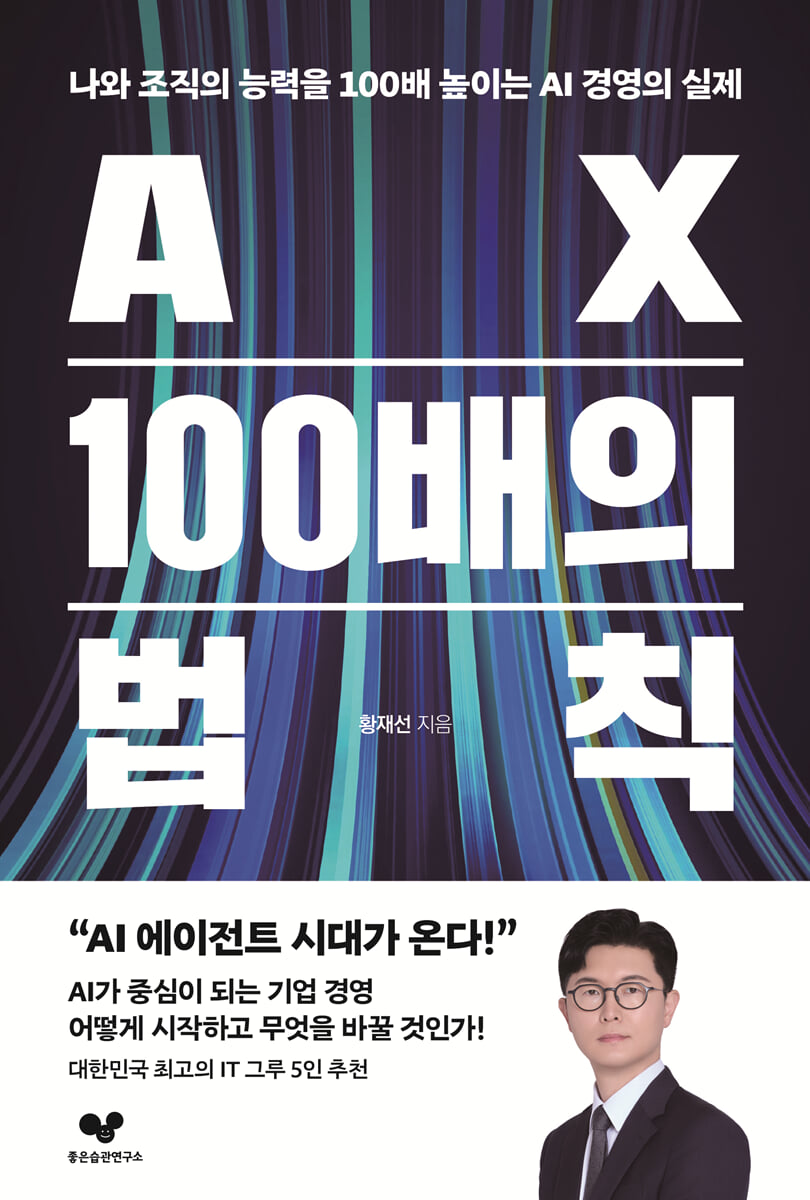
AX 100x Rule
 |
Description
Book Introduction
We are already experiencing the 100x rule by directly using generative AI.
These experiences must now be translated from the individual to the organization.
The book presents a five-step process for AI management that will increase your capabilities and those of your organization by 100 times.
Stage 1 is sufficient for a one-person business or small company, but for slightly larger companies, it is necessary to develop to stages 2 and 3, and for global corporations, to stages 4 and 5.
The book explains what resources are needed to reach each stage, what to keep in mind, what preparations organizations must make, and, most importantly, how individuals should position themselves and develop themselves going forward.
The author of this book, Jae-seon Hwang, Vice President of SK Discovery DX Lab, wrote this book based on his experience leading various AI projects in corporate settings, from the DX era to the current AX.
So it contains very realistic and systematic content.
The author has previously provided great inspiration to many managers by defining DX (digital transformation) as “changing organizational habits.”
Now, this message is being redefined as “AX (AI Transformation) is about changing organizational habits.”
These experiences must now be translated from the individual to the organization.
The book presents a five-step process for AI management that will increase your capabilities and those of your organization by 100 times.
Stage 1 is sufficient for a one-person business or small company, but for slightly larger companies, it is necessary to develop to stages 2 and 3, and for global corporations, to stages 4 and 5.
The book explains what resources are needed to reach each stage, what to keep in mind, what preparations organizations must make, and, most importantly, how individuals should position themselves and develop themselves going forward.
The author of this book, Jae-seon Hwang, Vice President of SK Discovery DX Lab, wrote this book based on his experience leading various AI projects in corporate settings, from the DX era to the current AX.
So it contains very realistic and systematic content.
The author has previously provided great inspiration to many managers by defining DX (digital transformation) as “changing organizational habits.”
Now, this message is being redefined as “AX (AI Transformation) is about changing organizational habits.”
- You can preview some of the book's contents.
Preview
index
Beginning. Beyond DX, into the AX era.
Part 1. AI Transformation - Concept and Historical Background
1. Difference between DX and AX
-- 1) Innovations and limitations brought about by DX
-- 2) Paradigm shift brought about by generative AI
-- 3) Specific use cases of generative AI
-- 4) What AX means
2.
Five Stages of Artificial Intelligence Development (OpenAI Outlook)
-- 1) Chatbot - Basic Q&A level conversation
-- 2) Reasoner - Multimodal and enhanced reasoning
-- 3) Agent - Makes decisions and judges on his own
-- 4) Innovator - Advanced domain expertise
-- 5) AG (IOrganization) - The era of human and AI convergence
Part 2. AI Transformation - Execution Strategy and Roadmap
Overview. 5-Step AX Implementation Strategy
Stage 1 (Initial) - Generative AI
-- 1) Generative AI concept
-- 2) Utilizing generative AI
-- 3) Achievements and Precautions
Phase 2 (Mid-term) - Introduction of RAG and Intelligent RPA
-- 1) RAG concept and application
-- 2) Intelligent RPA concept and utilization
Phase 3 (Mid-term) - Combining machine learning, deep learning AI, and generative AI
-- 1) Why integration between AI models is important
-- 2) Business Impact
Stage 4 (Review) - AI Agent
-- 1) What is an AI agent?
-- 2) Business Innovation Scenario
-- 3) Risk and Management Methods
-- 4) New opportunities
Stage 5 (Advanced) - The emergence of new business models, vertical LLMs, and SMLs.
-- 1) BM conversion
-- 2) Vertical LLM and SLM
Part 3. AI Transformation - Organizational Management and Talent Acquisition
1. Review your organization, infrastructure, and culture to prepare for AX.
-- 1) AI readiness
-- 2) Data and IT infrastructure
-- 3) AI team and talent acquisition
-- 4) Culture and Governance
-- 5) From DX to AX
-- 6) Check the current status
-- 7) Step-by-step implementation examples
2.
Why CEOs Are More Important
-- 1) 70% of AX's success depends on the CEO.
-- 2) AI literacy (basic skills) required for CEOs
-- 3) How to control power and political issues
3. AX Success KPIs and ROI Measurement
-- 1) Alignment of KPIs and AI Innovation
-- 2) Financial and non-financial performance indicators
-- 3) Project performance measurement
-- 4) Measuring performance in the short, medium, and long term
-- 5) Success and failure cases
4. AI Team and Governance
-- 1) The need for an AI team
-- 2) Collaboration with existing IT organizations
-- 3) Data Use Governance
5.
Talent Strategy and Training
-- 1) Transfusion of AI experts
-- 2) Prompt Engineering
-- 3) AI Manager/Operator
-- 4) Performance evaluation and compensation system
6.
Change Management and Organizational Culture Innovation
-- 1) Building trust with small PoCs
-- 2) Minimize documentation with dashboard-based reporting
-- 3) Award for success stories and best practices
-- 4) AI Hackathon, Ideathon
-- 5) A culture of tolerance for failure
-- 6) Human + AI Collaborative Organizational Culture
Part 4. AI Transformation - Case Studies and Future Prospects by Type and Industry
1. Application examples by AX type
-- 1) Create (documents, mail, reports, etc.)
-- 2) Summary (writing minutes, etc.)
-- 3) Language translation
-- 4) Grammar and spelling correction
-- 5) RAG and in-house chatbots
-- 6) Intelligent RPA (automatic collection and organization of external data)
-- 7) Creating a chart (Text-to-SQL)
-- 8) Coding
-- 9) Prediction and Simulation
-- 10) AI Search and Deep Research
-- 11) PC-based AI agent
-- 12) Image analysis such as OCR (image understanding and creation)
-- 13) Voice analysis (speech understanding and generation) for call centers, etc.
-- 14) CCTV video analysis (video understanding and analysis)
-- 15) Vertical LLM (Domain-Specialized AI)
-- 16) Ideas and Brainstorming
2. AX Application Cases by Industry
-- 1) Manufacturing and logistics
-- 2) Finance and Insurance
-- 3) Retail/Distribution
-- 4) Medical and healthcare
-- 5) Energy industry
-- 6) Construction
-- 7) Transportation and Logistics
-- 8) Hotels and restaurants
-- 9) Public and Education
-- 10) One-person business
Conclusion. The AI Agent Era and Beyond
Appendix. Startups (companies) that succeeded in AX
Appendix. Recommended Solutions and Services for AX
Part 1. AI Transformation - Concept and Historical Background
1. Difference between DX and AX
-- 1) Innovations and limitations brought about by DX
-- 2) Paradigm shift brought about by generative AI
-- 3) Specific use cases of generative AI
-- 4) What AX means
2.
Five Stages of Artificial Intelligence Development (OpenAI Outlook)
-- 1) Chatbot - Basic Q&A level conversation
-- 2) Reasoner - Multimodal and enhanced reasoning
-- 3) Agent - Makes decisions and judges on his own
-- 4) Innovator - Advanced domain expertise
-- 5) AG (IOrganization) - The era of human and AI convergence
Part 2. AI Transformation - Execution Strategy and Roadmap
Overview. 5-Step AX Implementation Strategy
Stage 1 (Initial) - Generative AI
-- 1) Generative AI concept
-- 2) Utilizing generative AI
-- 3) Achievements and Precautions
Phase 2 (Mid-term) - Introduction of RAG and Intelligent RPA
-- 1) RAG concept and application
-- 2) Intelligent RPA concept and utilization
Phase 3 (Mid-term) - Combining machine learning, deep learning AI, and generative AI
-- 1) Why integration between AI models is important
-- 2) Business Impact
Stage 4 (Review) - AI Agent
-- 1) What is an AI agent?
-- 2) Business Innovation Scenario
-- 3) Risk and Management Methods
-- 4) New opportunities
Stage 5 (Advanced) - The emergence of new business models, vertical LLMs, and SMLs.
-- 1) BM conversion
-- 2) Vertical LLM and SLM
Part 3. AI Transformation - Organizational Management and Talent Acquisition
1. Review your organization, infrastructure, and culture to prepare for AX.
-- 1) AI readiness
-- 2) Data and IT infrastructure
-- 3) AI team and talent acquisition
-- 4) Culture and Governance
-- 5) From DX to AX
-- 6) Check the current status
-- 7) Step-by-step implementation examples
2.
Why CEOs Are More Important
-- 1) 70% of AX's success depends on the CEO.
-- 2) AI literacy (basic skills) required for CEOs
-- 3) How to control power and political issues
3. AX Success KPIs and ROI Measurement
-- 1) Alignment of KPIs and AI Innovation
-- 2) Financial and non-financial performance indicators
-- 3) Project performance measurement
-- 4) Measuring performance in the short, medium, and long term
-- 5) Success and failure cases
4. AI Team and Governance
-- 1) The need for an AI team
-- 2) Collaboration with existing IT organizations
-- 3) Data Use Governance
5.
Talent Strategy and Training
-- 1) Transfusion of AI experts
-- 2) Prompt Engineering
-- 3) AI Manager/Operator
-- 4) Performance evaluation and compensation system
6.
Change Management and Organizational Culture Innovation
-- 1) Building trust with small PoCs
-- 2) Minimize documentation with dashboard-based reporting
-- 3) Award for success stories and best practices
-- 4) AI Hackathon, Ideathon
-- 5) A culture of tolerance for failure
-- 6) Human + AI Collaborative Organizational Culture
Part 4. AI Transformation - Case Studies and Future Prospects by Type and Industry
1. Application examples by AX type
-- 1) Create (documents, mail, reports, etc.)
-- 2) Summary (writing minutes, etc.)
-- 3) Language translation
-- 4) Grammar and spelling correction
-- 5) RAG and in-house chatbots
-- 6) Intelligent RPA (automatic collection and organization of external data)
-- 7) Creating a chart (Text-to-SQL)
-- 8) Coding
-- 9) Prediction and Simulation
-- 10) AI Search and Deep Research
-- 11) PC-based AI agent
-- 12) Image analysis such as OCR (image understanding and creation)
-- 13) Voice analysis (speech understanding and generation) for call centers, etc.
-- 14) CCTV video analysis (video understanding and analysis)
-- 15) Vertical LLM (Domain-Specialized AI)
-- 16) Ideas and Brainstorming
2. AX Application Cases by Industry
-- 1) Manufacturing and logistics
-- 2) Finance and Insurance
-- 3) Retail/Distribution
-- 4) Medical and healthcare
-- 5) Energy industry
-- 6) Construction
-- 7) Transportation and Logistics
-- 8) Hotels and restaurants
-- 9) Public and Education
-- 10) One-person business
Conclusion. The AI Agent Era and Beyond
Appendix. Startups (companies) that succeeded in AX
Appendix. Recommended Solutions and Services for AX
Detailed image

Into the book
The most important premise of this book is that “AI transformation is not something that can be achieved by the decision of one or two executives.”
Of course, the fact that top management sponsorship is essential remains unchanged.
However, as AI's penetration extends to office automation, business processes, and the entire company's decision-making process, virtually every employee will inevitably encounter AI in some form.
In this context, this book aims to serve as a basic guide for both executives and practitioners.
--- p.24
DX also had its limitations.
At some point, the question arose: "We've adopted the technology, but what next?" While RPA and big data analytics had taken root within the company, the organization's core decision-making still relied heavily on executives' intuition and experienced expertise.
Although data analysis reports were referenced when developing sales strategies, the final decision was based on the “executive’s intuition.”
--- p.34
While DX emphasized efficiency, data integration, and the digitization of existing business models, AX leverages generative AI across the enterprise to reorganize decision-making and creative capabilities. The digital infrastructure established during DX undoubtedly serves as a solid foundation for AX.
Employees familiar with cloud environments, big data platforms, and collaboration tools are less resistant to the introduction of generative AI.
The technical difficulty of linking with internal systems is also low.
--- p.45
To put it simply, the strategy is to first attract the attention of many members by providing them with experience using external generative AI services, create small success stories, use these as stepping stones to properly integrate internal data and infrastructure, and then gradually internalize in-depth AI capabilities throughout the organization to increase expertise.
And ultimately, we will reach the agent stage where AI can recognize goals and perform tasks independently without human commands.
Then, we dream of a commercialization stage where we can sell the final, advanced AI model to the outside world, although this is optional.
--- p.67
We also need to examine what management's expectations are about AI and whether those expectations are realistic.
If some executives overly believe AI is omnipotent and pressure it to produce amazing results in a short period of time, the burden on working-level staff will increase, and if the actual model performance falls short of expectations, it may be labeled a failure.
Conversely, if management is too conservative and takes the attitude of "what if errors occur when applying AI in the field, let's just stick with the existing methods for now", it will be difficult to even proceed with the pilot stage.
In other words, when evaluating AI readiness, the attitude and reality of management also become important points.
--- p.126
Even in the era of digital transformation (DX), there was a saying that “70% of the success of digital transformation depends on the CEO.”
No matter how much the business wanted to adopt IT technology, if the CEO didn't show interest, the budget wouldn't be approved and there was no way to control organizational resistance.
However, conversely, when a CEO delivers a strong message, "We will definitely transform our company into a digital company," they can overcome many obstacles and achieve massive innovation. I believe this trend will intensify in the AI era.
We must declare that direct AX is our essential survival strategy and guarantee investment in budget and talent.
--- p.145
We will examine the pros and cons of the integrated, separated, and hybrid models of the existing IT organization and the AI team, which is a dedicated AX organization, and examine how to structure the CoE.
Through a hypothetical case study, we examine organizational operations, decision-making structures, internal regulations and authority management principles that must be observed when utilizing generative AI or RAG, and the importance of AI ethics committees and bias monitoring.
Finally, we will also summarize the guidelines required when utilizing external APIs such as ChatGPT.
--- p.170
Talent strategy and training are key pillars of organizational and cultural innovation in the AX era.
Companies face countless questions, ranging from "Which is better: external hiring or internal development?" to "Should we extend prompt engineering to general employees?", "How will we establish and evaluate new roles like AI managers and AI operators?", and "What performance and reward systems will we use to attract and retain talent?"
The conclusion we can draw from this is that the human resources strategies we learned during the DX era are insufficient. Given the speed and explosive power of AI, partial training or limited external recruitment alone will be difficult to achieve sustainable innovation.
Companies should pursue a more integrated strategy, such as operating long-term AI bootcamps or in-house academies to massively retrain internal personnel, while simultaneously recruiting and leading externally, formalizing roles like prompt engineering and AI manager as internal promotion paths.
Of course, the fact that top management sponsorship is essential remains unchanged.
However, as AI's penetration extends to office automation, business processes, and the entire company's decision-making process, virtually every employee will inevitably encounter AI in some form.
In this context, this book aims to serve as a basic guide for both executives and practitioners.
--- p.24
DX also had its limitations.
At some point, the question arose: "We've adopted the technology, but what next?" While RPA and big data analytics had taken root within the company, the organization's core decision-making still relied heavily on executives' intuition and experienced expertise.
Although data analysis reports were referenced when developing sales strategies, the final decision was based on the “executive’s intuition.”
--- p.34
While DX emphasized efficiency, data integration, and the digitization of existing business models, AX leverages generative AI across the enterprise to reorganize decision-making and creative capabilities. The digital infrastructure established during DX undoubtedly serves as a solid foundation for AX.
Employees familiar with cloud environments, big data platforms, and collaboration tools are less resistant to the introduction of generative AI.
The technical difficulty of linking with internal systems is also low.
--- p.45
To put it simply, the strategy is to first attract the attention of many members by providing them with experience using external generative AI services, create small success stories, use these as stepping stones to properly integrate internal data and infrastructure, and then gradually internalize in-depth AI capabilities throughout the organization to increase expertise.
And ultimately, we will reach the agent stage where AI can recognize goals and perform tasks independently without human commands.
Then, we dream of a commercialization stage where we can sell the final, advanced AI model to the outside world, although this is optional.
--- p.67
We also need to examine what management's expectations are about AI and whether those expectations are realistic.
If some executives overly believe AI is omnipotent and pressure it to produce amazing results in a short period of time, the burden on working-level staff will increase, and if the actual model performance falls short of expectations, it may be labeled a failure.
Conversely, if management is too conservative and takes the attitude of "what if errors occur when applying AI in the field, let's just stick with the existing methods for now", it will be difficult to even proceed with the pilot stage.
In other words, when evaluating AI readiness, the attitude and reality of management also become important points.
--- p.126
Even in the era of digital transformation (DX), there was a saying that “70% of the success of digital transformation depends on the CEO.”
No matter how much the business wanted to adopt IT technology, if the CEO didn't show interest, the budget wouldn't be approved and there was no way to control organizational resistance.
However, conversely, when a CEO delivers a strong message, "We will definitely transform our company into a digital company," they can overcome many obstacles and achieve massive innovation. I believe this trend will intensify in the AI era.
We must declare that direct AX is our essential survival strategy and guarantee investment in budget and talent.
--- p.145
We will examine the pros and cons of the integrated, separated, and hybrid models of the existing IT organization and the AI team, which is a dedicated AX organization, and examine how to structure the CoE.
Through a hypothetical case study, we examine organizational operations, decision-making structures, internal regulations and authority management principles that must be observed when utilizing generative AI or RAG, and the importance of AI ethics committees and bias monitoring.
Finally, we will also summarize the guidelines required when utilizing external APIs such as ChatGPT.
--- p.170
Talent strategy and training are key pillars of organizational and cultural innovation in the AX era.
Companies face countless questions, ranging from "Which is better: external hiring or internal development?" to "Should we extend prompt engineering to general employees?", "How will we establish and evaluate new roles like AI managers and AI operators?", and "What performance and reward systems will we use to attract and retain talent?"
The conclusion we can draw from this is that the human resources strategies we learned during the DX era are insufficient. Given the speed and explosive power of AI, partial training or limited external recruitment alone will be difficult to achieve sustainable innovation.
Companies should pursue a more integrated strategy, such as operating long-term AI bootcamps or in-house academies to massively retrain internal personnel, while simultaneously recruiting and leading externally, formalizing roles like prompt engineering and AI manager as internal promotion paths.
--- p.198
Publisher's Review
- Bill Gates: “AI Agents Are the Future of Computing” (Gates Notes, 2023)
- Satya Nadella: “Every interaction will be through an agent” (Microsoft Build 2025)
- Sundar Pichai: “AI agents will deliver more personalized and intelligent experiences” (Google I/O 2025)
Elon Musk: “Ultimately, we are moving towards a general-purpose AI agent” (Interview, March 2005)
- Mark Zuckerberg: “In the metaverse, AI agents will play a key role in performing various activities, interacting with people, and exploring new experiences” (Meta Connect 2024)
The 53rd good habit suggested by the Good Habits Research Institute is the habit of companies utilizing AI.
We have previously inspired many managers with our book, "Digital Transformation: Changing Organizational Habits."
Now, that message is being redefined as “AI transformation is about changing organizational habits.”
AI technology is bringing about significant changes in corporate management.
In particular, the emergence of generative AI has expanded AI beyond the perspective of a large-scale project within IT departments or companies to become a personal issue.
This book also looks forward to the era of AI agents and discusses the coexistence of individuals and their interactions.
The book suggests approaching this change in five stages.
· Step 1 is the use of generative AI.
Since generative AI is already being actively utilized in our daily lives and work, no further explanation seems necessary.
· Step 2 involves the use of Retrieval-Augmented Generation (RAG). RAG provides a generative AI model with real-time results from internal databases or document searches, enabling the AI to generate answers based on richer, more accurate information.
Current generative AI relies on publicly available data or pre-trained text. However, much of the information critical to companies exists in private databases or internal files. RAG achieves this by combining internal search and generative AI to create customized AI for businesses.
Another important element is the use of intelligent RPA (Robotic Process Automation) to automatically process simple, repetitive tasks, which is also a task in the second stage.
While RPA has existed in the past, the AX phase combines it with generative AI to further increase the automation rate.
· Stage 3 is the combination of analytical AI and generative AI based on machine learning and deep learning already established within the company.
In the past, AI had limitations in that it could only be used and interpreted by data experts such as data scientists.
But now that it's combined with generative AI, even non-experts like me can use it freely.
I gain the autonomy to look into and check things myself, without having to ask the relevant departments for analysis anymore.
· Stage 4 marks the emergence of AI agents. AI agents don't respond to human instructions or requests. Instead, they set their own goals or recognize user-prompted objectives, then break them down into subtasks and execute them directly. This is the final stage of AI utilization, surpassing the 100x rule and enabling AI to perform the functions of 100 people.
Scenarios where decisions and tasks are performed unmanned become possible.
· Step 5 is to sell the AI models created through Steps 1 through 4, namely LLM and SLM specialized in a domain (specific industry), as a new BM.
We sell our company-specific AI model to other companies as a solution.
This has the effect of transforming general manufacturing companies into tech companies.
These are the 5 steps of AX as described in this book.
While each step may not be realized in the near future, it is not something that is too far in the future.
Considering the business environment that has changed with the advent of generative AI, it may happen faster than you think.
This book will help you understand what resources are needed to reach each stage, what precautions should be taken, what preparations organizations must make, and, most importantly, what roles individuals should position themselves for and develop in the future.
- Satya Nadella: “Every interaction will be through an agent” (Microsoft Build 2025)
- Sundar Pichai: “AI agents will deliver more personalized and intelligent experiences” (Google I/O 2025)
Elon Musk: “Ultimately, we are moving towards a general-purpose AI agent” (Interview, March 2005)
- Mark Zuckerberg: “In the metaverse, AI agents will play a key role in performing various activities, interacting with people, and exploring new experiences” (Meta Connect 2024)
The 53rd good habit suggested by the Good Habits Research Institute is the habit of companies utilizing AI.
We have previously inspired many managers with our book, "Digital Transformation: Changing Organizational Habits."
Now, that message is being redefined as “AI transformation is about changing organizational habits.”
AI technology is bringing about significant changes in corporate management.
In particular, the emergence of generative AI has expanded AI beyond the perspective of a large-scale project within IT departments or companies to become a personal issue.
This book also looks forward to the era of AI agents and discusses the coexistence of individuals and their interactions.
The book suggests approaching this change in five stages.
· Step 1 is the use of generative AI.
Since generative AI is already being actively utilized in our daily lives and work, no further explanation seems necessary.
· Step 2 involves the use of Retrieval-Augmented Generation (RAG). RAG provides a generative AI model with real-time results from internal databases or document searches, enabling the AI to generate answers based on richer, more accurate information.
Current generative AI relies on publicly available data or pre-trained text. However, much of the information critical to companies exists in private databases or internal files. RAG achieves this by combining internal search and generative AI to create customized AI for businesses.
Another important element is the use of intelligent RPA (Robotic Process Automation) to automatically process simple, repetitive tasks, which is also a task in the second stage.
While RPA has existed in the past, the AX phase combines it with generative AI to further increase the automation rate.
· Stage 3 is the combination of analytical AI and generative AI based on machine learning and deep learning already established within the company.
In the past, AI had limitations in that it could only be used and interpreted by data experts such as data scientists.
But now that it's combined with generative AI, even non-experts like me can use it freely.
I gain the autonomy to look into and check things myself, without having to ask the relevant departments for analysis anymore.
· Stage 4 marks the emergence of AI agents. AI agents don't respond to human instructions or requests. Instead, they set their own goals or recognize user-prompted objectives, then break them down into subtasks and execute them directly. This is the final stage of AI utilization, surpassing the 100x rule and enabling AI to perform the functions of 100 people.
Scenarios where decisions and tasks are performed unmanned become possible.
· Step 5 is to sell the AI models created through Steps 1 through 4, namely LLM and SLM specialized in a domain (specific industry), as a new BM.
We sell our company-specific AI model to other companies as a solution.
This has the effect of transforming general manufacturing companies into tech companies.
These are the 5 steps of AX as described in this book.
While each step may not be realized in the near future, it is not something that is too far in the future.
Considering the business environment that has changed with the advent of generative AI, it may happen faster than you think.
This book will help you understand what resources are needed to reach each stage, what precautions should be taken, what preparations organizations must make, and, most importantly, what roles individuals should position themselves for and develop in the future.
GOODS SPECIFICS
- Date of issue: June 1, 2025
- Page count, weight, size: 308 pages | 152*225*19mm
- ISBN13: 9791193639429
- ISBN10: 1193639425
You may also like
카테고리
korean


korean

![GQ KOREA Mark (Monthly): December [2025]](http://librairie.coreenne.fr/cdn/shop/files/8ef265dbbfbf186523ed75ba7319009d.jpg?v=1765340328&width=3840)


