

First-principles thinking
 |
Description
Book Introduction
“Why do we have to do that?”
Every problem can be rethought from the beginning.
The power of radical thinking proven by Elon Musk!
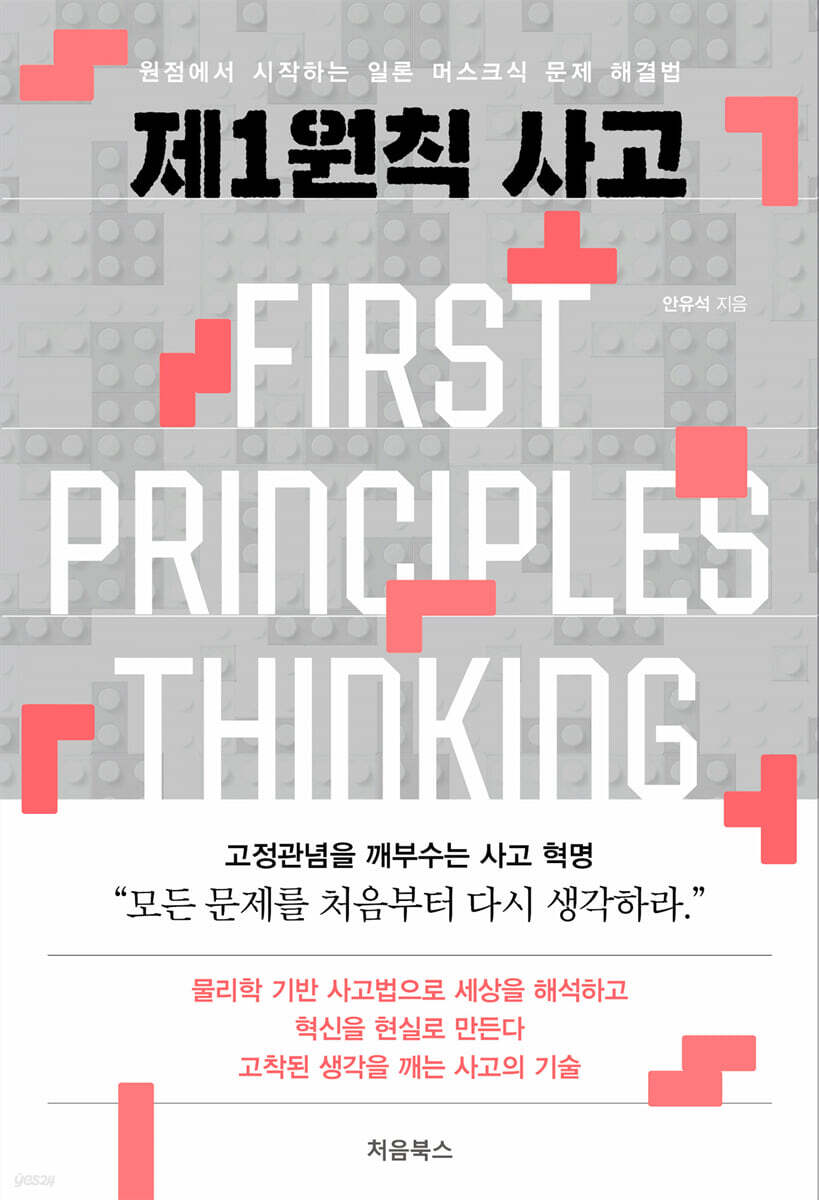
"First Principles Thinking" is a book that presents a way of thinking that fundamentally reexamines existing common sense and practices, based on Elon Musk's innovation strategy.
The author notes that the core of Musk's disruptive innovations in various fields, including Tesla, SpaceX, and Neuralink, lies in 'first principles thinking.'
This mindset shifts away from analogical thinking, relying on existing success stories or practices, and focuses on decomposing problems into their smallest components and reassembling them from the fundamental elements to create entirely new solutions.
Drawing on his own experience leading businesses across various industries for over 20 years, the author systematically organizes how this approach can be applied to practical decision-making, including establishing a startup's business model, improving a company's cost structure, driving technological innovation, and establishing organizational strategy.
In particular, by introducing a framework for redefining and solving problems through a combination of physical analysis methods and logical thinking, along with various real-life examples, it helps readers practice "questioning conventions and questioning the essence" in their respective fields.
This book makes us question the familiar rules we've always followed because "that's how we've always done it."
Just as Musk redesigned rockets and batteries, the problems you face today can be fundamentally redefined.
"First Principles Thinking" explores how to view the world through questions that shift the framework, rather than through a single correct answer. It argues that only those who keep asking these questions can discover possibilities beyond old assumptions.
Every problem can be rethought from the beginning.
The power of radical thinking proven by Elon Musk!
"First Principles Thinking" is a book that presents a way of thinking that fundamentally reexamines existing common sense and practices, based on Elon Musk's innovation strategy.
The author notes that the core of Musk's disruptive innovations in various fields, including Tesla, SpaceX, and Neuralink, lies in 'first principles thinking.'
This mindset shifts away from analogical thinking, relying on existing success stories or practices, and focuses on decomposing problems into their smallest components and reassembling them from the fundamental elements to create entirely new solutions.
Drawing on his own experience leading businesses across various industries for over 20 years, the author systematically organizes how this approach can be applied to practical decision-making, including establishing a startup's business model, improving a company's cost structure, driving technological innovation, and establishing organizational strategy.
In particular, by introducing a framework for redefining and solving problems through a combination of physical analysis methods and logical thinking, along with various real-life examples, it helps readers practice "questioning conventions and questioning the essence" in their respective fields.
This book makes us question the familiar rules we've always followed because "that's how we've always done it."
Just as Musk redesigned rockets and batteries, the problems you face today can be fundamentally redefined.
"First Principles Thinking" explores how to view the world through questions that shift the framework, rather than through a single correct answer. It argues that only those who keep asking these questions can discover possibilities beyond old assumptions.
- You can preview some of the book's contents.
Preview
index
introduction
In the AI era, we need to redesign our mindset.
Chapter 1: Why First-Principles Thinking?
· Traps created by familiar ways of thinking
Breaking the inertia and taking the first step
· Elon Musk's question: "Why should we do that?"
· What is first-principles thinking?
· Crucial differences between conventional methods and first-principles thinking
· Why Office Workers and Entrepreneurs Should Use First-Principle Thinking
Chapter 2: What is First-Principles Thinking?
· Definition of first-principles thinking
· The revolution in thought initiated by Aristotle
· How Science Uses First-Principles Thinking
· Link to systems thinking
· How to completely overturn your thinking
Chapter 3: How Elon Musk Changed the World with First-Principles Thinking
· SpaceX: Rewriting the Space Industry
Tesla: The Beginning of Electric Vehicle Innovation
Neuralink: Challenging Brain-Computer Interfaces
The Boring Company: Redesigning Urban Transportation
Chapter 4: Core Components of First-Principles Thinking
· Skills to accurately define the problem
· Analysis of fundamental elements that break down the essence
· Reassemble to basic principles
· Experiment, verify, and find answers
· How to use logical and mathematical thinking
Chapter 5: How to Apply First-Principles Thinking in Business
· Practical application methods for startup founders
· Strategies to reduce costs and accelerate innovation
· Problem solving for office workers
Chapter 6: People Who Shook the World with First-Principle Thinking
· Thinking habits of successful entrepreneurs
· Changes in the way existing companies solve problems
· Realistic application examples that anyone can follow
Chapter 7: Practicing First-Principle Thinking
· Step-by-step thinking training
· The art of asking questions again
Games and training that break the mold of thinking
Chapter 8: Thinking to Change the Future: Continuous Learning and Application
· How to make first-principle thinking a habit
· Technology to quickly adapt to changing environments
· Challenges to start right now
In conclusion
References
In the AI era, we need to redesign our mindset.
Chapter 1: Why First-Principles Thinking?
· Traps created by familiar ways of thinking
Breaking the inertia and taking the first step
· Elon Musk's question: "Why should we do that?"
· What is first-principles thinking?
· Crucial differences between conventional methods and first-principles thinking
· Why Office Workers and Entrepreneurs Should Use First-Principle Thinking
Chapter 2: What is First-Principles Thinking?
· Definition of first-principles thinking
· The revolution in thought initiated by Aristotle
· How Science Uses First-Principles Thinking
· Link to systems thinking
· How to completely overturn your thinking
Chapter 3: How Elon Musk Changed the World with First-Principles Thinking
· SpaceX: Rewriting the Space Industry
Tesla: The Beginning of Electric Vehicle Innovation
Neuralink: Challenging Brain-Computer Interfaces
The Boring Company: Redesigning Urban Transportation
Chapter 4: Core Components of First-Principles Thinking
· Skills to accurately define the problem
· Analysis of fundamental elements that break down the essence
· Reassemble to basic principles
· Experiment, verify, and find answers
· How to use logical and mathematical thinking
Chapter 5: How to Apply First-Principles Thinking in Business
· Practical application methods for startup founders
· Strategies to reduce costs and accelerate innovation
· Problem solving for office workers
Chapter 6: People Who Shook the World with First-Principle Thinking
· Thinking habits of successful entrepreneurs
· Changes in the way existing companies solve problems
· Realistic application examples that anyone can follow
Chapter 7: Practicing First-Principle Thinking
· Step-by-step thinking training
· The art of asking questions again
Games and training that break the mold of thinking
Chapter 8: Thinking to Change the Future: Continuous Learning and Application
· How to make first-principle thinking a habit
· Technology to quickly adapt to changing environments
· Challenges to start right now
In conclusion
References
Detailed image

Into the book
We often see companies that were once market leaders fail to recognize change and cling to their old formulas for success, ultimately leading to their downfall.
For example, a representative example is a company that maintained a high market share for a long time in a traditional industry, but suddenly lost its market position because it was unable to respond to the business model of an innovative startup.
While we cling to the belief that the old ways are effective and cling to established strategies instead of fundamentally innovating our products or services, consumer preferences and the technological environment change rapidly.
As a result, companies that fall behind in competition end up paying a huge cost as they realize too late that they are behind the market trend.
--- p.26
First-principles thinking is deeply connected to the fundamental development of science.
Because science is fundamentally a discipline that seeks to discover the laws and principles hidden behind natural phenomena, it is inevitably closely linked to first-principles thinking, which seeks the most fundamental truths.
--- p.51
The systematic approach demonstrated by SpaceX has had a powerful impact that completely changed the landscape of the space industry.
Previously, the space industry was dominated by government agencies and a few large corporations, with enormous costs and long development cycles. However, SpaceX has significantly lowered the barriers to entry into space by designing the entire system in an integrated and organic manner.
In particular, it shocked the entire industry by technically proving that rockets can be reused repeatedly, breaking away from the existing practice of discarding them after launch.
--- p.92
Neuralink has approached the fundamentals from a new perspective, not only in electrode materials and shapes, but also in signal processing and transmission methods that process the vast amount of data collected from the electrodes.
The electrodes are made from polyimide polymers to enhance biocompatibility, and the electrode surfaces are treated with special materials such as PEDOT:PSS* or iridium oxide to maximize signal sensitivity while preventing long-term signal quality degradation.
--- p.111
It is important to actively use ‘hypothetical thinking’.
Hypothetical thinking is the process of assuming a possible scenario for a specific idea or solution, even if it isn't perfect or realistic at the moment, and then logically testing it by imagining what the outcome would be if the idea were actually implemented.
For example, in business, if you don't take existing distribution networks, production methods, or technological constraints for granted, but instead ask, "What would happen if these constraints didn't exist?", you open the way to connect and combine fundamental elements in a new way, with the existing constraints removed.
In this process, sometimes even ideas that seem too extreme or even impossible can become valuable starting points.
--- p.150
PayPal completely changed the landscape of the previously complex and expensive online retail payments and remittances market.
It has laid a crucial foundation for the growth of e-commerce, making it much easier and cheaper for individuals and small businesses to transact online.
PayPal's success is considered another prime example of first-principles thinking, delving into the essence of financial transactions, eliminating inefficiencies in existing systems, and proposing new solutions optimized for the digital environment. It subsequently became a significant catalyst for the development of the FinTech industry.
For example, a representative example is a company that maintained a high market share for a long time in a traditional industry, but suddenly lost its market position because it was unable to respond to the business model of an innovative startup.
While we cling to the belief that the old ways are effective and cling to established strategies instead of fundamentally innovating our products or services, consumer preferences and the technological environment change rapidly.
As a result, companies that fall behind in competition end up paying a huge cost as they realize too late that they are behind the market trend.
--- p.26
First-principles thinking is deeply connected to the fundamental development of science.
Because science is fundamentally a discipline that seeks to discover the laws and principles hidden behind natural phenomena, it is inevitably closely linked to first-principles thinking, which seeks the most fundamental truths.
--- p.51
The systematic approach demonstrated by SpaceX has had a powerful impact that completely changed the landscape of the space industry.
Previously, the space industry was dominated by government agencies and a few large corporations, with enormous costs and long development cycles. However, SpaceX has significantly lowered the barriers to entry into space by designing the entire system in an integrated and organic manner.
In particular, it shocked the entire industry by technically proving that rockets can be reused repeatedly, breaking away from the existing practice of discarding them after launch.
--- p.92
Neuralink has approached the fundamentals from a new perspective, not only in electrode materials and shapes, but also in signal processing and transmission methods that process the vast amount of data collected from the electrodes.
The electrodes are made from polyimide polymers to enhance biocompatibility, and the electrode surfaces are treated with special materials such as PEDOT:PSS* or iridium oxide to maximize signal sensitivity while preventing long-term signal quality degradation.
--- p.111
It is important to actively use ‘hypothetical thinking’.
Hypothetical thinking is the process of assuming a possible scenario for a specific idea or solution, even if it isn't perfect or realistic at the moment, and then logically testing it by imagining what the outcome would be if the idea were actually implemented.
For example, in business, if you don't take existing distribution networks, production methods, or technological constraints for granted, but instead ask, "What would happen if these constraints didn't exist?", you open the way to connect and combine fundamental elements in a new way, with the existing constraints removed.
In this process, sometimes even ideas that seem too extreme or even impossible can become valuable starting points.
--- p.150
PayPal completely changed the landscape of the previously complex and expensive online retail payments and remittances market.
It has laid a crucial foundation for the growth of e-commerce, making it much easier and cheaper for individuals and small businesses to transact online.
PayPal's success is considered another prime example of first-principles thinking, delving into the essence of financial transactions, eliminating inefficiencies in existing systems, and proposing new solutions optimized for the digital environment. It subsequently became a significant catalyst for the development of the FinTech industry.
--- p.206
GOODS SPECIFICS
- Date of issue: June 2, 2025
- Page count, weight, size: 256 pages | 280g | 128*188*16mm
- ISBN13: 9791170223009
You may also like
카테고리
korean


korean

![GQ KOREA Mark (Monthly): December [2025]](http://librairie.coreenne.fr/cdn/shop/files/8ef265dbbfbf186523ed75ba7319009d.jpg?v=1765340328&width=3840)


