

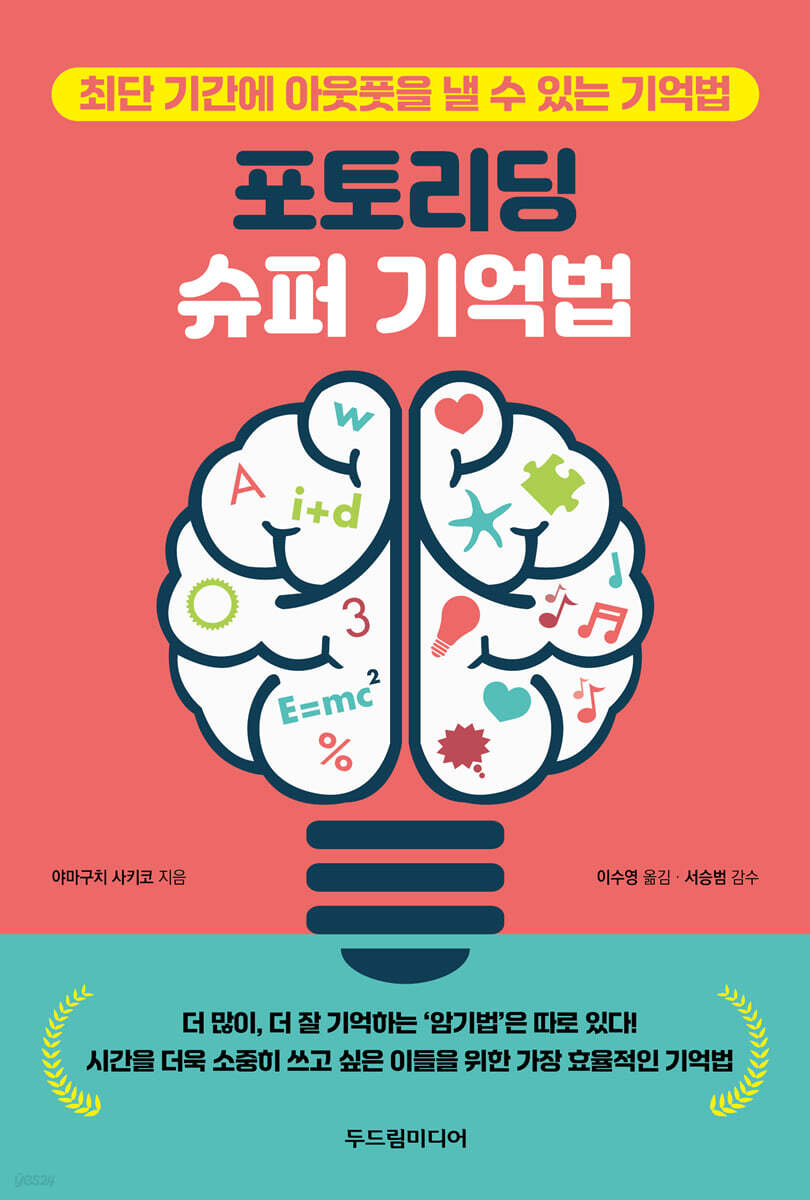
Photo Reading Super Memory Method
 |
Description
Book Introduction
A memory method that can produce output in the shortest period of time
- A practical secret to dramatically improving your memory
Many people say, 'I'm stupid...' or 'I have a bad memory, so I forget things often.'
However, Sakiko Yamaguchi, the author and Japan's top expert who has taught speed reading, memory, and study methods to many people for over 20 years based on photo reading methods that allow them to read a book per hour and mind maps that visualize their thoughts, says, "There is no difference in innate memory, and anyone can improve their memory."
Through the author's memory lectures, many people have achieved success in various fields, such as a high school student with low grades being accepted to a prestigious university, a working person who had to study hard three times to barely get into a night school, passing the national exam with a pass rate of only 10% in a few months, or raising their TOEIC score by 300 points in just six months.
The author has incorporated his long experience and know-how into this book.
Anyone can develop their memory skills.
Memory is not a matter of whether you are good or bad at something, but rather whether you have the power to remember things.
That is, people who have a weak memory capacity believe that they have a poor memory.
If you are not confident in your memory now, it is because you do not know how to remember properly.
The key to memory is learning the tricks (input method) of memorizing with your brain and the method of retrieving the memory when recalling what you have memorized.
This book contains the principles of memory and the methods for doing so one by one.
Having a good memory not only makes you stronger at studying and taking exams, but also allows you to handle work with professionalism.
In other words, if your memory improves in your studies, work, and relationships, your life will be greatly improved.
Let's learn the magical memory technique that will make your life more advantageous through this book.
- A practical secret to dramatically improving your memory
Many people say, 'I'm stupid...' or 'I have a bad memory, so I forget things often.'
However, Sakiko Yamaguchi, the author and Japan's top expert who has taught speed reading, memory, and study methods to many people for over 20 years based on photo reading methods that allow them to read a book per hour and mind maps that visualize their thoughts, says, "There is no difference in innate memory, and anyone can improve their memory."
Through the author's memory lectures, many people have achieved success in various fields, such as a high school student with low grades being accepted to a prestigious university, a working person who had to study hard three times to barely get into a night school, passing the national exam with a pass rate of only 10% in a few months, or raising their TOEIC score by 300 points in just six months.
The author has incorporated his long experience and know-how into this book.
Anyone can develop their memory skills.
Memory is not a matter of whether you are good or bad at something, but rather whether you have the power to remember things.
That is, people who have a weak memory capacity believe that they have a poor memory.
If you are not confident in your memory now, it is because you do not know how to remember properly.
The key to memory is learning the tricks (input method) of memorizing with your brain and the method of retrieving the memory when recalling what you have memorized.
This book contains the principles of memory and the methods for doing so one by one.
Having a good memory not only makes you stronger at studying and taking exams, but also allows you to handle work with professionalism.
In other words, if your memory improves in your studies, work, and relationships, your life will be greatly improved.
Let's learn the magical memory technique that will make your life more advantageous through this book.
index
Editor's Note | Photoreading, KAI, and Transformation: A Powerful Tool for Beginning Transformation
Prologue | The Art of Memory: A Life-Changing Advantage
PART 01 Basic Principles of Memory and Study
01 The most important thing to improve your memory - clarify the purpose of remembering.
02 The Real Reason Why You Need Motivation to Work - You'll only do well if it's something you enjoy.
03 Pleasure Changes My Behavior and Results - Pleasure is the Driving Force That Activates the Brain
04 Curiosity and excitement are essential for studying!? - Interest and excitement are the prerequisites for memory.
05 Memory retention methods based on brain science - The brain pays attention to repeated information.
06 Utilizing the subconscious mind improves memory - The subconscious mind is an infinite memory storage.
07 Four Steps to Determining Memory Quality - The Level of Memorization Should Vary Depending on the Purpose
08 Memory-Efficient 15-Minute Study Method - Stop Studying Before Your Brain Gets Tired
09 Memorization is better when you use your body - A memorization technique that uses sight, hearing, and body sensations.
10 Associative Memory Techniques That Make Memorization Much Easier - Incorporate Memory Cue into Memorized Items
11. How to Retrieve Memories Instantly - Create a Memory Hook with Connecting Clues
The more you memorize, the more you forget - just remembering the key words is enough.
13. To quickly memorize important content - Imprint 'This is important!' on your brain.
14. Setting a deadline makes your brain more active - A study method that maximizes brain efficiency.
15 If you think you can't memorize something, it will be harder to memorize it - anxiety is a big negative for the brain.
Memory Column | Creative Relaxation: Boosting Concentration
PART 02 Reading a book that you remember 10 times better than before
16. There are books that are memorable - books that make a weak first impression are difficult to remember.
17. Clearly define your purpose for reading - A clear purpose helps your brain.
18 In any case, memorization is based on repetition - the more you read, the stronger your memory becomes.
19 Reasons why you don't memorize things even if you increase the number of times you memorize them - Without enjoyment, your memory declines.
20 Previewing the table of contents improves memory efficiency - the table of contents condenses the book's key information.
21. Reading requires prior preparation - Planning your reading increases reading efficiency.
22 To remember the main points of a book clearly - Create questions in advance about what you will get from the book.
23. Reading with empathy makes it stick in your memory longer - Memories linked to emotions are easier to fix.
24 To easily recall the contents of the book later - Make it a habit to remember keywords and key sentences.
25 Colored Pens: Up to 2 colors are good for memorization - 3 or more colors can confuse the brain.
26 There is a separate way to mark well - Marking is limited to words and less than 10% of the total.
27 Reasons Why Memorizing with Diagrams and Illustrations Is Good - Illustrations Strengthen Memory
28. 15-Minute Reading Technique to Get the Whole Story in a Short Time - Skim Books in Unfamiliar Subjects
29 It's okay to skip over parts you don't understand - you don't have to understand everything at once.
30 Reading Techniques for Strengthening Debate and Persuasion - Read with a Subjective Opinion
31 How to Record and Memorize Key Content - Auditory and Somatosensory Activate the Brain
32 When you need to memorize perfectly, restore it to a blank sheet of paper - check your memorization status by restoring it to a blank sheet of paper.
33. If you are conscious of teaching, you will remember better - Tips to help your brain better accept memorization
34 How to remember what you've memorized more clearly - Explain what you've memorized to someone else for 3 minutes.
Memory Column | 3 Nutrients That Help You Study
PART 03 The Secret to Doing Better on Tests While Studying the Same Hours
35 Things to do before studying - Identifying the entrance and exit points for studying
A Study Roadmap That Doesn't Waste 36 Hours - A Disrupted Schedule Can Lower Your Study Confidence
37 How to Increase Your Pass Rate Even While Studying the Same - Remember the Benefits of Being a Brain Pleasure
38 The difference between knowing and memorizing - Knowing = understanding, memorizing = being able to reproduce
39 Visual Dominance Study Method and Auditory Dominance Study Method - Visual uses images, auditory uses sounds.
How to easily memorize 40 numbers - Memorizing them with wordplay and rhythm will help you remember them longer.
How to Memorize 41 English Words Quickly - 3 Tips for Memorizing Exam Vocabulary
42 Two Ways to Read an Introductory Text: Reading Through and Reading Through - An introductory text should be easy, above all else.
43 The most effective review time for memory - 10% of total study time is appropriate for review.
44 Divide professional books into three stages of reading - Make clear the purpose of each stage of reading.
45. Familiarity with the textbook will improve your grades - Decorate it with your own colors and review it often.
46 You can study without sitting at your desk - memorize key words during spare time.
Focus on reviewing starting a week before the exam - The idea that "studying = unconditional input" is wrong.
48 Reasons why you should sleep 6 to 7 and a half hours - Time needed for your body to rest + your brain to organize memories
49. The best time to study - watch it before going to bed, and watch it again the next morning.
50 When You Have to Memorize a Subject You Hate - Create a Study Environment That's Even a Little More Fun
51 Positive Statements to Boost Focus - Creating Affirmations to Strengthen Memory
Memory Column | People who can't organize things also have weak memories!?
PART 04: A Miraculous Way to Obtain Information: Photo Reading
52 Reading a book in an hour, Photo Reading - Seeing the pages at a glance as if taking a picture
53 Easy Steps to Photo Reading - Let Your Subconscious Read and Your Conscious Mind Understand
54 How to Read a Book with Photofocus - Seeing Blurry Images Without Focusing Your Eyes
55 Check if the photo focus is correct - if it overlaps because it is out of focus, it is OK
56 Photoreading: Rethinking Book Reading - An Information Processing Method Applicable to All Learning
Memory Column | Tips for Quickly Entering Focus Mode
PART 05: Note-taking techniques that produce results in a short period of time
57 Writing and speaking stimulate the brain - using your hands and mouth improves your memory.
58 Tips for Memorizing Long-Term Notes - Add Memory Clues to Your Notes
59. The memory method of stringing together memorized items - powerful tools for memory, association and imagery.
60 When there's a lot of information, reorganize it into keywords - how to put core keywords at the center of your memory.
61 How to Create a Core Memorization - Create a separate memorization technique and memorize it.
62. Schematicizing sentences is helpful for memory - Using symbols to indicate relationships
63 Memorization doesn't have to be perfect! - Focus on words, not entire sentences.
64 Mind Maps for Memorization: Organizing with Diagrams Makes Memorization Easier
65 Keyword Diagrams to Organize Content - 4 Principles for Connecting Words
66 Tips for Correcting a Badly Drawn Diagram - Make Keyword Connections Clear
67 Effective Keyword Diagram Review Method - Think of the connecting words without looking at the diagram.
68 Note-taking Skills for Strengthening Discussion and Conversation - Prepare Conversation Keywords in Advance
69 Preparing a Presentation with a Mind Map
- Indicates speaking order and emphasis
Memory Column | Everyday Tools to Boost Study Efficiency
PART 06 Memory Techniques That Will Make Your Life Hugely Beneficial
70 Basics of Gathering Business Information - Clearly Define Your Goals and Keywords
71 When you are conscious, your brain moves on its own - When you ask a question, your mind finds the answer.
72 How to remember what you just heard - repeat key words 5 times
73. Adding question marks helps you remember better - Questions in conversations improve memory.
74 Simple Memory Training: Recall Everything in Front of You for 1 Minute
75 Ways to Remember People's Names and Faces - Combine with People You Know or Existing Information
76 Tips for Note-taking the Key Points of a Conversation - Focus on the Status, Reason, Purpose, and To-Do
77 How to Memorize Conversations as Stories - Story Memorization Method by Memorizing Situational Images
78 Note-taking Habits of Recognized People - They write down money, dates, times, and places on the spot.
79 Still, notes are stronger than memories - Write important events in 3-5 steps.
80 Perfect Uses for Post-it Notes - Use two colors, one per sheet.
81 If you can't memorize something no matter what you do - find an alternative instead of just trying.
82 How to Deal with Suddenly Forgetting Something - Don't Beat Around the bush, Buy Time to Decide
Memory Column | Memory Training to Recall Today
Epilogue | To make the most of your time
Prologue | The Art of Memory: A Life-Changing Advantage
PART 01 Basic Principles of Memory and Study
01 The most important thing to improve your memory - clarify the purpose of remembering.
02 The Real Reason Why You Need Motivation to Work - You'll only do well if it's something you enjoy.
03 Pleasure Changes My Behavior and Results - Pleasure is the Driving Force That Activates the Brain
04 Curiosity and excitement are essential for studying!? - Interest and excitement are the prerequisites for memory.
05 Memory retention methods based on brain science - The brain pays attention to repeated information.
06 Utilizing the subconscious mind improves memory - The subconscious mind is an infinite memory storage.
07 Four Steps to Determining Memory Quality - The Level of Memorization Should Vary Depending on the Purpose
08 Memory-Efficient 15-Minute Study Method - Stop Studying Before Your Brain Gets Tired
09 Memorization is better when you use your body - A memorization technique that uses sight, hearing, and body sensations.
10 Associative Memory Techniques That Make Memorization Much Easier - Incorporate Memory Cue into Memorized Items
11. How to Retrieve Memories Instantly - Create a Memory Hook with Connecting Clues
The more you memorize, the more you forget - just remembering the key words is enough.
13. To quickly memorize important content - Imprint 'This is important!' on your brain.
14. Setting a deadline makes your brain more active - A study method that maximizes brain efficiency.
15 If you think you can't memorize something, it will be harder to memorize it - anxiety is a big negative for the brain.
Memory Column | Creative Relaxation: Boosting Concentration
PART 02 Reading a book that you remember 10 times better than before
16. There are books that are memorable - books that make a weak first impression are difficult to remember.
17. Clearly define your purpose for reading - A clear purpose helps your brain.
18 In any case, memorization is based on repetition - the more you read, the stronger your memory becomes.
19 Reasons why you don't memorize things even if you increase the number of times you memorize them - Without enjoyment, your memory declines.
20 Previewing the table of contents improves memory efficiency - the table of contents condenses the book's key information.
21. Reading requires prior preparation - Planning your reading increases reading efficiency.
22 To remember the main points of a book clearly - Create questions in advance about what you will get from the book.
23. Reading with empathy makes it stick in your memory longer - Memories linked to emotions are easier to fix.
24 To easily recall the contents of the book later - Make it a habit to remember keywords and key sentences.
25 Colored Pens: Up to 2 colors are good for memorization - 3 or more colors can confuse the brain.
26 There is a separate way to mark well - Marking is limited to words and less than 10% of the total.
27 Reasons Why Memorizing with Diagrams and Illustrations Is Good - Illustrations Strengthen Memory
28. 15-Minute Reading Technique to Get the Whole Story in a Short Time - Skim Books in Unfamiliar Subjects
29 It's okay to skip over parts you don't understand - you don't have to understand everything at once.
30 Reading Techniques for Strengthening Debate and Persuasion - Read with a Subjective Opinion
31 How to Record and Memorize Key Content - Auditory and Somatosensory Activate the Brain
32 When you need to memorize perfectly, restore it to a blank sheet of paper - check your memorization status by restoring it to a blank sheet of paper.
33. If you are conscious of teaching, you will remember better - Tips to help your brain better accept memorization
34 How to remember what you've memorized more clearly - Explain what you've memorized to someone else for 3 minutes.
Memory Column | 3 Nutrients That Help You Study
PART 03 The Secret to Doing Better on Tests While Studying the Same Hours
35 Things to do before studying - Identifying the entrance and exit points for studying
A Study Roadmap That Doesn't Waste 36 Hours - A Disrupted Schedule Can Lower Your Study Confidence
37 How to Increase Your Pass Rate Even While Studying the Same - Remember the Benefits of Being a Brain Pleasure
38 The difference between knowing and memorizing - Knowing = understanding, memorizing = being able to reproduce
39 Visual Dominance Study Method and Auditory Dominance Study Method - Visual uses images, auditory uses sounds.
How to easily memorize 40 numbers - Memorizing them with wordplay and rhythm will help you remember them longer.
How to Memorize 41 English Words Quickly - 3 Tips for Memorizing Exam Vocabulary
42 Two Ways to Read an Introductory Text: Reading Through and Reading Through - An introductory text should be easy, above all else.
43 The most effective review time for memory - 10% of total study time is appropriate for review.
44 Divide professional books into three stages of reading - Make clear the purpose of each stage of reading.
45. Familiarity with the textbook will improve your grades - Decorate it with your own colors and review it often.
46 You can study without sitting at your desk - memorize key words during spare time.
Focus on reviewing starting a week before the exam - The idea that "studying = unconditional input" is wrong.
48 Reasons why you should sleep 6 to 7 and a half hours - Time needed for your body to rest + your brain to organize memories
49. The best time to study - watch it before going to bed, and watch it again the next morning.
50 When You Have to Memorize a Subject You Hate - Create a Study Environment That's Even a Little More Fun
51 Positive Statements to Boost Focus - Creating Affirmations to Strengthen Memory
Memory Column | People who can't organize things also have weak memories!?
PART 04: A Miraculous Way to Obtain Information: Photo Reading
52 Reading a book in an hour, Photo Reading - Seeing the pages at a glance as if taking a picture
53 Easy Steps to Photo Reading - Let Your Subconscious Read and Your Conscious Mind Understand
54 How to Read a Book with Photofocus - Seeing Blurry Images Without Focusing Your Eyes
55 Check if the photo focus is correct - if it overlaps because it is out of focus, it is OK
56 Photoreading: Rethinking Book Reading - An Information Processing Method Applicable to All Learning
Memory Column | Tips for Quickly Entering Focus Mode
PART 05: Note-taking techniques that produce results in a short period of time
57 Writing and speaking stimulate the brain - using your hands and mouth improves your memory.
58 Tips for Memorizing Long-Term Notes - Add Memory Clues to Your Notes
59. The memory method of stringing together memorized items - powerful tools for memory, association and imagery.
60 When there's a lot of information, reorganize it into keywords - how to put core keywords at the center of your memory.
61 How to Create a Core Memorization - Create a separate memorization technique and memorize it.
62. Schematicizing sentences is helpful for memory - Using symbols to indicate relationships
63 Memorization doesn't have to be perfect! - Focus on words, not entire sentences.
64 Mind Maps for Memorization: Organizing with Diagrams Makes Memorization Easier
65 Keyword Diagrams to Organize Content - 4 Principles for Connecting Words
66 Tips for Correcting a Badly Drawn Diagram - Make Keyword Connections Clear
67 Effective Keyword Diagram Review Method - Think of the connecting words without looking at the diagram.
68 Note-taking Skills for Strengthening Discussion and Conversation - Prepare Conversation Keywords in Advance
69 Preparing a Presentation with a Mind Map
- Indicates speaking order and emphasis
Memory Column | Everyday Tools to Boost Study Efficiency
PART 06 Memory Techniques That Will Make Your Life Hugely Beneficial
70 Basics of Gathering Business Information - Clearly Define Your Goals and Keywords
71 When you are conscious, your brain moves on its own - When you ask a question, your mind finds the answer.
72 How to remember what you just heard - repeat key words 5 times
73. Adding question marks helps you remember better - Questions in conversations improve memory.
74 Simple Memory Training: Recall Everything in Front of You for 1 Minute
75 Ways to Remember People's Names and Faces - Combine with People You Know or Existing Information
76 Tips for Note-taking the Key Points of a Conversation - Focus on the Status, Reason, Purpose, and To-Do
77 How to Memorize Conversations as Stories - Story Memorization Method by Memorizing Situational Images
78 Note-taking Habits of Recognized People - They write down money, dates, times, and places on the spot.
79 Still, notes are stronger than memories - Write important events in 3-5 steps.
80 Perfect Uses for Post-it Notes - Use two colors, one per sheet.
81 If you can't memorize something no matter what you do - find an alternative instead of just trying.
82 How to Deal with Suddenly Forgetting Something - Don't Beat Around the bush, Buy Time to Decide
Memory Column | Memory Training to Recall Today
Epilogue | To make the most of your time
Into the book
The purpose of memory techniques is to 'remember better'.
To achieve this, we need to understand the conditions under which information input into the brain is better remembered, and input the information into the brain in a form that is easier to remember.
In situations where we are studying something vaguely, our brains do not remember information efficiently.
--- p.23
If you feel tired from studying, your brain was already tired enough.
You could say that my brain was tired and gave me the command to 'rest'.
If you repeat the habit of studying until you are tired, your brain will perceive that 'studying = tiring' and will show a strong aversion to memorizing.
It is counterproductive because it suppresses the desire to study.
--- p.36
The good thing about blank restoration is that it clearly reveals the parts you haven't memorized.
Because ‘the part that is not written down equally = the part that is not yet settled in the memory.’
When you have to memorize everything by copying it, test it by restoring it to a blank sheet of paper and focus on memorizing the parts you couldn't memorize.
--- p.96
The brain (human) does not function actively without pleasure.
When you become clear about the benefits of passing the exam, that is, the joy you will feel, you will become more serious about studying.
Simply finding out what people who passed the exam are doing and how much they envy those around them can be motivating.
If you're currently preparing for a qualification exam, think about the benefits of passing the exam—what good things it will bring.
--- p.112
When studying a subject you dislike, try to actively utilize elements that make you laugh and brighten your mind.
Because that leaves a positive impression on the brain.
Things that don't move my heart are hard to remember.
It just passes by.
--- p.142
If your goal is to acquire information and understand the content, it may be better to read a book that allows you to obtain only the information you need and remember it for a long time.
Photoreading makes that kind of book reading possible.
Photoreading is based on reading a book by utilizing the subconscious mind instead of the conscious mind, which has limited information processing capabilities. However, it also demonstrates how reading a book can enhance memory and shorten reading time through prior preparation and activation before and after photofocus.
--- p.161
If there is a table of contents, find the topic of interest there.
If there is no table of contents, I look for keywords I want by tracing a 5cm width from the center of the material.
For example, check to see if keywords such as 'IT industry, 4th industrial revolution, trend' that you initially searched for come into view.
This allows you to review large volumes quickly.
The most important thing in data collection and review is keywords.
If you don't read with the antenna up, the search efficiency is bound to be low.
Please keep in mind that my brain is also viewing the data along with my two eyes.
To achieve this, we need to understand the conditions under which information input into the brain is better remembered, and input the information into the brain in a form that is easier to remember.
In situations where we are studying something vaguely, our brains do not remember information efficiently.
--- p.23
If you feel tired from studying, your brain was already tired enough.
You could say that my brain was tired and gave me the command to 'rest'.
If you repeat the habit of studying until you are tired, your brain will perceive that 'studying = tiring' and will show a strong aversion to memorizing.
It is counterproductive because it suppresses the desire to study.
--- p.36
The good thing about blank restoration is that it clearly reveals the parts you haven't memorized.
Because ‘the part that is not written down equally = the part that is not yet settled in the memory.’
When you have to memorize everything by copying it, test it by restoring it to a blank sheet of paper and focus on memorizing the parts you couldn't memorize.
--- p.96
The brain (human) does not function actively without pleasure.
When you become clear about the benefits of passing the exam, that is, the joy you will feel, you will become more serious about studying.
Simply finding out what people who passed the exam are doing and how much they envy those around them can be motivating.
If you're currently preparing for a qualification exam, think about the benefits of passing the exam—what good things it will bring.
--- p.112
When studying a subject you dislike, try to actively utilize elements that make you laugh and brighten your mind.
Because that leaves a positive impression on the brain.
Things that don't move my heart are hard to remember.
It just passes by.
--- p.142
If your goal is to acquire information and understand the content, it may be better to read a book that allows you to obtain only the information you need and remember it for a long time.
Photoreading makes that kind of book reading possible.
Photoreading is based on reading a book by utilizing the subconscious mind instead of the conscious mind, which has limited information processing capabilities. However, it also demonstrates how reading a book can enhance memory and shorten reading time through prior preparation and activation before and after photofocus.
--- p.161
If there is a table of contents, find the topic of interest there.
If there is no table of contents, I look for keywords I want by tracing a 5cm width from the center of the material.
For example, check to see if keywords such as 'IT industry, 4th industrial revolution, trend' that you initially searched for come into view.
This allows you to review large volumes quickly.
The most important thing in data collection and review is keywords.
If you don't read with the antenna up, the search efficiency is bound to be low.
Please keep in mind that my brain is also viewing the data along with my two eyes.
--- p.215
Publisher's Review
There is a separate 'memorization technique' to remember more and better!
The most efficient memory method for those who want to use their time more preciously.
This book begins with the basic principles of improving memory and presents memory-enhancing techniques that can be practically applied in various fields, such as reading methods, test preparation methods, photo reading, and memory note-taking methods.
This book consists of six parts.
In 'PART 01: Basic Principles of Memory and Study', the purpose of memory is clarified and methods for activating the brain through motivation and enjoyment are introduced.
In 'PART 02 Reading books that you remember 10 times better than now', we emphasize the importance of setting a purpose for reading and remembering the key content, and introduce various methods for reading books while remembering well.
'PART 03 The Secret to Doing Better on Tests While Studying the Same Hours' covers study methods tailored to visual and auditory dominance, ways to adjust review time, and efficient test preparation methods.
It provides practical strategies for memorizing English words and studying for exams.
In 'PART 04 Miraculous Information Acquisition Method, Photoreading', we will cover in detail the photoreading technique, which involves reading a book 'as if taking a picture' of one page every 1-2 seconds, rather than reading text by letter or word, and grasping the core of the book's content through the preparatory and activation stages before and after.
This technique is a reading method that utilizes the brain's subconscious ability to process information and send it to long-term memory.
'PART 05 Note-taking techniques that produce results in a short period of time' covers strategies for improving memory using associative memory and mind maps.
'PART 06 Memory Techniques That Will Make Your Life Hugely Beneficial' covers how to remember the key points of a conversation and how to improve work performance through note-taking habits.
This book goes beyond simple study methods and provides practical answers to the question, "How can I learn and remember most effectively?"
And at the center of it all is 'KAI', the core driving force that enables continuous learning and growth.
Kai is a motivation that arises naturally from within, a spontaneous joy or voluntary pleasure, meaning the power to continue by wanting and enjoying change on one's own, rather than by forced change.
If you want to transform studying from a simple duty into a joyful process of transformation, try putting the methods introduced in this book into practice.
You will discover your own Kai and achieve true transformation in your studies and life.
The most efficient memory method for those who want to use their time more preciously.
This book begins with the basic principles of improving memory and presents memory-enhancing techniques that can be practically applied in various fields, such as reading methods, test preparation methods, photo reading, and memory note-taking methods.
This book consists of six parts.
In 'PART 01: Basic Principles of Memory and Study', the purpose of memory is clarified and methods for activating the brain through motivation and enjoyment are introduced.
In 'PART 02 Reading books that you remember 10 times better than now', we emphasize the importance of setting a purpose for reading and remembering the key content, and introduce various methods for reading books while remembering well.
'PART 03 The Secret to Doing Better on Tests While Studying the Same Hours' covers study methods tailored to visual and auditory dominance, ways to adjust review time, and efficient test preparation methods.
It provides practical strategies for memorizing English words and studying for exams.
In 'PART 04 Miraculous Information Acquisition Method, Photoreading', we will cover in detail the photoreading technique, which involves reading a book 'as if taking a picture' of one page every 1-2 seconds, rather than reading text by letter or word, and grasping the core of the book's content through the preparatory and activation stages before and after.
This technique is a reading method that utilizes the brain's subconscious ability to process information and send it to long-term memory.
'PART 05 Note-taking techniques that produce results in a short period of time' covers strategies for improving memory using associative memory and mind maps.
'PART 06 Memory Techniques That Will Make Your Life Hugely Beneficial' covers how to remember the key points of a conversation and how to improve work performance through note-taking habits.
This book goes beyond simple study methods and provides practical answers to the question, "How can I learn and remember most effectively?"
And at the center of it all is 'KAI', the core driving force that enables continuous learning and growth.
Kai is a motivation that arises naturally from within, a spontaneous joy or voluntary pleasure, meaning the power to continue by wanting and enjoying change on one's own, rather than by forced change.
If you want to transform studying from a simple duty into a joyful process of transformation, try putting the methods introduced in this book into practice.
You will discover your own Kai and achieve true transformation in your studies and life.
GOODS SPECIFICS
- Date of issue: March 27, 2025
- Page count, weight, size: 250 pages | 152*225*20mm
- ISBN13: 9791194223504
- ISBN10: 1194223508
You may also like
카테고리
korean


korean

![GQ KOREA Mark (Monthly): December [2025]](http://librairie.coreenne.fr/cdn/shop/files/8ef265dbbfbf186523ed75ba7319009d.jpg?v=1765340328&width=3840)


