

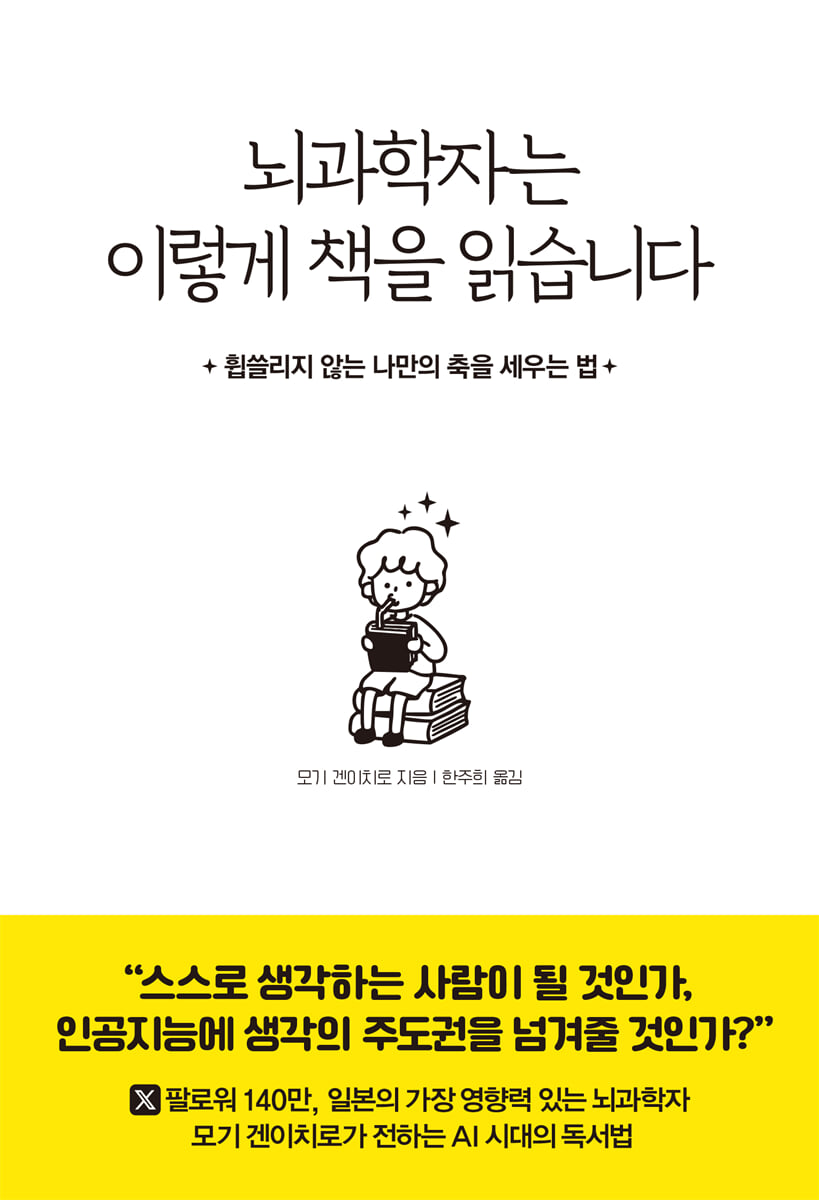
This is how neuroscientists read books
 |
Description
Book Introduction
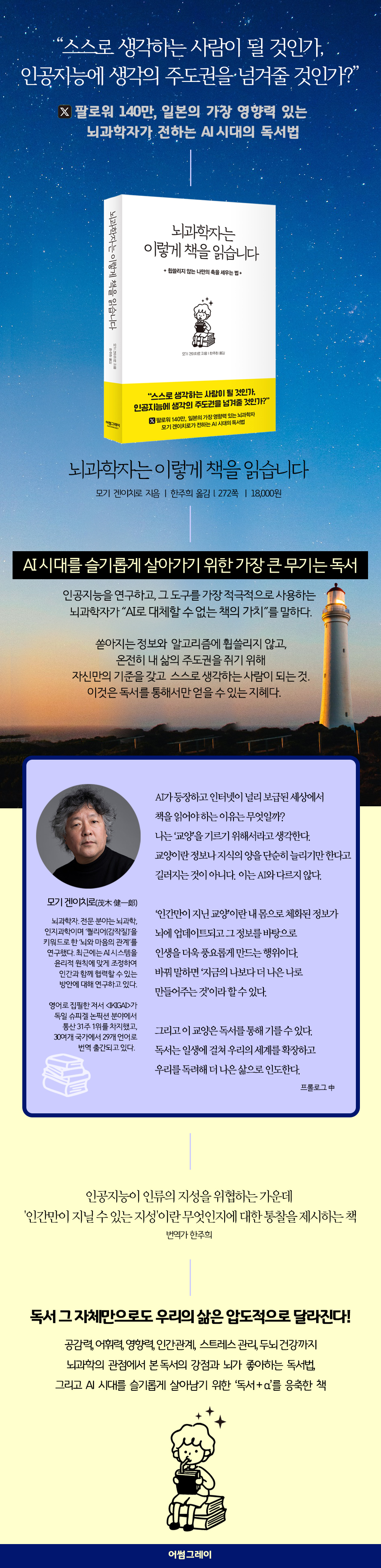
“Will you become a person who thinks for himself,
“Are we going to hand over control of our thinking to artificial intelligence?”
X 1.4 million followers, Japan's most influential neuroscientist shares his reading method for the AI era.
We think of reading as a hobby.
Because you don't have to read books to live without any major problems.
In the age of AI, where there is no information that cannot be found by searching the Internet and even creating information, books seem to have become even more useless.
But is it really necessary to spend money and time reading books?
The author, who has 1.4 million followers and is Japan's most influential neuroscientist, says that reading is absolutely necessary "to live wisely in the AI era."
In other words, from the author's perspective, reading is not a hobby but a 'necessity'.
One message the author consistently delivers throughout this book is that "you must become a person who thinks for yourself and has your own standards," and reading is essential for achieving this.
In the midst of the deluge of information in the digital world, we have become more aware of the need for our own standards than ever before, and we need to actively expand our inner world and perspectives to avoid being trapped within invisible algorithms.
You might think that you can also learn such things through the Internet.
That could be the case.
However, if we look at what kind of information the brain most effectively receives and imprints for a long time, text information that goes through the process of 'summoning and reconstructing information in the brain' is much more beneficial to our brain than volatile digital information.
In that respect, the author emphasizes that “books are much more cost-effective than the Internet.”
So, is there a way to read books well, suitable for the AI era?
The author first explains, from a neuroscientific perspective, why reading is good for the brain, and then introduces books by topic (reading to take charge of life, expand one's inner world, develop empathy, and strengthen one's resolve to face adversity) that are good to read to become a cultured person who thinks for himself.
And we introduce 'reading methods that keep the brain in optimal condition' and 'efficient reading methods in the AI era.'
Of course, you can read in your own way, and there is no set right way.
However, if you want to better utilize reading as a tool in your life and become a better person than yesterday, you will find the way through this book.
“Are we going to hand over control of our thinking to artificial intelligence?”
X 1.4 million followers, Japan's most influential neuroscientist shares his reading method for the AI era.
We think of reading as a hobby.
Because you don't have to read books to live without any major problems.
In the age of AI, where there is no information that cannot be found by searching the Internet and even creating information, books seem to have become even more useless.
But is it really necessary to spend money and time reading books?
The author, who has 1.4 million followers and is Japan's most influential neuroscientist, says that reading is absolutely necessary "to live wisely in the AI era."
In other words, from the author's perspective, reading is not a hobby but a 'necessity'.
One message the author consistently delivers throughout this book is that "you must become a person who thinks for yourself and has your own standards," and reading is essential for achieving this.
In the midst of the deluge of information in the digital world, we have become more aware of the need for our own standards than ever before, and we need to actively expand our inner world and perspectives to avoid being trapped within invisible algorithms.
You might think that you can also learn such things through the Internet.
That could be the case.
However, if we look at what kind of information the brain most effectively receives and imprints for a long time, text information that goes through the process of 'summoning and reconstructing information in the brain' is much more beneficial to our brain than volatile digital information.
In that respect, the author emphasizes that “books are much more cost-effective than the Internet.”
So, is there a way to read books well, suitable for the AI era?
The author first explains, from a neuroscientific perspective, why reading is good for the brain, and then introduces books by topic (reading to take charge of life, expand one's inner world, develop empathy, and strengthen one's resolve to face adversity) that are good to read to become a cultured person who thinks for himself.
And we introduce 'reading methods that keep the brain in optimal condition' and 'efficient reading methods in the AI era.'
Of course, you can read in your own way, and there is no set right way.
However, if you want to better utilize reading as a tool in your life and become a better person than yesterday, you will find the way through this book.
- You can preview some of the book's contents.
Preview
index
Prologue: The Great Joy of Reading
Chapter 1: Why is reading good for the brain?
The brain evolves through reading
Making reading a habit creates a "highway" for your brain.
The stimulation that reading provides is on a different level.
Even if you forget the content of the book, the reading experience remains.
7 Practical Benefits of Reading
Chapter 2: Reading to Take Control of Your Life
Natsume Soseki, who challenged absolute authority
Even innate talent isn't absolute.
Should I hand over control of my life to others?
Find a work that will set your own standards.
Training methods that stimulate creative thinking
When you find it difficult to do it alone, borrow the wisdom of the wise.
An 'otaku' is someone with high self-esteem.
How does our brain feel when we use ChatGPT?
Is ChatGPT educationally helpful?
Paper books and e-books: Let's decide what to use them for.
Chapter 3: Reading to Expand My Inner World
Reading books improves vocabulary and literacy skills by leaps and bounds.
Intelligence is the ability to understand other people's perspectives.
The abyss contained in a book
Books are much more cost-effective than the internet.
Steve Jobs and Bill Gates' idea vault
Why You Should Read Books That Will Shock You, Even If It's Deliberate
Expansion of Youth and Landing on Reality
The fateful book that led me to become a neuroscientist
A book that opened the floodgates of thought on 'nation' and 'freedom'
Chapter 4: Reading to Develop Empathy and Communication Skills
Empathy, now more essential than ever in the AI era
The less information a text has, the more it stimulates the imagination.
People who like books are also socially adept.
The best meeting that transcends time and space
Let's shift our thinking to a completely different world.
Why Reading Literature Improves Culture
Reading that finds me
Chapter 5: Reading to Strengthen Your Resolve in the Face of Adversity
Learning the 'sensibility of determination'
"The Birth of Tragedy": A heart-wrenching read when you're feeling utterly alone
One Day in the Life of Ivan Denisovich: Finding Salvation in Anxiety
"The Idiot Train": Reading When Your Mind Is Out of Balance
When I discover my insignificant self, my brain feels it is real.
Changes in the brain that occur when reading a novel
Chapter 6: Reading Methods that Optimize Your Brain
Reading Regardless of Difficulty Level Provides Positive Brain Stimulation
If you want to experience a fateful encounter
Let's build a reading habit through parallel reading.
If you don't read at the speed of writing, your knowledge will evaporate.
Only when I read the same book over and over again does it become my own.
Differentiate reading speeds depending on the book
Changes that occur in the brain when writing
Repeating input and output improves sentence structure.
Let's secure reading time with 'piecemeal reading'
Explosively increase your reading time with parallel reading.
Chapter 7: Smart Reading in the AI Age
You can't compete with AI by simply accumulating knowledge.
Dynamic Literacy: A New Knowledge Essential Now
How to apply the knowledge gained from reading to real life
How to give wings to dynamic culture
Why Marie Kondo's Tidying Up Method Changed the World
A unique domain that only humans possess
A tool to develop the ability to see the world 'broadly'
Discover clusters and dig deep to 'get to know them better'
The process of moving from knowledge-based to project-based learning
Let's question common sense
Let's learn culture by enjoying what we like.
References and Materials
Chapter 1: Why is reading good for the brain?
The brain evolves through reading
Making reading a habit creates a "highway" for your brain.
The stimulation that reading provides is on a different level.
Even if you forget the content of the book, the reading experience remains.
7 Practical Benefits of Reading
Chapter 2: Reading to Take Control of Your Life
Natsume Soseki, who challenged absolute authority
Even innate talent isn't absolute.
Should I hand over control of my life to others?
Find a work that will set your own standards.
Training methods that stimulate creative thinking
When you find it difficult to do it alone, borrow the wisdom of the wise.
An 'otaku' is someone with high self-esteem.
How does our brain feel when we use ChatGPT?
Is ChatGPT educationally helpful?
Paper books and e-books: Let's decide what to use them for.
Chapter 3: Reading to Expand My Inner World
Reading books improves vocabulary and literacy skills by leaps and bounds.
Intelligence is the ability to understand other people's perspectives.
The abyss contained in a book
Books are much more cost-effective than the internet.
Steve Jobs and Bill Gates' idea vault
Why You Should Read Books That Will Shock You, Even If It's Deliberate
Expansion of Youth and Landing on Reality
The fateful book that led me to become a neuroscientist
A book that opened the floodgates of thought on 'nation' and 'freedom'
Chapter 4: Reading to Develop Empathy and Communication Skills
Empathy, now more essential than ever in the AI era
The less information a text has, the more it stimulates the imagination.
People who like books are also socially adept.
The best meeting that transcends time and space
Let's shift our thinking to a completely different world.
Why Reading Literature Improves Culture
Reading that finds me
Chapter 5: Reading to Strengthen Your Resolve in the Face of Adversity
Learning the 'sensibility of determination'
"The Birth of Tragedy": A heart-wrenching read when you're feeling utterly alone
One Day in the Life of Ivan Denisovich: Finding Salvation in Anxiety
"The Idiot Train": Reading When Your Mind Is Out of Balance
When I discover my insignificant self, my brain feels it is real.
Changes in the brain that occur when reading a novel
Chapter 6: Reading Methods that Optimize Your Brain
Reading Regardless of Difficulty Level Provides Positive Brain Stimulation
If you want to experience a fateful encounter
Let's build a reading habit through parallel reading.
If you don't read at the speed of writing, your knowledge will evaporate.
Only when I read the same book over and over again does it become my own.
Differentiate reading speeds depending on the book
Changes that occur in the brain when writing
Repeating input and output improves sentence structure.
Let's secure reading time with 'piecemeal reading'
Explosively increase your reading time with parallel reading.
Chapter 7: Smart Reading in the AI Age
You can't compete with AI by simply accumulating knowledge.
Dynamic Literacy: A New Knowledge Essential Now
How to apply the knowledge gained from reading to real life
How to give wings to dynamic culture
Why Marie Kondo's Tidying Up Method Changed the World
A unique domain that only humans possess
A tool to develop the ability to see the world 'broadly'
Discover clusters and dig deep to 'get to know them better'
The process of moving from knowledge-based to project-based learning
Let's question common sense
Let's learn culture by enjoying what we like.
References and Materials
Detailed image
Into the book
ChatGPT, a conversational AI based on generative AI, reads large amounts of text data, such as sentences or news floating around online, and generates sentences according to the user's needs.
It is now common to see people using this to write reports or upload posts on social media as if they were their own thoughts.
This is similar to the act of 'cheating to get a perfect score on a test'.
At first glance, it might seem like there are many benefits to being praised by your teacher, or getting more likes and followers on social media thanks to your posts. But does your brain actually welcome these phenomena? No.
The act of completing sentences using ChatGPT does not put any burden on our brains, so it does not provide any stimulation and hinders our growth.
--- p.77, from “How does our brain feel when we use ChatGPT?”
Now that AI has become deeply ingrained in our daily lives, it is time for both adults and children to study ways to coexist harmoniously with AI rather than simply being vaguely afraid of it.
And for harmonious coexistence with AI, our ‘human power’ will become more important than ever.
--- p.82, from “Can Chat GPT be educationally helpful?”
Reading a book is not about copying information directly into your brain.
It is an experience of moving one's own emotions.
And it's also about understanding others, not just myself.
Additionally, the knowledge accumulated in the brain through reading is ‘fermented’ and develops.
The knowledge I acquire is connected to my past and future experiences, giving rise to new meaning and developing without me even realizing it.
Only through this fermentation process can ‘intelligence’ and ‘knowledge’ take root within me.
--- p.103, from “The Abyss in a Book”
Some people might think, 'If you want to know what a celebrity thinks, just look at their social media or blog.'
As the saying goes, you can easily find information by searching the Internet, but there is still a reason why I recommend books.
This is because of ‘qualitative value’, ‘convenience’, and ‘reliability’.
Personally, I welcome the development of the Internet with open arms, but I don't think that the Internet eliminates the need for books.
Because the roles of online writing and printed books are crucially different.
--- p.106, from “Books are much more cost-effective than the Internet”
Our world today is overly expanded through the virtual world through the Internet, movies, dramas, etc. before we can accept what is given.
You may fall into the illusion that your world and destiny will flow dynamically like the Internet or movies, as you fall into that world.
But there's no way my life could be separate from reality.
If we turn away from our own lives right in front of us and look to some other world, there is no way our life or destiny will be there.
However, it is important to note that expanding one's world is a good thing in itself.
No, it has to be expanded at least once.
As Anne's world once expanded.
Even if we are forced to settle for a reality where the world will inevitably shrink and narrow again in the near future, experiencing an expansion to the ends of the earth at least once is an important element of becoming an adult.
--- p.121, from “Expansion of Youth and Landing on Reality”
It's better to have a high threshold for fun than a low one.
In other words, it is more enjoyable to read a book that is difficult to read than a book that is easy to read.
Because easy is not so good for the brain.
When I read a book that is slightly more difficult than my level and understand the content, the thrill comes, and the brain releases dopamine, which gives me a sense of accomplishment and pleasure.
From a neuroscientific perspective, reading one difficult book regardless of difficulty level is more stimulating to the brain than reading ten easy books.
--- p.188, from “Reading Regardless of Difficulty Level Provides Good Stimulation to the Brain”
The brain's learning methods include 'sensory learning', which involves using one's senses such as listening, savoring, and reading, and 'motor learning', which involves speaking or writing down one's thoughts.
The better the balance between the two, the more perfect the brain's learning ability becomes.
When I can express my feelings about reading a book as if my heart was moved by it, only then will 'sensory learning' and 'motor learning' be balanced.
In other words, in order to utilize the knowledge or information you have acquired through books in real life, it is important to make it fixed in your brain so that you can retrieve it when needed. To do this, you need to create opportunities to recall what you have read as output.
But now we live in an age where input is overwhelmingly abundant.
Although we can obtain a variety of information through the Internet, there is a clear lack of output behavior to try to get it out on our own.
The balance between input and output is terribly broken.
It is now common to see people using this to write reports or upload posts on social media as if they were their own thoughts.
This is similar to the act of 'cheating to get a perfect score on a test'.
At first glance, it might seem like there are many benefits to being praised by your teacher, or getting more likes and followers on social media thanks to your posts. But does your brain actually welcome these phenomena? No.
The act of completing sentences using ChatGPT does not put any burden on our brains, so it does not provide any stimulation and hinders our growth.
--- p.77, from “How does our brain feel when we use ChatGPT?”
Now that AI has become deeply ingrained in our daily lives, it is time for both adults and children to study ways to coexist harmoniously with AI rather than simply being vaguely afraid of it.
And for harmonious coexistence with AI, our ‘human power’ will become more important than ever.
--- p.82, from “Can Chat GPT be educationally helpful?”
Reading a book is not about copying information directly into your brain.
It is an experience of moving one's own emotions.
And it's also about understanding others, not just myself.
Additionally, the knowledge accumulated in the brain through reading is ‘fermented’ and develops.
The knowledge I acquire is connected to my past and future experiences, giving rise to new meaning and developing without me even realizing it.
Only through this fermentation process can ‘intelligence’ and ‘knowledge’ take root within me.
--- p.103, from “The Abyss in a Book”
Some people might think, 'If you want to know what a celebrity thinks, just look at their social media or blog.'
As the saying goes, you can easily find information by searching the Internet, but there is still a reason why I recommend books.
This is because of ‘qualitative value’, ‘convenience’, and ‘reliability’.
Personally, I welcome the development of the Internet with open arms, but I don't think that the Internet eliminates the need for books.
Because the roles of online writing and printed books are crucially different.
--- p.106, from “Books are much more cost-effective than the Internet”
Our world today is overly expanded through the virtual world through the Internet, movies, dramas, etc. before we can accept what is given.
You may fall into the illusion that your world and destiny will flow dynamically like the Internet or movies, as you fall into that world.
But there's no way my life could be separate from reality.
If we turn away from our own lives right in front of us and look to some other world, there is no way our life or destiny will be there.
However, it is important to note that expanding one's world is a good thing in itself.
No, it has to be expanded at least once.
As Anne's world once expanded.
Even if we are forced to settle for a reality where the world will inevitably shrink and narrow again in the near future, experiencing an expansion to the ends of the earth at least once is an important element of becoming an adult.
--- p.121, from “Expansion of Youth and Landing on Reality”
It's better to have a high threshold for fun than a low one.
In other words, it is more enjoyable to read a book that is difficult to read than a book that is easy to read.
Because easy is not so good for the brain.
When I read a book that is slightly more difficult than my level and understand the content, the thrill comes, and the brain releases dopamine, which gives me a sense of accomplishment and pleasure.
From a neuroscientific perspective, reading one difficult book regardless of difficulty level is more stimulating to the brain than reading ten easy books.
--- p.188, from “Reading Regardless of Difficulty Level Provides Good Stimulation to the Brain”
The brain's learning methods include 'sensory learning', which involves using one's senses such as listening, savoring, and reading, and 'motor learning', which involves speaking or writing down one's thoughts.
The better the balance between the two, the more perfect the brain's learning ability becomes.
When I can express my feelings about reading a book as if my heart was moved by it, only then will 'sensory learning' and 'motor learning' be balanced.
In other words, in order to utilize the knowledge or information you have acquired through books in real life, it is important to make it fixed in your brain so that you can retrieve it when needed. To do this, you need to create opportunities to recall what you have read as output.
But now we live in an age where input is overwhelmingly abundant.
Although we can obtain a variety of information through the Internet, there is a clear lack of output behavior to try to get it out on our own.
The balance between input and output is terribly broken.
--- p.207, from “Changes that occur in the brain when writing”
Publisher's Review
How do neuroscientists read books?
Smarter Reading: A "Brain-Scientifically Correct" Reading Method
Reading has recently been gaining attention as a counter-trend to the dopamine-fueled era, fueled by a "regaining focus" trend. While the advent of AI seemed to signal the end of the "book era," younger generations have embraced reading as something unique and exciting, creating a trend known as "text hip."
However, regardless of the attention that reading receives, it is true that reading books is not an easy task for most people.
Everyone knows that reading is good, but reading books is difficult.
‘Which of the countless books should I read?’, ‘Is it okay to only read books about topics I like?’, ‘Do I have to read the classics known as recommended books?’, ‘Can listening to audiobooks count as reading?’, ‘Can I say I read a book even if I don’t understand half of it?’, ‘Do I really have to read poetry or novels even if they are of no use right away?’, ‘Why should I read a book if I don’t remember it even after reading it?’, etc. There are many questions about the act of reading itself.
If beginner readers have these questions, people who love books and read a lot also have these questions.
Is it better to read in the morning or before going to bed? Is it better to set aside a whole chunk of time to focus on reading or is it better to read sporadically? Which one sticks with you the longest: paper books, e-books, or audiobooks? Is speed reading effective? What kind of books are good to read a lot to become knowledgeable?
"This is how neuroscientists read books" contains all the answers to these questions.
The original title of this book, written by a neuroscientist who studies artificial intelligence, is “A Simple and Neuroscientifically Correct Reading Method” and it contains information on why reading is good for the brain and how to read in the most effective way for the brain.
The author also explains, based on his reading experiences, how this type of reading can dramatically impact certain moments in our lives.
The author's reading experiences, covered in four topics, provide a concrete and easily understandable demonstration of how the benefits of theoretical reading can be applied to life.
'Intelligence that only humans can possess',
And a guide to 'dynamic culture', essential in the AI era.
This book also provides guidance on smart reading methods for the AI era, and the concept of "dynamic culture," which is essential in this era, can be applied immediately.
Dynamic culture means that reading activities do not end with reading books, but rather utilize IT technology to collect information, re-edit it, broaden one's horizons of knowledge, and then apply this knowledge to action or communication.
It's a self-evident truth that simply accumulating knowledge is insufficient to compete with AI. Utilizing the knowledge gained through reading and the technological advantages of AI is a vital survival tool.
Acquiring dynamic knowledge will open your eyes to new values, increasing your chances of reaching new and more liberated places.
Anyone has the opportunity to influence others through social media channels, gain attention, and even make money by breaking new ground and breaking stereotypes.
From the perspective of dynamic education, those who will lead the AI era are not limited to those traditionally considered intelligent.
Anyone who has their own perspective and standards will be able to leverage the technological advantages of AI without being swept away by the oncoming changes.
In an age where there is widespread belief and fear that artificial intelligence will surpass human brain function, the author, a neuroscientist who studies artificial intelligence, believes that there is an intelligence that only humans can possess.
The author calls this act of updating the information embodied in my body into my brain and enriching my life based on that information 'culture' and says that it is a unique domain that only humans can possess.
Through this book, you will learn that this knowledge can be acquired most cost-effectively through reading, rather than through any other experience.
The Value of Books That Can't Be Replaced by AI
Author Genichiro Mogi is a powerful speaker with 1.4 million followers on X (formerly Twitter). He actively works across corporate, academic, broadcasting, and cultural circles, practicing "dynamic culture." He actively disseminates information and messages through social media, sometimes creating major topics both domestically and internationally. Although he researches AI and actively utilizes its tools, books remain a valuable and invaluable resource for him, a value that cannot be replaced by AI.
The author says this about the book:
“To me, a book is like a living ‘organism.’
A friend who meets, grows with, and lives with.
“It’s not a one-time encounter, but a person with whom we can share stories at any moment in our lives, discover new perspectives through them, offer advice when we have concerns, and even offer comfort with a simple word.”
This makes us reflect on how we have so far viewed books and reading only from a tool perspective.
Considering that the act of reading expands our world and develops our brain, and that it provides the most positive stimulation to the brain than anything else in the digital world, books have value beyond simply being a medium for conveying knowledge and information.
Well then, let's think about it again.
Do you still think that “books are useless in the AI era”?
Smarter Reading: A "Brain-Scientifically Correct" Reading Method
Reading has recently been gaining attention as a counter-trend to the dopamine-fueled era, fueled by a "regaining focus" trend. While the advent of AI seemed to signal the end of the "book era," younger generations have embraced reading as something unique and exciting, creating a trend known as "text hip."
However, regardless of the attention that reading receives, it is true that reading books is not an easy task for most people.
Everyone knows that reading is good, but reading books is difficult.
‘Which of the countless books should I read?’, ‘Is it okay to only read books about topics I like?’, ‘Do I have to read the classics known as recommended books?’, ‘Can listening to audiobooks count as reading?’, ‘Can I say I read a book even if I don’t understand half of it?’, ‘Do I really have to read poetry or novels even if they are of no use right away?’, ‘Why should I read a book if I don’t remember it even after reading it?’, etc. There are many questions about the act of reading itself.
If beginner readers have these questions, people who love books and read a lot also have these questions.
Is it better to read in the morning or before going to bed? Is it better to set aside a whole chunk of time to focus on reading or is it better to read sporadically? Which one sticks with you the longest: paper books, e-books, or audiobooks? Is speed reading effective? What kind of books are good to read a lot to become knowledgeable?
"This is how neuroscientists read books" contains all the answers to these questions.
The original title of this book, written by a neuroscientist who studies artificial intelligence, is “A Simple and Neuroscientifically Correct Reading Method” and it contains information on why reading is good for the brain and how to read in the most effective way for the brain.
The author also explains, based on his reading experiences, how this type of reading can dramatically impact certain moments in our lives.
The author's reading experiences, covered in four topics, provide a concrete and easily understandable demonstration of how the benefits of theoretical reading can be applied to life.
'Intelligence that only humans can possess',
And a guide to 'dynamic culture', essential in the AI era.
This book also provides guidance on smart reading methods for the AI era, and the concept of "dynamic culture," which is essential in this era, can be applied immediately.
Dynamic culture means that reading activities do not end with reading books, but rather utilize IT technology to collect information, re-edit it, broaden one's horizons of knowledge, and then apply this knowledge to action or communication.
It's a self-evident truth that simply accumulating knowledge is insufficient to compete with AI. Utilizing the knowledge gained through reading and the technological advantages of AI is a vital survival tool.
Acquiring dynamic knowledge will open your eyes to new values, increasing your chances of reaching new and more liberated places.
Anyone has the opportunity to influence others through social media channels, gain attention, and even make money by breaking new ground and breaking stereotypes.
From the perspective of dynamic education, those who will lead the AI era are not limited to those traditionally considered intelligent.
Anyone who has their own perspective and standards will be able to leverage the technological advantages of AI without being swept away by the oncoming changes.
In an age where there is widespread belief and fear that artificial intelligence will surpass human brain function, the author, a neuroscientist who studies artificial intelligence, believes that there is an intelligence that only humans can possess.
The author calls this act of updating the information embodied in my body into my brain and enriching my life based on that information 'culture' and says that it is a unique domain that only humans can possess.
Through this book, you will learn that this knowledge can be acquired most cost-effectively through reading, rather than through any other experience.
The Value of Books That Can't Be Replaced by AI
Author Genichiro Mogi is a powerful speaker with 1.4 million followers on X (formerly Twitter). He actively works across corporate, academic, broadcasting, and cultural circles, practicing "dynamic culture." He actively disseminates information and messages through social media, sometimes creating major topics both domestically and internationally. Although he researches AI and actively utilizes its tools, books remain a valuable and invaluable resource for him, a value that cannot be replaced by AI.
The author says this about the book:
“To me, a book is like a living ‘organism.’
A friend who meets, grows with, and lives with.
“It’s not a one-time encounter, but a person with whom we can share stories at any moment in our lives, discover new perspectives through them, offer advice when we have concerns, and even offer comfort with a simple word.”
This makes us reflect on how we have so far viewed books and reading only from a tool perspective.
Considering that the act of reading expands our world and develops our brain, and that it provides the most positive stimulation to the brain than anything else in the digital world, books have value beyond simply being a medium for conveying knowledge and information.
Well then, let's think about it again.
Do you still think that “books are useless in the AI era”?
GOODS SPECIFICS
- Date of issue: December 20, 2024
- Page count, weight, size: 272 pages | 304g | 130*190*17mm
- ISBN13: 9791198895318
You may also like
카테고리
korean


korean

![GQ KOREA Mark (Monthly): December [2025]](http://librairie.coreenne.fr/cdn/shop/files/8ef265dbbfbf186523ed75ba7319009d.jpg?v=1765340328&width=3840)


