

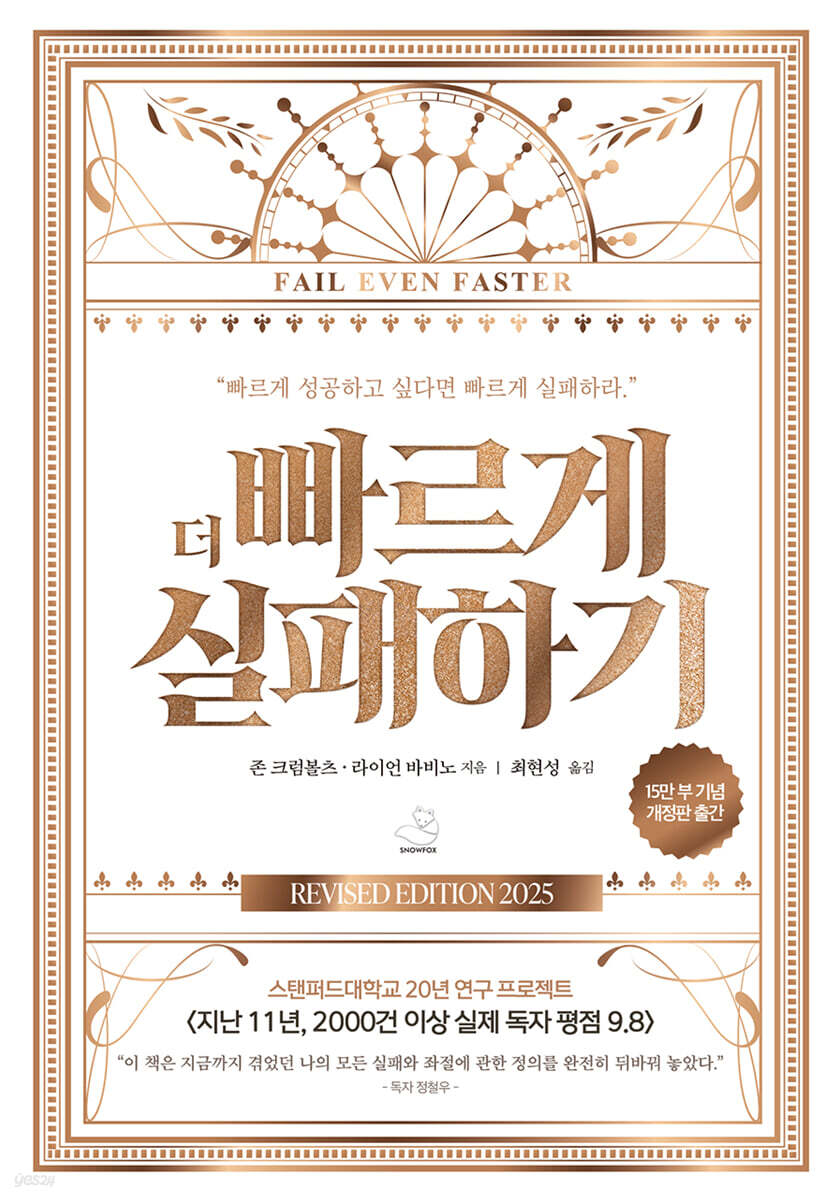
Fail Faster (150,000-Copy Commemorative Edition)
 |
Description
Book Introduction
* Over 2,000 reviews and a 4.5/5 rating (based on Amazon)
* Results of 20 years of research from Stanford University's Life Growth Project
* American Counseling Association Living Legend in Counseling Award
* Leona Tyler Award in Counseling Psychology
* American Psychological Association's most prestigious special award for intellectual contribution
(Distinguished Professional Contributions to Knowledge Award)
* Eminent Career Award from the American Career Development Association, honoring outstanding achievements
* University of Minnesota Outstanding Achievement Award
Fail Even Faster is a self-help book co-authored by John Krumboltz and Ryan Babineaux that encourages rapid trial and error.
Rather than pursuing perfection, we focus on ‘small, action-oriented’ things that can be implemented immediately.
The New York Times criticized the book, saying it was "like a 200-page vitamin B-12 shot," noting that it "helps you stop seeing failure negatively."
In fact, the text specifically states in several places that setting big goals creates a sense of oppressive pressure and burden, which leads to giving up and blocking the execution itself, and creates an oppressive 'burden'.
The book persistently asks readers, "What small action can you take right now?"—whether it's a challenge, a goal, a joy in life, or even a small hobby or diet—whatever you want to do or would like to do.
The results of the 20-year-long "Life Growth Project" research at Stanford University were persuasively utilized, drawing on the case studies of tens of thousands of people from the general public, various social classes, and different ages and genders, as well as solidarity experiments and results from other universities.
In a voluntary reader evaluation conducted prior to domestic publication, 92 out of 100 people gave the book a score of 9.8, and 50 of those unprocessed, pure evaluations were included in the text and compiled into a book.
From a corporate perspective, it focuses on testing possibilities and quickly evaluating business viability through "failing fast" rather than making detailed plans, thereby minimizing losses for the company and individuals from incorrect trial and error.
The book's strategy of anticipating and planning for failure, starting small, and learning from it became more widely known when Amazon's Jeff Bezos was quoted in his 2015 shareholder letter: "Failure and invention are inseparable twins."
* Results of 20 years of research from Stanford University's Life Growth Project
* American Counseling Association Living Legend in Counseling Award
* Leona Tyler Award in Counseling Psychology
* American Psychological Association's most prestigious special award for intellectual contribution
(Distinguished Professional Contributions to Knowledge Award)
* Eminent Career Award from the American Career Development Association, honoring outstanding achievements
* University of Minnesota Outstanding Achievement Award
Fail Even Faster is a self-help book co-authored by John Krumboltz and Ryan Babineaux that encourages rapid trial and error.
Rather than pursuing perfection, we focus on ‘small, action-oriented’ things that can be implemented immediately.
The New York Times criticized the book, saying it was "like a 200-page vitamin B-12 shot," noting that it "helps you stop seeing failure negatively."
In fact, the text specifically states in several places that setting big goals creates a sense of oppressive pressure and burden, which leads to giving up and blocking the execution itself, and creates an oppressive 'burden'.
The book persistently asks readers, "What small action can you take right now?"—whether it's a challenge, a goal, a joy in life, or even a small hobby or diet—whatever you want to do or would like to do.
The results of the 20-year-long "Life Growth Project" research at Stanford University were persuasively utilized, drawing on the case studies of tens of thousands of people from the general public, various social classes, and different ages and genders, as well as solidarity experiments and results from other universities.
In a voluntary reader evaluation conducted prior to domestic publication, 92 out of 100 people gave the book a score of 9.8, and 50 of those unprocessed, pure evaluations were included in the text and compiled into a book.
From a corporate perspective, it focuses on testing possibilities and quickly evaluating business viability through "failing fast" rather than making detailed plans, thereby minimizing losses for the company and individuals from incorrect trial and error.
The book's strategy of anticipating and planning for failure, starting small, and learning from it became more widely known when Amazon's Jeff Bezos was quoted in his 2015 shareholder letter: "Failure and invention are inseparable twins."
- You can preview some of the book's contents.
Preview
index
Recommendation
The obvious wisdom revealed in a 20-year experiment at Stanford University.
The key contents of the book sent by the research team are
Chapter 1 Is there anything so fun that you don't even realize how much time passes?
If only that problem could be solved
-The mindset that it's not yet 'time'
-What does your pleasure meter say?
-Creative and brilliant ideas that determine success or failure
-I just liked riding bikes, and I got $120 million?
-Dramatic moments of joy
-You have to eat a lot of pies to know
-Tracking Pleasure
-Mapping Pleasure: Where do you feel pleasure?
Chapter 2: Start as soon as possible and fail as much as possible.
Fail faster and more often
-Do it as quickly and poorly as possible
-Fail fast to learn fast
-Confident beginner
-Just try it
-The worst instructor in the universe
-Redefining failure
Failure is defined by definition.
-Failing and moving forward
Chapter 3 What is the essence of success?
Big thinking is freedom.
But for success, take small steps.
-Are great goals always good?
No pain, no reward? Wrong!
-The problems that arise when you only pursue great success.
-The power of small successes
The man who went from accountant to trash lord
-Small successes move your life.
-Now, start taking action.
-Suggestions for small actions
-Examples of small actions
-Build on your strengths
-Small efforts to feel the joy of accomplishment
-Celebrate small successes
-5 minutes a day
Chapter 4: Confront the Nature of Resistance That Appears at Every Moment of Opportunity
I feel like I shouldn't do it
-A voice saying 'Stop it', 'Don't do it'
-Don't trust your mysterious feelings.
Small actions turn on the switch of motivation.
-Small actions that move the mood
-Go through the tedious middle ground
- Develop grit
-Planning and Postponing
-One sheet a day, one sheet a day, once a day is enough
-I'll just do one today
Chapter 5: Going Beyond Analytical Thinking That Interferes with Action
Think deeply and consider? Well!
-Thoughts stop you
- Reduce the size of your decisions
-How to reduce the size of decisions
-Is it time to get some sun?
-If an opportunity comes, say “yes.”
-NO result value
Lessons learned from an annoying boss
-Jump into the diving board
-Jump into the diving board to move forward.
-There are hundreds of reasons why you shouldn't do it.
Chapter 6: Try something interesting that sparks your curiosity.
I could just play the guitar randomly once
-A question that kills curiosity! And the counterargument to it.
-Don't talk about yourself outside of life.
-Act on your curiosity
-Following the scent, doing the impossible
Curiosity is the unquenchable fuel of success.
- Make a list of things that would be fun to do
Chapter 7 Don't Waste Your Life on Things You Don't Like
Don't decide until you try
-Following the career matching model is foolish.
-Why is a customized career meaningless?
-A light plan is a smart plan
-Go out and see for yourself
From criminologist to interior designer
The Girl Who Was Afraid of Blood
-Get away from things that hinder your actions
-Start taking action with minimal investment
-The case of the disgruntled chemist
-Embrace change
-It's okay to change your mind along the way.
-What can hinder success?
-A light approach to achieving your dreams
Chapter 8: Become an Innovator Who Breaks Out of the Box
If you look at it another way, it looks different
-The phenomenon of seeing familiar things in a new light
- Take a 30-second snapshot
-Not 'how' but 'what'
- Keep a consistent record of your observations and questions.
- Charge your creativity
-Continuously learn
- Break out of the fixed frame
-Mapping your luck
Chapter 9 Go to a place where people with completely different backgrounds and perspectives gather.
Meeting people from completely different worlds
-Surround yourself with role models.
-Networking for ideas
-Working with dogs
-How diverse is your community?
- Maintain your existing network.
-Form a mastermind team
-Teach someone
-Interview with an expert
- Participate in conferences, workshops, and lectures
-Meet new people over meals or tea
-Get introduced and introduce yourself to others
- Participate in clubs and community meetings.
-Have a second meeting
Advice for introverts
Epilogue
The obvious wisdom revealed in a 20-year experiment at Stanford University.
The key contents of the book sent by the research team are
Chapter 1 Is there anything so fun that you don't even realize how much time passes?
If only that problem could be solved
-The mindset that it's not yet 'time'
-What does your pleasure meter say?
-Creative and brilliant ideas that determine success or failure
-I just liked riding bikes, and I got $120 million?
-Dramatic moments of joy
-You have to eat a lot of pies to know
-Tracking Pleasure
-Mapping Pleasure: Where do you feel pleasure?
Chapter 2: Start as soon as possible and fail as much as possible.
Fail faster and more often
-Do it as quickly and poorly as possible
-Fail fast to learn fast
-Confident beginner
-Just try it
-The worst instructor in the universe
-Redefining failure
Failure is defined by definition.
-Failing and moving forward
Chapter 3 What is the essence of success?
Big thinking is freedom.
But for success, take small steps.
-Are great goals always good?
No pain, no reward? Wrong!
-The problems that arise when you only pursue great success.
-The power of small successes
The man who went from accountant to trash lord
-Small successes move your life.
-Now, start taking action.
-Suggestions for small actions
-Examples of small actions
-Build on your strengths
-Small efforts to feel the joy of accomplishment
-Celebrate small successes
-5 minutes a day
Chapter 4: Confront the Nature of Resistance That Appears at Every Moment of Opportunity
I feel like I shouldn't do it
-A voice saying 'Stop it', 'Don't do it'
-Don't trust your mysterious feelings.
Small actions turn on the switch of motivation.
-Small actions that move the mood
-Go through the tedious middle ground
- Develop grit
-Planning and Postponing
-One sheet a day, one sheet a day, once a day is enough
-I'll just do one today
Chapter 5: Going Beyond Analytical Thinking That Interferes with Action
Think deeply and consider? Well!
-Thoughts stop you
- Reduce the size of your decisions
-How to reduce the size of decisions
-Is it time to get some sun?
-If an opportunity comes, say “yes.”
-NO result value
Lessons learned from an annoying boss
-Jump into the diving board
-Jump into the diving board to move forward.
-There are hundreds of reasons why you shouldn't do it.
Chapter 6: Try something interesting that sparks your curiosity.
I could just play the guitar randomly once
-A question that kills curiosity! And the counterargument to it.
-Don't talk about yourself outside of life.
-Act on your curiosity
-Following the scent, doing the impossible
Curiosity is the unquenchable fuel of success.
- Make a list of things that would be fun to do
Chapter 7 Don't Waste Your Life on Things You Don't Like
Don't decide until you try
-Following the career matching model is foolish.
-Why is a customized career meaningless?
-A light plan is a smart plan
-Go out and see for yourself
From criminologist to interior designer
The Girl Who Was Afraid of Blood
-Get away from things that hinder your actions
-Start taking action with minimal investment
-The case of the disgruntled chemist
-Embrace change
-It's okay to change your mind along the way.
-What can hinder success?
-A light approach to achieving your dreams
Chapter 8: Become an Innovator Who Breaks Out of the Box
If you look at it another way, it looks different
-The phenomenon of seeing familiar things in a new light
- Take a 30-second snapshot
-Not 'how' but 'what'
- Keep a consistent record of your observations and questions.
- Charge your creativity
-Continuously learn
- Break out of the fixed frame
-Mapping your luck
Chapter 9 Go to a place where people with completely different backgrounds and perspectives gather.
Meeting people from completely different worlds
-Surround yourself with role models.
-Networking for ideas
-Working with dogs
-How diverse is your community?
- Maintain your existing network.
-Form a mastermind team
-Teach someone
-Interview with an expert
- Participate in conferences, workshops, and lectures
-Meet new people over meals or tea
-Get introduced and introduce yourself to others
- Participate in clubs and community meetings.
-Have a second meeting
Advice for introverts
Epilogue
Detailed image

Into the book
By talking to tens of thousands of individuals who actually participated in this project, our research team made an important discovery.
The thing is, happy and successful people spend less time planning and more time taking action.
They went out into the world, tried new things, and profited from the mistakes they made along the way, gaining unexpected experiences and opportunities.
--- p.18
The mantra of "fail faster to learn faster" is often synonymous with "failing forward," as Silicon Valley entrepreneurs put it.
This concept is considered fundamental to successful business in Silicon Valley.
This means introducing new products as quickly as possible to get feedback and identify opportunities or vulnerabilities.
And then it means deciding what to do next.
--- p.82
A general rule of thumb for the Fail Fast approach is to always act in a way that 'leaves more options on the table'.
You may wish that amazing things will happen in your life and that good fortune will open wide for you.
By not being afraid to be a curious beginner, you'll be in the optimal frame of mind to learn and grow, and to embrace unexpected opportunities and experiences.
--- p.92
We know that success and happiness come from seizing the opportunities life presents.
It's just that the action is difficult.
Self-doubt, hesitation, and fear—questions like, "Can I really do this? Can I achieve it? Can I face and overcome challenges with confidence? Can I handle change?"—constantly hold us back.
The power of resistance is strong.
If so, we must find out why this phenomenon occurs.
--- pp.153-154
In fact, most people are good at procrastinating.
Even though I know it's important work that needs to be done, I can't seem to get started.
Maybe you need to do year-end accounting, reach out to future clients, or maybe you're just curious and want to try something new.
But after making the plan first, I put it off.
After making that resolution, I often feel much better and think, 'I'll take a day off and start tomorrow.'
The most familiar and subtle method resistance often uses is procrastination.
--- p.177
The problem with making decisions based on pros and cons is that it's easy to get caught up in negative biases.
In fact, people are better at detecting risks than at seizing opportunities.
This is because a higher premium is attached to ‘loss’ than to ‘gain’.
They also react much more strongly to negative stimuli.
It is for this very reason that I find it easier to find reasons for NO than for YES.
--- p.204
You don't need to figure out your personality type or decide on a career path in advance to live a successful life.
In fact, it is this kind of excessive planning and unnecessary dedication that hinders people's success and happiness.
--- p.249
People are full of different personalities.
Interests are always changing.
What challenges and excites me this year doesn't necessarily mean it will do the same next year.
Even your interests may change from day to day.
So the notion that you can be described by some immutable characteristics is quite dangerous.
--- p.251
When you realize that the most important learning can happen anytime, anywhere, you will find value in everything you do.
It also allows you to always be open to unexpected discoveries.
Perspectives on risk-taking and the likelihood of failure may also change.
There is always something to learn, meaning that no matter the outcome, you gain something from everything.
--- p.317
The more experience you have working across various industries, the more likely you are to succeed as an innovator.
Because working in a variety of work environments gave me the opportunity to become familiar with business procedures, communication styles, corporate culture, and products.
A wide range of experiences allows you to view problems from a broader perspective.
As a result, it stimulates the creation of ideas and strategies that transcend specific perspectives.
--- p.321
The point is that the people around you now influence not only your actions but also your beliefs about what is possible.
Actions and thoughts are highly contagious.
If you are surrounded by people who are active, passionate, positive, and warm-hearted, you become like them.
Even if you are with people who share just one of these, the value is incalculable.
The thing is, happy and successful people spend less time planning and more time taking action.
They went out into the world, tried new things, and profited from the mistakes they made along the way, gaining unexpected experiences and opportunities.
--- p.18
The mantra of "fail faster to learn faster" is often synonymous with "failing forward," as Silicon Valley entrepreneurs put it.
This concept is considered fundamental to successful business in Silicon Valley.
This means introducing new products as quickly as possible to get feedback and identify opportunities or vulnerabilities.
And then it means deciding what to do next.
--- p.82
A general rule of thumb for the Fail Fast approach is to always act in a way that 'leaves more options on the table'.
You may wish that amazing things will happen in your life and that good fortune will open wide for you.
By not being afraid to be a curious beginner, you'll be in the optimal frame of mind to learn and grow, and to embrace unexpected opportunities and experiences.
--- p.92
We know that success and happiness come from seizing the opportunities life presents.
It's just that the action is difficult.
Self-doubt, hesitation, and fear—questions like, "Can I really do this? Can I achieve it? Can I face and overcome challenges with confidence? Can I handle change?"—constantly hold us back.
The power of resistance is strong.
If so, we must find out why this phenomenon occurs.
--- pp.153-154
In fact, most people are good at procrastinating.
Even though I know it's important work that needs to be done, I can't seem to get started.
Maybe you need to do year-end accounting, reach out to future clients, or maybe you're just curious and want to try something new.
But after making the plan first, I put it off.
After making that resolution, I often feel much better and think, 'I'll take a day off and start tomorrow.'
The most familiar and subtle method resistance often uses is procrastination.
--- p.177
The problem with making decisions based on pros and cons is that it's easy to get caught up in negative biases.
In fact, people are better at detecting risks than at seizing opportunities.
This is because a higher premium is attached to ‘loss’ than to ‘gain’.
They also react much more strongly to negative stimuli.
It is for this very reason that I find it easier to find reasons for NO than for YES.
--- p.204
You don't need to figure out your personality type or decide on a career path in advance to live a successful life.
In fact, it is this kind of excessive planning and unnecessary dedication that hinders people's success and happiness.
--- p.249
People are full of different personalities.
Interests are always changing.
What challenges and excites me this year doesn't necessarily mean it will do the same next year.
Even your interests may change from day to day.
So the notion that you can be described by some immutable characteristics is quite dangerous.
--- p.251
When you realize that the most important learning can happen anytime, anywhere, you will find value in everything you do.
It also allows you to always be open to unexpected discoveries.
Perspectives on risk-taking and the likelihood of failure may also change.
There is always something to learn, meaning that no matter the outcome, you gain something from everything.
--- p.317
The more experience you have working across various industries, the more likely you are to succeed as an innovator.
Because working in a variety of work environments gave me the opportunity to become familiar with business procedures, communication styles, corporate culture, and products.
A wide range of experiences allows you to view problems from a broader perspective.
As a result, it stimulates the creation of ideas and strategies that transcend specific perspectives.
--- p.321
The point is that the people around you now influence not only your actions but also your beliefs about what is possible.
Actions and thoughts are highly contagious.
If you are surrounded by people who are active, passionate, positive, and warm-hearted, you become like them.
Even if you are with people who share just one of these, the value is incalculable.
--- p.337
Publisher's Review
* Over the past 11 years, actual reader ratings of 9.8 or higher out of 2,000 (based on Amazon and domestic standards)
* 150,000 copies commemorative revised edition
“This book completely overturns my definition of failure and frustration.”
--- Reader Jeong Cheol-woo
A clear answer was needed to the question, 'Why should this book be republished?'
This could be a situation that could tarnish the author's solid and prestigious award-winning work, a book that could never be republished under any pretext! Fortunately, after much deliberation and a short period of time, a revised edition was finally decided upon.
The reason is easily found in over 2,000 reader reviews.
The negative connotation of the word 'failure' has been around for so long that it is hard to pinpoint when it started.
The way we think about failure as bad and success as good has long led us to choose bigger goals and extraordinary success.
It was thought that only those who could secretly reveal their grand and magnificent goals were fit to become members of society.
It is also true that the world's extraordinary success stories light a hot fire in the hut of our desires.
Let's read one word here.
'So?' The next silent text is 'So what happened?'
Are you slim? So dieting is the end of your life?
How good is your English? So, you don't need to study anymore?
What field are you in? So you'll never find another job in your life?
How's your bank balance? Do you have as much as you thought you had 10, 20, or 30 years ago?
Do you enjoy playing tennis or golf as a hobby? Are you satisfied with your skills?
These are just a few very small assumptions, but even something as ordinary or small as that is in relative terms always has goals and desires.
As we grow in size, we come across the keyword 'success', which leads to wealth and fame, and each element and imagination listed under the word 'success' grows exponentially.
When everything is laid out, there's a moment of breathtaking, maddening ecstasy, and then a moment of wonder: "Could it really be something I can contain myself? Did I waste my ambitious, sci-fi imagination on a waste of time?"
This is something that anyone who has devoured self-help books has likely done, and it is true that they have been constantly urged, not criticized, to "do it!"
For this obvious reason, I decided to republish this book, Fail Fast.
Since it is a revised edition, I was wondering if I should change the title, so I added the word 'more' in front and changed it to the previous title, 'Fail Faster'. With a name tag that says 'Revised Edition', it will be put back on the bookstore shelves to meet readers.
The word that comes to mind when summarizing this book in one word is 'courage.'
The courage to know that perfection isn't necessary, the courage to plan not grandly but so small and insignificantly that it seems insignificant, the courage to transform planning into immediate action.
The courage to act quickly and experience trial and error, rather than setting goals.
Modern society rationalizes the pursuit of perfection and the tendency to procrastinate.
The words 'careful' and 'cautious' are used interchangeably and are understood.
In this world, the book 『Fail Fast, Fail Often』, published in the United States in 2013 on the topic of 'failure', is this one.
A new topic worthy of the attention of various media outlets has emerged.
This book is a compilation of the results of 20 years of experiments conducted at Stanford University, a university that has devoted a long period of research, so the cases and experimental results are enough to read without getting bored.
It is said that successful people have something in common: rather than making a detailed plan, they try things out right away and get immediate data to determine the practicality and feasibility of a long-term strategy.
There are so many entrepreneurs and people who are preparing and losing sleep over their plans, determined to succeed.
Doesn't it feel like someone got hit?
Not long after the book was published, many companies embarking on new ventures, including those in Silicon Valley at the time, not only immediately embraced the "fail fast" philosophy, but also began to value it as a crucial business element.
The fail-fast philosophy was later expanded upon by Amazon's Jeff Bezos in his 2015 shareholder letter, when he stated that "failure and invention are inseparable twins."
Let me ask you a quiz at this point.
"What do I need to do right now to become a successful professional photographer?"
Let's finish with a slightly easier quiz.
If you want to become a bestselling author or a bestselling publisher,
What should I do right now?'
--- From a planner who has been in charge of three domestic publications over the past 11 years
* 150,000 copies commemorative revised edition
“This book completely overturns my definition of failure and frustration.”
--- Reader Jeong Cheol-woo
A clear answer was needed to the question, 'Why should this book be republished?'
This could be a situation that could tarnish the author's solid and prestigious award-winning work, a book that could never be republished under any pretext! Fortunately, after much deliberation and a short period of time, a revised edition was finally decided upon.
The reason is easily found in over 2,000 reader reviews.
The negative connotation of the word 'failure' has been around for so long that it is hard to pinpoint when it started.
The way we think about failure as bad and success as good has long led us to choose bigger goals and extraordinary success.
It was thought that only those who could secretly reveal their grand and magnificent goals were fit to become members of society.
It is also true that the world's extraordinary success stories light a hot fire in the hut of our desires.
Let's read one word here.
'So?' The next silent text is 'So what happened?'
Are you slim? So dieting is the end of your life?
How good is your English? So, you don't need to study anymore?
What field are you in? So you'll never find another job in your life?
How's your bank balance? Do you have as much as you thought you had 10, 20, or 30 years ago?
Do you enjoy playing tennis or golf as a hobby? Are you satisfied with your skills?
These are just a few very small assumptions, but even something as ordinary or small as that is in relative terms always has goals and desires.
As we grow in size, we come across the keyword 'success', which leads to wealth and fame, and each element and imagination listed under the word 'success' grows exponentially.
When everything is laid out, there's a moment of breathtaking, maddening ecstasy, and then a moment of wonder: "Could it really be something I can contain myself? Did I waste my ambitious, sci-fi imagination on a waste of time?"
This is something that anyone who has devoured self-help books has likely done, and it is true that they have been constantly urged, not criticized, to "do it!"
For this obvious reason, I decided to republish this book, Fail Fast.
Since it is a revised edition, I was wondering if I should change the title, so I added the word 'more' in front and changed it to the previous title, 'Fail Faster'. With a name tag that says 'Revised Edition', it will be put back on the bookstore shelves to meet readers.
The word that comes to mind when summarizing this book in one word is 'courage.'
The courage to know that perfection isn't necessary, the courage to plan not grandly but so small and insignificantly that it seems insignificant, the courage to transform planning into immediate action.
The courage to act quickly and experience trial and error, rather than setting goals.
Modern society rationalizes the pursuit of perfection and the tendency to procrastinate.
The words 'careful' and 'cautious' are used interchangeably and are understood.
In this world, the book 『Fail Fast, Fail Often』, published in the United States in 2013 on the topic of 'failure', is this one.
A new topic worthy of the attention of various media outlets has emerged.
This book is a compilation of the results of 20 years of experiments conducted at Stanford University, a university that has devoted a long period of research, so the cases and experimental results are enough to read without getting bored.
It is said that successful people have something in common: rather than making a detailed plan, they try things out right away and get immediate data to determine the practicality and feasibility of a long-term strategy.
There are so many entrepreneurs and people who are preparing and losing sleep over their plans, determined to succeed.
Doesn't it feel like someone got hit?
Not long after the book was published, many companies embarking on new ventures, including those in Silicon Valley at the time, not only immediately embraced the "fail fast" philosophy, but also began to value it as a crucial business element.
The fail-fast philosophy was later expanded upon by Amazon's Jeff Bezos in his 2015 shareholder letter, when he stated that "failure and invention are inseparable twins."
Let me ask you a quiz at this point.
"What do I need to do right now to become a successful professional photographer?"
Let's finish with a slightly easier quiz.
If you want to become a bestselling author or a bestselling publisher,
What should I do right now?'
--- From a planner who has been in charge of three domestic publications over the past 11 years
GOODS SPECIFICS
- Date of issue: December 4, 2024
- Page count, weight, size: 376 pages | 460g | 140*200*23mm
- ISBN13: 9791191769845
- ISBN10: 1191769844
You may also like
카테고리
korean


korean

![GQ KOREA Mark (Monthly): December [2025]](http://librairie.coreenne.fr/cdn/shop/files/8ef265dbbfbf186523ed75ba7319009d.jpg?v=1765340328&width=3840)


