

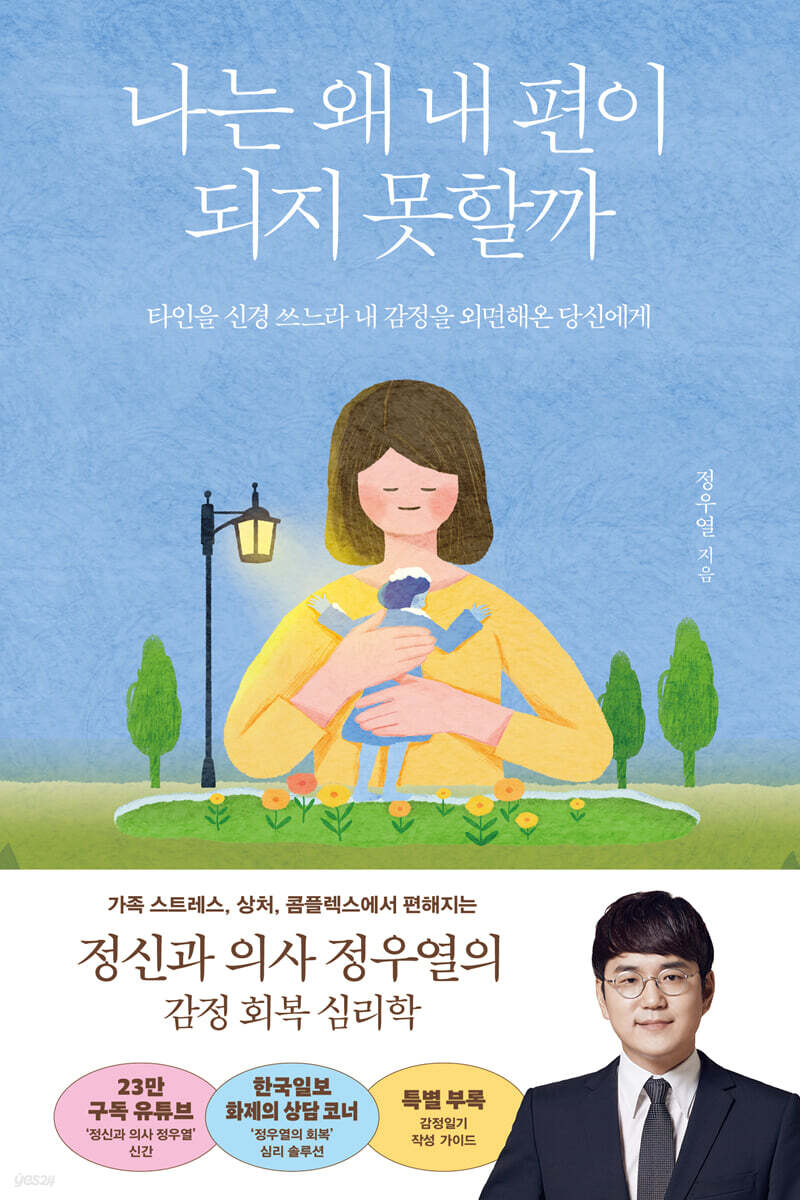
Why can't I be on my own side?
 |
Description
Book Introduction
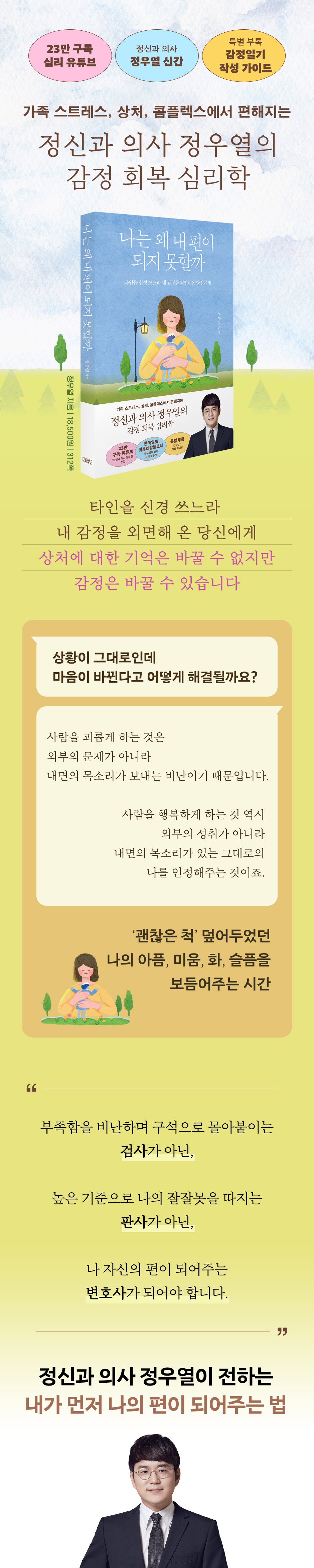
“If the situation remains the same, will it be resolved if I change my mind?”
Psychiatrist Woo-Yeol Jeong, the '230,000 Psychological Mentor'
How to be on my own side first
Recovery solutions for relationship stress, hurt, and complexes
Many people suffer from emotional pain because they are unable to properly face their own wounds and emotions amidst the various pains entangled with those of others.
Jung Woo-yeol, a psychiatrist and a YouTuber with 230,000 subscribers, says that while memories of trauma cannot be changed, emotions can.
I published a psychology book titled "Why Can't I Be on My Own Side?", which contains "emotional recovery solutions" to relieve relationship stress, hurt, and complexes.
Through the stories and solutions of people who have not properly healed the wounds of childhood pain, domestic violence, and emotional abuse and are struggling in all aspects of life, including interpersonal relationships, work, marriage, and childcare, you can face and heal your own wounded emotions.
The author says that only when we can embrace our own 'not-so-good feelings' can those feelings be resolved and we can move on to the next chapter.
This book takes you on a journey of emotional recovery, allowing you to truly examine the discomfort, hatred, anger, and sadness you feel toward those who have hurt you.
At the end of it, instead of trying to defend yourself or show more, you will have a strong heart that can face the anger, sadness, and hurt as they are.
Psychiatrist Woo-Yeol Jeong, the '230,000 Psychological Mentor'
How to be on my own side first
Recovery solutions for relationship stress, hurt, and complexes
Many people suffer from emotional pain because they are unable to properly face their own wounds and emotions amidst the various pains entangled with those of others.
Jung Woo-yeol, a psychiatrist and a YouTuber with 230,000 subscribers, says that while memories of trauma cannot be changed, emotions can.
I published a psychology book titled "Why Can't I Be on My Own Side?", which contains "emotional recovery solutions" to relieve relationship stress, hurt, and complexes.
Through the stories and solutions of people who have not properly healed the wounds of childhood pain, domestic violence, and emotional abuse and are struggling in all aspects of life, including interpersonal relationships, work, marriage, and childcare, you can face and heal your own wounded emotions.
The author says that only when we can embrace our own 'not-so-good feelings' can those feelings be resolved and we can move on to the next chapter.
This book takes you on a journey of emotional recovery, allowing you to truly examine the discomfort, hatred, anger, and sadness you feel toward those who have hurt you.
At the end of it, instead of trying to defend yourself or show more, you will have a strong heart that can face the anger, sadness, and hurt as they are.
- You can preview some of the book's contents.
Preview
index
Author's Note | The Signals My Heart Gives Me
Part 1: Why do I want to be loved even when I hate others?
: The source of anxiety, hatred, and hurt
The pain of not being able to hate your parents to your heart's content
The obsession that families must support each other
Life doesn't flow according to life cycles.
A person who has a particularly hard time with interpersonal relationships
Why does my daughter keep drifting away?
Antenna pointing outwards towards me
Being a parent is difficult for anyone.
Should I endure it for the sake of 'family harmony'?
Emotions don't go away if you ignore them.
Part 2 If my life is shaken by wounds
: Change direction to center your thoughts on 'me'
Perfectionism, or obsessive-compulsive personality
Do I have to do well to be loved?
The unwanted side of me that my child sees
Sexual identity not recognized by family
The avoidant husband and the pursuing wife
My family blames me for everything
Practice saying no
Masochistic tendencies that have become familiar
Patients who are afraid that their depression will be cured
Part 3 When My Emotions Knock at the Door
: How to Deal with Difficult Emotions
Good kid complex
It's okay to hate someone
Growing up with an alcoholic parent
The trauma of 'it's my fault'
I can do my parent's job
A disease called 'hoarding compulsion'
In a family where there is no one on my side
Supporting Parents, Where is My Future?
The pain of public speaking phobia
Part 4: Practice being on my own side first
: The power of emotional recovery, the life you want
If you can't escape from the past
Practice standing alone
When inferiority complex turns into violence
Parents who fear their children's independence
ambivalent feelings toward parents
There are families that deserve to be left behind.
Don't try to solve family problems
I am different from my parents.
Appendix | How to Write an "Emotional Diary"
Part 1: Why do I want to be loved even when I hate others?
: The source of anxiety, hatred, and hurt
The pain of not being able to hate your parents to your heart's content
The obsession that families must support each other
Life doesn't flow according to life cycles.
A person who has a particularly hard time with interpersonal relationships
Why does my daughter keep drifting away?
Antenna pointing outwards towards me
Being a parent is difficult for anyone.
Should I endure it for the sake of 'family harmony'?
Emotions don't go away if you ignore them.
Part 2 If my life is shaken by wounds
: Change direction to center your thoughts on 'me'
Perfectionism, or obsessive-compulsive personality
Do I have to do well to be loved?
The unwanted side of me that my child sees
Sexual identity not recognized by family
The avoidant husband and the pursuing wife
My family blames me for everything
Practice saying no
Masochistic tendencies that have become familiar
Patients who are afraid that their depression will be cured
Part 3 When My Emotions Knock at the Door
: How to Deal with Difficult Emotions
Good kid complex
It's okay to hate someone
Growing up with an alcoholic parent
The trauma of 'it's my fault'
I can do my parent's job
A disease called 'hoarding compulsion'
In a family where there is no one on my side
Supporting Parents, Where is My Future?
The pain of public speaking phobia
Part 4: Practice being on my own side first
: The power of emotional recovery, the life you want
If you can't escape from the past
Practice standing alone
When inferiority complex turns into violence
Parents who fear their children's independence
ambivalent feelings toward parents
There are families that deserve to be left behind.
Don't try to solve family problems
I am different from my parents.
Appendix | How to Write an "Emotional Diary"
Detailed image
Into the book
'The situation remains the same, so will changing my mind solve anything?' I had endless doubts.
But as I gained experience, I came to understand the amazing power of focusing my mind.
Because I've come to realize that it's not external problems that torment people, but the criticism from their inner voice.
This is because I have experienced countless times that what makes people happy is not external achievements, but the inner voice that acknowledges me as I am.
--- p.5, from the author's note
The wounds we receive from our parents as children remain as painful memories until we become adults.
Some may simply say, “Just become independent from your parents,” to those who are still struggling with pain and anger toward their parents. However, the person suffering is actually experiencing a second pain, unable to freely hate or escape from such parents.
Why do people hate their parents so much and still want to repair their relationship?
--- p.14, from “The Pain of Not Being able to Hate Your Parents to Your Heart’s Content”
Instead of asking, "Why does my sister keep doing that?", it's helpful to change the subject to, "Why do I feel uncomfortable about my sister?"
--- p.31, from “The Obsession That Families Must Take Care of Each Other”
Rather than being a prosecutor who criticizes my shortcomings and corners me, or a judge who judges me by high standards, I need to be a lawyer who takes my side.
--- p.105, from “Do I have to do well to be loved?”
I want to tell you that it's okay to hate those who made it hard for you as a child when you couldn't make your own decisions about your life.
Don't blame yourself for resenting your parents and siblings or hating your friends.
Only by facing that feeling raw and understanding it well can you overcome that feeling.
In this process, it is most important to get to know your own emotions and thoughts and to accept yourself.
--- p.171, from “It’s Okay to Hate Someone”
Having uncontrollable anger and hatred doesn't make you a bad or dangerous person.
It's just that my emotions, which I've been hiding, have been touched and I'm in so much pain that I can't control them.
By acknowledging that you have been influenced by your parents and surroundings, and confronting these emotions with compassion for yourself, you will eventually be able to understand and control your emotions.
--- p.177, from “Growing Up with Alcoholic Parents”
It's time to focus more on 'how I see myself' rather than 'how others see me'.
But as I gained experience, I came to understand the amazing power of focusing my mind.
Because I've come to realize that it's not external problems that torment people, but the criticism from their inner voice.
This is because I have experienced countless times that what makes people happy is not external achievements, but the inner voice that acknowledges me as I am.
--- p.5, from the author's note
The wounds we receive from our parents as children remain as painful memories until we become adults.
Some may simply say, “Just become independent from your parents,” to those who are still struggling with pain and anger toward their parents. However, the person suffering is actually experiencing a second pain, unable to freely hate or escape from such parents.
Why do people hate their parents so much and still want to repair their relationship?
--- p.14, from “The Pain of Not Being able to Hate Your Parents to Your Heart’s Content”
Instead of asking, "Why does my sister keep doing that?", it's helpful to change the subject to, "Why do I feel uncomfortable about my sister?"
--- p.31, from “The Obsession That Families Must Take Care of Each Other”
Rather than being a prosecutor who criticizes my shortcomings and corners me, or a judge who judges me by high standards, I need to be a lawyer who takes my side.
--- p.105, from “Do I have to do well to be loved?”
I want to tell you that it's okay to hate those who made it hard for you as a child when you couldn't make your own decisions about your life.
Don't blame yourself for resenting your parents and siblings or hating your friends.
Only by facing that feeling raw and understanding it well can you overcome that feeling.
In this process, it is most important to get to know your own emotions and thoughts and to accept yourself.
--- p.171, from “It’s Okay to Hate Someone”
Having uncontrollable anger and hatred doesn't make you a bad or dangerous person.
It's just that my emotions, which I've been hiding, have been touched and I'm in so much pain that I can't control them.
By acknowledging that you have been influenced by your parents and surroundings, and confronting these emotions with compassion for yourself, you will eventually be able to understand and control your emotions.
--- p.177, from “Growing Up with Alcoholic Parents”
It's time to focus more on 'how I see myself' rather than 'how others see me'.
--- p.226, from “The Pain of Public Speaking Fear”
Publisher's Review
The memories of the wounds cannot be changed,
Feelings can be changed
“Saving many people’s hearts”
Psychiatrist Jeong Woo-yeol's Emotional Recovery Psychology
The author has been running the psychological YouTube channel 'Psychiatrist Jeong Woo-yeol' for 7 years, and has been consistently providing 'psychological counseling that helps you become familiar with your own mind' by meeting numerous clients in his clinic and through newspaper columns.
The author, who has received rave reviews such as “a person who saves many people’s hearts” and “the best counselor in my life who reads my heart most clearly,” has compiled his counseling solutions into this book, “Why Can’t I Be on My Own Side?”
Covered up by 'pretending to be okay'
A time to embrace my pain, hatred, anger, and sadness
Part 1, “Why Do I Want to Be Loved Even While I Hate?” examines the root of anxiety, hatred, and hurt through various stories of people who suffer from the pain of “not being able to hate freely or escape” their parents, children, work, and people.
The author says that everyone has an inner ambivalence that makes them resent someone while unconsciously longing for affection or wanting to depend on them. He provides specific emotional solutions such as 'How to draw a line for a healthy relationship,' 'Practice making decisions independently,' and 'How to manage shame.'
Part 2, “If My Life Is Shaking Because of Wounds,” helps those who are suffering because their thoughts are centered on others, such as “I’m afraid I’ll think poorly of myself” or “I’m afraid I won’t be loved if I don’t do well,” to change their direction to thinking centered on “me.”
By practicing being kind to yourself, you can accept frustration in a healthy way.
Part 3, “When My Emotions Knock on the Door,” helps “adults who remain as bruised children” due to trauma from obsessive-compulsive behaviors, alcoholic parents, school violence, and sexual violence to face difficult emotions and take a step forward.
Rather than “suppressing and ignoring” trauma, we can move forward by practicing “accepting” the memories and emotions of that time and fulfilling the role that our parents were unable to fulfill.
Part 4, “Practice of Becoming My Own Side First,” helps those who feel the “fear of standing alone” due to conflicts with their in-laws and husband, fear of their children leaving, and inability to separate from their original family, to achieve true independence and move toward the life they desire.
You can regain your own "subjective territory" through daily practice of not trying to control or obsess over others and by making an effort to focus on your own mind.
Why do I hate you so much?
Do you want to be loved?
There are people who try to solve their problems by blaming themselves instead of embracing their wounds.
Everyone can love their parents and hate them at times, cherish their siblings and feel jealous, and be disappointed by their own shortcomings at times. However, we tend to ignore these uncomfortable feelings and quickly shut them out.
The author helps us face the uncomfortable emotions we have been ignoring and heal our wounds, even if it is uncomfortable.
Behind the 'resentment' towards violent parents, we discover the desire to be 'dependent', behind the 'worry' towards parents or siblings, we discover the excessive 'sense of responsibility', and behind the 'self-mockery' that we are failures, we discover the 'will' to ask for help.
As you follow the solution and discover stories similar to your own and empathize with them, you will eventually be able to accept emotions that you previously found uncomfortable, thinking, "This is how the human heart is."
By practicing gradually shifting your gaze from being focused on others to yourself, you can stand firm on your wounds.
One day, out of the blue
For when negative emotions hit
Includes a practical guide to "Emotional Diary"
The author emphasizes writing an 'emotional diary' as the best way to understand and become familiar with one's emotions, and provides detailed instructions on how to write one in the appendix of this book.
By recording “how my mind moves,” you will “understand your own emotions and desires,” and “the frequency and intensity of emotional surges will gradually decrease.”
Facing your feelings, which are less than you thought and less than you thought, can be a daunting task at first.
However, if you follow this book and consistently examine your emotions, and acknowledge that even uncomfortable emotions you thought were not so bad are 'natural,' you will be able to accept yourself as you are, and gain a new perspective that will make others and their wounds easier.
The experience of ‘being on my own side’ is the beginning of recovery.
Feelings can be changed
“Saving many people’s hearts”
Psychiatrist Jeong Woo-yeol's Emotional Recovery Psychology
The author has been running the psychological YouTube channel 'Psychiatrist Jeong Woo-yeol' for 7 years, and has been consistently providing 'psychological counseling that helps you become familiar with your own mind' by meeting numerous clients in his clinic and through newspaper columns.
The author, who has received rave reviews such as “a person who saves many people’s hearts” and “the best counselor in my life who reads my heart most clearly,” has compiled his counseling solutions into this book, “Why Can’t I Be on My Own Side?”
Covered up by 'pretending to be okay'
A time to embrace my pain, hatred, anger, and sadness
Part 1, “Why Do I Want to Be Loved Even While I Hate?” examines the root of anxiety, hatred, and hurt through various stories of people who suffer from the pain of “not being able to hate freely or escape” their parents, children, work, and people.
The author says that everyone has an inner ambivalence that makes them resent someone while unconsciously longing for affection or wanting to depend on them. He provides specific emotional solutions such as 'How to draw a line for a healthy relationship,' 'Practice making decisions independently,' and 'How to manage shame.'
Part 2, “If My Life Is Shaking Because of Wounds,” helps those who are suffering because their thoughts are centered on others, such as “I’m afraid I’ll think poorly of myself” or “I’m afraid I won’t be loved if I don’t do well,” to change their direction to thinking centered on “me.”
By practicing being kind to yourself, you can accept frustration in a healthy way.
Part 3, “When My Emotions Knock on the Door,” helps “adults who remain as bruised children” due to trauma from obsessive-compulsive behaviors, alcoholic parents, school violence, and sexual violence to face difficult emotions and take a step forward.
Rather than “suppressing and ignoring” trauma, we can move forward by practicing “accepting” the memories and emotions of that time and fulfilling the role that our parents were unable to fulfill.
Part 4, “Practice of Becoming My Own Side First,” helps those who feel the “fear of standing alone” due to conflicts with their in-laws and husband, fear of their children leaving, and inability to separate from their original family, to achieve true independence and move toward the life they desire.
You can regain your own "subjective territory" through daily practice of not trying to control or obsess over others and by making an effort to focus on your own mind.
Why do I hate you so much?
Do you want to be loved?
There are people who try to solve their problems by blaming themselves instead of embracing their wounds.
Everyone can love their parents and hate them at times, cherish their siblings and feel jealous, and be disappointed by their own shortcomings at times. However, we tend to ignore these uncomfortable feelings and quickly shut them out.
The author helps us face the uncomfortable emotions we have been ignoring and heal our wounds, even if it is uncomfortable.
Behind the 'resentment' towards violent parents, we discover the desire to be 'dependent', behind the 'worry' towards parents or siblings, we discover the excessive 'sense of responsibility', and behind the 'self-mockery' that we are failures, we discover the 'will' to ask for help.
As you follow the solution and discover stories similar to your own and empathize with them, you will eventually be able to accept emotions that you previously found uncomfortable, thinking, "This is how the human heart is."
By practicing gradually shifting your gaze from being focused on others to yourself, you can stand firm on your wounds.
One day, out of the blue
For when negative emotions hit
Includes a practical guide to "Emotional Diary"
The author emphasizes writing an 'emotional diary' as the best way to understand and become familiar with one's emotions, and provides detailed instructions on how to write one in the appendix of this book.
By recording “how my mind moves,” you will “understand your own emotions and desires,” and “the frequency and intensity of emotional surges will gradually decrease.”
Facing your feelings, which are less than you thought and less than you thought, can be a daunting task at first.
However, if you follow this book and consistently examine your emotions, and acknowledge that even uncomfortable emotions you thought were not so bad are 'natural,' you will be able to accept yourself as you are, and gain a new perspective that will make others and their wounds easier.
The experience of ‘being on my own side’ is the beginning of recovery.
GOODS SPECIFICS
- Date of issue: November 22, 2024
- Page count, weight, size: 312 pages | 404g | 140*210*20mm
- ISBN13: 9791194330714
- ISBN10: 1194330711
You may also like
카테고리
korean


korean

![GQ KOREA Mark (Monthly): December [2025]](http://librairie.coreenne.fr/cdn/shop/files/8ef265dbbfbf186523ed75ba7319009d.jpg?v=1765340328&width=3840)


