

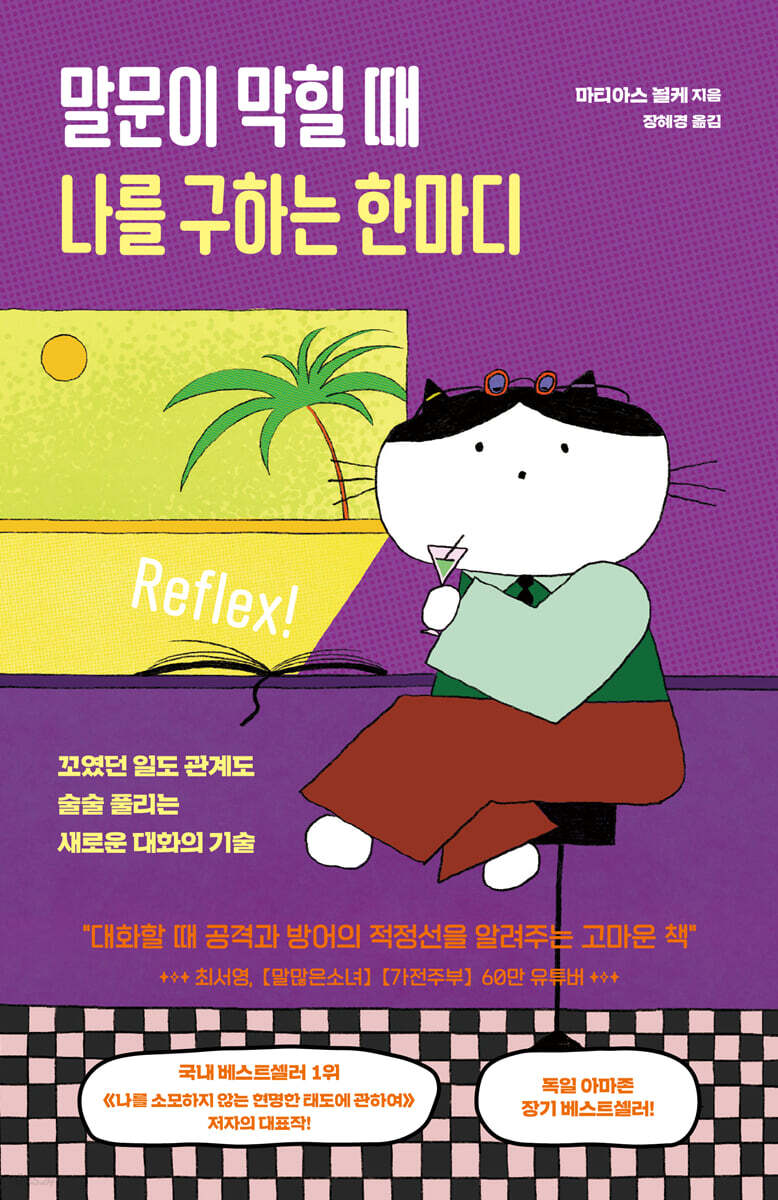
A word that saves me when I'm speechless
 |
Description
Book Introduction
“Ah, I should have said that back then…!”
The secret to exceptional quick wit revealed to adults who still struggle with conversation
A quick wit is not something you are born with, it is something you train!
It is said that recently, the number of people who have difficulty conversing not only in person but also remotely is increasing.
In fact, according to a survey, 3 out of 10 people in the MZ generation suffer from 'call phobia', which is a feeling of tension, anxiety, and fear when making phone calls.
They say the reason they have difficulty making phone calls is because they have to answer right away without having time to organize their thoughts.
The problem is that this call phobia continues into the workplace, causing conflict.
If you want to overcome the fear of communicating with others, you must, of course, repeatedly practice speaking and responding.
The expectation that racking your brain will yield a witty answer is misplaced.
The secret to a quick response lies in thorough ‘preliminary preparation.’
The quick thinking we're talking about here is another word for 'more thorough preparation.'
But unfortunately, not everyone is born with quick wit.
But that doesn't mean I can just be sad or stay still.
Matthias Nölke, a trusted journalist in Germany and an inspiration to many readers with his #1 domestic bestseller, "On the Wise Attitude That Doesn't Waste Me Out," has also published many insightful books on conversational skills.
According to him, quick wit is something that is 'learned' and 'trained'.
His representative work, "A Word to Save Me When I'm Speechless," which was published for modern people who have difficulty even in everyday conversation, was a bestseller in Germany for over a decade.
As we live, there are many times when the right words just don't come to mind, and because of that, even in situations where I'm clearly right, I end up losing to someone who's more articulate.
Especially in the workplace, you don't have much time to persuade others, and you have to deal with attacks that become increasingly harsh and vicious by the day.
That is precisely why the demand for books and lectures on quick thinking is increasing day by day.
--- From the author's note
The secret to exceptional quick wit revealed to adults who still struggle with conversation
A quick wit is not something you are born with, it is something you train!
It is said that recently, the number of people who have difficulty conversing not only in person but also remotely is increasing.
In fact, according to a survey, 3 out of 10 people in the MZ generation suffer from 'call phobia', which is a feeling of tension, anxiety, and fear when making phone calls.
They say the reason they have difficulty making phone calls is because they have to answer right away without having time to organize their thoughts.
The problem is that this call phobia continues into the workplace, causing conflict.
If you want to overcome the fear of communicating with others, you must, of course, repeatedly practice speaking and responding.
The expectation that racking your brain will yield a witty answer is misplaced.
The secret to a quick response lies in thorough ‘preliminary preparation.’
The quick thinking we're talking about here is another word for 'more thorough preparation.'
But unfortunately, not everyone is born with quick wit.
But that doesn't mean I can just be sad or stay still.
Matthias Nölke, a trusted journalist in Germany and an inspiration to many readers with his #1 domestic bestseller, "On the Wise Attitude That Doesn't Waste Me Out," has also published many insightful books on conversational skills.
According to him, quick wit is something that is 'learned' and 'trained'.
His representative work, "A Word to Save Me When I'm Speechless," which was published for modern people who have difficulty even in everyday conversation, was a bestseller in Germany for over a decade.
As we live, there are many times when the right words just don't come to mind, and because of that, even in situations where I'm clearly right, I end up losing to someone who's more articulate.
Especially in the workplace, you don't have much time to persuade others, and you have to deal with attacks that become increasingly harsh and vicious by the day.
That is precisely why the demand for books and lectures on quick thinking is increasing day by day.
--- From the author's note
- You can preview some of the book's contents.
Preview
index
Author's Note: The power of conversation depends on quick wit. 5
Prologue: Why can't I find words at the crucial moment? 8
Step 1: How to Get Out of a Tough Situation
01 Moments When You Must Stand Up Confidently 17
02 The First Step to Building Self-Confidence 20
03 Reinterpret the situation 23
04 Trust My Judgment 27
05 Be honest about your weaknesses 30
06 Face the Realistic 'Me' 34
07 All Relationships Are Two-Lane Roads 37
Step 2 How can I open my mouth?
08 Why do I always get hurt? 45
09 Why am I speechless? 48
10 How to Prepare for a Surprise Attack 50
11 Secure the distance 53
12 “I don’t take this situation seriously” 57
13 A little malice is also necessary 60
14 The Legitimacy of the Counterattack 63
15 Speak now or remain silent forever! 67
Step 3: Use body language that speaks louder than words.
16 The Body Speaks 73
17 How to Read Someone's Message Based on Their Posture 77
81 To persuade with 18 gestures
19 The Art of 'Reading' Your Opponent's Face 84
20 Find the 'Chocolate Tone' 87
Step 4: What to say and what not to say
21 When nothing comes to mind 93
22 Instant Sentences to Use Whenever You Need Them 97
23 Excessive jokes are harmful 100
24 Quote Famous People 103
25 Break the Mood 108
26 The Art of Response 113
27 Turn the muzzle towards the opponent 117
Step 5 How to Deal with Unfair Criticism
28 Misjudgments should be corrected as quickly as possible. 123
29 Respond with a rebuttal 129
30 Reclaiming Control of the Conversation 133
31 Poisoned Praise 137
32 Translate with Soft Words 141
33 'Bee's Tongue' Technique 144
34 When You Need a 'Snake's Tongue' 147
35 The "Diplomat's Tongue" technique is the most effective. 152
36 Emotions are replaced by reason 155
Step 6 If the other person gets angry without reason
37 Why get angry over trivial things? 163
38 A look of fear is forbidden 167
39 Wait until the embers die down 171
40 Golden Rules for Calming Your Opponent's Anger 176
41 If active explanation is required 180
42 Personal Insults Are Not Allowed 184
43 People Who Use Anger 189
Step 7: How to Deal with Ridicule and Sarcasm
44 Sarcasm is not humor 193
45 Why do words come out that are different from what's in my head? 198
46 See Through Your Opponent's Intentions 203
47 Ignoring can be the answer 207
48 The Magic Spell Called 'I' 211
49 Don't Fall for the Disruption Operation 217
50 Secrets of a Successful Counterattack 220
Step 8: Have the courage to laugh it off
51 The Magic of Communication: Laughter 229
52. Attack the Opponent's Laughter 235
53 Destroying the Opponent's Expectations 237
54 Harnessing the Contagious Power of Laughter 241
55 Gently stabbing the stomach 244
56 If You Can't Avoid It, Enjoy It 249
57 Make Counterattacks Fun 252
58 If you want to increase your hit rate, use acupuncture. 257
Step 9 How should I speak in a crowded place?
59 Things We Overlook When Discussing 265
60 How to Cut Off Someone 267
61 If the opponent throws trash 271
How to Avoid Leading Questions 275
63 Ask questions persistently 282
64 When the opponent asks for a choice 285
Epilogue: The Art of Relationships: Leading Sophisticatedly Without Fighting 287
Prologue: Why can't I find words at the crucial moment? 8
Step 1: How to Get Out of a Tough Situation
01 Moments When You Must Stand Up Confidently 17
02 The First Step to Building Self-Confidence 20
03 Reinterpret the situation 23
04 Trust My Judgment 27
05 Be honest about your weaknesses 30
06 Face the Realistic 'Me' 34
07 All Relationships Are Two-Lane Roads 37
Step 2 How can I open my mouth?
08 Why do I always get hurt? 45
09 Why am I speechless? 48
10 How to Prepare for a Surprise Attack 50
11 Secure the distance 53
12 “I don’t take this situation seriously” 57
13 A little malice is also necessary 60
14 The Legitimacy of the Counterattack 63
15 Speak now or remain silent forever! 67
Step 3: Use body language that speaks louder than words.
16 The Body Speaks 73
17 How to Read Someone's Message Based on Their Posture 77
81 To persuade with 18 gestures
19 The Art of 'Reading' Your Opponent's Face 84
20 Find the 'Chocolate Tone' 87
Step 4: What to say and what not to say
21 When nothing comes to mind 93
22 Instant Sentences to Use Whenever You Need Them 97
23 Excessive jokes are harmful 100
24 Quote Famous People 103
25 Break the Mood 108
26 The Art of Response 113
27 Turn the muzzle towards the opponent 117
Step 5 How to Deal with Unfair Criticism
28 Misjudgments should be corrected as quickly as possible. 123
29 Respond with a rebuttal 129
30 Reclaiming Control of the Conversation 133
31 Poisoned Praise 137
32 Translate with Soft Words 141
33 'Bee's Tongue' Technique 144
34 When You Need a 'Snake's Tongue' 147
35 The "Diplomat's Tongue" technique is the most effective. 152
36 Emotions are replaced by reason 155
Step 6 If the other person gets angry without reason
37 Why get angry over trivial things? 163
38 A look of fear is forbidden 167
39 Wait until the embers die down 171
40 Golden Rules for Calming Your Opponent's Anger 176
41 If active explanation is required 180
42 Personal Insults Are Not Allowed 184
43 People Who Use Anger 189
Step 7: How to Deal with Ridicule and Sarcasm
44 Sarcasm is not humor 193
45 Why do words come out that are different from what's in my head? 198
46 See Through Your Opponent's Intentions 203
47 Ignoring can be the answer 207
48 The Magic Spell Called 'I' 211
49 Don't Fall for the Disruption Operation 217
50 Secrets of a Successful Counterattack 220
Step 8: Have the courage to laugh it off
51 The Magic of Communication: Laughter 229
52. Attack the Opponent's Laughter 235
53 Destroying the Opponent's Expectations 237
54 Harnessing the Contagious Power of Laughter 241
55 Gently stabbing the stomach 244
56 If You Can't Avoid It, Enjoy It 249
57 Make Counterattacks Fun 252
58 If you want to increase your hit rate, use acupuncture. 257
Step 9 How should I speak in a crowded place?
59 Things We Overlook When Discussing 265
60 How to Cut Off Someone 267
61 If the opponent throws trash 271
How to Avoid Leading Questions 275
63 Ask questions persistently 282
64 When the opponent asks for a choice 285
Epilogue: The Art of Relationships: Leading Sophisticatedly Without Fighting 287
Detailed image

Into the book
'That kind of thing' can happen to anyone.
Fortunately or unfortunately, such things don't happen only to me.
Almost everyone has experienced this situation at least once.
Even people who are usually known for their quick reflexes sometimes get taken for granted.
The reason is simple.
Because it was a completely unexpected situation.
Since I was taken by surprise, I don't know what to do.
--- p.46, from “08 Why Do I Just Get Hit?”
Our reasoning only kicks in when we are faced with a new or difficult situation, or when our usual ways of doing things don't work.
And we invest time and energy in finding solutions.
It takes a lot of time and effort to think carefully.
But when a quick response is needed, there is no time for that.
You rack your brain hoping for an immediate answer, but your hopes are likely to be dashed.
The more pressure you feel to find a solution, the more your brain malfunctions.
--- p.47, from “08 Why Do I Just Get Hit?”
Before experiencing an unpleasant situation, let's practice entering the 'mind collision prevention glass' in advance.
It is best to practice when you are relatively less nervous.
Any shape is fine.
Whether it's glass or bulletproof vest
Let's imagine a shield or a protective barrier of the mind, whatever suits us.
However, you must imagine it as specifically as possible.
And let's connect the imagined mental shield with an appropriate answer or sentence.
Let's keep practicing so that the sentence comes to mind automatically whenever we think of the shield.
When this happens, an unpleasant situation may arise.
You will be able to immediately activate the shield and automatically recall sentences to respond to attacks.
--- p.55, from “Secure 11 Distances”
When speaking, look at the other person, especially their eyes.
That way, a bridge is built between the other person and me.
If I don't do that, my message won't reach the other person.
Not looking into the eyes of the other person is interpreted to mean that you hate the other person so much that you want to ignore them as if they don't exist, or that the other person is so strong that you don't dare look at them.
--- p.85, from “19 The Art of ‘Reading’ the Face of the Other Person”
“I have nothing to say.” You’ll be amazed at how powerful this phrase can be.
Tell the other person straight up that you have “nothing to say” about their accusations, sleazy jokes, or insults.
--- p.94, from “21 When Nothing Comes to Mind”
This is an indispensable skill when dealing with malicious slander or criticism.
All playfulness must be eliminated and a thorough response must be given in the form of an 'eye for an eye, a tooth for a tooth' approach.
It is to protest the opponent's criticism and turn the direction of the gun towards the opponent.
--- p.117, from “27 Turn the direction of the gun towards the opponent”
Translation skills are one of the most effective defensive strategies when under attack from an opponent.
The content can be changed in a variety of ways, and the intensity can be adjusted as desired.
It can be cheerful, polite, aggressive, elegant, brazen, or a little bit silly.
It is a technique that can respond to all attacks, including unfair criticism, so it needs to be used frequently and honed.
The principles of translation technology are very simple.
Become a translator and change the other person's malicious attacks into soft and kind words.
Taking on the role of translator and restating what the other person just said in your own words can build confidence and give you more control over the direction of the conversation.
--- p.141, from “32 Translate with Soft Words”
Silence and quick reflexes! It may seem like an odd combination, but the skill of keeping your mouth shut at the right time is also part of quick reflexes.
It's simple.
Just let the other person get angry.
What can you hear in the ears of someone who is mad and running wild, and how can you have a rational conversation with such a person?
--- p.171, from “39 Wait until the spark goes out”
Anger is evidence of great strength, but it is also evidence of weakness.
So there are people who take advantage of that point.
How long can someone tolerate you sneering, mocking, and hurting their pride?
Eventually, you will end up yelling or swearing.
--- p.190, from “43 People Who Use Anger”
There is another secret to shutting the mouths of sarcastic opponents.
It is a magic spell called 'I'.
Don't blame others for their inappropriate behavior or bad behavior.
But don't whine like a puppy in the rain, appealing to others' sympathy.
It only fuels the desire to be more sarcastic.
Be brave and speak up.
“My thoughts, my position, is this and that!” Firmly, until the other person has nothing more to say.
--- pp.213-214, from “48 The Magic Spell Called ‘I’”
If you are a member of a group, you have a laughter code that you share with each other.
It may not seem funny to others, but they laugh and enjoy it among themselves.
Because the very fact that you belong to that group and laugh about it together is important.
Of course, anyone who is not part of that group cannot laugh.
No, there are many cases where you don't even understand what is being said.
Let's actively utilize that kind of 'insider humor'.
Let's use topics or words that the group finds funny as a source of laughter or make fun of them in various ways.
There will definitely be a lot of laughter and everyone will have a great time.
Fortunately or unfortunately, such things don't happen only to me.
Almost everyone has experienced this situation at least once.
Even people who are usually known for their quick reflexes sometimes get taken for granted.
The reason is simple.
Because it was a completely unexpected situation.
Since I was taken by surprise, I don't know what to do.
--- p.46, from “08 Why Do I Just Get Hit?”
Our reasoning only kicks in when we are faced with a new or difficult situation, or when our usual ways of doing things don't work.
And we invest time and energy in finding solutions.
It takes a lot of time and effort to think carefully.
But when a quick response is needed, there is no time for that.
You rack your brain hoping for an immediate answer, but your hopes are likely to be dashed.
The more pressure you feel to find a solution, the more your brain malfunctions.
--- p.47, from “08 Why Do I Just Get Hit?”
Before experiencing an unpleasant situation, let's practice entering the 'mind collision prevention glass' in advance.
It is best to practice when you are relatively less nervous.
Any shape is fine.
Whether it's glass or bulletproof vest
Let's imagine a shield or a protective barrier of the mind, whatever suits us.
However, you must imagine it as specifically as possible.
And let's connect the imagined mental shield with an appropriate answer or sentence.
Let's keep practicing so that the sentence comes to mind automatically whenever we think of the shield.
When this happens, an unpleasant situation may arise.
You will be able to immediately activate the shield and automatically recall sentences to respond to attacks.
--- p.55, from “Secure 11 Distances”
When speaking, look at the other person, especially their eyes.
That way, a bridge is built between the other person and me.
If I don't do that, my message won't reach the other person.
Not looking into the eyes of the other person is interpreted to mean that you hate the other person so much that you want to ignore them as if they don't exist, or that the other person is so strong that you don't dare look at them.
--- p.85, from “19 The Art of ‘Reading’ the Face of the Other Person”
“I have nothing to say.” You’ll be amazed at how powerful this phrase can be.
Tell the other person straight up that you have “nothing to say” about their accusations, sleazy jokes, or insults.
--- p.94, from “21 When Nothing Comes to Mind”
This is an indispensable skill when dealing with malicious slander or criticism.
All playfulness must be eliminated and a thorough response must be given in the form of an 'eye for an eye, a tooth for a tooth' approach.
It is to protest the opponent's criticism and turn the direction of the gun towards the opponent.
--- p.117, from “27 Turn the direction of the gun towards the opponent”
Translation skills are one of the most effective defensive strategies when under attack from an opponent.
The content can be changed in a variety of ways, and the intensity can be adjusted as desired.
It can be cheerful, polite, aggressive, elegant, brazen, or a little bit silly.
It is a technique that can respond to all attacks, including unfair criticism, so it needs to be used frequently and honed.
The principles of translation technology are very simple.
Become a translator and change the other person's malicious attacks into soft and kind words.
Taking on the role of translator and restating what the other person just said in your own words can build confidence and give you more control over the direction of the conversation.
--- p.141, from “32 Translate with Soft Words”
Silence and quick reflexes! It may seem like an odd combination, but the skill of keeping your mouth shut at the right time is also part of quick reflexes.
It's simple.
Just let the other person get angry.
What can you hear in the ears of someone who is mad and running wild, and how can you have a rational conversation with such a person?
--- p.171, from “39 Wait until the spark goes out”
Anger is evidence of great strength, but it is also evidence of weakness.
So there are people who take advantage of that point.
How long can someone tolerate you sneering, mocking, and hurting their pride?
Eventually, you will end up yelling or swearing.
--- p.190, from “43 People Who Use Anger”
There is another secret to shutting the mouths of sarcastic opponents.
It is a magic spell called 'I'.
Don't blame others for their inappropriate behavior or bad behavior.
But don't whine like a puppy in the rain, appealing to others' sympathy.
It only fuels the desire to be more sarcastic.
Be brave and speak up.
“My thoughts, my position, is this and that!” Firmly, until the other person has nothing more to say.
--- pp.213-214, from “48 The Magic Spell Called ‘I’”
If you are a member of a group, you have a laughter code that you share with each other.
It may not seem funny to others, but they laugh and enjoy it among themselves.
Because the very fact that you belong to that group and laugh about it together is important.
Of course, anyone who is not part of that group cannot laugh.
No, there are many cases where you don't even understand what is being said.
Let's actively utilize that kind of 'insider humor'.
Let's use topics or words that the group finds funny as a source of laughter or make fun of them in various ways.
There will definitely be a lot of laughter and everyone will have a great time.
--- p.242, from “54 Harnessing the Contagious Power of Laughter”
Publisher's Review
Bringing about change in relationships by saying everything that needs to be said
New conversation skills
Before introducing various conversation techniques, the author provides several clues as to why people become speechless and how to open their mouths.
This will soon be the key to unlocking the secret of how to achieve exceptional agility.
Many people feel that when they are in a difficult situation, they must respond immediately.
But even the quickest of minds can be caught in a surprise attack and be left at a loss.
The important thing is to let go of the obsession with having to respond quickly anytime, anywhere.
Above all, you must not be overwhelmed by that unpleasant situation.
We also need to get away from the idea that quick wit means fluent and flowery speaking skills.
The key is a quick, accurate, and effective response appropriate to the situation.
This book helps you develop quick thinking by guiding you through various and vivid situations you might encounter in everyday life, explaining conversation techniques for each situation, and then organizing them into clear tips to enhance your ability to respond in real-life situations.
Why can't I say anything at the crucial moment?
To avoid being overwhelmed by unpleasant situations, mindset comes first!
scene 1.
??I'm sitting here working.
A colleague who happened to be passing by said something.
“??, the desk got hit by a bomb.
“When on earth did you clean it or not?”
scene 2.
“I read in the newspaper today that it was scientifically proven that women have trouble reading maps.”
scene 3.
My neighbor is picking a fight for no reason.
“Oh my, you seem to have gained weight in just a few days.”
If you heard something like that, what would you say in return? In such situations, what's needed is a single, elegant response that won the argument without resorting to personal attacks or blushing.
When we are stressed, we develop 'tunnel vision'.
In other words, thoughts are reduced to just two possibilities.
Should I run or attack? But what should I do when I can't run or attack? My mind is spinning, and I have no clear plan...
He seems infinitely incompetent and weak.
Whatever I do, it doesn't seem like a good idea.
My heart sinks infinitely.
But strangely enough, when this burdensome situation ends, my eyes suddenly open wide.
Answers that would never come to mind before are flowing out of my mouth.
The problem is, it's too late! (Page 48)
No matter how smart or articulate a person is, they cannot respond properly to what others say when they are put in an unexpected situation.
When our brain encounters behavior that goes against our expectations, it releases the stress hormone cortisol. As cortisol levels increase, anxiety levels rise, which impairs the brain's ability to think, reason, and solve problems.
That's why Matthias Nölke advises that we should build a "conflict-proof glass barrier" in advance by learning and practicing various conversation techniques that can be used anytime, anywhere.
This is because, even when you find yourself in an unpleasant or unexpected situation, your brain activates a glass membrane, instantly bringing to mind conversations that can help you escape from the situation.
Conversational techniques based on various scientific theories, including psychology, brain science, situational analysis, and human relations, will help good people, who have always been hurt by rude people, turn away without saying a word, to navigate the waves of the world.
Presenting various situations (scenes) composed of vivid conversations
→ Providing solutions that can be used immediately in real life
→ Organize with tips and create your own conversation method
No matter how witty a comment is, it is of no use if it doesn't come to mind at that moment.
Also, if you say something that doesn't fit the situation, it's no use.
Matthias Nölke, author of "A Word to Save Me When I'm Speechless," says that the ability needed in these situations is "quick thinking."
So how can we develop agility? According to Matthias Nölke, the key to agility is constant practice, training, and thorough preparation.
So this book focuses on developing quick thinking skills.
The author increases immersion by introducing various scenes commonly encountered in everyday life through realistic dialogue, and provides appropriate and clear conversation methods that can be applied immediately in real life.
Then, by organizing and practicing the conversation skills learned previously through tips, you will not only internalize them naturally, but also increase your ability to respond in real situations.
If you acquire the ability to speak with agility through this book, you will be able to quickly turn around unfavorable situations, avoid being swayed by what others say, and improve your social reputation by resolving conflicts flexibly and gently.
Against rude and unreasonable opponents
How to Win Gracefully and Without Blaming Others
Is there someone around you who nitpicks, picks arguments, and spews out absurd criticism? Or is there someone who cleverly disguises themselves as "praise" to make fun of you? Or perhaps they're just venting their frustrations on you, claiming they're not feeling well. When you encounter someone like this, you might find yourself unable to openly express your displeasure, but internally, annoyance wells up.
Moreover, I sometimes feel as if the other person's words are damaging my value and personality.
In reality, malicious criticism from others can threaten my dignity and self-consciousness.
The problem is when you don't know how to refute someone in this situation and just take it, or when the other person pushes you by saying that it was just a joke and you're being overly sensitive.
In times like these, you need to say something appropriate. If you say something that doesn't fit the situation or pour out your heart just because you're angry, you might end up being labeled as a weird person.
As the title suggests, "A Word to Save Me When I'm Speechless" provides appropriate words to save me when I'm in a crisis.
Let's take a look at some eye-catching conversation techniques, such as the rebuttal technique and translation technique.
First, the 'rebuttal technique' can be easily understood if you think of a 'rebuttal' in a newspaper.
This technology eliminates the need to rack your brain for creative answers.
Just keep in mind the principle of 'correcting the other person's wrong judgment'.
Next, 'Translation Technology' is, as the name suggests, a translator who neutralizes the opponent's malicious attacks.
For example, if someone sarcastically calls me a 'stonehead', I can counter with the word 'cornerstone', which reflects the characteristics and advantages of a stone.
In other words, it is the use of the 'bee's tongue' technique to change harsh words into sweet words.
Translation skills include the 'serpent's tongue' technique, which translates the opponent's harsh words into even harsher ones, and the 'diplomat's tongue' technique, which dulls the opponent's attacks and puts oneself forward.
'The tongue of a viper' needs a bit of exaggeration.
This is because we repeat what the other person said, interpreting it slightly more maliciously than it originally was.
And it is about bringing out the hidden meanness in the other person's words and putting it right in front of their nose.
You must respond clearly so that even the most insensitive opponent realizes that you have overstepped.
This way, you can blow away all the unpleasant feelings that arise when you have to endure the other person's rude words without being able to respond.
(Page 148)
How can I get him to talk?
9-Step Instantaneous Reflex Training to Become a Conversational Master
The author systematically introduces various training methods to develop quick reflexes in nine steps.
It focuses heavily on how to use humor to respond wittily and quickly, especially when you are being attacked by a mean person or are in an unpleasant or awkward situation.
For example, if you're showing off your new clothes to a friend, what if their tone is tinged with sarcasm? If you ignore their rude remark, you're more likely to experience similar situations in the future.
In such a situation, you must bring out the hidden meanness in the other person's words and thrust it right in front of their nose.
Of course, the other person may apologize right away, but you can also press them by asking, “Why are you overreacting by interpreting what I said that way?”
In that case, you can just counter by saying, “It’s not that I’m being oversensitive, it’s just the way you spoke.”
Q picks a fight with V.
“Isn’t your makeup too heavy? You look like a total clown.” V replies with a laugh.
"that's right.
Behind a bright smile, there are tears that no one knows about.
“I mean, there are a lot of colleagues who lack empathy.”
The Q in question also says this to P:
“You always come in last,” P replies.
"that's right.
“The protagonist always appears at the end.” (p. 146)
The conversation techniques discussed in this book are not about throwing dirt on yourself just because the other person is throwing dirt on you. They are about saying everything you want to say without making enemies, and they are neat and elegant ways to maintain your social status and dignity.
The spontaneous conversation techniques this book teaches will help people who have difficulty in interpersonal relationships because they cannot properly grasp the situation, blurt out strange words that can freeze the atmosphere, or cannot distinguish between what to say and what not to say at crucial moments, learn to say the right words at the right time.
The author says that simply practicing conversational skills appropriate for various situations will open your mouth.
Therefore, those who have not experienced various situations and have not been able to find the appropriate words to fit them will be able to become more confident and different from before by following and internalizing the various conversation techniques in this book.
I also believe that this will be a useful 'conversation guide' for business and service professionals who constantly have to meet, communicate, and persuade people.
New conversation skills
Before introducing various conversation techniques, the author provides several clues as to why people become speechless and how to open their mouths.
This will soon be the key to unlocking the secret of how to achieve exceptional agility.
Many people feel that when they are in a difficult situation, they must respond immediately.
But even the quickest of minds can be caught in a surprise attack and be left at a loss.
The important thing is to let go of the obsession with having to respond quickly anytime, anywhere.
Above all, you must not be overwhelmed by that unpleasant situation.
We also need to get away from the idea that quick wit means fluent and flowery speaking skills.
The key is a quick, accurate, and effective response appropriate to the situation.
This book helps you develop quick thinking by guiding you through various and vivid situations you might encounter in everyday life, explaining conversation techniques for each situation, and then organizing them into clear tips to enhance your ability to respond in real-life situations.
Why can't I say anything at the crucial moment?
To avoid being overwhelmed by unpleasant situations, mindset comes first!
scene 1.
??I'm sitting here working.
A colleague who happened to be passing by said something.
“??, the desk got hit by a bomb.
“When on earth did you clean it or not?”
scene 2.
“I read in the newspaper today that it was scientifically proven that women have trouble reading maps.”
scene 3.
My neighbor is picking a fight for no reason.
“Oh my, you seem to have gained weight in just a few days.”
If you heard something like that, what would you say in return? In such situations, what's needed is a single, elegant response that won the argument without resorting to personal attacks or blushing.
When we are stressed, we develop 'tunnel vision'.
In other words, thoughts are reduced to just two possibilities.
Should I run or attack? But what should I do when I can't run or attack? My mind is spinning, and I have no clear plan...
He seems infinitely incompetent and weak.
Whatever I do, it doesn't seem like a good idea.
My heart sinks infinitely.
But strangely enough, when this burdensome situation ends, my eyes suddenly open wide.
Answers that would never come to mind before are flowing out of my mouth.
The problem is, it's too late! (Page 48)
No matter how smart or articulate a person is, they cannot respond properly to what others say when they are put in an unexpected situation.
When our brain encounters behavior that goes against our expectations, it releases the stress hormone cortisol. As cortisol levels increase, anxiety levels rise, which impairs the brain's ability to think, reason, and solve problems.
That's why Matthias Nölke advises that we should build a "conflict-proof glass barrier" in advance by learning and practicing various conversation techniques that can be used anytime, anywhere.
This is because, even when you find yourself in an unpleasant or unexpected situation, your brain activates a glass membrane, instantly bringing to mind conversations that can help you escape from the situation.
Conversational techniques based on various scientific theories, including psychology, brain science, situational analysis, and human relations, will help good people, who have always been hurt by rude people, turn away without saying a word, to navigate the waves of the world.
Presenting various situations (scenes) composed of vivid conversations
→ Providing solutions that can be used immediately in real life
→ Organize with tips and create your own conversation method
No matter how witty a comment is, it is of no use if it doesn't come to mind at that moment.
Also, if you say something that doesn't fit the situation, it's no use.
Matthias Nölke, author of "A Word to Save Me When I'm Speechless," says that the ability needed in these situations is "quick thinking."
So how can we develop agility? According to Matthias Nölke, the key to agility is constant practice, training, and thorough preparation.
So this book focuses on developing quick thinking skills.
The author increases immersion by introducing various scenes commonly encountered in everyday life through realistic dialogue, and provides appropriate and clear conversation methods that can be applied immediately in real life.
Then, by organizing and practicing the conversation skills learned previously through tips, you will not only internalize them naturally, but also increase your ability to respond in real situations.
If you acquire the ability to speak with agility through this book, you will be able to quickly turn around unfavorable situations, avoid being swayed by what others say, and improve your social reputation by resolving conflicts flexibly and gently.
Against rude and unreasonable opponents
How to Win Gracefully and Without Blaming Others
Is there someone around you who nitpicks, picks arguments, and spews out absurd criticism? Or is there someone who cleverly disguises themselves as "praise" to make fun of you? Or perhaps they're just venting their frustrations on you, claiming they're not feeling well. When you encounter someone like this, you might find yourself unable to openly express your displeasure, but internally, annoyance wells up.
Moreover, I sometimes feel as if the other person's words are damaging my value and personality.
In reality, malicious criticism from others can threaten my dignity and self-consciousness.
The problem is when you don't know how to refute someone in this situation and just take it, or when the other person pushes you by saying that it was just a joke and you're being overly sensitive.
In times like these, you need to say something appropriate. If you say something that doesn't fit the situation or pour out your heart just because you're angry, you might end up being labeled as a weird person.
As the title suggests, "A Word to Save Me When I'm Speechless" provides appropriate words to save me when I'm in a crisis.
Let's take a look at some eye-catching conversation techniques, such as the rebuttal technique and translation technique.
First, the 'rebuttal technique' can be easily understood if you think of a 'rebuttal' in a newspaper.
This technology eliminates the need to rack your brain for creative answers.
Just keep in mind the principle of 'correcting the other person's wrong judgment'.
Next, 'Translation Technology' is, as the name suggests, a translator who neutralizes the opponent's malicious attacks.
For example, if someone sarcastically calls me a 'stonehead', I can counter with the word 'cornerstone', which reflects the characteristics and advantages of a stone.
In other words, it is the use of the 'bee's tongue' technique to change harsh words into sweet words.
Translation skills include the 'serpent's tongue' technique, which translates the opponent's harsh words into even harsher ones, and the 'diplomat's tongue' technique, which dulls the opponent's attacks and puts oneself forward.
'The tongue of a viper' needs a bit of exaggeration.
This is because we repeat what the other person said, interpreting it slightly more maliciously than it originally was.
And it is about bringing out the hidden meanness in the other person's words and putting it right in front of their nose.
You must respond clearly so that even the most insensitive opponent realizes that you have overstepped.
This way, you can blow away all the unpleasant feelings that arise when you have to endure the other person's rude words without being able to respond.
(Page 148)
How can I get him to talk?
9-Step Instantaneous Reflex Training to Become a Conversational Master
The author systematically introduces various training methods to develop quick reflexes in nine steps.
It focuses heavily on how to use humor to respond wittily and quickly, especially when you are being attacked by a mean person or are in an unpleasant or awkward situation.
For example, if you're showing off your new clothes to a friend, what if their tone is tinged with sarcasm? If you ignore their rude remark, you're more likely to experience similar situations in the future.
In such a situation, you must bring out the hidden meanness in the other person's words and thrust it right in front of their nose.
Of course, the other person may apologize right away, but you can also press them by asking, “Why are you overreacting by interpreting what I said that way?”
In that case, you can just counter by saying, “It’s not that I’m being oversensitive, it’s just the way you spoke.”
Q picks a fight with V.
“Isn’t your makeup too heavy? You look like a total clown.” V replies with a laugh.
"that's right.
Behind a bright smile, there are tears that no one knows about.
“I mean, there are a lot of colleagues who lack empathy.”
The Q in question also says this to P:
“You always come in last,” P replies.
"that's right.
“The protagonist always appears at the end.” (p. 146)
The conversation techniques discussed in this book are not about throwing dirt on yourself just because the other person is throwing dirt on you. They are about saying everything you want to say without making enemies, and they are neat and elegant ways to maintain your social status and dignity.
The spontaneous conversation techniques this book teaches will help people who have difficulty in interpersonal relationships because they cannot properly grasp the situation, blurt out strange words that can freeze the atmosphere, or cannot distinguish between what to say and what not to say at crucial moments, learn to say the right words at the right time.
The author says that simply practicing conversational skills appropriate for various situations will open your mouth.
Therefore, those who have not experienced various situations and have not been able to find the appropriate words to fit them will be able to become more confident and different from before by following and internalizing the various conversation techniques in this book.
I also believe that this will be a useful 'conversation guide' for business and service professionals who constantly have to meet, communicate, and persuade people.
GOODS SPECIFICS
- Date of issue: October 14, 2024
- Page count, weight, size: 288 pages | 358g | 133*205*19mm
- ISBN13: 9791191842739
- ISBN10: 1191842738
You may also like
카테고리
korean


korean

![GQ KOREA Mark (Monthly): December [2025]](http://librairie.coreenne.fr/cdn/shop/files/8ef265dbbfbf186523ed75ba7319009d.jpg?v=1765340328&width=3840)


