

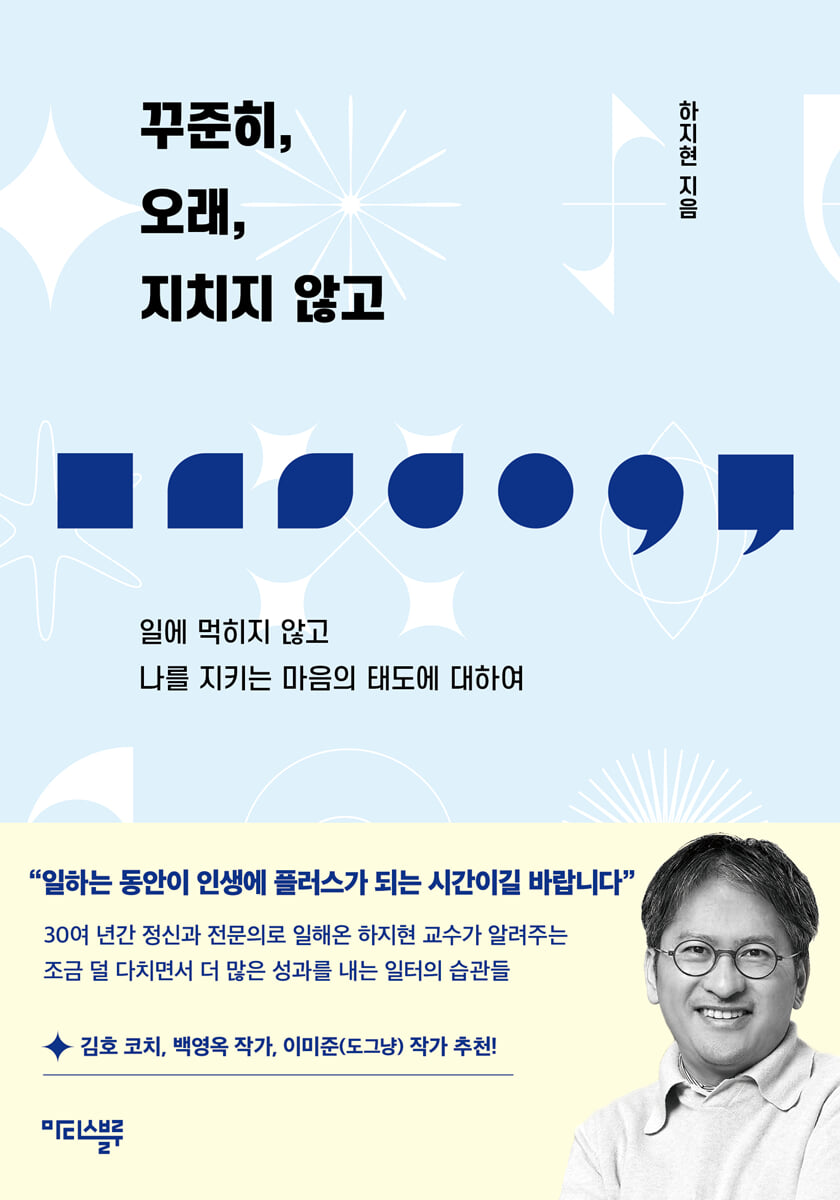
Steadily, for a long time, without tiring
 |
Description
Book Introduction
Without applying too much force, and without completely releasing it. How to work steadily for a long time without getting tired, rather than doing it well *Recommended by Coach Kim Ho, Writer Baek Young-ok, and Writer Lee Mi-jun (Dognyang)! Work is something we do out of necessity, and if we can avoid it, shouldn't we? But if we spend more than half our waking hours working, only to find it difficult and painful, how unhappy would that be? Author Ha Ji-hyun, who has spent over 30 years listening to patients' concerns and sharing their burden, draws on this awareness in her book, "Constantly, Long, and Tirelessly," to discuss the mindset needed to protect oneself and work for the many who have been hurt by their work. And it contains the experiences and insights he has gained over his long career as a psychiatrist, office worker, and writer. The basic principle for everyone is 'survival', and only after 'peace of mind' can one take on new challenges or move towards higher goals. Therefore, the most important thing is not to get tired, but to do it well. If you have to do it anyway, find a way to grow a little more during that time. This book presents the value of working 'steadily, for a long time, and tirelessly' and will be helpful to readers who want to grow themselves and achieve a balance between work and life. |
- You can preview some of the book's contents.
Preview
index
Prologue For all those who work, doing their part
Chapter 1: Will You Get Worked or Will You Get On?
The Self-Regulation of Wild Elephants│The Power of the Successful Mind│The Beginner's Mindset│What's More Important Than Optimality and Efficiency│What Should Be Done First: Important or Urgent?│The Trap of Finding the Exact Cause
Chapter 2: Working is also a part of my life.
Two Senses of Accepting Time│To Work Without Being Exhausted│The Invisible Power of Accumulation│Goals Can Always Be Revised│Work Becomes an Opportunity to Confirm My Existence
Chapter 3 Everyone Hits a Wall Sometimes
Four criteria for choosing a job│Getting out of the hole you made for yourself│Preventing burnout is the best way│The most rational way to make good choices│Why you need to coat your mind│Boreout, another reason for becoming apathetic│The misconception that you are the only victim
Chapter 4: I don't want to work, but I want to do it well.
The more you do, the higher the quality.│How to add skill to effort.│Smart planning from the beginning.│The power of a light bag.│To become someone people want to work with.│Things you must go through before moving on to intermediate level.
Chapter 5: Small Habits That Create My Own Space at Work
Become a person who is willing to give enough opportunities│Understanding my limits│Anger is not something to be 'expressed', but rather 'expressed'│Irritation is not the solution│Neutral mode of emotions│The trap of meritocracy│The know-how of 'every day, briefly, alone'│How to create good habits
Chapter 6: How to Respect My Heart
Can I get rid of anxiety? │Be generous to myself │My capacity for empathy is not infinite │Why more unfortunate things happen to me │How I console myself │Living within my own rhythm │The 60-point line for detecting crisis signals
Epilogue: Things I Wish I Knew in Advance
reference book
Chapter 1: Will You Get Worked or Will You Get On?
The Self-Regulation of Wild Elephants│The Power of the Successful Mind│The Beginner's Mindset│What's More Important Than Optimality and Efficiency│What Should Be Done First: Important or Urgent?│The Trap of Finding the Exact Cause
Chapter 2: Working is also a part of my life.
Two Senses of Accepting Time│To Work Without Being Exhausted│The Invisible Power of Accumulation│Goals Can Always Be Revised│Work Becomes an Opportunity to Confirm My Existence
Chapter 3 Everyone Hits a Wall Sometimes
Four criteria for choosing a job│Getting out of the hole you made for yourself│Preventing burnout is the best way│The most rational way to make good choices│Why you need to coat your mind│Boreout, another reason for becoming apathetic│The misconception that you are the only victim
Chapter 4: I don't want to work, but I want to do it well.
The more you do, the higher the quality.│How to add skill to effort.│Smart planning from the beginning.│The power of a light bag.│To become someone people want to work with.│Things you must go through before moving on to intermediate level.
Chapter 5: Small Habits That Create My Own Space at Work
Become a person who is willing to give enough opportunities│Understanding my limits│Anger is not something to be 'expressed', but rather 'expressed'│Irritation is not the solution│Neutral mode of emotions│The trap of meritocracy│The know-how of 'every day, briefly, alone'│How to create good habits
Chapter 6: How to Respect My Heart
Can I get rid of anxiety? │Be generous to myself │My capacity for empathy is not infinite │Why more unfortunate things happen to me │How I console myself │Living within my own rhythm │The 60-point line for detecting crisis signals
Epilogue: Things I Wish I Knew in Advance
reference book
Detailed image

Into the book
This is how I look at work now.
There are things I have learned through practicing and conducting research as a psychiatrist for quite some time, but these are also things I have experienced, realized, and naturally internalized as I live as a working person.
I've learned a lot through work, and my values have changed for the better.
And I believe that as my understanding of the world and people deepens, I also come to understand myself better.
I don't see my work time, which takes up the largest portion of my life, as a painful time, a minus time in my life that drains my energy.
I hope that while I'm working, this time can be a time that adds even a little bit to my life.
--- p.8, from "Prologue"
This contradiction is a characteristic of the concept of self-efficacy.
First, it is necessary to accomplish the 'basics', and after achieving those basics, you must make bold attempts.
Of course, if you go out there without thinking about your abilities, you could get hurt.
But if you think of it as a process of becoming more skilled while getting hurt, you will try again.
If you repeat this several times, your self-efficacy will be strengthened.
It's about changing the negative inner feedback of "I can't do it!" into positive feedback of "Let's give it a try!"
If you change things intentionally like this, you will eventually be left with the mindset that “I can do it.”
--- p.24, from “Chapter 1: Will You Be Eaten or Will You Get on Board?”
Work-life balance isn't about calculating my losses and gains by adding or subtracting a few hours.
It's about getting into the rhythm by adding or subtracting strength.
Even while working, we can feel closeness and affection toward someone and fully enjoy small pleasures, and conversely, even while resting, we can experience suffering and exhaustion.
If I, too, had lost trust in people while working and had not felt the joy of reward, I would not have wanted to connect work with my life.
However, after working for a long time, I sometimes have the opportunity to experience small pleasures more frequently than in everyday life, to confirm that I am alive and to positively recognize that I exist in this world.
--- p.76, from “Chapter 2: Working Me is a Part of My Life”
People don't work solely for financial rewards as much as you might think.
I want to grow through what I do.
But when you feel like there's nothing more to learn, you immediately feel bored and jaded.
It is not a good attitude to always feel inadequate and not have confidence in what you do.
But the moment you feel that you have reached a point where there is no more growth, you feel boredom rather than satisfaction.
That's human psychology.
So it's more difficult.
Work needs meaning.
Why I do this work, what kind of rewards I feel, whether I can experience life through my work, and whether it can be a source of joy are important to continuing my work.
And I gain strength when I can face and overcome difficulties or challenges, which can be an opportunity to confirm my presence and the power of my self.
--- p.113, from “Chapter 3 Everyone Hits a Wall Sometimes”
Most beginners feel unprepared and are afraid of failure.
One failure can be disheartening and cause you to hesitate before starting again.
Then, you become more nervous, make mistakes, and compare yourself to others, which makes you more likely to fail.
In times like these, the role of seniors or teachers is important.
“First, make a good plan and visualize how well you can make it so you don’t make mistakes.”
“Just try a lot.
It's okay to fail and make mistakes.
Then you can do it again right away.”
Both are good advice.
But looking back after half a year has passed, the latter advice will be more effective than the former.
The most important thing is to try a lot.
And you have to endure mistakes, failures, and the frustrations and shame that come with them.
Seniors and superiors, as well as those who are new to this job, must have a firm mindset to accept mistakes and failures as natural and try as much as possible first.
--- pp.129-130, from “Chapter 4: I Don’t Want to Work, but I Want to Do It Well”
Saying no or refusing is my right and duty to protect myself.
If you hold it in and then suddenly burst into tears, scream, or resign, others might think, “You must have had a hard time,” and understand, but in general, you’ll just hear, “Why is he acting like that?”
People don't really care about other people.
Most people only know the person's usual attitude and reactions, but few have empathized with how much that person has suffered.
So, usually, expressing my feelings little by little and talking about injustice is the way to protect myself.
--- p.181, from “Chapter 5: Small Habits for Creating My Own Space at Work”
Let's say to ourselves, "This is okay" or "I tried."
Once you understand and realize that it wasn't that difficult and painful, the painful feelings that arise within you will no longer be something you want to avoid.
And let's be generous to myself for forcing me to experience such feelings.
Shouldn't the person who treats me best be me?
Of course, it is not an easy task.
Honestly, I find it hard to be generous to myself.
There are more days when I force myself to do things I don't want to do because I think I need to train myself than days when I do everything with ease.
There are more days when I feel regretful and inadequate than days when I am satisfied and proud.
On days like that, I have to make an effort to pull myself together.
Avoiding getting bogged down in guilt, shame, and self-deprecation is a way to avoid getting stuck in emotions that don't serve me.
These efforts do not hold me back, but rather save me.
--- pp.222-223, from “Chapter 6 How to Respect My Heart”
We struggle to work and survive on an unfair and uneven playing field.
If you do that, you are bound to get hurt and tired.
At this time, we see that the harder a person is on himself, the more he works hard.
This is the case for self-made people and those who have achieved success through hard work in tight organizations.
But if you have that kind of mindset, it's hard to be satisfied with yourself, and you're always likely to feel like you're lacking.
So what should I do
Even if I do it, I don't like it.
I always experience conflict with myself.
It's common to blame yourself and be self-deprecating.
It cannot be denied that this aspect can be a driving force in life, but if you only use it as your life energy, even if you succeed, your anxious feelings will not go away.
So, more than anything, I want to be good to myself.
There are things I have learned through practicing and conducting research as a psychiatrist for quite some time, but these are also things I have experienced, realized, and naturally internalized as I live as a working person.
I've learned a lot through work, and my values have changed for the better.
And I believe that as my understanding of the world and people deepens, I also come to understand myself better.
I don't see my work time, which takes up the largest portion of my life, as a painful time, a minus time in my life that drains my energy.
I hope that while I'm working, this time can be a time that adds even a little bit to my life.
--- p.8, from "Prologue"
This contradiction is a characteristic of the concept of self-efficacy.
First, it is necessary to accomplish the 'basics', and after achieving those basics, you must make bold attempts.
Of course, if you go out there without thinking about your abilities, you could get hurt.
But if you think of it as a process of becoming more skilled while getting hurt, you will try again.
If you repeat this several times, your self-efficacy will be strengthened.
It's about changing the negative inner feedback of "I can't do it!" into positive feedback of "Let's give it a try!"
If you change things intentionally like this, you will eventually be left with the mindset that “I can do it.”
--- p.24, from “Chapter 1: Will You Be Eaten or Will You Get on Board?”
Work-life balance isn't about calculating my losses and gains by adding or subtracting a few hours.
It's about getting into the rhythm by adding or subtracting strength.
Even while working, we can feel closeness and affection toward someone and fully enjoy small pleasures, and conversely, even while resting, we can experience suffering and exhaustion.
If I, too, had lost trust in people while working and had not felt the joy of reward, I would not have wanted to connect work with my life.
However, after working for a long time, I sometimes have the opportunity to experience small pleasures more frequently than in everyday life, to confirm that I am alive and to positively recognize that I exist in this world.
--- p.76, from “Chapter 2: Working Me is a Part of My Life”
People don't work solely for financial rewards as much as you might think.
I want to grow through what I do.
But when you feel like there's nothing more to learn, you immediately feel bored and jaded.
It is not a good attitude to always feel inadequate and not have confidence in what you do.
But the moment you feel that you have reached a point where there is no more growth, you feel boredom rather than satisfaction.
That's human psychology.
So it's more difficult.
Work needs meaning.
Why I do this work, what kind of rewards I feel, whether I can experience life through my work, and whether it can be a source of joy are important to continuing my work.
And I gain strength when I can face and overcome difficulties or challenges, which can be an opportunity to confirm my presence and the power of my self.
--- p.113, from “Chapter 3 Everyone Hits a Wall Sometimes”
Most beginners feel unprepared and are afraid of failure.
One failure can be disheartening and cause you to hesitate before starting again.
Then, you become more nervous, make mistakes, and compare yourself to others, which makes you more likely to fail.
In times like these, the role of seniors or teachers is important.
“First, make a good plan and visualize how well you can make it so you don’t make mistakes.”
“Just try a lot.
It's okay to fail and make mistakes.
Then you can do it again right away.”
Both are good advice.
But looking back after half a year has passed, the latter advice will be more effective than the former.
The most important thing is to try a lot.
And you have to endure mistakes, failures, and the frustrations and shame that come with them.
Seniors and superiors, as well as those who are new to this job, must have a firm mindset to accept mistakes and failures as natural and try as much as possible first.
--- pp.129-130, from “Chapter 4: I Don’t Want to Work, but I Want to Do It Well”
Saying no or refusing is my right and duty to protect myself.
If you hold it in and then suddenly burst into tears, scream, or resign, others might think, “You must have had a hard time,” and understand, but in general, you’ll just hear, “Why is he acting like that?”
People don't really care about other people.
Most people only know the person's usual attitude and reactions, but few have empathized with how much that person has suffered.
So, usually, expressing my feelings little by little and talking about injustice is the way to protect myself.
--- p.181, from “Chapter 5: Small Habits for Creating My Own Space at Work”
Let's say to ourselves, "This is okay" or "I tried."
Once you understand and realize that it wasn't that difficult and painful, the painful feelings that arise within you will no longer be something you want to avoid.
And let's be generous to myself for forcing me to experience such feelings.
Shouldn't the person who treats me best be me?
Of course, it is not an easy task.
Honestly, I find it hard to be generous to myself.
There are more days when I force myself to do things I don't want to do because I think I need to train myself than days when I do everything with ease.
There are more days when I feel regretful and inadequate than days when I am satisfied and proud.
On days like that, I have to make an effort to pull myself together.
Avoiding getting bogged down in guilt, shame, and self-deprecation is a way to avoid getting stuck in emotions that don't serve me.
These efforts do not hold me back, but rather save me.
--- pp.222-223, from “Chapter 6 How to Respect My Heart”
We struggle to work and survive on an unfair and uneven playing field.
If you do that, you are bound to get hurt and tired.
At this time, we see that the harder a person is on himself, the more he works hard.
This is the case for self-made people and those who have achieved success through hard work in tight organizations.
But if you have that kind of mindset, it's hard to be satisfied with yourself, and you're always likely to feel like you're lacking.
So what should I do
Even if I do it, I don't like it.
I always experience conflict with myself.
It's common to blame yourself and be self-deprecating.
It cannot be denied that this aspect can be a driving force in life, but if you only use it as your life energy, even if you succeed, your anxious feelings will not go away.
So, more than anything, I want to be good to myself.
--- p.252, from "Epilogue"
Publisher's Review
“I hope that working will be a positive experience for your life.”
Professor Ha Ji-Hyeon, who has been working as a psychiatrist for over 30 years, explains
Workplace Habits That Help You Get More Done With Less Injury
We were not born into this world to work, but if we want to live our lives doing our part in this world, we all have to work.
We have no choice but to work in order to support ourselves.
Although work plays a large role in our lives, whether we like it or not, many people feel unhappy because of their work.
This is because they either work too hard and burn out, or they find their work too burdensome and dislike it, and that is why they feel like their life is in ruins.
On the one hand, I have this contradictory feeling that I want to do better at what I'm doing anyway and grow both career-wise and as a person through my work.
As a psychiatrist and writer for over 30 years, Ha Ji-hyun has met many patients who have confided in her about their work-related anxieties and difficulties, and has been asked many questions about work.
“Am I going to die from working like this?” “Should I keep doing this repetitive, boring work?” “I hate this job so much, should I quit and find something else?” As an office worker who has worked at one job for a long time and faced similar concerns, the author has now found some answers to these questions.
This book, "Constantly, Long-Term, and Untiringly," contains the author's experiences and insights into the attitude of mind that protects oneself while working.
I don't want to work but I want to do well, I have to work but I want to quit
A special prescription for all working people full of self-contradiction.
“No matter what you do, the anxiety doesn’t go away until you start doing it and become proficient at it.
Happiness is fleeting and there are more painful and anxious things to come.
And it took me quite a while to understand that it wasn't a problem with my abilities, it was just the way things were.” (From the text)
Author Ha Ji-hyun says that working tirelessly is more important than doing well.
If you try too hard to do well, you will end up exceeding your limits and using up all your energy at once, and you will not be able to work consistently for a long time.
You can work without exhausting yourself by working at an appropriate level, without putting in too much effort or taking too little effort.
And to become proficient at something, you must go through a process of boring and repetitive tasks, and it is not easy to endure that period.
However, as the invisible accumulation of time builds up, you must pass that stage before you can grow a little more.
He also points out that it is a dangerous perception to perceive work itself too negatively and think that putting too much energy into it is a loss.
This is because the 'me' that works, the 'me' that rests, and the 'me' that plays do not exist exclusively, but are all 'me's' with a single identity.
And work is extremely important in creating one's own identity.
The author explains work and self-esteem as follows:
“Through work, I confirm my self-esteem.
And this is the foundation of healthy self-esteem.
You don't have to like your work, but you don't want to feel like you're forcing yourself to do it.
“When I define myself by the things I do, I begin to view the most important parts of my life negatively and evaluate my current life negatively.” (Excerpt from the text)
“Above all else, I will be generous to myself.”
Things I wish I had known in advance
『Constantly, Long-Term, and Tirelessly』 also contains detailed and practical methods to work more efficiently and with less injury.
Chapter 1, “Will I be consumed by work or will I rise above it?” discusses what priorities should be prioritized in order to avoid being overwhelmed by work, and Chapter 2, “Working is also a part of my life,” explains how to accept “work,” which creates my identity.
Chapter 3, "Everyone Hits a Wall Sometimes," discusses how to prepare for and avoid difficulties encountered at work, such as burnout and boreout.
Chapter 4, "I don't want to work, but I want to do it well," and Chapter 5, "Small habits that create my own territory at work," cover how to work more efficiently by adding tricks to your efforts and how to control your emotions at work.
The final chapter, Chapter 6, "How to Respect Your Heart," encourages us to look at ourselves with warm and compassionate eyes, rather than being too harsh or critical of ourselves.
In the epilogue, author Ha Ji-hyun shares with readers five pieces of advice she has learned through her long experience as a psychiatrist and writer.
'I will be on better terms with you than anyone else', 'Everyone has their own assets', 'I need to have the mindset that I am not a great person', 'Create a role model', 'Let go of the thought that 'Why does this only happen to me?' Reading up to this point will be a great help in growing yourself as a worker and the master of your own life.
Professor Ha Ji-Hyeon, who has been working as a psychiatrist for over 30 years, explains
Workplace Habits That Help You Get More Done With Less Injury
We were not born into this world to work, but if we want to live our lives doing our part in this world, we all have to work.
We have no choice but to work in order to support ourselves.
Although work plays a large role in our lives, whether we like it or not, many people feel unhappy because of their work.
This is because they either work too hard and burn out, or they find their work too burdensome and dislike it, and that is why they feel like their life is in ruins.
On the one hand, I have this contradictory feeling that I want to do better at what I'm doing anyway and grow both career-wise and as a person through my work.
As a psychiatrist and writer for over 30 years, Ha Ji-hyun has met many patients who have confided in her about their work-related anxieties and difficulties, and has been asked many questions about work.
“Am I going to die from working like this?” “Should I keep doing this repetitive, boring work?” “I hate this job so much, should I quit and find something else?” As an office worker who has worked at one job for a long time and faced similar concerns, the author has now found some answers to these questions.
This book, "Constantly, Long-Term, and Untiringly," contains the author's experiences and insights into the attitude of mind that protects oneself while working.
I don't want to work but I want to do well, I have to work but I want to quit
A special prescription for all working people full of self-contradiction.
“No matter what you do, the anxiety doesn’t go away until you start doing it and become proficient at it.
Happiness is fleeting and there are more painful and anxious things to come.
And it took me quite a while to understand that it wasn't a problem with my abilities, it was just the way things were.” (From the text)
Author Ha Ji-hyun says that working tirelessly is more important than doing well.
If you try too hard to do well, you will end up exceeding your limits and using up all your energy at once, and you will not be able to work consistently for a long time.
You can work without exhausting yourself by working at an appropriate level, without putting in too much effort or taking too little effort.
And to become proficient at something, you must go through a process of boring and repetitive tasks, and it is not easy to endure that period.
However, as the invisible accumulation of time builds up, you must pass that stage before you can grow a little more.
He also points out that it is a dangerous perception to perceive work itself too negatively and think that putting too much energy into it is a loss.
This is because the 'me' that works, the 'me' that rests, and the 'me' that plays do not exist exclusively, but are all 'me's' with a single identity.
And work is extremely important in creating one's own identity.
The author explains work and self-esteem as follows:
“Through work, I confirm my self-esteem.
And this is the foundation of healthy self-esteem.
You don't have to like your work, but you don't want to feel like you're forcing yourself to do it.
“When I define myself by the things I do, I begin to view the most important parts of my life negatively and evaluate my current life negatively.” (Excerpt from the text)
“Above all else, I will be generous to myself.”
Things I wish I had known in advance
『Constantly, Long-Term, and Tirelessly』 also contains detailed and practical methods to work more efficiently and with less injury.
Chapter 1, “Will I be consumed by work or will I rise above it?” discusses what priorities should be prioritized in order to avoid being overwhelmed by work, and Chapter 2, “Working is also a part of my life,” explains how to accept “work,” which creates my identity.
Chapter 3, "Everyone Hits a Wall Sometimes," discusses how to prepare for and avoid difficulties encountered at work, such as burnout and boreout.
Chapter 4, "I don't want to work, but I want to do it well," and Chapter 5, "Small habits that create my own territory at work," cover how to work more efficiently by adding tricks to your efforts and how to control your emotions at work.
The final chapter, Chapter 6, "How to Respect Your Heart," encourages us to look at ourselves with warm and compassionate eyes, rather than being too harsh or critical of ourselves.
In the epilogue, author Ha Ji-hyun shares with readers five pieces of advice she has learned through her long experience as a psychiatrist and writer.
'I will be on better terms with you than anyone else', 'Everyone has their own assets', 'I need to have the mindset that I am not a great person', 'Create a role model', 'Let go of the thought that 'Why does this only happen to me?' Reading up to this point will be a great help in growing yourself as a worker and the master of your own life.
GOODS SPECIFICS
- Date of issue: August 20, 2024
- Page count, weight, size: 260 pages | 382g | 140*200*18mm
- ISBN13: 9791197993442
- ISBN10: 1197993444
You may also like
카테고리
korean


korean

![GQ KOREA Mark (Monthly): December [2025]](http://librairie.coreenne.fr/cdn/shop/files/8ef265dbbfbf186523ed75ba7319009d.jpg?v=1765340328&width=3840)


