

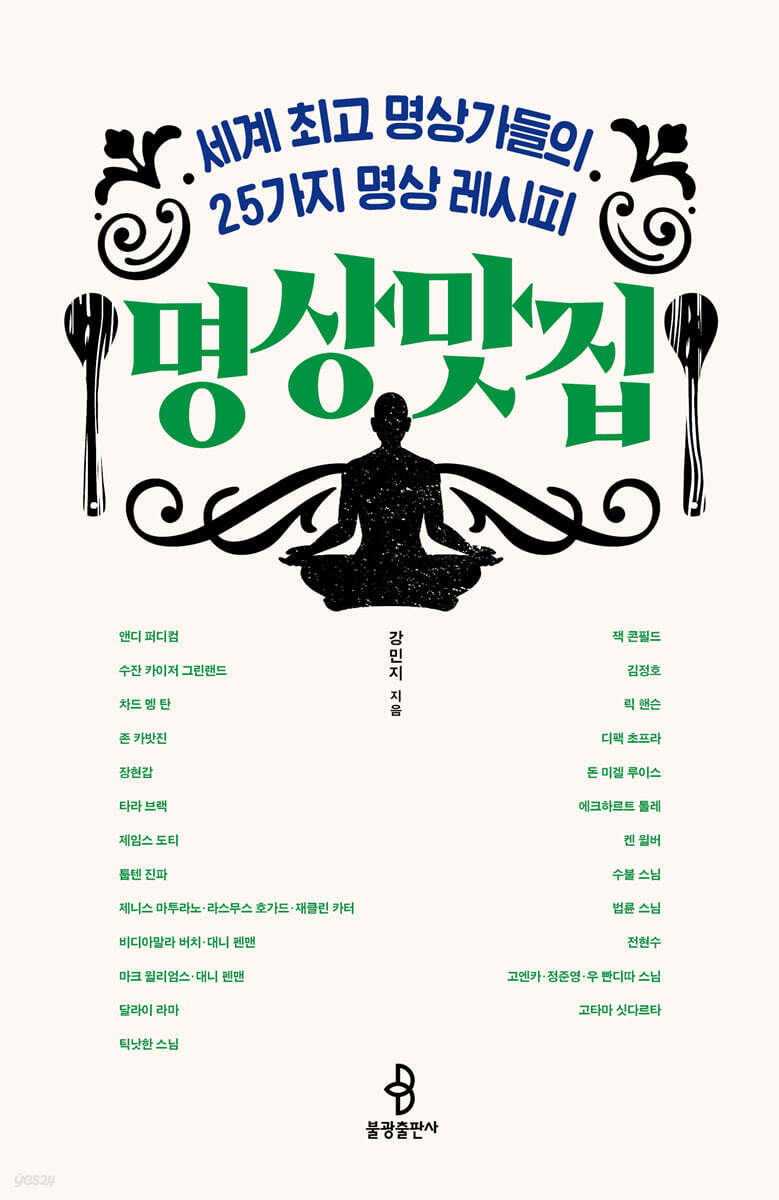
Meditation Restaurant
 |
Description
Book Introduction
'Everyone says meditation is good, but I'm just starting out and I don't know what to do.' For those of you who are lost in the world of overflowing meditation 'The Michelin Guide to Meditation'! "Meditation" has long since moved beyond the category of religious practice. Celebrities appear on TV programs practicing yoga meditation, and temple stays, often labeled as "healing meditation," are gaining recognition. Countless people from all walks of life, including world-renowned celebrities, influencers, and athletes, are engrossed in meditation and cite its benefits. In addition, the topic of meditation has grown even more as academic fields such as brain science and psychology have reported that meditation has a positive effect on our bodies. Meditation, which has attracted the interest of the general public, has reached a saturation point as it has become more popular. The flood of meditations can be toxic to novice meditators who are just beginning to take an interest. Because not all meditations are helpful even if you try them blindly. It is important to understand the differences between each meditation and what kind of meditation you need right now. The book you should open at this time is “Meditation Restaurant.” Just as 'good food' doesn't simply mean expensive and precious food, but rather food that our bodies need, the same goes for meditation. The author studied meditation around the world and conducted various meetings to understand what beginners really need. "Meditation Restaurant" compares and analyzes world-renowned meditators and their meditation methods, providing an easy-to-understand explanation of their differences and the situations in which they might be appropriate to practice. Let's begin a journey to discover your own taste by tasting the signature meditations presented before your eyes. |
- You can preview some of the book's contents.
Preview
index
Starting the appetizer meditation restaurant tour
Andy Puddicombe Do Nothing
Susan Kaiser's Greenland Imagination Zip-Up
Chad Meng Tan: Focus on your breathing for 2 minutes
Jon Kabat-Zinn's Raisin-Eating Meditation
Jang Hyun-gap Relaxation Meditation (feat.
Mantra)
Tara Brach: Recognizing Trans Weakness
James Doty makes his intentions clear
Topten Jinpa Loving-Kindness & Compassion Meditation
Mindfulness Meetings by Janice Maturano, Rasmus Hoggard, and Jacqueline Carter
Vidyamala Birch and Danny Penman's Joy Treasure Meditation
Mark Williams and Danny Penman: Recalling Specific Events from Words
Dalai Lama Healthy Skepticism
Thich Nhat Hanh: Look at your children like you look at a tree
Jack Kornfield on Recognizing His Own Personality Type
Kim Jeong-ho's deconditioning
Rick Hanson: Leaving More Positive Experiences in Your Nervous System
Deepak Chopra's Body in Consciousness
Don Miguel Ruiz's Four Promises
Eckhart Tolle Live in the Moment
Ken Wilber, the Watcher of All Things
Subul monk's Ganhwaseon (hwadu meditation)
The Enlightenment of Monk Beopryun
Jeon Hyun-soo selected (Samata)
Vipassana by Goenka, Jung Joon-young, and Venerable U Pandita
Siddhartha Gautama's Eightfold Path
Meditation Restaurant Dessert
Goodbye Kit
Finishing the meditation restaurant tour on the way home
References
Andy Puddicombe Do Nothing
Susan Kaiser's Greenland Imagination Zip-Up
Chad Meng Tan: Focus on your breathing for 2 minutes
Jon Kabat-Zinn's Raisin-Eating Meditation
Jang Hyun-gap Relaxation Meditation (feat.
Mantra)
Tara Brach: Recognizing Trans Weakness
James Doty makes his intentions clear
Topten Jinpa Loving-Kindness & Compassion Meditation
Mindfulness Meetings by Janice Maturano, Rasmus Hoggard, and Jacqueline Carter
Vidyamala Birch and Danny Penman's Joy Treasure Meditation
Mark Williams and Danny Penman: Recalling Specific Events from Words
Dalai Lama Healthy Skepticism
Thich Nhat Hanh: Look at your children like you look at a tree
Jack Kornfield on Recognizing His Own Personality Type
Kim Jeong-ho's deconditioning
Rick Hanson: Leaving More Positive Experiences in Your Nervous System
Deepak Chopra's Body in Consciousness
Don Miguel Ruiz's Four Promises
Eckhart Tolle Live in the Moment
Ken Wilber, the Watcher of All Things
Subul monk's Ganhwaseon (hwadu meditation)
The Enlightenment of Monk Beopryun
Jeon Hyun-soo selected (Samata)
Vipassana by Goenka, Jung Joon-young, and Venerable U Pandita
Siddhartha Gautama's Eightfold Path
Meditation Restaurant Dessert
Goodbye Kit
Finishing the meditation restaurant tour on the way home
References
Detailed image

Into the book
We've prepared a meditation buffet with the hope that you'll gain a taste of meditation levels 1-4, gain a broader understanding of the bigger picture, and find a meditation method that suits your tastes.
Although it's not my style right now, I hope that someday, when circumstances change and my tastes evolve, I can use it as a meditation guide to look back on and say, "What kind of meditation was there?"
--- p.14
If we think about why we meditate, the specific goals may vary—health, relaxation, peace, improved concentration, enlightenment—but if there's one common reason, it's the desire to change our current lives in some way.
However, despite the desire to start meditating, there are times when thoughts like, "I don't know how to do this," or "Is this really effective?" arise, and you don't even try meditating.
This is exactly when Andy is needed.
--- p.19
In the process of teaching meditation, there are often cases where only 'concentration', 'being calm', and 'seeing' are emphasized, but the unique feature and advantage of this book is that it introduces 'seeing anew', 'caring', and 'connecting' as the goals and results of meditation.
--- p.32
“People ask me,
Why is mindfulness so popular in Silicon Valley? First, it works.
Even if it's just 6 seconds.
The more you do it, the more effective it is.
It's like when you exercise your muscles a lot, they get stronger.
The second reason is that it changes our lives.
Just as a change from poor health to healthy health changes every aspect of your life, mindfulness, fitness for the mind, also changes every aspect of your life.”
--- p.39
The various 'thoughts or judgments' that arise during meditation are similar to the 'commentary' heard during a sports broadcast on TV.
Just as turning the TV volume down completely allows you to watch the game from a new perspective, the direct attention and observation we engage in meditation gives us the opportunity to see and understand our bodies and minds from a new perspective.
--- p.48
The 'relaxation response' refers to a series of bodily states that occur when the mind is calm, including a decrease in heart rate, a decrease in breathing rate, a drop in blood pressure, a slowdown in brain waves, and a decrease in metabolism.
So the relaxation response has the effect of breaking the vicious cycle of stress-induced harmful physical states such as anxiety, depression, and anger.
Meditation stimulates endocrine gland activity and activates the parasympathetic nervous system, which induces a relaxation response and brings peace to the body and mind.
--- p.58
Jinpa also gets hurt and hurts in his relationships with people, but when that happens, he tries to understand where his emotions come from.
Most emotional pain comes from disappointment, and disappointment occurs when expectations are not met.
Understanding your own feelings makes it much easier to deal with pain.
Opening your heart can be a path to becoming more vulnerable, but it can also be a path to greater experience, learning, and wisdom.
--- p.90
If you convert meeting time into money, it becomes quite expensive because you have to add up the hourly wages of all the attendees.
The desire to hold efficient and productive meetings is something that almost every office worker desires.
If you adopt the mindfulness meeting method recommended by Janice, you may gain completely new perspectives and ideas that are different from the meetings you've been holding so far.
--- p.102
Burpen's book is one of the most compassionate meditation books I've ever read.
It shows good and bad examples of sitting and lying meditation postures with pictures, and explains in detail the meditation program of 10 to 20 minutes a day, 6 days a week for 8 weeks, so that you can follow it just by reading the book.
--- p.114
Are there activities you frequently engage in that you lose track of time while doing, only to often regret afterward? Many people would cite excessive drinking, smoking, gaming, YouTube, TV, and social media as examples of these addictive habits.
Mapen's 8-week program outlines several specific activities to help you break your habits.
--- p.127
I think the ultimate reason we meditate is to discover and achieve what we truly want.
Have you ever thought about what you truly want to do? What kind of daily routine are you living to achieve it?
--- p.141
I'll just give you a taste of what happens when each temperament grows and changes.
The obsessive nature seeks out the good in people and transforms one's home and community into a place of material and spiritual harmony, creating 'beauty' and 'abundance'.
The temperament that was once hated has 'discernment' and 'clarity' and creatively resolves conflicts.
The foolish temperament gains 'calmness' and 'understanding' by asking questions with innocence and beginner's mind.
--- p.158
Chopra says it's most effective to begin the practice in the body, not the mind, because most people experience themselves as existing within a physical body.
When you stop seeing the body as a collection of flesh and bones and start seeing it as a form of consciousness, many changes occur. Now you see why I called him radical.
--- p.183
By thoroughly understanding and realizing that a life centered on the ego may seem good in the short term, but ultimately causes suffering to both ourselves and others, we become spiritual humans who live a different way (acceptance, joy, and passion).
The most effective way to avoid the ego trap is to live in the present moment, that is, through meditation.
Rather than recommending a specific meditation technique, Tolle kindly and consistently explains the ego and the egoless life to help us understand it.
Why is there so much emphasis on the ‘now’ in meditation?
--- p.203
When the goals of meditation and life are interlocked like cogwheels, both meditation and life will support each other and function well.
If meditation helps you achieve your life goals, a virtuous cycle is created in which you meditate even harder to achieve your life goals.
Before you begin meditating, it's a good idea to deeply reflect on your reason for meditating (your goal) and your ultimate goal in life, and also find the point where those two goals connect.
Although it's not my style right now, I hope that someday, when circumstances change and my tastes evolve, I can use it as a meditation guide to look back on and say, "What kind of meditation was there?"
--- p.14
If we think about why we meditate, the specific goals may vary—health, relaxation, peace, improved concentration, enlightenment—but if there's one common reason, it's the desire to change our current lives in some way.
However, despite the desire to start meditating, there are times when thoughts like, "I don't know how to do this," or "Is this really effective?" arise, and you don't even try meditating.
This is exactly when Andy is needed.
--- p.19
In the process of teaching meditation, there are often cases where only 'concentration', 'being calm', and 'seeing' are emphasized, but the unique feature and advantage of this book is that it introduces 'seeing anew', 'caring', and 'connecting' as the goals and results of meditation.
--- p.32
“People ask me,
Why is mindfulness so popular in Silicon Valley? First, it works.
Even if it's just 6 seconds.
The more you do it, the more effective it is.
It's like when you exercise your muscles a lot, they get stronger.
The second reason is that it changes our lives.
Just as a change from poor health to healthy health changes every aspect of your life, mindfulness, fitness for the mind, also changes every aspect of your life.”
--- p.39
The various 'thoughts or judgments' that arise during meditation are similar to the 'commentary' heard during a sports broadcast on TV.
Just as turning the TV volume down completely allows you to watch the game from a new perspective, the direct attention and observation we engage in meditation gives us the opportunity to see and understand our bodies and minds from a new perspective.
--- p.48
The 'relaxation response' refers to a series of bodily states that occur when the mind is calm, including a decrease in heart rate, a decrease in breathing rate, a drop in blood pressure, a slowdown in brain waves, and a decrease in metabolism.
So the relaxation response has the effect of breaking the vicious cycle of stress-induced harmful physical states such as anxiety, depression, and anger.
Meditation stimulates endocrine gland activity and activates the parasympathetic nervous system, which induces a relaxation response and brings peace to the body and mind.
--- p.58
Jinpa also gets hurt and hurts in his relationships with people, but when that happens, he tries to understand where his emotions come from.
Most emotional pain comes from disappointment, and disappointment occurs when expectations are not met.
Understanding your own feelings makes it much easier to deal with pain.
Opening your heart can be a path to becoming more vulnerable, but it can also be a path to greater experience, learning, and wisdom.
--- p.90
If you convert meeting time into money, it becomes quite expensive because you have to add up the hourly wages of all the attendees.
The desire to hold efficient and productive meetings is something that almost every office worker desires.
If you adopt the mindfulness meeting method recommended by Janice, you may gain completely new perspectives and ideas that are different from the meetings you've been holding so far.
--- p.102
Burpen's book is one of the most compassionate meditation books I've ever read.
It shows good and bad examples of sitting and lying meditation postures with pictures, and explains in detail the meditation program of 10 to 20 minutes a day, 6 days a week for 8 weeks, so that you can follow it just by reading the book.
--- p.114
Are there activities you frequently engage in that you lose track of time while doing, only to often regret afterward? Many people would cite excessive drinking, smoking, gaming, YouTube, TV, and social media as examples of these addictive habits.
Mapen's 8-week program outlines several specific activities to help you break your habits.
--- p.127
I think the ultimate reason we meditate is to discover and achieve what we truly want.
Have you ever thought about what you truly want to do? What kind of daily routine are you living to achieve it?
--- p.141
I'll just give you a taste of what happens when each temperament grows and changes.
The obsessive nature seeks out the good in people and transforms one's home and community into a place of material and spiritual harmony, creating 'beauty' and 'abundance'.
The temperament that was once hated has 'discernment' and 'clarity' and creatively resolves conflicts.
The foolish temperament gains 'calmness' and 'understanding' by asking questions with innocence and beginner's mind.
--- p.158
Chopra says it's most effective to begin the practice in the body, not the mind, because most people experience themselves as existing within a physical body.
When you stop seeing the body as a collection of flesh and bones and start seeing it as a form of consciousness, many changes occur. Now you see why I called him radical.
--- p.183
By thoroughly understanding and realizing that a life centered on the ego may seem good in the short term, but ultimately causes suffering to both ourselves and others, we become spiritual humans who live a different way (acceptance, joy, and passion).
The most effective way to avoid the ego trap is to live in the present moment, that is, through meditation.
Rather than recommending a specific meditation technique, Tolle kindly and consistently explains the ego and the egoless life to help us understand it.
Why is there so much emphasis on the ‘now’ in meditation?
--- p.203
When the goals of meditation and life are interlocked like cogwheels, both meditation and life will support each other and function well.
If meditation helps you achieve your life goals, a virtuous cycle is created in which you meditate even harder to achieve your life goals.
Before you begin meditating, it's a good idea to deeply reflect on your reason for meditating (your goal) and your ultimate goal in life, and also find the point where those two goals connect.
--- p.263
Publisher's Review
In a society steeped in fatigue, I discovered 'meditation' as a solution instead of exhausting myself.
Why should we pay attention to meditation?
Meditation, which goes beyond the framework of religious self-practice, is becoming increasingly important in modern society.
Meditation is not only being practiced by people from all walks of life, including celebrities, influencers, athletes, and global corporations, but it has also expanded into everyday life, connecting with the interests of the general public, such as stress relief, increased work efficiency, and parenting programs.
But why are we so obsessed with 'meditation'?
Modern life is filled with fatigue.
In our fast-paced lives, we don't even have time to take care of ourselves.
Sometimes, I try to forget the hardships of reality for a moment by using my smartphone, playing games, watching videos, drinking, smoking, or other entertainment, but the more I do this, the more empty and listless my heart becomes.
This exhausting method of coping has led to increased psychological depression, and research has even shown that the entire society is suffering from depression and anxiety.
Meditation is gaining attention as a new keyword to solve these social problems.
There is particular interest in the field of brain science, and it has been proven that meditation stimulates the prefrontal cortex and brings about positive changes throughout our body.
In countries around the world, including this one, meditation and medicine have been combined, and meditation has been found to be effective in treating chronic pain, including depression, and in maintaining health without relying on medication.
In addition, meditation has begun to show effectiveness in increasing concentration and creativity in various fields such as education and sports.
When you are wondering if there is a way to taste the essence of overflowing meditation,
Open up a single book, the Michelin Guide to Meditation!
As meditation has been proven to be effective for our bodies, the meditation market has grown rapidly.
However, with the emergence of numerous meditation methods and programs, the current meditation market has become saturated, making it easy for beginners to get lost.
While browsing the internet and bookstores offers a wealth of meditation resources, the sheer volume of content makes it difficult to select just the ones you need.
Beginners, in particular, can quickly become tired of endless meditation stories, or become so fixated on one thing that they can go down the wrong path.
The best way is to find a meditation method that suits your lifestyle, personality, and physical and mental state, but this is difficult for a beginner to do with their clumsy hands.
The book that will solve this problem faced by beginner meditators is “Meditation Restaurant.”
This book is a sieve where the author, on behalf of the reader, searches for proven and trustworthy meditators.
This book introduces world-renowned meditators such as Jack Kornfield, Tara Brach, and Andy Puddicombe and their representative meditation methods, and provides a friendly explanation of which meditation methods are best practiced by which person and in which situation.
For example, if you are new to meditation, we recommend meditation that allows you to experience the feeling of 'doing nothing', and for modern people who are pressed for time, we recommend meditation that can be done during a short time while waiting for the subway.
It also contains a variety of meditation methods for mental health, such as meditation to improve work efficiency and prevent depression.
You can read them in the order listed, or you can start with the twenty-five meditations listed in the table of contents and read them in any order that interests you.
It is enough to simply taste the meditation methods the author personally developed and the stories of the meditators who struggled to create them.
From mild to spicy, from meditation beginners to experienced practitioners
The Taste of Meditation Learned at Different Levels
The author deeply understands the struggles faced by those who have just begun to meditate.
Through personally learning meditation at the Korea Meditation Instructors Association and conducting various meditation meetings with various people, the author quickly identified the problems faced by both beginners and experienced meditators.
This book is a guide that contains the author's accumulated experience and is a meditation review that provides tips one step ahead.
This text meticulously analyzes and selects meditators who have established the basic framework of meditation in various fields, including neuroscience, alternative medicine, psychology, and religious studies, and introduces them to us.
It ranges from accessible meditation techniques for beginners to try in their daily lives, to thought experiments that will give experienced practitioners new ideas.
In addition, the 'Meditation Restaurant Dessert' and 'Goodbye Kit' provided as appendices provide readers with guidance on how to proceed so that they can go beyond simply reading the book and establish their own meditation group.
Through this, readers gain the perspective to study and challenge meditation on their own and become their own 'meditation chef'.
"Meditation Restaurant" doesn't stop at introducing meditation; it also provides next-level meditation options for new challenges.
Why should we pay attention to meditation?
Meditation, which goes beyond the framework of religious self-practice, is becoming increasingly important in modern society.
Meditation is not only being practiced by people from all walks of life, including celebrities, influencers, athletes, and global corporations, but it has also expanded into everyday life, connecting with the interests of the general public, such as stress relief, increased work efficiency, and parenting programs.
But why are we so obsessed with 'meditation'?
Modern life is filled with fatigue.
In our fast-paced lives, we don't even have time to take care of ourselves.
Sometimes, I try to forget the hardships of reality for a moment by using my smartphone, playing games, watching videos, drinking, smoking, or other entertainment, but the more I do this, the more empty and listless my heart becomes.
This exhausting method of coping has led to increased psychological depression, and research has even shown that the entire society is suffering from depression and anxiety.
Meditation is gaining attention as a new keyword to solve these social problems.
There is particular interest in the field of brain science, and it has been proven that meditation stimulates the prefrontal cortex and brings about positive changes throughout our body.
In countries around the world, including this one, meditation and medicine have been combined, and meditation has been found to be effective in treating chronic pain, including depression, and in maintaining health without relying on medication.
In addition, meditation has begun to show effectiveness in increasing concentration and creativity in various fields such as education and sports.
When you are wondering if there is a way to taste the essence of overflowing meditation,
Open up a single book, the Michelin Guide to Meditation!
As meditation has been proven to be effective for our bodies, the meditation market has grown rapidly.
However, with the emergence of numerous meditation methods and programs, the current meditation market has become saturated, making it easy for beginners to get lost.
While browsing the internet and bookstores offers a wealth of meditation resources, the sheer volume of content makes it difficult to select just the ones you need.
Beginners, in particular, can quickly become tired of endless meditation stories, or become so fixated on one thing that they can go down the wrong path.
The best way is to find a meditation method that suits your lifestyle, personality, and physical and mental state, but this is difficult for a beginner to do with their clumsy hands.
The book that will solve this problem faced by beginner meditators is “Meditation Restaurant.”
This book is a sieve where the author, on behalf of the reader, searches for proven and trustworthy meditators.
This book introduces world-renowned meditators such as Jack Kornfield, Tara Brach, and Andy Puddicombe and their representative meditation methods, and provides a friendly explanation of which meditation methods are best practiced by which person and in which situation.
For example, if you are new to meditation, we recommend meditation that allows you to experience the feeling of 'doing nothing', and for modern people who are pressed for time, we recommend meditation that can be done during a short time while waiting for the subway.
It also contains a variety of meditation methods for mental health, such as meditation to improve work efficiency and prevent depression.
You can read them in the order listed, or you can start with the twenty-five meditations listed in the table of contents and read them in any order that interests you.
It is enough to simply taste the meditation methods the author personally developed and the stories of the meditators who struggled to create them.
From mild to spicy, from meditation beginners to experienced practitioners
The Taste of Meditation Learned at Different Levels
The author deeply understands the struggles faced by those who have just begun to meditate.
Through personally learning meditation at the Korea Meditation Instructors Association and conducting various meditation meetings with various people, the author quickly identified the problems faced by both beginners and experienced meditators.
This book is a guide that contains the author's accumulated experience and is a meditation review that provides tips one step ahead.
This text meticulously analyzes and selects meditators who have established the basic framework of meditation in various fields, including neuroscience, alternative medicine, psychology, and religious studies, and introduces them to us.
It ranges from accessible meditation techniques for beginners to try in their daily lives, to thought experiments that will give experienced practitioners new ideas.
In addition, the 'Meditation Restaurant Dessert' and 'Goodbye Kit' provided as appendices provide readers with guidance on how to proceed so that they can go beyond simply reading the book and establish their own meditation group.
Through this, readers gain the perspective to study and challenge meditation on their own and become their own 'meditation chef'.
"Meditation Restaurant" doesn't stop at introducing meditation; it also provides next-level meditation options for new challenges.
GOODS SPECIFICS
- Date of issue: August 12, 2024
- Page count, weight, size: 296 pages | 350g | 130*200*18mm
- ISBN13: 9791172610401
- ISBN10: 1172610401
You may also like
카테고리
korean


korean

![GQ KOREA Mark (Monthly): December [2025]](http://librairie.coreenne.fr/cdn/shop/files/8ef265dbbfbf186523ed75ba7319009d.jpg?v=1765340328&width=3840)


